Windows Weekly 995 Transcript
Please be advised that this transcript is AI-generated and may not be word-for-word. Time codes refer to the approximate times in the ad-free version of the show.
Leo Laporte [00:00:00]:
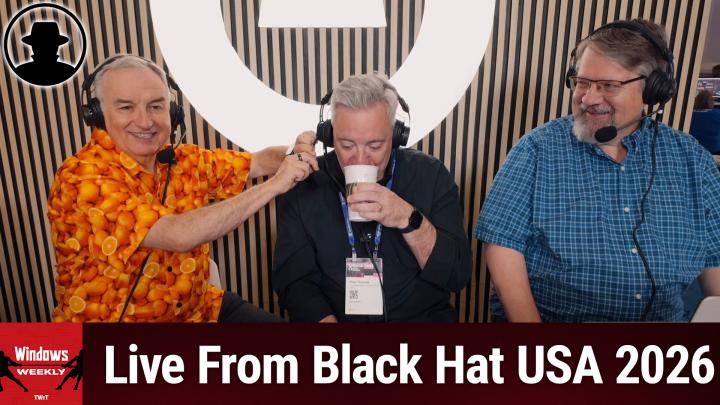
It's time for Windows Weekly. We are at Black Hat in Las Vegas, Nevada for a very special episode. Paul Thurrott has come down. There's his elbow right there. Richard Campbell is over there, and we are going to do the show live from the ThreatLocker booth. There is lots to talk about, including Microsoft's earnings, Xbox news, and yes, a local whiskey. All that coming up next on Windows Weekly. Podcasts you love.
Leo Laporte [00:00:31]:
From people you trust.
Paul Thurrott [00:00:34]:
This is TWiT.
Leo Laporte [00:00:41]:
This is Windows Weekly with Paul Thurrott and Richard Campbell, episode 995, recorded Wednesday, August 5th, 2026. The Greatest Depression. It's time for Windows Weekly. Hello, all you Windows and you dosers too. Yes, it's a little noisy in here because, hello, we're at the Black Hat Conference in Las Vegas, Nevada. Richard Campbell on the far right there. Hello, Richard.
Richard Campbell [00:01:07]:
Hey, great to be back. And right from fishing to this.
Leo Laporte [00:01:10]:
Oh my God, that's right, you were in Montana.
Paul Thurrott [00:01:12]:
I was.
Leo Laporte [00:01:14]:
Paul Theriot to my immediate left. Hello, Paulie.
Paul Thurrott [00:01:16]:
Hello, Leo.
Leo Laporte [00:01:17]:
Came all the— so we had people coming here from all 3 countries in North America.
Richard Campbell [00:01:21]:
Yeah, got them all.
Leo Laporte [00:01:22]:
Yeah, Canada, Mexico, the US of A. Uh, Black Hat is a big security conference, happens every year in Las Vegas.
Richard Campbell [00:01:29]:
And it is huge.
Leo Laporte [00:01:30]:
This is a lot of people. It is big.
Richard Campbell [00:01:32]:
Yeah.
Leo Laporte [00:01:32]:
Metadata, master of packets. I got that from Hosier, who runs the— is part— probably doesn't run it. I want to give him a promotion, but he's part of the network operations center here. I said, is it safe to get on the Wi-Fi? He said, oh yeah, there are 50 people in the NOC upstairs.
Paul Thurrott [00:01:48]:
We're going to take a tour. Last night I got on, turned on my laptop. My wife's like, what are you doing? And I'm like, what do you mean? I'm like, work or whatever. She's like, you told me I couldn't get on the Wi-Fi. Oh yeah, I told, I told you you couldn't get on the Wi-Fi. I have stuff to do here.
Leo Laporte [00:02:03]:
The wives are here. The wives. Uh, and Steve Gibson's also here. In fact, I see him chatting to fans. Uh, we're gonna do Windows Weekly now and Security Now a little later on. We moved Intelligent Machines, the normal Wednesday, uh, follow-up, to Monday, so we've done that one already.
Richard Campbell [00:02:20]:
Yep.
Leo Laporte [00:02:21]:
And we're here to talk about Windows. So we're glad you're all here. I hope it's not too noisy for you. If you are at Black Hat, come on by the booth. We are at the ThreatLocker booth, which is pretty much to your immediate left as you come in the business hall.
Paul Thurrott [00:02:37]:
Richard's instructions were so simple. He's like, just go in the main door and go to the left. It's a shorter walk. And I'm like, all right. And you know there's 18 main doors, right?
Leo Laporte [00:02:44]:
Yeah, the main door.
Richard Campbell [00:02:45]:
It was the first door. I said the first door.
Paul Thurrott [00:02:47]:
It's the last door. I came from that direction. That is the first door. Dude, if you— I went to the North Hall, I still wouldn't be here.
Leo Laporte [00:02:53]:
I got fricking fracked.
Richard Campbell [00:02:54]:
Don't go to the North Hall. I like my original route where it says, when you see the red kutas, turn right.
Paul Thurrott [00:03:00]:
Yeah, right.
Leo Laporte [00:03:01]:
Oh, there is, there's a kuta.
Paul Thurrott [00:03:02]:
Take a right at the kids selling fireworks and then—
Leo Laporte [00:03:05]:
So trade shows are fun. I always get jazzed when I come to trade shows. The days of me going to CES are long gone.
Paul Thurrott [00:03:11]:
Same. This is like a muscle I haven't used in a while. Like I, it's been a while.
Richard Campbell [00:03:16]:
Even my hip is like, you need to calm down.
Paul Thurrott [00:03:19]:
Yeah, yeah, yeah, yeah.
Leo Laporte [00:03:20]:
But of course, You know, we went to RSAC in San Francisco earlier this year, right? It's really fun to come to the security shows because it's a different—
Paul Thurrott [00:03:28]:
I mean, quality. Yeah, I mean, yes, other than a sobering look at your peers. But the, um, that's a good way to put it. I don't know. But other than CES, yeah, I, I, I can't remember a show this big. I can't believe how big this is.
Leo Laporte [00:03:46]:
This is big and getting bigger.
Paul Thurrott [00:03:47]:
Yeah, like this hotel is a city unto itself and it's full of security geeks.
Richard Campbell [00:03:52]:
I'm pretty sure we changed time zones getting to the convention center.
Leo Laporte [00:03:54]:
Yeah, we're at Mandalay Bay. Yeah. That's what Steve was saying. He said, I can't believe how huge these casinos are. They really are massive.
Paul Thurrott [00:04:02]:
I know.
Leo Laporte [00:04:03]:
And the Strip is under construction constantly as we're driving in. Of course, they're building a new stadium. They already built the Allegiant Stadium for the Oakland Raiders.
Paul Thurrott [00:04:10]:
So I asked about that on the way in. I thought it was maybe a concert venue. And he said, no, it's for baseball.
Leo Laporte [00:04:15]:
It's for the Oakland A's. I'm sorry, the Las Vegas A's.
Richard Campbell [00:04:17]:
They're taking all of, I mean, Oakland's to be so angry.
Leo Laporte [00:04:21]:
But you know what? You can also understand why Oakland's coming here because it's going to be an amazing complex. It looks like a beautiful stadium. Sure, it's huge. Yeah, it's right off the Strip.
Paul Thurrott [00:04:32]:
That thing will never be open to the air. It's perfect, right?
Leo Laporte [00:04:35]:
Yeah, it better not. It was 113 degrees when we arrived yesterday.
Richard Campbell [00:04:39]:
Yes, it's not nice outside.
Leo Laporte [00:04:41]:
113 degrees, and yet it's 64 degrees everywhere inside.
Richard Campbell [00:04:45]:
Yeah, I know.
Leo Laporte [00:04:46]:
So the, the shock of going out, it's like you're going in.
Paul Thurrott [00:04:49]:
Our AC in the room didn't kick off for one second. It was just constantly going.
Richard Campbell [00:04:54]:
Fighting for it. Yeah.
Leo Laporte [00:04:56]:
So, uh, Paul, you said there's nothing to talk about this week? That's too bad.
Paul Thurrott [00:04:59]:
This is all we got, so thanks for showing up, everybody.
Richard Campbell [00:05:01]:
I appreciate it.
Leo Laporte [00:05:03]:
Uh, Microsoft had an amazing stock market rally last week after they put out their quarterly results. It was right at the end of the show last week. The next day they went up Almost half a trillion dollars in CapEx.
Richard Campbell [00:05:16]:
Why?
Leo Laporte [00:05:17]:
In market value.
Richard Campbell [00:05:17]:
Crazy amount of value.
Leo Laporte [00:05:19]:
The largest jump in history.
Paul Thurrott [00:05:21]:
Yeah, so I think it says something about AI and finances that Microsoft is considered the adult in this room because—
Leo Laporte [00:05:28]:
Everybody else went down, didn't they?
Paul Thurrott [00:05:29]:
Yeah, it just doesn't make any sense.
Leo Laporte [00:05:33]:
Market punished Google.
Paul Thurrott [00:05:35]:
Market punished AMD yesterday. They had 50% jump in revenues year over year.
Leo Laporte [00:05:43]:
50%. And the stock went down.
Paul Thurrott [00:05:44]:
And the stock went down, at the time, 9% or 14%. I don't remember the number.
Leo Laporte [00:05:48]:
But for the most part, the reports are the market didn't like how much these companies were spending on building datasets.
Paul Thurrott [00:05:54]:
But they love how much Microsoft's making, right?
Leo Laporte [00:05:56]:
What is the distinction?
Richard Campbell [00:05:57]:
Well, Microsoft is being more conservative with their spend.
Paul Thurrott [00:05:59]:
Are they?
Richard Campbell [00:06:01]:
You give me the number.
Paul Thurrott [00:06:02]:
I'll look at it when we get to it. They've raised their estimate for CapEx spending this year. That raising of spending is accompanied by an accounting change where they're not going to put any of their physical, non-component physical assets into the AI spend. So they're still spending more money than they're spending more than they were, right? They're spending even more than they were, but we're not— we don't get to know it.
Richard Campbell [00:06:29]:
Importantly, they are concealing it. And Wall Street loves that.
Paul Thurrott [00:06:32]:
They're doing it really well. Yeah, the concealing part is going great. I don't know, it's like financial shenanigans. It doesn't ever make sense.
Leo Laporte [00:06:41]:
And I almost really feel like it's silly to talk about market valuation because that's not what we care about. We care about how— but it is an indicator. It's a bellwether. It's at least how the world feels Microsoft's doing with its business.
Richard Campbell [00:06:54]:
Traders feel.
Paul Thurrott [00:06:55]:
Yeah, there's a Cory Doctorow's making the rounds, he has a new book, whatever, right? So he has a 90-minute interview with Jon Stewart from The Daily Show, and he's probably made this comment elsewhere, and I'm gonna screw it up a little bit, but he said something like, there's these AI doomers who think AI's gonna drive this planet into the ground somehow. And he's like, the great spell checker in the sky is gonna turn us all into paperclips somehow. And he's like, I don't think you understand how science works. It's helpful sometimes just to kind of hear someone say something like that.
Leo Laporte [00:07:29]:
Yeah.
Paul Thurrott [00:07:30]:
Because the amount of money that's being spent on this stuff is just stupidity.
Leo Laporte [00:07:34]:
Well, give us the top line. What are the learnings from the earnings?
Richard Campbell [00:07:39]:
Yeah.
Paul Thurrott [00:07:40]:
Well, let's get— I mean, first of all, just basic finances, right? So Microsoft revenues were $90 billion in the quarter. quarter. That's a gain of 18% year over year. Interestingly, in this quarter, for the first time in— I'm going to call it 5 or 7 quarters— Intelligent Cloud, which is the part of the business that's Azure, which is also where a lot of the AI— not all of it, but a lot of it is kind of in there— is now Microsoft's biggest business again.
Richard Campbell [00:08:06]:
Yeah.
Paul Thurrott [00:08:06]:
It hasn't been for a while because Microsoft moved— actually, it's probably 4 quarters— they moved Windows revenues associated with Microsoft 365 AI, yeah, i.e., sorry.
Leo Laporte [00:08:20]:
Everything's AI these days.
Paul Thurrott [00:08:22]:
Commercial Windows revenues into business— sorry, productivity and business processes, which is the—
Leo Laporte [00:08:28]:
We're getting you a latte, don't worry. It's gonna be all right.
Paul Thurrott [00:08:30]:
It's a little early for me. By the way, this is the stupidest earliest time I've ever done this show by far.
Leo Laporte [00:08:35]:
It's true.
Paul Thurrott [00:08:35]:
It's weird. Like, it feels weird.
Leo Laporte [00:08:37]:
Even though we normally do it at this time.
Paul Thurrott [00:08:38]:
Well.
Leo Laporte [00:08:39]:
But you're in a new time zone.
Paul Thurrott [00:08:41]:
Yeah, I guess it's a— no, but it's still an earlier time.
Leo Laporte [00:08:46]:
Yeah, we started an hour early.
Paul Thurrott [00:08:48]:
11 AM when it started.
Richard Campbell [00:08:50]:
Yes.
Paul Thurrott [00:08:50]:
And normally it would be 12 in Mexico and 2 in—
Leo Laporte [00:08:54]:
Okay, so it's not too bad for your—
Paul Thurrott [00:08:56]:
This feels weird, but anywho, uh, so, uh, Intelligent Cloud again, number 1, almost $40 billion in revenues, 32% gain year over year. That's crazy. Uh, yeah, Avenue— uh, Azure— I can't say anything. Azure revenue growth was 43%, which is— it's been in the for a long time. Before this AI boom, Azure revenue growth falling from the 70s down to the 40s was a problem.
Richard Campbell [00:09:21]:
Yeah.
Paul Thurrott [00:09:22]:
Now that revenue growth is the greatest thing Wall Street has ever seen.
Leo Laporte [00:09:25]:
Yeah.
Paul Thurrott [00:09:26]:
They are in love with this.
Richard Campbell [00:09:28]:
'Cause one of the, I think, conversations we had as AI emerged in 2023 was this is perfect timing. That's why they're all over this, because their cloud numbers were starting to fail. They were, they were coming down enough where it's like, hey, we've taken the easy market. Now it's gonna be a battle. Oh, wait, we have a new product!
Paul Thurrott [00:09:43]:
Don't look over here, look over here! Productivity and business processes, No. 2. Close, almost $38 billion in revenues, gain of 14%. And then, the sad trombone that is more personal computing. This is Windows, Surface, Xbox, and then some ad and search stuff. $12.9 billion in revenues.
Richard Campbell [00:10:04]:
I'm loving that that's the sad trombone. $13 billion.
Paul Thurrott [00:10:08]:
Well, $13 billion, That's going down. I mean, it is a decline of 4% year over year, but you can see it was in the 13s. There was a time when these businesses, back when $11 billion a quarter was a big deal, they were all roughly 11 for a while. So the other 2 are now 3 times as big and this one is kind of just right where it was.
Leo Laporte [00:10:29]:
How big is it?
Richard Campbell [00:10:29]:
In decline. And declining.
Paul Thurrott [00:10:33]:
Yeah. It's like, wait, I have a 3rd child? So it's just out there doing whatever it's doing. Not so great. So let me see if I can find it.
Leo Laporte [00:10:42]:
How's Xbox doing these days?
Paul Thurrott [00:10:43]:
Excellent. I'm glad you asked. Yeah, not excellent.
Richard Campbell [00:10:47]:
So good, they have a whole— we have a whole segment on them.
Paul Thurrott [00:10:49]:
Yeah, actually the Xbox segment today is pretty great. Like, there's a lot of Xbox stuff going on.
Leo Laporte [00:10:53]:
They're not making a lot of money.
Paul Thurrott [00:10:55]:
I didn't say that. I just said there's a lot going on. So CapEx spending on AI, $45 billion in the quarter. And I don't have it here for some reason. I'm not sure why, but that's dramatic. I believe that's up possibly as much as 100%. It's a giant—
Leo Laporte [00:11:13]:
Now I understand why they're not getting punished because other companies, it's 3 figures. It's like $130 billion.
Paul Thurrott [00:11:20]:
Well, this is one quarter.
Richard Campbell [00:11:21]:
This is a quarter. This means $180 billion for this year.
Leo Laporte [00:11:23]:
Oh, never mind. They are right there with the best of them.
Paul Thurrott [00:11:26]:
Yeah, no, they're going for it.
Richard Campbell [00:11:28]:
But I like that they're quoting quarter numbers. Like they're literally playing games to make people comfortable.
Leo Laporte [00:11:32]:
Oh yeah, they told me. Apparently, they fooled the market.
Paul Thurrott [00:11:35]:
Their estimate for the year, and it's not clear to me as I say this if they mean their fiscal year or annual. It doesn't matter. But $205 billion— nope, I'm sorry. I'm absolutely reading the wrong numbers. Sorry.
Leo Laporte [00:11:49]:
You're talking CapEx here.
Paul Thurrott [00:11:50]:
And the numbers I just gave you were for Google, because I was making a comparison of these things. The problem with Google, there were 2 things in Microsoft's earnings in the call afterwards that were directly related to what just happened at Google, but without mentioning Google at all, right? So Google had raised their yearly spending estimate to $205 billion. That was the number I just gave. Sorry, that was Google, not Microsoft. $99 billion of Google's revenues actually came from investments it made in other AI companies, right? And I think I might have talked about this a little bit last week, but they were cash negative, which the first time in their history is crazy.
Richard Campbell [00:12:24]:
Mm-hmm.
Paul Thurrott [00:12:25]:
Cash flow negative.
Leo Laporte [00:12:28]:
For Google, that's saying something.
Paul Thurrott [00:12:30]:
But think about the—
Leo Laporte [00:12:32]:
given how much money they make.
Paul Thurrott [00:12:33]:
How bizarre is it that you are investing in your competitors and they made almost $100 billion investing in the companies competing with them? I mean, one of them is a partner, but they're still competing, right? And that's nuts. Microsoft's number for that was somewhere in the $13 billion, right? It was a really small number. Actually, it was even smaller. It was because they lost money in OpenAI. They had like $2.8 billion in investment gains. $2.8 versus $99.
Richard Campbell [00:13:02]:
$99. It's insane.
Paul Thurrott [00:13:04]:
Right?
Leo Laporte [00:13:06]:
Yeah.
Paul Thurrott [00:13:06]:
So, I'm actually trying to find this number for Microsoft. Let me see if I can do this. I can't. All right. So, we'll get to it. Where is Microsoft's investment number? I can barely see this thing.
Leo Laporte [00:13:18]:
You said in your notes, Microsoft finds a new way not to account for AI expenses.
Paul Thurrott [00:13:24]:
So this article generated an email from Microsoft PR to ask me—
Leo Laporte [00:13:31]:
Let us explain.
Paul Thurrott [00:13:33]:
Well, it's weird because—
Leo Laporte [00:13:34]:
Perhaps you don't understand, Paul.
Paul Thurrott [00:13:37]:
No, no. Oddly, they didn't quibble about any of the big bits. It was more like I had this comparison of short, medium, and long-term not investments, but rather the way you account for the cost of a thing over time.
Richard Campbell [00:13:51]:
Right.
Paul Thurrott [00:13:52]:
Depreciation, essentially, I guess. And they changed 2 quarters ago the way they depreciate hardware in data centers to extend the life. And I had made the observation at the time, because Amy had literally said in a conference call that, we found that the longer we use this stuff, the more efficient it gets. And I was like, yeah, I do the same thing with the cars, the tires of my car. I just run them until they're bald and it's more efficient. There's no friction with the road.
Richard Campbell [00:14:17]:
Low rolling friction.
Paul Thurrott [00:14:18]:
Yeah, it's great.
Richard Campbell [00:14:18]:
It's all good until you want to turn.
Leo Laporte [00:14:20]:
Perhaps you're thinking of generally accepted accounting practices. We are non-GAAP.
Paul Thurrott [00:14:24]:
Yes, I am. Yes, this is—
Leo Laporte [00:14:27]:
Our gap is 1 millimeter.
Paul Thurrott [00:14:29]:
So I don't have this in the show notes, but this is another thing Cory Doctorow just said, which I did not see. And I'm fascinated they did this because I was ragging on Spotify a quarter ago because they don't— they were claiming a profit when if you actually look at their books, they, they did not have a profit. But if you don't look at it using generally accepted accounting principles—
Leo Laporte [00:14:47]:
That's a new game. Yeah.
Paul Thurrott [00:14:49]:
So Anthropic just did the same thing.
Leo Laporte [00:14:50]:
Yeah.
Paul Thurrott [00:14:51]:
They're like, if you just ignore the legal standard worldwide for accounting, we're doing great.
Leo Laporte [00:14:55]:
Non-GAAP, we're making money.
Paul Thurrott [00:14:57]:
Yep.
Leo Laporte [00:14:58]:
So, so the SEC lets them as long as they say it. Well, we aren't using generally accepted accounting practices here.
Paul Thurrott [00:15:08]:
Well, by the way, so first of all, Spotify is a Swedish company that SEC doesn't apply.
Leo Laporte [00:15:13]:
They don't care.
Paul Thurrott [00:15:13]:
Anthropic, are they a publicly held company?
Leo Laporte [00:15:15]:
No.
Paul Thurrott [00:15:16]:
So who cares?
Leo Laporte [00:15:16]:
So it doesn't matter.
Paul Thurrott [00:15:17]:
They can do whatever they want.
Leo Laporte [00:15:18]:
Right. So Microsoft, on the other hand, is a publicly traded company.
Paul Thurrott [00:15:21]:
Yeah. So what they're doing is—
Leo Laporte [00:15:22]:
They're breaking the rules.
Paul Thurrott [00:15:23]:
This is ninja-level financial manipulation. It's good.
Leo Laporte [00:15:28]:
Don't try this at home. They're trained professionals.
Paul Thurrott [00:15:32]:
Yeah. I'm struggling to find this number. I'm so sorry, but it doesn't matter. So last year they spent $145.3 billion on CapEx related to infrastructure. I do have that here. I go through this. I just went through this whole thing.
Leo Laporte [00:15:45]:
So they're going from $145 to about $180.
Paul Thurrott [00:15:47]:
It's probably closer to $200, but eventually we'll come up. There was so much weirdness in this conference call. At one point, someone actually asked about, it was either ROI or just the spending or whatever it was. And Amy Hood answers first, of course, she goes through this whole thing and whatever. And then this is Satya Nadella's contribution to this conversation is that, this is a quote, all of us are reading this 1873 as the book to be read. And so in my mind, I think you've gotta get the product shape right. So Chris, you hear that and you're like, uh, what?
Leo Laporte [00:16:19]:
What?
Paul Thurrott [00:16:20]:
What's that? It came out of nowhere. There was no explanation what he meant by it.
Leo Laporte [00:16:24]:
Well, everybody's reading it, Paul, don't you know?
Paul Thurrott [00:16:26]:
Everyone in the senior leadership team's reading it. He probably handed it out for Christmas or something, right? So this is a book about the Rothschilds and the Great Depression.
Leo Laporte [00:16:34]:
And there was a big crash in 1873, maybe the biggest of all time. There's also a book about 1929, ironically. I guess that's a popular topic to be publishing now, right?
Paul Thurrott [00:16:46]:
Well, there's going to be one in about 2026 too, Leo, because like, like, like you're— I'm sorry, you're reading up on how people destroyed the economy?
Leo Laporte [00:16:54]:
Yeah, just in case. We got to be ready. We got to know what to do next.
Paul Thurrott [00:16:57]:
Just came out of nowhere.
Richard Campbell [00:16:58]:
It's a great reference.
Leo Laporte [00:16:59]:
So it is actually. It really is kind of a deep cut.
Paul Thurrott [00:17:02]:
It's just so bizarre.
Richard Campbell [00:17:03]:
I was like, you know what, Black Friday is not going to do it for me. Can we go darker? What's darker?
Paul Thurrott [00:17:08]:
Yeah, you got like a— right, literally the Great Depression.
Richard Campbell [00:17:11]:
Yeah. So is there a greater depression? Oh, 1873, greater depression.
Paul Thurrott [00:17:16]:
Yeah, this is gonna be the best depression. This is the greatest depression. Um, it's a record scratch moment. It was just really strange to me. So, uh, 2— I think it was 2 quarters ago, sometime in the past year, they did an accounting change, like I said, to spread out the cost of these AI hardware components over a longer period of time than they've ever done. That is, there is actually a standard of sorts for that, how you depreciate things over time, but they've extended it by 100%. So they're doing the same thing now with real estate related things. So property, buildings, things that are not the actual components, but the land, the whatever the things are.
Paul Thurrott [00:17:55]:
And they're going from 15 years to 25 years on the leases on that stuff. Wow. And, uh, and that's one way to—
Leo Laporte [00:18:02]:
it's just like your tires. I thought that was a good analogy.
Richard Campbell [00:18:05]:
That's a good analogy.
Paul Thurrott [00:18:05]:
It's the Apple, um, upgrade. thing. It's like now instead of— Spread it out. Yeah, spread it over 3 years. Except for a big company spending hundreds of billions of dollars. But there's another thing that's tied to that. They're not going to account for that cost in their CapEx spending for AI anymore. So it's going to— because of the nature of that change, they can account for it differently legally and it will not be included in these numbers.
Paul Thurrott [00:18:31]:
So when their spending went up quarter over quarter and year over year like it did in this quarter. And I'm still looking for that number. It's killing me. It doesn't— maybe this quarter it did, but going forward it will not include that number. So if you say something like, well, it went up 50% year over year, it probably went up 60% or 70% because we're not seeing part of the number anymore.
Richard Campbell [00:18:53]:
Right.
Paul Thurrott [00:18:54]:
It's not going to be in the same column, so to speak. So I thought that was just rather incredible. Microsoft will spend $50 billion this quarter, which they've not accounted for yet, but they will. That's a 25% increase quarter over quarter, but it's double the figure from a year ago.
Richard Campbell [00:19:11]:
Right.
Paul Thurrott [00:19:12]:
But it's also not the real number. Like I said, it's probably $60+ billion because we're just not gonna account for that anymore. We're gonna pretend that's not a cost. And I think that explains their, Wall Street acceptance and their market cap jump, one of the analysts literally complimented them in the call for making this change. They're like, oh, you got— it's like, you guys are just nailing the financial part of this.
Leo Laporte [00:19:39]:
But aren't analysts kind of sycophantic? I mean, is that meaningful that the analysts are—
Paul Thurrott [00:19:43]:
They are. So if you ever listen to a conference call, Apple, Google, Microsoft, yes, there's a lot of suckling going on.
Leo Laporte [00:19:48]:
It's like a cabinet meeting. It's gross.
Paul Thurrott [00:19:50]:
It's like, oh guys, nailing it in the quarter, good job.
Richard Campbell [00:19:52]:
Yeah.
Paul Thurrott [00:19:53]:
Softball question. And it's like, what are you doing? Your job is to protect people's money. I don't understand any of this stuff. But yeah, so I don't, again, I still can't find this damn number, but it's somewhere. I'm trying to see if this, it's somewhere in the $48 billions. So it's $41 billion, $31.9, $37.5, $39, $34.9 for the previous 4 quarters.
Leo Laporte [00:20:15]:
So that's a quarter-by-quarter capital expenditure.
Paul Thurrott [00:20:17]:
This quarter, past quarter was in the 40s. The next one will be $50 billion. Okay, they've said this. This is not a guess.
Leo Laporte [00:20:23]:
This is what they said. So pay no attention to the total.
Paul Thurrott [00:20:26]:
The total is one— it is $175 billion.
Leo Laporte [00:20:28]:
Just look at the subtotal.
Paul Thurrott [00:20:29]:
But it's all— but the only reason they didn't raise it is because they took part of the cost out of that equation, right?
Leo Laporte [00:20:34]:
So it really would be more.
Paul Thurrott [00:20:35]:
I'm thinking it's going to be— I don't, I don't want to say $200 billion. I don't actually know it, but it's north of that number somewhere, right?
Leo Laporte [00:20:41]:
It still doesn't— I mean, surely people buying Microsoft stock, institutional investors, serious traders, aren't fooled by this number game. They know.
Paul Thurrott [00:20:51]:
Well, it's not— so you're right, but I, but I feel like they also— look, maybe you understand this is a game because Wall Street's a game. It's a lot of marketing. It's like who's feeling good about stuff right now. It's not really about real—
Leo Laporte [00:21:03]:
Really, when you buy a stock, you're not—
Paul Thurrott [00:21:04]:
it's speculation.
Leo Laporte [00:21:05]:
I believe this company is going to do well. It's, it's what I think other people will pay for the stock down the road.
Paul Thurrott [00:21:10]:
And if you are a Microsoft investor, you probably don't care about Windows or Office or Azure or anything like that. What you care about is, are they speaking happy thoughts and making the stock go up? And they are. They're killing it.
Leo Laporte [00:21:22]:
As long as the number goes up.
Paul Thurrott [00:21:22]:
And they're like, yeah, that's what I want. I want explosive growth and I can sell this thing off when I want to.
Richard Campbell [00:21:27]:
So that's why they were complimenting them and saying, hey, great way to come up with a way to get your stock price to spike so I can get out at a profit.
Paul Thurrott [00:21:32]:
It's insane.
Richard Campbell [00:21:34]:
By the way, it worked, right? Yeah. 18%.
Paul Thurrott [00:21:36]:
100% worked. Yep.
Leo Laporte [00:21:38]:
So, all right. So we've now given great advice for the investor, the retail investor. Don't fall for this. But what does it mean for Microsoft's business, really? Not so much its CapEx or—
Richard Campbell [00:21:49]:
They're making scads of money.
Leo Laporte [00:21:51]:
They are making money.
Paul Thurrott [00:21:52]:
I mean, kind of eliminating that, I realize that's the point, but if you kind of eliminate that we're making a ton of money, I, I, in, well, in some ways the question should be like, but how are you making a ton of money? Right.
Leo Laporte [00:22:04]:
You know, then what's the long-term prospect for that?
Paul Thurrott [00:22:06]:
Yeah. Like there's a, there is this circular thing with, you know, again, not to keep mentioning, Oh, these 7 companies just exchanging $100 billion between them.
Leo Laporte [00:22:16]:
That's also a shell game.
Paul Thurrott [00:22:18]:
This is 100% what they're doing. Part of Microsoft's big investment in OpenAI is them exchanging money with each other that never came from anywhere. It's like, we're gonna invest X amount of dollars in you, but then you're gonna pay back to us 'cause you're using Azure infrastructure. There's never been an actual check, but it's just kind of— but both of them can book this as some form of revenue. And it's like, how does no one see through this? I don't know. It's incredible. I don't know.
Leo Laporte [00:22:46]:
This is just a general— well, this is what puzzles me. You could have— you could say you have— I'm generally bullish over AI. So I think Microsoft's investments in AI infrastructure are gonna pay off. But why doesn't Google get the benefit of the doubt there? Why is it only Microsoft?
Paul Thurrott [00:23:02]:
Well, so Google's— oh, I'm sorry. Never got to that point. Google had run cash flow negative for the first time ever. Microsoft, in their conference call, mentioned, like I said, 2 things related to this. One was, we are not cash flow negative. I don't think they've ever discussed cash flow, because why would you? Obviously, you're cash flow positive. You're Microsoft. You're making a ton of money.
Paul Thurrott [00:23:24]:
It's just something that doesn't come up and it comes in every month.
Leo Laporte [00:23:26]:
But the context here is unlike Google.
Paul Thurrott [00:23:27]:
Unlike Google. And we don't anticipate being cash flow negative at any time during this fiscal year. Right. Which is kind of a weird thing to say out loud because that opens the possibility you could see it happening in the future. Like, it's a weird thing to say, but it's something that—
Richard Campbell [00:23:42]:
It's hard to project, right?
Paul Thurrott [00:23:43]:
Yeah. And, but it's also something they would never have mentioned otherwise. I, they've never mentioned that. I, but, and their cash, actually their cash flow position is very positive.
Richard Campbell [00:23:52]:
So yeah, I don't know why she didn't say we have no expectations of not ever being cash flow positive.
Leo Laporte [00:23:57]:
They are limited a little bit about forward.
Richard Campbell [00:23:58]:
I think you're right.
Paul Thurrott [00:24:00]:
They are. But also, you might have anticipated this coming as a question because this just happened at Google last week, so, or the week before. But they said it proactively. They didn't wait for someone to ask about it.
Richard Campbell [00:24:12]:
Right.
Paul Thurrott [00:24:12]:
Right.
Richard Campbell [00:24:13]:
And—
Leo Laporte [00:24:14]:
No, I think that's relevant.
Paul Thurrott [00:24:15]:
Take that as you will.
Leo Laporte [00:24:16]:
They are, that was in the light of what Google said. I'm sure you're right.
Paul Thurrott [00:24:19]:
Absolutely.
Leo Laporte [00:24:19]:
And you know what? That might be the single sentence that made the $442 billion difference in their market.
Paul Thurrott [00:24:25]:
The one thing I'll say, One thing you hear consistently from Amazon, Google, and Microsoft is they talk about— they book revenue and they also book potential revenue or future revenue or anticipated future revenue in kind of different ways. But they all use the same language. They say, you know, we booked whatever it was. We did. We don't have the capacity to meet the need that we see. We're spending to try to meet that need sometime in the future. We could have booked a lot more if we just had the capacity that we're now building. They all say this.
Paul Thurrott [00:25:01]:
So what they're trying to do is explain why they're spending all this money, because if we had the business our customers say they would spend with us, this would make sense financially. But I, but I feel like there's a big gap between here's a check for the service you offered that I'm paying for, and I might sometime in the future want to use this service and And of course Microsoft's like, I mean, if you're just guessing, how much do you think you would spend on that? And they're like, well, it might be this much. And they're like, cool. And they use this to justify the spending. It's just that the spending is so, it just feels so incommensurate with what people would actually, what are people doing with this? What are they doing with it? Like, I, all I hear is that nobody uses Copilot. What, what, like, what is, what are they spending it on? Like what, or what would they spend it on? I, I'm, I'm having trouble understanding, like, you know, like a Windows license or an Office license is this thing you sort of understand. You have business customers, they have X number of seats or employees, they're sitting there every day doing work, whatever. The AI stuff feels so nebulous.
Leo Laporte [00:26:04]:
Right.
Paul Thurrott [00:26:04]:
Nebulous. It's also bigger, you know, somehow, you know, whereas, you know, whatever the percentage, some single-digit percentage of Microsoft 365 commercial subscribers are also paying for Copilot. It's tiny. It's still tiny. It, it went from 20 million seats to 30 million in one quarter, which is like, yeah, that's crazy.
Richard Campbell [00:26:24]:
But on a billion-something seats.
Paul Thurrott [00:26:26]:
It's still only 6.7% of the user base. So, you know, it's easy to jump big when you're small. You know, ChatGPT just passed the 1 billion mark.
Leo Laporte [00:26:36]:
Right.
Paul Thurrott [00:26:36]:
At the time of this article I wrote, it was 900 million, but now it's what we know, it's over a billion.
Leo Laporte [00:26:40]:
Yeah.
Paul Thurrott [00:26:40]:
Now those aren't—
Leo Laporte [00:26:41]:
Billion users.
Paul Thurrott [00:26:42]:
Paid users, right? I mean, but—
Leo Laporte [00:26:44]:
No, probably mostly not.
Paul Thurrott [00:26:45]:
Yeah, but there's some percentage of them are.
Leo Laporte [00:26:47]:
But they've got mindshare.
Paul Thurrott [00:26:48]:
Yeah, yeah.
Leo Laporte [00:26:49]:
Uh, in fact, I've seen—
Paul Thurrott [00:26:50]:
Oh, it's, um, it's actually, it's roughly 50 million people pay for ChatGPT.
Leo Laporte [00:26:56]:
$20 probably.
Paul Thurrott [00:26:56]:
So it's, yeah, whatever that per second. You can't do simple math, but, um, but it's what— that's a bigger number than—
Leo Laporte [00:27:04]:
5%.
Paul Thurrott [00:27:05]:
Yeah, uh, what Microsoft has.
Leo Laporte [00:27:06]:
Yeah, yeah.
Paul Thurrott [00:27:07]:
You know, as far as paid, paid subscribers. I don't know. I don't know, but they just see this, you know, they always talk about, uh, like GitHub Copilot. The one thing they dropped, remember, they just went to usage-based pricing, right? So the previous quarter before that happened, they were talking about, hey, we have X million users, we have X number of paid users. That at that time it was 4.7 million. They didn't mention that number this quarter. I bet it went down, right? But they're also charging those people more, right? Because now they're actually, you know, I don't know. I don't know what— I don't know.
Paul Thurrott [00:27:41]:
So there's that. Um, and then just looking at like individual businesses, Windows is going great, Xbox is fantastic. I think we can just gloss over all that.
Leo Laporte [00:27:52]:
Um, what is, what is the driving business for Microsoft now? Is it Azure?
Paul Thurrott [00:27:57]:
Azure.
Leo Laporte [00:27:58]:
Pretty clear.
Richard Campbell [00:27:58]:
Finally, right?
Leo Laporte [00:27:59]:
Finally. That's a good point. Well, this is In fact, that was a good move to make Satya the CEO.
Paul Thurrott [00:28:04]:
This is—
Richard Campbell [00:28:05]:
I mean, they were already on the Azure path, right? Yeah, but, uh, Satya had navigated that ship fairly well.
Leo Laporte [00:28:11]:
Oh, we finally have—
Paul Thurrott [00:28:13]:
thank you.
Leo Laporte [00:28:13]:
Oh wow, we finally have some—
Paul Thurrott [00:28:15]:
I'm gonna jump off a diving board and dive right into the coffee.
Leo Laporte [00:28:18]:
Yeah, is here.
Paul Thurrott [00:28:20]:
Um, thank you.
Leo Laporte [00:28:21]:
Thank you, Lisa.
Paul Thurrott [00:28:22]:
Thank you. Uh, look, I— in the history of just our industry, but of really every industry, I would imagine there's always this kind of fake it till you make it thing. And there's always this notion that you have this successful product, but Wall Street being Wall Street, you have to sell the next thing. So you're always promoting something else. And there's this thing that's really making the money and you don't talk about that thing, right? It was Windows for a long time and still is to some degree. It was Office for a long time, you know, but Wall Street wants to hear about the new and the exciting.
Leo Laporte [00:28:49]:
Right.
Paul Thurrott [00:28:49]:
And that kind of thing. So I think, you know, you could make the argument that's what's happening with AI. The problem is just the kind of exponential price of it. But yeah, Azure, I mean, how old is Azure? When did they announce Azure? 20 years ago?
Richard Campbell [00:29:02]:
In 2008.
Paul Thurrott [00:29:03]:
Yeah, so almost not quite 20 years, but it's been a long time. So it's, you know, now it's, and when they announced it, no one knew what it was. They had no, like, what is this?
Leo Laporte [00:29:11]:
Right, they didn't know how to even say the word.
Paul Thurrott [00:29:12]:
What are you doing? I don't get it. Couldn't even pronounce it.
Richard Campbell [00:29:15]:
Where's Ray Ozzie?
Leo Laporte [00:29:17]:
I know.
Paul Thurrott [00:29:18]:
This is all Ray Ozzie's fault. I knew it. You know, Apple did this in the— I always talk about Apple in the '80s, like Apple II was making all the money for the company. They were trying to sell a Mac. Nobody wanted it, you know? Right. And eventually desktop publishing happening and happened. Obviously now that thing still exists, but—
Leo Laporte [00:29:35]:
You know, this is why we are good businessmen and we really understand this and we should really—
Paul Thurrott [00:29:41]:
I am not a good businessman. No, I know.
Leo Laporte [00:29:42]:
This is like the wrong people to talk to.
Paul Thurrott [00:29:44]:
I don't know what you're talking about because I am—
Leo Laporte [00:29:45]:
Yeah, they seem to know what they're doing, these guys at Microsoft.
Paul Thurrott [00:29:49]:
I don't even My wife doesn't even let me carry money. I was at like a fair thing and there was like a cookie that was a dollar. I was like, oh, and I looked at my wife and I was like, can I have a dollar? And this guy next to me just burst out laughing. He's like, what are you, a child? And I'm like, I don't have money. I want a cookie.
Leo Laporte [00:30:03]:
Daddy wants a cookie.
Paul Thurrott [00:30:04]:
Yeah, you don't want to give me your money, but I don't know, whatever. So there's this weird thing, like Windows is, as an example of kind of a weird business, they sell licenses, but the license licenses they sell don't always match up with what's going on in the industry because there are different factors, right? So as, uh, last year especially, as we got late in the year and then into the beginning of this year, PC makers knew that component prices were going up, so they were buying up components and thus buying up Windows licenses. So there were a couple of quarters there where Windows kind of benefited from higher than usual sales, because when you compare the growth in that business to the growth in actual PC sales, they didn't line up.
Richard Campbell [00:30:43]:
They were lined up.
Paul Thurrott [00:30:44]:
There more Windows license sales and fewer PC sales. But now we're hit with— this quarter we hit the opposite. They've now stockpiled Windows licenses. So this past quarter, PC makers were not buying a bunch of them, so that business declined by 7%. Um, you know, okay, so I— we kind of go up and down. I— it— there's probably going to be another cycle of this because component prices are only going to keep going up.
Leo Laporte [00:31:07]:
Um, Xbox, you know, is Surface at this point a hobby.
Paul Thurrott [00:31:13]:
Yeah, it always has been, really. Right, right.
Leo Laporte [00:31:16]:
Never really took off. Yeah, they think it was going to be more.
Paul Thurrott [00:31:19]:
Yeah, of course.
Richard Campbell [00:31:19]:
I always looked at it as it was the reference hardware that encouraged the vendors to make better gear.
Paul Thurrott [00:31:23]:
Yeah, that is definitely how it started. But the thing is, you know, they saw this as— remember, at some point there were like 18 different Surface models. They had all those peripherals and different things. I mean, they really kind of expanded that into something, and now they've retracted it back to We basically have 2 core models and that's it. Like, that's the business. And, uh, you know, there are consumer versions and business versions. I—
Richard Campbell [00:31:44]:
well, you never— you know, Lenovo are the guys who now make all the crazy models, right? And so it's like, as long as that exists, do you need to make it, right? It's—
Leo Laporte [00:31:53]:
it's—
Richard Campbell [00:31:53]:
yeah, I mean, I appreciate the Ultra they're making, right? The 128 version, right?
Paul Thurrott [00:31:58]:
Right.
Richard Campbell [00:31:58]:
Is that— feels to me like a reference model. Like, oh, this is going to be ridiculously expensive, and for you Few fools who wanna spend that much, fine. But it sets a high watermark for the Dells and Lenovos and HPs of the world to go, well, I guess.
Paul Thurrott [00:32:12]:
Look, this is the same conversation we're starting to have about Xbox, which is you have these partners that are really good at this thing. They operate in a really low margin business. They're doing fine. I mean, they make money, so they're doing something right. Maybe let them do that. Xbox definitely, but Surface for its entire existence, the whole time has been like, why are you doing this?
Richard Campbell [00:32:34]:
Yeah.
Paul Thurrott [00:32:35]:
If this thing is never gonna be profitable, I don't get what the point of this is. It survived Satya Nadella, which is astonishing.
Richard Campbell [00:32:42]:
Yeah, but only barely.
Paul Thurrott [00:32:43]:
I know, but it's still, yeah.
Richard Campbell [00:32:44]:
Well, and it's lost Panos. Like from the moment Panos was out the door, we were all like, Surface days are numbered here.
Paul Thurrott [00:32:51]:
Yeah, that's true. He was there from the beginning. Well, almost the beginning.
Richard Campbell [00:32:54]:
But yeah, it was kind of his thing.
Paul Thurrott [00:32:55]:
Yeah, it became his thing. Yeah, yeah, yeah.
Leo Laporte [00:32:57]:
If you're just joining us, uh, you may notice it's a little noisy here. We decided the quiet environs of Paul and Richard's homes was just not conducive to good thoughts, so we decided—
Paul Thurrott [00:33:07]:
Honestly, this compared to Mexico City, this is like a tranquil oasis.
Leo Laporte [00:33:10]:
Where's the garbage lady? We are live at the Black Hat conference in Las Vegas, Nevada. We are thanking, uh, thanking ThreatLocker for letting us take over their booth space a little bit. Actually, they have quite a bit of booth space. It's a very large booth, and they have other things going on around the corner, as you might be able to hear. But we're really glad we could be here, and it's a fascinating conference. We're doing Windows Weekly. In a little bit, we'll be doing Security Now. Steve Gibson's here already, getting ready for that show.
Leo Laporte [00:33:39]:
We will continue with Windows Weekly in just a little bit. Stay right here.
Paul Thurrott [00:33:43]:
Thank you.
Leo Laporte [00:33:45]:
Welcome back to Las Vegas, Nevada, the Black Hat Conference. Leo Laporte going live from the ThreatLocker booth. We're doing Windows Weekly. Paul Theriot is here, Richard Campbell. We've been talking about the earnings learnings from this year's micro— this quarter's Microsoft's, uh, and results.
Paul Thurrott [00:34:04]:
I need like an anteater tongue so I can drink this.
Leo Laporte [00:34:07]:
Oh, here, let me just—
Paul Thurrott [00:34:08]:
thank you, Leo.
Leo Laporte [00:34:09]:
Slide your microphone out of the way. Look at that. Look at that. That's teamwork, baby.
Paul Thurrott [00:34:13]:
So every 30 seconds, if you could just do that.
Richard Campbell [00:34:15]:
Just pull the microphone back.
Leo Laporte [00:34:17]:
Yeah, it must be hard. We're wearing headsets so that the sound is a little bit better.
Richard Campbell [00:34:22]:
It's a very NFL rig, right?
Leo Laporte [00:34:23]:
Yeah, yeah. I feel like Pat Summerall or something.
Paul Thurrott [00:34:26]:
Someone give me a football. I'll demonstrate what a play looks like on the carpet.
Leo Laporte [00:34:29]:
Go run out there. The problem is Paul— poor Paul is suffering because he needs his coffee and he can't— he can't bring it in with the microphone there. So I'm Glad to help.
Paul Thurrott [00:34:38]:
I'll just dip it in.
Leo Laporte [00:34:39]:
Just dip it. Yeah, suck them up. You'll be good. So are we done with earnings or have we done it?
Paul Thurrott [00:34:46]:
No, no, no, no, no.
Leo Laporte [00:34:47]:
We've only just scratched the surface.
Paul Thurrott [00:34:48]:
We've only just begun. Well, no, that's right. I mean, I'm sure we're at least halfway through it, but I— Oh my God.
Leo Laporte [00:34:55]:
Well, you know, no, no, let's get the learnings.
Paul Thurrott [00:34:57]:
When Microsoft announces their earnings, right, you go through what they report and then you go through what they say, right? And there's that record scratch moment like with Amy, uh, I think it was Amy. Yeah, Amy Hood. No, usually it's Amy Hood, but this— yeah, this might— this, this quarter it was Satya. That was good. But then you see things like this. So maybe there's someone in the Discord or whatever who could look something up and, and prove me wrong, but Xbox content and services revenues declined 10% year over year. Okay. Microsoft cited strong first-party content performance from the year ago quarter.
Paul Thurrott [00:35:30]:
I'm like, what? So somehow one year ago from now, there was some big game release that did so great that the comparables were negative or were tough.
Leo Laporte [00:35:41]:
All the numbers changed.
Paul Thurrott [00:35:42]:
So I looked at, I looked at what we wrote a year ago to see what was out. I couldn't find anything. Right. I don't know. So I'm like, okay, maybe I, you know, huh. So I don't know what to say about that.
Leo Laporte [00:35:51]:
Oh, I know. It was that, that 3-month period where Game Pass cost $1 million.
Richard Campbell [00:35:56]:
Right.
Leo Laporte [00:35:56]:
Actually, they made all the money.
Paul Thurrott [00:35:58]:
That could be. I mean, when did they reverse that? I don't remember.
Leo Laporte [00:36:01]:
How long did that last? Not long.
Paul Thurrott [00:36:03]:
Not long. It was less than a year, I think. Okay.
Leo Laporte [00:36:06]:
And I doubt they made a lot of money on it just because it was so much.
Richard Campbell [00:36:09]:
I canceled. Got a lot of cancellations. Yeah.
Paul Thurrott [00:36:10]:
That's what they really got. Allegedly lost a million, at least a million people over that. Wow. Yeah. Nope. See you later.
Leo Laporte [00:36:16]:
Yeah. Yeah. I mean, they found out where the limit was.
Paul Thurrott [00:36:20]:
Right, right, right. How much can you charge people before they notice? Well, apparently it's $30. Hardware declined 13% year over year. The year-ago quarter, hardware revenue declined 32% year over year.
Leo Laporte [00:36:35]:
Yeah, hardware is not going to be—
Paul Thurrott [00:36:37]:
When does it hit zero and bounce back?
Leo Laporte [00:36:39]:
Let me actually— structural question. I don't know about Microsoft. Different companies handle this differently. It's always a challenge as a company gets big to keep that— Jeff Bezos used to call it the day one fervor, like of a startup where you're really gunning for. And the way companies do it is different. Does Microsoft—
Paul Thurrott [00:36:57]:
Yes.
Leo Laporte [00:36:57]:
Kind of say, okay, we're going to give you a division, turn it into a billion-dollar business and you live, but treat it autonomously? Do they kind of say, go ahead and do Surface?
Paul Thurrott [00:37:08]:
A couple of things. Billion dollars is so quaint. What is wrong with you? That used to be the number.
Leo Laporte [00:37:12]:
It's a billion-dollar business.
Richard Campbell [00:37:13]:
It's a bomber number.
Paul Thurrott [00:37:14]:
It used to be a number.
Leo Laporte [00:37:15]:
Yeah.
Paul Thurrott [00:37:15]:
No, so sometime in the past year, you might remember this better than me, but Satya Nadella kind of said internally, we're going to run this thing like a startup. And he— this is when he ceded a lot of his CEO responsibilities to other people, right?
Leo Laporte [00:37:28]:
Give them autonomy.
Paul Thurrott [00:37:29]:
Yeah, because what you want is that robot coming into the room and telling you, like, what— geez, like making you prove your worth, you know, to the CEO.
Leo Laporte [00:37:37]:
Well, it's scary, but—
Richard Campbell [00:37:38]:
It's awful.
Leo Laporte [00:37:38]:
But, you know, that's what Jack Welch did at GE. And he pitted different executives from different divisions against each other. He said, who's going to have the best numbers?
Paul Thurrott [00:37:48]:
Right.
Leo Laporte [00:37:48]:
And he felt like, I think he was wrong, but he felt like that kind of competition made everybody better.
Paul Thurrott [00:37:52]:
So we just mentioned Ray Ozzie. So one of the things Ray Ozzie, I love Ray Ozzie. The one thing I think he might've made a mistake with was he had too many different teams working on the same kind of product at the same time. And the idea was the best will win out, but it's Microsoft. So in the end, what we did was we had 5 different versions of the same thing.
Leo Laporte [00:38:08]:
Yeah, that's not good.
Paul Thurrott [00:38:09]:
It's kind of a bad thing.
Leo Laporte [00:38:10]:
There's also the risk of demoralizing people.
Paul Thurrott [00:38:13]:
Yes. And that ties into, Kosacha Nadella compared to Jack Welch is not about people in the company coming up with competing ideas and challenging each other. He just brings in people from the outside and outrages everyone who's in some executive position because they just gave a job that they should have had to some guy who used to work at Meta or Instacart.
Richard Campbell [00:38:35]:
Right.
Paul Thurrott [00:38:35]:
In Ashish Sharma's case or whatever it is like that. I don't know this for a fact, but it does feel like Far more upper-level people are coming into Microsoft today than at any time. Interesting.
Richard Campbell [00:38:47]:
Coming in in very senior roles.
Leo Laporte [00:38:50]:
Right. And that's really saying to the existing team—
Richard Campbell [00:38:52]:
We don't think you're good enough.
Leo Laporte [00:38:53]:
You're not good enough.
Paul Thurrott [00:38:54]:
Right. I mean, how many different ways can you say that? Multiple rounds of layoffs. Exactly.
Leo Laporte [00:38:58]:
And then you lay off 10,000, 20,000 people.
Paul Thurrott [00:38:59]:
Yeah. Right. And then you do a buyout, which was really successful, where you're literally targeting—
Leo Laporte [00:39:05]:
The old guys.
Paul Thurrott [00:39:06]:
The people who have been there the longest, making the most money.
Richard Campbell [00:39:09]:
Yep.
Paul Thurrott [00:39:09]:
Just trying to get rid of those guys. I mean, which is whatever. I mean, one way to do it.
Leo Laporte [00:39:14]:
And yet the stock market loves Microsoft.
Paul Thurrott [00:39:17]:
Love it.
Leo Laporte [00:39:18]:
And that may be what they like, actually. I think they like a ruthless leader.
Paul Thurrott [00:39:21]:
Wall Street does love layoffs. I mean, it's kind of a weird thing to say, but just in general, getting rid of overhead like that to Wall Street is one of the greatest things you can do.
Richard Campbell [00:39:29]:
And I'm all about ruthless, but is it effective? Are you actually getting results?
Paul Thurrott [00:39:33]:
Yeah, I don't know.
Richard Campbell [00:39:34]:
I mean, I got all the empathy in the world for Ashley Sharma. She seems like she's got a lot going on.
Paul Thurrott [00:39:38]:
Yeah.
Richard Campbell [00:39:39]:
And she's young.
Paul Thurrott [00:39:39]:
Yep.
Richard Campbell [00:39:40]:
She doesn't know a lot about gaming, but she's pulled a lot of good people together.
Paul Thurrott [00:39:43]:
But maybe what that business needs is someone who knows—
Richard Campbell [00:39:46]:
And different eyes.
Paul Thurrott [00:39:47]:
And business.
Leo Laporte [00:39:47]:
Yeah.
Paul Thurrott [00:39:48]:
Just more, you know, maybe the problem, like, I love Phil Spencer. I will die on that hill. I think he was great. I don't know what he was like as a business person. I don't know that Xbox maybe had the, I don't know what to call it, financial discipline or whatever it was, you know, because at one point very late in his tenure, he came out, you know, I referenced this recently, he said, you know, there's a lot of studios around here that aren't producing. And this really is a what have you done for me lately business. It's wonderful that 20, 15 years ago you made some awesome game, congratulations, we all loved it. But what are you doing right now? Because right now you're just collecting a paycheck and you guys are working on stuff but you don't ship anything.
Richard Campbell [00:40:24]:
There's no games.
Paul Thurrott [00:40:25]:
Yeah, I mean, it's so Look, it's a tough business. I don't know. I'm not— I don't know the business side of it, but—
Richard Campbell [00:40:32]:
Yeah, the thing that impressed me about Ash Sharma is that the caliber of people who went to her, right? You talk about a leader, like, they don't have to know everything, but can they put together a team? Yeah, there were a lot of folks from across Microsoft that went with her.
Paul Thurrott [00:40:45]:
I just— looking at Microsoft, I have, um, experience with people at upper levels of whatever business who were super knowledgeable about the technical aspects of those products, right?
Richard Campbell [00:40:55]:
Yep.
Paul Thurrott [00:40:55]:
And I've seen the opposite too. I've, I've, and at first this was kind of shocking because I think Microsoft and how I kind of came up with Microsoft came out of a real engineering background. A lot of people were very technical, they were programmers, and they kind of moved up in the company. And so they knew stuff, you know, about the products and things. And then you eventually run into a guy who literally has no idea what he's talking about. And it's a little, it's like a little off-putting, you know, at first. And maybe that's common, I, you know, in, I, in the history of the industry or in any industry. I don't know.
Paul Thurrott [00:41:24]:
I'm not really sure, but, but there are definitely, you know, so Asha Sharma is the most recent and high-profile version of that. She has a lot to learn about that business. Mm-hmm. Is she, but she had something that Sasha thought that business needed.
Leo Laporte [00:41:38]:
And she, and she was promoted from within though, right?
Richard Campbell [00:41:40]:
Or did she keep her before AI?
Paul Thurrott [00:41:42]:
Yeah. But she was not there super long though.
Richard Campbell [00:41:44]:
Right.
Paul Thurrott [00:41:45]:
Yeah.
Leo Laporte [00:41:45]:
So months.
Richard Campbell [00:41:46]:
Yeah.
Paul Thurrott [00:41:46]:
It wasn't like she was there for 10 years. And so, but again, I'm not, I'm not actually criticizing it. I actually like, I like her quite a bit. I, what I see from her is overwhelmingly been positive. But, um, but the point is Xbox has been floundering for a long time. So there's something about her that Satya believed was the right thing.
Leo Laporte [00:42:06]:
Well, and that was the concern was that she was brought in to be the hatchet man.
Paul Thurrott [00:42:10]:
That's the conspiracy theory that the, the reason you're here is to maybe spin that business off ultimately, you know, and maybe that's true.
Richard Campbell [00:42:16]:
You know, it's hard to say.
Paul Thurrott [00:42:18]:
We'll talk more about Xbox later and some other stuff that's related to this, but in the industry, it's not just Xbox. You see this thing where, you know, in this case Xbox spun off 4 studios and one of them's already announced layoffs. There'll be some related— I don't wanna get too far into it, but there's some other stuff and it has nothing to do with Xbox.
Richard Campbell [00:42:36]:
Yeah.
Paul Thurrott [00:42:37]:
This is going to happen a lot. This is happening everywhere. It's not just Xbox. OK, I think that's—
Leo Laporte [00:42:43]:
is that it? Is that it for the learnings? OK, we have learned—
Richard Campbell [00:42:46]:
what have we learned here?
Paul Thurrott [00:42:47]:
What have we learned? Microsoft is really good at hiding money. Yeah. Oh, I should just point this out because I'm super proud of it, which is so stupid, but I am super proud of it. This might be my greatest headline of all time, which is Hide Me the Money.
Leo Laporte [00:43:02]:
That is good. I like it.
Paul Thurrott [00:43:04]:
And I got the AI picture of Satya Nadella as the Jerry Maguire character, you know, yelling at Give me the money.
Leo Laporte [00:43:10]:
Yep, that's pretty good.
Paul Thurrott [00:43:11]:
That's funny. I'm oddly proud of that, but stupid. But that's—
Leo Laporte [00:43:16]:
yeah, you know, you gotta take your wins where you can find them.
Paul Thurrott [00:43:18]:
That's how my brain works. Yeah, yeah.
Leo Laporte [00:43:20]:
All right, well, actually, this would be a good time to take another break. We're going to talk about Windows when we come back. You're watching Windows Weekly. Paul Thurrott, Richard Campbell. Richard, it was easy to get here from Canada? No, your airline went on strike.
Richard Campbell [00:43:32]:
One of them, yeah.
Leo Laporte [00:43:33]:
So what were you flying?
Richard Campbell [00:43:34]:
I was flying WestJet, and then they had a threat of strike, and they went on strike, so I Uh, got refunds on the tickets cuz you can do that when they're on strike.
Leo Laporte [00:43:42]:
Sure.
Richard Campbell [00:43:42]:
And then bought—
Leo Laporte [00:43:43]:
That only seems fair.
Richard Campbell [00:43:44]:
And bought, and bought Air Canada tickets.
Leo Laporte [00:43:45]:
Oh, good.
Richard Campbell [00:43:45]:
And then they resolved the strike. But, oh, you know, as, as one does.
Leo Laporte [00:43:48]:
But you made it here. That's good.
Paul Thurrott [00:43:50]:
Yeah. John Mulaney does a great skit about airlines and how terrible they are.
Leo Laporte [00:43:53]:
Yeah.
Paul Thurrott [00:43:53]:
And one of them, you know, it's like, they, it's like, you know, we leaving? He's like, nope, sir, this flight's been delayed 9 hours. So he goes to the bathroom, comes back. He's like, is it still 9 hours? Like, this plane just took off. Where have you been? This plane took off.
Richard Campbell [00:44:02]:
What did you do? Yeah.
Paul Thurrott [00:44:03]:
And then he's like, so I'm gonna get my money back, right? And he's like, no, we're gonna frame you for murder. We, we can because we're Delta, you know.
Leo Laporte [00:44:12]:
And I could just see that in his voice.
Paul Thurrott [00:44:14]:
That's so perfect.
Leo Laporte [00:44:14]:
Like, so your wife came down with you, which is nice. What's Stacy doing right now?
Richard Campbell [00:44:18]:
Uh, I think she's out with Steph.
Paul Thurrott [00:44:20]:
Yeah.
Richard Campbell [00:44:20]:
Uh-oh, those two collaborated in the past.
Leo Laporte [00:44:22]:
Are they shopping?
Richard Campbell [00:44:23]:
Yeah, I imagine.
Leo Laporte [00:44:24]:
There's some good malls around here.
Paul Thurrott [00:44:25]:
I was expecting to say the word spa. Yep, there it is.
Leo Laporte [00:44:27]:
They're in the spa.
Paul Thurrott [00:44:28]:
Like, this is a text from my wife. I, I'm like, the word spa will appear in this, and sure enough.
Richard Campbell [00:44:32]:
Good.
Leo Laporte [00:44:33]:
I'm so glad that they came, and I hope they're having a good time. We're having a great time.
Richard Campbell [00:44:36]:
Well, when we did the cruise back in the day, Steph and And, and Stacy took off and went kayaking. And I think we just drank beer. Pretty sure we drank beer.
Paul Thurrott [00:44:43]:
I can tell you what we didn't do was go kayaking.
Richard Campbell [00:44:44]:
Yeah. We ate crab legs.
Leo Laporte [00:44:46]:
That was our last— that was—
Paul Thurrott [00:44:47]:
we had a pile of crab legs the size of our head.
Richard Campbell [00:44:50]:
Yeah.
Paul Thurrott [00:44:52]:
Which we have photographic evidence of. This is not an exaggeration.
Leo Laporte [00:44:54]:
We'll, we'll come back to Vegas right after this.
Paul Thurrott [00:44:57]:
Yeah. Like literally it's day pass to spa.
Leo Laporte [00:45:01]:
I love it. I love it.
Paul Thurrott [00:45:03]:
Classic.
Leo Laporte [00:45:05]:
You're watching Windows Weekly. Leo Laporte, Paul Theriot, Richard Campbell. We are in Las Vegas, Nevada for the Black Hat Conference. Thanks to our sponsor ThreatLocker for bringing us out here and setting us up with a little corner of the booth. We are in the hedges area. If you're looking for us, just, we're behind the hedges.
Paul Thurrott [00:45:23]:
When this show's over, can I have that? 'Cause that would go really good.
Leo Laporte [00:45:26]:
You can take it home.
Paul Thurrott [00:45:26]:
That would work on my balcony in Mexico really well.
Leo Laporte [00:45:31]:
You know, they never need cutting, they never need watering. They're just, uh, they're beautiful. Uh, all right, let's talk about Windows because that is— it's funny how Microsoft Windows and Office were the driving force for so long.
Richard Campbell [00:45:46]:
And M365 is still huge, to be clear.
Leo Laporte [00:45:49]:
Is it?
Paul Thurrott [00:45:49]:
Yeah.
Leo Laporte [00:45:50]:
Is that—
Paul Thurrott [00:45:50]:
but is it— but it's not really the—
Leo Laporte [00:45:52]:
I mean, it's not Office.
Paul Thurrott [00:45:53]:
It's not like a gross—
Leo Laporte [00:45:55]:
it's Office, but it's also M365. A subscription to Office and Word, right?
Paul Thurrott [00:46:01]:
But you also have to sort of feel that we're witnessing the end of an era here, that Microsoft 365 is going gangbusters, absolutely. But when you think about you as, whether you're an individual or you're in an office, whatever it is, and you're creating content, whatever it is, right? Today and for the past 40-plus years, whatever, we have thought in terms of these apps. I have to write something, I'm gonna use Microsoft Word. I'm crunching numbers, I'm gonna use Microsoft Excel, et cetera, et cetera. I feel like that's coming to a sharp close.
Leo Laporte [00:46:33]:
Absolutely.
Paul Thurrott [00:46:33]:
That the— and that means that the thing you're paying for will become something different, right?
Leo Laporte [00:46:39]:
That's kind of what I meant, right? You're not buying Word specifically. You're buying a suite of capabilities almost, right?
Paul Thurrott [00:46:45]:
Which we might call an AI chatbot, for example.
Leo Laporte [00:46:48]:
Could be.
Paul Thurrott [00:46:50]:
You can talk to conversationally and say in natural language, are you gonna fall over? I thought you were. I was like—
Leo Laporte [00:46:56]:
No, I just wanted to testify.
Paul Thurrott [00:46:58]:
Yes. Um, and you know, you're generating some content. It could be a chart, could be a report.
Richard Campbell [00:47:06]:
TPS reports.
Paul Thurrott [00:47:07]:
Yep. But it doesn't— it, it could be output for a little while. We'll output this in DOCX format because that's what we're used to.
Leo Laporte [00:47:13]:
I'll tell you a story. Uh, my father-in-law who's 84, Had a computer for 12 years, it died. Went to Staples, the office— I said, why didn't you call me? He went to Staples, the office supply store, got an HP.
Paul Thurrott [00:47:26]:
Okay.
Leo Laporte [00:47:27]:
Took it home. It was actually— the guy was nice, took the hard drive out of the old one, was able to recover most, but the one file that he wanted— and he describes it, he couldn't describe it. He said, well, it's a thing, it's a table, and I put all the expenses in there. I'm pretty sure it sounds like Excel, right? So he gets it home and he can't open the thing.
Paul Thurrott [00:47:46]:
Because he doesn't have Excel.
Leo Laporte [00:47:47]:
So he goes back to the store. The guy says, yeah, I got a card. It's $90. And there's no software. All he does is give him a serial number.
Paul Thurrott [00:47:54]:
Oh, it's a code.
Leo Laporte [00:47:55]:
It's a code. And he puts it on the machine. He doesn't know what it's called. He doesn't know what he bought. In fact, the way he described it, at first I thought the guy is scamming you. I don't know what the $90 is for. Yeah.
Paul Thurrott [00:48:06]:
365 Personal.
Leo Laporte [00:48:06]:
He bought 365 Personal. I realized that—
Paul Thurrott [00:48:08]:
which, by the way, should only be $70, but okay.
Leo Laporte [00:48:10]:
Whatever, you know, it's Staples. So you gotta make, you gotta make some money somewhere. So, uh, that was easy. And, uh, but I thought it was interesting because that is kind of the old school thing, is I have this document, I need to open this document, I need Office, right? But that's not the way of the future.
Paul Thurrott [00:48:27]:
I don't think so. And, and, and by the future, I mean like next Tuesday, right?
Leo Laporte [00:48:31]:
Tomorrow.
Paul Thurrott [00:48:31]:
I really do think this is going to change very rapidly. I agree with you. Because already people, well, you know, just as a person, right? You pay $20 a month, let's call it, for some AI, or you pay $20 a month for, let's call it, Microsoft, whatever it is. And, you know, the capabilities of that thing are way more than the content creation capabilities of individual apps that you have to take the time to master and learn, understand the nuances of, et cetera. This is the thing I, to keep talking about every January I make that chart. I, I forget how to make the chart. Right. So I have to relearn every January because I'm that, like apparently living in memento mori or whatever it is.
Paul Thurrott [00:49:08]:
And, or memento, I guess.
Leo Laporte [00:49:09]:
I know a guy at Staples if you ever need—
Richard Campbell [00:49:11]:
Yeah.
Paul Thurrott [00:49:12]:
Thank you. Okay. I do need a copy of Microsoft 365 Personal. I just tell AI to do it. Yeah. You know, well, people have speculated, is this the end of software?
Leo Laporte [00:49:23]:
Are we, are we seeing the end of software? I don't know if that's the case.
Paul Thurrott [00:49:26]:
I think it, the problem with that is it's, You're thinking of software in terms of these apps that we're used to, 'cause software never really goes away. It's all software, right?
Leo Laporte [00:49:34]:
It's all software. AI is software.
Paul Thurrott [00:49:35]:
Do movies go away because we have streaming and not discs? No. I mean, we still have movies. It's just a different delivery vehicle, whatever. But the— and again, I say this not as some like AI Pollyanna or whatever, but not having to learn how complex things work just to get one thing done is not necessarily a bad idea. You know, there are pros and cons to everything, but—
Leo Laporte [00:49:56]:
I think what's changed is the user interface. You now talk to your computer.
Paul Thurrott [00:50:00]:
Yeah, right.
Leo Laporte [00:50:00]:
Or you now say, I wanna do this, and it— But it still uses software.
Richard Campbell [00:50:04]:
But I just mean, this is Stevie Battish's outside mode, right?
Paul Thurrott [00:50:07]:
Yeah.
Richard Campbell [00:50:07]:
I describe my intent and then the tool orchestrates the software to get to your intent. Right.
Paul Thurrott [00:50:14]:
And I—
Leo Laporte [00:50:14]:
And it does an amazingly good job.
Richard Campbell [00:50:16]:
It does.
Leo Laporte [00:50:16]:
That's the kind of shock of it.
Paul Thurrott [00:50:18]:
I have repeatedly got the feedback, and I bet you guys have, as well. And I've gotten it from Mary Jo, by the way. This is a conversation I've had with her where what it amounts to is no one will ever talk to their computer.
Richard Campbell [00:50:29]:
And I'm like, I think you're wrong.
Paul Thurrott [00:50:31]:
I think everyone's gonna— I think that is gonna be how we interact. It's sort of like giving up handwriting or something. At some point, this thing that was just normal for a long time—
Leo Laporte [00:50:40]:
It's very natural.
Paul Thurrott [00:50:41]:
Goes away.
Leo Laporte [00:50:42]:
And this is really the most natural way to interact with anything is speech.
Paul Thurrott [00:50:47]:
It also enables refinement. If we're having a conversation like that. Exactly.
Richard Campbell [00:50:52]:
Of course.
Paul Thurrott [00:50:52]:
Yeah. Yes. And look, especially the beginning of this show, I'm stuttering over words and everything. I'm on camera at some stupid o'clock in the morning, whatever it is, with our latte.
Leo Laporte [00:51:01]:
Dude, it's 11:00 AM. Yeah.
Richard Campbell [00:51:04]:
Okay.
Leo Laporte [00:51:04]:
Hey, hey, we got you the latte anyway.
Paul Thurrott [00:51:09]:
But you understood me to some degree, right? Yeah. No, that's okay.
Leo Laporte [00:51:12]:
That's important. Really good point.
Paul Thurrott [00:51:14]:
AI does a good job of that, you know, as well.
Leo Laporte [00:51:16]:
In the old days, it was very deterministic and specific, and you had to get it just right, especially if you're coding. You know, one missing semicolon, the whole thing doesn't work. Now it is, it's much more natural.
Paul Thurrott [00:51:27]:
Yeah. And honestly, I, for all, you can get into whatever details you want about how things work and how different AI is or isn't, not however you wanna phrase it. But honestly, I think the most fundamental change here is that Software always did exactly what you told it to do, including all the flaws, the other things you forgot to tell it. That was always the way it was. Whereas AI tries to and often does understand your intent. And I just find that to be fascinating. But you can also just do that endless iteration of things. So it could be something as simple as an image.
Paul Thurrott [00:52:00]:
You create an image like this is, and in fact, the image—
Leo Laporte [00:52:02]:
You can say literally, do this every year for me.
Paul Thurrott [00:52:04]:
No one out there could see, but the image for this article, I told it I wanted this rising sun thing. landscape, mountains, whatever. Windows flag. The Windows flag it created initially was like the Windows 95 style flag. You know, that's funny curves. And it was in front of the mountain. And I said, no, I needed to be behind the mountain. And also it needs to be the Windows 11 logo.
Paul Thurrott [00:52:23]:
So it created the Windows 11 logo, but it put it in front of the mountain. And I said, okay, we're getting there. But I also, you know, so it took iteration. This is a stupid example in some ways, but you—
Leo Laporte [00:52:32]:
No, it's exactly right.
Paul Thurrott [00:52:33]:
But you're making a chart, you're making a report, you're doing whatever it is. And you have this kind of series of interactions that are part of the same conversation. You iterate and iterate, and then you get to the final thing, whatever that thing is. And then you can, whatever you're doing, sharing, collaborating, whatever you're doing. So yes. And I look, someone said something about an open office, right? Um, I feel like open offices are a big mistake, but I, but whatever.
Leo Laporte [00:53:01]:
I completely agree.
Paul Thurrott [00:53:01]:
But remember that when we say natural language and talking, You can also type. Yeah. You know, you don't have to say it.
Richard Campbell [00:53:07]:
Yeah.
Paul Thurrott [00:53:07]:
You can also type. So if you're in that kind of situation where a bunch of people talking into open air is bad, you know, obviously you're not gonna be doing that.
Leo Laporte [00:53:16]:
A lot of us are not working in an environment where there are a lot of people around. A lot of us work from home.
Paul Thurrott [00:53:20]:
I'll tell you what, AI will ensure that they don't want the humans getting together.
Richard Campbell [00:53:23]:
No humans allowed.
Leo Laporte [00:53:25]:
No, I end up talking to it much more than I type. I will do sometimes type and I under— and I also gave it a voice, which is kind of a mistake, but—
Paul Thurrott [00:53:32]:
Right.
Leo Laporte [00:53:33]:
Not from my point of view, but my wife's not so happy about it.
Paul Thurrott [00:53:36]:
Uh, did you give it like a British butler voice? Is that what it was?
Richard Campbell [00:53:39]:
Oh, you did?
Paul Thurrott [00:53:39]:
Did you go Jeeves? That's a lot. You went Jeeves. I went Jeeves.
Leo Laporte [00:53:42]:
Okay. Uh, actually, I've been playing with different voices. ElevenLabs has many, many choices. And so, uh, each agent has its own unique voice, mostly so I know who's talking to me. Oh, that's Claude Code. Oh, that's Codex.
Richard Campbell [00:53:56]:
Oh, I see.
Leo Laporte [00:53:56]:
Yeah. So that's helpful. I don't know. That's my own personal psychosis. I don't need to share that with you, but I'm just saying, I think people are resistant to it. Our Discord commenters are saying, well, I never wanna do that, but it's kind of the way of the future and it's more natural. It is the way we want ultimately interacting with people.
Paul Thurrott [00:54:14]:
If you're, say, a male of our age, yeah, you're gonna be against this. I get it. But you also understand you're 2 seconds away from retirement and there's a, there's a whole generation coming up that doesn't care at all about any of this.
Leo Laporte [00:54:25]:
Yep.
Paul Thurrott [00:54:25]:
Yep. They're absolutely ecstatic to talk to this thing. So, yep. Sorry. You know, it's just like the Teams thing from not quite, no, not even 10 years, 5 years ago, whatever that was. Um, you know, nobody wants to collaborate this way. It's like, no, if you grew up on Outlook and you're 50-something years old, yeah, you don't want that. But they're trying to attract younger people who are used to this form of communication.
Paul Thurrott [00:54:45]:
Mm-hmm. And that was the point of that stuff.
Leo Laporte [00:54:47]:
Yeah.
Paul Thurrott [00:54:47]:
And, uh, last time I checked, you know, Slack and Teams are doing pretty good. So, It's obviously worked out okay. Even though I hate both of those things with, you know, every fiber of my being. Yeah.
Leo Laporte [00:54:56]:
I think people hated Zoom, you know, when, when COVID happened and everybody was stuck on Zoom, people came to hate it. Right now it's just kind of part of how you work.
Richard Campbell [00:55:03]:
Yeah.
Leo Laporte [00:55:04]:
Uh, you just, you get used to this stuff.
Richard Campbell [00:55:06]:
It's, yeah, the dosage matters, right? Like how much you do. We did get burned outta screens during the pandemic. This is all we had.
Leo Laporte [00:55:12]:
Right.
Paul Thurrott [00:55:13]:
Well, yeah.
Richard Campbell [00:55:14]:
I mean, I even remember folks freaking out about the mouse. Like, why would you ever take your hands off the keyboard? That's crazy talk.
Leo Laporte [00:55:19]:
Right.
Richard Campbell [00:55:19]:
Right.
Leo Laporte [00:55:19]:
Like you get used to it.
Richard Campbell [00:55:20]:
Yeah. Do you put the— I'll use it as a foot pedal. That makes more sense. Right. Like just, but yes, it's a change in interface and that is disruptive to people's workflow.
Paul Thurrott [00:55:30]:
Right. Yeah.
Leo Laporte [00:55:31]:
People are very resistant to change in that regard.
Richard Campbell [00:55:33]:
Yeah.
Paul Thurrott [00:55:34]:
I think in every regard, honestly. I mean, but yes.
Richard Campbell [00:55:37]:
Yeah.
Leo Laporte [00:55:37]:
What else is, uh, happening with the Windows?
Paul Thurrott [00:55:39]:
Right. So I think it was last Friday. I think it was the last day of the month. So if that might have been last Friday, but, um, Microsoft released, uh, several builds. We'll talk about that in a second. Pavan Davaluri, who runs the—
Richard Campbell [00:55:53]:
who runs Windows, the new Windows boss. Yep.
Paul Thurrott [00:55:56]:
Yeah, so he posted kind of a status update. He's like, you know, a couple months back we said we're going to do this, here's the list of all our successes, you know. And I'm, I'm trying super hard not to be cynical. It's kind of my go-to, uh, for everything, I guess. But I, I And I want to be super clear, the things that are happening with Windows this year are overwhelmingly positive.
Richard Campbell [00:56:17]:
Mm-hmm.
Paul Thurrott [00:56:18]:
But I do have kind of 2 general concerns. One is the thing I raised when they first announced this, which is you go through the list of things he says they're going to do, and then you compare it to this list, because I do this because this is my life, of the actual problems with Windows 11. And what I see is you're fixing a bunch of problems I don't think are Big problems.
Richard Campbell [00:56:38]:
Right.
Paul Thurrott [00:56:39]:
I've never hit the start button and thought it came up too slow. We're real super hyper-focused on this right now for some reason, but okay. But you have these things which I would call a certification. There's maybe 5 or 7 of them. How many of those things are you addressing? And the number is 0 to 1. It's not very much, you know. So that's, that's a big one for me. But the other one, now you got to remember, this is what, 3, 4 months later? They— he's rattling off this list of successes.
Paul Thurrott [00:57:03]:
You said you wanted to move the taskbar to different sides. We've done that. You said you wanted a new Start menu. We've done that. You said you wanted the cleaner widgets with less— we've done that. You said you didn't— you wanted to be able to pause updates. We've done that. And you kind of go down the list and you're like, yeah, but have you done any of that? Because the truth is most of those things are still somewhere in the Insider Program.
Richard Campbell [00:57:22]:
Right.
Paul Thurrott [00:57:22]:
And the one thing that— for all this transparency, there's a, a real lack of transparency about when these things are going to hit. the world, you know, like people. So for example, actually we get this in the—
Leo Laporte [00:57:35]:
So who's he talking to?
Paul Thurrott [00:57:37]:
Just enthusiasts. It's, uh, the Insider Program.
Leo Laporte [00:57:39]:
Yeah, the Insiders.
Paul Thurrott [00:57:40]:
Yeah, but also to Microsoft's customer base, right? In other words, if you say to Insiders, we have delivered the taskbar, for example, that you can move around and resize, that's only true if you're in certain channels.
Richard Campbell [00:57:53]:
Not all.
Paul Thurrott [00:57:53]:
It's not everywhere.
Richard Campbell [00:57:54]:
And it hasn't been released.
Paul Thurrott [00:57:55]:
It's not in the Yeah. So the, the thing that has never been said, I believe, for a single feature— some have occurred, most of them are the smaller ones— is we're working on this, this is when it's gonna— this is when we think it's gonna— you don't have to be exact. I mean, I— look, we know things change, but, you know, I, I do like that there is a more logical path through the Insider Program channels now than there ever has— well, than there had been in recent years, right? They used to release new features, you know, randomly into whatever channel, sometimes just went public without testing. Okay. Now we're seeing a thing. So for example, the taskbar, we'll get to in a moment, but started in experimental. Now it's in beta. So you're like, all right, I can see a path here.
Paul Thurrott [00:58:38]:
But, but what kind of a, like it, how long ago did it hit experimental? Right. I actually wrote this down. Let me look. Um, they said they were gonna do it on March 20th.
Richard Campbell [00:58:48]:
Yep.
Paul Thurrott [00:58:48]:
A month before that, we had rumors they were improving the taskbar, right? Right. So the work was happening. They didn't release a build, any build with this thing in it until May 16th. This was 2 months later. 2 months— May, June, July— over 2 months after that, it went into experimental. So when does it get to release preview? When does it get stable? I'm looking at 26H2.
Richard Campbell [00:59:13]:
I guess it all depends on the feedback that comes from experimental, right? Yeah.
Paul Thurrott [00:59:16]:
But I mean, at this point you would think it would be, if anything, it's—
Richard Campbell [00:59:19]:
So you're saying he was making happy noises too soon or are you thinking they're going too slow? 'Cause it doesn't seem that slow.
Paul Thurrott [00:59:25]:
No, no, I, no, I don't think so. The one thing, the one thing I was very explicit about when I wrote this was this is Windows. Yeah. You're not changing like, no, a pixel on an app somewhere. This is Windows.
Richard Campbell [00:59:36]:
Yeah.
Paul Thurrott [00:59:36]:
You have to get this right. And by the way, it's a core UI of Windows, right?
Richard Campbell [00:59:38]:
Well, and it's also the thing, you know, what does anybody want from Windows, but reliability. Like, we're not looking for innovation here, we're looking for it not to make us angry.
Paul Thurrott [00:59:46]:
So yes, so I guess what I'm saying is you're touting a success that you've done this thing, but it's not released to the public. Yeah, you've never said when it will be released to the public. You're talking, you're making happy noises about being more transparent, but one of the ways you could be transparent is saying, hey, by the way, we think this will ship in the second half of the year, right, to everybody out in public.
Richard Campbell [01:00:06]:
Yeah, I don't even know if they know that number. Like, What's the threshold to say this is good enough to be pushed into?
Paul Thurrott [01:00:10]:
Well, I look at the schedule and I think that is what's going to happen. And I just don't understand why you don't just say that.
Richard Campbell [01:00:16]:
Yeah.
Paul Thurrott [01:00:16]:
Because the other thing that's tied to this is there is no such thing as Windows versions that matter mostly because you get all the features in any supported version of Windows.
Leo Laporte [01:00:24]:
Yeah.
Paul Thurrott [01:00:24]:
So if they ship this as part of 26H2, 25H2 is still supported. 26H1 is still supported. They will both get it too. I think He has never said that. No. You know, and this is what I mean.
Richard Campbell [01:00:36]:
Like, I wonder if there isn't a big debate about those release numbers anyway. It's like, are we going to stratify these things or is everything gonna go into everything?
Paul Thurrott [01:00:43]:
Well, I'll tell you, they do all this happy updates, we're doing great, everything's awesome, and then you don't ship it in the 2 of the 3 supported versions of Windows. That's not good.
Richard Campbell [01:00:54]:
So yeah, I mean, if you're gonna ignore anybody, ignore the ARM people, right? Because both of them will be angry, but they're wildly—
Paul Thurrott [01:01:00]:
Both of both of them. I know you're both, and I take that with great exception. Um, so I don't— look, I'm, again, I don't— I'm not trying to be super negative here. It just comes naturally. But I, I, and I, I do see the, the positive nature of what they're doing, right? I, I appreciate someone who cares.
Richard Campbell [01:01:16]:
There's a spokesperson for Windows who seems to care.
Paul Thurrott [01:01:19]:
Yep.
Richard Campbell [01:01:19]:
Right. Like that's—
Paul Thurrott [01:01:19]:
and a group of people around him like Marcus Ash and all those guys. Scott Hanselman is sort of in there in the mix somehow. who just are like, yes, let's get this thing right. And I love that. I love the positive attention it's receiving from within Microsoft because for years they ignored and/or made it worse on purpose, you know? And I like, but, but again, if you go through the, I, I'm sure I do. Yeah. Here's what the, the list of things that they're not fixing. Like what about all the crapware? What about just explaining what happens?
Richard Campbell [01:01:51]:
You're gonna poke at the revenue streams.
Paul Thurrott [01:01:52]:
Yeah, I am. I mean, like, when are you gonna stop advertising things everywhere? When are you gonna stop, I click a button and it goes to Edge even though I'm using Chrome or whatever browser?
Richard Campbell [01:02:02]:
Yeah.
Paul Thurrott [01:02:02]:
There are some examples where it does do that. There are many where it does not. And the ones that where it does not are the ones that the revenue generates from ads, you know, things like the MSN news stories and so forth. So there's all that stuff, you know, I mean, in a year that you're addressing pain points, We're having a component crisis where all of a sudden we're selling 8GB computers for some reason again, and you have hardware requirements for Copilot+PC and Windows 11 that kind of run afoul of the most modern hardware.
Richard Campbell [01:02:35]:
You know, can you respond fast enough to actually take care of that before it becomes a moot point?
Paul Thurrott [01:02:40]:
Well, if you have a— I'm going to call it a 7th gen Intel Core processor, which is right outside that support window for Windows 11, but it could run Windows 11, no problem. And maybe it has TPM 2.0, maybe it is TPM 1.2, whatever. You think they're ever going to open up Windows 11 of those computers just because there's a component crisis and what? No, absolutely not. Yeah, they will never do that. Um, they quietly extend the Windows 10 Extended Security Program, uh, or, um, uh, yeah, the update.
Richard Campbell [01:03:09]:
Yeah.
Paul Thurrott [01:03:11]:
They don't tell anybody. No, like, it's just, you know, it's like we're just gonna ride out the component shortage, you know. OneDrive will still enable file backup without your acknowledging it, even if you say no to it.
Richard Campbell [01:03:23]:
But see, you know, the bigger issue here is, is this, is this component shortage temporary or much longer? Like, how far?
Paul Thurrott [01:03:31]:
And I think that nobody knows, but, right, but okay, but let, um, Microsoft just extended the Windows 10 You know, ESU.
Richard Campbell [01:03:38]:
Yeah.
Paul Thurrott [01:03:39]:
So it's gonna be at least another year.
Richard Campbell [01:03:40]:
Yeah.
Paul Thurrott [01:03:41]:
I mean, we could make that, you know, people are gonna keep using the hardware they already have. So I guess they can keep using Windows 10 for one more year. I don't know. I, there's just a lot unsaid and I, for all the happy noises and, and positive stuff, there's still like a bunch of stuff that are problems that no one is even talking about. You know? So that's my, I just, Just wanna make sure, you know, like, just don't forget there's more, you know. Fix it.
Leo Laporte [01:04:08]:
You're saying fix it.
Paul Thurrott [01:04:09]:
Like, yeah. Okay. We're fixing it.
Richard Campbell [01:04:10]:
They're fixing it.
Leo Laporte [01:04:11]:
Let's not—
Richard Campbell [01:04:11]:
it hasn't shipped.
Leo Laporte [01:04:12]:
Let's not—
Paul Thurrott [01:04:12]:
let's do more than you said. Let's do, you know, let's do more than that.
Leo Laporte [01:04:15]:
But he's— I also, maybe he's a little defensive, but I understand he's saying, look, we're working on it.
Paul Thurrott [01:04:21]:
And they are. And I, and that's true. No. And I want to, I, we should acknowledge that. I, I wanna be super clear. Like, I think what they're doing is great. I don't think it's enough. But I think it's great.
Richard Campbell [01:04:30]:
Yeah, yeah, yeah.
Leo Laporte [01:04:31]:
Um, new Insider builds.
Paul Thurrott [01:04:33]:
Yeah, I already blew away the only interesting thing in it, but, uh, the taskbar is coming to beta. So it took 2 months, but now— okay, but that gives you a hint at the schedule. So yeah, the rate, I would say in 1 to 2 months release preview, and then from there it's within the month. Yeah, so it's the same schedule. It's 26H too, right? So, uh, that's fine. And then there's a just a hibernation policy that I could not care less about—
Leo Laporte [01:04:56]:
You're having a hard time getting excited about it, I can tell.
Paul Thurrott [01:04:59]:
Yeah. Hibernation is that thing we should all just disable and pretend never existed, but whatever. So there's that.
Leo Laporte [01:05:05]:
I'm excited Apple's gonna let me, uh, copy and paste to my iPhone.
Paul Thurrott [01:05:09]:
I love, you know, I like, I like how you just said that, like Apple's gonna let me do it.
Richard Campbell [01:05:13]:
Yeah.
Paul Thurrott [01:05:13]:
And, and that's proper cuz that is the Apple—
Leo Laporte [01:05:16]:
Apple's the gatekeeper, let's face it.
Paul Thurrott [01:05:19]:
Forced, right? By gunpoint, by regulators.
Leo Laporte [01:05:21]:
Right, right.
Paul Thurrott [01:05:21]:
So I just—
Leo Laporte [01:05:22]:
oh, this is the EU. Yeah, yeah, this is why interoperability. Yeah, yeah.
Paul Thurrott [01:05:26]:
So I just, you know, I've been updating the Windows 11 Field Guide. I just rewrote the Phone Link chapter, so I had to go back and use it with 3 different phones because you have different experiences, right? So if I have an iPhone, so I could do like 3 different things, nothing, it's garbage.
Leo Laporte [01:05:41]:
Something actually I use all the time, uh, because I'm Apple. In fact, it's the only thing keeping me using Macs honest with you, is that I can copy something on the Mac and then paste it on my iPhone. It's very handy.
Paul Thurrott [01:05:52]:
There's an irony to when I, when I saw the first, uh, pre-release, like, uh, prototype Windows on ARM Snapdragon X-based laptops. I was in New York with Qualcomm in a meeting and I brought my MacBook Air and there was a, they put up a screen before we got to see the machines with, uh, all this data on it. And I was like, man, I really wanna get a copy of that slide. So I was like, well, I'll just take a picture of it. And I'm like, man, I'd really like to get that into my notes.
Richard Campbell [01:06:18]:
Right.
Paul Thurrott [01:06:19]:
And I'm like, could I? So I'm like, I went and I copied the clipboard on the phone.
Leo Laporte [01:06:24]:
Did it work?
Paul Thurrott [01:06:25]:
Yeah, 100%. Took 1 second.
Leo Laporte [01:06:27]:
Thank you, EU.
Paul Thurrott [01:06:28]:
And I was like, well, this was iPhone to Mac at the time, right? Oh yeah, yeah, yeah, yeah. So I was like, man, I would love to have something like that in Windows. But if you have a, I think it's Android, you know, there's so many different features that only work somewhere, but you can do that with Android basically, right? So if you have Windows and Android, that works. It works, it works fine. It's good. There's different ways in Windows to send something to a phone or vice versa in some cases, right? Depends on the device, right? But this is the problem. So, well, there's 2 problems. So one is Apple's the gatekeeper.
Paul Thurrott [01:06:56]:
They limit what others can do to a degree that I think most people don't understand. So when something doesn't work—
Leo Laporte [01:07:02]:
We Apple users know.
Paul Thurrott [01:07:04]:
Well, but if you're a Windows guy, you might be like, oh, Microsoft They can't figure this stuff out. It's Microsoft's fault. No, you don't understand. This is not— they just don't allow certain things. You can do a— there's a sync you can do through Android where it's just in real time. And on the Apple side with an Apple device, you have to wait for a Bluetooth thing to kick in and kind of catch up. And it's not the same experience. So if you use an iPhone with Phone Link like I do, you're not getting— you don't know what you're missing.
Leo Laporte [01:07:33]:
Phone Link is best with Samsung actually, right?
Paul Thurrott [01:07:35]:
Right, that's the third experience. So my wife still has her old Samsung Ultra, so I use that for the third phone. And then you get like screen remote screen and stuff. Lots of really good stuff. You can drag and drop between like the phone and the desktop, which is crazy. There's some really good things in there.
Leo Laporte [01:07:49]:
I think that actually illustrates more that it's not Microsoft but the company, the phone companies.
Paul Thurrott [01:07:54]:
Well, so there's, like I said, there's two things. So on the Apple side, it's Apple. Apple just blocks everything. I mean, people don't appreciate this. The one thing I ran into on Apple recently that I found to be a huge problem is I don't want to use the Apple app for the camera app. I want to use like a third-party app, and you can, but you don't get all the resolution choices. You don't get the 24-megapixel thing that I want, JPEG, right? You could do RAW, I guess, but if you shoot JPEG, you're 12 megapixels. Apple just doesn't allow it.
Paul Thurrott [01:08:22]:
No one knows why. It's just a— And they'll, you know, Whatever. This, this is their thing. So yes, copy and paste Android Phone Link works fine. Can't do it on Apple. But now the news is that's going to happen soon. Like regulators in the EU, this is a clear case of just arbitrary gatekeeping and locking third-party developers out of the things you give yourself. They do this in Messages.
Paul Thurrott [01:08:47]:
They do this in the camera app. Like I said, they do this everywhere.
Leo Laporte [01:08:50]:
Yeah.
Paul Thurrott [01:08:50]:
Right.
Richard Campbell [01:08:51]:
You know, it scared—
Leo Laporte [01:08:51]:
they scared me, uh, yesterday. I use Telegram for a channel to my, uh, agent, to my AI. It's how it communicates with me, how I communicate when I'm not sitting at the computer. Apple pulled Telegram from the App Store.
Paul Thurrott [01:09:05]:
Well, did you, did you find out what— did you hear why?
Leo Laporte [01:09:07]:
Yeah.
Richard Campbell [01:09:07]:
Yeah.
Leo Laporte [01:09:08]:
Well, well, but this is the thing. So there was CSAM and Apple apparently made some sort of arrangement with Telegram to get it down and they put it back. But the fact that Apple can unilaterally just say, yeah, you're not— your app is no longer available, you won't get updates. And that scared the hell out of me. It actually moved me off Telegram.
Paul Thurrott [01:09:25]:
Well, there are a million examples of this where some developers like, we have been submitting an update. Yeah. And they're not doing it and they won't tell us why. It can be very arbitrary. Yeah. It's, it's, it's a lousy situation. Anyway, Apple's a terrible company is my point.
Leo Laporte [01:09:40]:
And we all agree.
Paul Thurrott [01:09:41]:
Okay. Just throwing it out there.
Leo Laporte [01:09:42]:
Until MacBreak Weekly, I'm in your camp.
Paul Thurrott [01:09:44]:
There you go. No, no. Microsoft is also a terrible company.
Leo Laporte [01:09:47]:
Oh, okay.
Paul Thurrott [01:09:47]:
The difference between me and an Apple guy is I, they're all terrible.
Leo Laporte [01:09:51]:
You admit it.
Paul Thurrott [01:09:51]:
No, they're all, I don't admit it. I'm just saying it. They're all terrible. I, you know, believing that Apple is somehow like morally or whatever better than any other, 'cause it's just a, is a, a brain-dead stance is they're terrible. Anyway, so this is antitrust working. I mean, I just, you know, I still get occasional people like, I, you know, a company should be able to do whatever they want. Like, no, there's a, There's a rich history of why we don't want that.
Leo Laporte [01:10:15]:
Yeah.
Paul Thurrott [01:10:15]:
And Apple's a great example. So whatever.
Richard Campbell [01:10:18]:
Yeah.
Leo Laporte [01:10:18]:
You could say they don't have a monopoly, but they have a monopoly over us, over the people who use their stuff.
Paul Thurrott [01:10:24]:
And that is an audience of billions. And I'm sorry, that is the definition of a monopoly.
Leo Laporte [01:10:28]:
And they lock us in, man. They really do.
Paul Thurrott [01:10:30]:
Yep.
Leo Laporte [01:10:32]:
What else is going on?
Paul Thurrott [01:10:33]:
So we got more earnings. I'm just gonna gloss over most of this stuff.
Leo Laporte [01:10:35]:
Okay.
Paul Thurrott [01:10:36]:
So we did the Microsoft stuff. So since Microsoft, which was last Wednesday. Uh, AMD was, I think, just yesterday. So their revenues were up 50%. Wall Street is not impressed. Um, their business is almost— it's 2/3 of their revenues now come from the data center, not from PCs. Their graphics business, which graphics cards for PCs, is declining rapidly. Like, it's— wow.
Richard Campbell [01:10:58]:
Yeah, it's all NVIDIA all the time now.
Leo Laporte [01:11:00]:
Yep.
Paul Thurrott [01:11:00]:
Yeah, they're, they're almost— that part of the business is like disappearing. They still have— they saw small single-digit growth in just PCs overall. Like the AMD Ryzen, uh, chipsets, sure, those are doing great.
Richard Campbell [01:11:12]:
There's nothing wrong with them.
Paul Thurrott [01:11:13]:
No, they're great.
Richard Campbell [01:11:14]:
You know, I built those 2 machines and one of them was a Ryzen and one of them was an Intel. I think I trust the Ryzen more.
Paul Thurrott [01:11:19]:
I absolutely do.
Leo Laporte [01:11:21]:
Can you even tell the difference though?
Paul Thurrott [01:11:22]:
Really?
Richard Campbell [01:11:22]:
Not really, no.
Leo Laporte [01:11:23]:
But it's a PC.
Richard Campbell [01:11:24]:
The Intel— I had that stint of weirdness with the Intel until I got the, uh, chipset update.
Leo Laporte [01:11:28]:
That's right.
Richard Campbell [01:11:29]:
Yeah.
Paul Thurrott [01:11:29]:
So I would tell you that Where you would notice it— see, the thing is, a normal person would not notice this, right? You buy a computer and you use it, whatever. So you just notice it working or not working. But the reliability of AMD-based PCs is actually— I almost want to say far greater, but it's definitely greater than Intel. So it gets better. Meaning, what happens when you open the lid on the laptop? Anything. You know, an Intel thing, you're spinning a roulette wheel. It could be— you could get a full boot, a hibernation reset.
Leo Laporte [01:11:56]:
We've talked about that Before that the OEMs are up, it's up to them to kind of fix Intel's—
Richard Campbell [01:12:01]:
Get the firmware right.
Leo Laporte [01:12:02]:
Yeah.
Paul Thurrott [01:12:02]:
Yeah. Yep. And so, but, but by and large, I think, no, I, I know for a fact Intel's chips require more fixing and are often much less reliable than AMD's. Right. That's just the way it is. So I, I would say categorically AMD's chips are better. That's how I would say it. But anyway, I'm trying to think.
Leo Laporte [01:12:20]:
I don't think I've bought an Intel chip in quite some time actually.
Paul Thurrott [01:12:23]:
Yeah, I mean, I review them because I—
Leo Laporte [01:12:25]:
more than 6, 7 years.
Paul Thurrott [01:12:26]:
It's still most of what you get, you know, from PC makers, right, is Intel. Like, they've cemented that relationship, um, you know, decades ago, really, right? Um, and then we have—
Leo Laporte [01:12:38]:
I want AMD to do well regardless because we need the competition.
Richard Campbell [01:12:41]:
Yeah, we're better off.
Leo Laporte [01:12:42]:
We're better off. And I'm glad that Qualcomm and Snapdragon are doing well. I think that's great. Yeah, actually, Qualcomm revenues were down But, okay, but I mean, you know, they're doing— they're not dead.
Paul Thurrott [01:12:51]:
No. And they're, I mean, they're a piece—
Richard Campbell [01:12:54]:
they're getting better.
Paul Thurrott [01:12:54]:
They're getting—
Leo Laporte [01:12:55]:
and Intel is actually coming back to the—
Paul Thurrott [01:12:57]:
Qualcomm's chips are better than everything else. There's a big— objectively much better, much better reliability, better performance. Battery life, battery life is insane. Efficiency, however you wanna measure it, it's better. Well, except for that one thing, that dedicated graphics game playing, which is all hardcoded for x86. And that's just the market. So that's not their fault, but that's the way that is. Amazon made a gajillion dollars, I'm going to call it.
Paul Thurrott [01:13:24]:
200 points.
Leo Laporte [01:13:25]:
I think that's the Jeff Bezos term.
Richard Campbell [01:13:26]:
Wow.
Paul Thurrott [01:13:26]:
Yeah.
Leo Laporte [01:13:26]:
Gajillion.
Paul Thurrott [01:13:27]:
Well, you can't look at year-over-year net income gains, but 20% for revenue. And actually you really can't because I didn't put the number in there. Just ignore that. But AWS, Um, up 36.7% year over year. Wow. Awesome. Um, but by the way, below Azure growth. I'll just throw that out.
Paul Thurrott [01:13:48]:
But fastest growth in 18 quarters. They dominate this world anyway. I mean, they're doing great. Um, Amazon's earnings, I, I, every quarter I just look at, they, it's like this mile-long list of all the products they shipped, which is, you know, they, that's what they do. They ship baby diapers and, you know, toys. I mean, it's like, it's crazy.
Richard Campbell [01:14:05]:
And low margin.
Paul Thurrott [01:14:06]:
It's hard to get through. Like, where's Where's the meat in here? You know, it's not that much, but they talk about this AI spending, right? So now they intend to spend $220 billion on CapEx tied to AI.
Leo Laporte [01:14:16]:
So that's $220 billion?
Paul Thurrott [01:14:17]:
Which is more than— yep, in a year. So more than Amazon— I'm sorry, more than Alphabet/Google and Microsoft.
Richard Campbell [01:14:24]:
Wow.
Paul Thurrott [01:14:25]:
Um, but the reason that went up— so I, I— the previous number, I, I don't have it here. I want to say it was $200. They're not actually building more. they're spending more on RAM. It's because of the RAM component cost.
Richard Campbell [01:14:37]:
Wow.
Paul Thurrott [01:14:37]:
So like, yeah, wow, their costs have gone up by $20 billion, like by 10%, I guess. Um, so that's crazy. Um, and their free cash flow was negative in the quarter. Uh, yep.
Leo Laporte [01:14:51]:
So, but there's a tradition with Amazon for that, right?
Paul Thurrott [01:14:54]:
That's right.
Leo Laporte [01:14:54]:
Yeah.
Paul Thurrott [01:14:55]:
So there, if you look, if you were to look at their products—
Richard Campbell [01:14:57]:
Can you still dip back into that pool? I know.
Leo Laporte [01:15:00]:
I think that was a time and they were building fulfillment centers all over the country.
Paul Thurrott [01:15:04]:
I don't know about cash flow for Amazon, but what I do know is profits and losses.
Leo Laporte [01:15:07]:
Yeah.
Paul Thurrott [01:15:08]:
And that this company is like this spiky thing. You don't— there's no way to understand what happened or why or how it—
Richard Campbell [01:15:15]:
they have more infra than anybody.
Paul Thurrott [01:15:16]:
There's just— right. They have— they're more physical in infra than like physical, like warehouses, like expensive drivers and trucks and, yep, you know, the whole, uh, Just that whole moving system is incredible. So they're just hard, they're hard to get a handle on. Um, Apple's doing pretty good. Uh, so yeah, $109.4 billion in revenues, up 16%. That's good. Um, strongest, they call it the June quarter, I guess it's the second, third quarter. Yeah, their quarter was different.
Paul Thurrott [01:15:44]:
Yeah. Um, you know, uh, iPhone is 50% of their revenue still directly. It's, I would say it's closer to 75 to 80% because everything flows around the iPhone, everything they do. But services, $30.7 billion, gain of 12%, would've been higher, but they're finally starting to see App Store revenue hit from regulation, right?
Leo Laporte [01:16:04]:
Right.
Paul Thurrott [01:16:05]:
Where they're starting in certain places, not in the United States yet, but they're gonna get there, where they're actually having to open up the store to third parties, et cetera.
Richard Campbell [01:16:12]:
And it is impacting them.
Paul Thurrott [01:16:13]:
I can't wait for that to go down because that is the most undeserved money that anyone has ever made in the history of mankind.
Leo Laporte [01:16:19]:
Sure.
Paul Thurrott [01:16:21]:
Terrible. Somehow, despite the fact that I spent almost $2,500 on an iPad Pro, uh, that business fell, but the rest of the company—
Leo Laporte [01:16:28]:
It's true.
Paul Thurrott [01:16:29]:
The rest of their businesses went up.
Richard Campbell [01:16:31]:
So—
Leo Laporte [01:16:32]:
Wait, wait till you see the new phones.
Paul Thurrott [01:16:33]:
I know, I know.
Leo Laporte [01:16:35]:
Uh, and this is traditionally the slowest quarter for Apple because it's the pre-phone, yeah, right, right.
Paul Thurrott [01:16:40]:
That's right. Yeah, yeah. This is when all the Apple blogs publish that story. This is the wrong time to buy an iPhone. Thank you, Rocket Scientist.
Leo Laporte [01:16:45]:
Yeah.
Paul Thurrott [01:16:46]:
Good Good. Over at appleblog.com, you know.
Leo Laporte [01:16:49]:
Yeah, yeah.
Paul Thurrott [01:16:49]:
Uh, yes, they're also the ones that publish, this is how you can watch the Apple keynote, like, because nobody knows how to Google anything. Um, but whatever.
Richard Campbell [01:16:57]:
Okay.
Leo Laporte [01:16:58]:
It's got great SEO though, let me tell you. Great SEO.
Paul Thurrott [01:17:00]:
Yeah.
Leo Laporte [01:17:01]:
All right, we're gonna take a little break. We are coming to you live from Las Vegas. That's why it's a little noisy. I apologize if it's too noisy. It seems like they're giving away that Countach or something over there. I don't know. But, uh, we are at the We're at the ThreatLocker booth at Black Hat, the big hacker conference in Las Vegas, having a lot of fun. Thank you, ThreatLocker, for sponsoring our visit here.
Leo Laporte [01:17:22]:
And we will be back with more of Windows Weekly right after this. Welcome back to Black Hat in Las Vegas at the ThreatLocker booth. It's Windows Weekly coming up. Steve Gibson in Security Now. And we're going to— Steve has made a special request.
Paul Thurrott [01:17:38]:
Mm-hmm.
Leo Laporte [01:17:39]:
That Paul and Richard stick around.
Paul Thurrott [01:17:41]:
He's made a huge mistake.
Leo Laporte [01:17:42]:
Yeah. So that'll be fun, I think.
Richard Campbell [01:17:45]:
Uh, the regret.
Paul Thurrott [01:17:46]:
Yeah. His future regret.
Leo Laporte [01:17:48]:
We'll let you go get some lunch or whatever, but, uh, yeah, it'd be nice to have you back. And sure, I don't know if the 3 of you have ever done a show together. I think that'd be kind of cool.
Paul Thurrott [01:17:56]:
I don't think so.
Leo Laporte [01:17:56]:
Yeah.
Paul Thurrott [01:17:57]:
I feel like he— I must have done maybe a—
Leo Laporte [01:17:59]:
maybe the holiday show or something.
Paul Thurrott [01:18:01]:
Yeah. Yeah.
Leo Laporte [01:18:02]:
We'll never forget the New Year's Eve where Steve was dancing Captain Kirk.
Paul Thurrott [01:18:07]:
That was something.
Leo Laporte [01:18:09]:
It was a moment. Uh, all right. I think it's time. Uh, and if Kevin King has the theme song back at the home office.
Paul Thurrott [01:18:17]:
Yeah, we have 2 AI things first.
Leo Laporte [01:18:19]:
Oh crap.
Paul Thurrott [01:18:20]:
Sorry.
Leo Laporte [01:18:21]:
It's, it's time for more AI. We don't have a theme song for that.
Paul Thurrott [01:18:27]:
No, no, that's how a trombone thing would work. No, just a couple things. I, I don't know why. So There were rumors ahead of Build that Microsoft was working on something.
Leo Laporte [01:18:37]:
Oh, the super app.
Paul Thurrott [01:18:38]:
The super app, right?
Leo Laporte [01:18:39]:
Yeah. What is that all about?
Paul Thurrott [01:18:40]:
It's, it's not that big of a deal, honestly. I don't know why people are like, uh, he, uh, Satya Nadella in his opening remarks for the earnings conference call last week, you know, talked for 5 or 10 minutes and mentioned somewhere there, not for the first time, we are working on a, like a, what is essentially the next generation of the Copilot app. And, uh, yeah, of course you are. So who cares? I don't know. Why is everyone excited by this? Nobody even uses Copilot. But, you know, uh, OpenAI has released their version of this, the new version of ChatGPT where they have everything inside. So it's, again, I forget names today, companies like Work and Codex and the in-app browser. It's all together.
Paul Thurrott [01:19:19]:
Anthropic does the same thing with Cloud. Microsoft's doing the same thing with Copilot. The, the one little nuance to this one is Microsoft currently, 'cause Microsoft is what they do, has 2 Copilot apps, right? So—
Richard Campbell [01:19:31]:
Only 2?
Paul Thurrott [01:19:32]:
Well, in Windows 11, right? So you—
Leo Laporte [01:19:34]:
Why do they have 2?
Paul Thurrott [01:19:36]:
Because there's a separation of church and state. Sorry, is commercial and consumer.
Richard Campbell [01:19:39]:
Yeah.
Leo Laporte [01:19:40]:
And, um, so one's like a chatbot.
Paul Thurrott [01:19:42]:
Well, no, they're, they're, they're very similar. I mean, you know, but I, I got 'em both pinned there, right?
Richard Campbell [01:19:47]:
There's the, the regular Copilot and the M365 Copilot, right?
Paul Thurrott [01:19:50]:
So if you—
Leo Laporte [01:19:52]:
and they differ how?
Paul Thurrott [01:19:53]:
If you buy a—
Richard Campbell [01:19:53]:
how much money you spent on them.
Paul Thurrott [01:19:54]:
Oh yeah. Well, yeah, that's true too. Um, if, if you get a new computer, um, if it's a consumer product running home, you'll get cons— you'll get Copilot. If it's running Pro, you'll get Microsoft 365 Copilot. You can install either, you can uninstall either, you can do whatever you want. So they're gonna merge that into one app, which, you know, like Teams, right? It's the same thing. It's, it's, they go through this process every time like that. It's just the way they, you know, viva Las Vegas, baby.
Leo Laporte [01:20:21]:
Yeah.
Richard Campbell [01:20:22]:
Which you can't see is Logan logged into both of them at the same time.
Paul Thurrott [01:20:24]:
Right.
Leo Laporte [01:20:25]:
Las Vegas, they're gonna get me.
Paul Thurrott [01:20:27]:
Yeah.
Leo Laporte [01:20:27]:
If you're not watching the video, you're missing the best part of the show. I love it. I love that.
Paul Thurrott [01:20:32]:
That's funny.
Leo Laporte [01:20:32]:
That's the Vegas impersonators.
Paul Thurrott [01:20:35]:
I don't even recognize this there. That's really weird. So yeah, I, you know, he, it was a throwaway sentence in the middle of a long string of sentences and it's like, Michael, you know, CEO confirms Super app, whatever. Yeah, he said it on stage at Build. Geez, guy, he's not confirming anything. It's still—
Leo Laporte [01:20:54]:
Elon Musk always talks about making X the everything app. Is that what a super app is or no?
Paul Thurrott [01:21:00]:
X is already the everything terrible app.
Leo Laporte [01:21:02]:
Yeah. So he succeeded there.
Paul Thurrott [01:21:03]:
Yeah.
Leo Laporte [01:21:04]:
I mean, what is a super how?
Paul Thurrott [01:21:07]:
No, it's, in other words—
Leo Laporte [01:21:08]:
Do I amuse you?
Paul Thurrott [01:21:10]:
What do you mean?
Leo Laporte [01:21:10]:
Yeah, yeah, right, right, right.
Paul Thurrott [01:21:13]:
No, it's just a combination of these previously separate capabilities, which is just, it's just the next generation of—
Leo Laporte [01:21:19]:
It's not super. It's just, you could say the combo.
Richard Campbell [01:21:23]:
Yeah.
Leo Laporte [01:21:23]:
The combo play.
Paul Thurrott [01:21:24]:
Consolidated.
Leo Laporte [01:21:25]:
Consolidated, whatever. That's not nearly as exciting as a super app.
Paul Thurrott [01:21:28]:
I don't think this is a big deal personally, but everyone seems really excited about it.
Leo Laporte [01:21:33]:
'Cause it's super.
Paul Thurrott [01:21:34]:
Yeah, it's based on Copilot. Do you still think it's super?
Leo Laporte [01:21:37]:
No.
Paul Thurrott [01:21:38]:
You know, I, I don't know.
Leo Laporte [01:21:39]:
Actually, the Copilot coding harness is pretty good.
Paul Thurrott [01:21:42]:
So I was gonna, so to be fair to Copilot, 'cause it does have a bad reputation, I also updated the Copilot chapter, right? So I had to go through that. I don't use Copilot and I have to say it has definitely gotten a lot better. So in the sense that the new Siri that's coming out this fall is kind of gotten up there, it's, you know, works like other AI assistants. That's true of Copilot as well. Actually. So it's easy to kind of dump on it. It's a little too cheap and easy maybe, but, uh, it's fine.
Leo Laporte [01:22:10]:
And a lot of people use Copilot in VS Code as a coding, uh, tool.
Paul Thurrott [01:22:14]:
Yeah.
Leo Laporte [01:22:15]:
And there is a Copilot harness now for coding.
Paul Thurrott [01:22:17]:
But you know, I, I don't know. Yeah, I don't, I don't know. I don't know numbers about this, but when you think about the audience for Visual Studio Code.
Richard Campbell [01:22:24]:
Oh, that's tiny.
Paul Thurrott [01:22:24]:
Well, no, I don't just mean tiny, but it spans the open source world and the traditional Microsoft world.
Leo Laporte [01:22:29]:
There's an OSS version.
Paul Thurrott [01:22:30]:
Yep. This is like the one Microsoft product even Linux guys are like, yeah, actually this is pretty good. You know, we like it, we use it. I bet a lot of those guys are using open models or, you know, smaller models, whatever they might be, like open source models. So I don't know, I don't know what the percentages are on GitHub Copilot.
Leo Laporte [01:22:49]:
Actually, that's a good question. I'll ask Christina Warren.
Paul Thurrott [01:22:51]:
That's where she works. Yeah, I bet there's a lot of mixed model uses there, but whatever. the point of it, right? I mean, that's the design. You can do whatever you want, right?
Richard Campbell [01:22:59]:
So it's fine.
Paul Thurrott [01:23:01]:
Um, and then this is a super minor one, but Proton last— late last week, I think it was— released 2 big updates. One to the Proton Pass, which is the password manager I use and love, and they've actually improved that pretty dramatically. So it works— basically just works better and faster, meaning there are certain ways you can construct a web page where the sign-in thing is in a frame and it doesn't really work very well. You have to cut and paste. That actually works better now, you know, whatever. And if you want to use it in a managed environment, they package it as an MSIX on Windows. So that means you can manage it with Intune, you know, whatever.
Leo Laporte [01:23:33]:
Nice. It's good.
Richard Campbell [01:23:34]:
Good.
Paul Thurrott [01:23:34]:
And then they have the Lumo, uh, AI assistant that now does, uh, data visualization across, you know, charts, graphs, whatever custom visuals. Like, you know, like every— we're all just doing the same things all over and over again. So there's that. All right. You wanted to cue some music, I believe.
Leo Laporte [01:23:49]:
Now. Kevin King can play the Halo in reverse because it's time for the Xbox segment. Yes, even here at Black Hat.
Richard Campbell [01:23:58]:
It'll be inserted in post.
Paul Thurrott [01:24:00]:
Yeah, it's fine.
Leo Laporte [01:24:01]:
Good enough. Yeah, good enough.
Paul Thurrott [01:24:02]:
Uh, boy, like an alien probe kind of insertion?
Richard Campbell [01:24:05]:
Won't be the first time.
Paul Thurrott [01:24:06]:
Okay.
Leo Laporte [01:24:08]:
Uh, so by the way, uh, somebody in our YouTube chat says we engineers are using the Azure AI Foundry, which means you can use, right, any AI you want.
Richard Campbell [01:24:17]:
Yeah. Anybody model you like.
Paul Thurrott [01:24:18]:
Even Microsoft itself is promoting the use of, uh, their, you know, 'cause they're not dumb. That's, they're like, you can mix and match.
Leo Laporte [01:24:26]:
Do what you want.
Paul Thurrott [01:24:27]:
Yeah, of course. Right. Yeah. Yeah. Look, we don't care what you use as long as you're paying us something every month. You know, that gets the, well, I mean, it's, no, of course it's their business. I mean, whatever.
Richard Campbell [01:24:35]:
Yeah.
Paul Thurrott [01:24:35]:
Yeah. Um, yeah, so a bunch of Xbox stuff. Um, uh, there's a, a leaked, um, memo from Asher Sharmer explaining the core priorities for Xbox over the next 12 months, which is an interesting timeframe because these are the 12 months before we even get a peek at the next console, which everyone seems to be betting big on for some reason, despite the fact Microsoft has never made money from consoles.
Leo Laporte [01:24:59]:
No.
Richard Campbell [01:25:00]:
Um, but the only reason a new console is interesting is it's a new game that goes with it, and then nobody seems to be talking about that, right?
Paul Thurrott [01:25:08]:
And We've had multiple generations where we didn't even have that. So I don't, I don't know. I, we'll see what happens in a year, but so strengthen this. So these are so vague. I don't even know what to do with this. Strengthen our platform led by console. You get to put those words in there, shut the Xbox guys up.
Richard Campbell [01:25:24]:
Okay.
Paul Thurrott [01:25:25]:
Uh, grow great games into global franchises, right?
Richard Campbell [01:25:28]:
Mm-hmm.
Paul Thurrott [01:25:29]:
Make Minecraft the world's creator platform and extend the worlds that fans love. So I'm going to, I'm going to assert a small bit of editorial in here that I think will actually save Xbox. And that is make movies and TV shows about Xbox content. Like, I'm not kidding. Think Nintendo during the leanest years as the Swift was falling apart before they got Swift 2, had 2 blockbuster movies that actually saved— not that the business was going away, but like actually saved quarters.
Richard Campbell [01:25:59]:
Pushed through quarters.
Paul Thurrott [01:25:59]:
Yep. There's so much IP in the Xbox space. Well, all the game studios, they have space. Why isn't there a Netflix series that's just Call of Duty that just never stops?
Leo Laporte [01:26:11]:
You know who pioneered that was George Lucas. That was the brilliance of George Lucas. It wasn't just a movie, it was merchandise, it was TV series.
Paul Thurrott [01:26:21]:
That was never a thing before. And Fox, I think it was at the time, was like, yeah, you can have that. Who cares?
Leo Laporte [01:26:25]:
It was building a universe. And there were— and his theory was, which was smart, was there were an infinite number of entry points. You get somebody into the universe, they're going to migrate into all the other products. And Xbox is really in a good position to do that.
Paul Thurrott [01:26:38]:
They have so much IP. So much IP.
Leo Laporte [01:26:40]:
They could do it. Maybe that's the problem.
Paul Thurrott [01:26:41]:
There's a little bit of it, you know.
Leo Laporte [01:26:42]:
Too much IP.
Paul Thurrott [01:26:43]:
Yeah, that's true.
Richard Campbell [01:26:44]:
You got to think there's a bunch of showrunners running around trying to develop shows on all these things, but actually getting to making product is hard.
Paul Thurrott [01:26:52]:
Yeah. So there is a Call of Duty thing happening, but that's been rumored for years. And at one point Steven Spielberg was allegedly gonna make a movie somewhere around something of something, something Call of Duty, whatever. I believe the TV series that's coming is gonna be like Modern Warfare stuff, which is okay, fine. But you know, Gears of War, Sea of Thieves would be a fun cartoon show for kids. You know, I mean like, no, I'm serious. Like why?
Leo Laporte [01:27:17]:
Learn how to be a buccaneer, kids. Why not?
Paul Thurrott [01:27:20]:
I, I, this is like, I think this might put this business over the top. How about if you just did it to subsidize the console?
Leo Laporte [01:27:28]:
That's actually super smart.
Richard Campbell [01:27:30]:
There's that great feedback loop then, and then people want to play the game. Yes. Yes. Like, yep. It, it introduced certainly Fallout to a ton of new players.
Leo Laporte [01:27:38]:
Yeah. But yeah, absolutely. Don't you think people are buying Fallout because they saw the show and said, oh, I'd like to do that?
Paul Thurrott [01:27:42]:
Definitely. In fact, the biggest failing of that, because that show was so successful and so great, Is that they didn't have a new game right then to tie into that. Yep. I mean, like, I know that doesn't matter.
Richard Campbell [01:27:52]:
But even the remasters are good.
Paul Thurrott [01:27:54]:
Yep. Yep. So that's just an idea. I, you know, whatever. But I, I don't know why—
Leo Laporte [01:27:59]:
Somebody's pointing out, oh, you are, Anthony, that the Halo series didn't do all that well.
Richard Campbell [01:28:04]:
No, no, not everything's gonna work.
Paul Thurrott [01:28:05]:
No, no.
Leo Laporte [01:28:06]:
And by the way, you could chase people away if you made a bad movie or a bad—
Richard Campbell [01:28:10]:
You're not gonna help things. That's for sure.
Paul Thurrott [01:28:12]:
Yeah. Yeah, I, I feel like they, they made some mistakes with that. But Halo is an, is an example of something that would be an incredible, uh, movie.
Leo Laporte [01:28:21]:
Could be. I still see master people in Master Chief costumes at Halloween.
Paul Thurrott [01:28:25]:
Yeah, sure.
Leo Laporte [01:28:25]:
I mean, there's something there.
Paul Thurrott [01:28:27]:
Gears of War would be incredible.
Leo Laporte [01:28:30]:
I just saw, uh, that they are in— they're gonna bring in, uh, there we are in the Gears in the Xbox.
Richard Campbell [01:28:35]:
We've been Xboxed.
Leo Laporte [01:28:36]:
I don't know what the hell that is.
Paul Thurrott [01:28:39]:
Thank you for making me Master Chief. And I don't know what the hell he is, but I'm a dork gamer.
Leo Laporte [01:28:43]:
You're okay with that?
Richard Campbell [01:28:44]:
You're the gamer.
Leo Laporte [01:28:44]:
You're the player.
Richard Campbell [01:28:45]:
I look like Jeff Fritz, actually.
Leo Laporte [01:28:47]:
I love that.
Paul Thurrott [01:28:48]:
Actually, you do. Yeah. That's funny.
Leo Laporte [01:28:50]:
We're, for those who don't know what we're doing, we're talking about, uh, AI images generated. Usually it's by Pretty Fly for a Sys Guy. Who is that? Who did that one?
Richard Campbell [01:28:57]:
No.
Paul Thurrott [01:28:58]:
No.
Leo Laporte [01:28:58]:
Is it Darren?
Richard Campbell [01:28:59]:
It's Andy Rez.
Leo Laporte [01:28:59]:
Yeah. All right. So that's nice. So we get, uh, a lot of people in the, uh, Club Twit Discord generating— I don't know what we should call them— images of us in the shows.
Richard Campbell [01:29:12]:
It's art.
Leo Laporte [01:29:12]:
It's art. And it's a lot of fun. Yeah. But, um, yeah, if you're not— if you're only listening, you just have to imagine, which might be better. Maybe that's, you know, that's what I'm thinking. Maybe they should do like, uh, imagination things with the Xbox game. Imagine yourself in Fallout Vegas.
Paul Thurrott [01:29:32]:
I mean, Vegas, we're 2 seconds away from being able to—
Leo Laporte [01:29:35]:
You know, we're here now, actually.
Paul Thurrott [01:29:36]:
They make it a real-time thing.
Leo Laporte [01:29:38]:
Yeah, all we need is a nuclear war and we're safe.
Paul Thurrott [01:29:40]:
Give me a fake gun and I can run around here and, you know, blow stuff up.
Leo Laporte [01:29:43]:
Actually, Jeff Atwood, who does that crazy club show Off By One, is, is, is doing some sort of Pip-Boy project.
Paul Thurrott [01:29:51]:
Okay.
Leo Laporte [01:29:51]:
And, uh, he says it's a surprise.
Richard Campbell [01:29:53]:
He's gonna tell us about it. He's great at that sort of thing.
Paul Thurrott [01:29:56]:
He loves his toys. Like a Palm OS.
Leo Laporte [01:29:58]:
He was wearing one It was like this big, but that's so you could put your phone in it and it had full screen.
Paul Thurrott [01:30:03]:
And then you could have the screen.
Richard Campbell [01:30:04]:
That's what it is in the show too, right? Like the game, the Pip-Boy was huge.
Paul Thurrott [01:30:07]:
Huge.
Leo Laporte [01:30:08]:
Like who's going to want to walk around wearing that? I guess so. I mean, Patrick Mahomes wears all the plays on his arms.
Paul Thurrott [01:30:14]:
Yeah, exactly.
Leo Laporte [01:30:16]:
What else? Anything else going on in the Xbox world?
Paul Thurrott [01:30:18]:
Yeah, just a couple of data points from this memo, which I think are kind of interesting. Xbox has over 100 million daily active users, over 500 million monthly active users, and nearly 1 billion yearly active users. So this is the—
Leo Laporte [01:30:31]:
That's interesting.
Paul Thurrott [01:30:32]:
This is the installed base, sort of, or yeah, the installed base, I guess we'll call it.
Leo Laporte [01:30:36]:
But who doesn't— if you play a game on Xbox, doesn't play it every month? Apparently half, half of the audience.
Paul Thurrott [01:30:42]:
Yeah, right.
Leo Laporte [01:30:43]:
Doesn't play it every month. What's that mean? So play it every 6 months?
Paul Thurrott [01:30:47]:
I think it means a bunch of different things, but it could be tied to game releases. You know, big franchises tend to come out Once a year or less. It could be— Okay.
Leo Laporte [01:30:54]:
That makes sense. You play it for a month, maybe once a year or something.
Paul Thurrott [01:30:57]:
Some of it might just be the basic thing everyone keeps talking about, which is that Xbox or games do not just compete with Sony and other games. They compete with movies, every form of entertainment there is.
Richard Campbell [01:31:06]:
Right.
Leo Laporte [01:31:07]:
And that's true.
Paul Thurrott [01:31:07]:
It may be cyclical. Yeah. You know, maybe in the, you know, you go back to school, you don't play so much. Maybe in the summer you have some free time.
Richard Campbell [01:31:13]:
But a Hail Mary comes out and video game playing goes down.
Paul Thurrott [01:31:16]:
Right.
Leo Laporte [01:31:16]:
Yep.
Paul Thurrott [01:31:17]:
Maybe.
Richard Campbell [01:31:18]:
Yep.
Paul Thurrott [01:31:18]:
It's a little cheap, I feel like, to blame other forms of entertainment.
Leo Laporte [01:31:21]:
Yeah.
Paul Thurrott [01:31:21]:
But I, I think that's the thing. Yeah. We talked about Game Pass subscriptions going down. The, the last figure we got officially was 32 million February 2 years ago, but now that figure is 30 million. So it's gone down by 2 million in about 2 and a half years. And a big chunk of that was no doubt due to the price increases, right?
Leo Laporte [01:31:39]:
Last year.
Paul Thurrott [01:31:40]:
Right. So there's that. So there's a couple of numbers in there that's always kind of interesting. Um, and then the whole, well, we'll, we'll get to the disc thing. I, that's a whole another conversation.
Leo Laporte [01:31:51]:
The, the, um, PlayStation disc.
Paul Thurrott [01:31:53]:
Yeah. Yeah. And, and the kind of debate around that, which is just, we're all, well, we'll get to it.
Richard Campbell [01:31:57]:
I'm sorry.
Paul Thurrott [01:31:57]:
I just wanna, that's a, I just, you, you sometimes you see a topic, you're like, oh geez, we're gonna be doing this for a week, aren't we? Like, you can just tell like it, yeah. It's really not my, anyway, let me get, we'll get to it. Sorry. You can't, you can't resist. It's hard for me not to go.
Leo Laporte [01:32:10]:
It's so viral. Oh, I can't resist it.
Paul Thurrott [01:32:11]:
It just makes me crazy. Now, so, okay. Xbox console prices went up in the US. They're going up in the UK and the EU. We don't have to be that one to discuss.
Leo Laporte [01:32:21]:
There's not, you know, there's never gonna be an end to prices going up.
Richard Campbell [01:32:25]:
No, no, no.
Leo Laporte [01:32:26]:
We are in dire straits.
Richard Campbell [01:32:29]:
Well, until the market's flooded with hardware, but that hasn't—
Leo Laporte [01:32:31]:
but how long is that gonna be?
Richard Campbell [01:32:32]:
Great question. I know. Hard to know.
Paul Thurrott [01:32:33]:
We're gonna talk about AI every week. We're gonna talk about price increases in hardware every week. It's gonna be the same thing.
Richard Campbell [01:32:38]:
It's just for a while.
Leo Laporte [01:32:39]:
And I guess we were living in a fool's paradise where this stuff was incredibly cheap.
Richard Campbell [01:32:44]:
Really, realistically, yeah, there is a market saturation point. We just don't know where it is. And that's both demand going down and supply going up. Yeah, somewhere it'll cross.
Paul Thurrott [01:32:54]:
When the prices were what they were, it seemed to me be a pretty good business for everybody. You know, everybody was happy making money.
Leo Laporte [01:32:59]:
But I mean, I think of the— I think for a long time we said The computer you want is $2,500, but $2,500 20 years ago is like $8,000 right now.
Paul Thurrott [01:33:08]:
Yeah, I know, I know. You could get a good premium computer in the PC space was about $1,200.
Richard Campbell [01:33:13]:
Yeah.
Leo Laporte [01:33:13]:
Yeah.
Paul Thurrott [01:33:13]:
Today it's $2,000.
Richard Campbell [01:33:14]:
Oh yeah, sure.
Paul Thurrott [01:33:15]:
And that stinks.
Leo Laporte [01:33:16]:
Maybe, I'm just saying, maybe that's a more realistic price. I mean, maybe we were, we were living in a—
Paul Thurrott [01:33:21]:
Well, see, I don't, that's what I'm not sure of. Like, I, I mean, the component prices have gone up for those companies I don't know. I mean, I feel like— I don't know. I don't know. Yeah.
Leo Laporte [01:33:32]:
Right now it's priced—
Paul Thurrott [01:33:33]:
We're going to be able to look back and maybe learn more about that. We're going to be able to compare companies' revenues and things and actual unit sales.
Leo Laporte [01:33:41]:
This was always the miracle of microprocessors and silicon in general was as things get smaller, they get more efficient, they get cheaper, they get faster. And that was kind of the reverse of everything else.
Paul Thurrott [01:33:56]:
Even within generations of hardware, whether it's computers or consoles, is a really good example, phones, whatever it is, you know, you, you are able to cost reduce this thing in various ways over time. And now it's the opposite. Like, you can try to cost reduce, but really the cost is going up. Yeah. I feel like Xbox is no exception. You can't get ahead of it. It stinks. So anyway.
Paul Thurrott [01:34:18]:
Yeah. Yeah. If you live in EU, how much is it now?
Leo Laporte [01:34:22]:
The Xbox? Do we know how much it's gonna be? Yeah.
Paul Thurrott [01:34:24]:
I mean, so US prices went up by $100 to $150 per model.
Richard Campbell [01:34:28]:
That's a lot.
Paul Thurrott [01:34:29]:
Yeah. Yep. In the EU, they're gonna go up, looks like, yeah, €130, €150 to €200 per model.
Leo Laporte [01:34:38]:
That's a lot. That's huge.
Paul Thurrott [01:34:39]:
Yep. It's not great. Wow.
Richard Campbell [01:34:42]:
Yeah.
Paul Thurrott [01:34:43]:
Yeah.
Leo Laporte [01:34:43]:
That does argue for getting outta the Xbox.
Paul Thurrott [01:34:45]:
Well, you have like, well, be honest with me. It's not just them. I mean, you know, everyone else is doing it too, right?
Richard Campbell [01:34:49]:
I mean, Sony's prices are up.
Leo Laporte [01:34:51]:
Everybody's up.
Paul Thurrott [01:34:51]:
Yeah. But these are big increases. I mean, like a, a 1 terabyte Xbox Series X was €600 is now €800.
Richard Campbell [01:34:59]:
Yeah.
Paul Thurrott [01:35:00]:
You know, that's, I mean, that's a number, 30%, you know, 33%, whatever that is.
Richard Campbell [01:35:04]:
Yeah.
Paul Thurrott [01:35:04]:
Price increase. Terrible. Um, this is the, one of those Captain Obvious stories. I'm not even sure why this merits— anyone could have written this. And anyone did. But when Microsoft announces 3 original Xbox games in backward compatibility for PC, that's not the end of it, right? So there will be more, but there will also be Xbox 360 games in time, and then eventually we'll move on to other consoles as well. So someone has reported that that's going to happen, and, you know, like, I mean, of course it's gonna happen, so whatever, that's just is super obvious. I would think by this time next year we're gonna have a healthy collection of probably hundreds of titles across various generations of Xbox games that work on PC.
Paul Thurrott [01:35:50]:
And that makes sense because the, you know, the Xbox has really always kind of been based on a PC in many ways, is today, and will be more so in the future as we move to this Helix thing they're working on now. But we'll see how that goes. This is an anniversary year for Xbox, 25th anniversary. So we're celebrating and not just by laying off everybody, but also—
Leo Laporte [01:36:12]:
Woohoo!
Paul Thurrott [01:36:14]:
Well, you want to give them free time to celebrate with the fans.
Leo Laporte [01:36:19]:
25 years. Wow.
Paul Thurrott [01:36:20]:
Yeah.
Leo Laporte [01:36:21]:
I remember going in 2001, going up to Seattle for the launch. Yeah.
Paul Thurrott [01:36:25]:
To this day, that, it was in a like a sports stadium, and it was Bill Gates and The Rock. And The Rock at the time was still a wrestler. He was not acting. I don't think he had acted at all.
Leo Laporte [01:36:37]:
It's where he got the idea for acting, I believe.
Paul Thurrott [01:36:39]:
Okay. And I didn't know him from any— he was just this big guy and he was hilarious. And Bill Gates with his stupid little whiny voice is like, well, I think that— and he goes, no one cares what you think, Bill. And it was like, I was just like, oh, just beautiful. It's the mo— it's one of the most excellent moments in a Microsoft event.
Leo Laporte [01:36:58]:
Bill said, roast me, Rock, roast me.
Richard Campbell [01:37:00]:
Come on.
Paul Thurrott [01:37:00]:
Well, it reminded me of like that South Park movie where Bill, he is like, bring me Bill Gates. He said, you said Windows 98 was gonna be fake. He says, well, it is, you know? And it was exactly that moment, but with The Rock. And it was just, it was so beautiful. Pretty cool. It was excellent. But anyway, they're doing FanFest events throughout the world because, you know, it's 25. That's hard to believe.
Paul Thurrott [01:37:17]:
Great year. Great year to celebrate. That was just so terrible. Anywho. So that's happening. Um, and then actually I remember Apple did the same thing.
Leo Laporte [01:37:25]:
Apple II Forever. They had a big conference, Apple II Forever.
Paul Thurrott [01:37:28]:
And that was the end of it.
Leo Laporte [01:37:28]:
That was the end. Yeah, exactly right.
Paul Thurrott [01:37:30]:
I went to the last Macworld that was in Boston and it was like a, it was like a flea market, uh, garage sale in the, in the, the, the tiniest corner of this vast new convention center.
Richard Campbell [01:37:40]:
It's so sad.
Paul Thurrott [01:37:41]:
It was just awful.
Leo Laporte [01:37:42]:
Conferences die.
Paul Thurrott [01:37:43]:
It's just terrible.
Leo Laporte [01:37:44]:
Terrible.
Paul Thurrott [01:37:44]:
Um, so 2, uh, sets of things happening here. Gears of War: E-Day is the next Gears of War game coming out in early access.
Leo Laporte [01:37:52]:
Is that the one with Batista in it? Dave Batista's gonna be in the next Gears of War.
Paul Thurrott [01:37:57]:
He should be.
Leo Laporte [01:37:57]:
Yeah, totally.
Paul Thurrott [01:37:58]:
He should be in the movie. Yeah, yeah, yeah. Okay, I'm not sure about that, but the next game that's coming out is a preview— I'm sorry, a prequel of the original series. So it's got those original characters but younger as the, you know, this— well, It's not an alien invasion. It's actually coming from in the ground, but the, the horde or whatever it's called, the, you know, the aliens that live underground are coming out. Honestly, this game looks awesome.
Leo Laporte [01:38:22]:
So it looks pretty—
Paul Thurrott [01:38:23]:
If you have a Game Pass subscription, you can play it starting tomorrow. I think it's Thursday the 6th, I believe. Yes. And then, um, yeah, if you preorder the game in the Microsoft Store, Steam, or have Game Pass Ultimate or PC Game Pass, you can play it starting Thursday, August 6th. So that's great. I'm looking forward to this. This game looks— I always like the Gears single-player stuff, and this one looks really good. So that's, that's good.
Paul Thurrott [01:38:45]:
Nice. Yeah. And then, uh, more Game Pass games. And we go through this every twice every quarter. Sorry, twice every month.
Leo Laporte [01:38:52]:
And then Richard and I go, what game was that?
Paul Thurrott [01:38:54]:
Oh, I do the same thing. Most of these. Well, I've heard of Heretic and Hexen. That's awesome. Those are the classic games. Oh, those are classic. Yeah. Um, Grounded 2 is another really good game.
Paul Thurrott [01:39:02]:
And then the rest of this is like, yeah, I don't know what it's like. PowerWash Simulator 2. It was so popular.
Leo Laporte [01:39:08]:
Do not knock the Power Wash.
Paul Thurrott [01:39:10]:
Just sit there like, now it's great.
Leo Laporte [01:39:12]:
Now with more water clean.
Paul Thurrott [01:39:14]:
Yeah. I like doing this thing on this wall, but what if it was a different surface? Like, okay, whatever.
Leo Laporte [01:39:19]:
I gotta write my game.
Paul Thurrott [01:39:20]:
Pretty soon it's gonna be like dirt. The game will be like mixing salt and like some cleaning fluid to get a stain out of a shirt, which is gonna be like a game, you know, which combination of things works on like a white shirt with an oil stain.
Leo Laporte [01:39:32]:
Power Wash fans You, you speak up for your game. You speak up for it.
Richard Campbell [01:39:35]:
There's like whole YouTube channels just like cleaning carpets and things.
Leo Laporte [01:39:38]:
Oh yeah. People love that.
Paul Thurrott [01:39:39]:
By the way, one of my favorite YouTube channels is a guy mowing lawns and it is, it's spectacular.
Leo Laporte [01:39:44]:
Oh, I know which one you mean. He cleans up yards.
Richard Campbell [01:39:46]:
Yeah.
Paul Thurrott [01:39:46]:
Yeah. Oh my God.
Leo Laporte [01:39:47]:
It's awesome.
Paul Thurrott [01:39:47]:
It's incredible. He's in Kansas or Iowa or somewhere in the middle of the country.
Leo Laporte [01:39:51]:
Weed eating yards.
Paul Thurrott [01:39:52]:
And he just does it for free.
Leo Laporte [01:39:53]:
He does the edging.
Paul Thurrott [01:39:54]:
And people are like almost crying. They're so happy.
Richard Campbell [01:39:56]:
You did my yard.
Paul Thurrott [01:39:57]:
Yeah. It's awesome.
Leo Laporte [01:39:58]:
Like, it's awesome. Yeah.
Paul Thurrott [01:39:59]:
So would that be a good video game?
Leo Laporte [01:40:01]:
No, but it's a great YouTube video.
Paul Thurrott [01:40:03]:
It is a great YouTube video. I know it's a crazy thing to recommend.
Leo Laporte [01:40:05]:
These are the things that we watch.
Paul Thurrott [01:40:06]:
Really good.
Leo Laporte [01:40:07]:
Now that we don't have the networks holding back the good stuff.
Paul Thurrott [01:40:11]:
Yep. I don't, I, I, it's, it hasn't been published on my site yet, but there's, Microsoft is doing another round of testing of system updates for the Xbox consoles. So I don't have that in front of me. I don't even know what's involved. It happened just as we were starting the show, but That's happening. And then they keep bringing the Xbox app to different smart TVs. So if you have a Hisense TV, 2024 roughly on running.
Richard Campbell [01:40:34]:
So it is an Xbox.
Paul Thurrott [01:40:36]:
Everything's an Xbox. I don't know if you got the marketing message.
Richard Campbell [01:40:39]:
Phil's message lingers on.
Paul Thurrott [01:40:41]:
It's like the Oprah thing. You are an Xbox and you are an Xbox. You are an Xbox. Well, not him. He's in a coma.
Leo Laporte [01:40:46]:
But, uh, what have you tried on a smart TV? These Xbox?
Paul Thurrott [01:40:50]:
No, I would never do that. It's terrible. Let's like, how could we introduce more latency into this process? Right, exactly. You know, one would be—
Leo Laporte [01:40:57]:
These things have the processors and these things are really pathetic.
Paul Thurrott [01:40:59]:
And it's like Bluetooth connection to a— what's happening? Wait, no, we're taking a photo.
Leo Laporte [01:41:03]:
We're all posing for photos.
Paul Thurrott [01:41:05]:
Okay, so there's that. Um, so last, I think it was September, um, a consortium of companies that involves the country of Saudi Arabia for some reason, um, decided to buy Activision— I'm sorry, Electronic Arts for $55 billion. And just shy of—
Richard Campbell [01:41:20]:
took it private.
Paul Thurrott [01:41:21]:
Yeah. And then took it private. And so that happened. That deal closed, I think, yesterday or the day before.
Richard Campbell [01:41:25]:
Wow.
Paul Thurrott [01:41:26]:
The— this— it's like a private investment fund from Saudi Arabia owns 93.4% of this company. Wow.
Richard Campbell [01:41:33]:
Okay.
Paul Thurrott [01:41:34]:
The thing I don't quite get here, because there are going to be massive layoffs, by the way.
Leo Laporte [01:41:38]:
Sure.
Paul Thurrott [01:41:38]:
Um, it's an all-cash transaction.
Richard Campbell [01:41:41]:
I know, I know a bunch of EA people who've already left. Like, as soon as it started going on, it's like, we gotta go find something else.
Paul Thurrott [01:41:46]:
Yeah, speaking of happy, you don't want to be around for this. Yeah, there's been a lot of memos that are trying to paint this in a positive light, but $20 billion of this includes debt financing, and that's going to be the layoffs. It's like, we have to account for this somehow, we have to make this money up somehow. Yeah. Um, and so we'll see what happens to EA. Um, they have a, you know, incredible, uh, franchises. They have a lot of the big sports games, obviously. Battlefield is a big thing as well.
Paul Thurrott [01:42:15]:
So we'll see what happens. I think you can expect to see— I don't know how they do it. I don't know if they have studios internally. They must, right? Some studio game closures, et cetera.
Leo Laporte [01:42:26]:
Pokémon Go got acquired by these guys and it turned out what they really wanted was all of the location data that they collected. And then now selling it to weapons companies. Oh good, so good. What could possibly go wrong?
Paul Thurrott [01:42:41]:
So if you found a Pokémon in a park, that could be like the site of a missile attack.
Leo Laporte [01:42:46]:
So what Pokémon was doing for a while— Pokémon, this is that game Pokémon Go where you walk around.
Paul Thurrott [01:42:50]:
Oh, I remember.
Leo Laporte [01:42:50]:
You'd get to somewhere and say, hey, you know what would be really great is if you walked around it and filmed from every angle what it looked like.
Paul Thurrott [01:42:57]:
Right.
Leo Laporte [01:42:57]:
And it turns out that was specifically because satellite imagery doesn't capture things under bridges Right. And in obscure areas. So they were getting you to record video of these locations. Oh man. And it made him very valuable.
Paul Thurrott [01:43:12]:
What's that guy, the guy that, um, Ender's Game, who wrote that? Orson Scott Card.
Leo Laporte [01:43:16]:
Orson Scott Card. Yeah.
Paul Thurrott [01:43:17]:
Isn't this a book by him?
Leo Laporte [01:43:18]:
I mean, like, it feels like it.
Paul Thurrott [01:43:19]:
It's crazy, right?
Leo Laporte [01:43:20]:
Feels like it.
Paul Thurrott [01:43:21]:
Oh man.
Leo Laporte [01:43:22]:
I don't know what— I can't imagine that EA has anything like that, but still, I don't know.
Paul Thurrott [01:43:27]:
See, well, there were—
Leo Laporte [01:43:28]:
I don't know.
Paul Thurrott [01:43:29]:
Yeah, I don't know either. Crazy.
Leo Laporte [01:43:31]:
What a world. What a world.
Paul Thurrott [01:43:32]:
$55 billion in cash.
Leo Laporte [01:43:33]:
Well, and I played Pokémon Go like crazy for about 5 years.
Richard Campbell [01:43:37]:
So we were—
Paul Thurrott [01:43:37]:
we did a home swap in Paris and it was— yeah, so it must have been 2016 because my son wasn't there.
Leo Laporte [01:43:42]:
And oh, that was the year it came out.
Paul Thurrott [01:43:43]:
And we were out walking, all 3 of us were looking, you know, finding little cartoon things in Paris like idiots.
Leo Laporte [01:43:50]:
But it was a fun game.
Paul Thurrott [01:43:52]:
It was.
Leo Laporte [01:43:52]:
Lisa still plays it.
Paul Thurrott [01:43:53]:
She loves it. Yeah, no, it was fun. The truth is it was fun.
Leo Laporte [01:43:56]:
Yeah. And it gets you out of the house.
Paul Thurrott [01:43:57]:
And you'd be out. Well, we're, we're, we're in Paris. I mean, we're already out of the house.
Leo Laporte [01:44:00]:
Oh yeah. What fun is that?
Paul Thurrott [01:44:02]:
Well, cause like we're walking around and then like Kelly screams like, I found one. You know? And it's like, oh, okay. Settle down over there.
Leo Laporte [01:44:07]:
Um, we were in Malta playing the game and, uh, some people that didn't speak English came up and said, come on, come with us. And I thought, and we started following them cause you know, there's a distinctive thing when you're playing Pokémon Go and you're swirling your finger around to catch. The Pokémon. So they must have seen us and they— it was a group of 4 guys.
Richard Campbell [01:44:27]:
Said, come on, come on.
Leo Laporte [01:44:27]:
And I thought, either we're gonna get murdered or we're going on a raid. And it turned out we were going on a raid.
Paul Thurrott [01:44:32]:
It was so fun.
Leo Laporte [01:44:33]:
It was so much fun. We met, we met these people. Yeah, it was really great.
Paul Thurrott [01:44:37]:
We had a thing on a— like when Angry Birds first came out, it was huge, right? And we— and I think my kids just had like the little iPod Touches. Yeah, we're on a plane, I think flying home from some home swap, and the guys behind them saw that they were doing Angry Birds. So, they all got together in the same row, my kids and these 2 older guys, and they're all playing Angry Birds together.
Leo Laporte [01:44:54]:
Gaming brings people together. Take that, Ashish Sharma!
Paul Thurrott [01:44:59]:
Right, until layoffs. All right, so Sony had their earnings announcement. I've stopped trying to translate yen into dollars. I can't stand it anymore. It's just too much work.
Leo Laporte [01:45:11]:
It's a million yen to one buck.
Richard Campbell [01:45:14]:
They're not having a good time right now.
Paul Thurrott [01:45:15]:
Yeah, their biggest business is gaming, right? So gaming network services, that's PlayStation. Um, they sold 1.3 million, uh, PlayStation 5 consoles in the quarter. They've now sold 95.3 million overall. That's awesome, frankly. I mean, you know, the best-selling one I bet was probably 2, might have been in the 140 range somewhere, you know, something like that. But, um, this is better than PlayStation 3. I don't remember 4, they haven't caught up before, but it's, it's good, you know, for them. So that's good.
Paul Thurrott [01:45:44]:
I mean, obviously it's going down. I mean, that's the problem. Um, but they have 125 million, uh, PlayStation accounts. Uh, they addressed the component prices there. They're okay with RAM. Uh, they're not doing discs.
Leo Laporte [01:46:00]:
We're okay with RAM, man.
Paul Thurrott [01:46:01]:
No, like we bought up enough of that. We're going to be good for the fiscal year, which goes—
Leo Laporte [01:46:04]:
How much RAM is in those things? Probably not that much.
Paul Thurrott [01:46:06]:
Yeah, no, probably not. And we don't know 16 gigs maybe. And it might not— I'm sure it's not the fastest RAM. Like, it doesn't need to be, right? Probably doesn't need to be. But, but they— but that was, you know, that's the right thing to say out loud. Like, you know, don't worry, we have a plan. We have a plan for that. So that's good for the, you know, for the through mid, mid next year.
Paul Thurrott [01:46:23]:
Um, but their big thing was they addressed the— I think this is a separate article. Yeah, yeah. So this is— this kind of story bothers me, right? So Sony announces that they're going to stop making physical discs, right? The rational response to that is, duh, yeah, of course you are. This doesn't make any sense anymore, right? But the people who like this stuff are very vocal. They might be a small minority, but they are very vocal.
Leo Laporte [01:46:48]:
My kid is very vocal about it. He's 22 and he says this, I sell my discs, I get a resale value out of them.
Paul Thurrott [01:46:55]:
No, I'm gonna get— I'm gonna get to that because that, that to me was the thing, like, so what's the market for that? What does that look like, right, for used games? So I just want to see where the figure is. So I know I put this in here somewhere. I want to say that something like— I don't see it, but yeah, 82% of the games that Sony sells and third parties sell for PlayStation are digital, not disc.
Richard Campbell [01:47:14]:
Right.
Paul Thurrott [01:47:15]:
So where does all the game selling occur mostly, right? Places like GameStop, right? So the CEO of GameStop came out and said, I just want to be super clear about this. This is the tiniest part of our business. It means nothing. If they killed us today, it wouldn't impact us in the slightest. And the big argument to be made about discs is that you have a thing that's an ownership.
Leo Laporte [01:47:37]:
That's right.
Paul Thurrott [01:47:37]:
That you can sell it to someone else and say, okay, now I can earn money, like you would with a paper book or something, right? Like that I do understand, but I feel like the list of advantages to digital is so long that it kind of outweighs that. And the other thing is, when you buy a disc, It's like the product code you— was your dad or your— who'd you say bought the new computer at Staples or whatever?
Leo Laporte [01:47:59]:
Oh, father-in-law.
Paul Thurrott [01:48:00]:
Your father-in-law. So it's, it's kind of like that. You get this thing, but you still have to download the whole game digitally. Like it's almost never could you just put a disc in and just play. Like it's, you know, there's always updates. So—
Leo Laporte [01:48:12]:
I do wanna mention, mm-hmm, the CEO of GameStop is not the most credible source for anything.
Paul Thurrott [01:48:17]:
Oh, I agree.
Leo Laporte [01:48:18]:
They just put in a bid for eBay. Right, right, right.
Paul Thurrott [01:48:22]:
I mean, yeah, I mean, but, but look, this is a company.
Leo Laporte [01:48:26]:
Yeah. It's not our biggest business. Our biggest business is auctions online.
Paul Thurrott [01:48:29]:
But a physical retail store chain that sells tchotchkes essentially, it's gonna buy eBay, that wants to buy eBay in a hostile takeover. I'm not saying it's the business of the future. I'm just saying, you know, by and large, if you're gonna sell games, there's a synergy.
Richard Campbell [01:48:44]:
It's a synergy move.
Paul Thurrott [01:48:46]:
Yeah. Uh, yeah. Things that adults who behave like children like. Yeah. Okay. Um, I guess Disney World, you know, Disney World's successful. I, yeah. Okay.
Paul Thurrott [01:48:55]:
But look, they just reentered like ice. I'm sorry. Like the data's really clear on this.
Leo Laporte [01:48:59]:
I'm sure it's true.
Paul Thurrott [01:49:00]:
Yeah, I'm sure it's true.
Leo Laporte [01:49:01]:
So, but it does, I think it, it just, it reminds people they don't own, actually own these games.
Paul Thurrott [01:49:07]:
And, uh, but you know what?
Leo Laporte [01:49:09]:
Who cares?
Paul Thurrott [01:49:10]:
Who cares? I mean, no, no. And I mean that like almost literally.
Leo Laporte [01:49:13]:
No, I'm, I'm with you.
Paul Thurrott [01:49:14]:
In the sense that all of our lives are temporary anyway. Like my physical ownership of like a Star Wars movie on some form of disc that could be harmed easily in any way. What is the meaning of this?
Leo Laporte [01:49:27]:
Look, I used to say this on the radio show 10 years ago, physical media's dead, get over it. And people hated me. They yelled at me for it, but it was inevitable.
Paul Thurrott [01:49:37]:
And now we live in this era where like these, The, the— my definition of a hipster is the person who is nostalgic for a time they did not experience, right? These kids who are buying vinyl records—
Leo Laporte [01:49:47]:
You buy vinyl because you never lived it.
Paul Thurrott [01:49:48]:
Exactly. You don't understand.
Leo Laporte [01:49:49]:
Like, it doesn't— You never owned a dishwasher.
Paul Thurrott [01:49:51]:
It doesn't mean that everything has been better as we evolve. Like, there are losses and gains.
Leo Laporte [01:49:56]:
It's just nostalgia.
Richard Campbell [01:49:57]:
Yeah, it's just nostalgia.
Paul Thurrott [01:49:58]:
It's just—
Richard Campbell [01:49:58]:
come on.
Leo Laporte [01:49:58]:
I like it though. For an era you never—
Paul Thurrott [01:50:00]:
The idea that like a vinyl record literally loses quality as that thing scratches it into the ground every time it spins. Does that mean nothing to you? I mean, like, I, you know, whatever. Yeah, it sounds warmer. I'm sure it does. So whatever. They're just nostalgic for this stuff. So this is not nostalgia yet, but yeah, like mourning the decline or the disappearance of something that you're used to.
Leo Laporte [01:50:21]:
And humans hate change. This is the theme of this show basically.
Richard Campbell [01:50:25]:
Right.
Leo Laporte [01:50:26]:
We all hate change. May I chime in for a second? Anthony Nielsen, ladies and gentlemen. No, our producer.
Paul Thurrott [01:50:31]:
You can chime in, but not if you're a physical media fan.
Leo Laporte [01:50:34]:
No, I think he is. I should say it.
Anthony [01:50:37]:
No, no. All right, go ahead. Well, so like, why, why, like, what's the benefit of going PlayStation versus PC once like there's no discs?
Anthony [01:50:45]:
Like the future console's probably gonna be $1,000.
Anthony [01:50:48]:
Get a Steam, like a Steam Box.
Paul Thurrott [01:50:50]:
Yes.
Richard Campbell [01:50:50]:
Steam Box is more than that.
Paul Thurrott [01:50:52]:
Yeah.
Leo Laporte [01:50:52]:
I actually asked Paris Martineau how she, she was a serious gamer. She plays all the time. Right. How do you play? She says, Steam Deck, Switch. I said, you have a beautiful TV. She says, sometimes I hook I could hook the Steam Deck up to this TV, right? There's no discs.
Paul Thurrott [01:51:03]:
Everyone does things differently. I mean, I— yeah, so what's it— right, that's a good question. I mean, you still— these— if we're in a console, I feel like consoles are just outdated and need to go away, and that will get its own—
Richard Campbell [01:51:14]:
That's not gonna anger anybody.
Paul Thurrott [01:51:15]:
We're gonna go—
Leo Laporte [01:51:15]:
No, nobody's gonna mind that message. You know, the PC is dead, Paul. Didn't you hear that? Yeah, it's all about the phone.
Paul Thurrott [01:51:21]:
Well, we still sell hundreds of millions of these things every year, and we still sell tens of millions of consoles, and I— the, the nice thing about the PC is the kind of infinite scalability of graphics quality and performance, etc. Um, there's no reason you can't do that on a console. There's some of that, you know, as we're starting to see that change a little bit as Microsoft evolves the Xbox to be even more like a PC. I hope to see more of that. I'd like to see a modular design where you could improve, you know, improve the graphics, improve the—
Leo Laporte [01:51:48]:
So you think they'll keep making it?
Paul Thurrott [01:51:50]:
For the short term, I mean. But the question is, will they have a disc for this next one? And my guess is no, because that's a 25-cent part that kills their profit margin. So—
Leo Laporte [01:51:59]:
And the disk was invented in an era where the internet wasn't ubiquitous.
Paul Thurrott [01:52:02]:
Yeah, well, I mean, look, I, I'm, I'm rereading this thing about the history of Commodore, and like one of the big changes that occurs in the late 1980s is that audio CDs occur, and it turns out you could store data on this thing. And we have this machine as a floppy that holds whatever it was, 800K, you know, kilobytes or megabytes, I guess megabytes.
Leo Laporte [01:52:20]:
No, it was a K.
Paul Thurrott [01:52:21]:
Or whatever it was. And then you have like 600, you know, versus 8 or whatever the numbers are. And it's like, okay, we're gonna move to this format. So that kind of change was super positive for the time, but now we just have like infinite, you know, storage and infinite—
Richard Campbell [01:52:35]:
Lots.
Paul Thurrott [01:52:35]:
You know, who was it?
Leo Laporte [01:52:36]:
What was the— who was the Microsoft executive who said, well, you're not gonna be able to play the games on a submarine?
Paul Thurrott [01:52:41]:
Oh, right, right. That was Don Matic, who, by the way, worked for Xbox for its 16 more seconds after you said that. Yeah.
Leo Laporte [01:52:49]:
But his point was—
Richard Campbell [01:52:50]:
Don Mattrick.
Paul Thurrott [01:52:50]:
Yeah. Don Mattrick.
Leo Laporte [01:52:51]:
People got upset because you needed internet access to play a game. Right, right, right.
Paul Thurrott [01:52:56]:
Well, they, they, they were promoting this notion of constant— you had to have internet access to do anything. Right. Not just play a game, like to just have the thing.
Leo Laporte [01:53:03]:
Right.
Paul Thurrott [01:53:04]:
And it was like, hold on, guy. Like, what about the guy? It's not just submarines. Like, what if you live out in a cornfield and, you know, you don't have broadband or whatever? Like, what does that mean? Like, everybody's complaining now. No, but that he— but at the time he said that, it was 2014 or whatever that— or 2012, 2013, whatever that was. He— that was the wrong thing to say then, of course, right?
Leo Laporte [01:53:22]:
And probably there's, you know—
Paul Thurrott [01:53:24]:
Well, I mean, look, we live in a world where you expect constant connectivity. Everyone's had the experience. Probably had it here. You walk around, you're like, what the—
Richard Campbell [01:53:30]:
where's the Wi-Fi?
Paul Thurrott [01:53:31]:
Why isn't this working, right? I had the thing— we got to Mexico, we didn't have the internet, and I thought— I, I'm like, I could do this for a day. But at the end of the day, I'm lucky— my wife's lucky I didn't murder her. She had nothing to do with the problem.
Leo Laporte [01:53:40]:
Cannot.
Paul Thurrott [01:53:41]:
But she was in the room and I just wanted to kill something. Like, I was like, I can't live like this. You know? I mean, it's, it's weird how you go, like, it goes south really fast.
Leo Laporte [01:53:50]:
Yeah.
Paul Thurrott [01:53:51]:
Um, so yeah, I mean, expectations change over time, uh, for sure. I mean, 8-track tapes used to fade out in the middle of a song. If you bought Boston's first album, one of the greatest songs ever recorded, More Than a Feeling, on the 8-track fades out. And then fades back in. What the— what? That's where you split it? That's crazy, right? So I mean, it doesn't mean that the next thing was 100% better. The next thing being like cassette tapes or whatever.
Leo Laporte [01:54:21]:
I miss the 8-track fade. What are you talking about, Paul? Those were the days.
Paul Thurrott [01:54:27]:
There was a physical kind of quality to it, right? Like it was—
Leo Laporte [01:54:29]:
I like the chunk.
Paul Thurrott [01:54:30]:
It was like a cartridge, like a video game console or whatever. Like it was kind of cool. Um, but yeah, it would fade out. That's just stupid, right? But these are the convers— you know, these are the things we debate.
Richard Campbell [01:54:41]:
And I gotta tell you, I got my local, uh, stash of music on my Synology working through Home Assistant this past weekend before we came down here.
Paul Thurrott [01:54:48]:
Yeah, so I've been playing a lot, a lot with that kind of thing. I, I just— the thing I published right before we started was about movies and TV shows and different kind of content. There's different kind of like— you talk about ownership or whatever, like you could buy a bunch of books. Yeah, you could. And I did. I had many bookshelves full of books. They were organized and it was beautiful. It was also like kindling for fire and 2 tons of paper to carry around every time I moved, which I moved a lot.
Leo Laporte [01:55:13]:
Yeah.
Paul Thurrott [01:55:14]:
So I had these sagging shelves and shagging floor, sagging floors, right? Yeah. So, okay, so you go to a Kindle so you can have a device as big as a phone that holds every single one of those. All of those. I mean, there are, are there things that are not as good with this thing? Yes. I can't smell the paper when I, you know, whatever. Yes, of course. But you kind of make that change. But do you— the other thing though is, so I, like everyone else in my industry, I have ADHD or whatever.
Paul Thurrott [01:55:40]:
So I have to own these things. They have to, they have to be organized exactly right. If I have all the James Bond movies, the question is not what order they go in. They go in chronological order.
Leo Laporte [01:55:49]:
Obvious.
Paul Thurrott [01:55:50]:
Not alphabetical order.
Leo Laporte [01:55:52]:
Obvious.
Paul Thurrott [01:55:52]:
But you know, that's whatever. That's the mentality.
Leo Laporte [01:55:55]:
Talk to the doctor now.
Paul Thurrott [01:55:55]:
But you know, think about it like a movie. A movie, a TV show, and a book are examples of things most people, for most of those types of content, are gonna do one time. You know, there are some things, movies, whatever, that you will rewatch. But like, the notion that you have to own the thing, right, in most cases, not all cases, is like, what are you doing?
Leo Laporte [01:56:16]:
It's an emotional thing.
Paul Thurrott [01:56:17]:
It's not a rational thing. No, it's completely irrational. Yeah. But also normal. And human nature, I'm not discounting that part of it, it is. But music is a good example of something where maybe a subscription service, as much as they stink, can make sense because there's so much music and you wanna mix things in, you wanna do whatever, and it's like you will re-listen to songs again and again, you know? So it's different for everything, but video games, one of the things that makes sense about Game Pass to me is that a lot of games are one and done.
Leo Laporte [01:56:48]:
Yeah.
Paul Thurrott [01:56:48]:
So a new Call of Duty comes out, you have it on Game Pass— you don't anymore, but you did for a little while— you could play that new game, you could be done with it in a month or two, and then you move on to the next thing. And that model to me does make some sense. Does— are there people who play the same game month after month, year after year, decade after decade? There's almost no way because those things improve so much. I mean, I, you know, in many ways buying that kind of thing might not make sense for most people, right? You know, right. But it depends on the person and it depends on the type of—
Leo Laporte [01:57:19]:
And I think the other thing that bugs people is you may not have a choice.
Paul Thurrott [01:57:23]:
Yeah, well, that's—
Leo Laporte [01:57:24]:
You know, you're being forced into it whether you want to or not.
Paul Thurrott [01:57:26]:
So by the way, so speaking of choice, you know, there's a, there's a very common phenomenon that I think everyone's heard of where if you have too much choice, it becomes like a big blocker.
Leo Laporte [01:57:33]:
Paradox of choice, right?
Paul Thurrott [01:57:34]:
Paradox, right. So you go to a supermarket, there's 111 kinds of Italian dressing. You need Italian dressing. you're looking at this sweeping vista of Italian dressings and you're like, yeah, I'm not buying Italian dressing. I can't deal with this. It's just too much. So we just got rid of a bunch of subscription services. And I gotta tell you, there's a weird kind of mental freeing effect where now that you don't have infinite choice in movies to watch or whatever it is, you don't do the thing I used to do with my wife, which was spend more time trying to find something to watch than we actually did watching the thing.
Richard Campbell [01:58:03]:
Right.
Paul Thurrott [01:58:04]:
And I know that's— it's a slight exaggeration, but I have a nice, And I get so mad, like 45 minutes of like, how about this one? Look it up. She's looking it up on Metacritic or whatever.
Leo Laporte [01:58:13]:
Worst.
Paul Thurrott [01:58:13]:
It's like, oh, that one's a 27. Yeah. You're like, ah, you know, like, and you know, right. Well, we spent nights and it's like, all right, let's go to bed. That was a fun night.
Leo Laporte [01:58:20]:
Shopping for movies.
Paul Thurrott [01:58:22]:
So sometimes, you know, you limit choice and it's actually—
Leo Laporte [01:58:24]:
I miss the days when you'd go to the movie store and you'd walk— Go to Blockbuster.
Paul Thurrott [01:58:28]:
Go to Blockbuster and look at the movie.
Leo Laporte [01:58:30]:
You're watching Windows Weekly. We are live Las Vegas at the, uh, Black Hat conference. Thanks to ThreatLocker for bringing us out here. I hope you're having fun. Uh, we're glad you're watching. And I do want to give a special shout out, a real thanks, uh, to the folks, uh, from our club who make all of this possible. We really, uh, appreciate your support as club members. Now back to the show and the back of the book, the best Part of the show where we get your tips of the week, your picks of the week, and your whiskey of the week.
Leo Laporte [01:59:02]:
When we have a Nevada whiskey.
Richard Campbell [01:59:04]:
I do, do indeed.
Leo Laporte [01:59:05]:
So that'll be interesting.
Richard Campbell [01:59:06]:
It's a great story.
Leo Laporte [01:59:07]:
Uh, but first let's kick off with Paul Theriot's tip of the week.
Paul Thurrott [01:59:11]:
So I feel like I've been talking about this every other week, but I'll just, just hopefully it'll last time for a while. But I just spent the last 2 months updating the book, the Windows 11 Field Guide. And, uh, I don't know, sometime last week I, I finished like the major part of it. I've, I've I added 2 chapters to it since then, but, and now I gotta go back and look for inconsistencies and things. But I actually updated this book. It's like 1,200 pages. So now it's, it's down to about, I dunno, 760 pages, something like that. Squeezed the screenshots down.
Paul Thurrott [01:59:42]:
That was the big thing. But it's, it's done. Like it's actually done. I mean, I, again, done until next time. It's never really done. Right. I mean, there'll be monthly updates.
Richard Campbell [01:59:50]:
26H2. Yeah.
Paul Thurrott [01:59:51]:
And the 20— And the—
Leo Laporte [01:59:52]:
do you think the guys painting the Golden Gate Bridge get to the end and they go, whew, that's done.
Paul Thurrott [01:59:55]:
And they're like, oh, now you gotta go back to the beginning and do it again. Yeah. Yeah. Yeah. 'Cause that end is now rested and yeah. Yeah.
Leo Laporte [02:00:01]:
It's never done.
Paul Thurrott [02:00:01]:
It is a thankless, endless job.
Richard Campbell [02:00:03]:
Yeah.
Leo Laporte [02:00:03]:
But, but you, you pause now or what do you do?
Paul Thurrott [02:00:06]:
I'm gonna move on to the next thing for a little while, but good. But also there will be those feature updates that come out every month. So I wanna, I'm gonna try to keep it up to date now going forward. Then I'll switch over to a new edition.
Leo Laporte [02:00:17]:
Nice.
Paul Thurrott [02:00:17]:
For 26H2. But it'll, yeah. Yeah. And then I have a style change and thing. There's other changes.
Leo Laporte [02:00:21]:
Can I ask you what your work, what the next thing is, or is that a secret?
Paul Thurrott [02:00:25]:
So you can do a World War II memoir? No, I've got, there's a, that Markdown book thing I wanna write.
Leo Laporte [02:00:30]:
Oh, good.
Paul Thurrott [02:00:31]:
I have, I wanna do a second edition of the, the Enshittify Windows 11 book. Um, approach it, it's kind of in a slightly different way.
Leo Laporte [02:00:38]:
Now with more enshittifying?
Paul Thurrott [02:00:39]:
Now with less enshittifying. Yeah. I don't know. Um, yeah, it'd be like 2 poops on the COVID instead of one. I don't know. I, I also have this— I've really— I've want for a long time— I, I, I've actually written big chunks of this, but I want to do an update to that Windows Everywhere book as well because it stopped at when, when Windows 10 happened, which now was 10 years old. Yeah, there's also things I didn't— I want to kind of put in there, but we'll see. I'm not sure which of the— I don't know, we'll see which one happens.
Paul Thurrott [02:01:08]:
It will kind of work out.
Leo Laporte [02:01:10]:
It's nice. You just like to write, obviously, so you're always going to have something.
Paul Thurrott [02:01:13]:
I think the other way to say that is I don't like to be around people, even though I'm vaguely nervous. I've been touching you a lot in weird ways and I don't mean to.
Leo Laporte [02:01:22]:
They have little stickers you can put at the bottom of your badges. Have you seen that? No.
Paul Thurrott [02:01:27]:
It says, do not talk to me.
Leo Laporte [02:01:28]:
Give me yours, Anthony, because I got one for Anthony that I think this would be good for you.
Paul Thurrott [02:01:33]:
Yeah.
Leo Laporte [02:01:34]:
Oh, poor Anthony's all tangled up with his badge.
Richard Campbell [02:01:36]:
So many wires. There we go.
Leo Laporte [02:01:39]:
This would be a good one for you. Can you read that out loud?
Paul Thurrott [02:01:42]:
Which one? Oh, deepfake detector.
Leo Laporte [02:01:46]:
Oh, you're not wearing the one I gave you. I gave him another one that said introverted but working on it. There's also extroverted, which I put on Lisa. Uh, there you go. You can add that. You can add that to your, uh, your badge.
Richard Campbell [02:01:57]:
Introverted but trying.
Leo Laporte [02:01:58]:
Introverted but trying.
Paul Thurrott [02:02:00]:
Did you know Todd Nelms when he worked at Microsoft? Do you remember this guy? So he went on from there to VMware. I'm not even sure where he is anymore, but I still follow him on Instagram and all the What he posts is things about being an introvert, and it is almost always the best part of my day.
Leo Laporte [02:02:13]:
Like, I— he is—
Paul Thurrott [02:02:14]:
his, his little meme things are so great. I miss him so much.
Leo Laporte [02:02:17]:
And mine says— I'll show you mine. Mine says, we'll code for pizza.
Richard Campbell [02:02:22]:
Love it.
Leo Laporte [02:02:23]:
Yeah. So that was—
Paul Thurrott [02:02:24]:
this is like, like in the '80s we would have like the FBI, Federal Body Inspector. Yeah, it's like kind of shit like that, but for introvert nerds.
Leo Laporte [02:02:32]:
When you're listening to your Boston 8-track, Yeah, that's good. Nice. App pick of the week.
Paul Thurrott [02:02:40]:
Uh, so the Document Foundation has gotten awfully vocal lately about kind of a thing that feels like it's almost from the past, which is Microsoft and Office and their document formats and how they're open but not really open because they're never, um, they've never been like fully documented. So like the implementations are all rather vague and there are compatibility problems, etc., etc. But anyway, they keep going and they make— so they make LibreOffice, and they just published a post about, um, how Office 2021 is exiting support in October.
Leo Laporte [02:03:13]:
So you're gonna need LibreOffice if you're gonna open those files.
Paul Thurrott [02:03:16]:
The thing about LibreOffice— well, there were many things, but they have— it's open source, it's infinitely supported. Like, there is no version where it's like, oh, sorry, you know. No, you can always upgrade to the latest version. for free. It just goes and goes. The, the history of this is kind of fascinating because, uh, what was— what became StarOffice, I guess, actually dates back to the 1980s, right? But they were in— by the 1990s had become sort of, I believe, an open-source alternative to Office. Sun bought them. When Sun—
Leo Laporte [02:03:47]:
And by the way, that's when it all went downhill.
Paul Thurrott [02:03:49]:
I'm not blaming that, but that was when it all went downhill.
Richard Campbell [02:03:53]:
Pretty clear trend.
Paul Thurrott [02:03:54]:
Well, I mean, you know, I feel bad about Sun, but, um, but oops. Uh, yeah. So when Sun bought them, I actually reviewed StarOffice that year for the first time, like, you know, what, 1996 or whatever year that was.
Leo Laporte [02:04:07]:
Yeah.
Paul Thurrott [02:04:08]:
I don't remember. But anyway, they're still kicking. So LibreOffice was a fork of openoffice.org, et cetera, et cetera. So they've been around for a long time. But, um, this is, I, I, I will, I will never use any office suite ever again. But if you need something that's like what I would call Office, Microsoft Office adjacent, like looks and works like that, compatible with all the file formats.
Leo Laporte [02:04:26]:
That's what I told my father-in-law is I'm sorry you bought, because all he was using is for that one file.
Richard Campbell [02:04:32]:
Yeah.
Paul Thurrott [02:04:32]:
You don't gotta, yeah. You do not need a subscription for that.
Richard Campbell [02:04:35]:
Yeah.
Paul Thurrott [02:04:35]:
Yep. So I, I use other things and I don't, you, I don't need any of the other stuff. I just need the writing stuff, but I don't, I'm never gonna use a word processor again. Um, but if you need that—
Leo Laporte [02:04:45]:
Really? For your books, you probably do it on Google Docs or what do you—
Paul Thurrott [02:04:47]:
No, I do it in Markdown. It's all Markdown. Really? Interesting. I've been doing it. I've been using Markdown.
Leo Laporte [02:04:51]:
I meant to tell you, on the next Jeff Atwood Show, Off By One. So you know the story of Markdown, which is Aaron Swartz and John Gruber, and they wrote a spec. Gruber wrote a Perl program that was the spec, but it was—
Paul Thurrott [02:05:04]:
The way he announced it was Markdown was 2 things. It's this processor that takes the thing and turns it into HTML, and then there's the syntax of the—
Leo Laporte [02:05:12]:
But it was vague enough that it caused problems when Jeff started Discourse, which was—
Paul Thurrott [02:05:18]:
But of course he did it You know, he was solving a problem for him.
Leo Laporte [02:05:21]:
He wasn't designing a language.
Paul Thurrott [02:05:24]:
It was a good thing.
Leo Laporte [02:05:25]:
I don't blame John at all. I'm glad he did it. But when Jeff Atwoods was creating Discourse, which is the form software we use, he wanted to be able to use Markdown, and it was so vague they couldn't. So he actually funded a process. Professor at Berkeley now, John McFarland, wrote a standardized version of it. They call it CommonMark.
Paul Thurrott [02:05:46]:
Yes.
Leo Laporte [02:05:46]:
It's what everybody uses now. We're gonna interview McFarland on the next, uh, Off By One. He's around. He's a very smart guy. And it's a really interesting story.
Paul Thurrott [02:05:55]:
Yeah.
Leo Laporte [02:05:56]:
Because Markdown, everybody uses it now in the AI era.
Paul Thurrott [02:05:59]:
Markdown quietly took over the world. I mean, yeah, it's just—
Leo Laporte [02:06:01]:
That's what the agents all write in Markdown.
Paul Thurrott [02:06:02]:
When I started doing this, which would've been, I guess for Windows, in the Windows 8 timeframe.
Leo Laporte [02:06:08]:
I remember when you started using Markdown editor.
Paul Thurrott [02:06:11]:
Yeah. It was different and it was, um, you know, the tools weren't as good, right? Of course.
Leo Laporte [02:06:16]:
Now you have Typora. Is that what you're using now?
Paul Thurrott [02:06:18]:
Yeah, mostly Typora. I would use iA Writer if it was better on Windows, but it's not. Uh, on the Mac it's better.
Leo Laporte [02:06:23]:
Yeah.
Paul Thurrott [02:06:23]:
Um, get ready because there's gonna be an onslaught of vibe-coded markdown programs. I should warn you, I've written at least 10 myself.
Leo Laporte [02:06:31]:
Exactly.
Paul Thurrott [02:06:31]:
Yeah, that's— it's become the new, like, they're all from this guy named P3. Yeah, yeah, yeah, at GitHub. I don't know. Yeah, so It's the new version of like the canonical app that everyone writes, the first app. So it used to, for a while it was like a podcast app, was like everyone, you know.
Leo Laporte [02:06:46]:
And then RSS Reader.
Paul Thurrott [02:06:47]:
RSS Reader, classic. Now it's like—
Leo Laporte [02:06:48]:
Now it's the Markdown one.
Paul Thurrott [02:06:49]:
Markdown one.
Leo Laporte [02:06:49]:
By the way, my watch now says it's 107 degrees outside, so—
Richard Campbell [02:06:53]:
Stay inside.
Leo Laporte [02:06:54]:
We're gonna stay here for a little bit. Stay inside. Yeah. I did wear my, I don't know, it looks like I'm wearing lava.
Paul Thurrott [02:06:59]:
You step outside in that, you're gonna burst into flames immediately.
Richard Campbell [02:07:01]:
You know, like on fire.
Leo Laporte [02:07:03]:
Richard Campbell, Run As Radio. What do you got for us? us this week?
Richard Campbell [02:07:06]:
Coincidentally talking to Heather Renzi, who's based here in Vegas. Oh, nice. She's spent a long time as a fractional CTO. So just doing—
Leo Laporte [02:07:14]:
what is that?
Richard Campbell [02:07:15]:
Literally taking care of multiple companies that, you know, small enough they don't need a full-time CTO, but they need that advice, they need that expertise and so forth.
Leo Laporte [02:07:22]:
I'd never heard that term. Total great term.
Richard Campbell [02:07:24]:
Total badass. And we— there's very few people that scare me quite as much as Heather Renzi. She's, she's quite, she's quite potent. She knows a lot what she's doing. Uh, and so we dove into— we were having a ransomware conversation. I said, can we just record this? Because it's good to just go back and have this conversation. She did the fundamentals. It's like, listen, if you need a plan— and then there's a sandboxing exercise that involves finance, legal, and IT.
Richard Campbell [02:07:48]:
And all too often it's the finance guys who sign the cyber insurance policy having never talked to IT or legal in any way about it. And then they find out when the crisis Hits that yeah, you don't have the appropriate coverage. You have no effectively no coverage. You're not in compliance. Da da da da da. And so we sort of pull all these pieces together. But she went to the next stage, which is the real sandbox exercise: is given you've been ransomware, you're locked out of your system. What breaks first? Like when? What falls over? Like yeah, you're probably not doing sales, and that's bad.
Richard Campbell [02:08:19]:
But there's nothing falling over there. Like if you're lucky, it's payroll, right? That you may have a few days when you need to pay people. and you really have a problem. But there's many other things go wrong. Totally depends on the company. And then given that it's broken, like, how long can you function for? And this is all about giving shape to what are our reserves, what are our actions, that kind of thing. And then the big one, and the one that people mess up the most, who can make decisions? Ah, who can make decisions at that moment? Who's available? How do we get—
Leo Laporte [02:08:47]:
Who gets to stay in the bunker?
Richard Campbell [02:08:48]:
Yeah, well, and it's literally like you have to— somebody else is going to detect this. Somebody else is going to be in the firefight, but then there's going to have to be a decision made about when you have— when and how you activate the cyber insurance, what their plays are, because they have a lot of responsibility in that space. Like, there's a whole method to that. So we really dug through that entire sequence again, just reminded ourselves, like, this is not simple. And a number of times she said, you know what, just pay the ransom.
Leo Laporte [02:09:12]:
Really?
Richard Campbell [02:09:13]:
Well, because the money's irrelevant.
Leo Laporte [02:09:14]:
Because the FBI says never pay the ransom.
Paul Thurrott [02:09:16]:
That was part of that Telegram story. So someone was trying to extort that company and they inserted that CSAM into the—
Leo Laporte [02:09:22]:
Oh, is that— oh, I didn't know that.
Paul Thurrott [02:09:24]:
Yeah, that was the latest.
Leo Laporte [02:09:24]:
They were extorting Telegram.
Paul Thurrott [02:09:26]:
Yeah, so that's how it got through.
Leo Laporte [02:09:27]:
So it wasn't— although, to be fair, there's a lot of crap on Telegram.
Paul Thurrott [02:09:31]:
Oh yeah, sure, Telegram's not clean. Yeah, but I've—
Richard Campbell [02:09:34]:
yeah, but in the end, that call is actually the Cyber Insurance Group ultimately.
Leo Laporte [02:09:38]:
Isn't that interesting? So yeah, we, we have a, we have a sponsor actually. I can't remember their name. I'm Sorry to say, uh, that's, that's what they do. This culture is— they, they focus on resilience. The idea of you're not going to bring it all back at once.
Richard Campbell [02:09:52]:
Yep.
Leo Laporte [02:09:52]:
You need to have a plan.
Richard Campbell [02:09:54]:
Oh no, no, I've done, I've done Ryanair with guys who did the recovery and it's like, it's a year.
Leo Laporte [02:09:59]:
Yeah.
Richard Campbell [02:09:59]:
Don't fool yourself.
Leo Laporte [02:10:00]:
Don't. Yeah.
Paul Thurrott [02:10:00]:
Don't.
Richard Campbell [02:10:01]:
It's a year.
Leo Laporte [02:10:01]:
Sometimes companies slow themselves down by trying to get it all back quick.
Richard Campbell [02:10:05]:
Oh yeah. And make mistakes and break more things. Like you actually dig the hole deeper, not the other way around.
Leo Laporte [02:10:09]:
So yeah.
Richard Campbell [02:10:10]:
Anyway, fun conversation. Very pleased to have had a chance to spend some time with her. Really, really cool. Really, really bright. Now, I apparently went to bed too early last night because we went and drank some Frey Ranch last night and you were gone and it was good.
Leo Laporte [02:10:23]:
So we can't bring liquor on the show floor for obvious reasons.
Richard Campbell [02:10:27]:
Well, listen, when it's on that rock set, it's my booth.
Leo Laporte [02:10:31]:
I'm just going to stand off.
Richard Campbell [02:10:32]:
When it's my booth, I might push the rules, but this is ThreatLocker's booth. booth. Yeah, you know, I don't mind getting kicked out of my own booth. I don't want to hurt them anyway. So no, I'm not going to bring booze here. But, but, you know, you would not be surprised if you find me in a .NET Rocks booth somewhere.
Leo Laporte [02:10:49]:
The bars here in Vegas do stock this.
Paul Thurrott [02:10:51]:
It is—
Richard Campbell [02:10:51]:
well, it's almost only found in Nevada.
Leo Laporte [02:10:53]:
Interesting.
Richard Campbell [02:10:54]:
Yeah. So we're talking about a town called Fallon, which is up in the far north of Nevada. Like, we're way down south here in Las Vegas, right? So this is 400 miles away from Las Vegas. It's like 6 hours drive. It's closer to Reno. It's like an hour from Reno. And this area is known as the Lahontan Basin or Lake Lahontan. Now Lake Lahontan is ancient.
Richard Campbell [02:11:16]:
And you wanna know how ancient?
Leo Laporte [02:11:17]:
How ancient?
Richard Campbell [02:11:17]:
Pleistocene.
Paul Thurrott [02:11:18]:
Wow.
Richard Campbell [02:11:19]:
Now I could go back 2.5 million years, but let's face it, that's a bit extreme.
Leo Laporte [02:11:22]:
Let's not start at the beginning.
Richard Campbell [02:11:24]:
Let's just do 50,000.
Paul Thurrott [02:11:27]:
Could you start at the beginning?
Richard Campbell [02:11:28]:
First there were the dinosaurs. First we have to make a universe. No, so 50,000 years ago, so we're very post-dinosaur, but we're well in the Ice Age, right? And that's when Lake Lahontan exists.
Leo Laporte [02:11:37]:
Oh, right.
Richard Campbell [02:11:37]:
And it's about 8,000 square miles, like it's a big lake, right? And what we now know as the Lahontan Mountains, if you get up there, they're just little islands, right? But it is the era of the megafauna, so this is the woolly mammoth, Smilodon, which you'd know as saber-toothed tigers, mastodons, giant ground sloths, the first evidence of humans in this part of the world 16,000 years ago. So, I mean, humans were around, and believe me, this all ties in. I'm not just doing this story for fun.
Leo Laporte [02:12:03]:
Uh, Paul often gets confused for a giant ground sloth, by the way.
Paul Thurrott [02:12:06]:
First of all, I always call it Smiley Nun. And secondly, the evidence of humans being around then were in that thing's stomach.
Richard Campbell [02:12:11]:
Nice.
Leo Laporte [02:12:12]:
So not true, actually.
Richard Campbell [02:12:14]:
Not far from Fallon, if you get up there, is an area called the Grimes Archaeological Site, and that has this Spirit Cave in it.
Paul Thurrott [02:12:21]:
Ooh.
Richard Campbell [02:12:21]:
Where they found Spirit Man in the 1940s. This is the oldest human mummy ever found in North America.
Paul Thurrott [02:12:27]:
Wow.
Richard Campbell [02:12:28]:
Is in this area, right?
Leo Laporte [02:12:29]:
Interesting.
Richard Campbell [02:12:30]:
In Nevada itself.
Paul Thurrott [02:12:30]:
It's actually rather surprising. Although I guess they would've come over the—
Richard Campbell [02:12:34]:
And modern DNA testing on the material from that mummy has shown that the, the Paiute-Shoshone, uh, native tribes in an area have a direct lineage to this person.
Paul Thurrott [02:12:43]:
Wow.
Richard Campbell [02:12:43]:
So just, you know, clear evidence. Wow. They've been there since Literally 10 millennia. Okay. Like, it's badass.
Leo Laporte [02:12:50]:
That's great.
Richard Campbell [02:12:51]:
Now, as the ice retreats, the water starts to disappear. It becomes more of a marshland, right? Not lakes anymore. And the deepest part of this is the Carson Sink. And it becomes covered in these reeds they call tule. It's a kind of water plant, and it's common elsewhere in the world. It's basically gone from that area now. They're trying to bring it back. But the Toitukuta are the people of the Shoshone that lived in this area that basically lived on the marshlands using these plants.
Richard Campbell [02:13:20]:
It was food, it was bedding, it was housing, it made boats, it does everything. It's an extraordinary plant. And they were literally there living in that style as the lake continued to shrink for thousands of years.
Leo Laporte [02:13:32]:
Wow.
Richard Campbell [02:13:33]:
Okay? Wow. So by the time you get out of the Ice Age and you're now in the Holocene and so forth, and the climates have changed and the lake continues to shrink, the wetlands are getting smaller, we finally fast forward forward into the, the, the Spanish colonial times. Okay, and the Spanish nominally, you know, controlled the— owned the area we know as Nevada, but they never came here at all. The first time you actually see any Europeans in this area, it's the Hudson's Bay Company, and they're coming down the Humboldt River, which is the very northern part of Nevada, uh, north of the Carson Sink. They don't actually get down in this particular area. Now, when Mexico gets independence from Spain in 1821, So nominally, all this land is now Mexico, right? Nominally, because they don't even come up here either, right? None of the Carson River Basin would have come in.
Paul Thurrott [02:14:15]:
Too hot.
Richard Campbell [02:14:15]:
It's just too far. It's where you see routine Europeans coming through this area is the California Trail, right? So this is the immigrants coming from the eastern part of the colonies of the, uh, of the United States trying to get either to California or Oregon, right? And they travel down the Humboldt River and then they split. They either go north of the Columbia River, they go south of the Carson River. South is the California Trail. North is the Oregon Trail. Either way, you're getting dysentery.
Paul Thurrott [02:14:40]:
I was going to say, you have dysentery.
Richard Campbell [02:14:42]:
Yes, you are getting dysentery.
Paul Thurrott [02:14:43]:
Yeah.
Richard Campbell [02:14:44]:
So, but when you turn south, and if you go onto the I-80, which is the highway that goes all the way across and where the 95 conjuncts, they, they have a marker for this thing called the 40 Mile Desert. This is this famous part of going down to the Carson River when you leave the Humboldt Trail. So you hit Humboldt Lake, you should load up on water because you have to cross the 40-mile desert. But this is not a sand desert. This is an alkali desert. This is the residue of the Lahontan Lake as it's been contracting into those marshlands, leaving behind these alkali powders. And these alkali powders are quite dangerous. Like, if you breathe them, it would burn and you'd immediately cover your mouth.
Richard Campbell [02:15:20]:
But for the emigrants at this point, they're thousands of miles into their journey, and although they're still coming up to Harper, 'cause they're gonna get—
Leo Laporte [02:15:25]:
They're looking for Burning Man, right?
Richard Campbell [02:15:27]:
You would hope, but yeah. Something's gonna burn and it might be the men. You have to cross this desert, right? Some would try and push straight through 20 to 30 hours nonstop, do not stop for anything, and kill, often kill their animals and sometimes just kill themselves. In fact, the 40 Mile Desert was literally littered with carcasses of oxen, people.
Paul Thurrott [02:15:47]:
Wow.
Richard Campbell [02:15:48]:
Wagons and so forth. The sort of ideal model was a 2-day where you'd load up on water, you'd travel till you got to night, to night, then you'd camp the night on, on a relatively stable spot the next day, get out. You go any longer than that, you're almost gonna all kill every bit of your load-bearing stock because they're breathing the alkali dust.
Leo Laporte [02:16:05]:
Wow.
Richard Campbell [02:16:06]:
And if you get to the end, you get to the Carson River, there was a little settlement there they called Ragtown. And the reason was when you spent 2, 3 days in an alkali lake, the stuff on your clothing is burning you. And so you wash everything.
Leo Laporte [02:16:18]:
It's Ragtown.
Richard Campbell [02:16:19]:
And so literally they see rags everywhere. Everything's hanging up drying.
Paul Thurrott [02:16:22]:
Wow.
Richard Campbell [02:16:22]:
Right? So this was this period. And here's the Here's the stupid part. The Takuta were just to the east of the whole thing in a marshland that was perfectly habitable. Like, if they'd just gone like 40, 50 miles further east, they could have gone along the waterway and be fine. But they were sticking to the trail and they went through this incredibly dangerous spot and it just killed a lot of people. By the way—
Leo Laporte [02:16:42]:
They didn't have Google Maps, I think.
Richard Campbell [02:16:44]:
The Donner Party made it through Moses. The Donner Party went through there. They made it through that.
Leo Laporte [02:16:49]:
No kidding.
Paul Thurrott [02:16:50]:
They made it through that.
Richard Campbell [02:16:52]:
Yes. Now they'd made some other mistakes, so they were weeks behind time, and then they went into the Sierra Nevada.
Paul Thurrott [02:16:57]:
You may have heard of those mistakes. Yes.
Richard Campbell [02:17:00]:
All right, so let's fast forward a bit. And now, then the whole time that whole area is Mexico, and it's Americans crossing Mexico into California, right? Now in 1848, we get the Mexican-American War ending. All that land that's Alta California now becomes US, so they're actually legal crossing that. And right after that, you get Sutter's Mill and the Gold Rush, and everything goes goes insane. The amount of immigrants goes way, way up. Like, there's way more pressure in that area. At the same time, in 1849— and this all directly relates to Nevada— you have the Mormons, right, with Brigham Young, settled around Lake, uh, Salt Lake City. And they declared the entire area the state of Deseret.
Richard Campbell [02:17:35]:
Oh yes, right.
Leo Laporte [02:17:36]:
That's right.
Richard Campbell [02:17:37]:
Utah, Nevada, parts of Oregon, California, Idaho, Wyoming, California Colorado, Arizona, New Mexico, very wide range. And Congress is like, oh, I don't think so. But they haven't made any decisions either. But the Mormons are there and they've raised a militia and they are the de facto government in the area one way or the other. Now they never get to the Carson River area, but nominally it's their, quote unquote, their land. By the way, the Californians also do the same thing, trying to expand their state going east. They also get pushed back on. It doesn't go anywhere.
Richard Campbell [02:18:07]:
But finally in 1850, Congress creates the Utah Territory. And so that's Utah, Nevada, somehow Idaho, big parts of Wyoming and Colorado as well, centered around Salt Lake City. Brigham Young is the governor, all wrapped in LDS. He has the Nauvoo Legion, which is his militia, and he operates that whole area. Now, again, they don't come to Carson River, like they don't actually are in this area of Nevada, but they do— they are sort of the rules there. Now, and amazingly, in this story about the, the, uh, the Frey family, supposedly this— in the middle of all this, the Frey family farm starts in and around what will become, but is not yet, Fallon. I think it's apocryphal because as I dug it, it's just like it doesn't line up.
Paul Thurrott [02:18:55]:
Because it's a farm and this area doesn't seem like—
Richard Campbell [02:18:58]:
Oh, it's very farmable actually. Along the river was fine, but you had to be along the river. It was mostly ranches. It was hay.
Paul Thurrott [02:19:03]:
I can't even picture what this must look like.
Richard Campbell [02:19:05]:
But the argument is like, where did these people come from? It's like, these are people that were on a wagon train and looked at Sierra Nevadas and went, nah, we're staying here.
Leo Laporte [02:19:14]:
And there we—
Richard Campbell [02:19:15]:
I did pull data from a bunch of different areas as far as Reno and so forth. There was a bunch of different Frey families. But this is very classic with whiskey making. You always want like old lineages. So I think they're just tapping these old families. It may not have any real relation. There is a— and remember, this is Nevada still wasn't even a state, right? One of their claims of this was that Charles Frey was one of 8 people who got a land allocation, but he got it before the state was a state. It just seems unlikely that that was even true.
Paul Thurrott [02:19:42]:
I'm sorry. Yeah, you're using Loop.
Richard Campbell [02:19:46]:
Yeah.
Paul Thurrott [02:19:46]:
No, what the—
Richard Campbell [02:19:47]:
because deep down, I like to torment myself. It could have been OneNote, right?
Paul Thurrott [02:19:54]:
Okay, anyway.
Richard Campbell [02:19:57]:
that they called it a ranch for a reason. They're mostly growing hay and they're— and it's cattle and, and horses and that sort of thing, right? Although they eventually will get enough water to be able to do barley and, uh, wheat and then into, into potatoes and that sort of thing. Uh, and now Carson Valley is one of the very few places where that could actually function.
Paul Thurrott [02:20:14]:
Interesting.
Richard Campbell [02:20:15]:
Now in 1857, we get the Utah War, right? And this starts with this Utah Territory. There's a lot of immigrants, there's still a lot of pressure around Gold Rush and Things like that. And so the Mormons are getting really concerned about how many people come through that are not Mormon. And there's this conflict. There was a local militia leader, but part of the Nauvoo militia, a guy named John D. Lee, who just freaks out about this one group of immigrants. There's 150 of them, and they besiege them, and then in a fake negotiated truce, kill everybody except the youngest children.
Paul Thurrott [02:20:50]:
Wow.
Richard Campbell [02:20:50]:
Like kill 120 people. It's a massacre. And of course, uh, and then Brigham Young comes out saying like, I wrote a letter saying don't attack any immigrants, but apparently it arrived late. Like it's all very sus, lots of mistrust.
Leo Laporte [02:21:02]:
There's actually a movie about this. Yeah, it's really good.
Richard Campbell [02:21:04]:
John Lee will be put to death for it 20 years later. Like, and, and all the whole time saying like, I'm the patsy on this. But it's what kicks off President Buchanan to send army to the Utah Territory, but they screw that up. And these guys get stranded in the winter and all, you know, almost kill them, get killed. Meantime, Brigham Young's guys are actually destroying their wagons, their supply trains, so they're starving and so forth. They end up being stuck in Wyoming. And the upside of that is by 1858, they negotiate a peace. The army never conflicts with the militia.
Richard Campbell [02:21:37]:
And so they do— Brigham Young steps down as governor. A non-Mormon becomes the governor of the Utah Territory, a guy named Alfred, uh, coming. And perfect timing, because then in 1859 you hit the Comstock Lode. So this was a huge silver discovery in an area they called Virginia City, just west of Fallon. And that's basically a new gold rush. People from California are coming up, there's more people moving to Nevada. This flood of people come in and they want California laws. They like the mining laws, like they know how to work in those things.
Richard Campbell [02:22:04]:
But the Mormons are strictly against all of that, and You also have technology moving. By 1860, you have the Pony Express, so you now have stations keeping horses in different parts along there so they can move letters back and forth quickly. And in 1861, they get the telegraph, and that becomes wildly important because 1861 is also the beginning of the Civil War. And Lincoln needs to get the 13th Amendment passed, and he doesn't have enough votes with the existing colonies. He needs another their state. And Nevada's arg— they're already fighting to be separated, and they've only been a territory for 3 years. It's kind of unprecedented ground. But one of the rules to becoming a state is you have to send your constitution for your state to Washington, DC.
Richard Campbell [02:22:50]:
Now, if you— if it's 1860—
Paul Thurrott [02:22:52]:
Flash disk?
Richard Campbell [02:22:53]:
Tricky.
Leo Laporte [02:22:54]:
Yeah, a little tough. Yep.
Richard Campbell [02:22:55]:
They do it by telegraph.
Leo Laporte [02:22:57]:
Oh, interesting.
Richard Campbell [02:22:58]:
16,000 Wow. It takes 2 days. It's the most longest, most expensive telegraph in history.
Paul Thurrott [02:23:06]:
Wow.
Richard Campbell [02:23:06]:
To get the state created in time to be part of the vote for the 13th Amendment.
Paul Thurrott [02:23:11]:
Wow.
Richard Campbell [02:23:12]:
So it's just a—
Leo Laporte [02:23:13]:
And were they for or against?
Richard Campbell [02:23:14]:
They were, oddly enough, were for the 13th Amendment, right?
Paul Thurrott [02:23:17]:
Yeah, yeah.
Richard Campbell [02:23:17]:
That's how they got it passed.
Leo Laporte [02:23:19]:
Not a slave state.
Paul Thurrott [02:23:20]:
Yeah, yeah.
Richard Campbell [02:23:21]:
But they become a state in 1864, which means they become a state during the Civil War. And if you see the state flag, flag for Nevada, it says on it, Battle Born.
Leo Laporte [02:23:30]:
Oh, interesting.
Richard Campbell [02:23:31]:
And it's a reference to the fact that they were born during the battle for the country.
Paul Thurrott [02:23:34]:
Wow.
Richard Campbell [02:23:35]:
Now, at that point, they've become a state in less than 3 years. There's a bunch of other territory that's still not state around them. They got about 40,000 residents, mostly because of Comstock. And so now the farmland I was talking about from 1854, now it's 1891, same land, but it's controlled by another family called Joseph Douglas. And they built this house on it, it's still there, it was built in 1917 called the Douglas Mansion. The final change, and this is an important one, it has to do with the land behavior, is a thing called the Newlands Project. That's in 1902. And this is the damming of the Carson River and building of canals and irrigation systems and so forth.
Richard Campbell [02:24:16]:
So that get rid of the mix of wetlands and the Tule Marsh and and the alkaline dust and so forth, they're going to constantly deal with alternating floods and dry seasons. You build a reservoir.
Paul Thurrott [02:24:27]:
Right.
Richard Campbell [02:24:27]:
And then you distribute the water so you have consistent water. So now you can, you don't have to count on natural flood irrigation, you have reliable irrigation. So it's a great plan for the farmers. It's incredibly destructive for the native population 'cause it destroys the wetlands once and for all, which is now there's a huge initiative to restore those wetlands and they're having some progress on it. But it's what makes grain growing in the Lahoshan Valley viable, which is why you start talking about things like whiskey in that part of the world. Now, the clear lineage on this property that is the Frey Ranch comes in 1944 when Charles P. Frey Sr. buys it from the Douglas family, and they are obviously benefiting from the Newlands Project.
Richard Campbell [02:25:08]:
And then it's the grandson, Colby, that, uh, is now running the farm, uh, today. So I— they want to talk about 1854, but I think it's really 1944 that you really get the, the logical operation.
Paul Thurrott [02:25:20]:
Slight difference in timing. Yeah.
Richard Campbell [02:25:21]:
And I went and looked these folks up. Like, Colby's father, uh, Charles Frey Jr., is actually a CPA. Accounting-minded, right? So they're pretty smart. And in fact, even when Colby takes over the farm in the 1980s, uh, they're mostly just growing grain, but they add grapes. They start They've actually built a winery.
Leo Laporte [02:25:38]:
Wow.
Richard Campbell [02:25:39]:
And they're just trying to make more product. They call it Churchill Vine— uh, uh, the Churchill Vinelands. Uh, they're very much modeled after Sonoma, and Churchill is the name of the, uh, county that they're in. So that's where they get that name from. And they have a tasting room and all those sorts of things. Like, it's very commercial. By the way, you will find none of that's on a website. I did this all out of archive.org.
Richard Campbell [02:25:58]:
They've ditched it all. Well, because they're a whiskey place now. Yeah, but they did wine for many years.
Leo Laporte [02:26:04]:
Interesting. Probably not very good wine is what I think.
Paul Thurrott [02:26:07]:
They'd probably do it again though.
Richard Campbell [02:26:09]:
I mean, they did all right, but they also then started experimenting with distilling and they were playing with brandy and things like that. Uh, and again, I poked through their older websites and they had various kinds of grappa, they had an onion brandy, pear brandy, different kinds of gins and absinthe and so forth.
Leo Laporte [02:26:23]:
Why would you do an onion brandy?
Richard Campbell [02:26:25]:
Well, and part of the issue here—
Paul Thurrott [02:26:26]:
The martini without the martini.
Richard Campbell [02:26:28]:
There were no distilleries. virtually no distilleries in Nevada at all because there were no state laws. So the Frey family was able to get a federal distilling law which allowed them to distill, but without state laws for alcohol production, you can't sell it.
Leo Laporte [02:26:44]:
Right. So it's not that there were laws against it, there were, there were no laws at all.
Richard Campbell [02:26:50]:
The laws were incredibly archaic, and so unless you were producing millions of gallons, you couldn't make it work. So the Frey family is involved in pursuing these laws the whole time operating the winery, and I found a, uh, a, a posting of a piece from them in the state records about being on record for wanting craft distilling laws as the winery.
Leo Laporte [02:27:10]:
Ah, interesting.
Richard Campbell [02:27:11]:
Because the other thing you couldn't do if you had alcohol— if you— as soon as you had a spirit, can't have a tasting room. You can only sell through distributors, right? You can't do anything local. There's just no way to do it. So those laws finally get passed in 2013. So now—
Leo Laporte [02:27:23]:
2013?
Richard Campbell [02:27:24]:
2013, which is— remember, a lot of craft distilling laws with tax breaks and all that sort of stuff, they come in around that period.
Leo Laporte [02:27:30]:
Right. I know, I remember. That's right.
Paul Thurrott [02:27:31]:
Yes.
Richard Campbell [02:27:32]:
We see this in Europe.
Leo Laporte [02:27:33]:
We see this in California as well. That happened in California as well. Yeah, yeah.
Richard Campbell [02:27:35]:
We see it in British Columbia and so forth. So Nevada, same thing.
Paul Thurrott [02:27:38]:
They get this thing going.
Leo Laporte [02:27:38]:
And then we got all these craft distilleries now as a result.
Richard Campbell [02:27:41]:
Yeah, it's a massive explosion. And the rules are pretty straightforward, right? You have to operate from a single location under 10,000 proof gallons. So if you make 50% alcohol, that's 20,000 gallons, right? And it has to be distilled and bottled on site. You can boost Direct sales, you can have a tasting room. You can have tasting rooms, yeah. But you can only sell a certain portion directly. It's like 2,000 cases a year, which is plenty. And you can do tours and all that good stuff.
Richard Campbell [02:28:03]:
They still pay the same excise taxes as everyone else. Remember, we're in Nevada, so Las Vegas, those kinds of things, excise tax is important, but the excise taxes are not that expensive.
Leo Laporte [02:28:11]:
Yeah, there's no state income tax here, so they need those.
Richard Campbell [02:28:13]:
They need that taxes. It's $3.60 per bottled gallon.
Leo Laporte [02:28:18]:
Okay.
Richard Campbell [02:28:20]:
Okay, which is not— it's a tax.
Leo Laporte [02:28:21]:
It's not too bad.
Richard Campbell [02:28:21]:
It's not outrageous, but it's up there. It's not pretty good.
Leo Laporte [02:28:24]:
90 cents a bottle of whiskey.
Richard Campbell [02:28:25]:
So they make their tasting room in 2014, uh, and they're— at that time they don't have any whiskey. Again, this site's gone, right? They've eliminated this site from existence. They had— they did one run of brandy, which I think was what they used up the last of their wine with, uh, and they never do it again. They make a gin that wins awards, they make an absinthe, and they make a vodka.
Leo Laporte [02:28:45]:
I'm starting to see a pattern. A lot of these whiskey places—
Richard Campbell [02:28:49]:
You got to start with a quick distill because you need money.
Leo Laporte [02:28:51]:
Yeah, yeah.
Paul Thurrott [02:28:51]:
Right? Yeah.
Leo Laporte [02:28:52]:
They sell gin and vodka first.
Richard Campbell [02:28:54]:
They do all those things first.
Paul Thurrott [02:28:55]:
They barely make anything out of it.
Richard Campbell [02:28:57]:
Yeah. But that website disappears in 2019 because now they've had 5 years.
Leo Laporte [02:29:04]:
People say archive.org doesn't have cool stuff on there. Yeah, that is interesting.
Richard Campbell [02:29:08]:
You got to know how to investigate.
Leo Laporte [02:29:09]:
All the history is there.
Richard Campbell [02:29:10]:
I filled it all out.
Leo Laporte [02:29:11]:
That's very interesting.
Richard Campbell [02:29:12]:
But now it's 5 years that they've been— so they laid up whiskey right away while they're making their gins and so forth. Now it's 5 years old, they start to get a decent addition. And so now, at the end of 2019, it's only bourbon. And that's where the 1854 narrative comes from. That's where all that stuff comes from. It's just to give that look of, we've always been a whiskey place. So there, 80% of what they make today is the straight bourbon we had last night. And it's—
Leo Laporte [02:29:36]:
You had.
Richard Campbell [02:29:38]:
Yes.
Paul Thurrott [02:29:38]:
Now traditionally— I don't know if you remember, but somebody suddenly had a hard stop on a bed test.
Richard Campbell [02:29:44]:
Suddenly went to bed. And again, traditionally bourbons are 3 grains, right? It's always corn with a little bit of barley for the amylase, right? 5 to 10% barley, but typically more than 60% corn. And then middle grain, called a flavor grain, often rye, sometimes wheat.
Leo Laporte [02:29:59]:
But this is a 4-grain.
Richard Campbell [02:30:00]:
It's a 4-grain.
Leo Laporte [02:30:01]:
Which is unusual.
Richard Campbell [02:30:02]:
They do wheat and rye. Oh, right.
Paul Thurrott [02:30:05]:
You're saying corn is not a flavor?
Richard Campbell [02:30:08]:
No, corn is sweet and cheap. Sweet is what it is. So the mash bill for the bourbon is 67% corn, though they make a note, non-GMO corn, 11% winter cereal rye, okay, 10% winter wheat, 12% 2-row barley, which is pretty high on the barley side. I don't know that you could taste it. It tastes like bourbon. Right? Is it spicy? No, not really. It's very smooth.
Leo Laporte [02:30:32]:
You don't get that rye coming through.
Richard Campbell [02:30:34]:
Not that real big bite. But we see that a lot. They're bigger than the typical craft distiller. They have a pair of a Vendôme still setup, which is classic, very American, right? So they have a 24-foot column still and they have a 500-gallon pot still, but they run it differently from most operations. Like if you go to Maker's Mark, goes through the column still first up to 60%, then polished to 69%, 70% in the pot still. These guys run the pot still first, then finish in the column still. Does it make a difference? The argument is it's more grain-forward.
Leo Laporte [02:31:11]:
Ah.
Richard Campbell [02:31:11]:
Right?
Paul Thurrott [02:31:11]:
That it leaves a lot more of the grain flavor in.
Richard Campbell [02:31:13]:
Again, drinking it last night, I couldn't have told you. It tasted like bourbon. Their production lots, the mash group and so forth, all 5,000 gallons. That's big for craft. They also have a beer well. I don't know why they mentioned this, but a beer well is where you store your beer after it's finished fermenting before you feed it into the pot still, which— but that's typically used for column distillation because it's a continuous feed. You can be making new runs and loading the beer well.
Paul Thurrott [02:31:38]:
You're not—
Leo Laporte [02:31:39]:
I should make this clear— making beer. They just call it the beer well.
Richard Campbell [02:31:42]:
Yeah, because it is beer at that point. When you—
Leo Laporte [02:31:44]:
It's just a low alcohol—
Richard Campbell [02:31:46]:
It's not low, it's high.
Leo Laporte [02:31:46]:
Oh, it's high?
Richard Campbell [02:31:47]:
It's 9%. Yeah, you try and go as high as you can.
Leo Laporte [02:31:49]:
Oh, okay.
Richard Campbell [02:31:50]:
But it's not— it's no hops or anything. It's not polished. It's brewer's beer, right? It's the beer you make to turn—
Leo Laporte [02:31:56]:
You'll later distill.
Richard Campbell [02:31:57]:
But you try and get as much alcohol as you can out of that yeast. Like, you'll, you'll let the yeast go all the way until it dies. The alcohol kills it, right? Because you're just trying to get every bit of alcohol you get there makes it easier to distill from. Um, it's not— I've drank it.
Paul Thurrott [02:32:10]:
Don't.
Leo Laporte [02:32:11]:
It's not tasty. No.
Richard Campbell [02:32:13]:
So they're able to put out about 10,000 cases of spirit a month, and they only distribute in California and Nevada. Uh, and it's— there are a few specialty shops elsewhere in the US that have it, but you know, it's rare. Uh, they do their warehouse storage very— it's warehouse-style storage, not dunnage storage. So concrete floors, wooden racks, barrels on their sides, 6, 7 high, big, big storage. They don't rotate or so forth, but I think temperature controls here are are reasonable. It's a deserty area, it's cool in the wintertime and so forth. And again, that bourbon is the bulk of what they make, but they're messing around. And if you go to the distillery, and I would like to do this, it's very far from here, but if I was further north, I'd go.
Richard Campbell [02:32:53]:
They make all kinds of distillery-only small bottles, like 375 mLs. They're playing with oats.
Leo Laporte [02:32:59]:
Oh, interesting.
Richard Campbell [02:33:00]:
And they're playing, you know, different grain combinations and things like that. So, and they've figured out how to malt their corn corn, malt their rye. And so, so they've tried malting combinations. So they're having fun with it, but it's really small. It's still a small operation, 2 states. They're not trying to go national and so forth. Buy this stuff direct if you can.
Paul Thurrott [02:33:16]:
You still can buy it, right? I mean, they're—
Richard Campbell [02:33:18]:
And we can get it here in Las Vegas for $45 out of Total Wine.
Leo Laporte [02:33:21]:
Nice.
Richard Campbell [02:33:21]:
Right? Or walk down to the bar here in the Mandalay Bay.
Paul Thurrott [02:33:24]:
Then it's $45 a shot because we're in Vegas.
Richard Campbell [02:33:27]:
I think we got 2 doubles for $45.
Leo Laporte [02:33:29]:
Oh wow.
Paul Thurrott [02:33:29]:
It was expensive.
Leo Laporte [02:33:30]:
Was it good though?
Richard Campbell [02:33:31]:
Yeah, no, it's legit.
Paul Thurrott [02:33:33]:
It really is. It's good enough that it should just be everywhere. Like, it's, it's very good.
Richard Campbell [02:33:39]:
And it's, you know, it's— and I think them—
Leo Laporte [02:33:41]:
I like their motto on the website though.
Richard Campbell [02:33:42]:
That's, uh, you're not making dust, you're eating dust.
Leo Laporte [02:33:45]:
Yeah, if you're not making dust, you're eating dust.
Paul Thurrott [02:33:47]:
What does it mean to make dust? To work.
Richard Campbell [02:33:49]:
Ah, right. Oh, I don't—
Paul Thurrott [02:33:51]:
that's why I didn't understand it.
Richard Campbell [02:33:53]:
Toby, Toby Frey's very big on, I like being a farmer. It's like, I'm pretty sure you were also a winemaker. Like, he is playing a character. Yeah. Right. Well, this is—
Leo Laporte [02:34:04]:
no, I think it's in on a— it's marketing.
Richard Campbell [02:34:06]:
This is a grain-to-bottle operation, and I love those every time.
Paul Thurrott [02:34:09]:
Nice.
Richard Campbell [02:34:09]:
Like, that's very cool to me that these guys grow all their own grains. I think they buy from the local market. They've worked out their bottling solutions, and they like telling a good story. This is way better. Really polished.
Paul Thurrott [02:34:19]:
But it's way better than it should be. I, I, it's like, this is good enough to be national.
Richard Campbell [02:34:24]:
Sit on any shelf. Yeah, absolutely.
Paul Thurrott [02:34:25]:
This really, it really is.
Richard Campbell [02:34:26]:
This will sit beside any other $40 to $50 bourbon.
Paul Thurrott [02:34:31]:
And I say that because we have a lot of local stuff where we live. We have in Mexico too. And, you know, quality varies, but this, this has the taste and feel of something that's been around for a long, long time.
Richard Campbell [02:34:41]:
And it's just not. There are no age statements on any of them.
Paul Thurrott [02:34:45]:
You would never know.
Richard Campbell [02:34:45]:
Whiskey, right? Never. They're not—
Leo Laporte [02:34:46]:
Freyranch, freyranch.com.
Richard Campbell [02:34:50]:
And one of the very— there's Only a handful of distilleries now in Nevada.
Leo Laporte [02:34:54]:
Really?
Richard Campbell [02:34:55]:
It's just half a dozen or so.
Paul Thurrott [02:34:56]:
Yeah.
Leo Laporte [02:34:56]:
They're more consumers than makers here.
Richard Campbell [02:34:59]:
Yes. Well, definitely, but it's just not an easy place to work, right? Like there's easier terrain to be in and you got to pick up the right stuff.
Leo Laporte [02:35:05]:
Well, it is now 108 degrees out there and we're gonna stay inside, but we are so glad you all came out for this. Thank you, Richard, for flying down from Canada. We appreciate it. And thanks, Stacy, for bringing you. And thanks, Stephanie, for bringing you. Paul, coming all the way up from Mexico City. And thanks to all of you for watching. A special thanks to our friends at ThreatLocker, a longtime sponsor here at the Windows Weekly show.
Leo Laporte [02:35:30]:
And they let us use their booth. It's been quite nice. Thanks to all of you for watching. We do Windows Weekly normally. We do it 11 AM Pacific, 2 PM Eastern, 1800 UTC on— well, we do it from our own respective, uh, places of, of work. Um, but we stream it to our club. If you're a club member, you can watch it in the Discord. I think, you know, most of the Discord watchers watch on YouTube, frankly.
Leo Laporte [02:35:56]:
YouTube is good. Twitch.tv, X.com, Facebook, LinkedIn, or Kick. Uh, but if you're not here live, 11:00 AM Pacific, 2:00 PM Eastern, 1800 UTC, you can also watch after the fact anytime. The website is twit. There's audio and video. You get both. You can watch it on YouTube. There's a channel dedicated to Windows Weekly.
Leo Laporte [02:36:18]:
In fact, all of our channels are at youtube.com/twit. You can find each individual channel there or subscribe in your favorite podcast client. You'll get it automatically the minute we are done. Thanks to Kevin King, who's going to edit this all up. Thanks to Anthony Nielsen, who brought all the gear down, set it up. I think did a great job. Thank you, Anthony.
Paul Thurrott [02:36:36]:
Thank you.
Leo Laporte [02:36:37]:
This is really working well. If you are watching live, stay tuned because we're gonna take a little break and then it'll be a special Security Now. And I think Paul and Richard might stick around for that, so that'd be a lot of fun. Steve Gibson will be here. So that's, I guess, everything there is to say from coming to you from the Black Hat conference. We're gonna try not to get hacked and be back in just a little bit. Thanks for watching. We'll see you next time on Windows Weekly.