Windows Weekly 975 Transcript
Please be advised this transcript is AI-generated and may not be word for word. Time codes refer to the approximate times in the ad-supported version of the show.
Leo Laporte [00:00:00]:
It's time for Windows Weekly. Paul and Richard are here. There are reorgs aplenty at Microsoft. We'll talk about that. A lawsuit perhaps in the future between Microsoft and their good buddy OpenAI. Is it divorce time? Mommy and daddy are fighting. And Microsoft's removed the "This is an Xbox" messaging. What does that mean for Xbox?
Paul Thurrott [00:00:24]:
I don't know.
Leo Laporte [00:00:25]:
Maybe Paul does. It's coming up next on Windows Weekly. This episode is brought to you by OutSystems, a leading AI development platform for the enterprise. Organizations all over the world are creating custom apps and AI agents on the OutSystems platform, and with good reason. Build, run, and govern apps and agents on one unified platform. Innovate at the speed of AI without compromising quality or control. Trusted by thousands of enterprises worldwide for mission-critical apps. Teams of any size and technical depth can use OutSystems to build, deploy, and manage AI apps and agents quickly and effectively.
Leo Laporte [00:01:00]:
Without compromising reliability and security. With OutSystems, you can accelerate ideas from concept to completion. It's the leading AI development platform that is unified, agile, and enterprise-proven, allowing you to build your agentic future with AI solutions deeply integrated into your architecture. OutSystems, build your agentic future. Learn more at outsystems.com/twit. That's outsystems.com/twit. Podcasts you love from people you trust. This is Windows Weekly with Paul Thurrott and Richard Campbell, episode 975, recorded Wednesday, March 18th, 2026.
Richard Campbell [00:01:49]:
A bubble of knowledge.
Leo Laporte [00:01:51]:
Well, hey, hey, hey, all you winners and dozers, it's Cheesy Leo here.
Paul Thurrott [00:01:57]:
What's up, Fat Albert?
Leo Laporte [00:01:58]:
Hey, hey, hey, that's Paul Thurrott from Mexico City, Mexico.
Richard Campbell [00:02:04]:
Hello, Paul.
Paul Thurrott [00:02:06]:
Hello, Leo.
Leo Laporte [00:02:07]:
And to his left, my right, your right, left, I don't know, Mr. Campbell, Richard, uh, from British Columbia, where they will be on daylight saving time for the rest of their lives, forever, and at least until winter arrives and everybody gets angry.
Richard Campbell [00:02:25]:
I don't know.
Leo Laporte [00:02:26]:
Yeah, they may say, hey, wait a minute, we're up north and it's dark at 10 AM.
Richard Campbell [00:02:30]:
I was literally talking in the truck with She Who Must Be Obeyed last night, and she's like, this is gonna be great. I'm like, wait till winter, and so we'll see how upset people are.
Paul Thurrott [00:02:38]:
Yeah, well, like I said, I think last week or two weeks ago, this only makes sense when the whole world does it, because the time change thing is a nightmare.
Leo Laporte [00:02:48]:
It really is bad. Now, in Mexico, you don't do it anymore, right?
Paul Thurrott [00:02:51]:
Which is nice. It is nice, but we used to be like one hour off from the US at all times, and now in this part of the year, we're two hours off, and You know, briefly. So before Windows Weekly, I had breakfast instead of lunch, you know, that kind of thing. It's okay.
Richard Campbell [00:03:09]:
You do have to check times. World Time Buddy is my friend. I use it all the time because I make a lot of shows.
Paul Thurrott [00:03:15]:
Yeah, I can't tell you how many times I screwed up times on math, and it's the simplest math, especially, you know, from like if you're staying on the continent, someone in Sydney, then you're— no, I know, at that point it gets ridiculous, but yeah.
Leo Laporte [00:03:28]:
Um, okay, let's, uh, let's talk about, uh, Microsoft. That's what we do here on Windows Weekly every Wednesday.
Paul Thurrott [00:03:38]:
What's going on? I'm so sorry, everybody. Um, actually, we got a bunch of big news stories this week. Um, a couple of Microsoft reorgs, and starting with one that impacts— well, actually, they both impact Windows. So, uh, And actually, I'm not even sure this is the bigger of the two now that I'm thinking about it, but the other day Microsoft announced that Rajesh Shah is retiring mid-year. And then some other things which we'll get to, but he runs the Experience and Devices team. You may remember him because after Terry Myerson left, when there wasn't someone directly responsible for Windows, he became the face of Windows for a little while, a couple years maybe. And then, you know, Panos Panay came in. But so Experiences— is it Experience Device or Experiences whatever it is? This is kind of the front-facing stuff that not just Windows, but for purposes of this discussion, Windows.
Paul Thurrott [00:04:36]:
To me, this thing must span business— I'm sorry, productivity and business processes, which is Microsoft 365, and more personal computing, which is Windows. Because Windows just does that, right? Like, that's the thing. It's— there's a little bit in both, you know.
Richard Campbell [00:04:52]:
But it's, um, it's M365s in that equation too, which is kind of a big deal.
Paul Thurrott [00:04:56]:
Yes, right. And so the— right, so tied to what you just said, uh, Jeff Teper, we've known for a long, long time, was just promoted to SharePoint. Yeah, Executive Vice President. He's a good guy.
Richard Campbell [00:05:07]:
So that kind of puts him in the leadership group now too.
Paul Thurrott [00:05:09]:
Yep. And Sumit Chauhan, who you may know, uh, and I do not, but Kirk Connesbauer, who I do know, uh, both promoted to And those are firmly in the Microsoft 365 part of the business, I guess. That's the way I would describe that. But this, let me see, this is so hard because I had to look every one of these people up because I don't know any of these people. Well, I'm sorry, that's not true. I know some of these people. So these are the names: Perry Clark, Charles Lamanna, which sounds like an awesome Spanish name. Lamanna.
Richard Campbell [00:05:43]:
That's the Power Platform dude.
Paul Thurrott [00:05:46]:
Yep, and Ryan Russ Lansky are all now going to report directly to Satya Nadella as Executive Vice President. So they've also been promoted as well. We know who Dov Lurie is, obviously. He's in charge of Windows and devices, right? Under more personal computing. But doop-a-doop-a-doop, Perry Clark was running Microsoft 365 Core. Charles Lamanana, whatever that guy's name is. Of Business and Industry Copilot. I'm sorry if I'm making some— I have the worst name in the world and I'm making fun of someone's name.
Paul Thurrott [00:06:24]:
It's not fair. And then Ryan Roslansky is CEO of LinkedIn and also the Executive Vice President of Office. So a lot of this is on the Microsoft 365 side. Now it's possible. So this type of thing, it's hard to see, you know, you see someone retiring.
Richard Campbell [00:06:42]:
He's past 60.
Paul Thurrott [00:06:43]:
Yep. He's been there for a long time. So Because Phil Spencer just left as well, or is leaving, you kind of think, okay, well, is this that kind of a situation? And yeah, I think it kind of is. This guy's been there for a long time, actually. Yeah.
Richard Campbell [00:06:59]:
I don't think it's— I don't think he's being pushed out. I think he's passing.
Paul Thurrott [00:07:02]:
No, no, I don't either. Yeah, exactly. I think so too. He seems to have done a good job in the sense that there are no issues within the organization and Satya Nadella clearly likes the guy, etc., etc.
Richard Campbell [00:07:13]:
I mean, I'm not thrilled with M365 Copilot, and I think Anthropic just embarrassed them. I don't think that has anything to do with anything.
Paul Thurrott [00:07:21]:
Yeah, yeah. No, I don't. Right. I just think he's actually retiring. That's why, you know, Phil Spencer retires, Susan Bond leaves, and it's like, okay, what's going wrong? What is this? And it's like, no, this was, you know, something that was coming. You know, it's—
Richard Campbell [00:07:37]:
Yeah, but these four, Clark, Lamanna, Daviluri, and Roslansky, they used to report to Jha.
Paul Thurrott [00:07:43]:
Right.
Richard Campbell [00:07:44]:
I mean, how does Satya have time to take 4 more direct reports?
Paul Thurrott [00:07:47]:
Oh, because he's not a CEO anymore. I don't know if you got that memo. Um, he gave up most of his CEO job to Judson.
Richard Campbell [00:07:53]:
Yeah.
Paul Thurrott [00:07:55]:
So I don't know.
Richard Campbell [00:07:57]:
I—
Paul Thurrott [00:07:57]:
to me, this—
Richard Campbell [00:07:58]:
aren't they reporting to him?
Paul Thurrott [00:08:00]:
Right, right. So here's my guess. Um, I feel like Satya Nadella is taking a— because we're going to talk a little bit more about this later in the show— but a little bit more of a hands-on thing when it comes to AI and how it's being rolled out inside Microsoft. And I think because these guys are all in charge of businesses where this will happen, he wants to have a— make sure there's a conversation occurring regularly with these, you know, to make sure they're all—
Richard Campbell [00:08:22]:
yeah. Now, if you were going to talk about the consumer-facing part of AI for Microsoft, it would be Windows and Office, and that's who's now reporting to him.
Paul Thurrott [00:08:31]:
Yep. Right. I know, interesting, right? Um, yeah. So his role, like, he leaves and his role kind of disappears.
Richard Campbell [00:08:39]:
I mean, yeah, which is always weird to me. Right?
Paul Thurrott [00:08:41]:
Like, yeah, right. Same.
Richard Campbell [00:08:45]:
And if it's a retirement, if he's been here for a while, didn't he plan a successor? Like, would that— would be a logical thing?
Paul Thurrott [00:08:52]:
Well, as with the Phil Spencer thing, uh, there was some language from Satya Nadella in the email to employees that they just published online that, you know, they've been talking about this for a while and they've been trying to figure out what this transition looks like, et cetera, et cetera. So there's a lot that goes into this. This is a big complicated company, right? So, um, this will occur at the start of the fiscal year, which is July 1st. Um, just fun fact about this guy, um, when he started at the company, he worked on Microsoft Works. Remember that?
Richard Campbell [00:09:19]:
Sure, because it was the mid— it was the early 2000s, right? Like, he's not an early—
Paul Thurrott [00:09:23]:
it was early night, it was 1990.
Richard Campbell [00:09:25]:
Was it 1990? Okay.
Paul Thurrott [00:09:26]:
Yes. Oh, he's been there for a long time.
Richard Campbell [00:09:28]:
He— for 20 years.
Paul Thurrott [00:09:30]:
Yeah.
Richard Campbell [00:09:31]:
Okay, that's crazy. He's always been under Ballmer, but he was—
Paul Thurrott [00:09:34]:
yeah, unless I'm— I just wasn't paying attention, I don't feel that he was a regular stage presence at Microsoft trade shows until Terry Myerson left. And then suddenly he— and, you know, there was, from my perspective, it was like, who is this guy? You know, but he was always Terry Myerson's boss. And, um, anyway, so he's leaving. That was kind of big news. And there's a— we'll talk about another reorg, which I do think is very much related to that. And then, um, I'm curious of some commentary around that, but let's Let's move on, uh, for now at least, to Windows. So, um, in the Insider program, since last time we spoke, there have been two major sets of releases. The first is to the Release Preview program, meaning this is a, a preview of the Week D update that will go out next week, which is a preview of the Patch Tuesday update that will go in April, right? Continuing with the trends we've been speaking about, this is a bunch of small stuff, right? So These are features we've already talked about, I would assume, for the most part.
Paul Thurrott [00:10:42]:
They're minor, I would say. Minor in the sense that they're not like, oh, we're throwing AI everywhere, the agents are here, or whatever it is. Like, this is stuff like improvements, you know, the Narrator and Settings, Smart App Control. This is the thing where you can toggle it on and off. Normally, Display Pen Settings, like seriously? Voice Typing in File Explorer, which I wrote as Fire Explorer, which is hilarious. Um, and then, uh, improvements to the Windows Recovery Environment specifically, uh, for ARM. So nothing I just said is earth-shattering in any way. And if that's what constitutes the April Patch Tuesday update, which I believe it is, I mean, this is the fourth straight month of like, yay, like just not a lot going on.
Paul Thurrott [00:11:25]:
It's good.
Richard Campbell [00:11:25]:
Incremental minor improvements.
Paul Thurrott [00:11:28]:
Yep.
Richard Campbell [00:11:28]:
I still feel like we're waiting to see, um, A Pavan's plan for Windows.
Paul Thurrott [00:11:34]:
Oh, we're still cleaning things up. This is— we're gonna— we're literally gonna talk about this later because, uh, okay, just to preview that, I'll just say don't think this means we're scaling back anything.
Richard Campbell [00:11:43]:
Like, no, but, but teams are rethinking, but probably more measured approach.
Paul Thurrott [00:11:50]:
Well, part of it might just be, okay, we're going to put AI in Windows, maybe make sure it's ready before we put it in Windows, right? The, the space way that they rolled out. I know. The Copilot app in, I guess it was 2023, ahead of 23H2, right, has set the model for what we've seen for the past 2 years. But now we're scaling back from that.
Richard Campbell [00:12:11]:
So that's, to me, is just, you know, a spin on this is we have spent a lot of time rushing to put AI into everything because we knew you all wanted it. Now that we found out that you don't, we're trying to be a bit more thoughtful, right?
Paul Thurrott [00:12:24]:
Um, yeah, that's like somebody's Crying. Well, it's like someone punches you in the face and then they say they're sorry and they're like, well, at least they're sorry. I don't— you know, you still punched us in the face, but it's fine, it's fine, we're all good. So, uh, we also got, uh, new Canary dev and beta builds, um, in keeping with tradition. Uh, Canary is nothing new, meaning nothing we've not seen elsewhere in the Insider program, right? So, okay. 26H1, ladies and gentlemen. And then Dev and Beta are minor things, right? So the Drop Tray, which is now the— well, which is now called Drag Tray, is the new name for that feature. This is the first thing I know.
Paul Thurrott [00:13:10]:
Disable Windows—
Richard Campbell [00:13:11]:
the name wrong. You thought it was—
Paul Thurrott [00:13:13]:
yeah, they got the feature right. The feature is terrible. Yeah, uh, here's what people are never going to do: share anything from Windows. So I don't know what this is for. No one does this. It's ridiculous.
Richard Campbell [00:13:22]:
You know, if you were good at sharing things, there might be a chance that someone would do it. So far we've learned not to go there because it's such a bad experience.
Paul Thurrott [00:13:31]:
But if the experience got better, it's not just a bad experience, it's an inconsistent experience. So, you know, you got that going for you. Um, yeah, I wish they don't get me started. I'm sorry. Uh, I'm going to editorialize and this makes me crazy, but it's okay. Um, but two interesting, what I will call low-level updates. One of them is not really low-level, but in settings, they're going to allow you at in the screen where you can name your computer, where you actually— if you do that, you have to reboot the computer and then go through settings again. They're going to allow you to change the user folder name, right? This is useful in some circles, right? When I sign in as paul@throt.net, in my case, it makes the folder Paul, which is what I want.
Paul Thurrott [00:14:12]:
I have a lot of scripts written that assume that directory structure, right? If I sign in with throt@outlook.com or whatever, that folder becomes T-H-U-R-R, and it's like useless. So in that case, actually, I would want to change the name to Paul because that's again like I have scripts. So it's a kind of a power user feature, but nice. And then I've been wondering about this. So Windows has had a feature called System Restore since probably Windows XP, I'm thinking. Yep. And it's sat there kind of unchanged for Not 50 years, uh, a long time, 10 years, 15 years. Yeah, to the point where, um, as Windows has modernized across Windows 8, 10, and now 11, there has become this belief that this won't always work.
Paul Thurrott [00:15:00]:
You know, the point of System Restore was you do something like install an app or a, um, a driver more likely really causes a problem, and you can go back to the previous point in time. Um, I, I do recommend using this feature in certain cases, like if you're using like a Windows 11 debloat type utility, it's smart to, you know, maybe make that, you know, take a restore point before you— yeah, take a restore point. So it looks like they're actually starting to build this thing out a little bit more now. So, um, there's a— they might be changing— they'll probably change the name, but right, it's like a point-in-time restore.
Richard Campbell [00:15:32]:
Yeah.
Paul Thurrott [00:15:32]:
Um, where you can actually configure settings and so forth. And so I see where this goes. I, I've never understood why they let it sit there.
Richard Campbell [00:15:41]:
Took the big blow about the AI thing. And then sort of came back later and said, hey, we're going to deal with some stuff. Like, doesn't improving restore point feel like one of those things? It's like, what have we done to keep people comfortable with the machine, to be more confident and so forth? Oh, we haven't touched system restore in a decade.
Paul Thurrott [00:16:00]:
Well, we should touch that. Let me make a prediction along those lines, because there's another kind of— I almost said major feature. In certain circles, And I would say in our circles, it is a major feature. The ability to change the name of the user folder at setup time, for example, or system restore functionality. The thing I would add to this list that has not been touched in years and years and years is remote desktop. And the reason I say that is that people today, and by Microsoft's plan, by and large sign into a computer using a Microsoft account. And if you do that and then try to sign into a remote PC on your home network that is signed in with the same Microsoft account, it does not work. Work.
Paul Thurrott [00:16:40]:
You have to work around it. I wrote something up about this a couple years ago. They need to add Microsoft account support to the RoboDesk remote desktop app. You're, you're telling people they have to do this, and then you're breaking this other feature that's in Windows when they do that, you know.
Leo Laporte [00:16:54]:
Yeah.
Richard Campbell [00:16:55]:
And so of course, on the admin side, we were pushed really hard to stop using remote desktop because it had so many vulnerabilities to it. And Microsoft ultimately lost that battle. There's a certain number workflows where it's like, sorry, RDP is the only way to do this.
Paul Thurrott [00:17:08]:
And certainly, especially within a single network, right? I mean, to me, it's— look, I'm talking about a home network. It's kind of an esoteric use case, but I mean, small business, a single, you know, little local network, whatever it is. I mean, the ability to get from here to there without having to spend half a day troubleshooting and making specific configurations would be—
Richard Campbell [00:17:29]:
well, in reality, the, you know, I think in the consumer's perspective, RDP is your alternative to other remote software for doing Remote Help, right?
Paul Thurrott [00:17:38]:
Like third-party remote software or whatever.
Richard Campbell [00:17:40]:
And there's the other thing when you're trying to push RDP out is go buy a product.
Paul Thurrott [00:17:43]:
Yeah, there's a, like, the Problem Steps Recorder that I think also started in XP has come and gone, right? I believe that's been removed already. And then I don't know what they call the— I don't— I, this computer's been so thoroughly cleaned, I don't have anything on here anymore. But there, I mean, there is a point, there are a need for assistance.
Richard Campbell [00:18:00]:
It's a good time to do a rethink. Of this. How do we help people keep their machines running? Yeah, how do we help them recover? How do we help?
Paul Thurrott [00:18:09]:
You're a crazy person, Richard.
Richard Campbell [00:18:11]:
I know, I know.
Paul Thurrott [00:18:12]:
I don't even know who you are.
Richard Campbell [00:18:13]:
I'm thinking good thoughts about them. Really? I'm trying to— Pavan's doing something great. I really— Yeah, being hopeful.
Paul Thurrott [00:18:21]:
Yeah, no, I, I like the positivity. I said I do.
Richard Campbell [00:18:25]:
Somebody's got to bring it on. Goodness.
Paul Thurrott [00:18:28]:
That's good. Um, last week we talked about Intel releasing a semi-confusing new set of desktop chips. Uh, these are the Core Ultra Plus series chips, right? Which is weird because it's really Core Ultra Minus because these things are Arrow Lake and they do not have the MPU that's in Lunar Lake or Panther Lake, right? So those chips, when they announced them, were described by Intel as the fastest gaming PC processors available. Since then, they've released the mobile version of this. This— and it's a family of chips, so there's two. This is the Core Ultra Plus 200HX series. Um, you know, you can't tell the Intel processors without a scorecard, I think is this phrase I'm looking for here. Um, these are Arrow Lake refresh chips like the, um, uh, the last week, the, uh, Core Ultra Plus, God, these names are terrible, that they announced last week, which were very inexpensive.
Paul Thurrott [00:19:29]:
Mobile chips are not sold at retail, right? So we don't get retail pricing, but they're in a variety of computers already. Like literally as of yesterday, they're selling them and there'll be many, many more this year. Of course, the thing is, you know, this is not a Copilot Plus PC chip and it's kind of, and I will also say on the mobile side, for whatever reason, Panther Lake, which is the kind of the successor, not kind of, is literally the successor to Lunar Lake is most notable for the graphics and performance improvements to the point where this thing basically performs as well as maybe we'll call it one or two previous generation NVIDIA dedicated graphics chips, right? So you get like a level of fidelity and performance that has never been seen before in an integrated graphics chip. But now they have these other chips. Now I suppose I, well, I have a couple of thoughts in this space.
Richard Campbell [00:20:18]:
One is I definitely know there are buyers of computers for business that are being specifically selecting non-MPU processors. They don't want any in the office. And so they specifically want that. I'm also— and when I saw this coming out and it's a gaming PC, it's like, have we gotten to the place with AI where it's like Vista, where people were so scared of Vista, they're like, I won't buy this machine if it has Vista on it. It's like, Are people walking into Best Buys and saying, I don't want any AI on my PC?
Paul Thurrott [00:20:47]:
It's like, so weird, because that's just bizarre to me. There's no—
Richard Campbell [00:20:52]:
I don't disagree, but remember, we live in a bubble, right?
Paul Thurrott [00:20:55]:
Well, I think, but it's a bubble of knowledge. I mean, like, like, that's a, a semi-ignorant, uh, viewpoint. I mean, well, it is.
Richard Campbell [00:21:05]:
I mean, told me she didn't want any Vista on her computer. I'm like, you're not qualified for—
Paul Thurrott [00:21:08]:
No, no, that wasn't— that was understandable. I Look, when Windows 8 came out, I had friends call me like, I just bought a new computer. Like normal, non-technical people. My friend Chris did this. He said, it's got this Windows 8 thing on it. He's like, can I, I can just go back to Windows 7, right? And I'm like, I don't think you can, man. That's a new computer. Like, I, I don't know, maybe, but there's no button in there to, you know, go back, right?
Leo Laporte [00:21:30]:
Downgrade me.
Paul Thurrott [00:21:32]:
Yeah. But, you know, with the case of like on-device AI stuff and Copilot plus PC, I mean, I mean, there's stuff that's truly useful, but ignoring that, I mean, you can turn most of it off.
Richard Campbell [00:21:43]:
I mean, I'm with you.
Paul Thurrott [00:21:45]:
And the stuff that you can't turn off is just innocuous. Like, you know, I can't turn off an individual AI, like the upscaling feature in the Photos app. It's like, okay, well, it's not hurting anything. So whatever. Yeah.
Richard Campbell [00:21:58]:
I mean, obviously these chips are already in the pipeline, but I got to think there's a PM out there that's like, I wonder if there's a market for non-MPU chips right now. Go see.
Paul Thurrott [00:22:06]:
This is like saying, you know what we should do? The 386 is really expensive. Why don't we make a version where we don't have a math coprocessor? Yes, you know, it's a little bit like that. But of course, I think that was a strategy. I think what you just said about Intel is correct. These things were in the pipeline. So is it going to come—
Leo Laporte [00:22:23]:
is it just bidding?
Paul Thurrott [00:22:25]:
No, it's, it's a different architecture.
Richard Campbell [00:22:27]:
Yeah, it's a refresh of the chip, right? It's the, it's the talk to the tick.
Paul Thurrott [00:22:30]:
So, right, so they don't, um, backwards talk. Yeah. At some point, there's no doubt that some successor to Arrow Lake now, whatever it's called, will get that 40 or whatever tops MPU. Um, you know, then we won't be having the stupid conversation.
Richard Campbell [00:22:46]:
Arrow Lake is going to fade out for Panther Lake ultimately.
Paul Thurrott [00:22:49]:
No, I don't think that. I think that the MPU that's in Panther Lake will just make its way to a successor of Arrow Lake. Arrow Lake will continue forward. You know, I, my guess with this stuff is at least in the piece— well, gaming PC, but maybe also creative space— is I feel like laptops that are based on this high level of chip, like, because this is a— I didn't look this up, but it's probably a— it's going to be a higher TPU, you know, than the Panther Lake stuff. The Panther Lake is for ultralights and whatever, but although the graphics performance is insanity, right?
Richard Campbell [00:23:19]:
Right.
Paul Thurrott [00:23:20]:
Um, these are— these systems will come typically with dedicated graphics. Right. I think that's going to be the point.
Leo Laporte [00:23:27]:
Oh, that makes sense. So they don't need the NPU because they're—
Paul Thurrott [00:23:31]:
Well, see, I still think they do, but yeah, I mean, artificially they do because of Copilot plus PC ridiculousness. But yeah, like a dedicated— the graphics chip that's built into these things is good. Obviously dedicated graphics could be excellent. I don't know what the TOPS ratings are for modern NVIDIA, but hundreds and hundreds of TOPS, right? And, um, those guys, whether you're— it's like a workstation or a gaming PC or something for a creator who's doing video editing or whatever it might be, um, they'll want that system that has— it's going to be a beefier, more power-hungry processor than Panther Lake. So it's, it's, it's, it's just the thing that makes it weird is it's, it's, it's a higher-level, more expensive chip, but it's lacking a couple of things that are over here on the lower end one, you know. So, but I think it's just a slice in time thing. Like, it's— and it's Intel, so it's not gonna like 6 months, it's gonna be 3, 4 years maybe. Um, you know, we'll see.
Paul Thurrott [00:24:29]:
There's no doubt like it's gonna change. Yeah, that's all.
Richard Campbell [00:24:34]:
The timing is weird. It feels—
Paul Thurrott [00:24:36]:
the timing is bizarre. And this has some of the same things that are on the desktop Arrow Lake, of course, like that binary optimization tool that significantly improves game performance and select games. Um, the year-over-year, what they call now die-to-die, uh, frequency boost of almost a gigahertz, right, over the previous gen, which is kind of fascinating. It's 900 megahertz, but you know, big, uh, clock, um, clock speed bump, I guess, you know. So we can go back to the, uh, megahertz method days or whatever. I don't know. Anyway, um, it's fine. It's not fine, it's weird, but whatever.
Paul Thurrott [00:25:10]:
There, it's— it is what it is, I guess, is the way I would say.
Richard Campbell [00:25:13]:
Well, I mean, I'm running Arrow Lake on the Intel machine, which a while ago I was complaining was very unreliable and I wasn't able to trust it. And then I got a set of driver updates.
Paul Thurrott [00:25:22]:
That's what happens. Yeah, you get these firmware updates through, um, your PC maker, in this case through Intel. If you run— you must run the Intel driver utility or whatever.
Richard Campbell [00:25:29]:
Yeah, Intel driver utility is a bunch of ASUS stuff because it's an ASUS motherboard. And voilà, problems.
Paul Thurrott [00:25:34]:
Yeah, that's— yeah, that's very typical, right? And especially when a new chip comes out, you'll probably get a more, you know, or higher frequency of those kind of updates in the beginning, and then it kind of calms down.
Richard Campbell [00:25:45]:
Yeah.
Paul Thurrott [00:25:45]:
Um, I've seen, uh, actually on this very laptop, so a couple of weeks ago, going back a couple of weeks, um, the day of this show, I would plug it into the dock here and it would green screen because I'm running like an Insider build and I'd bring it back and like, okay. And then I play like Call of Duty and there's a Call of Duty update, which is, you know, always hilarious. Because it takes the whole day.
Richard Campbell [00:26:08]:
It's the entire game.
Paul Thurrott [00:26:10]:
Yeah, yeah. And then you would run— you run it, it has to do all the shaders and everything. You finally— all right, here I am getting in. And then I got this error I've never seen before in my life. It's like a DirectX error, like crashed. And it— the game just crashes and it won't run. I'm like, oh, that's fantastic. And then I got an update from the— for the firmware, for the BIOS or whatever, updated that.
Paul Thurrott [00:26:31]:
Then Call of Duty runs again, nice. And then yesterday I was playing and like the, the controller would just randomly disconnect. I'm thinking, well, it could be the controller, could be the cable, could be the port. I don't, you know, who knows. Yeah, I got another firmware update and I fixed it.
Richard Campbell [00:26:44]:
Nice.
Paul Thurrott [00:26:45]:
Like, come on, man.
Richard Campbell [00:26:45]:
Like, seriously, like, it's, well, it's, I mean, you didn't dive into this, but the, the emergency Windows patches that have flown in the past 6 weeks, right, right.
Paul Thurrott [00:26:57]:
Yeah, I think I, I wouldn't be surprised if, assuming things go better that Ignite comes this year, November, probably November, definitely, I guess. And, you know, Pavan Davaluri gets on stage and says, remember all that terrible stuff that happened at the beginning of the year? We had to do that to get to the other side of that. And now that never happens again.
Richard Campbell [00:27:14]:
I hope we get that one way or the other because everybody wants to feel like there's a plan, but okay.
Paul Thurrott [00:27:19]:
Well, yeah, we— that's for sure. Yeah. Okay. And then finally, so IDC in November of last year warned about the RAM stuff and the uncertainty. Um, in December, a second warning. I think at that time they expected the PC, like PC sales to decline. I think it was, I don't remember where it was, 7.6%, I guess. Nope, that's a different number.
Paul Thurrott [00:27:46]:
I'm sorry. I don't remember. It was a single digit number. It was some small, uh, small amount. And of course now it's ongoing and they're like, yeah. Um, We got a war in Iran. We have this thing's— this thing's going to go through 2027 now. So yeah, now they believe that PC sales are going to fall as much as 13— I think it's 13.6%.
Paul Thurrott [00:28:05]:
Yeah, 11.3. Sorry, I just pulled that. I just— I've just thrown numbers out.
Richard Campbell [00:28:09]:
Well, and this is supply chain issues more than anything. My recommendation on the min side at the beginning of the year was this is a good year to buy extended warranties and not buy hardware. You'll overpay until this stupidity dies down. And this seems like the RAM manufacturers all know it, because they're not doubling production, they're raising it like 20%.
Paul Thurrott [00:28:26]:
Here's the problem, um, and by the way, Arrow Lake may actually solve this problem. Um, one thing— what this has been, this wonderful trend in PCs, and we saw this at CES especially with Lenovo kind of taking it to a Framework-like extreme where repairability has become a big thing. Right. So I bought this cheap, low— the lowest level Snapdragon X-based, like Windows on ARM PC last year laptop. And I can open this thing up without voiding the warranty, and I replace the SSD. Yeah, perfect, right?
Richard Campbell [00:29:03]:
No problem.
Paul Thurrott [00:29:04]:
But the one thing you can't do is the RAM, because the RAM is typically integrated into the processor SoC, right? Yep. Um, so I don't know this for a fact on mobile, but I do know for a fact on desktop that you— what you get are slots of some kind, right? And I think on the Arrow Lake one, I believe the Intel motherboards have 4 slots. And at some point you'll be able to update these things north of 120 gigs of RAM. Like, so it would be nice. No, no, no, no, but we don't have Windows 12 yet. So, um, It would be nice if you could buy a laptop today with a minimal amount of RAM just to kind of get you through this.
Richard Campbell [00:29:46]:
Yeah.
Paul Thurrott [00:29:46]:
And then you could update it later, right?
Leo Laporte [00:29:48]:
Yeah.
Paul Thurrott [00:29:48]:
When RAM prices come down or whatever it is. You've— enough time's gone by, you've saved up, however you want to look at it.
Richard Campbell [00:29:53]:
Yeah. Problem is your manufacturing pipeline's so clogged up you can't make those machines just to anticipate.
Paul Thurrott [00:29:57]:
Well, the other problem is the mainstream SoCs that these companies are selling in laptops for consumers don't allow that anyway. It doesn't matter. You know, so even though these things have become more broadly repairable and user serviceable across the board— batteries, Wi-Fi, Wi-Fi and Bluetooth modules, um, you know, keyboards, the whole thing— like, you could pretty much as a human being just replace all this stuff. It's nice.
Richard Campbell [00:30:20]:
And the thing that's in short supply are the surface mount RAM blocks, whether you solder them onto a DDR5 or you solder them onto an SoC, like It's all the same problem, right? They, they cannot make as much as what is currently backordered. It's just a question of how many of those backorders actually are going to or need to be filled, right? Like, do you get back that whole— you opened a whole bunch of browsers to get one pair of Taylor Swift tickets, so you've made all of these orders and you only want one set of them, you're going to cancel the rest. And again, the memory companies seem to have caught on to this is what's actually happening.
Paul Thurrott [00:30:56]:
It's too bad. I Look, if you know how to desolder RAM, you're probably going to have a pretty good year.
Richard Campbell [00:31:01]:
Yeah, apparently it's good business right now. Great story about a guy buying a used— selling a used 5090 and then getting it returned. And when he gets it back, all the RAM's been taken off of it.
Paul Thurrott [00:31:12]:
Yeah, we're going to get— you know, if anyone's ever bought a used car or just have an old car, whatever, you go to a junkyard and they have like, you know, cars were in crashes, but all these different parts are still fine. It's like a parts car, you know. Yeah, we're gonna have like parts laptops, you know, that these like stripped-down laptops, like this one doesn't have RAM, this one doesn't have the SSD, this one doesn't have Wi-Fi, whatever, you know. Um, yeah, I didn't, I didn't see if they talked about, um, smartphones. I know the prediction now is smartphones, uh, sales are also going to decline this year.
Richard Campbell [00:31:42]:
Apple, they kind of have our one-trick pony when it comes to revenue stream, and if you can't make enough iPhones, boy, it's not gonna be a good year for Apple.
Leo Laporte [00:31:49]:
Yeah, I mean, pretty confident You know, I was—
Paul Thurrott [00:31:51]:
yeah, they're big enough. They've been probably able to sew that up.
Richard Campbell [00:31:54]:
Whether it's one main talent was controlling his supply line. So yeah, one would hope.
Paul Thurrott [00:32:00]:
I think— yeah, I think Apple's going to be okay.
Richard Campbell [00:32:03]:
Uh, but I think all these companies are going to survive, but I think we're going to have a down year across the board, which is going to just help that bubble burst.
Paul Thurrott [00:32:10]:
Yeah, yeah, we did. We definitely need a little bit of a reset.
Richard Campbell [00:32:14]:
I would like to focus on efficiency, please.
Paul Thurrott [00:32:17]:
Leo, I have to ask a very important question.
Leo Laporte [00:32:18]:
Yes, sir.
Paul Thurrott [00:32:19]:
You've not sullied my notes with ad breaks.
Leo Laporte [00:32:22]:
Oh yes, I have.
Richard Campbell [00:32:23]:
Yeah.
Paul Thurrott [00:32:23]:
Oh, then I haven't gotten the update for some reason. Okay.
Leo Laporte [00:32:26]:
Oh, there's something going on with the Notion. Well, as a matter of fact, this Notion has finally failed me.
Paul Thurrott [00:32:30]:
You bastard.
Leo Laporte [00:32:32]:
This in fact is where I, you intuited. This is actually where I wanted to stick it.
Richard Campbell [00:32:40]:
All right.
Paul Thurrott [00:32:40]:
I'm going to go get a drink and pretend you didn't say that. Okay.
Leo Laporte [00:32:46]:
Insertion commence.
Richard Campbell [00:32:46]:
Oh, it's so not getting better.
Leo Laporte [00:32:50]:
We're glad you're here. This episode of Windows Weekly brought to you by Zscaler, the world's largest cloud security platform. We talk about AI all the time. We just were. And of course, the rewards of AI are for most too great to ignore, but then so are the risks. Things like the loss of sensitive data and attacks against enterprise-managed AI. And then of course there's the fact that the bad guys are also not sitting back on AI. Generative AI increases the opportunity for them.
Leo Laporte [00:33:21]:
They're using it to create phishing lures that are, you know, impeccable, impossible to detect, write malicious code, automate data extraction, everything. You know, so let's talk first about the risk of accidentally sending out important proprietary information from your company. There were 1.3 million instances last year. Of Social Security numbers leaked to AI applications. I bet it's happening right now. You know, we're getting close to tax time in the US. I bet a lot of people are saying, well, let me upload my tax return and see what it says. And of course, your social's right there, as is your address and everything else.
Leo Laporte [00:33:56]:
Your employees probably doing the same thing. ChatGPT and Microsoft Copilot alone saw nearly 3.2 million data violations last year. So I think we set the stage. It's clear it's time for a modern approach with Zscaler Zero Trust plus AI. It removes your attack surface, it secures your data everywhere, it safeguards your use of public and private AI, and it protects against ransomware and AI-powered phishing attacks. And you don't have to listen to what I have to say. Check out what Shiva says, the Director of Security and Infrastructure at Zuora. They use Zscaler.
Leo Laporte [00:34:32]:
Watch.
Paul Thurrott [00:34:34]:
AI provides tremendous opportunities, but it also brings tremendous security concerns when it comes to data privacy and data security. The benefit of Zscaler with ZIA rolled out for us right now is giving us the insights of how our employees are using various GenAI tools. So ability to monitor the activity, make sure that what we consider confidential and sensitive information according to, you know, company's data classification does not get fed into the public LLM models, et cetera.
Leo Laporte [00:35:03]:
With Zero Trust plus AI, you can thrive in the AI era. You can stay ahead of the competition. You can remain resilient even as threats and risks evolve. Learn more at zscaler.com/security. That's zscaler.com/security. We thank them so much for their Support of Windows Weekly. Actually, I'm going to go see them at the RSA conference on Tuesday. I'm taking next Tuesday off.
Leo Laporte [00:35:31]:
I'll be back for the show next week, next Wednesday, but I'm going to go over to RSA. I've never been. I'm looking forward to it. I'm sure you've been many times, Richard.
Richard Campbell [00:35:39]:
I dip my hand in those things once in a while, but those conferences can be a little hairy. A lot of real-time hacking going on.
Leo Laporte [00:35:46]:
Yeah. Okay, I'm going to leave my phones at home.
Paul Thurrott [00:35:49]:
Everyone connect to the Wi-Fi, please.
Richard Campbell [00:35:51]:
Yeah, there you go.
Leo Laporte [00:35:54]:
Uh, all right, speaking of AI, I know it's just a fad, it's going to blow over any day now.
Paul Thurrott [00:36:00]:
Nice. Yep, it's the pet rock of the 21st century.
Leo Laporte [00:36:04]:
But meanwhile, meanwhile, by the way, our AI show is coming up right after this on Windows Weekly, and we're going to talk, uh, to Runan Chaudhuri about something very exciting that I can't tell you. And Jeff's going to have a big announcement, but Oh, that's coming up. What's going on in your world of AI?
Paul Thurrott [00:36:23]:
Not even a hint? Huh? No, not even a hint.
Leo Laporte [00:36:26]:
No hints. What did you get? You get a little pulque? Did you get a little mezcal?
Paul Thurrott [00:36:31]:
No, it's just kombucha.
Leo Laporte [00:36:34]:
Kombucha. I would drink, if I were you, I would drink watermelon, whatever you call it, watermelon every day. I just love that.
Paul Thurrott [00:36:46]:
Sandia.
Leo Laporte [00:36:46]:
Right, Sandia. Those, those jucos they have, the juices are so good.
Paul Thurrott [00:36:50]:
Yeah, we do, we do drink that out in the world.
Leo Laporte [00:36:53]:
It's very refreshing on a hot day.
Paul Thurrott [00:36:55]:
Yeah. Yeah.
Leo Laporte [00:36:58]:
Uh, anyway, let's talk about AI.
Paul Thurrott [00:37:00]:
Yeah, so this is potentially blockbuster news. Um, I just want everyone to think back and remember when $11 billion was a lot of money. Oh yeah, remember that? Remember when OpenAI had one partner, Microsoft, that was— that they, they had this kind of, um, synergistic, you know, relationship, right? They helped each other.
Richard Campbell [00:37:24]:
Um, yeah, I'll, I'll invest a billion dollars in your company and you'll buy a billion dollars with Azure with it, and that makes my 1 billion into 2.
Paul Thurrott [00:37:33]:
Yes. Yep. No, it doesn't.
Leo Laporte [00:37:35]:
Wait, it's magic. Um, so it's AI magic.
Paul Thurrott [00:37:39]:
Yeah, um, their relationship— we all saw this coming, right? We know things are going to end badly here. I don't think Microsoft's had a breakup this bad since they had the IBM thing back in the early 1990s when they had the joint development agreement. Remember, they were both developing MS-DOS and OS/2, and yeah, and then they weren't, and then they hated each other, and then they fought each other, and then IBM left the computer industry eventually, which is the effect Microsoft has on people. Um, so, uh, I'm not— I can't— off the top of my head, there's no way I could thread through everything that's happened with OpenAI in just the past 3, 4 months. But let's suffice to say that they are now an integral part of that multi-tangled thing where everyone's touching everything. And, um, they have many, many partners. Um, they recently had a $110 billion valuation round, $50 billion of which which, sorry, was coming through a strategic partnership with Amazon, right, which has AWS. And, you know, we all know this stuff.
Paul Thurrott [00:38:40]:
Um, apparently, according to a report in the Financial Times, Amazon and OpenAI are working to get around a system, or to build a system that will work around the contract that Microsoft has with OpenAI, which is that Microsoft has exclusive rights to first refusal of any models or whatever that OpenAI makes and is the exclusive provider of OpenAI APIs to the world. Um, Microsoft does not like this. Um, Microsoft says it violates the spirit, if not the letter, of this agreement that they have. Uh, and if they go through with this, Microsoft is threatening to sue them, OpenAI. For breaching the terms of their contract. And that would be big.
Richard Campbell [00:39:28]:
That would be huge. It'd also be decades.
Paul Thurrott [00:39:32]:
Yeah, which in this era is, you know, like litigating something that happened with steam trains.
Richard Campbell [00:39:39]:
Yeah. Um, you know, finally, it very likely means at some point OpenAI turns off the APIs for Microsoft. Like, we're really going to litigate would be a material breach of the contract.
Paul Thurrott [00:39:49]:
So Yeah, which ties into this next thing. So I'm just going to kind of mingle, commingle these things because they are, I think, related. Microsoft also announced a second reorganization. This one I think was yesterday, and this one is related to Copilot and AI. And so there's a bunch of components to this and a bunch of people moving around, but Copilot is currently, or was until now, two separate teams, right? One for commercial and one for consumer. The consumer side was under Mustafa Suleyman, right, who came in from Inflection. Did I get that right? Inflection? Let's lose track of these names. He's head of Microsoft AI, right? And so I guess his job to date has been like kind of twofold, working on the consumer Copilot AI stuff, which I think we can all agree has gone gangbusters, and also make Microsoft Foundational models.
Paul Thurrott [00:40:43]:
These are the things they hope to replace OpenAI with, right? At some point, or at least be able to have their own stuff that is of that level. And then if customers want to use OpenAI or Anthropic, whatever, I think that's part of the model as well. But not the AI model, the business model. Someone named Jacob Andrew, Andrew, formerly of Snap, and then he worked at Microsoft 10 seconds before this little promotion. Um, is going to run Copilot. He's going to be an executive vice president of Copilot, new position, and will report directly to who? Satya Nadella. Because everyone's reporting directly now. I guess we're going to get through all the job, uh, the, uh, organizational hierarchy.
Paul Thurrott [00:41:26]:
Everything just goes right through him. You know, um, the Snap thing is interesting. At least it's not Instacart. Um, whatever. Okay. Mustafa Suleyman also wrote a— this was announced in an email to employees, which was published. And then Mustafa Suleyman also wrote his own email. And from his perspective, he was brought to Microsoft to get to superintelligence, meaning the center of his job, the point of his job is to develop this AI model layer, as he's calling it, which is foundational to everything Microsoft builds on top of it, replace OpenAI, which is not what he's saying, but minimizing and then removing Microsoft's reliance on models from OpenAI and from others is top of mind, right? Now, when I read this, I thought to myself, oh, this is almost a demotion.
Paul Thurrott [00:42:15]:
He had two kind of broad areas of responsibility. Now he has one. He is still reporting directly to Nadella because everyone is, but he's not in charge of this Copilot bit, right? And so is also gonna be, this is so crazy. These names will be familiar 'cause we just talked about all of them. Ryan Ruslanski, Perry Clark, and Charles, la la, manana, da na da, sorry, are all gonna be part of something called the Copilot Leadership Team because we have to have multiple leadership teams just like we have to have multiple CEOs. They will also report directly to Nadella. Okay, uh, so the point of this thing is Copilot is a mess. Um, yeah, we all know this.
Richard Campbell [00:43:04]:
I really feel like Microsoft bit themselves by calling everything the same name.
Paul Thurrott [00:43:08]:
100%.
Richard Campbell [00:43:09]:
And it's not the same things.
Paul Thurrott [00:43:10]:
This would have been not a— well, at least a year and a half ago, but 2 and a half years ago, I think. It might have been the first Ignite that I went to where no one else went to it for some reason, because you had— you got me in under the podcast thing. I was talking to Donna Sarkar, and you might've been there when I had this conversation, I can't remember, but she said, right now internally at Microsoft, there are 117 things called Copilot, and that is 115 things too many. And, you know, one of her goals at the time, and, you know, I don't know that she's been successful, was to, you know, kind of reduce that, right? There were also things where—
Richard Campbell [00:43:45]:
You know, that was the mission that Satya set out in January '23, like that email said, yep, here are the APIs that you were doing. All these product teams need to make something.
Paul Thurrott [00:43:54]:
Yeah.
Richard Campbell [00:43:55]:
What do you think was going to happen?
Paul Thurrott [00:43:56]:
Yeah. And if you're not on board with this, leave because we'll just get rid of you because we, we need you to be on board. Right. So you have all these hundreds, probably, of teams, at least dozens, but probably hundreds of teams, hundreds, let's call it hundreds of teams, all working to add AI to their product somehow. They can see that Microsoft has rallied around the name Copilot. They are adding the name Copilot to their products, right? I know of one instance, uh, it's not really important to say what it was, but Microsoft was on the verge of announcing two products at, I guess it was last year's Ignite, that were almost literally identical and didn't just have some crossover, it was like 90-something percent crossover. And that was only stopped at the last second. And part of that problem is there isn't this cohesive app, or there wasn't at the time.
Paul Thurrott [00:44:42]:
I think this is the point of this, is the— they were actually in the same part of the company, which is what makes this really screwed up. But you could imagine between Windows, Microsoft 365, and then Power Platform and different parts of Microsoft, that different teams are going to come to the same, you know, we need this, you know, whatever it might be.
Richard Campbell [00:45:01]:
Well, and like, I don't saying that Satya's mission was a bad idea. Everybody needed to learn in a hurry.
Paul Thurrott [00:45:07]:
And get people on the same page, right?
Richard Campbell [00:45:09]:
Yeah, everybody's got to have— what, what was missing was the 'then what' part, where, yeah, this is a leadership team gets together and actually goes through this, says what's the same, what's different, like consolidate. This is very common, suspiciously what we're talking about right now.
Paul Thurrott [00:45:24]:
This is like the war with Iraq, you know, 30 years ago, or 30 years ago, yeah, 20 years ago, whenever that was, 20 years ago, I guess. Um, it's like, yeah, We're going to overthrow the regime in Iraq. It's like, all right, what are we doing after that? Yeah, we have no idea. We'll make it up as we go. And that went great. We're doing it now with Iran. It's going great. And this is an attempt to rein that in.
Paul Thurrott [00:45:44]:
And the thing I kind of want to get to here is that there are— I think people draw the wrong conclusions sometimes, right? Like Zack Boden. Good guy, but an enthusiast, right? You kind of approach the world like I do, really, honestly, you know, from a Windows-centric kind of point of view, right? He was talking about how in 2024, which, by the way, literally 2 years ago, Microsoft showed off some kind of a feature where you were going to have actionable AI-related integrations in notifications. And have you noticed they never shipped that? Microsoft is scaling back on their Copilot ambitions in Windows. That's not what that means. That's not that— you're— what do you call that? That's a false equivalency, right? Microsoft has publicly broadcast their desire or their intention to put features in Windows that never appeared many times. I would point everyone at Longhorn, by the way, is the most obvious example. But also remember Sets from Windows 10, right? This kind of over-promise, under-deliver thing has been— this has been a big problem in Windows for a long time. It's not surprising given how fast AI is moving that this will happen a lot in this era, right?
Richard Campbell [00:47:00]:
Well, I mean, there's an argument that for some classes of products, and I probably put dev products in here, showing you, show us the bits when they're new so we can push back on them makes a lot of sense. But an operating system, I have a tougher time with that.
Paul Thurrott [00:47:14]:
You're also, what you're suggesting, I think implicitly here is that we have an Insider Program, which would be a great place to do stuff like that. And they just abuse that system horribly. I don't know what they're doing. And in the case of Copilot, like I said, you know, 2023, they jammed that thing down everyone's throats. Um, again, I, I, I don't want to beat this to death, but there is this— I, I think people make these connections that aren't there, you know. Um, Microsoft also has a habit of just lying, right? I mean, it's clear, this company is pathological, right? So, and when they came out with Windows 10, I had forgotten about this. In fact, in the course of writing my De-enshirtify Windows 11 book, I was looking up the history of this. I forgot this.
Paul Thurrott [00:47:59]:
I blocked these things out. This is when Microsoft started adding all the privacy problems in Windows, when they started putting on tracking and didn't let you turn it off, that kind of thing. There were two, at least two that I remember, antitrust regulators regulators, France and the Netherlands, who came to them and said, no, you can't do this. This, this is, this is a, this is a gross violation of— yeah. So Microsoft did at the time what I called privacy theater, which is they pretended to make all these changes, and they added a lot of language to set up, and they added like toggle switches, but they didn't actually change any of the telemetry stuff. You're still sending that stuff in. And, uh, you know, pretty much regulators fell for it, you know? Recall was another example. Supposed security experts all freaking out.
Paul Thurrott [00:48:47]:
I meant to look this up before the show. It has been 1,200— whatever the number is. It must be like 575 days since Microsoft announced Recall. How many security vulnerabilities have been— or hacks or anything? Nothing. Zero, right? Microsoft made a big show of delaying the feature and changing everything. And then you look at the changes they made, you compare it to what they announced originally, and if you can read, and I can read, they made no technical change, no material technical changes. Now, they did make it opt-in, not opt-out. Okay, that's right.
Paul Thurrott [00:49:17]:
That's, that's great. But this is another form of theater, right? And so I think the— this is not so much them lying in this case, it's people reading between the lines. But when people hear that Microsoft is going to— as, because my, you know, Pavan Daveil already said it, One of the big focuses this year for Windows is going to be the pain points, right? Stability, reliability, you know, the foundational stuff. And we've talked about we're about to enter the fourth month of the year in which the, the body of feature updates we've gotten to Windows, things that we could actually describe as feature updates, it's pretty small. Like there's nothing major there. And so, of course, the connection people draw is, oh, they're scaling back Copilot, they're scaling back AI. No, they're not. They're just not.
Paul Thurrott [00:50:00]:
I'm sorry. All that agentic nonsense that they announced at Ignite this past year, it's happening, guys. I'm sorry. You know, so look, yes, they announced something and didn't release it. Yeah, they do that all the time. It's not because there's been a giant reshuffling of how things work. That said, one of the things I think could and should come out of this little reorg with Copilot having one thing is here's an idea. How about having a single Copilot experience in Windows instead of Microsoft 365 Copilot as an app, which used to be the Office app, remember? And Copilot, right? Have one app.
Paul Thurrott [00:50:38]:
Like, why do you have two? I mean, that's, that's a, that's mental. The, the thing that I've seen on my own PCs as I reset them and, you know, I do that all the time is on a certain certain class of PC, usually, not always, but usually, if you do a fresh install as an individual— and now obviously if you're in a managed environment this might be different— you will actually get Microsoft 365 Copilot, the app, and not Copilot. And it's because— well, I think it's because no one's ever talked about this, but I believe it's because these are business-class computers, like it's an HP EliteBook, right, or a Lenovo ThinkPad, not an Omnibook or Yoga or something like that, not a consumer laptop. If it was a consumer laptop, I suspect, and I've seen, you would get Copilot, not Microsoft 365 Copilot. But to the average person, that's just confusing. I mean, if you're going to have an experience or an app in this case that is called Copilot, you should have one and it should be called Copilot. So we'll—
Richard Campbell [00:51:39]:
and preferably one of the good ones.
Paul Thurrott [00:51:41]:
Yeah. I mean, right, like that, I can't even, maybe. So false equivalency. But fair to say, we have had the reorg. Things are going to change to some degree. We'll see what comes out of this. Microsoft is on the back end working to get their own foundational models going. Mustafa Suleyman is in charge of that bit.
Paul Thurrott [00:52:03]:
Okay. But yeah, I don't think we're going to go back to local account sign-ins. Phones and, uh, you know, like whatever we had back in the year 2000. We're not, we're not, we're not taking steps back. There's also, it seems to be this whole subtext of they're doing their best to not be dependent on OpenAI or any other provider, which, you know, by the way, is one of the many things that speaks to the need for local AI. Because, well, I just don't know the Microsoft incentive on local AI.
Richard Campbell [00:52:35]:
They're in is the cloud, right?
Paul Thurrott [00:52:37]:
No, I know that, but as far as like, uh, local AI features that are running on a Copilot+PC— so there's Microsoft Phi, right, which I think most people have heard of, and then there's dozens of other small models that I— that probably are in fact based on OpenAI models, frankly, at this point, but they're local models, right? They're on the— they're installed on the computer. Um, that— if that stuff ever could take off, aside from helping Microsoft with the expense of the cloud hosting stuff. That would also lower the reliance on OpenAI, I would think.
Richard Campbell [00:53:09]:
Yeah, well, and sooner or later, one of the other players is going to come up with a good local AI solution. And if you're not there, you're, you know, going to be in trouble. Yeah, you want to, you know, the ultimate outcome here is when you need the big model, you call the big model, you consume cloud resources, and a lot of the work can be done locally. My Home Assistant rig is configured that way right now.
Paul Thurrott [00:53:30]:
Yeah, yeah.
Richard Campbell [00:53:31]:
This is one interface. If you can process it locally, it does, and if it can't, it kicks it to OpenAI.
Paul Thurrott [00:53:36]:
Yeah, that sounds exactly like something Windows should just do, right?
Leo Laporte [00:53:39]:
But do you make money on local AI? I mean, that's—
Paul Thurrott [00:53:42]:
yeah, through volume. Um, no, I don't know.
Leo Laporte [00:53:45]:
I, yeah, I guess you could sell them.
Paul Thurrott [00:53:46]:
No, no, the argument is you're saving money, right? And like, no, I know the consumer is, but is Microsoft? No, no, Microsoft is. So imagine, um, for example, I just, I use this example earlier, just use it now. Um, today there is a feature in Photos, the app in Windows, if you have a Copilot Plus PC. There's actually several, but the one I'll focus on is, um, it's an upscaling feature. So you can take like a scan of a photo that you made, you know, from a photo from the 1990s or something that's super low res. You can upscale it to 4K. It improves the quality and the resolution, and then you save it, and now you have this new file. This is all done locally.
Paul Thurrott [00:54:24]:
Right?
Leo Laporte [00:54:24]:
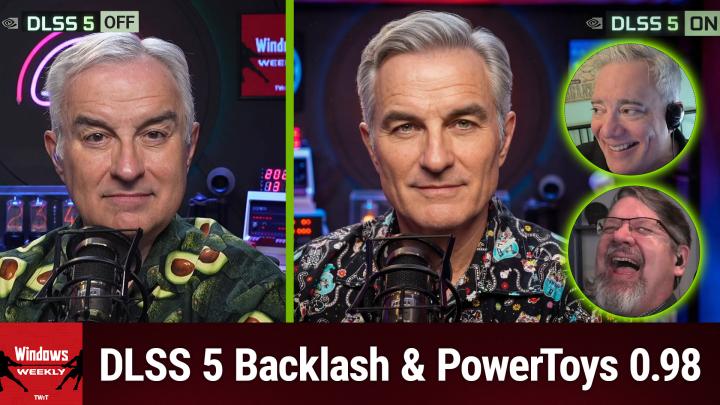
And if you use NVIDIA's DLSS, you can make it super sexy.
Paul Thurrott [00:54:29]:
We're gonna get to that. So, but, but for now, you don't use— it's— this is running on the MPU. This is saving Microsoft money, right? In other words, a human being bought a computer.
Richard Campbell [00:54:40]:
You don't make money directly on a browser, but you use the browser so that you have the telemetry, and you're a gateway drug.
Paul Thurrott [00:54:46]:
Yeah, but I mean, in this case, literally, Microsoft could offer that to Windows 11 users. But if they did, most of them are running non-Copilot Plus PCs. It would have to hit something in the cloud that would cost them money.
Richard Campbell [00:55:00]:
Yeah.
Paul Thurrott [00:55:00]:
So you, as this person that is— you bought a computer once, you know, Microsoft's not making any more money off you for the most part. So what's the option here? You could put this thing behind a Microsoft 365 paywall. That would help mitigate some of the costs, I guess. And they do do that, by the We have some features, or you just make it NPU only. You know, you have to have the Copilot Plus CC, which is what they're doing for this particular feature. So if they just open this up to everyone and people, I mean, there would be people who would like literally spend days just upscaling photos. This would cost money, Microsoft, lots of money. Sure.
Paul Thurrott [00:55:35]:
So I think that's the strategy, such as it is. So in the future, hopefully, This will be more sophisticated. Again, keeping it to the single feature, you try to upscale an image. If you have a Copilot Plus PC, it runs on the NPU. If you have a— well, ideally it would run on a GPU, by the way, but let's not add another nuance to this.
Richard Campbell [00:55:58]:
1500 tops in my 5080.
Paul Thurrott [00:56:00]:
I know, geez, I know. Is that more than 40? I can't remember.
Richard Campbell [00:56:04]:
Yeah, it is.
Paul Thurrott [00:56:05]:
Yeah, a lot more. Not quite exponential, but it's a lot more. But if you had a Microsoft 365 subscription you were paying for, you might build a— use a cloud model. They don't do that right now, but they could. And then, uh, if you don't, then it just doesn't appear. You don't even get the option, you know? Like, that to me is how maybe a lot of this stuff should work, you know? We'll see. It's— the problem is they, they throw this stuff out there so fast, like, it doesn't have a chance to make sense. You know, if that makes sense.
Paul Thurrott [00:56:38]:
Okay. And then just real quick, I don't want to spend too, too much time on almost any of this, but if you could think of— we talked about this, I think Leo was talking about— you're using— no, you were using it for retirement stuff. I was saying that that's the second worst use case for AI. The first worst is health. And Microsoft, of course, announced Copilot Health. In the US. Yep. For consumers, it's on a waitlist.
Paul Thurrott [00:57:04]:
So if you want to wait to get really bad information, you can do that. I don't know. I, I don't even want to talk about this thing. It's gross. Google also announced a personal intelligence feature. This is the, the way that Gemini connects to apps. And in this case, they're kind of like web apps or services, things like search and Google Photos and whatever. So you sign into Google, you have access to all these AI capabilities everywhere.
Paul Thurrott [00:57:35]:
Who can keep track of this anymore? And, you know, when you do things like, say, I'm going to make something up, you know, you search for Google Photos for something, it's going to take into mind all of the data it has across whatever you have with Google, like Gmail or Google Calendar or whatever. So if you say something like, I would like a photo from the meeting I had in New York in March. It can know from your calendar what the day was and then go find the photos from that day, that kind of thing. So that's good, I guess. You know, obviously you have to buy into that stuff. And then this week, OpenAI announced their GPT-5.4 Mini and Nano models, which are the smaller ones. They're optimized for speed and efficiency. And if you use Duck AI, which is private and anonymizes everything if you use any of the big models, you can actually access GPT-5 Mini right now through there for free with whatever usage limits.
Paul Thurrott [00:58:35]:
And then if you have an OpenAI ChatGPT subscription of whatever kind, you can use GPT-5.2 as well for reasoning. I'm sorry, I should have said these, they're using for reasoning models. So reasoning, The reasoning models are the ones that take a long time. So you ask it a question and it kind of, it's like when a magician does something over here so you don't see his hand putting the card in his pocket. He's like, oh, let me think about that. Yeah, I guess if I was going to research this topic, I would blah, blah, blah. And then while you're sitting there like, oh, look at how smart this is. It's just buying time.
Richard Campbell [00:59:04]:
I think describe it as it gets the answer immediately, but then it does analysis on the answer.
Paul Thurrott [00:59:09]:
And then corrects itself over time.
Richard Campbell [00:59:11]:
Sequence. Whether it corrects itself is a separate issue, but it mainly does is show a kind of language progress bar so you feel like these—
Paul Thurrott [00:59:18]:
yeah, there you go. To me it's a lot of hand waving, but, um, yeah, I see this in the coding stuff. Yeah, I mean, it's just like, uh, it seems like you'd want to do that, like, oh, actually that's not a good idea, let's do this instead. Oh wait, hold on a second. And then whatever, at the end you get what is hopefully, and usually actually, a more accurate response. Response or something.
Leo Laporte [00:59:40]:
Or something.
Paul Thurrott [00:59:42]:
That's the theory.
Leo Laporte [00:59:44]:
Wow, you guys, uh, just burning through this stuff.
Paul Thurrott [00:59:46]:
I'm surprised, but I actually thought to myself that we're gonna run in— we're gonna run into problems today.
Richard Campbell [00:59:51]:
Yeah, the whiskey bit is huge because I went all in on Irish history. I looked at it. I am appalled at myself and delighted at the same time.
Leo Laporte [01:00:00]:
It was St.
Richard Campbell [01:00:01]:
Patrick's Day yesterday, so I put the green shirt on.
Paul Thurrott [01:00:05]:
We have a big Xbox segment too.
Leo Laporte [01:00:07]:
I did, I have to say I'm very proud of myself. I had a very successful St. Patrick's Day. I did a nice—
Paul Thurrott [01:00:14]:
What constitutes a successful St. Patrick's Day?
Leo Laporte [01:00:16]:
Well, I did a corned beef and cabbage, except that when I was at the grocery store looking at the corned beef, I noticed that they had way back behind all the bright red corned beefs, they had a corned pork. And I thought, that sounds mighty delicious. So I asked the butcher, I said, corned pork, is that good? Is that good? I never heard of that. He said, yeah, it's great.
Paul Thurrott [01:00:44]:
Would you like, would you like to try? Would you like to like things that have been corned?
Richard Campbell [01:00:48]:
Yeah.
Leo Laporte [01:00:49]:
All that means is it's salted, I guess.
Richard Campbell [01:00:51]:
Yeah. Right. Corns of salt.
Leo Laporte [01:00:53]:
It's back in the— yeah, big, it's big chunks of salt. Back in the day, when they didn't have refrigeration, they would corn the pork or the beef. So I said, all right, I'll take the corned pork. I'll take it. And I slow cooked it yesterday with cabbage and potatoes and carrots. And ladies and gentlemen, I just want to show you, that is—
Paul Thurrott [01:01:15]:
wow, that looks like an Easter meal. That's nice.
Leo Laporte [01:01:18]:
It was really good. It was, yeah, it was kind of a cross between— it's a pork loin Yeah, uh, but it wasn't— you know, sometimes corned beef is a little stringy and, and yeah, tough and dry. This was amazing.
Paul Thurrott [01:01:30]:
That's why they slather it in mustard.
Leo Laporte [01:01:32]:
Yeah, I did put the mustard out for the Germans in the, in the family. Well, sure. So that was my, uh— so I would say I had a successful St. Patrick's Day. And of course, Irish whiskey was—
Paul Thurrott [01:01:45]:
I had a ramen with Korean chicken, so it was also sort of a—
Leo Laporte [01:01:50]:
I bet though, knowing Mexico City that there were people celebrating St. Patrick's Day.
Paul Thurrott [01:01:55]:
So actually yesterday it rained, which is very unusual this time of year. Yeah, I gotta tell you, this, this city shuts down when it rains. Like, it just shuts down. It was quieter walking up the street last night than I've ever seen it, ever. And normally, yeah, I think it would have been stupidity central. Um, but I think they don't— that yet the rain— well, you know, think about the impact of rain in a place where it doesn't really rain a lot. So it's very disruptive. Drainage, uh, actually it was fine.
Paul Thurrott [01:02:23]:
I, I'm always looking out for that. It was fine.
Richard Campbell [01:02:26]:
Yeah.
Paul Thurrott [01:02:26]:
Um, but it keeps people at home, you know.
Richard Campbell [01:02:29]:
Yeah, that's interesting.
Paul Thurrott [01:02:30]:
So that might have actually saved us some noise last night. I think last night would have been stupid.
Leo Laporte [01:02:34]:
Yeah.
Richard Campbell [01:02:34]:
I'm gonna— next time I go to make corned beef from a brisket, I'm also going to buy a pork loin and I'll do them both.
Leo Laporte [01:02:39]:
Try it. It was amazing. And then I, you know, cooked it in the, you know, the Crock-Pot, the slow cooker. For 6 hours, uh, and it just came out great. But I also had the spices, you know, the pickling spices and all that. But anyway, that's pretty nice.
Richard Campbell [01:02:55]:
Awesome.
Leo Laporte [01:02:56]:
Per nothing at all, you're watching Windows Weekly with Paul Theriot. It's just— I'm just stalling for time. And, uh, Richard Campbell, because I know everybody really is here for one thing and one thing only: the Xbox segment.
Richard Campbell [01:03:09]:
And that's Halo theme songs.
Leo Laporte [01:03:13]:
Time for Halo. Thank you, Kevin King.
Paul Thurrott [01:03:24]:
It's still a religious sounding backwards, you know.
Leo Laporte [01:03:28]:
I love it backwards. Do you think we could get dinged for playing it backwards?
Richard Campbell [01:03:32]:
I don't think—
Paul Thurrott [01:03:32]:
does it ever say Paul is dead?
Leo Laporte [01:03:36]:
No, he is barefoot, however.
Richard Campbell [01:03:38]:
Mm.
Leo Laporte [01:03:39]:
What's the latest in Xbox?
Paul Thurrott [01:03:45]:
Well, in keeping with the earlier segment about rumor versus reality, there was a news story the other day that Microsoft had removed the "this is an Xbox" messaging from its website, right? Which was so controversial for—
Leo Laporte [01:04:00]:
Oh yeah.
Paul Thurrott [01:04:01]:
Console.
Leo Laporte [01:04:01]:
Implying that you really didn't need an Xbox. To be an Xbox?
Paul Thurrott [01:04:04]:
Well, because you really don't, but yeah. Um, people hated that. People, I don't know why I just said people. Some people hated it, but console users, console users. Yeah. Console fans, people stuck in the past, people who don't seem to realize that they've never done anything but lose money on this hardware, whatever. Anyway, but you know, as we know, uh, Xbox is back. And so people are saying, oh, see, they're going to focus on the console again.
Paul Thurrott [01:04:31]:
and it's like, guys, I got bad news for you. Nothing has changed. I mean, literally nothing. And I had this person respond. I wrote, you know, half of the article I wrote, um, half of an article I wrote was about this. The other half was that Windows, like, nothing is actually changing thing. Um, someone said, well, if nothing is changing, why did Phil Spencer and Sarah Bond leave? You know, and it's like, because Phil Spencer was always going to retire and Sarah Bond was really not well liked. And expected to be his replacement and—
Richard Campbell [01:05:04]:
and didn't get the job. And what else do you do when you don't get your job?
Paul Thurrott [01:05:07]:
So, um, yeah, I mean, you gotta remember, like, in its best console generation, Xbox 360 came in third of three consoles and lost money. So, like, I'm sorry, but, like, you know, so when you look at what Microsoft has announced for this next-gen console, which, by the way, won't ship to consumers at the earliest until the very end of next year, which is 18 months plus from now. This is not anything different than they've already talked about. Sarah Bond talked about this console fairly incessantly, frankly. She talked about how it was going to be next generation. And, you know, they always use things like— what's the phrase— a step change, you know, in performance and ray tracing and blah, blah, blah, whatever. Yeah. Look, it's also going to run Windows, right? It's also going to run Windows games and allow you to run Windows stores, game stores like Steam and Epic and so forth.
Paul Thurrott [01:06:03]:
And then tied to this, of course, the Windows— right now they're looking at how they bring backward compatibility to Windows 2 as well, which to me is the magic part of this because it being a PC, I know there are downsides. I mean, we should be crystal clear about this. Windows is not perfect as we discuss every week. Um, but they've done some work in Xbox— well, sorry, it's called Game Mode first in Windows 10 and then 11. That's becoming Xbox Mode, which I think we talked about last week. Um, they did the full-screen experience for the Xbox ROG Ally, which is going to form the basis for what this Xbox Mode on PC is, but also for, uh, the Xbox UI or OS, which will be based on Windows, right?
Richard Campbell [01:06:44]:
Because I can't imagine now that they've gone down this path and there is the ROG They don't get to abandon these guys. Like, they've got—
Paul Thurrott [01:06:49]:
No, I mean, well, that thing is still a— it's a— it's Windows, right? I mean, that one is unabashedly— well, maybe slightly bashfully— a PC, right? You can— yeah, I wouldn't, but you could drop down into Windows and run Word and type things on it. I mean, you could, you know, it's a computer. Like, it's not a— it's not a sort of computer, it's literally a computer. But yeah, but the OS by default runs in that full-screen experience, which is essentially Xbox mode, which is coming to all PCs in, you know, where it takes a lot of the background processing type stuff away, a lot of the background or the stuff that runs at startup goes away, etc., etc. So, you know, we'll see. I— this— but there they have announced nothing that was like, oh, see, there's the change. Nope. I mean, the timing of the console hasn't changed.
Richard Campbell [01:07:36]:
It's still the same thing on the website.
Paul Thurrott [01:07:38]:
Actually, they took away the 'this is an Xbox' branding stuff. It was like a marketing campaign. Which, which by the way, probably just came to an end, folks. You know, yeah, like we would have won where, as ad campaigns do. You know, I, again, this is, we, we see, this is that human thing. This is why conspiracy theory exists, right? It's a, I remember reading the story in the New York Times probably 20-plus years ago that was talking about early man. One guy in the crowd would be like, I think I saw a tiger in the grass, we gotta run. And like the people who thought they saw the tiger in the grass are the ones who survived, right? Because they weren't always right, but the people who never believed it died, and they were all— those people got kind of bred out.
Richard Campbell [01:08:18]:
Paradolia is the tendency to see faces.
Paul Thurrott [01:08:22]:
So we— this is what humans do, we draw these connections.
Richard Campbell [01:08:25]:
And I love this Xbox paradolia, this is the best.
Paul Thurrott [01:08:28]:
Yeah, so the Xbox— this is an Xbox ad campaign is over, thus Microsoft is not doing this cross-platform blah, blah. No, no. Like, you gotta— if you look at Xbox as a business today, if you look at it 2 years from now, 5 years from now, whatever, 90-something percent of it is tied to game sales directly, right? They're a game publisher. This is where it's coming from. And, uh, yes, I, I'm sure the next Xbox console will be fantastic. I'm sure it will be more of a curated experience. You know, turn the thing on, it plays, it works, whatever. Yep, great.
Paul Thurrott [01:09:02]:
I also am sure it's going to cost about $1,000 and they're going to sell about 3 of them.
Richard Campbell [01:09:06]:
So yeah, hey, both guys who get them are going to love them.
Paul Thurrott [01:09:10]:
Exactly, exactly. And look, I'll probably be one of them. I'm, I'm, you know, just to try it, right?
Richard Campbell [01:09:16]:
It's not like the PS5 Pro has sold hotcakes either.
Paul Thurrott [01:09:20]:
Well, but compared to Xbox, it kind of has, right? I mean, like, compared to PCs, no, for sure. But, um, but PlayStation Uh, is a good business. I don't know where they're at in the profitability scale and hardware sales, but I suspect they've crossed that line. Nintendo does that pretty quick every generation. Um, and maybe more important, and this is actually the kind of the part of the thing I care about, and they've done right by fans, right? So those people that do want that thing can get it. We don't have that on the Xbox side, right? Xbox Series X and S. Xbox have been stuck in time since the first release. They haven't changed anything material.
Paul Thurrott [01:09:59]:
I mean, yes, you can get more storage, big deal. But yeah, yeah, I know. This is if you are an Xbox console fan and you're looking for more— what do you call it? What's the— you see something that's not there? What's it called?
Richard Campbell [01:10:14]:
Pareidolia.
Paul Thurrott [01:10:15]:
Pareidolia. You're looking for a further sign of pareidolia. They're testing a feature now that will come to the Xbox consoles probably the next month or two, which is a long-awaited feature, which is per-game quick resume. Quick resume is a great feature, dot dot dot, when it works, right? It does not—
Richard Campbell [01:10:33]:
kind of a hibernate, isn't it? Like, it literally—
Paul Thurrott [01:10:36]:
it's a way— yeah, I, I'm sure they use terminology like, we freeze-dry the game, and then the console turns off, and when you come back, we reconstitute it from its its freeze-dried state, whatever.
Richard Campbell [01:10:49]:
Rehydrate.
Paul Thurrott [01:10:50]:
It's a way for a game that you were playing— because if a lot of people will play the same game, right? So you play the game for a little while, you're done, you go away, come back, you know, you want to get into it as quickly as possible. And this, it's, it's, yeah, it's basically like sleep, resume, or hibernate, whatever. The problem is it's super unreliable. So there are certain games where this thing does not work well at all. So if you're playing one of those games, you have to turn this feature off, but then you don't get the advantage elsewhere. So what they're allowing you to do is disable quick resume on a game-by-game basis, which is frankly what they should have done, you know, from the beginning. Um, and then there's a bunch of other features that, uh, they're testing as part of this, which I think will be part of, you know, again, probably April, but at the latest May, the Xbox monthly update that they do. Um, uh, more groups on the home screen, so now you can pin up to 10 groups.
Paul Thurrott [01:11:38]:
Um, the ability to pick a custom color to to personalize the guide, which is that thing over the side, and then profile badges when you're looking at people's profiles for some reason, which I usually only do because I'm upset with somebody and I want to block them or complain about their username or something. So I don't really care about the badge, but whatever. Where am I? I'm looking at the wrong part of the notes and wondering why my brain is broken. Okay. So we've entered into the second half the month, as evidenced by the Ides of March and then, um, St. Patrick's Day. So we're getting a second wave of Game Pass games, uh, across PC, console, cloud, etc. Um, and there's some, some big ones in this one.
Paul Thurrott [01:12:19]:
So Resident Evil 7: Biohazard is a nice add. That's the one Resident Evil game I've actually finished.
Richard Campbell [01:12:27]:
Wow.
Paul Thurrott [01:12:27]:
Um, it's a good one. Yeah, it's pretty good. Um, what's 7? Yeah, I know. So we're on 9 now, I guess, in the mainstream of the mainline games. Uh, yeah, no, they do, they do pretty good. Um, Final Fantasy 4 is in there, uh, Dragon Infinite Wealth, uh, Gabby's Dollhouse. I'm really excited about that one. Um, Disco Asylum also.
Paul Thurrott [01:12:52]:
If I could only play both of those at the same time, that would be fantastic. And then of course, good names, right? Barbie Horse Trip.
Richard Campbell [01:12:59]:
Oh my God. Oh, now I need Ultra, clearly.
Paul Thurrott [01:13:05]:
But, uh, also, well, in the horror— I believe this is a horror title— Claire Obscure Exhibition 33.
Leo Laporte [01:13:12]:
Oh, that's a very— it's not horror. That's a wonderful—
Paul Thurrott [01:13:15]:
it's not? Oh, it's not?
Leo Laporte [01:13:16]:
Oh, it's an amazing game. In fact, is it arguably the game of the year last year?
Paul Thurrott [01:13:21]:
Oh, interesting.
Leo Laporte [01:13:22]:
Uh, highly recommend it. It's magical. It's, uh, it's It's a fighting, you know, it's a fighting game.
Paul Thurrott [01:13:29]:
RPG.
Leo Laporte [01:13:30]:
Yeah, yeah, thank you. Kevin King knows the words.
Paul Thurrott [01:13:33]:
That one's not coming till April 2nd, so I kind of assume they're going to be talking about that one again next month.
Leo Laporte [01:13:38]:
Uh, I'm not sure where they announced it right now, but I feel like that was on Game Pass. That's how I played it.
Paul Thurrott [01:13:45]:
Games come and go, you know, that's, that's part of it. Um, and it might have only been on certain platforms, so Oh, maybe with this release it's actually going to be everywhere. So cloud, Series X and S, handheld.
Leo Laporte [01:13:55]:
Actually, it's Disco Elysium, not Disco Asylum. Oh, there is a difference.
Paul Thurrott [01:14:02]:
There is. Yeah, I should be in— I should be in one but not the other. Um, this is the big difference.
Leo Laporte [01:14:10]:
Um, I want to play Disco Inferno, but that's me, you know.
Paul Thurrott [01:14:13]:
Yeah, exactly. Um, Starfield. Starfield, uh, which great game, you know, exclusive to the Xbox, uh, Skyrim in space.
Leo Laporte [01:14:23]:
All these games would look so much better in DLSS 5. In fact, they showed Starfield as one of the things.
Paul Thurrott [01:14:29]:
All right, so this wasn't part of the story, the filter. So people have a problem. So Nvidia has announced DLSS 5, right? Yeah. So this is one of many technologies that improves the visual quality of games without actually requiring you to bump up the resolution or download new assets.
Leo Laporte [01:14:48]:
You want to see what I look like in DLSS?
Paul Thurrott [01:14:50]:
I do.
Leo Laporte [01:14:51]:
Because we've actually run myself through it, and I just— I think it's much more accurate.
Paul Thurrott [01:14:57]:
Oh my God, you are stunning.
Richard Campbell [01:15:01]:
You've been Josh Brolin.
Paul Thurrott [01:15:02]:
You look like, um, you're like, uh, Leo Hasselhoff in this photo. That's crazy. You should be— do you have like one of those like, uh, uh, inflatable, like, well, not inflatable, those, uh, lifeguard, what do they call, floaty things, like the red thing that would—
Leo Laporte [01:15:18]:
yeah, I'll come and save you, run down the beach.
Paul Thurrott [01:15:20]:
Yeah, exactly. I like it in slow motion.
Richard Campbell [01:15:22]:
It's just, it's a lot of chin. That's a lot of chin.
Leo Laporte [01:15:26]:
A lot of chin. The realism is amazing, says Burke.
Paul Thurrott [01:15:33]:
That's funny. So I guess this has gotten some really— well, no, not, not I guess, it has gotten some negative feedback to the point where, uh, Jensen from NVIDIA, the founder of NVIDIA, was like, you're all wrong.
Leo Laporte [01:15:47]:
He's all defensive.
Paul Thurrott [01:15:48]:
Yeah, he's really defensive. Yeah. So one of the descriptions I read was like, imagine you could play the game Assassin's Creed Shadows without shadows, or, you know, because it changes— it changes the look of in-game assets to the point where they're sometimes not recognizable.
Richard Campbell [01:16:07]:
Yeah, change the tone of the game.
Leo Laporte [01:16:10]:
It makes it— yeah, it makes it look more realistic, I think. Don't you think?
Paul Thurrott [01:16:13]:
Well, I— look, the goal here should be like Auto SR, right? It's, it's—
Richard Campbell [01:16:17]:
it—
Paul Thurrott [01:16:17]:
the goal here is you can— A, on a lower-end PC, it's going to look like it's playing on a higher-end PC. If you're just on whatever PC, it— like, it looks— it should look as good as it can look. Like, the— hopefully the—
Leo Laporte [01:16:31]:
the Starfield Oh yeah, baby.
Paul Thurrott [01:16:34]:
See, it changes. So it's weird, like it's a different person is what it is. Yeah. So if you think— if you know, like, you're familiar with like Pixel phones and the photography features, right? There, if you zoom up to— depending on the phone, if you go up to like, uh, I think it's 20x or something, it's using machine language to fill in the gaps. It's not creating anything, but if you go above that, it's creating something, right? And what it's creating may not be what you're actually looking at, right? I— the example I had was a photo of a, a gold statue and a monument in Berlin that's not an angel. It's a— maybe it is an angel, whatever, it doesn't matter. But it was facing away from me, so it's doing whatever pose, and it created a face for the back of its head because from its perspective it was like, should have— what, you know? Yeah, it should have a face on the back of its head. Yeah, sure.
Richard Campbell [01:17:22]:
And that's what this is doing, and I, I get You're talking about the victory column?
Paul Thurrott [01:17:26]:
The victory column, yeah.
Richard Campbell [01:17:27]:
The winged victory, yeah.
Paul Thurrott [01:17:29]:
That's right.
Richard Campbell [01:17:29]:
So just throw a face on the back of the winged victory.
Paul Thurrott [01:17:32]:
Mm-hmm, mm-hmm. And now it becomes like the winged demon of defeat because there's a face on every side of its head so it can see you winged no matter where you're coming from.
Richard Campbell [01:17:40]:
Wow. That or you're in tiger country and the tigers won't pounce on you if they see eyes.
Paul Thurrott [01:17:44]:
Right. So yeah, this has become controversial really quick. So the example, I think one of the examples you were showing. Yeah, like the game, the latest Resident Evil game, which by the way is gorgeous. I look at the changes it made there and I'm like, yeah, no, that actually, that looks to me looks great. You know, I, if it could somehow remain faithful to the original and, you know, not completely changing it, that I feel like should be appreciated.
Richard Campbell [01:18:18]:
When I watch Jensen, that he's not just talking about AI, that he's at at least hedging his bets a little. Although still a business, you know, he talked about the CUDA engine for other purposes too. It's like, yeah, there is still a business out there, not just the AI business.
Leo Laporte [01:18:31]:
Anthony says this is what gamers are worried about, is Minecraft turning Steve into a real, a real person.
Paul Thurrott [01:18:39]:
Hey, look, as long as it doesn't look like— what's that comedian, the awful comedian that was in that movie, uh, Jack Black? Yeah, just don't make it look like him. As long as it doesn't look like him, I kind of wouldn't mind.
Leo Laporte [01:18:53]:
Uh, I don't know, gamers are funny. They don't want you to mess with their, uh— yeah, here's the rest.
Paul Thurrott [01:18:58]:
Well, this is an extension of all the AI complaints, right? Or the extension of the complaints of like Windows enthusiasts about AI and Windows. Like, it's the same, it's the same argument.
Richard Campbell [01:19:07]:
I mean, change for change's sake.
Leo Laporte [01:19:09]:
Anthony says if they just showed backgrounds improved, nobody would have complained. And that might be— it's the uncanny valley.
Paul Thurrott [01:19:15]:
Honestly, what you look— yeah, it's— you, you kind of want the effect of an up-res, right? Even if it's fake, like if it's just a, you know, it's really running at low-res but it looks like it's high-res, like nice. Like you want it to be faithful to the original, I guess.
Richard Campbell [01:19:29]:
Yeah.
Leo Laporte [01:19:30]:
I love all the examples people are putting in.
Paul Thurrott [01:19:32]:
Uh, yeah, this is— this, this is— this was like— is lobbed over the plate for to be mocked. I mean, it was just I, I— how they did not see that. And then his reaction afterwards, right?
Leo Laporte [01:19:46]:
Great.
Paul Thurrott [01:19:47]:
In case you thought this guy was godlike and made no mistakes, um, a, a billionaire tech leader lashing out at his own customers for being wrong is something I would expect from OpenAI, but not necessarily from NVIDIA.
Leo Laporte [01:20:03]:
I mean, here's from Patrick Delahanty, the blue this guy post that says it all. DLSS on, RAM is $99. DLSS off, DLSS on, it's $700. Hey, you're watching, uh, Windows Weekly, uh, the non-DLSS 5 version, sad to say. Damn, I want to look like that, uh, with Paul Thurrott and Richard Campbell. You know, we do thank our Club Twit members. If you would all join Club Twit right now, maybe we could afford to have DLSS 5 Leo all the time, uh, or not. Actually, that would be a good thread.
Leo Laporte [01:20:41]:
If you don't want DLSS 5 Leo, go to twit.tv/clubtwit and join the club. $10 a month gets you ad-free versions of all the shows, access to the Club Twit Discord where all that fun is happening, uh, plus of course all the special programming we do. Uh, we've got the photo guy Chris Marquardt coming up later. This week tonight at 6 Pacific, 9 Eastern, Micah's Crafting Corner. Micah's going to do paint-by-numbers, a very chill version. As I said, Chris Markwardt on Friday. Monday, Home Theater Geeks Jet Set. Next Thursday with Johnny Jet.
Leo Laporte [01:21:14]:
Uh, lots of stuff going on in the club, and it's all because of you. Thanks to you, our Club Twit members. twit.tv/clubtwit. If you're not a member, join the club. Now let's get to the back of the book and Lil Paulie Throt and his tip of the week.
Paul Thurrott [01:21:35]:
I'm going to ruin the rest of my year by writing about like switcher topics, not for the entire year, but it's going to ruin my year. Um, so I kind of make the case— not, I literally make the case in the— in Certify Windows 11 that Windows 11 is still the best desktop platform for, you know, what I would call kind of traditional productivity work. It has lots of problems, we all know about that, but they, they can all be fixed or worked around. So I— that to me is a better solution for most people than switching platforms and whatever. But, um, I know that's not true for everybody. And also there is this fear that maybe one day what I just said will no longer be true, right? Um, we I mean, you can kind of see Microsoft's direction in certain places, but one obvious example is local accounts and forced Microsoft account usage and how they are kind of slowly chipping away at that to remove the workarounds and fixes and so forth. And so, you know, I don't actually see a day where they can't, you know, they can't allow that somehow, but I mean, but you know, that's the fear. So I've been looking at, you know, I do this all the time anyway, but I've kind of escalated this year with the idea of writing more about that later in the year as sort of like a monthly focus thing.
Paul Thurrott [01:22:55]:
But this— the problem with switching platforms is so, it's so broad and so deep that it just, it's almost like a non-starter even talking about it. I remember 20-plus years ago, you know, people would write into Walt Mossberg at the Wall Street Journal and be like, oh, I'm having this problem with Windows, you know, what do I do? And he's like, you should buy a Mac, you know. Yeah, that's a $3,000 solution to a $20 problem, you know, like just completely switch platforms, buy new apps, hope they have all the apps. You know, back then that was actually not a guarantee. Today that would be a lot easier. But, um, but I'm trying to figure out like all the different things that go into this. It's like kind of use cases, like do I use a computer all the time? Like people like us us. We use computers all day long, but there are younger people especially who are on the phone all day long and they only need a bigger screen sometimes.
Paul Thurrott [01:23:41]:
And so maybe you need a simpler platform, you know, workflow, which I think of as a combination of like apps and online services and habits. You know, as I work throughout the day, maybe I write in whatever app, I edit, uh, documents and whatever, uh, documents, uh, images and whatever app I update. You know, I read things on the web and then I publish to the web and I use whatever tools I use and then there's the online storage in the background. And it's like, some of this is not reproducible elsewhere. And it's like, well, then how change-averse are you? Because are you able to make this? Can you change the way you work? Is it worth doing that? I mean, the amount of time it takes just to do that. And you're familiar with whatever platform, in this case, maybe Windows, and that familiarity leads to a certain form of efficiency. And that also makes it just small things like on the Mac, it's Command+C to copy and paste or copy, not Control+C or whatever, or the ridiculous, um, you know, multitasking capabilities in the Mac, which to me completely sub— it's just sub— just kill this whole experience for me. But, um, which you can fix with utilities, et cetera.
Paul Thurrott [01:24:48]:
So there's probably a lot that goes into it, but I'm looking into this and I, I mean, I kind of always look into this, but, um, as sort of a side project to let's fix Windows is, well, we could replace Windows too, right? Um, I will say though that in the same way that there's this kind of narrative out in the world like Microsoft needs to go back to making consoles and forget about this cross-platform stuff, or Microsoft needs to stop putting AI in Windows, or whatever it is, you know, I, I see, I see this on YouTube. These things get hundreds thousands of views. Like, Windows is worse than it's ever been. Yeah, is it?
Richard Campbell [01:25:23]:
Have you—
Paul Thurrott [01:25:24]:
did you ever use Windows 8? Are you kidding me? I, I— like, it's not even close.
Richard Campbell [01:25:29]:
RC0 Vista, like, that— there's some grim versions of Windows, man.
Paul Thurrott [01:25:33]:
Yep. I mean, I, I'm sorry, but I— that's, that's ludicrous. Windows in some ways is better than it's ever been. I mean, there are absolutely behaviors in there that are not great. I mean, like, we talk about this a incessantly. But my, my role, as I see it, is to help people get work around that stuff or fix it when possible. Um, and, you know, to date, that's been— that's— that works, you know. Um, it may not always work, so it's just something.
Paul Thurrott [01:25:59]:
But I, I guess the— I guess the, the message here is the grass is always greener thing, right? Like, um, I think people feel like, well, if I just switched to a Mac, everything would be great, or I could just run Linux and everything would be terrible, or whatever it is.
Leo Laporte [01:26:10]:
Like, I It's actually true about Linux. I'm just—
Paul Thurrott [01:26:14]:
well, I mean, Linux is a world of hurt. Not in the way—
Richard Campbell [01:26:18]:
maybe—
Paul Thurrott [01:26:18]:
no, no, no, no, no. I mean, in that there are 1,000 distributions, multiple app package or package standards, file systems. I mean, it goes on and on and on. And like, you have to want to control it enough to— and you have to— you have to get a little lucky or do the research to understand whether whether this distribution will work on this PC that I have, because one of the appeals of Linux is that it will run on the thing you already have, you know, that you don't have to buy a new computer.
Leo Laporte [01:26:44]:
Good, good point. Uh, I'm not sure about ARM, uh, PCs.
Paul Thurrott [01:26:48]:
ARM is way dicier.
Leo Laporte [01:26:50]:
It's dicey.
Paul Thurrott [01:26:51]:
But even within the PCs I want to get the new Dell XPS.
Leo Laporte [01:26:54]:
I gotta make sure it'll run. So they come with Ubuntu.
Paul Thurrott [01:26:56]:
Yeah, Dell tends to be pretty good with Linux, by the way. My Lenovo X1 Carbon, Lenovo's always great. Even the fingerprint reader works. But, uh, right, I have one— I think I have one PC and one— what was the distri— it might have been the Android OS, I don't remember. But one of them, the fingerprint reader worked, and I was like, oh my God, this is a game changer. Like, like having to type in a password every time you want to sign in, like a peasant. Yeah, exactly, exactly. Yeah.
Paul Thurrott [01:27:23]:
And then you look away from the computer and it signs you out. You're like, come on, man.
Leo Laporte [01:27:26]:
You know, like, yeah, I even asked SUDO. I, uh, with the fingerprint, everything, it makes it so much easier. It's just really nice.
Paul Thurrott [01:27:33]:
Oh my God, biometrics are— I know this is the—
Leo Laporte [01:27:37]:
I feel like it's more secure too.
Paul Thurrott [01:27:39]:
Yeah, it is more secure. That's what makes it bizarre. Like, all of Apple's platforms fall back to PIN sometimes. You're like, it's been a while, you got to use the PIN.
Richard Campbell [01:27:46]:
Like, why?
Paul Thurrott [01:27:47]:
What do you like?
Richard Campbell [01:27:48]:
Now I feel safe.
Paul Thurrott [01:27:49]:
Why? Why don't you have Face ID on any Mac?
Richard Campbell [01:27:52]:
Come on.
Paul Thurrott [01:27:53]:
Yeah, it's crazy. Anyway, um, the grass is always greener, I guess, is the point.
Leo Laporte [01:27:57]:
No, that's right. You're right.
Richard Campbell [01:27:59]:
That's right.
Leo Laporte [01:27:59]:
Although I have to say, I haven't been looking over the fence at Windows in a long time.
Paul Thurrott [01:28:04]:
Yeah, if your neighbor had set fire to the grass and then sat in like on their porch with a rifle, that would be that fence. Um, but we're, you know, even—
Leo Laporte [01:28:16]:
I'll be honest, even Mac— don't— to be fair, I feel the same way about Mac. I, I Both companies have become so, yeah, anxious to monetize.
Paul Thurrott [01:28:25]:
They're so— yeah, they're so big that the previous model was like, we're just going to let people do what they want. The— that's that we want to keep on the platform. It's like, no, we actually want to make money from you every month.
Richard Campbell [01:28:36]:
Yeah.
Paul Thurrott [01:28:37]:
Um, yeah, yeah. Which is why, you know, the Mac is probably the most comfortable thing for Windows users because it's more of the same. It's— it really is in some ways. I mean, but it is also— but it supports all the mainline cloud services with file-on-demand syncing and all that stuff. Like, if you— most apps, if it's like Adobe, Microsoft Office, whatever, you know, any browser obviously runs on both. The cloud services all run on both. Like, you know, you can, you can, you don't have to— if you're going to buy a new computer anyway, it's probably not any more expensive. For the most part.
Paul Thurrott [01:29:13]:
I don't know. We'll get there. But probably not in this show. I'm just throwing it out now. So, and then a couple of app picks. Microsoft just released a major new version of PowerToys, which if you follow PowerToys, you'll know is still under sub 1.0.
Richard Campbell [01:29:29]:
Classic.
Paul Thurrott [01:29:29]:
How could it?
Leo Laporte [01:29:30]:
How many years has it been around?
Paul Thurrott [01:29:32]:
It's on the 98th version. It's still not 1.0.
Richard Campbell [01:29:35]:
Running out of numbers.
Paul Thurrott [01:29:36]:
Like they're, you know, it's incredible.
Richard Campbell [01:29:38]:
Gonna go to 99.1.
Paul Thurrott [01:29:41]:
There are no new apps. Like, this is a set of utilities. If you don't— by the way, if you're not using, uh, PowerToys, you need to be using PowerToys.
Richard Campbell [01:29:50]:
They're fun.
Paul Thurrott [01:29:51]:
That's amazing. Um, so what they've done is improve, uh, several of the features, and some in very big ways. So Command Palette, which is kind of like the Mac— what do they call it on the Mac? Uh, Spotlight search. Like, you hit like the Yeah, Spotlight. It's like on— yeah, and Windows, it's like by default it's Windows key, Alt, plus space, and it brings up a search bar in the thing, and you can type what you want to type in there. So you can type the name of an app, you're running the app right now.
Leo Laporte [01:30:14]:
Can you do documents too?
Paul Thurrott [01:30:16]:
Yep. Yeah, it's actually fairly fantastic, and they— it's extensible. There's all these extensions you can install. Um, it, it is, to me, depending on how you use Windows, this is a viable Start menu replacement. The problem is Microsoft doesn't actually let you replace the Start menu with something It's not Start. So if you could get rid of that thing, and now thanks to this new feature, get rid of the taskbar, this is like the complete UI for launching apps and launching searches and finding documents and stuff. So what they've added is something called— what is it called? Uh, it's a dock.
Richard Campbell [01:30:51]:
It's—
Paul Thurrott [01:30:51]:
what it is is a toolbar that goes at the top of the screen by default, but you can put it on the sides unlike the taskbar. You can move it around and it gives icon access to extensions if you want that. And then it has a bunch of like, you know, CPU, RAM, uh, Wi-Fi kind of monitors, and the clock, date and time, just like the taskbar. So you could hide the taskbar and then use Command Palette to launch apps, and then use this for shortcuts for things, which are not just apps by the way— could be documents, could be extensions, whatever. They've turned this thing into a viable Start and taskbar replacement. I wish they would just actually let you do that thing. Crazy. Keyboard Manager got a major set of updates.
Paul Thurrott [01:31:34]:
So WinUI 3 UI, but also a much simpler UI and a single UI across what used to be like multiple screens. So this is the utility I use to map the Copilot key to nothing. Because I never want anything to launch when I hit that key. And on a laptop, I will often hit it by mistake. So actually, I lied. I'm sorry. I don't map it to nothing. I map it usually to left arrow.
Paul Thurrott [01:32:00]:
It's whatever's to the right of that key, I map it to that. So as I fumble finger, I might miss the left arrow key and I might hit that key by mistake. And now we'll just do left arrow, right? But that's what that app does. It's wonderful. And then Cursor Wrap, which is a fairly recent entry or addition to PowerToys. This is where if you enable this, if you move the cursor to the right side of the screen, it wraps around to the left side, top and bottom, same way. If you have multiple screens, it will do it across screens. I love this thing, but I have to turn it off on multi, like on multiple screen setups because it's, it's like, where's the, where's the cursor go? Like it's crazy.
Paul Thurrott [01:32:44]:
Like, like it's bizarre. But interestingly, one of the several changes they made in this release, because they actually made a bunch, is, well, one of the other ones is you can hold down like a key, like Control or Alt, and that is when it will wrap. So you do it kind of purposefully. You get— but the one that I was thinking of, the one that to me is a big deal, is if you're on a single screen configuration, as you would be on like a laptop, it will be on. But if you connect it to a dock and you have multiple displays, you can at that point say don't be on for multi-screen. And that's actually the way I would want to use it. So that's pretty cool. And then there's a bunch more.
Paul Thurrott [01:33:17]:
I just, those are the big ones to me, but there's actually several more. This is a really big update. I have no idea why this wasn't 1.0, but okay. Mozilla is really, really trying right now to make Firefox a thing again, which I love. I feel like we, you know, like the internet without Mozilla would be a sad place. I wish they were doing better, but they're not. But we'll see what they can do. It seems like they're making the right moves.
Paul Thurrott [01:33:44]:
You know, they have a new CEO, they have a new mascot. Okay. Firefox, a little fox, you know, cute. They have the AI kill switch thing I was talking about a couple of weeks ago. And now what they're doing is talking about the roadmap for the rest of the year. And they've, they're highlighting some features that are coming. Is it next week? If it's not next week, it's the week after. Soon in the next version of Firefox, and then some features for the future, and then generally—
Richard Campbell [01:34:07]:
They've gotten a lot of bug fixes lately too.
Paul Thurrott [01:34:11]:
Yeah, so right. So we have things like the Anthropic deal, which led to the bug fixes, which is fantastic. They're going to have a free built-in VPN with 50 gigabytes of data, free data per month, US, France, Germany, and UK to start. Split screen, which, you know, yes, every other browser already has. A tab notes feature where you can add notes to any tab you're viewing and have it saved to your profile so that if you bring up that site again, your notes will be there. And I would imagine if you're using AI in Firefox, which I would also imagine a lot of people aren't, but if you are, it would be able to read that and, you know, work with that data. They had announced, I don't know, last fall, probably something called AI Window. Remember, this was their original Solution to the AI problem.
Paul Thurrott [01:34:58]:
The AI problem being a lot of Firefox users hate AI. This is now called Smart Window. It's opt-in and off by default, or it will be when it comes out. This will probably be in Firefox 150, which is 2 versions out. There's a wait— not a waitlist. There's a— I think they're soliciting feedback now from people who want it, like early access to it. And this is the— this is a feature that will give you inline AI for whatever you're viewing in a tab in a kind of a pop-up window. So things like definitions, summaries, uh, product comparisons, whatever else, um, you know, typical kind of AI stuff.
Paul Thurrott [01:35:32]:
And they're, they, they're trying to kind of sandbox it from the rest of the browser, I think is the, the central point here. But, um, very vague. But the, the person who wrote— the head of Firefox, uh, who wrote this post was talking about, um, some new open standards in the Gecko rendering engine they're going to announce in the next couple of months. Um, you know, the typical all the power choice, privacy kind of stuff. There's a big refresh to the Firefox user interface coming sometime this year, probably later in the year. Completely new look and feel, uh, new themes, new icons, etc., across the board. So a lot of work going on with Firefox. Um, this has inspired me to try Firefox again.
Paul Thurrott [01:36:12]:
Um, I have a couple of minor problems problems with this browser that are kind of specific to the way I use browsers. So I'm trying to work around that right now. But honestly, I mean, you know, if you care about Firefox— I'm sorry, not Firefox— if you care about privacy and you just can't stand the thought of using a Chromium browser because you hate Google that much, which, you know, I have to say I kind of get, um, you know, it's there.
Richard Campbell [01:36:36]:
I mean, it's, uh, remember, um, but there are some rendering differences like If you spend a lot of time on Firefox, do you like running them side by side? And every so often you're looking at the page, you're going, what the heck?
Paul Thurrott [01:36:48]:
Yeah.
Richard Campbell [01:36:48]:
Then you fire up Chrome and take another look.
Paul Thurrott [01:36:51]:
The thing I often have to do in a browser because of the nature of my job is I'll look at a blog post from some company. And there's an image, or it's part of a thing, or whatever it is. And usually you can right-click on something and save image as. You got it, right? But sometimes you can't. Actually, here's a good example. So every week when I post a link to the Windows Weekly episode, like I'll do this tomorrow, if I— one of the— I open a browser, has 3 tabs. So there's one is the episode page on twit.tv, one is the YouTube channel page for Windows Weekly, and then the final one is the episode page on YouTube for that episode, right? And what I want is that thumbnail image. Um, and I've done this so much, like Leo may know this and know why it's this, but when you, um, right-click on the page, the, the image isn't there on the page.
Paul Thurrott [01:37:43]:
You can't see it. It's like a thumbnail that's built into the, like the video preview or whatever. So you go to inspect, you bring up that, you know, the F12 developer thing, you go over to sources and this works in, you know, Edge, Chrome, whatever you go down and there's like an, it says Elroy. Something, and then you expand that, and then your image server.
Richard Campbell [01:38:03]:
Yeah, yeah.
Paul Thurrott [01:38:03]:
So that's where I go to get it, right? And so from there I can right-click, download the thing. It's nice.
Leo Laporte [01:38:07]:
I'm sorry that we don't make that easier to do.
Paul Thurrott [01:38:09]:
No, it's fine. No, you don't— this is just a— no, it's just something I do every week.
Leo Laporte [01:38:15]:
You now know how to do it.
Paul Thurrott [01:38:16]:
Not a problem at all.
Leo Laporte [01:38:17]:
I can talk to Patrick. We could probably make that a simpler—
Paul Thurrott [01:38:19]:
it's, it's not a problem.
Leo Laporte [01:38:20]:
It works great.
Paul Thurrott [01:38:21]:
Okay, except in Firefox. So when you bring up the developer tools in Firefox, the F12 stuff, whatever they call it, same thing, right? There is no, there's no sources view, right? So I actually don't know how to find that image in Firefox. And I've spent time today on this, literally not on twit.tv, but just whatever site. And I cannot for the life of me, I know it's in there somewhere, right? I, based on the, what I see here, the layout and the options, it's a little more convoluted. I also just want to be super clear. This is not a normal problem, right? This is not like most people don't— okay, you know, like this is—
Leo Laporte [01:38:56]:
we— you can disable right-click.
Paul Thurrott [01:38:58]:
I—
Leo Laporte [01:38:58]:
we might have done that. I don't know why we would do that.
Paul Thurrott [01:39:01]:
No, no, the image isn't there. So like if I—
Leo Laporte [01:39:04]:
like, in other words, it's not there at all. No.
Paul Thurrott [01:39:05]:
So if I go to like twitch.tv/ww, which is the main page for this podcast, there's a thumbnail there. I could right-click there.
Leo Laporte [01:39:13]:
Oh, I see. Oh yeah, it's in LROI.
Paul Thurrott [01:39:15]:
Okay, so I get a low-res version, right?
Leo Laporte [01:39:17]:
Elroy is our, uh, is that Drupal backend that we use for our workflow.
Paul Thurrott [01:39:21]:
Okay.
Leo Laporte [01:39:22]:
And so Elroy makes all of these, makes thumbnails and stuff for social posts.
Paul Thurrott [01:39:25]:
It does all this. This is named after Elroy Jetson from The Jetsons.
Leo Laporte [01:39:29]:
At one point, all of our, uh, all of our different servers had a Jetson's name.
Paul Thurrott [01:39:35]:
Yeah, I'm just familiar. I just see it every week. I just, I'm just used to it.
Richard Campbell [01:39:38]:
All of mine are South Park characters.
Paul Thurrott [01:39:40]:
There you go. I used to do one like, it was like James Bond locations. Like, you know, the bottom of my servers were named after like Goldeneye, which was the name of Ian Fleming's place in Germany.
Leo Laporte [01:39:50]:
I think our server, Atlassian Coherence documentation, had a Jetsons— I can't remember. Patrick says all that's left is El Rey and UniBlab.
Paul Thurrott [01:40:03]:
UniBlab.
Leo Laporte [01:40:06]:
Patrick, do you know, is— would there be an easy way to get Paul this thumbnail? Which size?
Paul Thurrott [01:40:10]:
No, no, no, I'm not— I'm—
Leo Laporte [01:40:12]:
so you don't mind doing it?
Paul Thurrott [01:40:13]:
No, this is not a problem. This is no problem at all. My problem is when I do it in Firefox, I can't find it from there.
Leo Laporte [01:40:18]:
You could— I'll be honest, this would be a great thing for Claude Code. You can easily get Claude Code to have a routine that just automatically goes and gets that every, every week.
Paul Thurrott [01:40:27]:
Or actually, that's a good idea.
Leo Laporte [01:40:28]:
Yeah, that more and more, that's what I do now is just go, oh, I do this every week, I'm gonna have Claude Write a review.
Paul Thurrott [01:40:35]:
This is— I mean, I want to be— this, this takes me 10 seconds. I am so used to this. Like, I don't—
Richard Campbell [01:40:41]:
this is not a—
Paul Thurrott [01:40:42]:
it's not a hide-and-seek game. Like, I find it really quick.
Richard Campbell [01:40:46]:
Okay.
Leo Laporte [01:40:46]:
Yeah, because you know where it is.
Paul Thurrott [01:40:48]:
Yeah, right. But my problem is not with—
Leo Laporte [01:40:50]:
I wonder why Firefox doesn't—
Paul Thurrott [01:40:52]:
I don't know, someone out there who's a developer uses Firefox says, you idiot, it's dot dot dot. I'm sure it's there. Yeah, but I, but I also— I'm sure that in the past I've looked this up and it's just not the same. It's not— this is one thing I just think that Chromium browsers just do a little bit better for me anyway. I don't know, it's not about—
Leo Laporte [01:41:11]:
it won't be— not about—
Paul Thurrott [01:41:12]:
I want to be super clear about that.
Richard Campbell [01:41:14]:
I think for a long time Firefox was like the tool, right? Uh, the browser that with Firebase— yeah, if you're— yeah, if you're developing on the web, you need to work from Firefox. It's not true anymore, but And they owned it for a long time.
Paul Thurrott [01:41:29]:
Yeah, yeah.
Leo Laporte [01:41:29]:
I think, uh, everybody has multiple browsers now, right? Or not?
Paul Thurrott [01:41:33]:
Yeah, not especially developers, but, um, I, I, yeah, but I like this morning, not again, not Twitter TV, but some other site I had to— I actually, I'm trying to use Firefox, right? So I, I had to— I, I spent minutes on this and I'm like, okay, I just got to get my life— I gotta get going here. I have a life to live. So I just ran Chrome, went to to the page, downloaded it, you know, really quick. Yeah, just a little frustrating.
Leo Laporte [01:42:00]:
Well, thank you, Paul. Guess what? Get ready because there's a lot of Irish coming up in just a bit. You're watching Windows Weekly with Paul Thurrott and Richard Campbell. I believe Campbell is a Scottish name. It's true. Do the Scots and the Irish have some sort of— are they The joint here, are they both Gaelic? Is there some joint heritage?
Richard Campbell [01:42:22]:
They, they, if you go back far enough, yeah. And we are gonna, we are gonna start with, uh, with early going back that far.
Paul Thurrott [01:42:28]:
They're gonna be, they're gonna be some Irish people in the audience that don't like this comparison. I want to be super clear about that.
Richard Campbell [01:42:34]:
Careful. And they, and we're definitely going to touch on Aeneas Coffee and the decline of the Irish whiskey.
Leo Laporte [01:42:40]:
I asked yesterday when I was having this little, you know, corned beef and cabbage party I wanted to put an Irish movie on, and I asked—
Paul Thurrott [01:42:48]:
Irish movie? I did.
Leo Laporte [01:42:49]:
And they kept saying things like The Commitments. No, Trainspotting. No, no, no, I mean a nice Irish, a happy Irish movie. I said, aren't there any musicals?
Paul Thurrott [01:42:58]:
Uh, like Cruise movie where they come to the United States and they run across all the free land and they— anyone who—
Leo Laporte [01:43:03]:
gangs in New York? No, no, no, I want something positive. I said, isn't there any musical like Brigadoon or something? And ChatGPT was so dismissive. It Well, that's Scottish, but if you would like an Irish movie—
Paul Thurrott [01:43:16]:
Did it recommend like a Lucky Charms commercial from the '70s?
Leo Laporte [01:43:20]:
There— it's, you know, I ended up playing a very bad Fred Astaire movie in my movies last called Finian's Rainbows.
Paul Thurrott [01:43:26]:
So what's the Irish spring soap where they slice it with the knife?
Leo Laporte [01:43:30]:
Yeah, and I like it too. Uh, yeah, it recommended The Banshees of Inisherin where they cut off their fingers one No, no, you don't understand. I want a happy— apparently there aren't that many.
Paul Thurrott [01:43:43]:
Is there an Irish story that ends well? I mean, is there even— I don't think so.
Leo Laporte [01:43:48]:
I would have played gangs in New York, but I don't think Lisa's father-in-law would have— my father-in-law, Lisa's dad— would have enjoyed that quite so much. So, uh, anyway, let us, let us, uh— you are watching Windows Weekly with Paul Thurrott and Richard Campbell. We are thrilled that you are here, and you are too, because It's now time for Run As Radio.
Richard Campbell [01:44:07]:
One of the shows I was able to get while I was at NDC London at the end of January, I got to sit down with Darshana Shah, and she's the chief AI officer at Elastic, Elasticsearch and so forth, and a brilliant lady, really a phenomenal conversation. But one of her responsibilities was this conversation around efficiency around AI. And so we really got into sustainable talks. So what the evaluations were, and what's the appropriate utilization. We actually went down the path of the whole GitHub Green Software Foundation. Of course, being in Elastic where they work heavily in the cloud, there was this whole conversation about how they're starting to build software that follows solar power around. And so it literally moved workloads data center to data center so that while they're in the sunshine, the power is zero emission. Essentially.
Richard Campbell [01:45:01]:
But it certainly got— we got down into the weeds of what does this really look like for on the efficiency side with large language models and what they're going to evolve into. So I was a very enjoyable conversation, but yeah, very smart lady.
Paul Thurrott [01:45:14]:
And we— nice.
Leo Laporte [01:45:17]:
All right, Richard, uh, I am ready, and I'm sure a few of you are as well.
Richard Campbell [01:45:23]:
I mean, it started so innocently. I just thought, oh, you know, I should just get an Irish whiskey, and I had to pick one I hadn't talked about before, right? And so I went with Teeling, uh, and, uh, they— and this specifically, their small batch, which we'll, we'll get to, but there's a little bit of a path. And it started with this simple statement as I was reading up on the stories of Teeling, is that it's— it— the distillery is located in the Liberties of Dublin.
Leo Laporte [01:45:50]:
Oh my.
Richard Campbell [01:45:51]:
So a little bit of story about Dublin itself. Now Dublin is a, is a, a city that is today anyway long before there was a city there. You know, if you go back to some ancient times, so really the Gaelic period, it was called— and I'm going to totally destroy the Gaelic pronunciation— but Beil Atha Cliath, which is a little bit west of where the city is today on the Liffey River. The Liffey River is the big, big tidal river in that area. And the translation actually, and this is always a challenge, is the town of the ford of the hurdle. And I'm like, well, what the heck is that? Well, a hurdle is a sapling, is a small tree. And so literally the name, and this is classic Gaelic, is a description of where they would ford the Liffey River by putting down saplings. The Liffey River famously is very silty, is a tidal river, and so that makes for very treacherous terrain.
Richard Campbell [01:46:48]:
And so back in the day before they were doing a lot of bridge building, they would put saplings down in the shallow parts to make more stable ground to cross the river. And that's where you sort of, a town pops up because once you get across the river, you can do some things. Now, needless to say, now that's literally talking, you know, pre-AD times. You can go back to even Neolithic times if you wanted to go that far. But let's jump up to the Vikings. Of course, the Vikings have a play in there. The Vikings show up near the Ireland in 1795. They, they raid Lambay Island, sort of the first documented thing.
Richard Campbell [01:47:24]:
And Lambay is just off the coast of where Dublin is today. But they don't set up a— they, they're the ones who set up a permanent settlement on the Liffey, and they call the— their name is Dublin, which in their language translates to Black Pool, because where they set up was this intersection between the Liffey River, the big tidal one, and the smaller river, the Puddle. And the consolidation of those two makes a black pool, which is typically a tidal zone of a larger chunk of water. That's where you see the names Blackpool everywhere, right? It's not an unusual name. And so Dublin is sort of a literal translation of that. And Dublin becomes Irish by 988, when the Irish King Mael Sechail captures it from the Vikings and keeps it thereafter. That doesn't explain the liberties at all. If we're going to talk about the liberties, we have to go up to the 1100s.
Richard Campbell [01:48:14]:
So jump forward about 150 years or so. To the reign of King Henry II, and he was king from 1154 till his death in 1189. And at that time, this is the English king, but England, he's got control of much of Wales, almost of eastern Ireland, a big chunk of France, most of western France, but oddly enough, not Scotland. But let's leave that alone. They call it actually called the Angevin Empire after his death when his sons take over. And early into his reign, He appoints a new Archbishop of Canterbury. In 1162, he makes Thomas Becket the Archbishop because Theobald of Bec had died. Now, you got to remember, this is the 1150s, so the Church of England is still Catholic, right? They're still tied to the Pope and so forth.
Richard Campbell [01:49:02]:
And we don't get to split with the papacy until we get to a different Henry, Henry VIII. This is only Henry II, so that's 500 years later. And, but even then, in going further back than that, like several hundred years before that, the Archbishop of Canterbury is the person who crowns kings, right? That's even true today. When the current King Charles gets crowned, he gets crowned by the Archbishop of Canterbury. And so Theobald of Bec had actually crowned Henry II as well, and they had a good working relationship. And Theobald, he kind of put the priorities of king ahead of all, and the government is sort of ahead of the church for the most part. So they were pretty happy with each other. And this Becket, Thomas Becket, actually had been working for Theobald for quite some time.
Richard Campbell [01:49:49]:
He came from a noble family that fell on very hard times, and it was typical then, you sort of parceled your kids out to people who would take care of them. And so Theobald worked, thought well enough of Becket that he actually recommended him to Henry II as a chancellor. And a chancellor in that era is a guy who basically is responsible for running the team that collects taxes. Specifically, Thomas Becket was responsible for collecting taxes from the landowners. So that includes churches, bishopries, and so forth. And so the As Becket becomes— is working as chancellor and is now sort of well-to-do and living a high life, you know, as a tax collector is good business and working for the king. Henry also takes one of his sons, Henry, who will be a king later, and moves him to Becket's household. So I just want to get a sense of how close all these people are to each other, right? These nobles sort of exchange around.
Richard Campbell [01:50:49]:
And so the future king is now living in Becket's household. And he's chancellor, he's been a good fundraiser, but because he had a tie to Theobald, when Theobald dies in 1161 and he needs a new Bishop of Canterbury, he basically says to him, like, why don't you be the bishop? Which is great. And he's expecting things to continue as usual, right? And that is not at all what happens. The moment that Thomas Becket is the Archbishop of Canterbury, he goes into this sort of aesthetic state, an aesthetic being. He renounces all sort of worldly pleasures. So dresses very simply, spends very little money, you know, abstinence, all of that sort of thing, and totally drives on ecclesiastical rights. Now that he has this power, he's like, he's pushing hard against Henry II on how he wants to run the church and the church's relationship in England. And that goes down to the things like, one of the big ecclesiastical rights is that they are responsible people for the enforcement of church laws against their members.
Richard Campbell [01:51:52]:
And at that time, Becket pushes on the idea that all clerks of the church are a church's member and cannot be judged by the government. And at that, there was an estimate that's like 20% of the male population in England worked with the church in one form or another. So it's a huge amount of people. And, you know, Henry's pretty concerned about that. It's kind of an undercutting of his laws. And so That's problematic. He also— Becket also goes after getting back land that had been lost, lost to the archdiocese in various ways, which of course then pisses off a bunch of nobles in the process too, because he's going— that's the land he's going after. And this— the story is long, but it ultimately culminates in an exile where Becket goes to France, but he goes to the part of France that's largely controlled by Henry II anyway.
Richard Campbell [01:52:37]:
And there's lots of, of letters flying back and forth, and the Pope's involved. And the Pope doesn't want to just back his guy because the Pope needs the support of England in his conflicts with other parts of Europe. And so, and now Becket starts excommunicating certain English nobles that are supporting the king against him, which creates even more problems. And this all hits a head in 1170 when Henry II decides to crown his son a bit early. He calls him the young king. This was the Henry that was living in Becket's household, but since Becket's now been in exile, and Henry's back with him, and because the Archbishop of Canterbury's not there, he's in France, he uses the Archbishop of York to do the crowning. And this is a big deal. You're definitely infringing on the role of the Archbishop of Canterbury.
Richard Campbell [01:53:34]:
And so this is where the Pope kind of goes to Henry and says, listen, Yeah, you really can't do this. You need to sort this out. You guys have got to work together. And so essentially convinces Henry to allow Becket to come back to England to try and reconcile. It doesn't go well. More excommunications happen. And at some point, and this is maybe apocryphal, but it's the way the history is currently written, that Henry says the line, "Will no one rid me?" of this turbulent priest, which is enough of an encouragement for a group of 4 knights to go find Becket and kill him.
Leo Laporte [01:54:14]:
Murder in the cathedral.
Richard Campbell [01:54:15]:
Yes. This is a big famous story, and the Pope loses a gasket. There's a huge conflict with the papacy, but Henry backs off ultimately in the Compromise of the Avranches. And so To the point where in 1174, Henry actually performs a public act of penance, allowing bishops and monks to hit him with a rod. A king. And this all comes back to the liberties of Dublin, because as part of his penance, Henry II travels to Ireland. And while he's there, he visits this ancient church of St. Catherine, which is literally like several hundred years old, and funds an abbey to be built there in the name of Thomas Becket.
Richard Campbell [01:54:59]:
And so these Augustine monks are going to be able to do this. And at the same time, he gives these Augustine monks liberty, which is to say freedom from rates and taxes for the area of the land, the manor that they control around St. Catherine. This becomes the first liberty of Thomas Court and Dunar. There'll be a bunch more. At one point, there's 6 or 7 of them around Dublin, By far, the Thomas Court in Dunor is the largest at about 380 acres, although that size comes and goes and so forth. And as the power over the centuries wanes for the church, a lot of these regions get handed over to nobles. And so that liberty still exists today, but it's now known as the Meath Liberty because it was given control over by the Earl of Meath.
Richard Campbell [01:55:50]:
Now, this zone is sort of the southwestern part of contemporary Dublin. And in the 18th and 19th century, it becomes this huge whiskey area. There's documentation from the, from the early 1800s that there was 37 distilleries. They called it the Golden Whiskey Triangle. And this is where Teeling enters the story. Walter Teeling sets up a small distillery in 1782, a little craft distillery on Marrowbone Lane. In the Meath Liberty and does very well. It's good business.
Richard Campbell [01:56:27]:
By 40 years on or so, by the 1820s, there's like 28 distilleries in the area. And because the Liberty has lower taxes, essentially they're doing their own taxation. They also do like their own policing. They have a court, they even have a hospital that's all controlled by this region. You get this concentration there. And I want to point out whiskey making even then in Ireland is very different from whiskey making in Scotland. Scotland's whiskey making was always a farm business. You're growing lots of barley, you have more than necessary, you make whiskey.
Richard Campbell [01:57:01]:
It's sort of a side, uh, business, and it's just highly distributed. But Dublin was always a city, and a city of commerce. It has very good shipping up and down the Liffey, and so You don't grow your grain there. It comes from elsewhere in Ireland. It's brought into Dublin, it's made into whiskey here, it's aged up in the hills in the area, and then it's shipped back out again. It was always an urban business. Now, by now, we have things start to change, right? I mean, arguably great time for whiskey in the 1820s, but in 1832, and we've talked about this before, and yes, coffee produces the continuous still, the coffee coffee still, right? And it's using steam rather than direct heat, which won't really come into vogue for another 100 years elsewhere. Steam engines are still relatively new.
Richard Campbell [01:57:47]:
Uh, it's meant to make, uh, high-distilled alcohol. They typically use wheat and so forth. And the Irish will have nothing to do with the coffee still, right? He's like, you're never, uh, you're never a prophet in your hometown. Aeneas Coffey got no love from the Irish, but the Scots think it's brilliant. They buy these continuous stills like mad and they make blended whiskey from it, which is a good-tasting, inexpensive product. And so they start taking a lot of market share. The Irish are offended by this. They think it's a very lousy way to make whiskey.
Richard Campbell [01:58:19]:
And that's when they start adding an E to the name whiskey. The original word whiskey had no E in it. And so the Irish want to distinguish themselves from the Scottish, the cheap Scottish whiskey. Whiskey, and so they add the E. Now things only get worse for, you know, if you think about the history of Ireland. We have the Great Famine, right, 1845 to 1859, uh, which is the potato blight. The English don't, uh, don't help out. It's always the English fault.
Richard Campbell [01:58:51]:
Uh, you have these huge, uh, um, departure of, of Irish going to America. And even in the middle of that, in 1850, there's a— there I found the newspaper article where they're talking about Irish whiskey is making up 60% of all whiskey sales in the world. Like, it's huge, huge business while there's also a famine going on and this is huge migration going on. It's a, it's a crazy time, but people are dying and they're leaving, you know, and they're broke. So the, you know, business is starting to wind down. There is a side story here that's roughly in the same time span. In 1875, there is the Great Dublin Whiskey Fire. So this is believed to have started at Lawrence Malone's bonded storehouse in the Dublin Liberty, same area that we're talking about.
Richard Campbell [01:59:40]:
The fire started in the afternoon, and as the heat built up, barrels in these storehouses started to explode, sending streams of burning whiskey down Cork Street. The first that people knew about this was when there were pigs caught in the fire in a pen and 35 homes were destroyed. This was a massive fire. But the good news is there were no human fatalities from the fire. But enough people tried to collect the whiskey, which of course was cast strength and had come directly barrel, that there were 24 hospitalizations due to alcohol poisoning, resulting in 13 deaths.
Leo Laporte [02:00:17]:
Oh, I shouldn't laugh.
Richard Campbell [02:00:18]:
But unbelievable.
Leo Laporte [02:00:19]:
It was pretty strong.
Richard Campbell [02:00:21]:
That cask strength is the straight stuff.
Leo Laporte [02:00:23]:
Okay. They didn't know.
Richard Campbell [02:00:25]:
Yeah, well, you know, it's like it's free alcohol flowing down.
Leo Laporte [02:00:29]:
It's real good.
Richard Campbell [02:00:30]:
You're going to do what you're going to do. So somewhere I couldn't find the exact date. So that Teeling started his distillery in 1782. We have that date. But he— the family operated it for almost over 100 years before it was acquired by Jameson's family. Right. One of the big— one of the biggest whiskey makers in the world. So sometime after 1882, it is sold, and it was sold for a fair price at the time, which speaks to the acumen of the Teelings, because it was right before whiskey really fell apart for Ireland.
Richard Campbell [02:01:01]:
So Jameson ended up with this thing and largely ends up shutting it down within a few years. Uh, and then you get into more modern times, into the 20th century, where we have the Irish War of Independence and the UK market is cut entirely, and Right, as that is done, then there's US Prohibition for a decade and that hurts. And the Scots are big on circumventing the rules and so forth, so they keep in the business of Prohibition. And I've told this story part, but that by 1966, there are 2 Irish distilleries left, right? There's the Cork Distillers and John's Powers, and they merge together to create this thing called the Irish Distillers Group. And they build a new distillery in 1975 called the New Middleton Distillery. Distillery that opened up in Cork. And the whole point was this, was Bushmills and Old Middleton were old distilleries. They had managed to round up a lot of the brands, Red Breast and Yellow Spot and all of those sorts of things.
Richard Campbell [02:01:57]:
And so the design of their new distillery was designed to switch between different mash bills and product lines so that they could maintain the business of all these different kinds of Irish brands that were worth money. There's no distilleries left in Dublin whatsoever. This one's down in Cork. It started the last distillery. And this is where our new hero comes into play, a guy named John Teeling. Yes, a descendant of Walter Teeling. Now, Teeling's not— John Teeling's not necessarily a whiskey guy per se. He's born in 1946, and he gets— he's educated at the University College Dublin, gets a bachelor's degree in commerce and a master's degree in economic sciences.
Richard Campbell [02:02:34]:
Smart enough that he gets a scholarship for a full-ride MBA from the Wharton School of the University of Pennsylvania, and then another scholarship for Harvard for a Doctor of Business Studies. And in 1975, his PhD thesis published called The Evolution of Offshore Investment. But what's actually in it is a detailed explanation of exactly why the Irish whiskey industry collapsed. And it's based on this idea of the value model, which is very hip in the late '70s, early '80s, right? This is Benjamin Graham, this idea of value investing. In fact, on the side, Teeling makes a comfortable fortune doing the value style investing that was so popular in the early '80s. But he does love Ireland, even though he is working from America for quite some time. And he eventually goes back and teaches at the University College in Dublin and works as an advisor consultant. To a variety of industries.
Richard Campbell [02:03:29]:
He works in the mining industry and uses value investing tactics to improve the mining systems. He gets in and restructures the textile industry in all of Ireland. He's involved in pharmaceuticals, gas and oil, uh, gold and diamonds. In fact, he holds the record as an Irish person for bringing the most public listings to the London Stock Exchange. He brought 10 companies onto the London Stock Exchange. And in the '80s, he sort of announces that he felt that it was time to break the monopoly that Irish distillers owned in making whiskey. They'd had a good 10 years of pretty much being it. And so he sets up— and we, I mentioned this in another Irishman— the Cooley Distillery in 1987 in Louth, which is north of Dublin.
Richard Campbell [02:04:11]:
It used to be an alcohol distillery where they used potatoes to distill to make grain alcohol or high alcohols like your rubbing alcohol, that sort of thing. And he retunes it and actually starts making Cooley whiskey. And then when he starts running short on space, he takes the old mothballed Kilbeggin Distillery— and we talked about Kilbeggin in 1988— initially to store whiskey, and then actually starts the entire still systems and so forth up, and does well enough that by 2011 he's acquired by Beam for $95 million. Uh, at this point, his sons Jack and Stephen are also working in at Cooley, and they're involved in the negotiations. And while they can't turn down that kind of money, it was— they didn't want to get out of the whiskey business. So part of their deal in selling Cooley to Beam is that they retain 16,000 already racked and aging casks of Cooley whiskey. So, you know, Beam's going to do their own thing in their own way. So they don't— they're not too worried about the existing casks, but the boys know what they've got there.
Richard Campbell [02:05:11]:
And so as soon as that deal is signed, They set up a new company called Teeling Whiskey, and they built it. They set it up in Dublin. Now, initially, they're just making blends from the stash of Cooley they've got because it takes time to gear, build out a distillery, and you've got to age your whiskey. It takes at least 3 years. So they only opened the doors on the distillery in the Dublin Liberties in 2015. And it's the first distillery in Dublin in 125 years. It's a new market. Square, right in the— well, not that far from where their, you know, ancestor Walter Keeling set it up.
Richard Campbell [02:05:47]:
Uh, and if you look at their bottle, their branding is the phoenix coming out of pot still. They're bringing back the business. And, uh, right away they're working in malted and unmalted barley, very typical of, of Irish. So they buy their own malted barley directly from farmers, uh, in Ireland. Their malted barley comes from malt houses. They don't do their own malting, and they store it in separate silos outside of the building. They make batches, 4-ton batches at a time. They use Steinecker equipment, so they use a wet mill.
Richard Campbell [02:06:18]:
So they actually use water as they're grinding, and then that grist moves into a 27,000-liter or 1,025-hectoliter Steinecker mash tun where it's held for 4 to 6 hours so the enzymes in the malted barley help break down the unmalted, then it goes to washbacks. They have 4 washbacks, all 30,000 liters. That's about 8,000 gallons each. 2 of them are Douglas fir and 2 of them are stainless steel, and they're open-topped. There's a reason for that. The stainless steel tanks, they use a South African yeast called Anchor yeast, which is in sort of ball-shaped granules. So I know you were looking for some yeast cream here. No yeast cream.
Richard Campbell [02:06:55]:
But even weirder, their Doug fir washbacks, they don't add yeast to those at all. They're using lambic yeast, the yeast that's in the air. And there's a whole conversation about whether or not that yeast actually is just the anchor yeast that's already in the air from what's going on there. The stills are Italian. They're from Frilli and Piani from Tuscany, and they're pretty straightforward stills. They're just straight onion stills. They have no bulbs, they have short strain line arms. But of course, there's 3 of them because they are Irish and they're named for Jack, Teeling's children.
Richard Campbell [02:07:27]:
So the largest of the stills, the wash still at 15,000 liters, is named Alison, and their wort goes in at about 8% and produces a low wine at about 30%. Pretty typical. Then the intermediate still named Natalie at 10,000 liters takes that low wine up to about 65%, and then the final stage, the 9,000-liter still named Rebecca, the spirit still, lifts it all the way to 81%. Again, very typical Irish whiskey that they come in high, then they may cut with water to do maturation. Now, the facility in Dublin is not large enough to actually do barrel maturation, so they have big storehouses about an hour's drive north near the old Cooley facility that they used to own, um, for doing their maturation. And they actually bung on the head rather than in the bulge in the center of the barrel, because they do not store their barrels on the side. They store them upright, palletized, 6 barrels cast to a pallet. 6 pallet high, and with a total production capacity of about 500,000 liters per year.
Richard Campbell [02:08:25]:
And so, uh, they opened in 2015. Their first release, the Batch 1, was in 2018, uh, which was 50% malted, 50% unmalted, aged in virgin oak, ex-bourbon, and wine— and ex-wine. Was only sold in Ireland. There was only 6,000 bottles. It sold at €55 each. Today at auction, that bottle's worth worth thousands. And the whiskey we have today is the Teeling Small Batch, which, if you read very carefully and I do a little bit of research, they say is hand-selected casks of grain and malt whiskey. So, and apparently it's 60% grain and 40% malt.
Richard Campbell [02:09:04]:
So what does that actually mean? This is a blended whiskey, and it has straight grain, which is typical. You would have about 60% of it is just clear spirit water because it's inexpensive, and then 40% malt. Uh, it also says that they're fully aged in ex-bourbon barrels. So what does fully mean? I mean, it needs to be at least 3 years, but I'm pretty sure that everything's in that— that's in this bottle is either straight clear grain whiskey or some of those older Cooley barrels. So I don't think anything here came from the actual Teeling Distillery per se. And they don't give a time— an age range on this, so they could be very old, but they do say that it's finished in Central American rum casks for up to 12 months. So at some point they take— they pull from the Koolie barrels, they put a batch together, when they're happy with it, they put it in rum casks. Now my guess— there's no documentation of this— is that it's because they said Central American.
Richard Campbell [02:09:59]:
There's only a few places that make rum, and you would also have to be in the business of doing barrel exchanges, which is very unusual for rum. Most rum producers do the Solera style where they just keep their barrels for a long time. But Flor de Cana in Nicaragua does not. A, they're a big rum producer, massive. B, they use ex-bourbon casks, which they buy from America. So they're already in the cooperage exchange, and those barrels are thin enough that they would rotate them out. And so I'll bet these are aged in Flor de Cana casks. And it goes into the bottle.
Richard Campbell [02:10:33]:
They actually bottle this at 46%, which is unusual for a blend, which typically 40%. And let's have a taste. I just opened this bottle now. I have not tried it at all. Smells like Irish, which is to say no burn on the nose, just, hey, there's some whiskey here. Oh yeah, yeah, yeah. It's, you know, this is the thing you normally have in your flask on your hip when, off for an unpleasant day like a funeral or something like that. It's just a super nice drinking.
Richard Campbell [02:11:03]:
It's got a little heat to it. But my friends, $25. Wow. Nice Irish whiskey. Like, that's as cheap as Jameson and got so much more character to it too. Now, this whiskey isn't going to last. This is their small batch, 16,000 barrels that they acquired in 2012. So it's been a dozen years, you know, more, 14 years.
Richard Campbell [02:11:28]:
They'll eventually use it up. But they've— this in a lot of ways reminds me of something like a Famous Grouse, right? Which is the same kind of thing. They're taking very nice older whiskey at about 40% of the barrel combined with grain alcohol, so you still get that flavor, but it's not too expensive. This is an Irish you leave on your shelf you can give to absolutely anybody because, A, it doesn't cost a ton. They don't have to be wildly into whiskey to care about it.
Paul Thurrott [02:11:56]:
It.
Richard Campbell [02:11:56]:
It's not going to hurt anyone, drinks very nicely, and it's got that distinctly Irish nature to it. It's not too grainy, it's certainly not peaty, just kind of open and available to drink. You feel warm drinking it. It must be St. Patty's Day.
Leo Laporte [02:12:11]:
I wish I had some yesterday. Teeling Small Batch.
Richard Campbell [02:12:16]:
Small Batch.
Leo Laporte [02:12:17]:
And, uh, I wonder if I can get that in, uh, the United States of America.
Richard Campbell [02:12:24]:
I looked it up, that's just $25 out of Venmo. Ah, so you have a Venmo? No big deal.
Leo Laporte [02:12:30]:
I might have to check this out. I need stuff that I can give my brother-in-law when he does a small job. If he does a big job, I'll give him something, maybe a little Red Breast.
Richard Campbell [02:12:42]:
But you always do the Red Breast 12 or the Green Spot or the Yellow Spot, but those are all new Middleton. You know what I like about this? This is John Teeling broke the monopoly and broadened the Irish whiskey market and showed that it was possible that you didn't just have to be in the conglomerate. I love that it could be a bigger entity around that. And for that, he's in the Whiskey Hall of Fame. Like, he's an extraordinary man.
Leo Laporte [02:13:07]:
And tell him that it's in the Whiskey Hall of Fame, so you better like it.
Richard Campbell [02:13:11]:
And it's his sons Jack and Stephen that run the distillery today. Nice. John's still alive. He's 80. Wow. But yeah.
Leo Laporte [02:13:20]:
And his sons, the stills are named after his sons?
Richard Campbell [02:13:23]:
No, the stills are named after Jack Teeling's daughter.
Leo Laporte [02:13:26]:
Oh, the original.
Richard Campbell [02:13:27]:
Ah, okay.
Leo Laporte [02:13:30]:
Well, once again, the lovely whiskey segment that makes me thirsty. And we need to take a break though, because I have to go find something weird from my closet.
Richard Campbell [02:13:41]:
I think, yeah, well, this was not in my closet, but it's going to be hanging around now because it's not super approachable. But I, I, as I was writing all this out and I ended up, you know, exploring the entire story of Thomas Becket, I thought, uh, I'm in the weeds, but I love it because to this day the Liberty still exists.
Leo Laporte [02:14:01]:
Nice.
Richard Campbell [02:14:02]:
Because some knights of Henry II killed a guy.
Leo Laporte [02:14:05]:
They just have funny— in the cathedral. Yeah, uh, if you do go to somethingweirdfrommycloset.com, you will find a list of all of the, uh, Windows Whiskey segments to date. I mean, it takes us a while to convert them all, but there are quite a few in here. So if you start now, you'll probably— Teeling will make it to the list by the time you get to the end. If you love whiskey and you want to learn, there's so We just got to the rum distillery and my story about rum in Australia.
Paul Thurrott [02:14:40]:
Oh.
Richard Campbell [02:14:41]:
That's the latest one.
Leo Laporte [02:14:42]:
Yeah, Kevin does these kind of in his spare time, so it's not a—
Richard Campbell [02:14:44]:
Yeah.
Paul Thurrott [02:14:45]:
But I love it.
Richard Campbell [02:14:46]:
Yeah. That was from episode 960 and we just did 975, so we're 15 behind.
Leo Laporte [02:14:50]:
There's 115 total, so folks, there's plenty of whiskey. Something weird from my closet dot.
Richard Campbell [02:15:00]:
Com. And now, and now at first 8 are me explaining how, how Scottish whiskey works.
Leo Laporte [02:15:05]:
Oh, he just put the stumbers—
Richard Campbell [02:15:07]:
runtime of those first 8, 2 and a half hours.
Leo Laporte [02:15:10]:
Nice. Well, there's a dedicated audience, you know, and, uh, there you go, 3,000 views on that first whiskey creation process. Uh, thank you, Richard Campbell. You'll find Richard at runasradio.com. That's where the Run As Radio podcast lives, and.NET Rocks! He does with Karl Franklin. And the Geek Outs are part of.NET Rocks. So if you're looking for Richard's famous Geek Outs on a variety of subjects, deep dives on things like space and nuclear power, those are all at Run As— I'm sorry,.NET Rocks on runasradio.com. Paul Theriot is at theriot.com.
Leo Laporte [02:15:44]:
That's where he makes his home and hangs his hat and his lovely articles. If you're a premium member, there's even more goodness there. You can also find his books at leanpub.com, including The Field Guide to Windows 11, Windows Everywhere, and De-enshitifying Windows 11, the newest volume, because he just can't stop writing. They come here every Wednesday at 11 AM Pacific, 2 PM Eastern, 1800 UTC, to do Windows Weekly. You can actually watch it live if you're in the club. Of course, the club Discord's the place to be. We chat with you and and all that. And Richard's in there and Paul's in there, and they talk with you while you're— while they're doing the shows.
Leo Laporte [02:16:23]:
Uh, you can also, uh, watch on YouTube. Everybody can. You don't even have to be a club member. Twitch, x.com, Facebook, LinkedIn, and Kick. After the fact, on-demand versions of the show available at our website, twit.tv/ww. And, uh, of course you can subscribe in your favorite podcast client. Um, and do leave us a good review if you would, and 5 stars to spread the word about Windows Weekly and Windows Whiskey. The, uh, it's like the, the little, uh, pod that we, the, uh, the escape pod that goes in the full large Windows Weekly.
Leo Laporte [02:16:58]:
There's a little Windows Whiskey pod that comes out at the end.
Richard Campbell [02:17:02]:
We punch out of the bottom there like that.
Leo Laporte [02:17:05]:
Thanks for being here, you winners and you dozers. We'll see y'all next week on Windows This Week in Tech. Bye-bye. Hi there, Leo Laporte here. I just wanted to let you know about some of the other shows we do on this network. You probably already know about This Week in Tech. Every Sunday I bring together some of the top journalists in the tech field to talk about the tech stories. It's a wonderful chance for you to keep up on what's going on with tech, plus be entertained by some very bright and fun minds.
Leo Laporte [02:17:36]:
I hope you'll tune in every Sunday For This Week in Tech, just go to your favorite podcast client and subscribe. This Week in Tech from the TWiT Network. Thank you.