Windows Weekly 955 Transcript
Please be advised this transcript is AI-generated and may not be word for word. Time codes refer to the approximate times in the ad-supported version of the show.
Leo Laporte [00:00:00]:
It's time for Windows Weekly. Paul is in Mexico City. Richard's in Stavanger, Norway. We're going to talk about. Don't say it out loud. Windows AI. You know, the C word. Paul will trigger.
Leo Laporte [00:00:14]:
I'm telling you, he's going to trigger it over and over and over again. The emergency Update for Windows 11 and I think a little bit of Xbox news. All that coming up next on Windows Weekly. Podcasts you love from people you trust.
Paul Thurrott [00:00:35]:
This is twit.
Leo Laporte [00:00:42]:
This is Windows Weekly with Paul Thurad and Richard Campbell. Episode 955 recorded Wednesday, October 22, 2025. Chewy indifference. Well, hey, hey, hey. How are you today? It's Windows Weekly time. Welcome all you winners and you dozers. It's not an insult, it's just a play. Never mind.
Leo Laporte [00:01:04]:
Paul Thurot is here from thurrot.com joining us.
Paul Thurrott [00:01:09]:
I was hoping you were gonna explain it yet again.
Leo Laporte [00:01:12]:
No, no.
Paul Thurrott [00:01:14]:
The fallout, rage that occurs.
Leo Laporte [00:01:16]:
Somebody was mad that I called them dozers.
Paul Thurrott [00:01:19]:
Did you just call me Caucasian? Who do you think you are?
Leo Laporte [00:01:22]:
Are you not from the Caucasus Mountains? I, Yeah, I may be mistaken. There's Paul the, the, the wag, the wit, the wisdom of Paul Thurat ready to go. Look at how handsome he is there. Look at that posing. That's blue steel, baby. Also, also with this Richard Campbell. I think my, my overnight oats are going to my head.
Paul Thurrott [00:01:43]:
I was gonna say they're fermented.
Richard Campbell [00:01:46]:
Yeah.
Leo Laporte [00:01:47]:
Richard Campbell from RunnersRadio.com he is in Stavanger, Norway.
Richard Campbell [00:01:53]:
Stavanger.
Leo Laporte [00:01:53]:
Stavanger.
Paul Thurrott [00:01:54]:
Stavanger, yeah.
Leo Laporte [00:01:55]:
Yeah, Stavanger.
Richard Campbell [00:01:57]:
Yeah. Proper Viking.
Leo Laporte [00:02:00]:
Is it, Is it Viking headquarters there?
Richard Campbell [00:02:02]:
It's one of them. I was in Trondheim earlier this week, which is even more. That's where the great Olaf is buried. So.
Leo Laporte [00:02:08]:
Oh, well, yeah.
Richard Campbell [00:02:09]:
But I've been doing the west coast tour of Norway doing different conferences.
Leo Laporte [00:02:13]:
Nice.
Richard Campbell [00:02:14]:
Yeah. It's been really a lot of fun. Lovely people. We've been having a good time, you know, re these regional shows. I think I've said this before. That's why I was down in South Africa. I love a little regional show.
Leo Laporte [00:02:23]:
Oh, yeah.
Richard Campbell [00:02:24]:
The local folks, you know, there were, there were four English speaking speakers at Trondheim.
Paul Thurrott [00:02:30]:
Wow.
Richard Campbell [00:02:30]:
Well, we sat at a table together.
Leo Laporte [00:02:32]:
They speak English quite well. They do very well.
Paul Thurrott [00:02:35]:
Yeah.
Richard Campbell [00:02:35]:
So which is good because my Norwegian is terrible.
Leo Laporte [00:02:39]:
You look like you're. I'm just guessing. In a, in a booth in, in a Norwegian pub called.
Paul Thurrott [00:02:45]:
You're not.
Leo Laporte [00:02:48]:
I don't know, called the Horn and Pig or Something. I don't know what.
Richard Campbell [00:02:52]:
I am up in the loft space of an old brewery called Tao. And this place had been making beer in the early 1800s, and they were bought by a large corporate buyer in the early 2000s, who promptly shut it down and angered all of the locals. But it got turned into an art center, and they're using it as a conference space.
Leo Laporte [00:03:15]:
Nice.
Richard Campbell [00:03:15]:
This is one of the rooms. It's cozy. There's a party going on downstairs, so they said I could have the loft space to myself, and that's where I am.
Leo Laporte [00:03:22]:
I think that was a Marvin Gaye song. There's a party going on downstairs.
Richard Campbell [00:03:27]:
It's absolutely true.
Leo Laporte [00:03:29]:
Yeah. Anyway, good to see you both world travelers.
Paul Thurrott [00:03:34]:
It's.
Leo Laporte [00:03:35]:
It's really fun. And here I am hither and yon. I haven't even left the house in 14 days, so.
Richard Campbell [00:03:40]:
Yeah, but do you have four walls? That's the real question.
Leo Laporte [00:03:43]:
Well, in this room, I do. I have a roof and four walls. If you go out to the main area, maybe not. Little patch here. There are stucco people here.
Richard Campbell [00:03:52]:
Well, that. They're putting walls back together again. That's a good sign.
Paul Thurrott [00:03:55]:
Yeah.
Leo Laporte [00:03:56]:
They got their trowels.
Paul Thurrott [00:03:57]:
Yeah.
Richard Campbell [00:03:58]:
I'm just heartbroken for you not going on the river trip that well.
Leo Laporte [00:04:02]:
20, 27. It's on the books.
Paul Thurrott [00:04:04]:
Oh, good.
Richard Campbell [00:04:05]:
I'm glad. Yeah.
Leo Laporte [00:04:06]:
I have my. Right here.
Richard Campbell [00:04:07]:
I'm usually not envious of other people's travel. I do plenty. But that trip. That's a special trip.
Leo Laporte [00:04:12]:
I know I was Memphis and, you know, just all the. You know, I wanted to see Vicksburg anyway.
Richard Campbell [00:04:19]:
And from. And from the water.
Paul Thurrott [00:04:20]:
Right.
Richard Campbell [00:04:20]:
Like where. Yeah. They were originally built.
Leo Laporte [00:04:22]:
Yeah. From the Big Muddy.
Richard Campbell [00:04:24]:
There you go.
Leo Laporte [00:04:25]:
Well, do you travel a lot? Is. Do you feel like this is business? Because my experience with business travel is. And I'm sure, Paul, you feel the same way. It's not really travel. It's more business than travel.
Richard Campbell [00:04:35]:
It's true. I mean, I try and put some fun in between. Like, I've chained all these different. I'm doing six shows in four weeks.
Paul Thurrott [00:04:40]:
Right.
Richard Campbell [00:04:41]:
But I still have weekends here and there, so you can have some fun. And I know a lot of people, so I'm. You know, I'm going to be staying with some friends the weekend, not just always in hotels. And it makes.
Paul Thurrott [00:04:50]:
That helps.
Richard Campbell [00:04:51]:
Yeah, it's huge.
Leo Laporte [00:04:52]:
Yeah. If you know people, the locals and. And so forth, that is real travel. You're not.
Paul Thurrott [00:04:57]:
You're.
Leo Laporte [00:04:58]:
You're actually.
Richard Campbell [00:04:59]:
You know, I don't have to do this many conferences. I do them because I get to hang with.
Leo Laporte [00:05:03]:
Isn't that nice?
Paul Thurrott [00:05:04]:
I know I could never do that, what you're doing. I, I, I don't know. Even, like, even my wife will tell people now. It's like, oh, you guys went to Hawaii. That must have been nice. And she's like, it was nice for me. I was hanging out by the pool all day. He was working like 13 hours a day, like, yeah, yeah.
Paul Thurrott [00:05:17]:
So it was a beautiful place. But I didn't really.
Leo Laporte [00:05:18]:
It's almost worse if it's a beautiful place and you have to.
Paul Thurrott [00:05:20]:
Yeah, I never left the resort, you know, like, we just went from room to room. I mean, it was whatever, but.
Richard Campbell [00:05:25]:
Well, it's been drippy rain all day in Stavanger, so I'm not unhappy to be inside. And I got a chance to sit down with a bunch of university students, which is just, you know, extra bonus.
Leo Laporte [00:05:33]:
Oh, that's.
Richard Campbell [00:05:33]:
They're happy to chat and, you know, you learn things talking to some 20 somethings about how they're approaching computing.
Leo Laporte [00:05:39]:
But no Norwegian whiskey on the agenda today.
Richard Campbell [00:05:43]:
No, no. We did have Norwegian a few a year ago or so. We did the Halvardson and so I didn't really lock one down this time around. I, I am going to a party this weekend at a friend's place and they have serious collection of old whiskey and they have whiskeys. They said, when Rich is finally here, we're going to open this. And so there's like three or four bottles we're going to open.
Leo Laporte [00:06:03]:
Nice.
Richard Campbell [00:06:03]:
So I will have stories after that, but today's is, well, I won't call it a filler. It's been on the list to do for a while. It's a classic.
Leo Laporte [00:06:10]:
It's a classic. It's a big name.
Richard Campbell [00:06:12]:
It's a big name. You know it. And we're going to talk about it.
Leo Laporte [00:06:15]:
I don't know how to pronounce it. It's a big name.
Richard Campbell [00:06:18]:
It does not need to buy a vowel. Let's be clear.
Leo Laporte [00:06:22]:
Paul Thurat. Let's talk Windows and Windows 11 specifically. And Windows 11 AI even more specifically.
Paul Thurrott [00:06:30]:
Yeah. So as I was writing this part of the notes, I was like, we talked about this last week. I kept checking the date. I was kind of confused by this, but I realized it was probably because they had announced some of this stuff through the Insider program ahead of time. Right. And so some of the features that Microsoft kind of formally went out to the world with last week on Thursday, where things like you And I. And the people listening or watching this probably are like, oh, I've already heard of this stuff. I don't quite get it.
Paul Thurrott [00:06:56]:
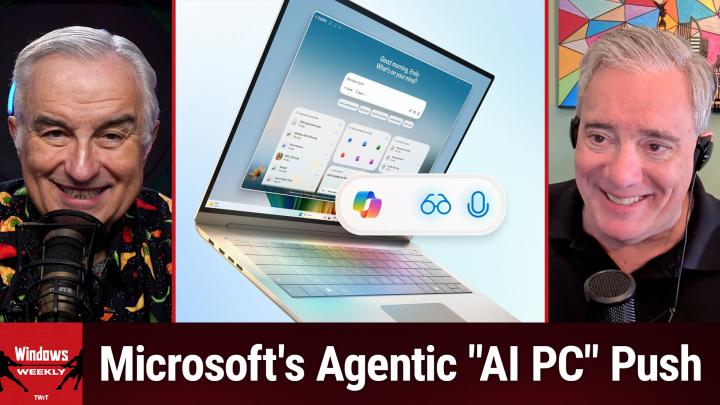
But they had kind of a big virtual event on Thursday. They, the Windows Copilot teams about new AI features coming to Windows 11, but also a broader initiative to turn. You're going to love these terms, guys, Windows into an agenic OS and. Or an AI native os.
Richard Campbell [00:07:22]:
All right, now you're just making stuff up.
Paul Thurrott [00:07:24]:
Yep, yep. And I'm so sorry that those words just came out of my mouth. But they also very explicitly are seeking to redefine the term AI PC, which is something that intel came up with, possibly in partnership with Microsoft actually, probably two years ago for the Meteor Lake generation of intel Core Ultra PCs. The first gen.
Richard Campbell [00:07:53]:
Right.
Paul Thurrott [00:07:53]:
Because they had.
Richard Campbell [00:07:54]:
They only made one of those ones. Yes.
Paul Thurrott [00:07:59]:
And then they did it again with Lunar Lake. But yes. And yeah, two one off designs. But I think they figured it out now. New one looks good. We'll see. But yeah. And then of course, Microsoft six months later came out with Copilot Plus PC.
Paul Thurrott [00:08:13]:
And those were for PCs that had a NPU capable of 40 or more, tops. Right. And as we've discussed and included arm, obviously. Yes. Right out of the gate, it was only arm, actually. And then eventually, you know, intel and ARM AMD with their subsequent chipsets. So it's fair to say stuff hasn't gone over great, you know.
Richard Campbell [00:08:35]:
Well, I would also remind me that Microsoft had to walk the intel guys out of build.
Paul Thurrott [00:08:41]:
Yes. Yeah. They were to crash. Was. Well, it was the event. The Copilot PC event.
Richard Campbell [00:08:47]:
The Copilot Plus PC event.
Paul Thurrott [00:08:48]:
Yeah, Literally, they escorted them off. The Microsoft Security escorted them off campus. They tried to crash it.
Richard Campbell [00:08:54]:
Wow, you can't be here.
Paul Thurrott [00:08:57]:
It's like, listen, we get that your entire shtick is beating up on the rest of the industry, but you're gonna have to take today off because that's not happening.
Richard Campbell [00:09:04]:
Now, I'm struggling with you painting Microsoft as the good guys here, but.
Paul Thurrott [00:09:08]:
Okay, I'm not sure I said that, but in this one case, yeah, it's like the. Yeah, I don't know how to. I'm not sure what the comparison is here. What. You know, one bad actor protected me from another bad actor. I guess for two seconds they're the good guy.
Richard Campbell [00:09:21]:
But I bring that all up because, you know, you're right. Intel had their AI PC concepts, which were obviously focused on their chips. And then Microsoft Copilot Plus PC was initially just armed, but it's now an inclusive everybody can play.
Paul Thurrott [00:09:35]:
It was always going to be for everybody. But in the beginning it was, they had that whatever, six months, maybe not even really. But yeah, until. Didn't like that and until, you know, you know, when you're a bully, it's hard. It's like riding a bike, you know, you don't, you know, it's. It's hard to stop doing the thing that always worked in the past, you know, whatever. But.
Richard Campbell [00:09:55]:
Yeah.
Paul Thurrott [00:09:55]:
So look, Microsoft is not criticizing Copilot plus PC. Microsoft is also not addressing the fact that no major use case for an on device MPU has ever emerged that would benefit some large population of people. There's obviously a million little features.
Leo Laporte [00:10:11]:
But.
Paul Thurrott [00:10:12]:
In discussing this new AI PC concept, this notion that Windows 11 or maybe some future Windows version will be infused with AI in and out, you know, Yusuf Mehdi, who's been around honestly longer than I have in some ways, but long time. Yeah. I mean I first met him in 98 at the Windows NT 5.0 reviewers workshop to put that one in perspective. But he had been there for several years by that point. Also doesn't appear to be aging, which is vaguely irritating. He's unfortunately multiple times, both in this presentation he gave and then in interviews and things has described this effort as Microsoft rewriting Windows from the ground up. You know, that should always cause a little bit of like, oh, I don't think that's what's happening.
Richard Campbell [00:11:00]:
Yeah, pretty sure that seems very unlikely.
Paul Thurrott [00:11:03]:
Yeah, I wish they would walk away from that kind of language. But anyway, but they are. Their point, so to speak, is Windows is transitioning into this new era and it's going to be an agentic os, meaning there'll be agents in Windows that you can control also, I'm sure in Microsoft 365 et cetera. But as a major platform maker, they're doing this thing. I mean, to me this makes sense, right?
Richard Campbell [00:11:34]:
I arguably they have more right to define the AI PC than just about anybody else on the planet.
Paul Thurrott [00:11:39]:
Yeah, exactly. And for the PC to keep moving forward as it has, by the way, even as the world has kind of moved to mobile and you know, we all spend more time on these devices.
Richard Campbell [00:11:48]:
And everyone knows Mac's taking a bigger share. But still.
Paul Thurrott [00:11:51]:
But you know, for Windows, you know, Bill Gates once described, you know, the incredible versatility of the PC, how it's been able to kind of come along with all these tech shifts and this is one, honestly, I feel like it could successfully do the cloud thing. Didn't make a Lot of sense with Windows. All you had were these minor entry points with like OneDrive and files on Demand and obviously the Office apps may be running up in the cloud or whatever, but as far as Windows itself, like the cloud stuff, like, I mean obviously they put Windows in the cloud to rate Microsoft or Windows 365 I guess. But as far as the day to day OneDrive, it was like eh, you know this though. Yeah, I mean this makes sense to me.
Richard Campbell [00:12:34]:
Right, because this is, this is as much a client as it is the backend service.
Paul Thurrott [00:12:38]:
Yeah, exactly. Well, I'll jump ahead a little bit here. Tied to this is this notion of what I think I've described as like programmable apps. I'm still looking for the right term here, but it's this notion if you accept that like Windows as a service is Microsoft's attempt by the way pretty successful now to turn Windows into an online service in the sense that that's how it gets serviced, which is continually. Most people would probably say it was a little too successful, kind of irritating. Apps are adapting to. Again, I'm searching for terms. I don't think the industry has come to the right terms for this stuff, but I'm going to say publish individual features so that they can be consumed by services which will include AI agents.
Paul Thurrott [00:13:26]:
Right, right. And the idea there is that it's, you know, it's like creating a flowchart of, you know, we're trying to get this task done. What are the features that we need that might be an app? Some of them will be in online services. And then we're going to orchestrate that all together into a single workflow that gets whatever that thing is done. Right. And I talked about how, you know, the right click menus in Windows are turning into these unbelievable like long lists of things with all these sub menus. You know, we're going to have, you know, we have open with, we have share with, we have AI actions are coming soon. If you don't already see that.
Paul Thurrott [00:13:59]:
We have individual apps like photos and OneDrive that have their own side menus, you know, or submenus. It's, you know, this is, this is happening. Right. And so this is. I wrote an editorial last week. I don't remember before, when is weekly or after, but saying that, you know, AI is the end of apps. And you know, to my literal audience that was a little bit problematic. But the, the point, if you think about what's the natural end game for a web browser, we're turning these things into agenic browsers that are going to do tasks on your behalf, just like their operating system here, so people don't read already.
Paul Thurrott [00:14:39]:
Browsing is going to effectively go away. Not literally everybody, but I mean, as the primary use case, do we even need the browser anymore? I mean, we're just going to be talking to something and it will do this on the back end. Right.
Richard Campbell [00:14:51]:
I found it easier to digest. You just look at like an ERP system. Like a guy working in Accounts Receivable uses a piece of software that's just a wrapper over a database.
Paul Thurrott [00:14:59]:
Yeah.
Richard Campbell [00:15:00]:
And if you had the database data properly marked up with the right security rules and so forth, why couldn't a prompt give every answer that that AR app could possibly give? Who owes us money? Who should I call first? What's their information like? Yeah, that can be promptified.
Paul Thurrott [00:15:15]:
It's one of the unique things about this AI stuff right now is that because these companies are racing to get the stuff out in the world without being regulated and without being stopped in any way. They're agreeing with each other. Right. They're agreeing on standards. Right. And you know, there's MCP stuff. Exactly right. And so these capabilities that we're seeing in apps and Windows now, and you'll see them in app, actually you do, of course.
Paul Thurrott [00:15:41]:
Like magic cue on the pixel. Is it orchestrating individual apps to do things for you proactively? Right. Same theory. The apps are becoming what I again, I call it. I'm lacking for language here, but these apps are becoming programmatic. I know I need a better term, but much like the Olay. Com whatever interfaces of the 1990s, they have public interfaces. And those public interfaces can be used by AI agents and other apps and services too.
Paul Thurrott [00:16:12]:
Of course, like Windows does that. That's where those menus come from.
Richard Campbell [00:16:15]:
Maybe it's interoperable.
Paul Thurrott [00:16:16]:
Yeah, Interface is a good word. Like, I like that one. I remember the little like flower, like the circle on the stick icon, you know, that would, you know, visually indicate the public and I guess private interfaces. But yeah, I keep looking. Every time. Anthropic, OpenAI, Microsoft, Google announces something. I always look, I'm like, oh, are they going to say something where it's like, this is it, you know, someone will come up with a better term. All right, so I've jumped ahead a little bit.
Paul Thurrott [00:16:42]:
So let me just talk briefly about what they announced, right. Which was a. The vision that Windows will be agentic. And they're saying, look, Ignite's coming in November. We are going to talk more about this the stuff they talked about last week was essentially and probably entirely consumer features, but it is coming to business. And that was the promise at the end. Like, look, we have a lot more to say about this stuff. And as that comes together, I think we'll learn a lot more and maybe some timing stuff, whatever.
Richard Campbell [00:17:08]:
But it'll be interesting to see how this fits against M365, because right now, when you think about AI for business, you think M365 copilot.
Paul Thurrott [00:17:15]:
Yeah.
Richard Campbell [00:17:15]:
So how does the OS play with that?
Paul Thurrott [00:17:18]:
Yep. I mean, I can only speculate, but if we go back in time to the beginning. Right. And so it's spring 2020. The beginning, I'm sorry, of this era. Right. The beginning, the bad times or whatever, whatever you want to think about, you know, the dark ages that we're living in. So in February, March 2023, Microsoft, over a period of time, said, we're going to do something called Microsoft 365 Copilot.
Paul Thurrott [00:17:44]:
And then I think it was at build that year, they said, we're going to put Copilot in Windows. And the plan then, remember, was 23H2. But they rushed it out early so everyone would be kind of forced to get it. Of course, there's some construction thing happening right now. That's crazy. Sorry if you could hear that and sorry if you couldn't, because I just paused for two seconds there. So that stuff happened in the conversation at that time was, well, these are the two places where it makes sense for Microsoft to add AI. Windows, as that orchestrator like Stevie Batiste described it will integrate these capabilities at an OS level.
Paul Thurrott [00:18:21]:
Makes sense. And you can see these programmable apps, again, for lack of a better term, as part of the steps to get to this thing. Right. That has to happen. You can't just screen scrape and move a fake mouse cursor around a web browser and click on things like, it has to be programmatic, for lack of a better term. So that made sense then. Now, what we've seen since then is Microsoft added copilot to those Microsoft 365 apps as a sidebar. They've integrated it further.
Paul Thurrott [00:18:51]:
You can right click and do things and select words and do things and all that kind of stuff. They're kind of in the apps. Right. We've seen what they've done in Windows. Some of it's successful, some not. Some tied to copilot plus PCs. Right. Which is a problem because that limits its availability to everybody.
Paul Thurrott [00:19:06]:
And so part of this is a recasting of what it means to be an AI PC, specifically because we can't just limit it to copilot plus PCs. We have to make these. For this to make any sense, it has to be available to everybody. Right? And that's. So that's what they're talking about. And that seems correct to me. But as far as, like, how does this integrate with. There's always going to be this confusing matrix of features, some of which are free with limits, some of which are just free, some are cloud, some are at local, some require subscription.
Paul Thurrott [00:19:41]:
If you're not the subscription holder, you can't. There's not even an option for you. You can pay for these new subscriptions, like Microsoft 365 Premium. On the business side, obviously, Microsoft 365 Copilot, if you're a business, you could roll this out to some users and not others and et cetera, et cetera. But if you're. The best case scenario for Microsoft, and I would say for a user as well, if you're in the Microsoft space, is you're running Microsoft 365 on top of Windows. And so will Word and Excel and PowerPoint expose their features through AI actions. Probably.
Paul Thurrott [00:20:17]:
Right? I mean, and so I say probably only because there's always like an asterisk because is this a paid feature? Do you have to have a 365 subscription? Does it show up if you don't? Do they just not do it because they only want to put that through the subscription and you do those in the app. I can't say right now they didn't talk about that. But that might be a good thing for Ignite. Right. If they're going in that direction. Okay, so a lot of this stuff is going to sound familiar because we've talked about it, but hey, Copilot as the wake word and then goodbye as.
Richard Campbell [00:20:50]:
Goodbye are more things you can't say on a podcast, right?
Paul Thurrott [00:20:54]:
Starting today, we should never. I should never say it again. Sorry. Yeah, well, most of you guys probably don't have this enabled anyway. Who cares? So if you do, you get what you deserve. It's fine. So, yeah, so Copilot will, you know, pop up. The Copilot supports all these different modes.
Paul Thurrott [00:21:09]:
It runs as an app. It has that quick access view. It takes over the Alt space keyboard if you want to do that. Windows Key plus C. Does that work? I don't know, actually. That one might be off again. I don't know. There's all these different ways you can do this stuff.
Paul Thurrott [00:21:21]:
Obviously it did it came up slow because it's Copilot. All right, so there's that Copilot vision, which we've been talking about for months, is how Copilot interacts with the outside world, most obviously through just sharing your screen or an app. But also when you have cameras and things, like I've been saying, I think that's more useful on a mobile device. But as far as you doing stuff right, and this is an interesting crossover point with the Office stuff or the Microsoft 365 copilot stuff, because you could be using Windows, you're not paying for anything, but now you're going to have Copilot Vision. You could share your screen that has an Office document in it and you could ask that thing, or you could do it through click to do whatever. Summarize this. Do whatever. You don't have to have Microsoft 365 copilot.
Paul Thurrott [00:22:06]:
Are there going to be DRM protections that will prevent that in the future? It's Microsoft, of course, but they've not said that.
Richard Campbell [00:22:13]:
But that means Vision's both looking through the camera at you or whatever you're pointing the camera at, as well as looking.
Paul Thurrott [00:22:18]:
Yeah. The way it works now is you see a pair of eyeglasses in the ui, click it, and then you determine what you're going to share with it at that time. So it's. It's kind of like a live thing, essentially, which is probably why Google calls the same feature Gemini Live, essentially. Although they do other things too, like you talk to it. But. Well, that's part of this, too. It's very confusing.
Paul Thurrott [00:22:37]:
Anyway, so that stuff is. All those two things are available now. And then they're going to replace the search box that's in the taskbar with a Copilot Actions or Copilot. I'm not sure what the name of it's going to be, but a Copilot box. It's a searchable to search +Copilot. Right from the taskbar. Copilot Actions, which most people don't see yet, will be made available for local files, not just stuff that's in the cloud. If you're working on documents and other files.
Paul Thurrott [00:23:08]:
I mentioned, I think it was last week. This is part of my confusion here. I think I talked about Manus, this AI chatbox with a chatbot, rather with an agent, and I was like, this thing looks a lot like Copilot. Like, why would they be promoting this the way they described it? I just said Copilot and it popped.
Richard Campbell [00:23:28]:
Up the way they now you're doing it.
Paul Thurrott [00:23:31]:
I'm doing it to myself. So I get what I deserve.
Richard Campbell [00:23:33]:
Microsoft, right?
Paul Thurrott [00:23:35]:
What's that? No. So that was my confusion at the time. Last week the wording suggested it was theirs, but when I found it in the store and looked it up online, it was a third party company. And when I went back, when they did this announcement, finally I looked at it again and I realized this is one of two apps they're promoting because they're already integrating with the, the AI Actions menu in File Explorer. Or they will soon, I should say. Actually, they're not there yet. And what that means is you'll be able to right click on a document or file or whatever, and one of the actions you'll be able to do, well, it could be a series of actions because actually this thing's pretty powerful, would be to push it through Manus and use their agent to go off and do something on that document or whatever. So that's coming Filmora, which is an AI based video editing app as well, which is paid, so I didn't look at it too hard.
Paul Thurrott [00:24:25]:
But also we'll integrate with that menu and then so will a thousand other things. That's going to be the problem. And then we're getting Zoom integration with Click to Do. And what that means is if you're using Click to Do, it has, you know, purple Pink selected all the text and graphics. If there is an email address in there or a phone number, you're going to be able to click on that. One of the actions will be created a Zoom meeting with that thing, that person or that, you know, phone number, whatever.
Richard Campbell [00:24:53]:
Sorry, you said Zoom meeting.
Paul Thurrott [00:24:55]:
Zoom. Yeah, Zoom is going to. Yeah.
Richard Campbell [00:24:58]:
Not integration, not a team meeting.
Paul Thurrott [00:25:01]:
Right. Well, that's probably already there. Actually, I think teams is already there for that, but they're doing it with Zoom as well. And you know, you know, the EU's like, oh, you're doing some good. Okay. You know, just keeping an eye on that one. The weird thing to be me about that, by the way, is the Manus and Filmora integrations are with File Explorer. So that right click menu, the Zoom integration is with Click to Do different teams.
Paul Thurrott [00:25:25]:
Yeah, I mean, that makes sense because, you know, Click to Do is looking at what's on your screen. But then again, you could share the screen with Copilot Vision. Is there a way in? I don't know. So there's gonna be a lot of crossover here. It's kind of interesting.
Richard Campbell [00:25:41]:
Yeah. You haven't even said recall yet.
Paul Thurrott [00:25:44]:
Yes, I will now, because a day or no, the same day that Microsoft had this big announcement, of course they published a blog post describing this stuff. But they published a separate blog post that went into great detail and then a third one on the, I think on the Microsoft Learn site that went into even more technical detail about how exactly they are going to secure agents in Windows. And I can tell you that they did this because of what they didn't do with recall, which wasn't secure it properly, but rather not document it correctly from the get go. They just were very laissez faire about it and everyone was like, hold on, what's going on here? And look, whatever anyone thinks of recall, this is a far bigger threat to anybody because of the nature of what agents are. No, I mean it. I mean, like, as far as, you know, the end game here, one of the end games is you say you set an agent up. That's something simple like, look, I'm going to buy this Sonos speaker, but I'm only going to buy it when it goes under whatever price. I don't care where it comes from, I just want it at that price or lower.
Paul Thurrott [00:26:48]:
As soon as that happens, take this credit card number, buy it, ship it to my house, right? And you're going to get up one day and you're going to get a notification that says, hey, that speaker's on the way. Congratulations, you just spent two or six or what, 800 bucks, whatever it is. And that's going to be a gut check moment for people, I think. And we're going to see you let.
Richard Campbell [00:27:06]:
The software buy you a product and.
Paul Thurrott [00:27:09]:
You know, look, no big. I mean, this is the way the news has always worked. But we're going to hear about the mistakes. Oh, sure.
Richard Campbell [00:27:17]:
Well, think about the early days of the Amazon product whose name, while I will not mention, did not cause harm to others, where that's exactly what happened. Kids learn to use it like people learn pretty quickly to turn that off.
Paul Thurrott [00:27:30]:
I woke up on a Sunday, I'm going to call it 20 years ago, ish. And just looked at my email and it was like, Apple charge of $50, Apple charge of $78. Apple charge of $80, Apple charge of $100.
Leo Laporte [00:27:43]:
Sounds like mine.
Paul Thurrott [00:27:44]:
Sounds like mine. And I was like, what the heck is this? My kids are playing some game on their ipod. Touches that have little fish in them, like a fish thing.
Leo Laporte [00:27:50]:
Oh, that's. They had no idea what they were doing.
Paul Thurrott [00:27:53]:
Yeah, yeah.
Leo Laporte [00:27:53]:
Apple had to change their credit rules.
Paul Thurrott [00:27:56]:
Yeah, they changed the rules, but that Day I ended up calling them. It was the only way I could get through to anybody or whatever. And they reverse all the charges. You know, they told me the kids could keep the fish that they already got. And I'm like, the kids are not keeping the fish. The kids. We're getting rid of that app. Thanks.
Paul Thurrott [00:28:12]:
You know, and then they changed the rules. Yeah, but.
Richard Campbell [00:28:15]:
But, you know, everybody learned in a big hurry.
Paul Thurrott [00:28:18]:
Yeah. The article I wrote at that time was called so easy, Even a child can do It. You know, it just works. But that stuff, this is. This will happen. And it won't be $50 worth of fake fish. It's going to be $1,000 stereo system. It's going to be.
Paul Thurrott [00:28:32]:
There could be just fraud. Right. I mean, this will happen. Not because AI is inherently flawed or blah, blah, whatever. Like, there'll be success stories, too, but the failures here are going to be pretty dramatic, some of them anyway. And, you know, so everyone who's doing this is trying to go into it very carefully, at least. And Microsoft, to their credit, is trying to document what they're doing. So.
Richard Campbell [00:28:55]:
Yeah, you really don't have any excuses. We've made these mistakes before. You don't need to make them again.
Paul Thurrott [00:29:01]:
Yep. Yeah. I mean, if anything, you could at least learn from history. I mean, doesn't always happen, but. No, we'll see. It's a brave new world. I'm just curious. You know, we keep talking about Windows 12 and this year and a half now maybe, I don't know.
Paul Thurrott [00:29:17]:
And yeah, it would have been early 2023. I had written something like, Windows 11 is about to have its big AI moment. And that moment, at that time was Copilot. And maybe that was going to be 12 and it wasn't. But, you know, you realize now looking, you know, with two years almost of. Well, no, over two years, sorry, of time between that and now, things have advanced pretty, Pretty dramatically, you know. Yeah. And when, you know, this agency stuff again, it's a mess right now, but, you know, it's just starting to happen.
Paul Thurrott [00:29:49]:
It's going to be interesting to see how people react to this.
Richard Campbell [00:29:52]:
Yeah. And whether, like I said, I think the patterns already exist. But the more interesting part is recognizing that for the most part, after those original instances, people have simply rejected this to the point where the company's largely given up on the product. The reason Amazon made that product was to get people to buy stuff through it. And it just didn't happen.
Paul Thurrott [00:30:11]:
Right.
Richard Campbell [00:30:12]:
And I always like, this is going to have. At the same place.
Paul Thurrott [00:30:16]:
Yeah. You put like a disc or dot or whatever they called it into onto like a laundry detergent thing in your spare room where the laundry equipment is. And when that thing is, you know, empty, you hit the button and just orders it for you. But again, there's a bit of trust going on there, right. Like, we live in a world now where they surge pricing is a thing. Right. And you could imagine that if you bought it that way, you know, they would get charged you five bucks extra or something. You wouldn't even notice it if, you know, most people wouldn't.
Paul Thurrott [00:30:44]:
Yeah, there's a lot of danger inherent to this stuff because this is going to be a direct connection. No, it's not. It's going to be an AI middleman that sits between your wallet and the services where you might want to spend money. And when that system works, you know, like Tap to Pay or anything else, like, it's nice, you know, when it doesn't work, you know, Tap to Pay has never bought a stereo by mistake, I can tell you that. At least not so far.
Richard Campbell [00:31:10]:
Well, they have limits on Tap to Pay, which. For a reason.
Leo Laporte [00:31:13]:
Yeah, some reason. As much as I use and love AI, I've never been tempted by these agentic browsers. And maybe that's one of the reasons is I want to give over control of my credit card.
Paul Thurrott [00:31:23]:
So I wonder sometimes about that kind of thing because I feel the same way. And I think part of it is I like to read and I want the browser to be this kind of minimalist thing that I go and look at the content I want to look at, and ideally in a distraction free environment or whatever, and it's turning into this other thing. Now I've also been the person who complained a year ago or whatever that browsers have not changed ever really in 20 years, and we use them more than any other app. And how is it possible that this thing has sat here basically untouched for so long and now they're touching it and I'm like, what are you touching my thing? What are you doing?
Leo Laporte [00:32:03]:
Well, you know, like, you kind of.
Richard Campbell [00:32:05]:
Loved ARC for a while there. I love arc, yeah.
Leo Laporte [00:32:08]:
Yeah. And I, you know, I still use an ARC clone.
Paul Thurrott [00:32:11]:
I like things that work, you know, like I.
Richard Campbell [00:32:14]:
Now you're just getting crazy.
Leo Laporte [00:32:15]:
Here's my question, is, did anybody ask for this or is it seems to me this is big tech's agenda because it's great for them, it's great for Amazon.
Paul Thurrott [00:32:27]:
It is. But in an ideal world, and it's.
Leo Laporte [00:32:29]:
A revenue model for all the AI companies for OpenAI is desperate for revenue.
Paul Thurrott [00:32:34]:
Amazon sells books and that's a revenue model too. But you want the books. And so ideally this would benefit both sides, right? That there would be. And I think we will benefit from it very early on especially the issue is going to be this insertification stuff because inevitably, as these guys all find their positions in the world and now we're using these products. Whatever. Maybe there's been a big shift. Maybe Google search does go away, whatever happens.
Richard Campbell [00:32:58]:
But first they have to compete. You know, the insurance comes later, that's why.
Paul Thurrott [00:33:02]:
Right. And so in the beginning, it's going to be great.
Richard Campbell [00:33:05]:
You know, this seems disturbing, like a positive message from Paul and we're going to get hooked.
Paul Thurrott [00:33:10]:
We're screwed. Yeah, we'll see what happens. I mean, you know, you're really going to get it. Yeah. If it follows the historic path, you know, we'll see. I mean, one of the, you know, Google got off mostly scot free from the search thing, even though they're arguing every little point, but the big thing that they're arguing for there. And I think I'll. I don't know if this ties into ads or not, but definitely in search is don't tie AI to this.
Paul Thurrott [00:33:32]:
Like we get it, you think this thing's dominant, you're doing what you're doing. Whatever. We disagree. But just so we're clear, Gemini, something else. And of course they would want that. Right. You don't want the lock on this thing to go forward in the next generation. It would hobble them against Apple, Microsoft, OpenAI, whomever, anthropic, whatever.
Paul Thurrott [00:33:52]:
Yeah. So they're doing their thing. They're all.
Leo Laporte [00:33:54]:
It's already though, a tussle for control. Like do you control it or do they control it? Like, who's in charge here?
Richard Campbell [00:34:01]:
What are the chances that they're going to let the user have any control?
Paul Thurrott [00:34:05]:
Oh, there'll be tons of language about how you're always in control. No.
Richard Campbell [00:34:11]:
The truth will be in the eula, the thing you never read, Right.
Paul Thurrott [00:34:14]:
Yep. Oh, even something. Here's something really simple. Let me bring this up and find this. So because of all this stuff going on with Copilot, I had put this and other PCs in the dev channel. By the way, just finding settings in this app is a near impossibility. You have to open a side pane and then click on your face just in case you couldn't find it.
Leo Laporte [00:34:33]:
Sure.
Paul Thurrott [00:34:34]:
And then the text was setting. When in doubt, it's like one point you, you can't Even read it. But let me see if I can find this. I can't see it in here, but somewhere it says, literally, this is like a slider, checkbox, whatever. And it says something like, if you check this, we're not going to use your data for training our AA models anymore.
Leo Laporte [00:34:52]:
But hide that box.
Paul Thurrott [00:34:53]:
It's actually by default your chats are being used to.
Richard Campbell [00:34:58]:
It's like, guys, negative option building.
Paul Thurrott [00:35:01]:
Yeah, I know.
Leo Laporte [00:35:04]:
All right, let's. On that note, let's take a tiny little pause and we will continue.
Paul Thurrott [00:35:09]:
Before we go, can I just say, industry is so great and everything they do is fantastic and it's all for us and we should just be thankful.
Leo Laporte [00:35:17]:
Thank you for finally telling the truth, Paul.
Paul Thurrott [00:35:20]:
I know it took a while, but it's hard. It's scary. I feel better now, though.
Leo Laporte [00:35:23]:
Our AI overloads. Appreciate it.
Paul Thurrott [00:35:26]:
Yes. I'm not going to get struck by the AI lightning anymore.
Leo Laporte [00:35:29]:
The robots are coming. All right, I see. I see that the people have come for Mr. Richard Campbell. So now I'm going to pause and do a little commercial and we will be back. Windows Weekly continues. We got lots more to talk about. There's an Xbox segment.
Leo Laporte [00:35:46]:
There's a AI segment. Didn't we just do the AI segment? There's tips, there's pics, and there's brown liquor. All of that still to come.
Paul Thurrott [00:35:54]:
And you're gonna need the brown liquor by the time.
Leo Laporte [00:35:56]:
You're gonna need it by the end of the show. Actually, I want to welcome a brand new sponsor to the show. I had a great conversation with them just a couple of weeks ago, Vention, and it fits right in, really, to what we're talking about. AI, obviously is everywhere. And when you're in business, you know, constant bombardment of AI, AI, AI. What are you going to do? What are you going to use it? How are you going to use it? We use us. When used right, AI definitely delivers results. But the chances are you're already thinking about how to bring it into your business.
Leo Laporte [00:36:28]:
You know, how to do it without wasting time, money, or momentum, without giving up control.
Paul Thurrott [00:36:35]:
Right.
Leo Laporte [00:36:35]:
Well, Vention has an answer. They've been doing this for a long time. Backed by two decades of software delivery experience, Vention has now AI workshops. You're going to want to do this. That offer practical, expert led sessions that give your team the insights and structure they need to make smart decisions. Somebody is on your side, Vention. You bring your product vision, you bring your current stack, they bring their deep expertise in AI in engineering, and yes, in your business domain too, because they've been doing this for a long time together. You will turn high level ideas into, you know, the stuff that you, the dreams you have right now into a tailored, workable roadmap you can trust because you did it in partnership with somebody you trust.
Leo Laporte [00:37:27]:
Vention. Whether you're a cto, a tech lead, a product owner, don't do this on your own. You don't have to spend weeks figuring out tools, architectures or models. Vention is the fast track to this. It helps assess your AI readiness, helps you clarify your goals. Your goals, that's what's important. Not somebody else's, not big tech's goals. And then outline the steps to get you to where you want to be without the headaches.
Leo Laporte [00:37:57]:
And you know that's the workshop. But if you need help on the engineering front, they are great at that too. Their teams are ready to jump in. As your development or consulting partner, this is really the most reliable step to take after your poc. Let's say you've built a promising prototype, unlovable as one does, right? You probably did it last weekend. Runs well in tests, but now what do you open a dozen AI specific roles just to keep moving. Do you bring in a partner who has done this across industries? Oh, maybe. Yeah, that's an interesting idea.
Leo Laporte [00:38:32]:
Someone who has who can expand your idea into a full scale product. Take that proof of concept and make it something real without disrupting your systems or slowing your team. Bringing your vision to life. Even with modern platforms, prototyping can be very draining and challenging. Once you get something working, chances are you'll want to shift gears from problem solving mode to the big picture view. That's exactly why product leaders for 20 years have turned to Vention. Not just for ventions AI workshops, but for the peace of mind that comes from knowing you're not building blind. I'm so impressed with these guys, I spent a bunch of time talking to them.
Leo Laporte [00:39:12]:
So if you value speed, clarity and impact and want to avoid second guessing your next AI move, learn more at ventionteams.com or book your workshop at ventionteams.com twit you'll leave with a plan that works, a partner you can count on, and a lot fewer gray hairs. That's very ventionteams.com TWiT ventionteams.com twit all right, we've given Paul a little time to cool down.
Richard Campbell [00:39:43]:
Convince security guys that I'll be out of here on 11 on time.
Leo Laporte [00:39:46]:
Oh, good. That's all did they come in and say, Mr. Campbell, what are you doing in here?
Richard Campbell [00:39:51]:
They knew I was in here. She was just. She was just like, you're done by 11, right? Yes, I'll be.
Leo Laporte [00:39:57]:
What time is it now?
Paul Thurrott [00:39:58]:
10:50.
Richard Campbell [00:40:01]:
What is it? It's almost 9, so.
Leo Laporte [00:40:03]:
Oh, yeah, you'll be done by 11.
Richard Campbell [00:40:04]:
It's the three hours. You. You'll be in Intelligent Machines by the time I need to get out by then.
Paul Thurrott [00:40:09]:
Yeah.
Leo Laporte [00:40:09]:
You know, actually, you might be interested, we're talking to some people from HP's Hewlett Packers AI. They have a new DGX little mini box based on the Blackwell, just like.
Richard Campbell [00:40:22]:
Nvidia has been making.
Leo Laporte [00:40:23]:
Yep, yep. It's got Nvidia in it. And we will. We will talk to them about local AI for business and home.
Richard Campbell [00:40:29]:
See if you can get a little bag of them there. Leo, I wouldn't mind a couple with one. Yeah, I could put one to work.
Leo Laporte [00:40:34]:
We had Harper Reed on. On Sunday on Twit, and he holds up his little Blackwell box, his little DGX Spark, and I went, what?
Richard Campbell [00:40:43]:
Said, yeah, you get one of those?
Leo Laporte [00:40:44]:
They sent me one.
Richard Campbell [00:40:45]:
That's nice.
Leo Laporte [00:40:46]:
They sent me one. Just sent it to me. Because he's an AI. He's got an AI startup. That's why.
Richard Campbell [00:40:49]:
There you go.
Paul Thurrott [00:40:50]:
That's nice.
Leo Laporte [00:40:51]:
They're hoping he'll buy 10,000 of them.
Richard Campbell [00:40:53]:
Well, and, you know, part of the conversation in a place like Norway has definitely been, hey, we don't want this stuff in the cloud. We want it to be as local as possible.
Leo Laporte [00:41:03]:
This is a hot topic right now.
Paul Thurrott [00:41:05]:
Totally.
Richard Campbell [00:41:05]:
And when you go around making NUCs, like mini PCs.
Leo Laporte [00:41:09]:
Yeah. You should see this thing that can.
Richard Campbell [00:41:10]:
Run GPT3 plus in it. What are we talking about? Like, there's a lot of companies that would drop a decent figure to have these hosted models here.
Leo Laporte [00:41:19]:
Yeah, I mean, that's what I've got with this Framework desktop. And I can run GPT OSS120.
Paul Thurrott [00:41:24]:
Yeah.
Leo Laporte [00:41:26]:
Pretty cool. Pretty neat. This is. It's the ZGX, not the DGX, they call it, because DGX was taken, I guess.
Richard Campbell [00:41:35]:
But I think there's also the counter on. We're also finding out these really large models are only good in certain circumstances and they need a lot of governance. Like, there's a case for making smaller, more precise models for particular workloads, and those will fit nicely in this small hardware.
Leo Laporte [00:41:48]:
Yeah. Look at this thing. It's so cute.
Richard Campbell [00:41:51]:
It's cute.
Leo Laporte [00:41:51]:
It's so cute.
Richard Campbell [00:41:53]:
It's cute.
Paul Thurrott [00:41:54]:
Yeah.
Richard Campbell [00:41:54]:
By all means, we go. I'll take one there. Leo, when you're chatting.
Leo Laporte [00:41:57]:
I'll ask them. I'll ask him.
Richard Campbell [00:41:59]:
We're keen.
Leo Laporte [00:42:00]:
Yeah. Comes with a Blackwell. You know, it's weird, I don't. I think it runs. It doesn't run Windows, it runs an Nvidia os. Right.
Richard Campbell [00:42:08]:
It probably should. Yeah. Just a Linux derivative. It just needs to be as light as possible.
Leo Laporte [00:42:13]:
Yeah, get. Get out of the way.
Richard Campbell [00:42:15]:
Yeah, because.
Leo Laporte [00:42:15]:
Yeah, I'll ask them. Will be talking to the product manager for this device and guy who's kind of in charge of AI at HP.
Richard Campbell [00:42:24]:
I've been doing a bunch of stuff against my 5080 through WSDL for exactly the same reason.
Leo Laporte [00:42:28]:
It's really interesting.
Richard Campbell [00:42:29]:
It's efficient.
Leo Laporte [00:42:31]:
In fact, I still think Claude code is better even though it goes to the cloud. But I've been using open code with LM Studio and that GPT OSS120 edit. It's pretty cool. Local coding, local vibe coding.
Richard Campbell [00:42:46]:
Yeah. Anyway, these back end service devices, you don't really care what the OS is. It's an API, right. You know, data in, data out. Thanks for playing.
Leo Laporte [00:42:54]:
Right. I'm actually running Cashy OS on the framework. Runs beautifully. It's very fast and yeah, it gets.
Paul Thurrott [00:43:00]:
Out of the way.
Leo Laporte [00:43:01]:
Cache is nice because it's a Linux that's optimized for modern hardware. The kernel is optimized. Everything's optimized for speed and so you really do get a snappier performance. Anyway, I'm sorry, I'll. I'm gonna step back now, let you guys continue on.
Richard Campbell [00:43:17]:
Let's talk about a bad patch week, my friend, because, boy, oh boy. We took a kicking.
Leo Laporte [00:43:22]:
Oh, geez. Oh, geez. I saw this, man. Oh, geez.
Paul Thurrott [00:43:27]:
I don't even know what you're talking about. Everything's fine.
Richard Campbell [00:43:30]:
When Minnesotan Leo comes out, you know, it's bad.
Leo Laporte [00:43:33]:
Oh, geez. This is bad.
Paul Thurrott [00:43:35]:
Oh.
Leo Laporte [00:43:36]:
Killed my mouse. Oh, man.
Paul Thurrott [00:43:38]:
Well, I mean, okay, so to be fair, what they killed was USB keyboard and mice in the Windows recovery environment. It didn't impact the timing.
Leo Laporte [00:43:50]:
Yeah, you wouldn't even notice it until you loaded the recovery environment. But then, you know, that's kind of like the last time. You want to notice that what you're.
Richard Campbell [00:43:57]:
Telling me is that I've been hanging onto this PS2 keyboard for a reason?
Paul Thurrott [00:44:00]:
Yes.
Leo Laporte [00:44:01]:
Oh, yeah. It would work, wouldn't it?
Paul Thurrott [00:44:03]:
Well, if you have a port. I mean, I.
Richard Campbell [00:44:05]:
Nobody has that port anymore.
Paul Thurrott [00:44:06]:
That's the thing. I have a PC here that will not install any insider build. So it's on some insider program thing. And when the new build comes out, it goes to 10%, then it fails. You look up the error and it says, the problem is the Windows recovery environment. The recovery partition is too small. And so literally, the advice from Microsoft is to. There's a command line you can do to get into the recovery environment, even though it doesn't have a.
Paul Thurrott [00:44:36]:
Sorry. The recovery partition, even though it doesn't have a drive letter. And then you delete some fonts, and then it works fine. And so, like a typical Windows idiot, I did that for four to five builds. And then I was like, okay, here's an idea, Paul. Maybe I should fix this. And there are command lines that involved. Well, it's a combination of command lines with disk part and use the disk management Legacy interface, Windows Q.
Paul Thurrott [00:45:05]:
And you can do this. You can do this. And it's actually pretty good information. When we get to the back of the book, I'll talk about this a little bit more because I had to do this for another reason later. But you basically make the thing. It was 768 megabytes or something. I made it like a gigabyte. And that seems to solve the problem.
Paul Thurrott [00:45:24]:
So there you go. So you. Essentially, what you're doing is you delete the partition, you make the change to the disk, you do whatever you're doing, and then you go back and then you just. There's a command that brings it back and it reloads it off of this Windows recovery environment. And. Yeah, not being able to access. If this isn't a laptop where it has an integrated keyboard, it'd be kind of hard to use this thing without a keyboard and mouse.
Richard Campbell [00:45:48]:
If you had a wireless keyboard, you still have a USB dongle, so it's effectively a USB keyboard. Anyway.
Paul Thurrott [00:45:52]:
Yeah, I don't know if. I mean, maybe a Bluetooth something would work from. I doubt it, though, Marisol, I don't know how you would. Maybe there's a command line you could run.
Richard Campbell [00:46:00]:
Tell me what isn't USB. Like, I pulled out the PS2 out of nowhere, but nobody's got that port anymore.
Paul Thurrott [00:46:06]:
I'm surprised I didn't run into this, because I've been in the Windows recovery environment approximately 21 times in the past week and.
Richard Campbell [00:46:12]:
Yeah, but all on laptops.
Paul Thurrott [00:46:14]:
That's okay. Actually, that's true. That's.
Richard Campbell [00:46:16]:
Yeah. Who has a desktop anymore? Oh, wait, it's me.
Paul Thurrott [00:46:19]:
Yeah, well, I have one. I told you about the desktop monitor. That doesn't work that was for that little Lenovo desktop, which is a Qualcomm computer, which would have to use a USB keyboard and mouse. But I don't. I don't have a display that works. So that's been going great. Anyway, yeah. So the Patch Tuesday update from this month, October, broke this for people.
Paul Thurrott [00:46:43]:
So you're only going to notice this if you actually have to access the Windows recovery environment. You can technically there are different versions of that. You can boot from install media in this Windows Recovery environment on that disk as well. But does that. If you made it with an earlier version of the OS, I suppose that would still work. I'm not actually 100% sure, but I've not experienced it. Anyway, there's an emergency fix. You can download the cumulative update and if you didn't get the Patch Tuesday update from last week, you could just install this.
Paul Thurrott [00:47:14]:
And this brings all that stuff in as well. So it will be part of the update stream over this called going forward. So as November, December etc comes along, all the stuff will be there. We'll come up with a new problem next month, don't worry about it. So there's that. And then what else we got here? We have a set of insider builds last week, beta and dev, which is 24 and 25 H2 got. Actually one update I think is pretty cool if you've ever used the mobile devices Interface in Windows 11. But if you go in Settings, Bluetooth and Devices and then mobile devices, this thing was broken for a really long time.
Paul Thurrott [00:48:01]:
It would let you add Android devices but not take them away, like remove them.
Richard Campbell [00:48:06]:
Oh, wow.
Paul Thurrott [00:48:07]:
Yeah. And you couldn't do it from the Microsoft account website either, which is where you're also supposed to do that. But they fixed it. And on this computer I'm running here, it's the interface we've always had. You click the button, a window comes up, it lists all your phones and then whatever capabilities each might have. So for example, I'm using an Android phone as a webcam. I can have one of my Android phones because I have several configured for that purpose. Right.
Paul Thurrott [00:48:31]:
So whichever one it is, I'm using for that, but they're going to put it inline in Settings. And so I don't have it yet on this computer. But if you imagine the Settings interface, the Settings app, instead of it posting like, or pulling up a new window, it's just going to be inline. It will expand inline like everything else does in that app actually. So that will be consistent drag tray improvements. Never seen a drag tray by the way.
Richard Campbell [00:48:56]:
What's the drag tray?
Paul Thurrott [00:48:58]:
So it's like the Snap layout thing. And the way that works is you drag a file toward the top of the screen and a little bar will come down, like with Snap. But it will give you options for sharing. Now, I say that like I know what I'm talking about. I've never seen it, so it's out there somewhere. I'm sure some of you might have it. I don't know. I don't have it on any of my computers.
Paul Thurrott [00:49:17]:
But apparently it's been out for a little while because now they're improving it, but I don't have it. So I don't know. I don't know what to tell you.
Richard Campbell [00:49:24]:
This machine grabbed 25H2 the other day.
Paul Thurrott [00:49:27]:
So I'm 20, so I actually got it. Yeah. So that's starting to happen. That's good. Yeah. And you must have noticed all kinds of different, you know, new things. Different. Sorry, I can't even maintain this.
Paul Thurrott [00:49:39]:
Yeah. Completely transformed. Yeah. Today, Microsoft released a release preview build. So this is. It should be 25 and 24H2, depending on which build you're on in the release preview. So it doesn't matter because they're going to be the same thing. So this is where they're delivering that new start menu, which I do have on this computer.
Paul Thurrott [00:50:00]:
I have this on different computers. I don't quite get it. New battery icons, so you can do. Those colors now are green and orange, depending on the status of the battery. Copilot integration in the taskbar, which is that search replacement thing I was just talking about. And I said that word. And copilot launched.
Richard Campbell [00:50:19]:
There you go.
Paul Thurrott [00:50:20]:
I know.
Richard Campbell [00:50:21]:
Now this is. This. Seriously, this is your life. Yeah.
Paul Thurrott [00:50:24]:
And then serializes. Yeah. No, my life is a living hell where, like, the only person I want to talk to, my wife can't hear me. But these things hear me all the time. And I'm not even talking to them.
Leo Laporte [00:50:35]:
Sometimes they hear me in another room.
Paul Thurrott [00:50:37]:
Yeah.
Leo Laporte [00:50:37]:
I hear a dim voice saying, yeah.
Richard Campbell [00:50:39]:
What?
Leo Laporte [00:50:40]:
What?
Paul Thurrott [00:50:42]:
Yeah, my hearing's terrible, too. Whatever. So a bunch of stuff. Most of it's not super important or dramatic, but the copilot vision thing, the copilot bit in the taskbar, I think is a big deal. Start menu is a big deal. And so based on the timing, if you look at the calendar, next week is week D. And that tells me we're going to see a preview update with this exact stuff in it for Windows 11, 24 and 25H2, and then two weeks later, I guess. And whatever.
Paul Thurrott [00:51:09]:
The second Tuesday of November will be patched Tuesday and then it will go out to stable sort of. Because these things never go out like that. But eventually, like I said. Drag bar. Yeah. I've never seen it, not even once, so I don't know. I've seen pictures of it, but I've never seen it. Also today, Microsoft announced a version of the Paint app for Windows 11 that's going out to Dev Beta and Canary, but not Release Preview.
Paul Thurrott [00:51:34]:
Curiously, that adds the Restyle capability that's already available in Pan. Sorry, in Photos. And that's where you have some kind of an image and you click Restyle. It's just a bunch of, you know, like impressionist, you know, futurist. Like whatever the different styles are.
Richard Campbell [00:51:53]:
All those Instagram filters from a million years ago.
Paul Thurrott [00:51:56]:
Yeah, I mean they're. Yeah, they're pretty dramatic actually, but. Yeah. Well, we'll see. That seems. That seems okay then. Just a couple of app things outside of Microsoft, you win one, you lose one or you get one. Actually, we didn't get anything.
Paul Thurrott [00:52:12]:
So OpenAI yesterday, it's all bad for Windows. It's all terrible. I got Nothing but bad. OpenAI launched their browser, which we've known has been coming for a long time. It's called Atlas or ChatGPT. Atlas. It's only on the Mac right now because screw you, Microsoft. Even though you were once our biggest partner.
Richard Campbell [00:52:33]:
Yeah, I mean, how many customers do you want, right? I guess they are in the Valley. So it's all maxed out.
Paul Thurrott [00:52:38]:
I get it. Like, yeah, those guys probably all use Macs. I understand. But it's Chromium. This is a Chromium browser. This could just work on Linux. Really? No.
Leo Laporte [00:52:47]:
Skus.
Paul Thurrott [00:52:47]:
Yeah. What are you doing? Like, what's the difference?
Richard Campbell [00:52:49]:
Well, it's an AI. You think they have any software developers.
Leo Laporte [00:52:52]:
They could be able to do this?
Paul Thurrott [00:52:53]:
That's the thing. Right? So like the browser company that makes DIA and ARC is small company based in Brooklyn. It's not too many people. They're Mac guys. They have Macs, they develop in Swift. Obviously the Mac version's coming out first. They eventually did get it. Well, got ARC out of Windows to this day, by the way.
Paul Thurrott [00:53:10]:
So we still don't have dia. Okay. I can give them a pass, I guess. I don't like it, but I was like, okay, fine. OpenAI though. It's a checkbox in the visual studio. What are you doing? I don't even understand. Understand not having all of the.
Richard Campbell [00:53:24]:
I'm pretty sure. They could have asked Copilot for that.
Paul Thurrott [00:53:27]:
Exactly right. We vibe code the browser.
Leo Laporte [00:53:29]:
Yeah, I know, it's crazy.
Richard Campbell [00:53:31]:
How could they not?
Paul Thurrott [00:53:33]:
I don't know. It doesn't make sense. I. I literally, I'm like, I just don't. I don't understand it. I don't know.
Richard Campbell [00:53:39]:
I suspect they told the LLM to make the Windows version and it failed and then they just shipped the Mac version while they try to figure out what went wrong.
Paul Thurrott [00:53:46]:
If you're, I don't know, in the right frame of mind, maybe you've drank too much or maybe you don't drink at all and you need something that has that effect. I strongly recommend watching the announcement video for this browser. It's hilarious. It's Sam Altman, who's not quite a human being, and then what appears to be three children sitting on a couch. And his attempts at being conversational, ironically, are really not very good.
Richard Campbell [00:54:13]:
He spoke. He's supposed to be the host in this scenario.
Paul Thurrott [00:54:16]:
That's not a good thing. Yeah, yeah, yeah. He looks. This Guy can't be 40, right? He's got to be younger than 40, I'm guessing. Or maybe he's around 40. He looks like he's 40 years older than the other people on the couch, which doesn't make any sense, right? Mathematically. But yeah. Anyway, they step through.
Paul Thurrott [00:54:34]:
It's. Look, if you're familiar with DIA or Comet or Neon, we're in the same ballpark here, right? So it's a minimalist kind of chrome looking thing that, you know, that's the new tab pages, of course, the ChatGPT prompt box and there's some little integration bits. And then the agenic stuff is coming a little bit later, I believe and will be made available first to those who pay for ChatGPT. Right. Eventually they'll have limits for everybody and it will just work. But anyway, they plan. They said we will Windows and mobile soon. But Talk is cheap.
Paul Thurrott [00:55:15]:
I hope no one was using this. I hope no one ever uses this. But Meta is about to pull the plug on its messenger app for Windows and also for the macOS, which we don't really care about, but this is probably something you can get in the Microsoft store today. But I guess they're going to get rid of it in about 60 days. They'll deprecate it and then. 60 days. Well, I guess after 60 days they'll. They'll just block this thing.
Paul Thurrott [00:55:40]:
It will be gone.
Richard Campbell [00:55:41]:
So use a web client.
Paul Thurrott [00:55:43]:
Yep. Yeah, that's the. Yeah. Yep, yeah. Messenger.com is they probably paid more than that than they paid for Instagram is the URL for that. If you are a Facebook messenger guy. I guess, I don't know. Facebook messenger is like the 17th place someone could contact me directly.
Paul Thurrott [00:56:05]:
It's not my preferred one, but everyone's on Facebook, I guess.
Richard Campbell [00:56:10]:
Or was not everyone. Lots of people have left it. The Venn diagram doesn't overlap completely on anywhere. If it's some signal, some WhatsApp, some messenger.
Paul Thurrott [00:56:20]:
So I don't have to use. Not to get up on a tangent on that little thought, but I respect it. But also, screw you guys because I'm left behind over here like I'm holding a bag. There's no, you know, no one's here anymore. Or some people are. It's my stupid uncle and his son and like three other people. And it's like, could we just all be on the same thing? You know? Like, could that be a thing?
Richard Campbell [00:56:43]:
No.
Paul Thurrott [00:56:43]:
No, we can't. Yeah. God, I can't do that.
Richard Campbell [00:56:47]:
Oh, well, okay.
Paul Thurrott [00:56:50]:
All right.
Richard Campbell [00:56:53]:
Where'd the Minnesotan go?
Paul Thurrott [00:56:55]:
I don't know. I will move along. So, yeah, I don't remember when I did this. I want to say six, nine months ago, maybe longer. I went to the sec. I had to sign up for this. I had a, like, they had to vet me and determine it was okay for me to get this. And now I get notifications every time Microsoft has a filing with the sec.
Richard Campbell [00:57:17]:
Right.
Paul Thurrott [00:57:18]:
And most of them are kind of like, eh, like, you know, like Bob Smith is selling some number of shares. It's over some limits. We have to report that. It's, you know, whatever.
Richard Campbell [00:57:27]:
Yep.
Paul Thurrott [00:57:27]:
It's not really. Most of it's kind of like whatever. But yesterday, I'm not sure why yesterday, but their annual report was published through the SEC. So I got an alert.
Richard Campbell [00:57:40]:
As of June 30th. The last fiscal year.
Paul Thurrott [00:57:42]:
Yeah, literally for the last fiscal year that ended. What is that now? Three, three months ago, July 4th, four months ago. Whatever. Yeah, yeah. So, okay. And it's like 88 pages long. I started reading through it and I was like, all right, I'm going to put this thing aside. I want to spend some time going through it.
Paul Thurrott [00:57:59]:
And then I saw that Todd Bishop wrote a story about how much Satya Nadella made last year. And I was like, okay, so this is the type of thing probably most people are interested in. But I'm like, I'm going to comb through this thing and I'm going to look for how Microsoft talks about consumers as A customer base that Microsoft has, business customers or commercial customers which span businesses of all size, governments, et cetera, et cetera. And then they have consumers. I have to say there's some clarity here that I really enjoy. They still don't divulge numbers where they don't do it elsewhere. And if you think about Microsoft's consumer products, this will be a brief conversation. Obviously Windows, right? Because Windows PCs are bought by people.
Paul Thurrott [00:58:47]:
Microsoft 365 has consumer versions, right?
Richard Campbell [00:58:51]:
Family Edition, that kind of thing.
Paul Thurrott [00:58:52]:
Family Personal Now Premium, and then whatever the low end one is that used to be OneDrive, paid storage, whatever that's called, Core or something.
Richard Campbell [00:59:00]:
Sad.
Paul Thurrott [00:59:01]:
Yeah, the Sad1. Yeah. Microsoft 365. Sad, sad. You pay us and we give you nothing. Thank you, thank you, thank you. They have another. And then also Xbox Gaming.
Paul Thurrott [00:59:12]:
So these things are all unique in their own ways. Xbox Gaming is what I. This may not be the right term, but I think of it as Microsoft's only kind of pure play consumer offering, right? It's literally only for consumers. You're not going to be managing intune while you're playing Call of Duty, you know, off the console or whatever.
Richard Campbell [00:59:30]:
I can't put Xbox in my conference, right? It upsets people.
Paul Thurrott [00:59:34]:
Microsoft 365 and Windows are both interesting. And Microsoft addresses this in this. I was fascinated by this because if you think about how would a company measure the success of something it sells, right? The two primary ways are obviously revenues, literally the dollars that are coming in, what the shareholder cares about, and then the size of the audience, right? The number of customers, the number of active users, perhaps like monthly active users. There's only one Microsoft product I can think of and oddly, well, it's consumer and commercial actually. But where Microsoft routinely to this day gives us both of those numbers. If you look at Microsoft 365 consumer, they tell you every quarter how many there are. I don't remember the last number. 100 million ish.
Paul Thurrott [01:00:24]:
Somewhere on there, paying users. They pay the subscription, they get the service, right? There are supposedly a billion ish Office users overall. I don't remember the number on commercial, but let's say it's three or four times that size, because I think it is. So about half of the user base right now is paying Microsoft on an ongoing basis for these products, which by the way, super lucrative, right? Way more lucrative than I got Office with a computer eight years ago and I'm still using it. You know, that's what they want. They want that. So that business is unique, you know, Windows is unique, but the thing that came up in the context of both of those businesses is they said that the complexity of their own business is such that it makes it very hard to audit any of these things to find out where the money's coming from. Which is the thing I've been complaining about for years and years.
Paul Thurrott [01:01:13]:
Right. So Microsoft 365 encompasses Windows and those apps and all the other stuff in Office or what I still think of as an office. Most of that is in that business and productivity services company, whatever the name of that is. But some of it's in more personal computing because the consumer stuff includes things like consumer copilot, Windows. Obviously from a business perspective, you have these, I'm going to call them business units or groups or whatever inside of the company. So you might have a group that's working on, I'll just say Windows commercial to make it super complicated. So is that part of the Windows group? Is that part of Microsoft 365, like the budget we give them for marketing and R and D and whatever else do we. How do we proportion that between those two business units, the money that comes in, how do we allocate those revenues to either business unit? Right.
Paul Thurrott [01:02:08]:
I mean it's very, it's actually very complicated. They wrote a whole thing. They basically said. They didn't say it this way, but they said auditing our businesses next to them possible. Wow. It was like. Yeah, I know, exactly. There's probably like three people in the C suite who have all the numbers they need to make sense of this.
Paul Thurrott [01:02:24]:
My God, it must be like a, you know, multi.
Richard Campbell [01:02:27]:
Yeah. And I don't know how much they want to share it. Like some of that's fairly self serving too. It's like I really don't want to show these numbers, but it helps it. That's really hard to show them in the first place.
Paul Thurrott [01:02:34]:
Yes. And this doesn't come up in the annual report, but I know from many, many years of writing about their earnings reports, I recorded that they've been purposefully falling off to the side with details. You know, hard numbers are very hard to come by. And that's. Yeah. How much, how much is Microsoft losing? Let's assume it's losing on Copilot right now. You know, how could you ever tell? Copilot is spread over the entire company. You know, there's no way to know.
Paul Thurrott [01:03:01]:
And that's absolutely. Well, at least partially by design. Right. I mean it has to be. You can obfuscate where money's coming from, where it's going, you know, where we're making investments, etc. But other than that little weirdness, I have to say their description of Xbox and gaming as a business is maybe the clearest I've ever seen from them. There's no new information, it's just the way they spell it out. Like this is what we're doing, this is why we're doing it.
Paul Thurrott [01:03:28]:
This is how this world is changing and we have to be competitive. Right. They don't go into a lot of details on competitors, but they do specifically mention which competitors exist in each of these businesses. They have concerns about this new iPad thing with iPadOS. Again, they don't say that, but they talk about kind of a high end consumer electronics company from California, that kind of language where it's like they don't really say Apple but they mean Apple, the iPad and then Android tablets are going to be these productivity devices and, and that people will be able to use them to replace PCs now. I'm sure some have, but this was becoming more and more viable so that's a threat, et cetera, et cetera. So it's just kind of interesting stepping through it. Surface doesn't look good for Surface.
Paul Thurrott [01:04:20]:
There's not a lot of talk about it. They mentioned that they do it. They mention some of the competition, but they also talk about how for this thing to survive, like the, the value it has to bring is one of those things they still talk about like inventing new form factors. And it's like guys, like I think.
Richard Campbell [01:04:38]:
I would think Pavan wants a shot at this. Right. He's only just gotten his presidency. He's got all of Windows together. Like. Yeah, why would you charge that?
Paul Thurrott [01:04:46]:
Yep.
Richard Campbell [01:04:47]:
Yeah. Why wouldn't you want the hardware too and put your own brand on it?
Paul Thurrott [01:04:51]:
So I speculated in here that from just from a kind of traditional hardware perspective, you know, laptops, desktops, the various permutations. We've been kind of stuck in this space for a while. It's possible that these new natural language interactions will lead to a change in form factors. You know, that USB problem in the Windows recovery environment maybe wouldn't be a problem if you could talk to it, you know, or whatever. I'm not saying that justifies what the deal.
Richard Campbell [01:05:21]:
Where we're going.
Paul Thurrott [01:05:21]:
We don't need keyboards where we live, the keyboards type us. Yeah. But interestingly so, you know, Microsoft 365 is a business great. That thing's great. Windows from my perspective in some ways is coasting, but they're very bullish. On that, all the copilot stuff coming in, the transformation of this kind of part of the market. So we'll see. They literally talk about gaining share in the PC space, which is kind of interesting.
Paul Thurrott [01:05:52]:
But they spend more time in space talking about gaming than about I think everything else they make consumer wise combined. Almost. It's almost that much stuff. It's really interesting.
Richard Campbell [01:06:04]:
Well, and let's face it, you know, Xbox, and I know you're probably talking about this in the Xbox section is going through a transformation.
Paul Thurrott [01:06:11]:
Yeah.
Richard Campbell [01:06:11]:
And not one that they didn't need.
Paul Thurrott [01:06:13]:
Fully divulged, you know. Yeah, yeah. They for the first time are having third party hardware makers design and sell Xbox branded devices.
Richard Campbell [01:06:26]:
Well and more importantly and make a PC a first class Xbox client.
Paul Thurrott [01:06:30]:
Yep, yep. They claim that they will continue to invest in buying gaming studios and content, expand their lives, library of intellectual property, leverage new content creators. This sounds like a regulatory impossibility to me, but that's what they're saying. A lot of this is just standard. Like we make video game consoles, we have a collection of first party studios. They create iconic and differentiated gaming experiences. We put those things on our devices, we put them on PCs, we put them on mobile, stream them through the cloud, et cetera. I read this as.
Richard Campbell [01:07:11]:
So yeah, I don't know what this left to buy. You know, EA is now fully off the market. You already got Blizzard, Activision, like we got Zenimax. What are you buying?
Paul Thurrott [01:07:20]:
Yeah. So I think there's a sweet spot in gaming that is way below the Call of Duty level. Right?
Richard Campbell [01:07:28]:
Yeah.
Paul Thurrott [01:07:28]:
And at the end of the show I'm going to touch on this very briefly, but there are a lot of these kind of smaller game makers that just have a couple of, you know, a couple of hit games like a.
Richard Campbell [01:07:38]:
One or two, the sort of indie game space.
Paul Thurrott [01:07:41]:
Exactly right. And Microsoft, like Sony and maybe Steam, I'm not familiar with that, but does have a nice kind of focus area for indie games. And bringing those things in house would be really neat because that's a simple.
Richard Campbell [01:07:55]:
Solution to that by Unity. It's just. You want to talk about the FTC getting in your way?
Paul Thurrott [01:08:00]:
I was going to say that they would say no way. Right.
Richard Campbell [01:08:02]:
They would blow a gas at this.
Paul Thurrott [01:08:04]:
Point, you know, when they were going through the process for Activision Blizzard, they had to know it's like we're doing this right. Because we're not doing anything else. Like we will never be allowed to do anything big after this. And yeah, Unity would be. There's no way It'd be huge. It would be unbelievable.
Richard Campbell [01:08:22]:
Yeah, well. And Unity's wobbly. Like they have not had some good years here. They've hurt themselves, you see, their investors are putting pressure on them to find new ways to make money and they're damaging the company doing it well.
Paul Thurrott [01:08:34]:
So Mark Whitten, the same genius behind a lot of the Xbox One greatest successes, was the architect of the. Let's charge a usage fee for. People license our software every time they sell a game. We're going to make a percentage of.
Richard Campbell [01:08:49]:
It and it's like retroactively because that's not going to anger any.
Paul Thurrott [01:08:52]:
Oh, and by the way, this supersedes whatever agreement you already have with us, so you have to do it now. And it's like it didn't go over well, you know, it didn't go well. That's one of the big studies in that Cory doctor a book, right? He does. You know, it's a. Yeah, that was a boneheaded. You know, and they completely reversed. They had to. That was stupid too, because what happens, you know, when you're.
Paul Thurrott [01:09:13]:
You're like, all right, look, this market is some size. We pretty much have whatever part of it, you know, some percentage. Most of the games, you know, are being made with our engine. We don't really have growth. All right, so what do we do?
Richard Campbell [01:09:25]:
You're in the red ocean state. You only can go after existing market piece.
Paul Thurrott [01:09:29]:
Yeah. What do you. Yeah, exactly. All we can do now is charge the people or rely on our stuff more the most to, you know, charge more. And that's in certification. Right. Just literally like, how do we drag more value out of this thing and hinder the people who now rely on.
Richard Campbell [01:09:46]:
The issue here in my mind is you took investment dollars x many years ago, and those investors now don't see ongoing growth and they want their exit. And so. And they're really pushing you to either pay them out or take on other investors. And you can't do either one. And so things get stupid.
Paul Thurrott [01:10:05]:
Yep. I'm sure this was influenced by the 30% app fee thing where they were like, I mean, Apple's getting money on an ongoing basis of people subscribe to apps, you know, like, why can't we do that?
Leo Laporte [01:10:16]:
Everything do that with NFTs. You know, every time you sell the NFT, I get a sec.
Richard Campbell [01:10:20]:
A little and I have pictures of monkeys. I'm really excited about it.
Paul Thurrott [01:10:27]:
Well, anyway, so it's worth reading just for the Xbox stuff. I. They really do make a good case for this. Whatever you Want to call it Xbox anywhere, like everything's an Xbox, however you want to say that. And again, the future growth will be determined by things like the success of this subscriptions, that's revenue based sales of first and third party content, although, well, it depends on the game. Right. So Call of Duty will probably make a billion bucks. Again I guess there's money obviously there, advertising, but then there's the user base.
Paul Thurrott [01:11:03]:
Right. I don't think anyone right now would be like, man, Xbox is nailing it in the terms of like making their user base feel good about themselves and the choices they made. But the reality is from the perspective of a gamer, Xbox is still today the most gamer centric, if you will of these ecosystems. In part because they do all the cross play and backward compatibility stuff and you can move across the different devices, play the same game, keep your progress, et cetera, et cetera. But you know, they have to keep cranking out new games around that treadmill. They have to figure out some availability of those games via schedule and, or how, you know, you can if you're going to put it in game pass and if so when, et cetera, et cetera. You know, there's complexity there, but if they're not the biggest game publisher on earth, it's weird. I haven't been able to really find that out for sure.
Paul Thurrott [01:11:55]:
But I think they are. If they're not, they're like a close number two. Right. They're one of the biggest we can.
Leo Laporte [01:12:00]:
EA has to be the biggest.
Richard Campbell [01:12:01]:
No, no, I feel like it's.
Paul Thurrott [01:12:03]:
I think Activision Blizzard slash, Microsoft is bigger than.
Richard Campbell [01:12:05]:
I guess.
Leo Laporte [01:12:06]:
Yeah, you're right.
Paul Thurrott [01:12:06]:
But EA is, I mean they're big.
Leo Laporte [01:12:08]:
Didn't they say though in the lawsuit that that only made them number three or something? Yeah, but that was consoles.
Paul Thurrott [01:12:14]:
Well, that was counting mobile, right? That's how that goes. Because once you like you have someone playing wordle on a phone, that gamer, and there are a billion of those devices on both platforms. That's the bigger market, Apple, but, but that's why Xbox or Microsoft Gaming or whatever you want to call this thing is so important because they pegged the number of monthly active users or active users, whatever. The figure is at about 500 million. Right. 385 million of which came from Activision Blizzard. If you look at a billion Office users, you're like, oh, that's half. You look at 1.5 billion Windows users, supposedly that's one third.
Paul Thurrott [01:12:53]:
But the thing that those guys get that you don't See in Microsoft 365 or Windows is engagement. Like those guys are actively buying games and stuff. Like they're actually, you know, they're doing stuff, spending money like not just on the subscription maybe, but also if they're not subscribing or if they are, they're also buying some games. Right. And so look, 500 million is not a small audience. But I mean it may look a little small compared to some other platforms. But I, you know, they don't, they don't actually say this explicitly. I'm saying this, but that's an audience that is in some ways much more valuable.
Paul Thurrott [01:13:26]:
It gives them a little bit of exposure to the kind of thing Apple and Google get on mobile, where you get people who are super engaged in doing stuff. Anyway, a lot of stuff here. But looking to the future, how we think these businesses are going to do, what the competitive risks are, et cetera, et cetera. Just looking at just consumer, which I have to guess because they don't say this, but revenue, user base, I bet it's about one third of what they have in the commercial side. There are certain parts of that commercial side, like Microsoft 365, which includes Windows, Windows Pro and enterprise licensing, which I think is incredibly lucrative for Microsoft and is also that kind of ongoing payment thing that they love. But on the consumer side is not small. You know, I mean, I don't argue.
Leo Laporte [01:14:17]:
Too much that it's big because one of the things that advertisers tell us is, oh, Windows is for consumers. And we're going, yeah, what are you.
Paul Thurrott [01:14:25]:
That's the thing. Like I, when I, maybe this was my mistake, I maybe stupidly wrote the headline for this because I went through different permutations. But I called it do Consumers Matter to Microsoft at All? Which is slightly provocative.
Leo Laporte [01:14:39]:
30% they matter.
Paul Thurrott [01:14:40]:
Yeah, well, I don't, I mean I'm guessing on that front, but. But yeah, it's got to be somewhere around there.
Richard Campbell [01:14:45]:
It.
Paul Thurrott [01:14:45]:
Yeah, of course it matters. This is still built billions of dollars and they, and they're still trying to grow the user base and grow revenues. Right? It's. They haven't given up on this. I mean you could be kind of snide about it. Be like, do. Does Microsoft matter at all consumers? And like, okay, yes, maybe not to you, Linux guy, but. But the truth is, yes, actually it's.
Leo Laporte [01:15:06]:
The number one consumer operating system.
Paul Thurrott [01:15:08]:
If you don't look at mobile on the desktop.
Leo Laporte [01:15:11]:
If you don't look at mobile.
Paul Thurrott [01:15:13]:
Yeah, yeah, yeah. But that's the thing. The primary difference between a Phone and a tablet and Windows or a Mac is primarily the computer's used for work. Right. And that's fine. It's good at that. It's optimized for that big screen, full size keyboard, etc. So you're a creator using Photoshop or using some video editing software.
Paul Thurrott [01:15:33]:
You're right. Writing in Word or you're in Excel, whatever it is. Right. You're working. I mean, some older people might still be on Facebook and maybe viewing photos and movies for some reason, but for the most part, those kind of fun things occur on other devices. And so, yeah, I mean, you could look at it, be like it's not fun or whatever, usually. I mean, although you can play games on Windows, obviously. But look, that's still a captive audience.
Paul Thurrott [01:15:59]:
It's not going anywhere. We're using these things. I mean, maybe these new devices will screw that around. But for right now, I mean, I. I think they make. They can make a good case, you know, for Windows, for consumers. So I'm sure they won't screw it up with Copilot.
Leo Laporte [01:16:13]:
Don't worry.
Richard Campbell [01:16:13]:
It'll be fine. Everything will be fine.
Paul Thurrott [01:16:15]:
Everything's fine.
Leo Laporte [01:16:16]:
All right, let's take a little break and then we will continue on with Windows Weekly. It's not just for consumers, let's say it that way.
Paul Thurrott [01:16:25]:
There you go.
Leo Laporte [01:16:26]:
It's for everybody. You know, maybe a few consumers, I guess, are in the mix. You're all winners in my book, and a few of you are dozers. Our show today, actually, if you want to be a good dozer, you might want to think about our sponsor, Helix Sleep. I was just looking at my sleep score, man. It's better than it's ever been. And I have to give credit to my Helix Sleep mattress. It is.
Leo Laporte [01:16:47]:
Oh, that thing is lush. It is comfortable. It is the best mattress I've ever had. As we get ready for in the Northern hemisphere anyway, for the colder season. If you're in Stavanger, I'm sure it's getting a little chilly up north. Means you're going to spend more time indoors. Make sure you're comfortable with a Helix mattress. Helix changes everything.
Leo Laporte [01:17:09]:
I'm not kidding either. No more night sweats, no back pain, no motion transfer. Don't settle for a mattress made overseas with kind of low quality and questionable materials. And you know that too, because you get those other mattresses and they smell like container ship, to put it nicely. Rest assured. No, no, not with Helix. Your Helix mattress is assembled, packaged, and shipped from Arizona. It smells fabulous and it's made within days of your order.
Leo Laporte [01:17:41]:
It's made in response to your order. So they do it quickly. It's just in time. But it's nice because it's fresh, it's brand new. Hasn't been sitting in a warehouse, hasn't been sitting on a container ship. It's just, I mean it's so ready to go. I just love my Helix matrix. Helix has been recommended by multiple leading doctors of sleep medicine, psychology and neurobiology as a go to solution for improving sleep.
Leo Laporte [01:18:06]:
One doctor of sleep medicine says, quote, helix offers different options to give great support regardless of what position you sleep. The materials used also help prevent overheating during the night. End quote. Now we got take the questionnaire when you get to helixsleep.com windows take the questionnaire. And we did. And you know, I'm a stomach side sleeper. So we ordered a mattress that was appropriate for how we sleep and you'll do the same. We actually ended up getting the topper as well.
Leo Laporte [01:18:37]:
They have a wonderful topper that even makes it cooler and it's been really nice. In a recent Wesper sleep study, Helix measured the sleep performance of participants after switching from their old mattress like we did to a Helix mattress like we did. Here's what was found. 82% of participants saw an increase in their deep sleep cycle. For sure, I did like another 10, 15 minutes.
Paul Thurrott [01:19:04]:
Actually.
Leo Laporte [01:19:05]:
It says participants on average achieved 25 more minutes of deep sleep per night. Wow, that's fantastic. Deep sleep's the most important one. That's the one that cleanses your brain, right? Participants on average achieved 39 more minutes of overall sleep per night. So they slept longer, they slept better Time and time again. Helix Sleep remains the most awarded mattress brand. Wired's Best Mattress 2025 let me just say that Good Housekeeping's Bedding Awards 2025 was given an award for premium plus size support. GQ Sleep Awards 2025 Best Hybrid Mattress Wirecutter New York Times Wirecutter Award this year 2025.
Leo Laporte [01:19:45]:
These are all for 2025. Featured for plus size. Oprah's Daily Sleep Awards for 2025 Best Hotel like feel that one cracks me up. But you know, if I think about it, it's true that you know when you're really at a nice like a five star, six star hotel, you get in bed and you go, oh, I want this at home. This is nice. That's what I got. That's what you're gonna get when you go to helixsleep.com windows 20% off site wide right now during the fall savings event. That's helixsleep.com windows for 20% off, and that's site wide.
Leo Laporte [01:20:22]:
This offer ends on October 31st. Make sure you enter our show name after checkout so they know we sent you. That's important to us. Oh, and if you're listing after the sale ends, still check them out. Always great deals@helixsleep.com windows. I will say it. Absolutely. I will sing it to the rooftops.
Leo Laporte [01:20:44]:
Helix Sleep mattress. I love it. I sleep better on it.
Richard Campbell [01:20:49]:
So nice.
Leo Laporte [01:20:51]:
Can't recommend it more highly now as if we haven't been. Let's talk about AI.
Paul Thurrott [01:20:59]:
Well, yes, I guess we can't avoid it. So let's see, what do we got here? So Copilot for Education is coming in December. It will be less expensive than Microsoft360. I should say Microsoft365, copilot for education. So the business offering is typically $30 per user per month. This one will be $18 per student per month, I guess we'll say. And it's. Well.
Paul Thurrott [01:21:27]:
But it will be available to educators as well. So if you are working at an educational institution or a student 13 and older, you'll be able to get basically the capabilities you see across Microsoft 365 copilot for less money, I guess. Right. And of course, I keep saying, I got to turn this thing off. I keep saying that word and the new C word.
Richard Campbell [01:21:51]:
The new C word.
Paul Thurrott [01:21:52]:
Can you change it?
Leo Laporte [01:21:53]:
Does it.
Paul Thurrott [01:21:54]:
Yeah.
Leo Laporte [01:21:55]:
Accept some other word.
Paul Thurrott [01:21:56]:
Oh, can I change the verbal? Oh, I don't think so. That's got to be. That's got to be.
Leo Laporte [01:22:01]:
I wish you could. I don't understand.
Paul Thurrott [01:22:02]:
I have some choice words I'd like to use.
Richard Campbell [01:22:04]:
Yeah.
Paul Thurrott [01:22:04]:
Yes. Yeah. For this thing.
Richard Campbell [01:22:06]:
Change the wake word.
Paul Thurrott [01:22:08]:
Hey, yeah. Each time it comes up, it's momentarily confusing because it's kind of a little chime sound. Be like, oh, that's very pleasant. What's making the sound? And then you realize it's listening to you. And if I gave it a second, it would be like, hey, Paul, what's happening this afternoon? Because it's super. It's super happy all the time. And it's like, dudes, lower it down a little bit, man.
Richard Campbell [01:22:30]:
Like, dial that stuff down.
Paul Thurrott [01:22:32]:
Yep, yep.
Leo Laporte [01:22:33]:
Chill, man.
Paul Thurrott [01:22:34]:
I did. I recorded several episodes of Hands on Windows recently. So I have all this stuff on. On this computer. And it's like, it's making. It's making me insane. I can't stand it. But anyhow, okay, so that's happening last week? Oh, no, it was.
Paul Thurrott [01:22:51]:
I think it was last week actually. Anthropic announced they were bringing integration between Cloud, their AI chatbot, et cetera, with Microsoft 365 commercial, which they didn't really say, but as you read it, you realize it's not the consumer version. So they're using connectors like a lot of AIs and they're connecting. I think they already do the Google stuff and now they're changing or they're adding a connector for Microsoft 365. So obviously your IT staff or your admin will have to enable this functionality for you to get it. And then either they'll send it to you and you'll just have it, or you'll. You could just install this as an individual, I guess. And yeah, I mean, this is, this is one of.
Paul Thurrott [01:23:36]:
This is the interoperability thing I was talking about. Like we've all agreed on standards, everything going to work with everything. If you are for some reason a company that's using Microsoft 365 for the word, Excel, Exchange stuff, whatever, but you want to use Anthropic, you're going to be able to do that. Right. Instead of using Microsoft 365.
Richard Campbell [01:23:52]:
I usually see Claude in the coding context. I haven't seen it in any other context because it has been an option.
Paul Thurrott [01:23:57]:
Right, right. I didn't put this in the notes and actually I didn't write this up either. But yesterday or the other day, their cloud code product is now available in the web, interestingly, so you don't have to install anything. But the other thing they're doing with this connector, and I don't know if this is there today or if it's coming soon, is what they're describing as enterprise search, which is the dream, which is the point of the Microsoft graph. Right. That Jeffrey Snover helped invent or did invent, I don't know. Or did work done anyway.
Richard Campbell [01:24:27]:
A part of.
Paul Thurrott [01:24:28]:
Yeah, a part of. And the idea there is that any enterprise, Microsoft space or otherwise, but you're a company, you've grown up over time, you've tried different things, used different things. Now you have all these data silos. Right. So in the Microsoft space, you might have stuff in SharePoint, OneDrive, you're gonna have emails up in Exchange, Outlook, you're gonna have teams which has conversations and maybe things that could be like meeting summaries that are useful. And the goal here, of course, just as it was before, we were talking about ML or AI with the Microsoft Graph was, we got to break down those walls to some degree with enterprise control. Right. Where you, with the appropriate permissions would be able to essentially.
Paul Thurrott [01:25:09]:
Now what you do is write a prompt or whatever, or you ask a question. And you don't really have to know, like how your organization is structured, where your data is. But you're like, I need to know the people with these skills. Or I want to write a report about this topic to some product we've been working on for several years. There's probably a. A team in teams that's talking about it. That's probably a Data store in SharePoint or OneDrive where their files are stored, et cetera. It will be able to reach into all those places.
Paul Thurrott [01:25:36]:
Right. So this is another fairly common and useful capability that's going to be kind of hitting across the board there. I'm trying to think of how to say this without being super sarcastic. It's not possible. So I'll just be myself. I can't think of a place where I want Copilot or AI less than my tv.
Richard Campbell [01:26:00]:
There you go.
Paul Thurrott [01:26:02]:
Yeah, okay, fair enough.
Richard Campbell [01:26:04]:
Large language models on your tv. Hooray.
Paul Thurrott [01:26:06]:
Yeah. This is a thing that is running a processor that's slower than the thing that went to the moon on the original Moon Lander. And the apps that are on it are already out to date. Out of date or whatever. But I guess if it's running, it's probably running through the cloud anyway. But. So some time ago, I don't remember when that was a couple months back, whatever. Samsung, Microsoft announced that.
Paul Thurrott [01:26:27]:
Oh, no, Samsung. No, no, sorry. Microsoft announced that. And Samsung. Sorry that Copilot was coming to their newer smart TVs. And Copilot just came up for me, of course, because they keep saying the C word.
Richard Campbell [01:26:39]:
Because you keep saying it. Just go away saying the C word.
Paul Thurrott [01:26:43]:
I wish you could see it's also.
Leo Laporte [01:26:44]:
Coming to the older TVs. It initially said 2025 TVs. And I realized. And I thought, oh, I've dodged a bullet. But I.
Paul Thurrott [01:26:51]:
And it's like, we can go back.
Leo Laporte [01:26:52]:
Yeah, they're going back. These things like Tizen based Roku announced this too, by the way. They're adding it to the Roku remote.
Richard Campbell [01:26:58]:
Everybody needs AI.
Paul Thurrott [01:27:00]:
I'm going to make one case for this in a second. But now Samsung has announced that Perplexity is coming to their smart TVs as well.
Leo Laporte [01:27:08]:
Nice.
Paul Thurrott [01:27:08]:
And it will coexist finally with Bixby that.
Leo Laporte [01:27:12]:
Oh, great.
Paul Thurrott [01:27:13]:
We've all forgotten completely about. I know. God.
Richard Campbell [01:27:18]:
Coexist Both those Bixby users are going to be so excited.
Paul Thurrott [01:27:22]:
I know. Does it work with SmartThings? No. No one's ever heard of that. Shut up.
Leo Laporte [01:27:28]:
So you have to install it to put pictures on your Samsung frame. So depressing.
Paul Thurrott [01:27:32]:
And you have to let us continue to listen to everything you do and connect online or not that your TV will not boot anymore. Yeah, it's going to be horrible. But. So the only case I'll try to make for this is Samsung, right? So Samsung is pretty big in the smart home stuff. I mean, joking about smart things or whatever. But you could make a case that a tv. If you're using the TV like in other words, if you're an Apple guy, you're probably using an Apple tv. It does this.
Paul Thurrott [01:28:00]:
If you're a Google guy, you could have a Google TV streamer. It's a threat and matter controller or hub or whatever, you can control your smart home from the device. Fine. I guess you could make a case, you know, Samsung ecosystem maybe or just Samsung tv, whatever. That could be a hub for this stuff. And AI is actually maybe not a horrible way to interact with it because of that natural language thing. I think creating, what's the term in AI like you have like a routine or whatever is maybe a bridge too far for a lot of normal consumers. But you might be able to say, hey, we're going to watch a movie, you know, dim the lights, close the blinds, whatever you say, just tuck, tuck, tuck.
Paul Thurrott [01:28:37]:
And it just does it, you know, I mean, maybe. Or you know, maybe using it to generate images. I don't know what you're using it for, I don't know. But like that, that's the one case I think I could be like, okay, yeah, maybe that must be why they're doing it. Must be, Must be.
Richard Campbell [01:28:51]:
Yeah, you do.
Paul Thurrott [01:28:52]:
I've already talked about it more than I ever wanted to think about it. And I just want a screen that turns on when I press the power button, which now you just.
Richard Campbell [01:29:00]:
That's crazy talking.
Paul Thurrott [01:29:00]:
Which I don't have. Yeah, I don't even have that.
Leo Laporte [01:29:02]:
They don't even do that.
Paul Thurrott [01:29:03]:
Dude. I can't even wait for it to boot up. I don't get anything. Opera Neon is kind of dribbling out to people. This is a paid product, which is kind of interesting. And it shipped originally with three agents, AI agents. And it's now soon going to get a fourth. And this one has.
Paul Thurrott [01:29:26]:
It's kind of a stupid name, frankly. It's called Odrah O D R A which stands for opera. Deep Research Agent. Yep.
Richard Campbell [01:29:37]:
All right.
Paul Thurrott [01:29:38]:
The other agents had good names. Chat do make. This one is just like, I don't do 2.0, do advanced.
Leo Laporte [01:29:47]:
I don't know.
Paul Thurrott [01:29:47]:
I don't know why it has to have such a stupid name. But anyway, it's going to work exactly like agents work. I mean, we'll see. It's not there today. You can't test it right now, but it's going to be coming out soon. They do provide a kind of a cool chart about. There's a deep research benchmark test which I'm sure is totally accurate. They score above OpenAI and just like a hair below Google Gemini, whatever.
Paul Thurrott [01:30:10]:
The latest 2.5 Pro deep research model, whatever it's called. I'm scanning this list. I don't see a Microsoft logo in there. I don't know, maybe it fell off the side of the chart. I don't know. But it's supposed to be pretty good, I guess is the point. So we'll see. I don't.
Paul Thurrott [01:30:29]:
We don't have it yet.
Richard Campbell [01:30:30]:
All right.
Paul Thurrott [01:30:32]:
It's coming soon. It's not such a threat, you know, it's coming soon.
Richard Campbell [01:30:36]:
It's coming soon. You won't see it coming. It's just going to hit you out of nowhere.
Paul Thurrott [01:30:39]:
Exactly. Right, right.
Richard Campbell [01:30:41]:
Controller.
Paul Thurrott [01:30:42]:
You're not going to expect it. And that's when it's coming. Yep. Sorry. So anyway, yeah, that's it. That's all I have for AI. I'm trying to keep that short now because if I literally talked about every single thing that happened this week, we would.
Richard Campbell [01:30:58]:
You got all the AI stuff in Windows as well, right?
Leo Laporte [01:31:01]:
We'll be right back with more in a moment. But first, a word from our sponsor. This episode of Windows Weekly is brought to you by Framer. Let me ask you a question. Are you still jumping between tools just to update your website? You know, you got design, you got the content management system, you've got css, you got HTML. How about if you could do it all in one thing? Framer unifies design, CMS and publishing on one canvas. No handoff, no hassle. Everything you need to design and publish in one place.
Leo Laporte [01:31:38]:
Framer already built the fastest way to publish beautiful production ready websites. And it's now redefining how we design for the web. With the recent launch of Design Pages, a free canvas based design tool, Framer is more than a site builder. It's a true all in one design platform. From social assets to campaign visuals to vectors and icons, all the way To a live site. Framer is where ideas go live, start to finish. Framer is a free full. Did I say free? Yes, I did.
Leo Laporte [01:32:12]:
Free full feature design tool. Think unlimited projects, unlimited pages, unlimited collaborators, and all the essentials you get. You get vectors, you get 3D transforms, gradients, wireframes, everything you need to design. Totally free. Wow. Framer is your entire workflow in one place. No figma imports, no messy HTML. It's faster, it's cleaner, it's more efficient design.
Leo Laporte [01:32:39]:
More than websites, Framer lets you create social assets, campaign visuals, icons, even site resources, all in inside the tool. No switching back and forth. Framer stands above the others because it's not just a site builder. Framer is a true design tool that also publishes professional production ready sites. If I were a better designer, I've been using Framer and I love it. It just makes me realize. But fortunately they have a lot of designs ready to roll. I know my limitations, but Framer makes it easy.
Leo Laporte [01:33:11]:
Ready to design, iterate and publish all in one tool. Start creating for free@framer.com design oh, and if you use the code WW, get a free month of Framer Pro. That's framer.com design and use the promo code www.framer.com design promo code WWW. Rules and restrictions may apply. I think you'll be very impressed. I was framer. Framer.com design and don't forget the promo code because that helps us. W W.
Leo Laporte [01:33:44]:
Thank you, Framer. Now we could talk about the world's best. No, I'm sorry. The world's number three gaming platform currently it's Nintendo Take 2 and then Microsoft.
Paul Thurrott [01:34:01]:
As a game publisher, though I'm just being game publisher.
Leo Laporte [01:34:04]:
Nintendo.
Paul Thurrott [01:34:04]:
I don't think Nintendo's the top.
Richard Campbell [01:34:07]:
Sony's number one.
Leo Laporte [01:34:08]:
Sony's number one. Somebody. I was misinformed.
Richard Campbell [01:34:13]:
Yeah. Sony 10 cent, Microsoft.
Leo Laporte [01:34:16]:
Sony and 10 cents mobile.
Paul Thurrott [01:34:18]:
Sony and Nintendo both sell hardware too. I mean, I just mean pure game. Like just games.
Leo Laporte [01:34:23]:
Publishers.
Paul Thurrott [01:34:23]:
Yeah, yeah. I don't know. It's. They're up there. Let's want to. You know, they're one of the.
Leo Laporte [01:34:28]:
One of the top.
Paul Thurrott [01:34:29]:
One of the ones.
Richard Campbell [01:34:29]:
Few billion here a billionaire.
Leo Laporte [01:34:31]:
Pretty soon.
Richard Campbell [01:34:31]:
You're talking about real money.
Leo Laporte [01:34:32]:
Real money.
Paul Thurrott [01:34:34]:
Yeah, yeah, yeah, yeah. Imagine how profitable this business would be.
Richard Campbell [01:34:38]:
We've got so many overlaps between the different categories today. There was AI in Windows 11. There was.
Leo Laporte [01:34:45]:
You got Xbox and Micro Butter.
Richard Campbell [01:34:48]:
It's all over the place.
Leo Laporte [01:34:49]:
It's everywhere.
Paul Thurrott [01:34:50]:
You got me your peanut butter and my chocolate. That's Right, Yeah, well, yeah. So the Asus Rog Xbox Ally devices route, that happened late last week I think. So there's the normal version, the X, which is, you know, better specs. They both have 7 inch screens. I wouldn't even consider getting the low end one personally. Although the high end one is thousand bucks. I am old.
Paul Thurrott [01:35:17]:
So, you know, when I use the Legion, go to the Lenovo device which is very similar but slightly bigger screen, eight inches. I can't. I mean, I try. I'm. All I'm doing is harming my KD ratio here because there's like a sniper in the background is like literally like a pixel and it's on, you know, I can't.
Richard Campbell [01:35:38]:
I don't know why I got down the hand.
Paul Thurrott [01:35:40]:
You ever go like, like a jeweler thing, like the magnifying glass?
Richard Campbell [01:35:43]:
You're not that guy.
Paul Thurrott [01:35:44]:
Yeah.
Richard Campbell [01:35:45]:
Stop playing the handhelds. You need a 43 inch 4K screen at DPI to play.
Paul Thurrott [01:35:49]:
Look, I'm 16 inch laptop is great, you know. Is there a 16 inch tablet?
Richard Campbell [01:35:56]:
No, it'd be something.
Paul Thurrott [01:35:59]:
But that's me. I mean I'm. Look, I'm, I'm aging out of this market. It's not that these things are fine, but I guess this thing is doing pretty well. But it sold out, you know, initially, whatever that means. But Sarah Bond is the president of Xbox and she's, you know, she's been involved in a couple of controversies already because that's what this job is now. And so she's going on tour and talking to the press and is talking about the future a little bit. Right.
Paul Thurrott [01:36:29]:
Because this is their thing. And she told Mashable that there will be a next gen console and she described it as very premium and high end curated experience. You're starting to see some of the thinking we have for that product in the handheld. But I don't want to give it all away, but I do and I think. Yeah, so I mean, first of all, I think this Xbox app thing that's on Windows is basically the ui. It's essentially the Xbox dashboard that's on console today. Right?
Richard Campbell [01:36:58]:
Yeah.
Paul Thurrott [01:37:02]:
I think they're going PC. I mean, I think this is pretty obvious, right? Like we've talked about this. The only little wild card asterisks out there is whether or not they can do arm, you know.
Richard Campbell [01:37:11]:
Yeah. Next book maybe on arm, that might be a problem.
Paul Thurrott [01:37:16]:
We'll see. They do have an ongoing partnership with AMD for the graphics, as does Sony. Like we talked about some of the bizarre announcement last Week, which will be one for the ages, but we'll see. But anyway, I read this and I think to myself, okay, very premium. Interesting. I think what she's cautioning here, in a way, is that this thing's going to cost like a thousand bucks.
Richard Campbell [01:37:39]:
That would just get you one of those Raj allies, wouldn't it? That's.
Paul Thurrott [01:37:43]:
This is something you can stick in. Look, the Ally thing is a problem because you can bring that anywhere. What you want is a device that only works in one room and one house ever. And that's what a console is. Right. So some people still want these things. And I get that there are definitely certain advantages of a console around simplicity, of ui, et cetera, et cetera. But honestly, the big one, and I don't see how they can't bring this to Windows.
Paul Thurrott [01:38:06]:
But it's the app updating thing. So if you don't mind destroying the planet by leaving your Xbox on all the time, it will download these app updates in the background, and the next time you go to play a game, you can play a game. That's what a concept. When I do this on the PC, good old.
Richard Campbell [01:38:19]:
I turn on my Xbox, I walk away for two hours while all the updates.
Paul Thurrott [01:38:23]:
Which, by the way, is what you can do on a PC as well. Because if, you know, like, I pretty much play Call of Duty, but I, you know, I experiment with other stuff. But when I launched Call of Duty on a laptop, I can't say I actually genuflect, but I do a little silent prayer that it's just going to run the game and I'm going to be able to play. But oftentimes I'd say one out of every three time. Maybe 250 megabytes. Yeah, that's. That's the question. So the other day, it was an app update, and I'm like, oh, come on, man.
Paul Thurrott [01:38:52]:
Come on. I have like an hour here. Like, this is going to fill up the whole hour. And it was like 1.8 gigabytes. And I was like, nice. But then sometimes it's 200, you know, you just don't. Most times it is, I would say.
Richard Campbell [01:39:02]:
Actually time for all new art.
Paul Thurrott [01:39:05]:
So that's something that needs to come to Windows. Like, that's. This is a very real need, you know?
Richard Campbell [01:39:09]:
Yeah.
Paul Thurrott [01:39:11]:
And, you know, I would say the experience is kind of simple enough, if that makes sense. But I don't know, I guess I could get like a Rog Ally or a the Legion Pro and just put it on a big screen or something, because I'M an idiot. I don't know.
Richard Campbell [01:39:25]:
I'm not gonna do.
Paul Thurrott [01:39:27]:
I know big screens are good and then you know, the whole immersive things, speakers or headphones and whatever. But anyway, so the ally stuff seems like that's going pretty good. It's not going to save the platform. This is not where Xbox makes sense for hardware. But I think this is part of that vision for Xbox. You're going to play it on any screen. Right. And this is another.
Richard Campbell [01:39:47]:
They have $1,000 unit. They do. They have a premium. Premium.
Paul Thurrott [01:39:51]:
Well, they just, you know, so this year they've raised the price of the existing consoles. Right. So these things are very expensive. You can right now, I think spend. I want to say it's $900 on one of the Xbox series X models, if I remember correctly. It's very expensive. It was outrageous when Sony came out with a $600 console. I mean this is like the entry level now.
Paul Thurrott [01:40:11]:
So I do wonder. It's almost like psychologically you're going to have this expensive device that the biggest fans are going to buy begrudgingly maybe at this point. But they will, right? Some number of them will. But for most people, they look at that and they're like, well, okay, that's too much. What else do you have? And it will be a PC or something, you know, like it's. Yeah.
Richard Campbell [01:40:33]:
And you get more value from it because there's also people about that PS5 Pro, that thing's not cheap either.
Paul Thurrott [01:40:39]:
Right. And I'm not sure. Look, that's honestly in the console space, a best case scenario. But it's probably still negligibly different for many games. Like what did I just spend all this money on? You know, like it's probably not necessarily worth it. It's not like there have been big advances in graphics technology over the past years or whatever. Like, you know, what are we, what are we charging all this money for? It's kind of, you know, it's. It's hard to say.
Paul Thurrott [01:41:03]:
So we don't, we don't know what it looks like yet. We'll see. But, but I sort of view that comment about this, you know, how'd she say it? Just enjoy the construction sound. Yeah. The very premium. Very premium.
Richard Campbell [01:41:18]:
Very premium.
Paul Thurrott [01:41:19]:
It's like saying very very. It's like it's redundant.
Richard Campbell [01:41:23]:
But it implies there's a slightly premium.
Paul Thurrott [01:41:26]:
Right. You could spend less than have a pretty good experience. And I think that's the point. And I think it's like Xbox game pass ultimate. Now when it went to 30 bucks. It's like you are, you're telling people not to buy this thing. You know, you actually, it might be better for you, Microsoft if they did something else. Right.
Paul Thurrott [01:41:41]:
Even though it's cheaper because thousand dollar.
Richard Campbell [01:41:45]:
Consoles and $30 subscriptions.
Paul Thurrott [01:41:47]:
Yeah, well, right. So imagine who could afford the game. Well, what if part of it was you get Xbox Game Pass ultimate for a year or something? Right, like that. You know, we'll see then what, you return the machine. Yeah, I'm making this up. But yeah, I don't know.
Richard Campbell [01:42:01]:
Yep.
Paul Thurrott [01:42:03]:
Okay. And then today as well, Microsoft announced a bunch of new games come to game pass across PC console and cloud. Microsoft Flight Simulator 2024 is in there.
Richard Campbell [01:42:14]:
That's a phenomenal game.
Paul Thurrott [01:42:16]:
That's with Game Pass Premium.
Richard Campbell [01:42:17]:
And it's a Game Pass Premium. Okay, that's only.
Paul Thurrott [01:42:19]:
So that's day and date, right? Yeah. Well, what that means to me is actually it was already available on Xbox Game Pass Ultimate. Right. Because that still has day and date. So some of the stuff is just. We have a new tier, so now.
Richard Campbell [01:42:32]:
We'Re bringing, we're trickling down.
Paul Thurrott [01:42:33]:
Yeah, but don't worry. If you have ultimate, you get power Wash Simulator 2.
Richard Campbell [01:42:38]:
Thank goodness. But only for ultimate because it's that good.
Paul Thurrott [01:42:42]:
The other big one is a new game coming out next week on. What is that? Tuesday probably no, Wednesday. Next Wednesday, Outer Worlds 2 is coming to Game Pass ultimate and PC Game Pass on October 29th. Just curious how they break this down. Anyway, bunch of stuff there and then this one will unpack. Nobody. And I, I don't want to make too big of a deal out of this, but right after, you know, they really, they raised the price of the consoles. Microsoft also has another piece of Xbox hardware that no one ever sees because we're not developers.
Paul Thurrott [01:43:14]:
But there's an Xbox developer kit and this thing typically costs up to $2000 or I'm sorry, about 1500 dollars. And it looks like an Xbox One S for some reason. That might be an old photo. Maybe it doesn't look like that anymore, I have no idea. But they're raising the price of that by 33% as well to 2000 bucks. But you know, if you're a developer, I mean, unless you're an indie developer and you're really scrapping by, maybe this is, that could be a problem.
Richard Campbell [01:43:41]:
But if you're an indie developer, you're not building an Xbox game.
Paul Thurrott [01:43:43]:
This is super exclusive. You can't just go buy one. You have to know, present a proposal about the Game you're going to make. And they'll decide why this is public.
Richard Campbell [01:43:51]:
This is only the big vendors buying them anyway. You could have emailed them.
Paul Thurrott [01:43:53]:
Yeah, exactly. It's not like, you know. Yeah, it's not like, like, what do you call it, the Vision Pro or whatever. Like, you can't just go buy it or Hololens, you know, because you could buy a HoloLens if you wanted to spend money, you know, you could buy a lens, you know, but.
Leo Laporte [01:44:06]:
But I want one because it says, has the FPS on the front and it looks cool. It's white.
Paul Thurrott [01:44:12]:
I like the FPS on the front. Yeah, I always want FPS on I. This is.
Leo Laporte [01:44:17]:
Yeah, wouldn't that be nice to know? You know? And you could do that on a lot of games on the PC.
Paul Thurrott [01:44:24]:
Yeah, you can do it with the game bar, but it's. It's not always. And you can pin it so it's always on the screen. It's not always reliable for some reason. I'd like to. I'd like to just have that on all the time.
Leo Laporte [01:44:35]:
It's expensive. 2,000 bucks. That's a lot.
Paul Thurrott [01:44:37]:
Yeah, it's expensive, but you know, you're making a game for a console, it's nothing.
Leo Laporte [01:44:41]:
For a developer, of course. Yeah. For a big.
Richard Campbell [01:44:43]:
Well, the developer's not paying for it. His house is paying for it. And they're not buying one of them, they're buying a hundred of them.
Paul Thurrott [01:44:47]:
Right, I know. That's the thing. They probably buying a bunch of them, so.
Richard Campbell [01:44:50]:
And I bet you they're not paying retail either, right?
Paul Thurrott [01:44:54]:
I would hope not.
Richard Campbell [01:44:55]:
So again, I'm wondering, why is this out?
Paul Thurrott [01:44:58]:
Well, someone relate this to somebody, but it's just. Whatever. That's what I mean. That's what I meant. Like, I don't want to make too big of a deal about this. Honestly, I really don't think it's a big deal. But it's just, you know, the timing is tough, whatever, but it's okay. It's okay.
Richard Campbell [01:45:14]:
All right.
Leo Laporte [01:45:15]:
All right. Now I'm thinking this would be a nice time to pause as we prepare for what I laughingly call the back of the book. And for those of you who never got a computer magazine in the mail.
Paul Thurrott [01:45:28]:
Who are those people?
Leo Laporte [01:45:30]:
Which is probably most of you, you'd have, you know, the COVID story, which have a nice picture of a PC on it, and you'd have various reviews and stuff, and you'd keep going. Pretty soon, though, you'd get to the kind of the final few pages and that's where they'd stick. People like John C. Dvorak.
Paul Thurrott [01:45:48]:
Well, between all the ads that were.
Leo Laporte [01:45:50]:
Like the final 50 and like what looked like classified ads for stuff, you know, games that came in Ziploc bags and that kind of thing. So I think of it as kind of the. To me, it was always the first place I'd turn in the computer.
Paul Thurrott [01:46:04]:
I was literally gonna say that I'm curious where this is going. But yeah, I would go right to the back.
Leo Laporte [01:46:08]:
That's where the X ray glasses live. You know, that's where you go, you wanna, you know, you wanna get that Whoopi cushion before it's too late.
Paul Thurrott [01:46:15]:
Dear God.
Leo Laporte [01:46:17]:
So in a. What I'm telling you is our X ray glasses and whoopee cushion segment is coming up next. Stay tuned.
Paul Thurrott [01:46:23]:
Nice. The sand getting kicked in the face of a geek comic in the back.
Richard Campbell [01:46:31]:
Charles Atlas.
Leo Laporte [01:46:32]:
Well, memories, you know, we gray hairs, we really know how to live, you know, in our minds, in the.
Paul Thurrott [01:46:38]:
We've forgotten how to live. But yeah, we did. We used to.
Leo Laporte [01:46:41]:
We used to know how to live. Now it's all tips of the week, which is coming up next. But first, and of course, a memory of a wonderful brown liquor that everyone should have tried once in their life. Would you agree? Yep.
Paul Thurrott [01:46:59]:
Yeah, I gotta go look at what it is.
Leo Laporte [01:47:01]:
Ah. Wants to see if he's tried it. Our show today, brought to you by our good friends at Outsystems. Have I talked. I can't remember if I've talked about Outsystems before. They're the leading AI powered application and agent development platform. And they've been doing this for a while, more than 20 years. The mission, they were really kind of one of the original low code houses, right? The mission of Outsystems is give every company the power to innovate through software.
Leo Laporte [01:47:33]:
And, you know, for years, you remember this build versus buy conundrum, right? That you, any IT department would have two choices when it came to software for the, you know, dedicated for the enterprise. You'd either buy off the shelf SaaS products. You know, that's fast, but you lose flexibility, differentiation. So that's, you know, that's buy. Or you could build, you could build custom software at great expense and time. And by the way, we've done both. We've done both at twit. And I have to say, it was always a fork in the road.
Leo Laporte [01:48:08]:
I dreaded because it really wasn't a good answer. But now there's a new way, a third way. Build buy no what about a middle road AI forging the way for another path. It's the fusion of AI low code and devsecops automation into a single development platform. And that's Outsystems. Your team will build custom applications with AI agents as easily as buying generic off the shelf sameware. But what's nice about Outsystems is flexibility, security and scalability come standard with AI powered low code. Teams can build custom future proof applications as fast as they could buy them, except that they are exact fits for what you need.
Leo Laporte [01:48:54]:
And what's great about Outsystems? They come with fully automated architecture security integrations. This is all built in data flows permissions. Outsystems gives you the backbone for everything you need in a reliable rocksteady enterprise app. But the beauty of this is Outsystems is the last platform you need to buy because you can use it to build anything and customize and extend your core systems. Isn't that great a Solution? The build versus buy conundrum OutSystems Build your future with OutSystems. Visit OutSystems.com Twitter to learn more. That's OutSystems.com twin We thank him so much for supporting Windows Weekly. I think we should now go to the Whoopee Cushion segment of our show.
Leo Laporte [01:49:46]:
Yep, with Paul Thurat and his tip of the week.
Paul Thurrott [01:49:50]:
Paul Whoopee Cushion I don't have any Whoopee Cushion app picks, but I review dozens of laptops each year. One of the really nice reversals that's occurred over the past I guess it's several years now. A couple of years anyway, is the return of repairable and upgradable laptops. It's not 100% universal, but every laptop I reviewed this past year, this Legion GO2 might be an exception. I'm actually not even sure about that one, but and this is true, whether they're consumer or business class laptops, whatever is user serviceable to some degree. You know the one weird holdout here is often ram. For some reason RAM is still often soldered on somewhere, whether it's part of the chip package or just on the board. And you don't see additional DIMM slots for some reason.
Paul Thurrott [01:50:46]:
Sometimes you do, but they're unusual. Even that little Lenovo Snapdragon PC I have doesn't offer any RAM expansion whatsoever, which I don't quite understand. But I recently reviewed a very low end HP OmniBook 5 laptop, Snapdragon X lowest end processor, 16 gigs of RAM and 256 gigs of storage, which I kind of knew when I bought it was going to be a problem. But the only issue I had with this laptop literally was the storage. I ran out of storage space like almost immediately. And so I was kind of futzing around trying to figure that out. And then I realized I could just replace the ssd, you know, So I wrote something about doing that and I bought a terabyte SSD. It's just an M2 slot, right.
Paul Thurrott [01:51:33]:
Normal, like standard part. I eventually had to buy a little USB device to put the SSD in so I could have both SSDs at the same computer at the same time. So I could image the first one to the second one, which I technically didn't have to do, but I probably will still clean install it at some point. But this took about 30 minutes and, you know, and maybe only that long because I was taking pictures and stuff. But, you know, four screws unscrew the thing. Just connect the batteries. You don't kill yourself. There was a kind of a.
Paul Thurrott [01:52:06]:
I don't know what to call it, like a cover, like a metal cover over the SSD and unscrew that, pop the, the thing out, pop the new one in, pop it back together. I didn't pop the bottom back on until I made sure it booted. But I sat it on top of it. Worked the first time. Super easy. I don't remember for this particular laptop, but I want to say the battery, the SSD, the probably the Wi Fi module, which is also an M2 card, but a smaller one. And maybe that's it, I don't remember. But those are all user serviceable.
Paul Thurrott [01:52:32]:
Meaning like any customer can do it. You don't violate the warranty, just do it. And then they also document how you can, you can replace the whole thing. You can replace the screen, you know, the whole thing is replaceable, obviously. I mean, the circuit board, whatever. But I was. Yeah, I'm really super happy about this. Like I'm.
Paul Thurrott [01:52:50]:
I'm probably going to do more of this kind of thing now. I love that you can do this with a laptop.
Richard Campbell [01:52:54]:
So we started out, we're going the other way. Right. The whole thing about getting an Ultrabook was getting rid of all the sockets.
Leo Laporte [01:53:00]:
Everything was glued in.
Paul Thurrott [01:53:01]:
Everything that we did was to make thinner, lighter devices.
Richard Campbell [01:53:05]:
Right, right. Trying to make a more Mac era, like.
Paul Thurrott [01:53:08]:
Right. So you take the dim. DIMM slots, take up vertical space. Yes. And space on the board, etc. So you get rid of that. You know, you can have these really tiny Chips that are the same thing, this ram, but smaller. You know, the storage was integrated for a long time as well, like, meaning soldered right on the board.
Paul Thurrott [01:53:26]:
So, you know, an M2 card is of whatever size. It's not huge, but it's, you know, it's size. You can do that. Storage smaller right on the board as well. And then you couldn't get into these things, you know, so if you had to replace the battery or whatever, you have to go to a service center, they'd have to do it, you know, and they. We all remember the stories about like the, the glue gun stuff with the, the Alcantara surface laptops and stuff and how they literally had to like, rip the thing off and you had to replace the whole bottom part, like, just to do that. It was stupid. So this is just.
Paul Thurrott [01:53:54]:
I don't know if it's the right to repair laws that are, you know, have taken effect around the world or, I don't know, just consumer demand. I'm not sure what drove this, but it's wonderful.
Richard Campbell [01:54:03]:
And yeah, I think they were pushed to be as lean and smooth and tight as Mac Airs, and then now they're realizing people don't care that much and they hate giving up the flexibility.
Paul Thurrott [01:54:12]:
Yep. Yeah.
Richard Campbell [01:54:13]:
I mean, not. I think most machines are never upgraded. Right. But.
Paul Thurrott [01:54:17]:
Oh, 100% like. But. But this is the thing. This is the same argument with like alternative app stores and mobile. Yeah. 99% of people are not going to use those things.
Richard Campbell [01:54:26]:
Yeah.
Paul Thurrott [01:54:26]:
But for the people who want that, yeah. Wonderful, wonderful. So anyway, I was super happy with how well this went because I am pretty clumsy, but that worked out pretty good. So. It was good. It worked out great.
Leo Laporte [01:54:41]:
Do you think Framework influenced this?
Paul Thurrott [01:54:44]:
Yeah, I think that was part of it. Yep. And, you know, Framework doesn't want to think about it this way, but if Framework is successful as an initiative, it will disappear because everyone will be doing that thing. Right. I mean, and that's not the outcome they want. I mean, that's not the outcome I want.
Richard Campbell [01:54:56]:
Well, and even with Framework, I debate how many people actually buy a new motherboard for their chassis.
Leo Laporte [01:55:01]:
Never.
Paul Thurrott [01:55:01]:
Well, even before Framework, you could buy an Intel Nuc and you could buy it as a completed little machine. Right. You have a keyboard, mouse and a screen, or you get a kit, so you get the body with the little circuit board. You can add RAM and storage and you could do expansions and things if that's what you wanted. You could go to town with that thing. Right. And I always thought that was an awesome little computer. I've owned probably four NUCs at this point.
Paul Thurrott [01:55:24]:
They're gone. I mean, you know, Asus makes them now. But you know, it's good. Like, you know, you could build a, like Richard a couple weeks ago, right. Or a month ago or whatever built a computer, like a desktop computer. That's quite an undertaking. I've done that with my son most recently and then when he brought it home from college we had to redo it. But you know that's, you know that's its own little can of worms.
Paul Thurrott [01:55:45]:
But like taking something that you bought in a box that's sealed and you use and you're like this thing is good. But I would like this one little. And being able to fix that thing, that's neat. Especially on like a laptop, you just wouldn't expect it, you know, it's good. And I won't spend too, too much time on most of these things because I have several kind of app picks here, but kind of a grab bag if you will, something that happened this week. So I did a couple of things that kind of led into these other things. So for example, I installed the Epic Games Store on a Snapdragon laptop because I wanted to see if some of the lower end, like kind of indie type games would work well on that platform. And they do.
Paul Thurrott [01:56:25]:
So Epic Games emulation, or actually are. They're almost certainly emulation. Yeah.
Richard Campbell [01:56:32]:
But they're old enough games that they don't. Aren't an asset on the machine.
Paul Thurrott [01:56:35]:
So I'm going to mention one specifically. It's actually brand new, but it's a lower end title if that makes sense. It's not Call of Duty, it's like a little side scroller thing. But Epic Games Store, if you don't know, gives away at least two games every year. Every year, Every month. Sorry. For the PC. One of those two is.
Paul Thurrott [01:56:52]:
There are two available now. One of those two, it's called Samorost 3. That name doesn't mean anything to me. But it is from the. As soon as I saw the game I'm like, this is that company. It's the company that made Machine Machinarium or whatever.
Richard Campbell [01:57:09]:
Machinarium.
Leo Laporte [01:57:10]:
Oh, that was a fun game.
Paul Thurrott [01:57:11]:
I love that Drake looks a lot like it. It's the same style where you have a little guy on the screen and the screen shifts over and it's the next scene and solve puzzles and stuff. You can get that for free right now. It runs great on Snapdragon. Just saying. So that's good. I downloaded the beta version of 1Password because it works with Windows 11 now with its new third party password support.
Richard Campbell [01:57:32]:
And so passkey support.
Paul Thurrott [01:57:35]:
Oh, passkey, sorry, sorry. So if you. Now you can pass your passkeys if you will, and your passwords obviously through this. I'm going to call this. It's like an identity manager, but a password manager as they call it. And you can do it at the system level. So when you get a Windows hello, kind of a prompt like, hey, do you want to save this passkey? Instead of saving it to Windows, it will save it to 1Password, which gives it portability. Right? Because if you use Password on multiple devices, the password should be able to take keys with you, which is what you want.
Paul Thurrott [01:58:05]:
You don't want it stuck on that one Windows 11 computer. I installed Zorin OS 18 last week which is the latest version of this kind of Windows like consumer friendly Linux distribution. I usually use Rufus to make installation media, especially Windows. And if you have Windows on arm, you have to use Rufus because the Microsoft tool does not work with arm. Go figure. But it works fine for Windows. It's always very good. I couldn't get it to work for this one for some reason.
Paul Thurrott [01:58:37]:
I've used it. I'm pretty sure I've used it Rufus with Linux. But this is an app everyone's probably heard of called Balena Etcher.
Leo Laporte [01:58:44]:
Oh yeah, that's great.
Paul Thurrott [01:58:45]:
All one word, which works fine. You know, it works great.
Richard Campbell [01:58:47]:
I use it for making ESP32 hardware. ESP32 little sock devices for homes and stuff like that. You use Balance Etcher for loading those?
Paul Thurrott [01:58:57]:
Yeah, I guess you could. I think you can use it to make like a bootable SD card.
Leo Laporte [01:59:01]:
Is it better than Rufus somehow?
Richard Campbell [01:59:03]:
No.
Paul Thurrott [01:59:03]:
If you're a Windows user, Rufus is actually better because you get the options in there to change, you know, get rid of the.
Richard Campbell [01:59:09]:
Rufus is great for Windows. It's when you get into the odds and ends and iOS.
Leo Laporte [01:59:12]:
Yeah, I use Balena on yeah for Linux.
Paul Thurrott [01:59:15]:
It seems to work more reliable for me. It's hard to. I have one laptop that won't boot off usb and it took me a while to realize it was the laptop. So then I switched to Balenaetcher and then it still wouldn't boot and I'm like, okay, maybe it's the laptop and what if it's worth Zorin? You know those guys last week when Windows 10 went out of support Asterisk were promoting their Linux distribution as an alternative. And I have to say this thing works great. It works really great. And you have to pay for the Pro version, which is only 30, 30, 35 bucks to get all of their different layouts. Because you can make this thing look like Windows 11 if that's what you want.
Paul Thurrott [01:59:57]:
You can make it look like all these other versions of Linux, like Elementary and Ubuntu is one, et cetera. But it also has these things built in for, for Google integration. So you get Google Drive integration in the file system and then email, calendar, contacts in Evolution. Same thing with Microsoft, although the OneDrive integration, unless I'm missing something, I think is only Microsoft 365 commercial. I couldn't get it to work with the consumer account, but you can do the mail and that stuff through there if you want. There's an app that will. I mean, you can do this in your browser, but there's an app that makes basically any web page like an app, essentially, which works pretty well, honestly. Although again, you can also do a Windows app compatibility thing.
Paul Thurrott [02:00:43]:
So if you have the installer for Microsoft Office, which I tried, it will say, all right, so it's like we can try this. We have a Windows app compatibility thing which is Wine plus, I think it's called Bottles that they do. Or you can use the thing we have that's built in, or there's another Linux app in this case like LibreOffice is pre installed. Or you can use the web app version. Right. So you kind of get these choices. So they're intercepting essentially. Windows exes.
Paul Thurrott [02:01:12]:
Yeah, Windows Exes. And then depending on what it is trying to give you, options, which I think is kind of interesting, not a bad approach. But the big thing to me was just that with the exception of the fingerprint reader, which is kind of a weird proprietary Windows low type thing, it recognized every hardware component in this product in this laptop. Not this one here, but the one I put it on, which is like a 16 inch elitebook, a couple of years old, including the discrete and integrated graphics. Right. So the next thing I'm going to try is some of the gaming stuff and see how that goes. But you can right now right click on an app and one of the choices is literally run off of the integrated or dedicated gpu. Like you could actually choose that at runtime, which is kind of curious.
Paul Thurrott [02:02:01]:
So.
Leo Laporte [02:02:02]:
But their downloads like doubled.
Paul Thurrott [02:02:05]:
Yeah, I noticed that too. It's big. Yep. Yeah, it's big. I think a lot of it's just like graphic layout stuff. They do a pretty good job with that, honestly. But the core version is free. I mean, you Know, it's Linux obviously and it's like because it's Linux you can boot with that USB key and play with it and see if you want to actually install.
Leo Laporte [02:02:23]:
Because it looks like Windows that people want to use.
Paul Thurrott [02:02:25]:
Yeah, one of the things they're promoting is. Yeah, it can look like Windows. It doesn't have to by the way, but I mean like one of the default. In fact I think it is the default theme or whatever it's called layout is like basically Windows 10, you know.
Leo Laporte [02:02:37]:
It looks like Windows 10 and it comes with Wine. So it can run a lot of Windows apps.
Paul Thurrott [02:02:41]:
Yeah, I haven't. When I left it to come in here to do the show, it was maybe trying to figure out how to make Office work with Wine. I don't think that's going to work by the way. Everything I've read about that suggests newer versions of Office do not work. But I'm going to try. It's worth it anyway, it's pretty good.
Leo Laporte [02:03:00]:
Any Linux is a good Linux in my book.
Paul Thurrott [02:03:06]:
I will just accept that at face value. It's probably true. I don't know. Probably. I don't know.
Leo Laporte [02:03:12]:
Well, I almost sound better than my book. But I thought. Well, I don't want to be offensive on this.
Paul Thurrott [02:03:16]:
No, it's fine. You could be. You can be offensive. That's. That's fine.
Leo Laporte [02:03:21]:
I actually think thinking of replacing even my Macs with Linux at this point because I just.
Paul Thurrott [02:03:26]:
Your Macs is that harder on a Mac? It must be like Apple. Silicon Macs.
Leo Laporte [02:03:31]:
Yeah, they're really. Apple has got to be some hardware advantages. It's kind of hard to. Hard to. Well, I mean I wouldn't put Linux on my Mac. No, I'm just saying buy a. Buy like a Lenovo X Card.
Paul Thurrott [02:03:42]:
Oh, I'm sorry, I got you. I know you can run like Ubuntu.
Leo Laporte [02:03:45]:
Yeah, you can. There are some Linuxes but I don't do that stuff. Yeah, I don't know. Yeah, I'm running. Yeah, I'm running stuff in Parallels but you know, I don't know.
Paul Thurrott [02:03:56]:
I think so whatever it's worth. I mean going from Windows to the Mac, it's not a big deal but you know, you go from like whatever the keys are alt to command and just slightly different keystrokes. Right. Copy paste are just different. It's a different kind of layout for your fingers. Yeah.
Leo Laporte [02:04:13]:
Instead of Control it's Command, which is weird.
Paul Thurrott [02:04:15]:
Yeah. It's a different place than a keyboard. It's not a big deal. I'm not Presenting this as a major blocker. But Windows to Linux is the same. And this is the other thing this thing does, like Windows key +D, which is show Desktop that works. And this thing, Windows key +E brings up file Explorer and Zorin brings up their Files app. Like they.
Leo Laporte [02:04:34]:
That's, you know, they're actually smart.
Paul Thurrott [02:04:35]:
Greasing the wheel a little bit to make it easier for people.
Leo Laporte [02:04:37]:
They really positioned themselves as the alternative. Yeah, yeah, that's smart.
Paul Thurrott [02:04:42]:
Yep. You don't get a lot of crap. You know, you don't put the Start menu. It's like, oh, it's just apps. That's weird.
Leo Laporte [02:04:47]:
Remember what that was like, where's not.
Richard Campbell [02:04:49]:
An ad in sight? I'm so strange.
Paul Thurrott [02:04:52]:
There's no AI built into this thing. There's no, you know, like. Yeah, I mean, it might be something interesting.
Leo Laporte [02:04:59]:
It looks like. Yeah, I mean, they have three versions. I mean, they're all free, but they're three versions. Pro, Core and Education.
Paul Thurrott [02:05:07]:
So the Pro has a bunch of.
Leo Laporte [02:05:08]:
Pro is more for people with Windows, it seems like, because Windows 11 setup.
Paul Thurrott [02:05:13]:
Creative and productivity apps that aren't in the free version, whatever that means.
Leo Laporte [02:05:16]:
I don't even install those all so easily.
Paul Thurrott [02:05:18]:
But it's the layouts. To me, it's the layout. So, like, if you love Windows 11 or something or whatever it is, like you want it to look a certain way, you could spend the whole week just trying different UIs, you know, it's nice.
Richard Campbell [02:05:30]:
Yeah.
Leo Laporte [02:05:32]:
All right, thank you, Paul. It is now Richard's turn with Run As Radio. Yeah.
Richard Campbell [02:05:39]:
Bringing back one of my favorite people. Paula Yanischewitz is security expert. Been running her own company out of Poland for forever, with offices in Dubai and the UK and a few other places. Huge team of folks. And she's the people that governments call when they've been hacked. Yeah. As I've said on more than one occasion, do not let this woman anywhere near your computer. She's very, very good at what she does.
Richard Campbell [02:06:05]:
And we end up in sort of a casual conversation about careers and how she ended up in the particular niche that she's in. Because cybersecurity is such a broad term. There's so many different ways to work in the cyber security space and. And to be an ethical hacker, to be part of pen testing and to press against systems that way, you know, it's like, what is it that makes you go there? And for her, it's that insatiable curiosity. Like it was never enough to fix the problem, it was to track it all the way down and know exactly what the root cause was, what all the steps were so that you can make sure it never happens again. And so that, you know, that's the path we ended up going down, which is to sort of, hey, do you like this? Are you interested in that? Look over here. Here. Evaluate these kinds of things.
Richard Campbell [02:06:47]:
How much education you need, how much experience you need. Like, it's never simple. There's no real third party qualifications that will make you an expert at anything. You have to have done some of the work and have some experience in the space. And that as she did, she worked for some, a couple of companies getting a feel for what was going on before she struck on her own and built her own team.
Leo Laporte [02:07:07]:
Nice.
Richard Campbell [02:07:07]:
And it's been very successful.
Leo Laporte [02:07:13]:
Unlike me and my switching. All right, now it's going well.
Richard Campbell [02:07:16]:
It's all going very well.
Leo Laporte [02:07:18]:
Now we take you to from Norway to Scotland for our brown beverage pick of the week.
Richard Campbell [02:07:30]:
I mean, I've been drinking whiskey on and off all week, trying to take it easy. Nothing special. But I do have a party coming up on Friday where I know is going be to be a bunch of special whiskies. So I'm holding on to those until I can actually taste them and take my notes and then I'll tell you about them. But I have a couple already I've been told are coming. And so for this week, I ended up in a big conversation about PETA whiskies. And I realized I had never talked about Lefroy and Lefroy. I mean, it's not Lagavulin was part of the Classics malts, which was purely a marketing exercise in 1988 by Diageo, or what was in the United Distillers.
Richard Campbell [02:08:02]:
Lefroy in some ways is even a more honest manifestation of an isle of Malt, just because it's been around for forever. But they've kind of done the same thing the whole time. So Alexander Donald Johnston formed Lefroy in 1815, which was several years before the excise tax comes in, where there actually is a legal requirement for how you make whiskey. They had been working the land for many years before that. So there's every evidence that they were making booze the whole time. And they had a pair of stills. But, you know, once the laws come into place, you have to kind of do the thing. And they were relatively successful.
Richard Campbell [02:08:37]:
By 1836, Donald buys out his brother Alex, who goes off to do other things and then horribly like, this is one of the most dreadful stories I've ever heard in 1847, Johnston Falls into a vat of boiling pot ale and it kills him.
Leo Laporte [02:08:51]:
Oh, God, it's a. And.
Richard Campbell [02:08:53]:
And suddenly, you know, his family's lost a. The father, he's the master distiller. A guy by the name of Walter Graham, who worked at Lagavulin literally down the road, stepped in and kept the distillery running until Donald's son Dugald was old enough to take over in 1857. And then when he passed away in 1877, his sister Isabella, who was married to a different Alexander Johnston, ran the distillery for a number of years until finally the great grandson of Donald Johnston joined in 1908. They started growing the distillery back then in the 20s. And then the grandson, Ian Hunter, took over in 1927 when his cousin passed away. Ian Hunter really put Lefroy on the map in a big way. And one of the things he did was he created an entity called D.
Richard Campbell [02:09:46]:
Johnson and Company after his great grandfather, the original Donald Johnston, to be the owner's distillery, which is true till this day. The crazy part is that he had no heirs, he never had any children. And so he actually leaves the distillery to his secretary and also operator of the distillery when he was on the road, a lady named Bessie Williamson. And so she, she had it until it gets acquired by Shenley through a third party company. And we mentioned, or I mentioned Shenley just a few weeks ago because they were the folks behind the distillery known as Ancient Age, now known as Buffalo trace. So American company in 1960 takes control of Lefroy and they expand the distillery again. They do an interesting thing. They build, they go to five stills, which is odd because normally we always have pairs of stills, right, A wash still and a spirit still.
Richard Campbell [02:10:41]:
But in the case of Lefroy's process, their spirit phase is very slow. And so often the one of the wash stills wasn't being used. And so it was actually Shenley that bought, brought in an extra large spirit still to do the offset. And they've had an odd number of stills ever since. They have seven stills today that eventually gets sold to allied distillers, which will ultimately progress past that in 1994 for Prince Charles, now King Charles, who is known as to the Scots as the Duke of Rothesay, because they don't use the English titles, they use the Scottish titles. Granted a royal warrant to Lefroy. It's the only ones Prince Charles ever granted because it is his favorite. And at the same time that they did that, the marketers at Lefroy to Take advantage of this, created this entity called the Friends of Lefroy.
Richard Campbell [02:11:39]:
And you can still become a friend of Lafroy. You can. It's cost you a certain amount of money and they grant you a square foot of land on the distillery grounds on the pretense that you lease it to them indefinitely and their payment is a dram of Lafroy. But you have to collect it.
Leo Laporte [02:11:56]:
How big is a dram? An ounce. An ounce? Okay, yeah, that's a little bit. That's a tiny amount.
Richard Campbell [02:12:02]:
But you only can collect it if you go tour the distillery. So they're basically saying, you're going to be a friend of Laphroai, you should tour the distillery. We'll give you a drink.
Leo Laporte [02:12:09]:
Nice.
Richard Campbell [02:12:10]:
2005, the Allied Distillers is acquired by Beam. And in 2014, and we've talked about this before, Suntory takes over. Beam briefly becomes Beam Suntory, but now is known as Suntory Global. So that's the chain of ownership. And how are the company's gone. Let's talk a little bit about how they actually make whiskey. They own a huge. The battles in the.
Richard Campbell [02:12:28]:
In the 1800s over protecting their product meant they own a really large block of land on Islay, including their water sources, the Kilbride reservoir. And down the stream runs down to the distillery. This water is actually peaty. It runs through peat beds on the way down and so there's lots of sediment in the water and so forth that needs to be filtered. They also cut all of their own peat for making their own malts. Although they only make 20% of their own malt, the rest they have to buy because they simply don't have it enough. But they still cut their own peat a meter at a time. They dry it out over months.
Richard Campbell [02:13:01]:
They have storage spaces for it. It's primarily sphagnum, which is typical for. For Islay, plus the seaweed tastes and things like this. Same for their floor maltings.
Paul Thurrott [02:13:10]:
They.
Richard Campbell [02:13:11]:
They still do floor mountains, which virtually nobody else does, but it's only 20% of their production. So they pull out 7 tons of grain, soak it, soak it in barrels over in tanks over 3, 3 days, then spread it out over concrete floors to germinate. They keep the room cool because if it gets too warm, the. The barley will go moldy. And so part of keeping that cool is to keep stirring it. In the old days, that would literally be men with shovels picking up and tossing it. And that's really to cool it down because the germination Process generates a fair bit of heat. Today they have electric shovelers that pick it up and toss it to do that as well.
Richard Campbell [02:13:47]:
And after the three days when it's sufficiently sprouted and those carbohydrates are more sugar, it's all pushed through grates down into the lower kilning rooms. Now in the kilning rooms, they will do a separate stage of both adding peat flavor and drying the malt. So they do about a 12 hour peating which just makes the whole space smoky. And then they dry it after that and then send it through their own grist mills. Typically, it's five and a half tons worth of grist that goes into a mash ton. These mash tons are about 55,000, 000 liters. They put in 63.5 degree water and about 25 liters flush it a couple of times. The leftover grain after that is sent off for cattle feed and they're ready to go into the, into these washbacks and start a fermentation.
Richard Campbell [02:14:35]:
They use cream yeast. And when it's completed, they have a very sweet, yeasty and smoky beer at about 150ppm for, for the Pete, which is much higher than the finished product will actually be. And then off to what they call the Magnificent seven. The seven stills, that's four, three wash stills and four spirit stills. And with fairly short necks but inclined line arm so there's lots of reflux. And like I said, they have a very slow high distillate process. So the initial distillation is at 35%. They actually have a holding tank for the low winds because it takes time to load and run those spirits stills.
Richard Campbell [02:15:13]:
And then they do this very slow spirit distillation which is part of their flavor characteristics. They do no chill filtration. They use Makers Marks bourbon barrels because of course, Makers Mark also owned by Suntory. And they typically these barrels as they specify they, after the Maker's Marks drain them, they actually let them sit for three months before they ship them out to Lefroy. Their Lefroy has their own cooperage on site. It does maintenance and repairs on all the barrels. And then once they're filled, they are sent off to what they call the big sleep. They have two wooden warehouses, wood floors, walls and ceilings, all horizontal racking, three barrels high, right beside the ocean.
Richard Campbell [02:15:54]:
So always a sense of salt and the ocean air in every bit of Lefroy. And then their bottling is also done on site. So we're talking about the classic, the original, the fundamental product, the LeFroy 10, the one that Bonnie Prince Charles loves so much with about 40 to 50 ppm for Pete, which is considered very much a mild medium with a little bit of iodine flavor, seaweed, but also caramelly and sweet and smoky. This is a good drink. It's a sturdy peated whiskey. If you're not. This is not the first peated whiskey you should drink. We've talked about some starter peated.
Richard Campbell [02:16:29]:
This is. I want to drink a peated whiskey. And Lafroy has been around for more than 100 years. 150 years. It's a legit product at about $70 a bottle.
Leo Laporte [02:16:42]:
So that's. Would you say this is like the default for people who want a peated.
Richard Campbell [02:16:49]:
We talk about sort of the most famous peateds. Most people would refer to Lagavulin. And again, that's mostly because that masters of malt promotion in the 1980s, which.
Paul Thurrott [02:16:57]:
Right.
Richard Campbell [02:16:58]:
United still is, was sure the number one of those ones would be Craggamore. It ended by Lagavulin. It really put Peted back on the map in the 80s, which was a slow time for whiskey. But. Yeah, no, look, Lafroy is right there.
Leo Laporte [02:17:11]:
It's a classic.
Richard Campbell [02:17:12]:
It's such a. Such a.
Leo Laporte [02:17:13]:
And the 10, you think they have older?
Richard Campbell [02:17:16]:
Yes, they absolutely do. And prices priced accordingly. There's all I could go into the whole story of the quarter cast and so forth. They do some sherry cast askings like, there's lots of variety, but we're talking about the fundamental. This is the core product, the 10. And like I said, it's been around forever. There are people who collect the variations on the bottle. Like if you.
Richard Campbell [02:17:35]:
You know, they have the bottles from before it got the royal Warrant, because after it did, they've all got warrant labels on them, which is kind of a big deal. Like people collect because there's 150 years of bottles. Yeah, it's such a diversity available. That's true for Lig as well. But when you talk about other great peats, other great Islays, you're going to go to Beaumore, Bonahab and Kauila, like. And then the really rare is the port, Port Charlottes, Port Ellens, things you just can't find anymore. But look, there's a ton of great distilleries on. On Islay, they use peat for the simple reason that that's what they've got, because it's hard to get coal out there to do their drying.
Richard Campbell [02:18:12]:
And Lefroy has been Lefroy since the early 1800s.
Leo Laporte [02:18:17]:
Hasn't always been in those barrels, but it's something like them.
Richard Campbell [02:18:20]:
No. Yeah. It was Hunt, it was Ian Hunter that really adopted the bourbon barrel. Even before World War II, he was pushing hard on bourbon barrels. So he was early to it.
Leo Laporte [02:18:30]:
The iconic Lefroy. Now I know how to pronounce it.
Paul Thurrott [02:18:35]:
Yeah.
Richard Campbell [02:18:36]:
Hey, you know, I've been busy looking at my notes while I've been talking about this whiskey. You've gone on with all the Kirby boxes here.
Leo Laporte [02:18:41]:
I know. I just miss messing around. Very fancy.
Richard Campbell [02:18:44]:
Very fancy. I feel very pilled in the.
Leo Laporte [02:18:48]:
You're in a pill. You're in a pill. Thank you.
Paul Thurrott [02:18:51]:
Rectangles. Nice.
Leo Laporte [02:18:52]:
Yeah, Yeah. I don't know what's going on here. I didn't do it.
Richard Campbell [02:18:57]:
Okay, Everything's fine. We're fine.
Leo Laporte [02:19:00]:
Don't, don't. Leo's messing with the buttons again, folks. I'm sorry. I apologize. That is Richard Campbell. You'll find him as run it@runnisradio.com right now. You'll find him in Stavanger, Norway. Where are you going next?
Richard Campbell [02:19:13]:
I'm off to Utrecht in Netherlands for next place.
Paul Thurrott [02:19:17]:
Yeah, yeah.
Leo Laporte [02:19:20]:
So jealous.
Richard Campbell [02:19:21]:
It's great.
Leo Laporte [02:19:21]:
Like I said, I haven't left the house in months. Yeah, the house. I'm not talking.
Paul Thurrott [02:19:26]:
We're gonna leave. Utrecht would be a. Not a horrible place to try go to Utrecht.
Leo Laporte [02:19:32]:
I bet you can get Stroopwafel there to go with your.
Richard Campbell [02:19:34]:
Oh, without a doubt, yes.
Leo Laporte [02:19:37]:
Thank you, Richard. Runnersradio.com net rocks is also there. The show he does with Carl Franklin. He joins us every week and it is always a pleasure to have you on from all over the world. Paul Thurat is in Mexico City in Roman Norte. He is of course also on the Internet@the.com. that's the place to go to read his great stuff. Keep up on what's going on in the Microsoft world and join if you want to be a premium member.
Leo Laporte [02:20:01]:
There's a lot of great stuff behind the paywall too. Thorat.com his books, the Field Guide to Windows 11 available and Windows Everywhere available@leanpub.com We get together here every Wednesday, 11am Pacific, 2pm Eastern, 1800 UTC to talk Windows and copilot.
Paul Thurrott [02:20:24]:
Next week I'm going to do a series of tips on using APT Get.
Leo Laporte [02:20:27]:
Okay, good. It's going to be the Linux show soon actually. Jonathan Bennett from the Untitled Linux show is joining you. And me.
Paul Thurrott [02:20:37]:
Oh yeah.
Leo Laporte [02:20:37]:
Friday and Paris Martineau and Jacob Ward. Micah Sargent's our dungeon Master and We're going to do a. I'm going to.
Paul Thurrott [02:20:45]:
Leave Roy Jenkins the hell out of this game.
Leo Laporte [02:20:48]:
Have you chosen your.
Paul Thurrott [02:20:50]:
No, I gotta. I. I'm gonna do that right now. I haven't done that yet, but yeah, you're gonna leave like a stupid, like chaotic.
Leo Laporte [02:20:58]:
I think you're gonna have to be a barbarian of some.
Paul Thurrott [02:21:00]:
Yeah, it's gonna be something. It's gonna be good.
Leo Laporte [02:21:03]:
It's gonna be a lot of fun if you're a member of the club. It's a special Club Twit event. Dungeons and Dragons with some of our favorite people. And you will be able to see that this Friday, 2pm Pacific, 5pm Eastern for three hours.
Richard Campbell [02:21:17]:
So I was tempted to join, but I am going to be talking to a user group that day.
Leo Laporte [02:21:21]:
Hey, I have a feeling we'll be doing this more than once.
Richard Campbell [02:21:23]:
Yeah, I'm looking. I hope so.
Leo Laporte [02:21:25]:
Paul's already got his copper goblet ready.
Richard Campbell [02:21:27]:
That's right. Ready.
Paul Thurrott [02:21:28]:
I'm gonna throw it right into the fire. It's gonna be good.
Leo Laporte [02:21:34]:
It'll be a lot of fun. If you're not a member of Club Twit, please join the club. We'd love to have you. It supports us. It supports the work we do here with Paul and Richard and everybody else. 10 bucks a month. You get ad free versions of the shows. You get access to the Club Twit Discord, a great hang.
Leo Laporte [02:21:48]:
You get special programming. Find out more. Twitter, tv, Club Twit. A couple of things a little different there. If you haven't been to the website lately, there is a two week free trial and there's a discount code for the holiday. So this would be a great time to gift Club Twit to a friend or family member.
Paul Thurrott [02:22:07]:
Member.
Leo Laporte [02:22:08]:
Find out more. I won't tell you the code. You got to go to Twit TV Club Twit. Please join the club. We'd love to have you. We stream this show for the club in the Discord as we're doing it live on Wednesday morning. But we also stream it on YouTube. Twitch, tick.
Leo Laporte [02:22:27]:
No, not Tik Tok anymore. X dot com, Facebook, LinkedIn and Kick. The TikTok was complicated. We had a. Every hour they would say click a link and all this stuff. It was just too complicated.
Richard Campbell [02:22:37]:
Oh my God.
Leo Laporte [02:22:38]:
So if we feel like six or seven different locations is sufficient for most.
Paul Thurrott [02:22:44]:
Most dream of being a Tik Tok star is remains. Yeah.
Leo Laporte [02:22:49]:
Well, we put little. We do put clips of you with your head. Enormous head.
Paul Thurrott [02:22:52]:
Oh, good. Yeah.
Leo Laporte [02:22:54]:
On Tik Tok so you get to. You get to see that.
Paul Thurrott [02:22:56]:
Okay, so I probably have. I'm not sure. There's a bunch of teenage girls super excited to see this content every day.
Leo Laporte [02:23:00]:
Oh, it's Paul again.
Paul Thurrott [02:23:02]:
That guy.
Leo Laporte [02:23:04]:
He reminds me of my phys ed teacher.
Paul Thurrott [02:23:06]:
Yeah, exactly. Yeah, right.
Leo Laporte [02:23:10]:
You can download the show after the fact. That's the easiest way. It's what most people do. There are a number of places to go. Twit TV WW is the website. There's a YouTube channel dedicated to Windows Weekly. Great for the video, great for sharing little clips too. And of course you can see subscribe in your favorite podcast client.
Leo Laporte [02:23:26]:
Get it automatically the minute it's ready, which is usually just a couple hours after the show. On Wednesday we try to get the shows out, publish them as quickly as possible. Thank you, Kevin King, our producer and editor. Oh if you do subscribe in a podcast client and that client allows you to leave reviews, please give us a good review. Share the five plus stars and all that helps us spread the word about the show and we thank you. Thanks everybody for joining us. Thank you, Paul. Thank you, Richard.
Leo Laporte [02:23:56]:
Safe travels. We'll see you all next week on Windows Weekly.
Richard Campbell [02:24:13]:
I was doing screen test before my session. They had the screen already switched over to my machine. So I flip. I always fire up like the wildlife camera just show.
Leo Laporte [02:24:21]:
Oh, isn't that nice?
Richard Campbell [02:24:22]:
Various critters.
Leo Laporte [02:24:23]:
Do they love that?
Richard Campbell [02:24:25]:
They went wild for the black bear, which I didn't expect. I figured the Norwegians would be more chill about that.
Leo Laporte [02:24:29]:
They'd be plenty of black bears up there.
Richard Campbell [02:24:31]:
Not a thing apparently. Yeah, not a thing. They got brown bears up in the mountains and brown bears are really shy. They got polar bears. We only get to see one of them once. Then they just find pieces of your camera.
Paul Thurrott [02:24:42]:
Yeah, exactly. Yeah, that's pretty. Pretty funny. Good line.
Leo Laporte [02:24:48]:
You can see a polar bear once.
Paul Thurrott [02:24:50]:
Yeah.
Richard Campbell [02:24:50]:
Once.
Paul Thurrott [02:24:53]:
In a lifetime experience.
Richard Campbell [02:24:55]:
Yeah.
Paul Thurrott [02:24:55]:
You.
Richard Campbell [02:24:55]:
You should have run.
Leo Laporte [02:24:58]:
Are they that angry?
Paul Thurrott [02:24:59]:
It's like parachuting with.
Richard Campbell [02:25:00]:
They're pretty aggressive. Yeah. You don't want to mess with polar bear and it. And it's just. And you are. You are snack. The seals they snag are bigger than you by far. Right.
Richard Campbell [02:25:09]:
You know the right they'll you'll. You're down in one swipe. You have no chance. There's none of this climb a tree or play dead. It's like you're just an order while they move on to a no.
Leo Laporte [02:25:20]:
No point in making yourself large and yelling at the top of your lungs.
Richard Campbell [02:25:23]:
Not gonna work. £2,000 of chewy indifference, right? He's just gonna. It's like I'm gonna have a refer seal after you because you don't even qualify as a salad. Wow.