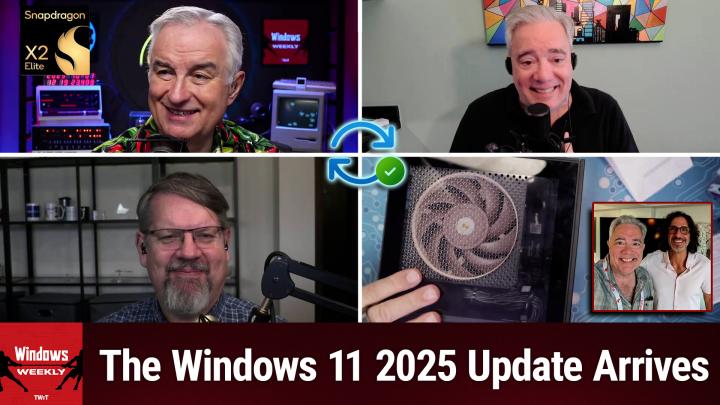
Windows Weekly 952 Transcript
Please be advised this transcript is AI-generated and may not be word for word. Time codes refer to the approximate times in the ad-supported version of the show.
Leo Laporte [00:00:00]:
It's time for Windows Weekly. Paul Thurrott is here and believe it or not, so is Windows 25H2. What's the difference between 24H2? Not much. But we have a list of new features still to come. A big Xbox segment. Paul will give you a report from the Snapdragon Summit. He's just back from that and a whole lot more coming up next on Windows Weekly. Podcasts you love from people you trust.
Paul Thurrott [00:00:32]:
Tweet.
Leo Laporte [00:00:39]:
This is Windows Weekly with Paul Thurrott and Richard Campbell. Episode 952, recorded Wednesday, October 1, 2025. You can see the edges of the bubble. It's time for Windows Weekly, the poor name, frankly, for a show that is about Microsoft, although frequently about Windows. Let's welcome our fabulous hosts, Mr. Paul Thurat of thurat.com he's in Mexico City today. And Mr. Richard Campbell in Canada.
Leo Laporte [00:01:08]:
It's the North American version of Windows.
Paul Thurrott [00:01:11]:
Yeah.
Richard Campbell [00:01:12]:
Very rare one.
Leo Laporte [00:01:13]:
Yeah, yeah.
Paul Thurrott [00:01:14]:
How small can I make this thing?
Richard Campbell [00:01:20]:
It's a stormy day out there, Leo.
Leo Laporte [00:01:22]:
Oh, it's pretty. What a beautiful day.
Richard Campbell [00:01:24]:
There's a bit of white caps. The weather's a little mean. You can see fall is upon us.
Leo Laporte [00:01:29]:
I see the foreground sunflower has fallen, but there are two in the background.
Richard Campbell [00:01:34]:
Which are still holding out.
Leo Laporte [00:01:36]:
Yes.
Richard Campbell [00:01:36]:
And I should roll you the clip from the. From 2:00 clock this morning when the bear came through and oh, my God.
Leo Laporte [00:01:42]:
How fun is that?
Richard Campbell [00:01:44]:
Yeah. Found a little. Found a little container of fertilizer and stripped it open and went, this is just fertilizer. Moved on.
Leo Laporte [00:01:50]:
Paul is enjoying a fine camote sweet potato, condensed milk, kind of a corn liquor.
Paul Thurrott [00:01:57]:
What am I enjoying? It's a cowboy. Looks good. Chicken soup.
Leo Laporte [00:02:01]:
He went out onto the street and purchased food before the show, like, could.
Paul Thurrott [00:02:05]:
I get extra chicken skin in that? And they're like, obviously.
Leo Laporte [00:02:11]:
Oh, ladies and gentlemen, Ladies and gentlemen. Hey, we're very excited because 25H2 is here.
Richard Campbell [00:02:18]:
It's actually.
Paul Thurrott [00:02:19]:
Yeah, I didn't think it was going to happen so quickly, but.
Leo Laporte [00:02:23]:
Well, it is October and 25.
Paul Thurrott [00:02:26]:
Yeah, today it is. I, I just, you know, if you remember, last week was the Tuesday of week D. Generally sometimes these days, I guess we get a preview update. And my expectation was the preview update was going to be the preview of 25H2. And then we would get the final one maybe in October or it would be shifted over to October and November. But the preview update, which we'll discuss in a moment, I think. Right. Yep.
Paul Thurrott [00:02:53]:
Actually came out Monday. So Week E, which isn't really a thing, but a little late, you know. And then the next day, Tuesday, Microsoft announced Windows 11 version 25H2 is done. Wow.
Richard Campbell [00:03:09]:
So we've been on the insiders. This is like regular win 11 machines are going to get it.
Paul Thurrott [00:03:14]:
Let me qualify that. Because Microsoft. So there's like, language that one might use, and then there is language that I would describe as accurate. And those two things aren't always, you know, in the same ballpark. Fair. So what they announced was that it would start rolling out. And I. I haven't seen it yet.
Paul Thurrott [00:03:37]:
And like, I have more computers here than I'm embarrassed to even admit to, but. And also made a critical error, which I will admit to in a moment. I haven't seen it yet. So my expectation. And maybe someone out there has gotten this magically. I don't know that anyone's gotten it, but if you have, let me know because I believe it's probably a preview update and the, you know, final. I don't know, maybe November. I don't know.
Paul Thurrott [00:04:03]:
We'll see. But it's one of those things that's, you know, happening over time, which you.
Leo Laporte [00:04:06]:
Do, as a Douglas man in our YouTube chat suggests, or I'm sorry, Greg M. Suggests says, no rush, we just got 24H2. Let's find the other bugs.
Paul Thurrott [00:04:17]:
Well, so in this case, it's. It doesn't matter. They're actually 100% the same thing. The only difference is the one character in the build number and then the version number that says 25 instead of 24H2. So they are literally identical.
Richard Campbell [00:04:32]:
Wow.
Paul Thurrott [00:04:33]:
Yeah. And that means this is one of the more exciting releases of Windows ever. Really? Because, well, you know, everything is. So it's going to say squishy, I guess that's a pretty good word. You know, back in the day, it would be like, it's August 25th. Windows 95 is available today. You can get it today. We are continuously updated in the Windows world today, and not all at once.
Paul Thurrott [00:05:00]:
Right. And so the rolling updates. Yep. Like, this particular computer does not have the new Start menu. This is one of the things I have to go through. Like, this particular computer also does not have the phone length on the side. For some reason it should. And so if you were to make a grid of all of the Windows 11 features that have rolled out this year, let's say, and then compared them to multiple computers, you would create a patchwork quilt of checks and X's, because it really just depends on the computer.
Paul Thurrott [00:05:28]:
There are third party tools like Vive Tool, which you can find on GitHub and then you have to know the special codes to make it do things. But that can enable features for you. But it's not 100% right. And I've done that. Obviously I'm trying to get the newest features as quick as I can, but that's not really a thing. Oddly, Microsoft has accompanied this update, if you will, which may or may not have actually delivered, been delivered to anybody with a list of new features. Right. Which again just want to be really super clear on this, are not unique to this release.
Paul Thurrott [00:05:58]:
Right. If you have 24H2 and for some reason you don't ever go to 25H2, but you're on a supported computer, obviously, et cetera, et cetera, but you keep getting those cumulative updates. Every month you'll get those updates, you'll get them on 24H2. So maybe someday that changes. But as of today, no, right now there are no unique features that are in one or the other. Well, okay, actually they took away a couple of features. So I guess if you go to 25H2, you're going to lose an old version of PowerShell that nobody should be using anyway and that kind of thing. But for the most part, I mean 99 point something percent they're identical.
Paul Thurrott [00:06:36]:
So that kind of takes the. That kind of adds the sad trombone sound to the falling confetti of this celebrating this release. But it might be worth look, I mean I'm not going to read this thing through, but Microsoft actually put up a document on their support site explaining what is new, so to speak. None of it's new, especially if you've been watching the show, you've heard of all of these things and they do segregate out the Copilot PC features, things like Recall, which is still in preview, click to do. They're calling it Windows. They really need a name for this. Windows Search, like semantic search is what I would call this the Copilot powered agent that's in Settings, which is actually pretty good by the way. And then the voice access stuff, which is coming to new language, et cetera, et cetera.
Paul Thurrott [00:07:24]:
But if you go through all the rest of this list, it's a pretty long list. But really what this is is just a partial summary of the features that we've been talking about for the past several months.
Leo Laporte [00:07:35]:
Right.
Richard Campbell [00:07:35]:
They've got, they've been moving through the dev and beta builds and we do radically.
Paul Thurrott [00:07:39]:
They're pinballing their way through. They're not following some logical trajectory or whatever. And look, maybe I overemphasize this point, but just to be super clear, and I think this is true of a lot of people in our industry and probably a lot of people listening to this. If you're on, like if you have ADHD or you're compulsive in any way, you have autism or you're on some spectrum, whatever it might be, this kind of thing makes me insane. I don't like Richard and I think it was on. Maybe it was not. Maybe it was on Net or. Actually, yeah, I think we were talking to.
Paul Thurrott [00:08:15]:
Doesn't matter. I'm sorry, you were talking about determinism or deterministic. Non deterministic. This is non deterministic.
Richard Campbell [00:08:22]:
In fact.
Paul Thurrott [00:08:25]:
It'S worse than non deterministic. It's like chaotically random and like I said, several computers here and it's not funny, it's not amusing, but you bring them up and you get them up to date. They're all in the same build except for one, which I'm going to get to, and y' all have different features, you know, so whatever. I talk about this a lot. I don't mean to beat it to death. It's just a constant refrain of our existence these days. It's just the way it is. And it's one thing that is semi amusing to me is to read the Microsoft explanation of this stuff because they act like this is completely normal.
Paul Thurrott [00:09:01]:
You know, like. Yeah, you know, as you know, we're delivering innovation continuously. Yeah, you sure are. You delivering something. Give me that. So anyway. Okay, so that's happening sort of. Right? I mean, and again, I need more.
Paul Thurrott [00:09:18]:
Maybe some of these already happened in the chat. I don't really know. But I don't know if anyone has gotten this. I don't, you know, I'm already on. Sorry.
Richard Campbell [00:09:26]:
Yeah, nobody. I haven't seen anything about anybody having this yet.
Leo Laporte [00:09:30]:
No, they're not saying.
Paul Thurrott [00:09:31]:
I mean, I'm. I'm on 25H2 pretty much across the board via various Insider bills. Insider Pro, yes. And like the ISO stuff we talked about previously, for example, there's been no talk of, oh, here's the ISO. Oh, if you use the media installer tool, the media creation tool, you're going to get 25H2. Now, like they haven't said this. I assume most people know that Pavan Davalori runs Windows and Service, by the way. Right? And he was promoted into that role a little over a year ago.
Paul Thurrott [00:09:59]:
I guess he appeared Last year at ifa. At ifa. At Lenovo's event. I was expecting to see him again at ifa at Lenovo's event. And that's not what happened. Right. So this other guy came out. I've never heard of Mark Lipton, I think his name was.
Paul Thurrott [00:10:15]:
And I was like, oh, that's interesting. But is he busy? I mean, why isn't he here? It's weird, you know, we get the guy running like Intel's, you know, PC chip business was there. Like, it seems like he would have been there. Right. And then last week I was in Hawaii, which, by the way, feels like nine months ago, and. And I was there for that Snap Dragon Summit, which was fantastic. We will get to that, obviously. And I.
Paul Thurrott [00:10:38]:
He'll be here. And he was not there. Stevie Batiche was there now. That's great. And we're going to talk about that too. I love Steve.
Richard Campbell [00:10:43]:
I saw your picture. He must have been having a blast.
Paul Thurrott [00:10:46]:
Oh, God, I'm so. I love him so much. Yeah, that was cute. Yeah. Yeah.
Leo Laporte [00:10:49]:
It's like you saw a celebrity.
Paul Thurrott [00:10:50]:
Yeah. I got a chance to just kind of talk to him about, like, how great he is, you know, which he was not super comfortable with.
Richard Campbell [00:10:54]:
How we keep bringing up his build.
Paul Thurrott [00:10:57]:
Yeah, literally, some guy. He admitted. He admitted that he was very happy with that talk, by the way, the one we keep bringing up, the three app structure talk. I can't tell you how many times I've referenced it. It's got to be several hundred. I mean, I just keep talking about it anyway. So I've been kind of wondering about him. And it turns out he was promoted and now he is.
Paul Thurrott [00:11:16]:
Went from a corporate vice president to president as part of his promotion. His first big move, at least that I'm aware of, is a reorg inside of the Windows organization. And they're bringing back the engineering group, which you could sort of think of as like the core development stuff, the kernel, the stuff around the kernel drivers, et cetera, et cetera. This has gone back and forth over the years. Right. If you know anything about the history of Windows, you know, that used to be Server back in the day, which to me was like the adults, you know, under Steven Sinofsky. He brought that back in and actually made Server somewhat subservient, if you will, to him and the client group for that period of time. And after that was over, they pushed it back out to Azure, which is where this server group effectively went.
Paul Thurrott [00:12:00]:
If you.
Richard Campbell [00:12:00]:
Azure Core.
Paul Thurrott [00:12:01]:
Azure Core. And also, you know, the adults and to Me, that made some sense and now they brought it back into Client and I think effectively. I'm not really sure what the. What this means, if it means anything strategically or.
Richard Campbell [00:12:18]:
I don't see it that way, Paul. I don't see it brought back declined. I see it as unified.
Paul Thurrott [00:12:23]:
Like really, Please, then talk to me. What do you mean?
Richard Campbell [00:12:25]:
Just the idea that they should be unified. That clearly there's a major new version of Windows coming. Like how do you get a Windows 12 with this schism, right? Where you have very different sets of motivations from very different teams.
Paul Thurrott [00:12:38]:
When Terry Meyerson was running Windows, the split within client was effectively. This is called Windows Experiences, right. It was the client at UI stuff, right. The. And then all the features they would add over time, the creators, updates and all that crap. And then there was what I think of as the core, the kernel, whatever. And that was under Jason Zander and Azure and that group. Right.
Paul Thurrott [00:13:01]:
So to me that makes sense. But I guess on the one hand you've got this, this group Windows client waiting for some deliverable or they have very specific needs that maybe don't apply to server or Azure.
Richard Campbell [00:13:15]:
Totally.
Paul Thurrott [00:13:15]:
So they have to kind of go hat in hand and say, hey, well.
Richard Campbell [00:13:19]:
It'S specifically on the kernel side, right? Like that to me would be the issue. And the classic one is the problem with the networking stack. Like Outlook bonks and your whole machine network hangs, right. And you check Task manager and there's 68 threads dedicated to Outlook.
Paul Thurrott [00:13:35]:
None of them are for you, none.
Richard Campbell [00:13:37]:
Of them for the ui.
Paul Thurrott [00:13:38]:
Nice.
Richard Campbell [00:13:40]:
And that's a conversation at the kernel level that's really tough to have because it's just a client interaction problem.
Paul Thurrott [00:13:46]:
So we ran out of time last week. One of the things I wanted to get to last week if we could. I'm not going to waste a lot of time on this. It's related to what you just said, which is Visual Studio, which is this kind of battleship of an application, right?
Richard Campbell [00:13:58]:
Oh yes, that's the term.
Paul Thurrott [00:14:00]:
It's, you know, they're revving it now so the 2025 version is in preview is to me a significant upgrade.
Richard Campbell [00:14:05]:
2026 version.
Paul Thurrott [00:14:06]:
Yeah, 20. And it's very good. It's better looking and all that stuff, but whatever. But to me the big thing is the app doesn't hang every time you try to debug or run a compile or actually run the application. That used to be this moment where the whole thing was like. And then it kind of spit out what it was doing. Now it's like they discovered multi threading or something. Now it actually works.
Paul Thurrott [00:14:34]:
So I mean that was a self inflicted problem, I guess. I don't think they have another group to point fingers at. Or maybe they do, I don't know. But in the case of Windows. Yeah. As Windows evolves into this thing that actually Davaluri has been talking about, this kind of multimodal interaction model which I know where it's not just touch, mouse, touchpad, keyboard, but also just kind of a lot of awareness that we get through sensors like we have on phones, natural language, voice obviously and in two directions. Right. It's not us dictating to the machine all the time, although that is a thing, but also it coming back and replying to us and then the agents that run in the background and do things on our behalf.
Paul Thurrott [00:15:18]:
And I talk a lot about orchestration and yada yada yada. And for Windows to be an effective orchestrator, for lack of a better term of this kind of new way of working, which is the old way plus the new stuff. Right. Not replacing the old stuff. Yeah. They're gonna have to be some changes and those things don't apply. I mean you can think, just thinking about it right now, you can tell like those things will never apply on server or Azure. Right?
Richard Campbell [00:15:43]:
Sure.
Paul Thurrott [00:15:43]:
This is very much for a one to one interaction between you and Microsoft.
Richard Campbell [00:15:47]:
And I gotta think that one of pavan's pitches is hey, we need to build a really important AI version of Windows. It's all about the client and we need controller, kernel if we're going to make this happen.
Paul Thurrott [00:15:58]:
Yep. And if that is what happened, I don't have the full memo. I'm not really 100% sure. Obviously there are, it's very clear to me there's another memo we're going to get to today that when it comes to Microsoft communications to employees, there's the stuff that they give to employees, some of which leaks and then this is stuff they give to employees but they also publish on their own website. And those are a little filtered, you know, little, you know, not the whole story. Maybe because they're trying to do the public.
Richard Campbell [00:16:24]:
Even the order is sometimes suspect too. Like they kind of put it out in the world so that it can't be no backsies.
Paul Thurrott [00:16:30]:
Right, Right, that's right.
Richard Campbell [00:16:31]:
I've certainly seen that behavior as well.
Paul Thurrott [00:16:34]:
Yeah. So I like this guy. He is an engineer, he's a good, seems like a good person to me. Smart, you know, we'll see. I mean I've liked a lot of the people who've run Windows actually. But. And you know, again, without knowing the full details, but I do feel like the, the things we just spoke through are what's happening.
Richard Campbell [00:16:56]:
Imagine updates making sense. Like one of the things you're looking at here now is if there's a unified strategy for Windows, maybe it's a unified strategy for updates and insiders. Too much to wish for.
Paul Thurrott [00:17:09]:
Okay, that might be the dumbest thing. No, I mean. Yes. Oh, that's again. No, I'm kidding. Obviously. It's like it's this, it's. Yes.
Richard Campbell [00:17:20]:
I don't worry, Leo, I'm not bothered by this. All I've clearly said dumber things than this.
Paul Thurrott [00:17:26]:
Yeah, and I'm clearly joking, but I. No, yes, yes. I should say you could look at various behaviors throughout the Windows. Org. Whether it's the kind of insertification stuff that's, you know, in the UI, the OneDrive folder backup nonsense, the forcing you to run edge, etc. As part of that process where whether they want to or not, this thing has to make sense in the Microsoft as it is today. But now that this is evolving and wherever you fall in the AI curve with regards to it's going to kill the world or it's the greatest thing to happen to mankind in the middle somewhere it's happening. What Richard just said about the client team needing control of the kernel because these are very specific interactions that are unique to Windows client to me is correct.
Paul Thurrott [00:18:19]:
I do think that's it.
Richard Campbell [00:18:20]:
I would also debate that server's less important to Azure now than it's been. If you look at the population of Azure, just the sheer amount of Linux in it and the customized versions of things and so forth, like there's just not the same level of urgency now in terms of controlling server. That made sense maybe in 2018.
Paul Thurrott [00:18:40]:
Right. So when Microsoft announced what was then Windows Azure. I don't remember or know, maybe it doesn't matter whatever the exact organization was, but obviously it was built off of the work they had done previously in server. Right. Which itself built the work there. Yes. Yeah, but I mean as far like. But it was.
Paul Thurrott [00:18:59]:
We're going to take this thing and put it in the cloud. Okay, now what do we have to do differently? Because it's the cloud and at some point Azure becomes this amazing multi headed monster of functionality. It's just astonishing. I couldn't ever keep track of that. And you get into a virtuous cycle.
Richard Campbell [00:19:15]:
They had to do a custom version of Git to be able to put the Windows Source code into it like that.
Paul Thurrott [00:19:21]:
I mean, that makes total sense to me, actually. Right. Not because I understand it, but because of course it's that complex, you know, but you learn. Microsoft learns things with Azure and they can apply some of that back to server and then you get into this, you know, the virtual cycle thing. Virtual cycle thing Steve Jobs used to talk about. It's good. So it benefited both sides. It's nice.
Paul Thurrott [00:19:42]:
And obviously the shared engineering to some degree, et cetera, et cetera. But yeah, to your point, I think maybe we're at the point now time for a new leader where these things can move forward on their own little trajectories. Right?
Richard Campbell [00:19:54]:
Yeah.
Paul Thurrott [00:19:54]:
And if there's an outlier, it's client. And listen, before we had Azure, and this is 20 years ago, I used to make the argument that there was no reason for Windows Client, Windows Server to be the same thing from kind of a UI UX perspective, as long as everything under the covers, meaning all the app compat drivers, yada yada, was the same. That you could have this utilitarian thing for server and you could have this crazy colorful playschool thing for people and you could have one for businesses that was completely different too, and it would be fine because we're just talking ux, you know, and they never did that, obviously, per se, but this is kind of a deeper level version of that that, you know, these products now have evolved. They're. They're doing very specific things and those things in many cases are very different from what the other ones are doing.
Richard Campbell [00:20:43]:
Right. Well, you remember back in the day, Mark Russinovich finding the reg keys to be able to switch a client edition into a server edition and disrupting the licensing model in a big, big way.
Paul Thurrott [00:20:54]:
Hey, he was rewarded for that. What's he running now?
Richard Campbell [00:20:59]:
CTO of Azure.
Paul Thurrott [00:21:00]:
Most people would be. Was that before or after the dcma? I mean, like, a lot of people would have been in trouble for that.
Leo Laporte [00:21:10]:
But that's clearly a long tradition of hiring hackers because.
Richard Campbell [00:21:14]:
Bring that guy on the inside.
Paul Thurrott [00:21:16]:
Exactly, yeah. He's way better on the inside. He's awesome. It's one of the smartest people I've ever met. He might be the smartest person I've ever met. He's a Jew and a super nice guy. Right. That's a nice combination.
Paul Thurrott [00:21:28]:
Anyway, yeah, I kind of wish, you know, after sinofsky and Windows 8 and all that stuff, he went to the. That's when he went to Azure. And my God, he's doing God's work, There's no doubt about it. But selfishly, I'd love to have him on Windows. For some reason I can't imagine he would never.
Richard Campbell [00:21:45]:
Yeah, I don't think that's his focus at all these days. And there's certainly no, it's not conversations with him. But listen, the whole idea that Windows has a leader unified, that to me is a big deal. And it's been a while.
Paul Thurrott [00:21:58]:
It's been years. It's been literally since the. Even before, I would say before Terry. Only because he was the one. I don't know if he made that decision, but that was when engineering split off and went to Azure. Right. Like that was his deal. Like we're going to focus on the, you know, fixing the ui, which it absolutely needed.
Paul Thurrott [00:22:14]:
Right.
Richard Campbell [00:22:15]:
Yeah. And I always felt like Terry Meyerson drew the short straw and got all of the products that were no longer the focus of Microsoft.
Paul Thurrott [00:22:22]:
Yeah, 100%. And also we're going to call that part of the company you run, more personal computing because that means something.
Richard Campbell [00:22:28]:
Yeah.
Paul Thurrott [00:22:28]:
Why don't you just call it, et cetera, et cetera, you know, the other stuff. Yeah, Anyway, yeah, look, he got the short end of the stride many ways. How?
Richard Campbell [00:22:39]:
All I know is this show just got a whole new band of energy. Because if pavan starts cranking out things the way he could and we start seeing a really unique version of Windows next coming down the path. We have a lot to talk about.
Leo Laporte [00:22:50]:
Seemed really odd that CoreOS was in Azure of all places.
Paul Thurrott [00:22:53]:
Well, but that's where the real engineers were doing that type of deep level work. You know, it's. As Microsoft kind of grew and expanded, especially during the cloud era, a lot of the guys that would have been doing that kind of stuff in Windows went to other parts of the company and at some point it, you know, it just didn't make sense, I don't think, to have separate engineering organizations that would still have to work together, you know, obviously. So they put it under Azure.
Richard Campbell [00:23:21]:
Well, Windows tend to do rapid iterations. Like there was a lot of experimentation that went on with Windows and part of it was sort of shaking up the engineering culture. I remember having a drink with Larry Osterman a number of years ago when all this was going on. I'm like, this is kind of nuts, dude. What are they doing? It's like, listen, there's a lot of 30 year plus veterans inside of the Windows team and unless they have eight wives in a cocaine habit, they don't need the money. So how do you Manipulate these guys. How do you push them to change in any way? And I'm like, all right, that's the best line I've ever heard, ever. Larry, you're the best.
Paul Thurrott [00:23:55]:
Yeah, I've never met him in person. I love him, by the way. I've watched his, you know, presentation.
Richard Campbell [00:23:59]:
He's fantastic. When he switched out, he moved to Azure. He left the Windows team after 30 years to go work inside of Azure.
Paul Thurrott [00:24:05]:
Yeah, because that's where, you know, people look. People have careers, they have whatever they. You want to be fulfilled day to day at work. I mean, you can, you can see externally, I mean, imagine what it's like internally where the. As the focus shifts away from the thing that you're doing, like what that feels like, you know, you're. He's like, do I hear an echo in here? Like, what's going on? You know, like, am I alone? Yeah.
Richard Campbell [00:24:28]:
The last thing, you turn off the lights as you leave.
Paul Thurrott [00:24:31]:
Actually, before you leave, actually just hit the compile button and walk out. You'll be fine.
Richard Campbell [00:24:34]:
Yeah. Make sure.
Paul Thurrott [00:24:38]:
So. Oh, God, the stuff is all over the place in the notes. Unfortunately, there's another big reorg happen. Well, reorgan.
Leo Laporte [00:24:44]:
Do you want to pause here and get to that?
Paul Thurrott [00:24:45]:
Yeah. Does that make sense? Yeah, yeah, yeah. Yes, yes. This is a good time. Thank you.
Leo Laporte [00:24:49]:
We will pause and continue. You're watching Windows Weekly with Paul Thurat and Richard Campbell and a big day. I think this is a big. This is a big story. So we'll get more, more to come. Just a moment, but I do want to tell you about our sponsor, 1Password. You know, it's more than just passwords these days. Over half of IT pros say that their biggest challenge is securing SaaS apps.
Leo Laporte [00:25:14]:
And part of it is because of Shadow IT. With the growing problems of SaaS sprawl and Shadow IT, it's pretty easy to see why this has become an issue. Thankfully, there is a solution and it's from 1Password. It's something new they do called Trelica. It's part of their extended access management suite. Trelica can discover and secure access to all your apps whether they are managed or not. Trelica by 1Password it inventories every app and use at your company. All right.
Leo Laporte [00:25:43]:
Then pre populated app profiles and they have them for everything. Assess the SaaS risks, they give you the power to manage access, to optimize spend, to enforce security best practices. And it's across every app your employees use, even the ones you don't know about. The Shadow it, you can manage shadow it. You can securely onboard and offboard employees. That's nice. And it meets compliance goals. Another, you know, big check box Trelica.
Leo Laporte [00:26:13]:
That's what it's called. T R E L I C A by 1Password provides a complete solution for SaaS access governance. And this is just one of the ways the many ways that extended access management helps teams strengthen compliance and security. Of course you know about 1Password's award winning password manager. It's trusted by millions of users, over 150,000 businesses from IBM to Slack. And now they're securing more than just passwords with 1Password. Extended Access Management. Of course Security's job.
Leo Laporte [00:26:45]:
1@1Password they're ISO 27001 certified, they have regular third party audits and and this is really important, the industry's largest bug bounty. 1Password exceeds the standard set by various authorities. It's a leader in security. So take the first step to better security for your team by securing credentials and protecting every application, even unmanaged. Shadow it. Learn more at 1Password.com WindowsWeekly that's 1Password.com Windows Weekly it's all lowercase. 1Password.com Windows Weekly we thank them so much for making Windows Weekly possible. Now let's continue on with the endless reorg.
Paul Thurrott [00:27:33]:
Monday we got the preview Update for Windows 11 version 24H2. A bunch of stuff in there, but all the stuff we've already been talking about. There's no reason to beat it to death. Probably Friday, I don't remember anymore, but whatever day Microsoft put us in, preview builds to dev and beta. So 25 and 24H2 respectively. Nothing major here, but these are features that are coming to both versions of the OS in the coming month or two. I don't know, it's not worth discussing. It's like a.
Paul Thurrott [00:28:06]:
Well, you can access a network speed test from that. Fly out the Quick settings, fly out WI Fi and cellular Quick settings pages. But it just loads Bing and does the if you had searched for it and Bing, it's like that, you know.
Richard Campbell [00:28:18]:
We got the same result. I love that.
Paul Thurrott [00:28:20]:
Exactly the same. The Get Started app was updated with a page that scribes Microsoft 365 Copilot the app which to me is an advertisement for why you would uninstall it. And then if you have a Copilot plus PC there is like, you know, we need a term for this. Maybe we have a term. It's like the AI glow that you get around things in Windows, Android and iOS. Actually Apple OSes it's kind of that pink, purple, little sparkly thing that I used to associate with like unicorns flying in space or whatever.
Richard Campbell [00:28:55]:
But it's either magic or hallucination. And hallucination is particularly good term. Yeah, it's like, oh, no, did I eat a mushroom by accident? Like, what's wrong with my phone?
Paul Thurrott [00:29:05]:
You know, I like the universal. Universality, I guess, of this. Like there's a phrase about like people, you know, when you're. You're about to die in the desert, you haven't had something to drink in three days, you're stumbling along, you see a mirage in the distance.
Richard Campbell [00:29:20]:
That's it.
Paul Thurrott [00:29:21]:
You only see that mirage when you're doing that. You don't see it when you're in Whole Foods buying oranges. Like, the mirage only appears when your brain is like, you need this.
Richard Campbell [00:29:30]:
You're desperate. Yeah.
Paul Thurrott [00:29:31]:
And Microsoft has just done that for all of us all the time. Like, we don't need this. We don't want it. And you're getting it anyway.
Richard Campbell [00:29:36]:
So you know it's coming.
Paul Thurrott [00:29:38]:
Did you see a sparkle? Yeah, no. It's on all the screens. It's the one thing that's actually consistent across windows. Yeah. So they added a sparkle, I don't know, a halo, a whatever the hell it is to the little.
Richard Campbell [00:29:50]:
Go with sparkle.
Paul Thurrott [00:29:51]:
I like sparkle. Yeah, an AI sparkle to the search box just to highlight it to let you know, hey, you should use this thing because now it actually works. Because I think people have been ignoring it for so long because it wasn't working. The photos app is getting what I assume is the first of several related updates where it will auto categorize your photos for you from a set of four categories. You don't get to edit them, you don't get to change them. You don't get to add your own.
Richard Campbell [00:30:20]:
We know best.
Paul Thurrott [00:30:21]:
Yeah, it's probably because even they would probably agree they don't know best. But what are those categories? I'm trying to find the list. Sorry. It's like, why you think they'd be the easiest thing in the world to find in my own article anyway? Four categories. Who cares? It's identity. I can't read it. Notes, receipts, and something else. Screenshots.
Paul Thurrott [00:30:43]:
So, okay. I mean, it's fine. You can read. You can re categorize something that will help train the model. I should say copilot plus PC only again. But obviously they're going to add the ability to add remove. You know, it's like when they added the one tile to the Lock screen. You're like, what is this thing? And then they added two more, three, one more and another one.
Paul Thurrott [00:31:03]:
You're like, okay. And then eventually it took a year or more but they let you determine which ones were there, which order they appear in, et cetera. So that's how we do things now.
Richard Campbell [00:31:14]:
Half assedly well first version too. So maybe they'll fix it by the time the next version comes along. Or the screaming noises finally penetrate into the bubble.
Paul Thurrott [00:31:25]:
Yeah, that's.
Richard Campbell [00:31:26]:
I'm in an optimistic mood today, Paul.
Paul Thurrott [00:31:28]:
I was gonna say, man, I don't know what's going on with you. I had got a lot of sleep last night. No, good for you. Yeah, that's going to come up again in the show. I'll just leave it at that. Because the screaming that you're going to hear from the user base is quite pronounced this week. Yeah, I know, I did that. And then you may know.
Paul Thurrott [00:31:52]:
And this is another one of those things that gets kind of over popularized or promoted in the sense that I feel like people today who write news are using AI to generate it for them are always looking for that little hook where they can get people just to go and read it. Right. So it's more about page views than it is about actually relaying information. And Windows 10 and the Extended Security Updates program for individuals is a lot like that. I think it was last week or whenever we talked about this notion of should Microsoft extend this for everybody? And the way I described it was like I kind of see it both ways. I see both sides of this in the sense that because Windows 10 is Windows 11 fundamentally it shouldn't be hard for now.
Richard Campbell [00:32:36]:
There's no real justification on a cost perspective.
Paul Thurrott [00:32:39]:
Yeah, that's my feeling.
Richard Campbell [00:32:40]:
If you cared that much, you wouldn't made the Copilot plus PC so isolated. That's the harder break than the difference between regular win 10 and regular win 11.
Paul Thurrott [00:32:48]:
Yeah. Trying to discover the true motivation behind things is often interesting, but. Yeah, but on the other hand, 10 years that's been traditional. That was something Microsoft's been doing for a long time. It wasn't formally the case, but they did it and now they're extending it for a year. They've never done this for individuals. It's free now as originally envisioned. It wasn't going to be free, but low cost.
Paul Thurrott [00:33:17]:
Then it was going to be free but you had to back up your computer to, to cloud, to OneDrive essentially, you know. Yeah. To you know, the Windows Backup app which backs up like nothing but you know in our little community, of course that's outrageous. You know, this causes people, people to lose their minds over this stuff. I, I don't see it as an onerous requirement, but whatever. So yeah, I, I see both sides but in the EU they have, I don't know if you know this about Europe, they have some regulations and laws that are weird, but privacy and competition and all kinds of stuff. And so Microsoft, prodded by the eu, meaning like a, like a Kyle prod is just going to make it free so you don't even have to have a Microsoft account. You don't have to back up.
Richard Campbell [00:34:00]:
I saw Consumer Reports asking for basically the same thing too.
Paul Thurrott [00:34:04]:
Yeah, that. Okay, that's, that's what the. All right, so this, maybe that was two weeks ago when you're out. But yes, and so we had a lengthy, we talked about that, all the shows lengthy discussion.
Leo Laporte [00:34:11]:
Higginbotham wrote the letter. So.
Paul Thurrott [00:34:13]:
Yeah, I know.
Leo Laporte [00:34:18]:
By the way, the EU, the EU's forcing this underscores the fact that Microsoft can do it.
Paul Thurrott [00:34:25]:
Yeah, just like the EU forcing Apple to make their app store open for proves they can do it. And that the 18 step scare screen thing they had was not necessary. But.
Richard Campbell [00:34:34]:
Right.
Paul Thurrott [00:34:35]:
You know, look, this is the problem. You have a company that's kind of marketing their own thing and they have their own aims and you have regulators that are pushing at them and you've got people like us who are maybe just consumers or consumer advocates ourselves who want things to be free and fair. Not free, but fair, let's say. There's a lot of different things going on. But the one thing I did say about the Consumer Reports thing was in a world in which we have phones that are not updated for as long as Windows just was, by the way, none of them. And the cry about E waste is a little bizarre to me because I think phones are actually not that it's not a problem, you know, but how are. Why did you take a stand on this one? Like, you know, Mike, if you could look at like an iPad or something and be like, yeah, Apple supported that thing with eight years of updates, you're like, great, well that's less than 10 and less than 11. And what about data? You waste anything? No, you got nothing.
Paul Thurrott [00:35:33]:
You don't have a little editorial about that for some reason? I don't, I don't know, I don't get it. So whatever. I just, I thought it was a weird targeted thing on something that I don't think is the biggest problem. It's a problem I do acknowledge that. Anywho. Yeah. So last week I was in Hawaii to think about this. Where was it? Yeah, we got home at 4 o' clock in the morning on Saturday and yeah, I'm doing great.
Richard Campbell [00:36:03]:
So home being romanerte.
Paul Thurrott [00:36:05]:
Yes. I've been meaning to talk to you about that, by the way, but just a quick. I don't remember if we did this on the air, if it was you and me or something. I said something about going home one time, he just did it again. He's like, oh, what do you mean by home? What does that mean? And I'm like, well, going back to Pennsylvania. He's like, well, how do you define home? And I'm like, I mean, I have like two homes. He goes, let me ask you a question. Where do you own real estate?
Leo Laporte [00:36:30]:
That's home.
Paul Thurrott [00:36:31]:
Just cuts to the chase. So. Correct. I own real estate here, I guess. I don't know. But we just bought our place in Pennsylvania, so.
Richard Campbell [00:36:39]:
Oh, you did?
Paul Thurrott [00:36:39]:
I've been. I. Yeah, I.
Richard Campbell [00:36:41]:
You buy the apartment that you're in there.
Paul Thurrott [00:36:44]:
Yep, yep.
Richard Campbell [00:36:44]:
Okay.
Paul Thurrott [00:36:45]:
Because we've moved before and it's terrible. And that was. But yeah, my wife made that happen. She. This came together in a two week whirlwind of.
Richard Campbell [00:36:53]:
Well, this was working and this was a family thing in the first place. So you're fixing and fantasies the only.
Paul Thurrott [00:36:58]:
Reason it could have happened the way it happened. Like the only way. So yeah, anyway, I just, I always think of you when this thing comes up, like. Because I say, like I'll say it and catch myself saying it. Yeah, I'll be like, oh man, Richard will catch me on that one.
Richard Campbell [00:37:09]:
And he just paying attention to your friend.
Leo Laporte [00:37:13]:
He's now one of the upper class with multiple homes.
Richard Campbell [00:37:16]:
Oh, yeah. He said, yeah.
Paul Thurrott [00:37:17]:
So I own a closet here and I own a walk in closet there to qualify it. I guarantee you, Leo, in your house right now you have a closet that's bigger than this apartment.
Leo Laporte [00:37:28]:
Well, I'm sure I do, but he.
Richard Campbell [00:37:29]:
Doesn'T have all the walls.
Leo Laporte [00:37:30]:
But I only have one home. You have two homes? Yeah, I have friends who say, you know, the North Carolina house. Or then there's a New York house and then there's the LA house. So that's multiple homes.
Paul Thurrott [00:37:42]:
I don't know other people. Like. I know, I know, I know what this makes me sound like. I. No, I know because. Well, because I just wrote a thing about this. It's stupid stream of consciousness thing. But you'll be out in the world here you sit at A bar or something or whatever.
Paul Thurrott [00:37:57]:
And you start talking to people, right? They could be locals, they could be Americans or wherever. How long are you here? Like, we're here for a couple months. Like, really? It's like, where are you staying? No, like, over in Norman. Aren't they, whatever, like, okay, like Airbnb or did you use some other thing? It's like, you're like, okay, now I have a place. They're like, you have a place that's incredible. And then you go down this thing. I didn't want to talk, I didn't want to talk about that. Like, I just, you know what I mean? Like, it was, it's not the, it's.
Leo Laporte [00:38:23]:
I don't know, just jealous, Paul.
Paul Thurrott [00:38:25]:
Well, don't be jealous because that means I always have to come here, you know, like, hard for me to do other things, you know. Oh, it's okay. Anyway, which, by the way, part of that conversation is I've, like, I said to this person, I said, I'm so sorry, I'm exhausted. We just got off the plane and at 4 o' clock in the morning, he's like, oh, where are you coming from? I'm like, oh, boy.
Leo Laporte [00:38:45]:
Oh, it was a work trip. It was a work trip.
Paul Thurrott [00:38:47]:
That's the thing you don't need. I said, well, we flew in from San Francisco, but we were in Hawaii. He's like, hawaii? Really? And I'm like, well, it was a work trip. And he's like, really? Really, really? And then for my wife, she was just hanging out at the beach, watch, reading a book. She was, had a great time. I was actually really busy. And then I said, yeah, I used to travel a lot for work and I don't travel as much. I said, in fact, this year I've only traveled for work.
Paul Thurrott [00:39:10]:
He's like, oh, where else did you go? And I'm like, berlin. He's like, dude, who are you? And I'm like, please stop. I can't. I can't have this ball.
Leo Laporte [00:39:16]:
James Bond.
Paul Thurrott [00:39:17]:
Yeah. It's just. Anyway, Richard travels way more than I do and I don't know how he does it. I. I travel so poorly.
Richard Campbell [00:39:25]:
I have been jet lagged the entire time. It's enormous.
Paul Thurrott [00:39:28]:
I feel like I've been dread lagged my entire 50s. Yeah, that's how I feel, you know?
Leo Laporte [00:39:33]:
Anyway, you get to your 60s, Paul. That's all I can say.
Paul Thurrott [00:39:36]:
I don't know if I'm gonna make it, Leo. You know, let's see how it goes. Let's not, let's not plan too far out ahead. Okay. So I was, I was in Hawaii.
Richard Campbell [00:39:46]:
You were in Hawaii.
Paul Thurrott [00:39:47]:
I remember the Snapdragon Summit, which was fantastic. You know, it's funny because it only really boiled down to two announcements. Right. There was the chip for the phones, which I don't care that much about, but awesome. And then the chip for the computers, which I have to say I care quite a bit about. And there was this moment about a year and a half ago where I had gone into New York to see prototypes of this. What was that? Well, what is the first gen Snapdragon X chips? Right. And it was there that we learned there were going to be multiple SKUs.
Paul Thurrott [00:40:17]:
And then I don't think they mentioned plus SKUs at that time, but they certainly did later in the year at ifa. Right. So now if you look at that product lineup, they probably have eight or nine different SKUs across the three tiers of chip types. They have first gen Snapdragon X. So that that March trip to New York where I finally got to see the first prototypes of those first gen things was the moment for me where oh my God, I think they actually did it. And then I spent the next couple of months in a holding pattern waiting for that one little the thing like where they're going to prove like oh no, they screwed this up or something and it never came. Like those chips are amazing. And so for the second gen they actually had those prototypes at the show.
Paul Thurrott [00:41:02]:
And so, you know, that gives me a little hope that even though it's not happening till next year, maybe it will be earlier in the calendar year than like mid year. Right. And we'll see. No one's ever said anything about that, but these are major double digit improvements across all the core types like cpu, GPU and npu.
Richard Campbell [00:41:20]:
What you think of for a second generation chip.
Paul Thurrott [00:41:24]:
Yeah, I mean, yeah. And, and it, you know, they're in an awkward place right now because. And they're going to be again by the way. But when they came out with the first gen chips, they were talking about M2. And then of course Apple shipped M3 and it was, you know, and they, they actually perform pretty well comparatively, but they aren't as good. And this time they're as good as the M4, M4 stuff across the board. Because Apple's just about to release M5.
Richard Campbell [00:41:46]:
Yeah.
Paul Thurrott [00:41:46]:
And so we'll see. But the point is they're still competitive and they're doing great and they've made major gains across the board. 80 tops NPU et cetera et cetera. Just as a quick thing. One of the things I deal with are these people who refuse to believe that anything is real. And I had said for the first gen the same thing that a guy from Qualcomm said to me literally about the second gen. Because I said, people are going to question these numbers because they're really good. And he said, listen, we can't lie about this.
Paul Thurrott [00:42:17]:
You guys are all going to benchmark this on real computers.
Richard Campbell [00:42:19]:
Yeah.
Paul Thurrott [00:42:21]:
If we're lying, you're going to find out in two months. Which is part of the reason they had prototypes there. Now these are prototypes. They're going to be thicker and have awesome cooling systems. Maybe, maybe this is not completely accurate.
Richard Campbell [00:42:31]:
And a 1% yield, like. Yeah, that kind of thing.
Paul Thurrott [00:42:34]:
Yeah. But it's like the crowd that doubts everything. I just find this. A guy really pushed me on. I don't know, he's pushing me. I'm just reporting it. But they're doing like 2x2x2x comparisons across the board to competitors. And then for some reason, when they got to GPU performance, they said it was 2.3x performance per watt compared to the previous generation.
Paul Thurrott [00:42:57]:
And he's like, why, why are they. What are they hiding behind? What is this? Like, he was freaking out.
Richard Campbell [00:43:01]:
Yeah.
Paul Thurrott [00:43:02]:
And so I said, look, you got to remember that the big deal with the first gen was not just that it was efficient and arm, but that it could compete with modern current gen, you know, x86 chips. Right. And what they were trying to highlight is the thing, I think is the, maybe the single most important thing, the thing, the, maybe the most magical thing about these chips, or maybe it's what's broken with x86, come to think of it, which is that when you unplug an x86 computer, the performance drops dramatically, especially with Intel. The intel chips right now drop by almost 50 or maybe more than 50%. When you pull the plug out of a Snapdragon computer, it doesn't drop. It does drop point something percent tiny. So it runs as good as fast, if you will, off power as it does on power. And so the reason they did that, I was told, because I asked, was for that reason.
Paul Thurrott [00:43:54]:
They want people to understand we're. We're actually more efficient and more powerful. So I said, okay, but what's. I said, just bald, you know, just high level. What are we talking about here compared to real world? Blah, blah, blah, whatever. He goes, oh, this is two times faster than everything else. He's like, yeah, it's Twice as fast. I also met the guys, but it's.
Richard Campbell [00:44:14]:
Even more power efficient than it is twice as fast.
Paul Thurrott [00:44:17]:
That's right. Just raw performance. Forget about efficiency. It's twice as fast. There you go. Well, no, not there you go. That was a guy from intel, but I mean from Qualcomm. But I also spoke to the two guys who had showed him.
Paul Thurrott [00:44:28]:
I can't remember the name of the company, I'm sorry, but they do all the like some of the big benchmarks and they were there to oversee the benchmarking. They had never been to this event before. They'd never dealt with Qualcomm before. And I just happened to sit with them at the luau thing they have at the end of the show and I'm like, let me ask you a question. And I went through the whole thing, I just did it just. And I didn't tell him what the guy from Qualcomm said, but I said, you've been doing this all week. He said, the two of them, they said this thing is over twice as fast as anything we've ever seen. We have never seen anything like this.
Paul Thurrott [00:45:00]:
And they were blown away. And I was like, yeah, there you go.
Leo Laporte [00:45:04]:
Exciting. That's great.
Paul Thurrott [00:45:05]:
It's really good. Now that doesn't mean that we're going to have laptop gaming machines that are. They're still kind of easing into that part of it.
Richard Campbell [00:45:12]:
But still got the software issues.
Paul Thurrott [00:45:14]:
Yeah, but it's getting there. They've got the anti cheat stuff is happening. Fortnite's coming soon, et cetera, et cetera. So we're going to. And look, the proof is in the so called pudding. We'll get computers, we'll see, we'll find out. But not only did I not see anything alarming or anything bad, it was way better than I thought it was going to be. My only disappointment is can we get it right? No.
Richard Campbell [00:45:37]:
Yeah. 2026 is what's killing you. It's not going to get. You want it for Christmas?
Paul Thurrott [00:45:41]:
Yep. Yeah. And maybe I talked about this last week a little bit, but I wrote about it since and just real quick, it's like I came here only with ARM devices. So I had two ARM laptops, Windows, an ARM based, obviously Apple, Silicon, MacBook Air and then several phones because I'm reviewing Pixel phones which are not Snapdragon, which is a huge problem but, but ARM based and, and I, I had several like examples of like what it's like which you have to understand for a person like me coming up in the x64 x86 world, whatever. With Windows. Don't get a lot of this. You know, like, things actually just working. You know, the example from that March trip when I was in New York, when I finally got to see the prototypes and saw, like, this is really happening.
Paul Thurrott [00:46:31]:
They were doing a little presentation ahead of time. There's a thing up on the board and I wanted to capture it in the notes I was taking, but it's too much. So I took a photo of it and I thought, man, I wish I could get this into my notes. I got to remember to do this. But I was like, wait, I have something. Apple something, Continuity or whatever it is. I'm like, I wonder if I could copy and paste this. And yeah, it worked.
Paul Thurrott [00:46:50]:
You know, like, that was magical. Wow. I did the same thing during the keynote at the Qualcomm event, but using a Pixel phone and a Windows laptop. Because when you have Phone link, you actually get that capability and you get a notification that comes up every time you take a photo. So I could take a photo, download it to the computer, post it to four different social media accounts at the same time, and keep going. And it was great. This thing was recording the meeting, taking photos, uploading them to my computer. I'm on my computer doing my thing, and awesome.
Paul Thurrott [00:47:24]:
It's awesome. So there's a future in here.
Richard Campbell [00:47:28]:
You're starting to feel like stuff might actually work.
Paul Thurrott [00:47:31]:
Yeah. Yep. And I didn't link to this. Sorry, I forgot. I guess I did it too late in the game. But I got an email from Qualcomm last night. I think they've noticed, like, how on my other side, I am in this topic, but ARM holdings had sued them, remember, three or four years ago, because they acquired Nuvia. And what they were trying to do was get Qualcomm to pay for the Nubia license in addition to their license, basically doubling the amount of money that ARM made off Qualcomm.
Paul Thurrott [00:47:56]:
And Qualcomm was like, yeah, no, we have lawyers too. No, thanks. And no one thought this was going to go to trial. It did. It lasted 15 seconds. Total victory for Qualcomm. Two things that came out of this, though. There was a remaining issue where Qualcomm was still holding, questioning whether Nuvia violated their patents as well.
Paul Thurrott [00:48:17]:
Nuvia does not exist anymore, but they were going to pursue that. And Qualcomm's position was, we don't have a position. We weren't part of that. That was a different company. We didn't make those decisions. We don't know anything about that. But the other one was that Qualcomm sued ARM and said, you guys lied on the stand. You purposely tried to prevent us from competing effectively, even though we're your biggest partner, because you want to produce products that compete with ours across the board, like data center, PC, et cetera.
Richard Campbell [00:48:46]:
Sure.
Paul Thurrott [00:48:47]:
That later issue is going to go to trial in March, by the way, so we'll see. I'm guessing Qualcomm's going to do pretty good because those guys lied on the stand, including the CEO of arm.
Richard Campbell [00:48:56]:
Yeah. Question is, do they settle?
Paul Thurrott [00:48:58]:
Yep. Well, they didn't last time. Maybe they'll learn lesson. So the Nuvy issue was decided by a district court in Delaware, and they found that Nuvy did not violate ARMS licensing agreement. And. And by the way, that company doesn't exist anymore. So Qualcomm's description of this is, and I quote, total litigation victory.
Richard Campbell [00:49:18]:
Nice.
Paul Thurrott [00:49:19]:
Qual. ARM's response is, actually, we're going to ask to. We're going to appeal this. So I guess it's not. It's not completely over yet, but.
Richard Campbell [00:49:29]:
Yeah, I don't know how you get to say final judgment when there's still appeal, so.
Paul Thurrott [00:49:33]:
Yep.
Richard Campbell [00:49:33]:
Yeah, good luck with that.
Paul Thurrott [00:49:35]:
I know.
Richard Campbell [00:49:36]:
And also make a deal. Like, what are you doing?
Paul Thurrott [00:49:39]:
Yes. Across the board. Make a deal.
Richard Campbell [00:49:42]:
Yeah.
Paul Thurrott [00:49:42]:
I feel like this industry as a whole should look at what Microsoft did with antitrust in the late 90s, early 2000s EU and the United States and say, you know, maybe there's a lesson to be learned here and we could apply it to lots of things like the dma.
Richard Campbell [00:49:55]:
And the simple one is winning a court case is like winning an earthquake.
Paul Thurrott [00:50:01]:
Right.
Richard Campbell [00:50:01]:
Nobody's winning anything. You're just spending a lot of money.
Paul Thurrott [00:50:05]:
Yes. And so in this case, literally case hilarious. They should never go to trial.
Richard Campbell [00:50:13]:
No.
Paul Thurrott [00:50:13]:
You know the case that Google lost against Epic, the judge literally begged them, would you settle?
Richard Campbell [00:50:21]:
Yeah.
Paul Thurrott [00:50:22]:
He ordered them to have mediation separately and say, I don't want to see you guys here again. You're gonna lose. Yeah. And it didn't settle. Yeah. Unbelievable. Yeah.
Richard Campbell [00:50:35]:
Willful.
Paul Thurrott [00:50:35]:
Yep. Crazy. But Apple's being super belligerent across the board, everywhere. You know, Google is to some degree, because when it comes to App Store stuff, they're just lockstep with, you know, Apple. That's what they do now.
Richard Campbell [00:50:47]:
I just kind of wonder if this is sort of a. There's a state for law right now. Maybe the LLM threat is making them all crazy worse. Gotta litigate a lot of Galate. Gotta let it get. I don't know.
Paul Thurrott [00:50:56]:
You guys probably know there's a term for this, but I believe this might still exist in Japan today. But certainly in the 1980s, when they were perceived as this big threat to the United States, especially in electronics, there was this notion that Japanese companies compete, but they also cooperate and they prop each other up in a way that in most places would be illegal for antitrust reasons. Right. Collusion and market dividing up markets, et cetera. This is absolutely.
Richard Campbell [00:51:24]:
You're talking about Keiretsu.
Paul Thurrott [00:51:26]:
Thank you. I actually didn't know the term, but I figured there was a term. And this is what Apple and Google are doing. Remember when Steve Jobs was still alive? It was total thermal nuclear war. Today, Google is paying Apple 26 billion, 25, 26, whatever it is, every year, and everything's fine. No problem. And, you know, whatever day last week I think was. It must have been Thursday.
Paul Thurrott [00:51:51]:
Friday, Apple came out this giant statement about how the DMA is broken. You got to fix this thing. And two seconds later, Google had an exact duplicate of that. Same argument, same length. They were calling for a reset of the dma.
Richard Campbell [00:52:05]:
Yeah.
Paul Thurrott [00:52:05]:
I'm telling you, these guys are colluding. Like, it's just, you know, they're just like. They have so much to lose.
Richard Campbell [00:52:12]:
Yeah.
Paul Thurrott [00:52:12]:
It's like, listen, can we share some legal strategies here? Like, how are we going to get over this? You know, here's how. Settle.
Leo Laporte [00:52:18]:
Yeah.
Paul Thurrott [00:52:20]:
Meet us halfway. Because if Apple was charging 10% on App Store fees, you wouldn't hear anything about Apple in the App Store these days. You wouldn't hear a thing.
Richard Campbell [00:52:31]:
So anyhow, quietly make your money, for crying out loud.
Paul Thurrott [00:52:35]:
Yep. Yeah. I think these companies get addicted to numbers. The numbers meaning literally profits, but also margins and revenues and growth. Right. Which is.
Richard Campbell [00:52:46]:
The CEO tells us we can't tell the shareholders we did anything other than grow. You will do. Your promotion and bonus is dependent on making sure we grow to the expense of everything rational.
Paul Thurrott [00:52:59]:
We are one of the top five most profitable companies on Earth and have been for a decade. Everything's great. Our businesses are mature. No one's leaving. Everything's great. Yeah, but are you growing? Well, no. I mean, we're flat. Because everything's great.
Paul Thurrott [00:53:12]:
Yeah. Down the toilet, you know, it's the stupidest. It's a big problem. I'm not an economist, obviously, but it's a big problem.
Leo Laporte [00:53:22]:
I am ready to do a little break if you are and continue on. We're going to talk about AI and so forth while you've been talking, I've been assembling and I am now complete on my.
Paul Thurrott [00:53:35]:
I. You made a checkerboard and that's.
Leo Laporte [00:53:37]:
I made a little checkerboard and I put in my Noctua fan and my clear panel and it was pretty easy not to.
Paul Thurrott [00:53:44]:
A fan. Was that like an upgrade?
Leo Laporte [00:53:46]:
Yeah, well you could choose your fan, but yeah. I bought the Nocturnal.
Richard Campbell [00:53:49]:
You went for the 50s. That a 120 or 140 fan?
Leo Laporte [00:53:53]:
You're asking me now? After I put it in.
Paul Thurrott [00:53:55]:
I don't know. I'm guessing.
Leo Laporte [00:53:57]:
Look how big it is. It's a huge.
Richard Campbell [00:53:59]:
Yeah. So must be 140.
Leo Laporte [00:54:00]:
And the reason you want a big fan is because they're quieter.
Paul Thurrott [00:54:03]:
Right?
Leo Laporte [00:54:03]:
Bigger is quieter.
Paul Thurrott [00:54:04]:
Yeah. Yeah.
Richard Campbell [00:54:04]:
Then they move more.
Paul Thurrott [00:54:06]:
Yeah.
Leo Laporte [00:54:07]:
So anyway, I. Look how little cute little thing this is.
Richard Campbell [00:54:11]:
It's brilliant.
Leo Laporte [00:54:12]:
I'm ready to power this up and install Windows.
Paul Thurrott [00:54:15]:
It looks like Pal. It's like Pal 9.
Leo Laporte [00:54:19]:
Hello. I don't know why I bought this module. Module. Since it. Hello. It has Ethernet on the back. It also has HDMI and plenty of type C connections and all that stuff.
Paul Thurrott [00:54:31]:
So.
Leo Laporte [00:54:32]:
Oh, it's even got. I didn't even see that DisplayPort.
Richard Campbell [00:54:34]:
So a couple of DBs.
Paul Thurrott [00:54:35]:
Yeah.
Leo Laporte [00:54:37]:
Nice. Nice little box, this. 128 gigs. It's an AI machine. This is the AMD Ryzen AI Plus 395 I think. Yeah. Anyway, I'm just proud of my. I've been doing a little handiwork while.
Richard Campbell [00:54:49]:
You guys are busy.
Paul Thurrott [00:54:51]:
It's actually. It's gonna be a good Windows box.
Leo Laporte [00:54:53]:
I've got a few Framework laptops. They make it really easy. It's gonna be great, isn't it? I can't wait, man. I just can't wait.
Paul Thurrott [00:55:02]:
What I'm going.
Leo Laporte [00:55:03]:
To do with it. I was thinking this is a light little like a local AI machine. But we'll see.
Paul Thurrott [00:55:08]:
We'll see.
Leo Laporte [00:55:08]:
They actually have a. They have an article on the Framework site about using it for local AI. So that'll be. That'll be interesting. Anyway, I want to take a break. We're going to come back with more. You're watching Windows Weekly. Paul Thurat, Richard Campbell and the handy Leo laporte.
Leo Laporte [00:55:28]:
You know, it's funny, it's like I think there's something called like the IKEA law that economists noticed. If you build your own furniture, however trivial and easy it was to do, you feel a love and an ownership for it that transcends the actual value of the furniture. And I'm sure That's what Framework's thinking. Yeah, we could easily assemble this, but let's let them do it. They'll have fun. They'll have fun and then they'll feel better about it. Our show today, brought to you by another little project that I've been working on, Zapier. I've talked about Zapier before.
Leo Laporte [00:56:02]:
I love Zapier for automating workflows. I use Zapier every day, many, many times a day, because when I bookmark a story out, I'm going through my news checks and I bookmark a story in Raindrop IO Zapier, which connects, by the way, to thousands. I think it's almost 8,000 different apps. Zapier sees that there's something new on Raindrop IO, automatically posts it to Mastodon, to my Twitter social, to the news links. But it also makes a line in Google spreadsheets because it understands Google Docs really well and makes a line in Google spreadsheets, takes the data from the bookmark, puts it on the spreadsheet, and that makes it easier for producers then to build the rundowns for the shows. And it's just Zapier is about automating things. But now Zapier is even better because Zapier now has, among all the apps, it connects with pretty much all the AI models. ChatGPT, Anthropic, Claude, Gemini.
Leo Laporte [00:57:05]:
And that means you can add a little dash of AI into your workflow. Otter AI. Maybe you like a podcast, but you don't have time to listen to it. You can have Zapier automatically download it when there's a new podcast, run it through Otter AI for the transcription, summarize it in ChatGPT, and deliver to you the key bullet points. I mean, in any form you want. Zapier is remarkable. For the last few months, you know, we've been talking about AI, but. And I know a lot of you use, you know, Copilot.
Leo Laporte [00:57:37]:
And by the way, Copilot's also available to Zapier and are using it in some simple ways, the ways Microsoft kind of sets up for you. But, man, when you have Zapier, suddenly the sky's the limit. You can use it and put AI to work across your company in a variety of ways. Zapier is how you can actually deliver on your AI strategy, not just talk about it. Zapier. Think of it as an orchestration platform. You could bring the power of AI to any of the infinite number of Zapier workflows. So you can suddenly take your Zapier workflows and they have, by the way, a whole bunch of them.
Leo Laporte [00:58:12]:
In the Discover tab you can see so many of the things people do with Zapier and add AI to it and do more of what matters. You can connect ChatGPT, Claude Copilot to the tools you're already using. So you can add AI wherever you need it. Whether that's AI powered workflows or an autonomous agent. A customer chatbot. If you wanted to build your own, you know, Scarlett Johansson AI bot, Zapier could make it possible. They also have a lot of customer facing possibilities, customer service chatbots, things like that. The point is, the sky's the limit with Zapier.
Leo Laporte [00:58:49]:
Zapier is for everyone. You don't have to be a tech expert. Teams have already automated get ready for this. 300 million AI tasks using Zapier. I am a huge Zapier fan. I have been forever. And now Zapier is even better with AI. Join the millions of businesses transforming how they work with Zapier and AI.
Leo Laporte [00:59:09]:
You get started for free by visiting zapier.comwindows that's Z A P I E R.com windows all lowercase. I am. So I've been using Zapier forever and now with the addition of AI, I can think of a hundred new ways that I want to use it. It is fantastic. Highly recommended. Zapier.com Windows it's easy to use and very powerful. Often those two don't go together. Thank you Zapier, for supporting Windows Weekly and supporting our workflow.
Leo Laporte [00:59:44]:
This baby going to be doing some working. Let me tell you, my Noctua fan gonna be blowing hot air. I hope I put it in the right way. They said label down. That makes sense. There's no arrow saying which way.
Paul Thurrott [00:59:54]:
So I want to thank you for using the word orchestration in there.
Leo Laporte [00:59:57]:
Yes, I did that for you and Stevie.
Paul Thurrott [00:59:59]:
I'm crying a little bit also because I caught that the one, but it's okay.
Leo Laporte [01:00:07]:
Talk AI, shall we?
Paul Thurrott [01:00:09]:
Oh, sorry. Yes. So this one came out of nowhere. Satya Nadella, CEO of Microsoft, suddenly with an asterisk, announced today that he was passing over, passing across, passing, moving, changing, transitioning many of his responsibilities.
Leo Laporte [01:00:31]:
What?
Paul Thurrott [01:00:32]:
To someone named Judson Alfoff.
Richard Campbell [01:00:37]:
Alpha Alfoff.
Paul Thurrott [01:00:38]:
He's pulling that marriage.
Leo Laporte [01:00:40]:
Stepping back.
Paul Thurrott [01:00:41]:
He's the holiest of institutions. I'm sorry, sorry. My name is terrible.
Leo Laporte [01:00:48]:
Judson.
Richard Campbell [01:00:49]:
Al off.
Leo Laporte [01:00:50]:
It's probably Althoff.
Paul Thurrott [01:00:52]:
Yeah, so maybe you guys know I. This. This has been a trend at Microsoft lately. This is another one of Those things, you know, for the kind of adhd, kind of techie guys, they can't stand this. Doesn't every company just have one CEO? Microsoft has multiple CEOs within the company. So they're CEOs of their respective businesses. Remember like Phil Spencer was like head of Xbox, actually COO of Xbox. There's the gentlemen who run their various AI businesses are CEOs of those businesses.
Paul Thurrott [01:01:25]:
Right. I don't know. To me this is just the title. I wouldn't worry about that.
Richard Campbell [01:01:31]:
He was evp, Commercial Office for Commercial Means what?
Leo Laporte [01:01:34]:
He's basically part of the business.
Paul Thurrott [01:01:36]:
It's business, government, education, like everything that's not consumer.
Leo Laporte [01:01:39]:
It's a sales job though.
Paul Thurrott [01:01:40]:
Right?
Leo Laporte [01:01:41]:
That's his position.
Paul Thurrott [01:01:42]:
Yeah. So but here's the thing, like they don't say it this way but. Well, let me say what he said first. I mean, so Micro or Satya Nadella in his words is going to be laser focused on Microsoft's highest ambition. Technical work across data center, build out systems architecture, AI science and product innovation. Where this group that he is working with there, the engineering leaders will lead with intensity and pace in this kind of generational platform shift. Okay, but what's Judson going to be doing? He's going to be running the business is what it sounds like. Microsoft sales, marketing and operations businesses are all under him now.
Paul Thurrott [01:02:31]:
Now Microsoft is not as transparent as they used to be with regards to the various sub businesses within those core, you know, the core three groups and who reports to whom and yada yada yada. And now as they announced the Microsoft AI organization about a year and a half ago ago, I don't remember even the name of the one they announced last October. They're referred to as organizations. You know, they're not like I'm looking for, you know, a diagram of the structure of their business and I'm not seeing it. Right. So it's kind of unclear. But this is interesting. You know this is an example of one of those things where they, this was a letter to employees but also a letter to the world because they publish it on their website.
Paul Thurrott [01:03:19]:
Right. And so it's, you know, it's, it's a little, maybe a little more targeted. Plus they know they put anything out there, they're going to, you know, it's going to leak. But it seems to me because Satya Nadella, and again I'm not, I'm not an economist and I'm also not a, I don't know, a corporate structure expert or whatever. But Satya Nadella is the CEO and chairman of Microsoft, and he's the chairman of the board. Board. And it seems like the CEO is the person doing that other stuff that he's now not doing and that maybe he's just the chairman and he could do this kind of strategy, innovation, tech stuff. And it's.
Paul Thurrott [01:03:55]:
I don't know, maybe the optics of him not being CEO or just would be bad for Microsoft financially or something. And we don't know the. We talked about motivation. We don't know the motivation behind this. Was this something he decided. Decided that he wanted to do? Was there pressure from below that maybe you're not paying enough attention to the business and paying too much attention to the technical end or whatever? I don't see that from the outside, by the way. But we don't know. So this is a curious thing.
Paul Thurrott [01:04:22]:
So I'm kind of wondering where this goes. I also want to point out, because I did my article, he used two exclamation points in one sentence. And I find that a little. No, A little tough. I don't know. So, yeah, this just happened. I don't know. I haven't seen any perspective on it.
Paul Thurrott [01:04:40]:
I haven't heard from any employees who maybe have some of their own perspectives on this. I don't know. I don't know what happened there.
Richard Campbell [01:04:47]:
But there's been a wave inside of Microsoft of turning EVPs, which seem to be the top of the stack, into presidents.
Paul Thurrott [01:04:56]:
Yeah. And that's what happens to Bavan, right? He's now a president.
Richard Campbell [01:04:58]:
Yeah, he's done that as well. And there's been a bunch of them. So it's literally the make. There's the thing I think it's interesting about when they create a stratum like that is it's more of a question of why are you still an evp? Like how. You know, it's a way to say who's important in the company right now and who's.
Paul Thurrott [01:05:15]:
In the early days, what you used to see was proliferations of product managers. And what was the other one called? Product. And there was another one. Do it too. One was technical, one was more marketing and communications, that kind of thing. Vision, whatever. Excuse me, Sorry. I'm literally coming off a horrible cold.
Paul Thurrott [01:05:35]:
So I'm still kind of paying for it here. But in recent years, meaning probably in the past 15 years or so, it seemed like there was a giant proliferation of corporate vice presidents. Like, for a long time, that was like the big title. Like, you would see all the.
Richard Campbell [01:05:48]:
Cvp.
Paul Thurrott [01:05:49]:
Yeah, cvp. Very, very Common. Now, Microsoft is in the midst of an effort to downsize business, but also to lower the number of levels between things. Right. So it's possible that what we're seeing is tied to that in a way that maybe there's. The strata is no smaller than it ever was, but there are fewer pieces of strata, if that makes sense, or layers or whatever. Maybe.
Richard Campbell [01:06:10]:
Yeah. No, I'm with you. I do think you're seeing a way to identify senior leadership and to sort of shake out should you stay. You know, you don't go around laying off EVPs. It's just bad for business.
Paul Thurrott [01:06:23]:
I mean. Right.
Richard Campbell [01:06:25]:
Comfortable enough that they go do something else.
Paul Thurrott [01:06:27]:
Yes, yes. And that's. Something else is almost always meta right now. But yes, 100%. I know it's not great. But I will offer a potentially complementary viewpoint of this, which is that Microsoft is coming off a tough half year of layoffs that I think were badly mishandled. Yes, badly.
Richard Campbell [01:06:48]:
And we're net zero according to the annual report.
Paul Thurrott [01:06:51]:
Yep. And had the added awfulness of not making any sense at all. There were in many ways, just not justifiable, like it just didn't make sense. So what I see here, again, maybe I. Maybe you're influencing me. Richard. I'm looking at the bright side of things right now is him leading by example. You know, he has been saying for years now, we're transforming.
Paul Thurrott [01:07:15]:
You know, he's tried. He's tried threatening. He said things like, look, you need to understand we're doing AI and if you're not on board with this, you can leave. Like, we. We are doing this, we'll do it the other.
Richard Campbell [01:07:24]:
And the other part is the focus part. Yeah, like one of the. One of the angles on the cuts where you guys are working on things that aren't important, which clearly means you have too many people. So now you have fewer people.
Paul Thurrott [01:07:34]:
Also, one thing we've talked about repeatedly, just the past. All this year, I would say all year. You know, you listen or you read, in my case, usually, or listen to their quarterly call after the earnings reports. And I was. I was here. It's probably July, I guess. Yeah, it must have been July. So for the first time in years, I actually listened to the call because I happened to be here at the time.
Paul Thurrott [01:07:59]:
You know, the day is shifted because of the time change. And it just worked out. I'm like, I'm just gonna listen to this. And I came away not with the first time, because I've read these things too. Where. And I think I said this to Richard privately. I don't remember the conversation, but I said I was like, is abhorrent running this company because there were multiple examples where it was almost a bit of an exaggeration, but almost like Sasha was like a child and they get, he gets to speak first and then she's like, that's cute, Sasha. Anyway, what's really happening is.
Paul Thurrott [01:08:26]:
And again, I'm exaggerating. But, but you got this multiple times. You can listen to it yourself, read it, whatever. But times where I sort of felt like she was setting the record straight after he spoke.
Richard Campbell [01:08:37]:
Right.
Paul Thurrott [01:08:37]:
You know, in the guise of, you know, the way those people always speak. Let me, I'd like to add a little color to that. Satya.
Richard Campbell [01:08:44]:
I mean a public company, the CFO is, you know, that's Amy does have certain requirements in place. And so Claire, clarification is appropriate. But I get, I listen to it too. I've heard that pattern that's. Oh yeah, you're a bit out of control. Let me reign that in.
Paul Thurrott [01:09:02]:
Yeah. Right. So you say. Right. I think anyone who listened to it would hear it too. I'm not, I'm not inventing it but, and you know, look, these people have different roles. I get that. I, I, There's a, this is going to seem like it's off topic a little bit, but there's an excellent video on YouTube that might be from CNBC or maybe the Wall Street Journal.
Paul Thurrott [01:09:21]:
You can look it up. But it's, it's trying to explain what happened to Intel. But the guy who explains it is a financial expert. What he does is looks at the, all the decisions they made. So pre. Pat Gelsinger, a lot of it was just done for like stock buybacks, prop up the stock price. Not doing much in the way of, well, anything in the way of innovation or tech, but just running the company as like a cash exchange kind of a thing.
Richard Campbell [01:09:45]:
Sure. And he keep buying back shares. Those shares, the shares that remain are more valuable.
Paul Thurrott [01:09:50]:
Right. And so his thing was like this is, you know, based A.I. summarize it. It's like short term gain. And then you screwed the company like you just screwed us. And it's a fascinating viewpoint. I don't know enough about that world.
Richard Campbell [01:10:04]:
And the argument is you should have put that money to work making more money and instead what you did was buy back stock to keep the stock price high.
Paul Thurrott [01:10:11]:
Well, yeah. So someone might argue that is one way to make more money. Okay. But the short term and long term. Yeah. Part of it is investing in R and D Or the next manufacturing process that you're foundries or just bringing your foundries up to date, whatever. And they let that stuff sit for 10, 15 years. I mean, they really just kind of sat on it.
Paul Thurrott [01:10:32]:
They also missed, you know, just. They missed mobile, they missed Cloud. You know, they obviously. All failures are really. Well, failures of this scale are multi. I'm gonna say multimodal, because.
Richard Campbell [01:10:45]:
I don't know, I mean, because AI Steeping into your.
Paul Thurrott [01:10:47]:
Exactly. It's like polluting my brain. Yep. Okay, look, this week, and by the way, just today has been. It's only Wednesday, but it's been monumental. There are at least three or four stories in here that could have been the top story. This is one of them. The last one was one of them.
Paul Thurrott [01:11:07]:
Microsoft announced a new offering for individuals called Microsoft 365 Premium. It sits above Personal and Family in that group of subscriptions. Right. It has the same basic layout, if you will, as family, meaning it works across six users, terabyte of storage for everybody, all the Office apps, et cetera, et cetera. But it's also replacing what was called Copilot Pro. Copilot Pro, essentially being the consumer version of Microsoft 365 Copilot. It was $20 per month, not $30. But it was basically the same thing.
Paul Thurrott [01:11:41]:
You have a Microsoft 365 subscription. You pay for this thing and you get all these additional Copilot features with the Office apps. Now they have this thing that has that and the subscription. So for the same price per month, $20, you're getting everything you got in family. Right. Six accounts, all the apps, terabyte of storage for everyone. The little asterisk. The only problem I have with this is the AI features, as in family, are only for the account holder.
Paul Thurrott [01:12:13]:
They're not for everybody.
Richard Campbell [01:12:15]:
So. Not for everybody.
Paul Thurrott [01:12:16]:
That is not okay. I really. I feel like we're going to get there. It's sneaky. It's sneaky to the tune of a little number in the quote that's in light gray. That goes down to a footnote that explains this. It's like you had it. I mean, you had it.
Paul Thurrott [01:12:33]:
To me, what this thing should have been was family, but AI for everybody.
Richard Campbell [01:12:37]:
Right?
Paul Thurrott [01:12:38]:
Right. So I'm not gonna get this exactly right, but I feel like.
Richard Campbell [01:12:44]:
Well, you know, the real piece here is. And then I have control over what my children see, you know?
Paul Thurrott [01:12:50]:
Yeah.
Richard Campbell [01:12:50]:
They. They've not done enough with the potential on family here.
Paul Thurrott [01:12:55]:
Yeah.
Richard Campbell [01:12:56]:
So about kids, tools and.
Paul Thurrott [01:12:58]:
Right. I feel like we're seeing the first steps in that direction with this thing. Because there's a couple of other little things that are interesting. This is not the right term, but Microsoft essentially identifies their corporate customers against anyone suing them. Because AI created something. They don't actually indemnify them, but there are legal protections that they provide you. They also have enterprise security standards that they apply to all the data you're exchanging with AI, et cetera, et cetera. They're bringing that stuff to consumer.
Paul Thurrott [01:13:25]:
Now it's interesting because it's really not consumers, it's individuals who yes, are consumers. But really what we're talking about are creators, you know, power users, etc, entrepreneurs, you know, whatever the term you want to use. They're allowing. Not that like everyone was doing this already and no one really cares, but they're allowing. They're essentially licensing this, these app, Office apps to be used for work. Right. This is a little gray area, but I mean, you know, you could start a small business day by office in a box and you could use it for work. No one's gonna stomping your door or anything.
Paul Thurrott [01:14:01]:
But that's the thing. So you're also getting more than you were getting in family. So family, remember AI credits and all that nonsense, whatever. So that still exists, but the levels are all much higher in premium. Again, only for the controller. You're getting the deep research stuff. You can use the AI agents as they come. So it's a more powerful offering.
Paul Thurrott [01:14:23]:
I think the thing that sells this is if you did feel the need to pay for Copilot Pro, this is the same price, but you're getting the whole thing. And so if there's, there's probably three of them out there. But if there's a family out there where multiple people are paying, maybe they have family, which is like, we'll call it a hundred bucks a year and copilot Pro for two or more people, which is 20 bucks a month, you could make a very compelling case for these people. Drop the family, have everyone to sign up for premium, get their own premium and going to town, you know, and.
Richard Campbell [01:14:55]:
That'S what it sounds like. It's like it's $20 a month per person. If you want per person. Co pilot.
Paul Thurrott [01:15:00]:
Yep, yep. Which sounds, when you, when you come at it from family, you say, well, hold on a second family, if you broke that down, it's like 9.99amonth. And I had six users, all of whom got a terabyte of storage, all of whom got all the Office apps and all the perks and all the stuff. And now you're telling me it's going to be twice as much, but for one user essentially to get all the stuff right. And it's like, yeah, I mean, that's one way. But I'm looking at it more from the. We just had Copilot Pro. And look, a year ago in August, I wrote that I will not pay for an AI article, which is misunderstood in some ways.
Paul Thurrott [01:15:35]:
But this maps into this to me because I don't want to pay for something called AI. I don't want you to tell me like, I bought a graphics app and I could have AI based font smoothing if I paid for this other subscription. Right. To me, that's a feature of the thing I'm using. So I don't mind and I think a lot. Well, I mean, hundreds of millions of people do it. You Pay for Microsoft 365, which is a subscription. The features that are AI based to me are the types of features we used to get, not for free, but as part of the thing we were paying for.
Paul Thurrott [01:16:05]:
And now you're telling me I have to pay for another thing to get those. That rubbed me the wrong way. This, to me at least makes sense. You know, if you don't want this or need it, they're not killing the thing you're using, you're fine.
Richard Campbell [01:16:17]:
No, but now I'm thinking if it's 10 bucks for. For family and an extra 10 bucks for one of the co pilots, like charge me another 10 bucks so both parents have co pilot and don't need for the gift.
Paul Thurrott [01:16:28]:
I am with you. I. I think we get there. I think this indicates we're going to get there. They're. They're adjusting on the fly. And again, and to put myself into the uncomfortable position of defending this company, which has moved chaotically over the past two and a half years, starting a firestorm that, you know, they created, this at least makes sense. You know, when they Release Copilot in 22H2, before 23H2 comes out, and then they move the icon around three times.
Paul Thurrott [01:16:58]:
They literally change the app structure eight times. They change it from a sidebar to a floating app to a resizable thing to with blah, whatever. That feels chaotic to me. Yes, they've changed these subscriptions a little bit over. It's not as spastic as what's happening in Xbox and wait till we get to that. But this feels more mature and it feels like a step in the right direction. Right. Also, we're going to talk about this next, but Stevie batish of the build 20, 23 and 24 talks we always talk about with his three app structures.
Paul Thurrott [01:17:31]:
Right. Tied to that. I view this as Microsoft moving. I'm going to call it Microsoft 365, what I still think of as Office into the inside app structure era, if you will. It's not really an era, meaning there are these three app structures that Stevie identified for us. He didn't invent them, I don't believe. But it doesn't really matter the way Microsoft views the world and that the first step to getting this out is to have this beside the app structure, the copilot, where you have the app, you've always been using Microsoft Word or Edge, whatever it is. And then you have the sidebar on the side or another app.
Paul Thurrott [01:18:06]:
And that's the copilot side by side beside app. Right. The second structure is inside the app and this is either a new, newly written app, maybe from the ground up. They'll see some of that. Not really in Windows per se, but you will see some of that. But more likely it's going to be an app that was just rearchitect or reimagined or re added to whatever you want to say, modernized. Right. That where the AI kind of moves into the app and that's, I think, what we're seeing here.
Paul Thurrott [01:18:32]:
Well, it is what we're seeing. So tied to this, a couple of days before they announced this, they. And I don't like this phrase, but they referred to something called. I miswrote it in the notes. I'm sorry. Vibe working, I think was the term or Vibe. Where is this thing? Is this. Yeah, Vibe working.
Paul Thurrott [01:18:52]:
So in other words, by adding AI inside of the apps in Office, starting, you know, it goes in steps. Right. And so it's the three core Office apps for creating documents or content. Right. Word, PowerPoint, Excel. It's the web versions first because those the easiest update. Right. You just do it.
Paul Thurrott [01:19:10]:
Once it's there, it will come to desktop and I'm sure it will come to mobile, but they've explicitly said it's coming to. To desktop with agents that do that work on all the language. We know, you know, we don't understand it yet because we don't have a lot of good examples of it. But agents that work on your behalf. So there's an Excel agent, there's an overall Office agent, you know, and Word, we're going to call this vibrating. I'm never going to call it that. It'll be the last time I ever say that, but, and look, I, as a writer, you might think I think this is horrific and, you know, a crime against humanity, blah, blah, blah, whatever. But honestly, the one thing I do know as a writer, because I look at writing all day long, is most people can't write.
Paul Thurrott [01:19:51]:
And this helps. And even people who can write well don't always get there quickly.
Richard Campbell [01:19:56]:
I've.
Paul Thurrott [01:19:57]:
Writer's block.
Richard Campbell [01:19:58]:
Writer's block is a thing.
Paul Thurrott [01:19:59]:
Yeah. It's not my biggest problem, but I have multiple examples of documents I've started where I write. A couple, three paragraphs, a couple hundred words go down, and I started, and I go down again, you know, and, and I, I, I, I work through it until I get to where I want it to be. Um, anything that could help me or anyone through that process, to me makes sense. And it falls into that kind of productivity world that is, are these apps? I mean, this is, you know, so fine. I mean, this is fine. I'm fine. Everything's fine.
Leo Laporte [01:20:28]:
It's gonna be okay.
Paul Thurrott [01:20:29]:
It's gonna be fine. The. And so when I wrote about this today, it kind of occurred to me, if you think back again, because I will never stop referencing this, the Stevie Batiste 3 app structure thing, because the third app structure is outside the app. And this is agents. This is when we kind of the UI diminishes over time and goes away probably in time. And it's just agents working on our behalf. This is where the natural language stuff makes sense. We don't have to have an app, you know, with a frame, with controls.
Paul Thurrott [01:20:57]:
Like, we talk to it, do this thing, it does that thing, right? You're, in some ways, you're pulling a feature out of what used to be a very monolithic app, right? Or maybe a set of features. You're orchestrating it, right? To do those functions and come back with something. And when you're doing that, in the case of, say, writing a document, maybe the application that we call Word today at some point doesn't come up anymore. It's just a bunch of services that are based on things that Word did back in the day when we were still cavemen writing on computers. And so those are the three structures right Beside inside and outside. And it would be logical again, ADHD suffering from this. You would think of this as a progression. We go from beside to inside to outside, and that's the way the world evolves.
Paul Thurrott [01:21:39]:
But the truth is that we're going to have all three of these all the time. That's the way that's the world we have Agents now, they're basic, so the third one's already starting to happen. Microsoft is moving some of its core productivity apps into the second of those structures. They will always be, we can call them legacy classic apps if it makes you feel better, but whatever, there will always be apps that you have to use beside functions. Right. I use a markdown editor to write, and one of the things I could use is a plugin maybe, or a side, like just a copilot type thing on the side that can look at what I'm writing as I'm writing and help me with it. And that editor maybe will never have that built inside of it, but that thing on the side will always be able to help. So maybe it's a little bit, you know, it's a little less sophisticated perhaps, but it still works, right? So we're going to have all these things.
Paul Thurrott [01:22:25]:
Just like today you have native apps. Well, sorry, desktop apps, web apps, mobile apps, modern apps, whatever kind of apps on your Windows computer, Linux apps. You could have Android apps for a few more minutes, whatever it is, you know, AI, these AI apps is a tough, we're going to get past the term apps too. I'm not sure to call these things the services really, to me, but AI will also be, I don't know, promoted, accessed, whatever, used in multiple ways, right?
Richard Campbell [01:22:56]:
Yeah, it's a feature. It's going to show up everywhere. It's going to be embedded in things.
Paul Thurrott [01:23:01]:
And it might be different everywhere, you might, you know, but it will be there, right? We'll be able to get those things, you know. So, yeah, I, I'm going to look at this. I, if this thing had given full AI rights to everyone, I probably would just move over to it, Right. Because I do have family right now, but my wife is the one who uses Copilot, not me.
Richard Campbell [01:23:21]:
Right.
Paul Thurrott [01:23:22]:
And she could use this.
Richard Campbell [01:23:23]:
And I was, she doesn't want to be the primary account holder either.
Paul Thurrott [01:23:26]:
Well, I mean, the problem is I, I, I, I am the, I don't know, maybe you can switch, but I mean, the Microsoft 360, this is something I should be managing, frankly. Right. My wife doesn't care about this. But more to the point, I, it's, it's kind of grandfathered in through the next couple years, right? Because sometimes you get a computer that has a few months where you could add it to it, whatever. So I, I've been doing that over the years and, you know, if I could turn like, we'll call it two years of family into 18 months or whatever, the Figure is of premium. I would do it if she got it all, but she doesn't. I can't. Cynically, you might look at this change because they got rid of the paid thing.
Paul Thurrott [01:24:09]:
And remember, this is only, I'm going to call it consumer, just to make it simple, but it's only the consumer side. Like Microsoft 365 copilot continues. It's still a $30 per month per user. Add on to whatever version of M3. They're not changing that. I feel like that has to change in time.
Richard Campbell [01:24:24]:
Well, yeah, now that you've offered basically a $10 version.
Paul Thurrott [01:24:28]:
Exactly right. And the problem is, if I was.
Richard Campbell [01:24:31]:
An IT guy, I'd be looking at this going, huh, can I switch the company over to premium?
Paul Thurrott [01:24:36]:
Well, they just license family for work. I mean, you know. No, I mean, look, obviously there's a lot more going on in the Microsoft 365 space than these core apps. And there's the whole management, security, whatever. There's a lot of stuff. Identity management. Right, but, yeah, but fair enough. So I actually, I do think that happens.
Paul Thurrott [01:24:55]:
There's also been lots of evidence that Microsoft 365 copilot has not done well as a business. This.
Richard Campbell [01:25:00]:
Right.
Paul Thurrott [01:25:01]:
I don't know if you guys know this name. I, I, he's not familiar to me, but his name is Ed Zetron or Zitron.
Richard Campbell [01:25:06]:
Oh, sure.
Paul Thurrott [01:25:07]:
Yeah, he's a very.
Leo Laporte [01:25:08]:
Oh, I know. Head Zitron. Yeah, he's been on our shows. He's an interesting guy.
Richard Campbell [01:25:14]:
Yeah, he's the AI is doomed guy.
Leo Laporte [01:25:16]:
There's a number of them.
Paul Thurrott [01:25:17]:
He's the AI Sucks guy is how I say it. Yeah, there are a number of them. I, I will say he is wordy to a degree that makes me look like, like someone who just tweets.
Leo Laporte [01:25:26]:
Financial Times just had a profile of him and it's getting a lot of attention as a result. He has a podcast and we've had him on a couple of times on.
Paul Thurrott [01:25:35]:
He really comes out of marketing. He's a, like a PR guy.
Leo Laporte [01:25:38]:
He's a PR guy.
Paul Thurrott [01:25:38]:
Yeah, but he's a.
Leo Laporte [01:25:41]:
And he's very vigorous.
Paul Thurrott [01:25:44]:
Yes, he is. Yes. That's a good way to put it.
Leo Laporte [01:25:46]:
Sometimes a lot of numbers are not good.
Paul Thurrott [01:25:49]:
Okay, Right. Well, all right. So, I mean, he does some math here and I kind of followed a lot long and I'm like, yeah, maybe. So his contention is that, and by the way, you know, it's, I think it's like 18, 000 words condensed on 180 words.
Leo Laporte [01:26:02]:
And a lot of profane, I might add. He's 100.
Paul Thurrott [01:26:04]:
Yep. I've had to asterisks out a few things when I quote him. Yeah, you know, it's just like whatever. I, this is a shtick. I'm just trying to position it. I, you know, he has a lot of commentary, but a lot of things. But the basic, the one thing I want to highlight here is that by his math, There are only 8 million paying customers for Microsoft 365 Copilot, and none of them were paying full price.
Leo Laporte [01:26:30]:
So where does he get his numbers? I mean, how much?
Paul Thurrott [01:26:34]:
I'm just throwing it out. I, you know, the reason I paid any attention to it at all was because we have seen other things pointing in this direction. Sure. I did look up what I could of what he said and it's like.
Leo Laporte [01:26:45]:
Yeah, I mean, what if he's right? What would that mean?
Paul Thurrott [01:26:48]:
What it means is that if he's right, 1.7% of that customer base is using this thing actively and paying for it. So that's bad. That's really low. And by the way, the one thing I didn't mention about this Microsoft 365 Premium offering was the sheer number of times they mentioned chat GT plus specifically. Plus plus being the 20 per month version of chatGPT, which by the way, is going to gangbusters.
Leo Laporte [01:27:14]:
I pay for them all. I get Copilot, don't I? With my Microsoft 365.
Paul Thurrott [01:27:18]:
Yeah.
Leo Laporte [01:27:19]:
So that's how I pay for it. I would think there gotta be more than 8 million Microsoft 365 subscribers.
Richard Campbell [01:27:28]:
Oh, there, well, no, no, there are.
Paul Thurrott [01:27:29]:
Hundreds of millions of commercial subscribers. There's 150 to 200. I don't remember the exact number.
Leo Laporte [01:27:37]:
Pilot.
Paul Thurrott [01:27:38]:
No, the commercial ones have to pay for that extra.
Leo Laporte [01:27:40]:
Oh, it's just the commercial ones that have to.
Paul Thurrott [01:27:43]:
Yeah, well, no. Well, I mean, until fairly recently, even consumers did too. Right. So at some point in the past year, they switched the consumer subscriptions to. If you were the, the account holder, you got a credits, you know, because we have to go back to Microsoft plants for a certain number of AI. I'm going to call transactions, for lack of a better term, every month. And if you find yourself exceeding those on a regular basis, you could upgrade to. To Copilot Pro at the time, which was the $20 a month extra.
Paul Thurrott [01:28:10]:
So now they've added it into a core part of the suite. Everyone gets something now. Unless you're not an account holder, by the way. And so what they're saying here this is true. I mean you could pay 20 bucks a month for a chatgpt plus or you could pay 20 bucks a month for this thing and get all the office apps across all your devices, mobile and desktop and web 6 users all with a terabyte of storage and extensive rights across all the co pilot capabilities including the deep research stuff or whatever. So. But you know again they're partners too. Right? Like you know, you see a little bit of this rift between the two companies where they're, they're like hey this thing we have is way better deal than the thing are, you know, those guys, whoever they are and we, so I mean it's, well it's interesting.
Paul Thurrott [01:28:59]:
I mean so but you might look at this change that they're making. You might look at the way they're positioning themselves specifically against ChatGPT+ as a cynical kind of reaction to the reality behind his thing, which is that maybe the 8 million figures in accurate, maybe it's much bigger number, maybe it's doubled, maybe it's three times, whatever. But it's still a small percentage of the overall base is his point. And well is my point I guess. And I think that maybe, you know, it's fair to say Microsoft's part of the chaos is throwing stuff against the wall and see if anything sticks and Microsoft's case, it feels like nothing is stuck.
Richard Campbell [01:29:44]:
Yeah.
Paul Thurrott [01:29:45]:
You know, Microsoft hasn't had their nano banana moment. They've had we do everything ChatGPT does. Hello, don't you love us anybody?
Richard Campbell [01:29:54]:
Why not?
Paul Thurrott [01:29:55]:
I mean the best they can hope for these days is like ambivalence. I don't think you find enthusiasm on copilot for whatever reason it's. I can't speak to it, I don't know but I feel like it's probably.
Richard Campbell [01:30:07]:
Not going to be in the ball. The devs are one thing although they also are enthralled with anthropic.
Paul Thurrott [01:30:13]:
Yes.
Richard Campbell [01:30:14]:
But when you talk about the public consumer, you know, I'm going, I went, I've done a couple of rotary clubs now so 25, 30.
Paul Thurrott [01:30:22]:
I already know older people. I know what you're gonna say, you.
Richard Campbell [01:30:25]:
Know, it's 100 chatgpt, it's 100.
Paul Thurrott [01:30:27]:
And that's how you, this is how I, I could always like this happened. I use this example when the ipod I could tell it was big but when normal people started asking me about it, people didn't care about tech where you're like this thing is a breakthrough product, it has nothing to do they're.
Richard Campbell [01:30:41]:
Not saying AI, they're saying ChatGPT.
Paul Thurrott [01:30:43]:
That's right.
Richard Campbell [01:30:43]:
It is Xerox. It is, yeah.
Paul Thurrott [01:30:44]:
So. Right. It's striking to me how many people I know. So these are extended family members, friends, whatever, who pay for it. That is. I mean, that's astonishing. Yeah, but they see that value and it's.
Leo Laporte [01:30:58]:
Is this a failure of marketing on Microsoft's part or is there actually a difference in capability? Maybe.
Paul Thurrott [01:31:04]:
I mean, I understand why people use.
Leo Laporte [01:31:06]:
Cloud code, although GitHub.
Paul Thurrott [01:31:08]:
But that's a very specific. That's a very specific market. I'm talking about like, just general consumer. Right.
Leo Laporte [01:31:12]:
Because I understand what you're saying and I'm wondering.
Paul Thurrott [01:31:13]:
Wondering why. Why they don't.
Richard Campbell [01:31:15]:
Well, because Microsoft's not a consumer brand. They just aren't.
Paul Thurrott [01:31:18]:
And OpenAI. I don't see it personally because I look at their stuff, I look at the way they market. But somehow this company and this product have resonated with normal mainstream people who are not technical.
Leo Laporte [01:31:31]:
And I should point out, for the first time ever, they have now done mass advertising on NFL football. They're actually buying ads now.
Paul Thurrott [01:31:39]:
Okay, well, because growth's not coming from nowhere. Right? You know, that's the thing. Their growth has been so explosive. It's like Azure for many years.
Leo Laporte [01:31:48]:
You know, it's the fast. Somebody said it's the fast. I think it's true. The fastest growing consumer app of all time.
Richard Campbell [01:31:54]:
Well, it did 100 million users in two months.
Paul Thurrott [01:31:56]:
Yeah, right.
Richard Campbell [01:31:57]:
That was the kickoff.
Paul Thurrott [01:31:58]:
That's the technological trigger number today is 400 million somewhere. It's somewhere. It's big.
Leo Laporte [01:32:03]:
It's pretty impressive.
Richard Campbell [01:32:04]:
Well, they didn't maintain trend then.
Leo Laporte [01:32:05]:
Now, here's what Cory Doctorow says. He says that basically that AI bubble. I'll show you the article. This is a pluralistic is driven by monopolists who've conquered their markets and have no more growth potential, who are desperate to convince investors they can continue to grow by moving into some other sector.
Paul Thurrott [01:32:30]:
Right.
Leo Laporte [01:32:30]:
Which includes, of course, crypto, blockchain, NFTs, blah, blah, blah, and now super intelligence. He says AI cannot do your job, but an AI salesman can 100% convince your boss to fire you and replace you with an AI that can't do your job. And when the bubble bursts, this is his point. The money hemorrhaging foundation models will be shut off and will lose the AI that can't do your job, and you will be long gone, retrained or retired or discouraged out of the labor market. No one will do your Job, he says AI is the, the asbestos we are shoveling into the walls of our society and our descendants will be digging it out for generations.
Paul Thurrott [01:33:07]:
All right, so 2, 2 Pennsylvania references here. Pretty good.
Leo Laporte [01:33:11]:
It's cold, man.
Paul Thurrott [01:33:13]:
We'll call that coal. I know. I'm not going there at all. No, no, I was going to say so in Pennsylvania. I don't know if this is true in every state or if you suspect there might be asbestos in something. You're trying to sell property and it's a certain age and you test for it and find it, you have to fix it. And it's hugely expensive. But if you think there's asbestos and you don't look for it and don't say anything, you don't have to divulge it, talk about it, doing it, you have to worry about it.
Paul Thurrott [01:33:38]:
So that, that, that's kind of, you know, the asbestos thing is kind of hit home. Yeah. But a month or two ago I brought up there was someone who might be listening today who we were talking about data centers and I was talking about how they're building like warehouses where I live are the big thing. They're everywhere. They're the structure ruining the roads, traffic problems. It's a big problem. But now the big buildup that's occurring, of course, is AI dentist centers. And these things are going to be the new.
Paul Thurrott [01:34:04]:
The place we go to film post apocalyptic movies because they're all going to be empty, doing nothing because we don't need this capacity. And they're going to build these humongous things. They're going to bring Three Mile island back. Whatever the earth is going to be radiating like a red star from space. And then it's like, just kidding. It was a bubble. And he had written me and said they're actually, they're doing this in my town. And him and his son and a bunch of other people went to one of those meetings where the township in Pennsylvania, different part of Pennsylvania, you know, has the developer come and they talk about all the benefits to the town and the questions are things like, well, where, where's the water coming from that's going to cool these things? And it's like, well, it's coming from someplace.
Paul Thurrott [01:34:41]:
You guys get water. I see. And the electricity. Oh yeah, it's coming from your electricity. Okay. And how many jobs are we going to get from the community? Zero. I see. And you know, I was saying to him via email, this is the type of thing, you know, when you're, you run a township, it's however Many hundreds of thousands of people.
Paul Thurrott [01:35:00]:
There's no industry here. Right. The farmland stuff is gone. I mean it's not. It's still there, some of it, but it's not big business and it's not a good business. It's not a profitable business. Most of these people are growing things that will become feed for animals that will then be raised in a factory farm somewhere. It's terrible.
Paul Thurrott [01:35:17]:
So a lot of the farms are disappearing. Housing is going up, warehouses are going up, whatever. So my fear for him and for his community was that of course they're going to say yes. This is. They're going to get millions of dollars, whatever. It feels like we're winning the lottery. But I'm happy to say because he told me that they have decided to say no to this company. They're not going to put a data center in there township.
Paul Thurrott [01:35:40]:
And good for them because.
Richard Campbell [01:35:41]:
Well, the other thing they're finding is that they're noisy. Right? They really should be. Right now they're taking over light industrial and they should be zoned heavy industrial like they should be.
Paul Thurrott [01:35:51]:
Have to be Further in the same way that we have these suspicions about high power wiring causing cancer, et cetera, et cetera. You live in, I know you live near a data center and it's like T. T is that. Do you hear that? It's like this constant hum in the background that would drive you insane. Which by the way, another great post apocalyptic setup. That's what turned the people into zombies anyway.
Richard Campbell [01:36:19]:
Well, the other part about being heavy industry is I also have to have a working deal with the power company for moderating and controlling power. So the power company gets to tell you when you turn. Dial it down, turn it up. Which we obviously need. We have to start recognizing that these data centers are factories.
Paul Thurrott [01:36:33]:
I without even understanding what a black hole is, I think most people would probably agree that they are the black hole of powered electricity. You know.
Richard Campbell [01:36:44]:
I don't know. They are essentially heating up rocks with your electricity and then cooling them down with water. That's what they do.
Paul Thurrott [01:36:50]:
Oh, like a sauna but the size of a football stadium times five.
Richard Campbell [01:36:53]:
That's right.
Paul Thurrott [01:36:55]:
That makes sense. Does it make sense? No, it doesn't make any sense.
Richard Campbell [01:37:00]:
But yeah, I know and I appreciate people are seem to be catching on and, and folks are showing up to those meetings and putting pressure on their communalities.
Paul Thurrott [01:37:08]:
If this had happened a year or two ago, I bet that would have sailed right through Y, you know, because they would have been like, oh my God, this is great. We Got nothing going on here. You know, we could use this money. You don't, you know, sometimes you don't understand what you're throwing away. Yeah. So plus, you know, people are like, well, where's this thing going? I mean, am I going to see this from my house? It's like, do you live in the town? Yeah. Well, yeah, you're probably going to see it.
Richard Campbell [01:37:31]:
It's on the other side of the road.
Paul Thurrott [01:37:32]:
Yeah.
Richard Campbell [01:37:33]:
That's the thing is normally this is what zoning's for, is to say, hey, this needs to be set back from residential areas. It has to be out of bottom range. Right.
Paul Thurrott [01:37:41]:
Yep. The problem with Pennsylvania, though, is in many cases, you. In many places, you can make this case. In fact, it probably is illegal precedent for protecting forests or wetlands or whatever it might be here. What we have are lands that were destroyed for that years and years, decades ago.
Richard Campbell [01:37:59]:
Yeah.
Paul Thurrott [01:37:59]:
To turn into farms. So, you know, when I, like in Massachusetts, if you built a new community of homes, like McMansions, right. And you tore down the woods, built them, it would be. You'd be like, what. What did you do? There were these old growth trees here. They're gone. Like, what are you doing here? A lot of places we don't have that. They're farms.
Paul Thurrott [01:38:18]:
It's our. Those trees are already gone. Right. So it feels like. I don't want to say ideal, because it's a terrible word, but it, you know, you're going to build something, you're not destroying trees or whatever, or rivers or whatever might be there. Like, that was gone already. So it's just flat, sitting there doing nothing. All we're getting is the weird corn that keeps growing every year for some reason because it was in the ground or.
Paul Thurrott [01:38:40]:
So it's just, you know, it doesn't hurt anybody yet.
Richard Campbell [01:38:43]:
I don't know that, you know.
Paul Thurrott [01:38:45]:
Yeah, that we know so far. Exactly. The kernels are as hard as a rock and they're brown for some reason. But, yeah, it's. It's a weird thing. Anyway, I'm glad to see any data center be denied at this point. I would.
Richard Campbell [01:38:58]:
Well, and he said with the bubble, the, The. The important part about a data center is that it, in the end, it is land, a structure, a whole bunch of concrete and power lines pulled into it and water supply pulled into it. The computer equipment will be changed routinely.
Paul Thurrott [01:39:13]:
Oh, yeah. Even if the thing goes gangbusters for years, that's going to keep getting replaced. That's whatever.
Richard Campbell [01:39:19]:
And in the end, cloud consumption is going to grow. Whether AI plays Or not. Like the other side of this is pre pandemic. It was getting really hard to build data centers. Like these companies who are only speaking, spending cash.
Paul Thurrott [01:39:34]:
Right.
Richard Campbell [01:39:34]:
Like they're not leveraged at all.
Paul Thurrott [01:39:36]:
Which is his point. These are only monopolists that have. The richest companies on earth are the only ones that can afford to do this, you know, and bring up Massachusetts again, former kind of factory towns. You know, they would have like, you know, water based turbines and things that would do manufacturing of materials and whatever. It was before my time. But those things get turned into condos and apartments and everything. And it's kind of a natural. It's like, at least, well, we can use, we can use the building and like, it's, it's okay.
Paul Thurrott [01:40:06]:
And, and some of them are historic in a way. So it's kind of cool. They can change the inside of it. Looks, you know, it's looks historic. It's nice. I mean, we're going to do this with like data centers. We're all going to live in a little like circle.
Richard Campbell [01:40:16]:
It's a lot of lofts.
Paul Thurrott [01:40:17]:
Yeah, it's a lot of little, little closet. Like, where do you live? I, I have one of those Japanese, like our hotel things where you just. It's like a coffin. I don't know, maybe I just. I'd rather see. It's not.
Richard Campbell [01:40:30]:
It's, you know, my, my AI talk has definitely pivoted towards. Hey, we're in a bubble. What's it going to look like when it ends? And clearly I'm not alone. Like, Dr. I was there. Lots of folks are playing. Like, you can, you can see the edges of the bubble now. Sooner or later it pops.
Paul Thurrott [01:40:46]:
Speaking of AI sparkle, the inside of the bubble sparkling. What is that?
Leo Laporte [01:40:50]:
Yeah, this is depressing.
Paul Thurrott [01:40:54]:
Sorry. That's what I bring to the table, Leo.
Richard Campbell [01:40:57]:
There you go.
Paul Thurrott [01:40:57]:
You feeling good today?
Leo Laporte [01:40:59]:
But you got a couple. I got a couple of things now, if you want. Right.
Paul Thurrott [01:41:02]:
God, where is that?
Leo Laporte [01:41:05]:
Actually, before we get to that. Yes, let me do a. Just a quick pause for station identification. Remember they used to say that you're watching the Mutual Broadcasting Network. No, you're not. Actually, you're watching Windows Weekend.
Paul Thurrott [01:41:20]:
I beg you, I begged you all.
Leo Laporte [01:41:24]:
Up and down the network line. Let's pause for station identification. This is the Twit Broadcasting Network from Europe. You're watching Windows Weekly. That's Paul Thurat to his left. Mr. Richard Campbell. I am Leo Laporte.
Leo Laporte [01:41:41]:
We are glad you're here. Let's continue on. You mentioned that you got A. A selfie with Stevie Batish.
Paul Thurrott [01:41:49]:
Yeah. Yeah. Such a pretty guy.
Leo Laporte [01:41:52]:
Pretty exciting.
Richard Campbell [01:41:52]:
I wasn't envious of being in Hawaii. I wasn't envious of the Snapdragon. But you got to hang out with Batiste now.
Paul Thurrott [01:41:58]:
Yeah, I mean, very briefly, but I. But I was super happy to see him and. Well, I mean, kind of tied to that thing I was talking about last week. I just. At least I could say to him, like, look, I just need you to understand, like, how great you are. Like, you know, and this guy who works for him was like, would you just shut up? Just stop, Stop. Anyway, yeah, so he appeared in the product keynote and was talking about, you know, obviously these are a new gen of copilot plus PCs with.
Leo Laporte [01:42:26]:
He does look like a rock star, doesn't he?
Paul Thurrott [01:42:28]:
Yeah, he's great. He's just amazing, you know? Yeah, he's just so casual and great. Like, I just. One Stevie Batist story. Years ago, when he was on Surface, right? They had come out with the initial Surface book, which it didn't close flat, Remember, it had that kind of gap opening, really. Kind of a tear down shape where you could see. And I was always worried, you know, like maybe a pen would get in there and scratch the screen or something. You know, I never actually had any problems with it, but he.
Paul Thurrott [01:42:51]:
There's a big product showcase thing where all the computers and the peripherals are everywhere and you walk around, talk to people and whatever. And Stevie was standing there and I just walked up and I said, hey, I asked you a question. I said, I know you guys are super proud of the hinge in this thing and all this stuff, but. But I said, I have to imagine the goal is to get that thing to lay flat like a laptop. He goes, oh, yeah, totally. He says, what we're working on. And then this woman grabs him and says, nope, nope. And she grabs bad stuff.
Paul Thurrott [01:43:17]:
He's just, you know, plain spoken, right? Like, I. Really honest. Yeah, I love stuff like that, by the way.
Leo Laporte [01:43:21]:
I love it because you posted this picture on your Instagram and. 0 comments, which means your family and friends were baffled. Who's this guy?
Paul Thurrott [01:43:30]:
Who's that guy?
Leo Laporte [01:43:32]:
You had to say Stevie and everybody else just shut up.
Paul Thurrott [01:43:35]:
You guys probably know this because, like, on Instagram now, they show you, like, how many views each of your pictures have. Yeah. And I don't. I. I'm not Instagramming with a purpose. I'm just. You don't care. I don't.
Paul Thurrott [01:43:47]:
I'm not making money on it or anything.
Leo Laporte [01:43:49]:
And I Follow you on Instagram because I love your pictures of food and yeah, fun and family and all that.
Paul Thurrott [01:43:55]:
But it's funny what drives like views, right? So I could do something like if I, right now I'm podcasting, I could take a picture of this thing. It would be like 2015 views and then a picture of something like an awesome monument of like three views, you know, like it's.
Leo Laporte [01:44:08]:
It's weird, it is unpredictable, what people.
Paul Thurrott [01:44:10]:
You know, kind of gravitate toward. But yeah, anyway, but Stevie's great and yeah, so he, you know, he spoke at the show and one of the things he. I think he said it in the talk, but one of the things he certainly has said that week was this notion of concurrent AI that in pushing the MPU from 40 plus, I think the Qualcomm one was 45 first gen to 80. It enables concurrent AI, which is what it sounds like. Right. I guess it was single threaded before. I don't know. You just do one thing at a time basically.
Paul Thurrott [01:44:46]:
I thought we figured out this sort of task slicing thing like decades ago, but whatever. I mean, so. Okay, cool. He said something very interesting. Someone had asked him about what his favorite AI features were that were on copilot plus PCs. Right, right. And look, I would have expected he'd be like, oh, click to do, maybe semantic search, whatever. And he didn't mention click to do.
Paul Thurrott [01:45:12]:
He didn't mention semantic search. But the thing he. The second of the three things that he said was just so unexpected. I was just really. I just thought it was bizarre. He talked about co creator and paint and I was like, wait, what? And to me, that is one of the things that highlights the problem with local AI, which is that it's not as sophisticated as the stuff you get in the cloud. And because pictures are visual, it's super obvious. Right? So if you go up to Microsoft Designer or whatever you use for image generation and type in some prompt and you get this photographic quality masterpiece.
Paul Thurrott [01:45:51]:
If you do that inside of a local AI version of it, like in Paint in this case, you get a kid's drawing that you would hang on the fridge. Like it's. It's ridiculous. And. But the way he described this was as not deterministic. I always forget terms. He described this as a. The reason it wasn't so much the implementation, it was just like what it was, was so different.
Paul Thurrott [01:46:14]:
He said that most prompt based AI interactions are command response, command response, command response, and that you're kind of. You. Sometimes you'll just accept the first thing you get back, you're like, oh, there you go. And then sometimes you're like, well, this is close, but could you. And he was saying that this was more of like a stroke based thing. In other words, you have a pencil or pen in the app. And that it was a cooperative interaction, not ask answer. And he thought this was fairly unique in this way.
Paul Thurrott [01:46:48]:
I'm trying to think of the term he used for this. Not deterministic. It's something very close to that. But he thought this was very powerful as kind of a concept. And I was okay. He also kind of. Someone asked, someone mentioned the Talk right from 2023 and they said you talked about these three app structures, where's outside the app. And he says, that's agents, which Microsoft has actually said before.
Paul Thurrott [01:47:09]:
I kind of knew the answer to that one coming into it, but I just want to see. He was like, yeah, no, that's, that's, that's what agents are. And he says, look, we're early days on that, obviously, but the kind of increasingly canonical example of that is you get an app like Photoshop or basically any Office app, if you're not familiar with them, that are these battleships of commands and functions and whatever. How do I do a thing? And I know just because I follow Microsoft over the years in Office they've tried to address that, right? And many, many repeatedly. And you can talk about things like I could ask Copilot in Windows today, hey, how do I turn on dark mode? And it will tell you how. And then you have to go do it. And your reaction is just do it. Like, I don't, don't tell me how to do it.
Paul Thurrott [01:47:51]:
I just want to, I'm not trying to learn how to fish. I just want to get the fish. You know, the settings agent does that now the Settings agent in Windows 11 now, which I think is, yeah, is a copilot plus PC only feature, is actually shockingly good. And what I mean by that is it sounds stupid, it sounds pointless, but the way the UI works is you can often do the thing right there in the dropdown. You don't even have to go to the thing. Like, it's just, it's actually, it's pretty cool. But of course it's me. I was sitting there biting my time.
Paul Thurrott [01:48:24]:
We were talked around this and no one brought it up. And I was like, I have to ask about orchestration. I have to ask. You said, which is my favorite thing that people say to me. But you said with this laser, like memory of something from 18 years ago.
Richard Campbell [01:48:42]:
Yeah.
Paul Thurrott [01:48:43]:
You know, which I don't remember saying. And I probably sounds like something I'd say, I don't know, whatever. So. But I said, you said, you know, that when, when you were explaining orchestrators, that Windows was an orchestrator, you know, for. For the computing tasks of the time, Windows is orchestrating resource usage, et cetera, et cetera. Right. We don't have to worry, like on the old classic Mac, about assigning an amount of memory that an app can use. Would this happen? The system does this.
Paul Thurrott [01:49:08]:
You don't save memory. You just let it be used. Like it just works, you know. And so I said, look, I get it. I said, we get three app models, it's all happening. Great. But I said, when's Windows going to become an orchestrator for AI? Because I feel like this is the thing we were talking about at the top of the show when PAVAN took over engineering, and we're talking about natural language and changing the way we interact with computers, et cetera, et cetera, what's needed. And I see this big picture, I see this granular level, I see this all over the place, but we need orchestration.
Paul Thurrott [01:49:41]:
What we don't need is click on the dropdown and choose an AI model. Because this time what I want is a deeper rapport about a subject like I that asking a human being to do that. It just seems like the stupidest, you know, just unsophisticated, you know.
Richard Campbell [01:49:59]:
Right.
Paul Thurrott [01:50:00]:
So unfortunately, I did not get any details because, of course. Right. He's not here to blab about Windows strategy. Right. I mean, but. But he did. He talked around it, I guess is the way to say it. And I don't mean that in a mean way.
Paul Thurrott [01:50:13]:
I mean, he talked, he said what he could say, but he. He's so cool. He kind of said, he goes, look, he goes, we have a couple of insights that I think will help you down to see where this is headed. You know, this is the kind of the way he said it. And one of the things he talked, and this is one I can't say, I can't claim to understand this fully, but he talks about these foundation models and people write this code around them, some of which is orchestration, but some of which is just we're trying to manipulate this thing into responding correctly in certain situations. And what they found was that the code that they and others are writing around these foundation models is brittle, and that's where things break all the time. And what they found was that it turns out we probably just want to Move the orchestrator into the model when it comes to orchestration. And this is true, actually, I think this is true of everything computing, frankly.
Paul Thurrott [01:51:05]:
But it's complexity that kills, right? Complexity is the problem. And the best orchestrated is that Heaps has seen are actually, he said, the simplest ones. And he says that's the other important trend. He says we have to get these things to be simple. And I think they are part of the model. They get bundled with the model, if that makes sense. Or they're in the model. He described it as.
Paul Thurrott [01:51:25]:
It's weird the way this is a phrase. I asked him to make sure I understood this. He said the large language models end up eating the structure around them, including the orchestrators. And I was like, did you say eating? You know, he said, yep, yeah, he said they. I think what he really meant was it was breaking the. Or the code around the models and what they found, I think. And again, I hope I'm not misquoting this, but I believe what he was saying was that in this sort of model, first world, you have a simple orchestrator in the model. Right.
Paul Thurrott [01:52:01]:
And because I approach this like one of the things I see in Windows, when you think about the AI agents in Settings, is instead of having like one model on the computer, we have these tiny models that do very specific things. They're optimized for that thing. An agent that is, well, I should say a model that is optimized for set it grounded in all of the settings that are in the Settings app. Sounds stupid to me in a way. On one level, it doesn't seem like this is the optimal way to do it. But as it turns out, when you train the model to do this one thing, it just works because this is all it knows.
Richard Campbell [01:52:40]:
There's nothing to hallucinate on when you only do one thing.
Paul Thurrott [01:52:44]:
Let's pick a number. There are, let's say there are 2,000 commands in there. That is not a lot of data. No. So it has to have world understanding, language understanding. It has to understand that when you don't use the exact name of the feature or whatever that you talking about that thing, it has to make that connection so that there's training and there's, you know, there's the other stuff going on. But, and I did, I asked him explicitly, does this mean that this is kind of the future instead of like the big God model in the sky? You know, OpenAI, whatever we're on, it's thousands or whatever number of smaller models? He's like, well, not exactly, you know, not Exactly. Because, you know, in the hybrid world, we're going to do both things.
Paul Thurrott [01:53:23]:
And it turns out in the cloud maybe does make more sense in some situations to have that kind of word world knowledge. I guess I'll call it, you know, the grounded in search and grounded in the Internet, which is to me is not grounded, but whatever.
Richard Campbell [01:53:37]:
Yeah. Anyway, the Internet is not a thing.
Paul Thurrott [01:53:39]:
Yeah. Grounded. The Internet. Yeah. It was fascinating. He's just such. God, he's just so great.
Richard Campbell [01:53:44]:
Yeah. Great guy to talk to.
Paul Thurrott [01:53:46]:
Yep. I feel like we're about a year away from this podcast will be something that looks like what we're doing now, but it's actually going to be AI agents.
Leo Laporte [01:53:54]:
None of it should be here.
Paul Thurrott [01:53:55]:
Yeah, yeah, yeah, yeah. So the first step toward that is, I guess there has been a call from Microsoft's customers for Copilot to have some kind of identity, you know, because people find themselves talking to Copilot, right. As they do to other AIs. Like, they somehow, you know, they. They've developed voices, and voices to me are like ringtones. And you on your phone where you go through all. 180 of them. They all aggravate the hell out of it.
Paul Thurrott [01:54:24]:
I hate them all. But you go through the voices that are available in Copilot in this case, and maybe you find one you like. I. Every one of them, like, not exactly. I'm not sure what I'm looking for exactly, but. But people do that and they customize it and they're like, okay, but now I want to. I want to see it. I want this thing to look like a person.
Paul Thurrott [01:54:44]:
And so the first step to that is they've introduced something called Copilot Portrait, which today is kind of cartoon like. Not kind of. It's cartoon like. It's rolling out in the us, UK and Canada. It's an experiment. You have to kind of turn it on at Copilot Labs. Right. But the idea is that it's not a sparkle, it's not a blob, it's not a circle.
Paul Thurrott [01:55:04]:
It's like a. It's a thing. Like, you look at it, it's a. It's a clippy. One might say a little. Yeah, little. Little paperclip would be the one I would choose.
Richard Campbell [01:55:13]:
I don't know if I'm going to turn that on, but. All right.
Paul Thurrott [01:55:17]:
Yeah, I'd rather turn on the one that makes me look like something, you know, Like, I'd rather, you know, than. I don't need to interact with something. But. But I get it. I Get it? You know, people are people are people. They're, you know, it's fine.
Leo Laporte [01:55:27]:
Well, unless they're cartoons.
Paul Thurrott [01:55:28]:
Unless they're cartoons. Unless they think they're people.
Richard Campbell [01:55:31]:
Can we take a minute before we go into Xbox here, guys? I just got a thing, I'll be right back.
Leo Laporte [01:55:35]:
Yeah, okay, we'll take a break. While we're doing that, maybe I'll talk a little bit about our club. Ladies and gentlemen, we would love to have you join Club Twit Boy. It's become more and more important to us. I don't know if you're aware of this, but what's happened in podcasting is that the big guys, the really, really big guys, are flourishing and then a lot of the independent podcasts like ours are not. And I think now more than ever, independent media, not owned by a corporation without any, you know, being beholden to any big company is important. This is the information you get when you hear journalists talking about stuff without any attachment to a big company or without any, you know, government agency telling them what to say, that kind of thing. So I really think it's important that we do what we do.
Leo Laporte [01:56:31]:
And I also understand that doing it is going to require your help more than ever. 25% of our operating costs are now paid by club members. I'd like to see it be even more because then it's the listeners paying for it and we really owe nothing to anybody except you. I've always felt that way. Anyway, so let's make it real. Club Twit's 10 bucks a month. There are corporate memberships, there are family memberships, so you can get more people involved for less. There's a year membership which is 120 bucks, of course.
Leo Laporte [01:57:05]:
And there's also a two week free trial if you want to see what it's like. The benefits are many. You get ad free versions of all the shows. You get access to the Club Twit Discord, which is a really fun place to hang out, not just to talk about the shows that are going on or even talk with our hosts. In this case, our hosts participate actively in the Club Twit Discord, but you can also join a special events that we do in the club. All of our keynotes are now part of Club Twit. We also have our AI user group that's coming up this Friday. Anthony Nielsen puts that on.
Leo Laporte [01:57:41]:
I'll be there as well. And it's always a lot of fun to talk about AI and people who are using it. We have a lot of Very active AI users in our audience. We do the photo show. That'll be next week with Chris Marquardt. That's Thursday the 9th. His photo assignment this month is solid. So you still have a week to take a picture that reflects the concept.
Leo Laporte [01:58:04]:
Solid. Micah does his crafting corner. We've got the book club coming up. What a great book. A memory called Empire by Arkady Martine. If you haven't read it, you have time. It's October 17th. Lots of other things, in fact, Micah's one shot adventure.
Leo Laporte [01:58:19]:
He's going to do Dungeons and Dragons with us. Paul, you said you were kind of interested in participating.
Paul Thurrott [01:58:23]:
I used to be a dungeon master. What?
Leo Laporte [01:58:25]:
Oh, well, maybe we should have you be the dungeon master.
Paul Thurrott [01:58:28]:
No, I don't want to do that anymore.
Leo Laporte [01:58:29]:
Okay, well, you can participate. I didn't know that. So Paul and I and Micah and I think there were other people, maybe Paris, I think, wanted to participate in this. And of course club members will do a Dungeons and Dragons game in the club. We want to make the club a fun place for you to hang out, and I think it is. And we do all this because A, we love you guys, we really appreciate your support, and B, we want to give you an incentive for that. 10 bucks a month, I think you get value. But the main value, I really like to say, is that you are supporting the programming that you hear or watch on Twitter.
Leo Laporte [01:59:08]:
And without you, it wouldn't exist or would exist in a different form. Club Twit. Twit TV Club Twit. Consider this your personal invitation to join the club. Now it's time for the Xbox segment with Paul Thurat. Richard Campbell is back. And what should we talk about today?
Paul Thurrott [01:59:29]:
Paul? Oh, boy, there's so much.
Richard Campbell [01:59:32]:
It's been a big Xbox week. Really?
Leo Laporte [01:59:35]:
How exciting?
Paul Thurrott [01:59:37]:
Good and bad. So Microsoft has added to, and I will say revamped its Game Pass subscriptions a couple times. The most notorious so far, although this might rate, was last year when they replaced just what was Xbox Game Pass with? I think Xbox Game Pass standard, I think, was what they went and what they lost there was the Day One stuff, right? Which kind of was one of the central benefits of this, that if an Xbox Studio title came out for sale, you as the subscriber would get it access to it on day one, which, you know, if you really care about this stuff is kind of an awesome perk, right? So that went away. And so going into today, the only subscription that offered that perk was ultimate. And ultimate was expensive. It was 1999amonth. You know, originally, probably prior it was 14. I don't remember the original price, but it was less before.
Paul Thurrott [02:00:36]:
But they've raised prices too. Right. So anyway, today they are announcing a new revamping of this and they're renaming the two of the three tiers and they are dramatically raising the price on the third, which is not great, obviously. I know, but they're also taking cloud gaming, which is the former Project xCloud, out of beta, finally. And to put that one in perspective, they announced this in 2018, literally. They first made it available as a Preview as Project xCloud in 2019. I don't remember when they made the switch over to cloud gaming, but that happened at some point in there, and it's been sort of in beta ever since, and only as part of Xbox Game Pass ultimate, the most expensive tier. And depending on the game you're playing, maybe not the greatest experience because of latency and lag and all that stuff, but it depends.
Paul Thurrott [02:01:32]:
Some of that stuff works great and some of it, in my experience, hasn't. And there's also issues around the quality of the games. What is it exactly that's up there in the data center running these things? My understanding is that they were actually based on the Xbox series X, but I'm not actually sure, but they were limited to 1080p, et cetera, et cetera. So as of today, we have three tiers still, or again, or something, I don't know. The entry level tier, which was Core, before which it had replaced Xbox Live Gold. Right. At some point, Xbox Game Pass Core 9.99amonth. A library of at least 50 games, but now across PC console and cloud.
Paul Thurrott [02:02:19]:
Right. So not console. I'm saying that out loud. Let me make sure that's true. Yeah, not console only, right? Because remember, there used to be a PC Game Pass standalone kind of a thing. So now this is one that offers a library of 50, whatever games. That's pretty good. Unlimited cloud gaming.
Paul Thurrott [02:02:37]:
Right. So this is the cloud gaming, this is the xcloud thing. So they're actually providing that as part of all of the tiers now. That's pretty cool. Some of the stuff is a little nebulous in game benefits include including riot games like, okay, online console multiplayer. Again, one of the weird things Xbox did from day one. Well, from day two, I guess, when they did Xbox Live back in the day, you would play multiplayer games on a PC like you would today. No one's charging you for that as part of the.
Paul Thurrott [02:03:05]:
But because Microsoft was throwing up an infrastructure at the time to host those games. It wasn't multiplayer games hosted on servers out in the world. It was Microsoft posting it. They charge for that as part of the Xbox experience or whatever. So that's now across all the tiers as well. I think it already was, actually. And then this is the one that sounds like it might be okay, but it's like the ability to earn up to $25 in Xbox rewards for use in the Xbox Store. So in a year, what that means is as you play games, you get points, right.
Paul Thurrott [02:03:39]:
That go toward these rewards, and then you can use those points to buy things in the Xbox store. Now, with 25 bucks, you're going to be able to buy about a third of a game, but you could use it for in game purchases, I guess, or whatever. Like it's, you know. And this is the cheapest here. So it's the smallest amount, whatever. This is not something I know a lot about. I've not ever used rewards for anything. I don't.
Paul Thurrott [02:03:59]:
I don't know. But I have noticed in the Xbox app, every month now, you get a little. Hey, you won some rewards. Yeah, whatever. The middle tier is. Xbox s. Can't speak today. I'm sorry.
Paul Thurrott [02:04:12]:
Xbox Game Pass Premium. This replaces Game Pass standard, which replaced Game Pass. Right. So this one is a game library of over 200 games across PC, cloud and console. Again, unlimited cloud gaming with shorter wait times. A little bit of a perk there. New X. This is crazy.
Paul Thurrott [02:04:34]:
New Xbox published games within a year of launch. Right. So this is the old day one perk is now day year one perk.
Richard Campbell [02:04:40]:
Now year one perk.
Paul Thurrott [02:04:41]:
Yeah. Now, hopefully some of them will be quicker than we'll see in game benefits, including riot games as before, console gaming, multiplayer, et cetera, et cetera. And then the rewards figures up to $50 a year. So you're getting close to two thirds the price of one game. If you play game enough, you get enough points, you can get a free game maybe, or free something, I don't know. And then Game Pass ultimate is not being rebranded, but the price is going to $29.99 per month. I just want to pause on that one for a second because this was already the most expensive tier. It was 19.99amonth.
Paul Thurrott [02:05:13]:
So it didn't go up to 24.99. It went up like a 50% price hike.
Richard Campbell [02:05:18]:
Wow.
Paul Thurrott [02:05:19]:
Yeah. So let's do the math. It's almost a justifies. Yeah, exactly. Yeah, I know.
Richard Campbell [02:05:27]:
It's half the price of a game like you're buying six games a year, then this makes sense.
Paul Thurrott [02:05:33]:
Well, yes. So it's a little more nuanced because of the other stuff you might be interested in here. But yeah, we'll see. So this one is 75 plus day one games every year, including Xbox published games. So the distinction there is. It's not just Xbox game, Xbox studios games. They're suggesting there'll be third party games that might.
Richard Campbell [02:05:58]:
Right. I'm sure no one has.
Paul Thurrott [02:06:00]:
No one has bitten on that ever. So. But Anyway, we'll see Ubisoft Plus Classics, which as a standalone subscription is $16 a month. So that just whittles the price right down. I guess if you're going to pay for buy. Okay. You get EA play for. There's something called Fortnite Crew coming out November.
Paul Thurrott [02:06:20]:
That's $12 per month. You get that. So actually that's something I don't know anything about, but the notion that Epic or whomever feels like they could charge 12 bucks a month for something related to Fortnite is hilarious to me. But okay. Unlimited cloud gaming at the best quality, which is now 1440p, which was not the case before. It used to be 1080p. And the shortest wait times. So we'll see.
Paul Thurrott [02:06:48]:
I'm going to have to test this one here. I'm curious about this. I haven't had a good experience ever playing something like a Call of Duty or Doom or something. That's fast action. First person. Doesn't seem to work well over the cloud for me, no matter where I am.
Richard Campbell [02:07:01]:
But no, latency is still latency. You can't beat it.
Paul Thurrott [02:07:04]:
Yeah. You're saying physics is a thing.
Richard Campbell [02:07:06]:
Yeah, it's weird.
Paul Thurrott [02:07:06]:
That's a weird. In game benefits, Riot Games, online console, et cetera, et cetera. The rewards figure is a hundred dollar a year. So that, that's more than a game. So if you play enough games and I guess if you were doing this, you probably are right. If you feel the need to pay 30 bucks a month. At 30 bucks a month, Let me think here. Yep.
Paul Thurrott [02:07:31]:
I think this is by far my most expensive monthly cost for like a digital service of any kind. I mean like I even Spotify Family with the highest level or whatever or Netflix Family with the highest level. I mean it's a lot of money. Seems expensive to me. Yeah. So I'm going to talk about a little bit more about this in the back of the book, but this is going to be a gut check moment for A lot of people. I've already seen an astonishing amount of negative feedback to this. We live in an era where these online services have not just proliferated like cancer, but they raised prices multiple times a year.
Paul Thurrott [02:08:12]:
Yeah. And it's become a real problem. And it's causing people. Not because maybe that. It's not that they don't maybe want the things, but now that they're so expensive, they have to kind of pick and choose, you know, And I think.
Richard Campbell [02:08:27]:
It'S part of it. I think people are in general getting better at, hey, go cancel this. Right? Like, yeah, checking things. A bad thing.
Paul Thurrott [02:08:35]:
100%. And Jeffrey Fowler writes for the Washington Post. I took this with this sort of humorous grain of salt. I think he intended it to be taken with. But he said he found that the best possible use for ChatGPT or AI in general was to use it to cancel subscriptions. You don't want it anymore because those things are often like, Byzantine. There's a page hidden somewhere on the Wall Street Journal website that actually lets you cancel that subscription. Subscription.
Paul Thurrott [02:09:05]:
I never found it, so I had to call them. And that was a fun time, you know, but. So. Yes. Yeah. So this is already. This is causing some issues. I feel like when they dropped the Day One perk last year, whatever time frame that was, that was a big problem because that, to me was the central benefit of Game Pass.
Paul Thurrott [02:09:27]:
And when you head into them acquiring finally, as they did in October or whatever year, Activision Blizzard, there were these questions of, like, you just spent 88 billion bucks or whatever it was in this thing. What's the math on how many copies of Call of Duty do you not sell and how many Game Pass subscription do you sell so those people can play this game where it actually makes sense financially? I think what they did when they ran the numbers, probably using like an AI agent in Excel, was found out that there is no, no version of that ever happening. And that's why they had to drop that. Right. Because there are just certain games that just blow this model out of the water. You know, Game Pass began as a place for game makers to earn money again on, like, catalog titles, I guess is the term older games that maybe people weren't actively buying anymore. And, you know. Yeah.
Paul Thurrott [02:10:24]:
And I think they filled that model. You know, they did that and they were like, all right, what else can we do? And eventually they got so excited. They were like, all right, we're going to order day One games. Day One games is not a bad thing. When you own the Halo Studios Is I think it's called now or the, the coalition that makes Gears of War. And you only have our flight simulator. Whatever you have like a handful of AAA Blockbuster. Gotta have a games but now that you have Activision Blizzard, you like running the rack on that stuff and it's like, oh, this doesn't actually make any sense.
Paul Thurrott [02:10:58]:
So to me that was tough. The biggest issue, I like that you can get cloud gaming across tiers now. That's great. They didn't really raise the price I guess otherwise but the game pass ultimate one. Geez. Like I don't, I don't quite see where it makes sense.
Richard Campbell [02:11:15]:
Like I don't, I don't know who buys that. It's just a lot of money.
Paul Thurrott [02:11:18]:
Too much. I, we would have gotten complaining at 2499amonth. Month. I mean they don't even, I, I bet they don't even offer an annual thing anymore. That's a new thing too with subscription services. Like a lot of times they won't even let you do that. But you know, 20 bucks a month, that's 240 bucks a year. So if you, if you what if you could pay 200 bucks a year, you know, which would be probably the standard discount.
Paul Thurrott [02:11:38]:
If you paid up front, would that be a good deal? 20 bucks a year, like you know, even at $70, that's three games. Yeah, I play one game, you know, like, I mean even if Call of duty is like 100 bucks, I'm saving money and it's not, you know, and.
Richard Campbell [02:11:53]:
As the chat is reminding us. And you also don't own the games in these models.
Paul Thurrott [02:11:58]:
Yes. I mean, I don't know why we're picking that nit. No, I mean that's right. As soon as you stop paying, it's over. Right. You have nothing. So which, you know, depending on the game is fine. I mean if you're playing a single player game, maybe you play through the campaign and you're done.
Paul Thurrott [02:12:12]:
You maybe don't ever to want to do it.
Richard Campbell [02:12:14]:
Yeah, no, these days most games I fire up a let's play. If I can't finish a let's play, you can't buy the game. And if I do finish a let's play, half the time it's like now I've seen it, I don't want to play the game. There's very few games that at the end of a let's play, like I got to play that.
Paul Thurrott [02:12:28]:
Yeah, this is tough because everyone's a little different. Like just. But since you're, since you're here. Richard, let me ask, like, what do you play? Like what kind? Like, do you tend to play one game all the time? Do you go from game to game? Or like, how do you game? Like, what's your gaming thing? What's your.
Richard Campbell [02:12:41]:
Yeah, you know, I like, I, and I'm past reflex games. Not interested, not fun, don't need to be tea bagged by 14 year olds. And, and so I kind of live for that.
Paul Thurrott [02:12:50]:
But you know, I like, I, I'll.
Richard Campbell [02:12:52]:
Play occasional story game. Like I played out dredge twice actually and completionist action on it. It's a good story.
Paul Thurrott [02:13:00]:
I'm trying to remember the last time I went through a game again.
Richard Campbell [02:13:03]:
Yeah, no, I actually picked it back up, did it again. And I've always got Kerbal space program running in the background because that's, I call that a gardening game.
Paul Thurrott [02:13:11]:
Like you pick it up for an.
Richard Campbell [02:13:12]:
Hour, but it kind of sits there.
Paul Thurrott [02:13:14]:
Going without you sort of, if that makes sense.
Richard Campbell [02:13:17]:
Basically, you know, it's one of those things where I have a bunch of scheduled missions that are running. So it's like, do I want to fast forward to the next mission moment or do I want to set up another one?
Paul Thurrott [02:13:26]:
You have a gaming agent is what I just heard.
Richard Campbell [02:13:29]:
What's that?
Paul Thurrott [02:13:30]:
You have a gaming agent.
Richard Campbell [02:13:31]:
That's. I don't, I. It's just a way to approach that game where, you know, space is mostly a lot of waiting.
Paul Thurrott [02:13:39]:
Right. Get. Right, right. You're the guy at the company that sent the spaceship, an alien out to wherever it was. And what you're saying is, let me know when you get there. You know, I don't care about the journey, you know.
Richard Campbell [02:13:52]:
Well, and, and, and Kerbal in what they call the science mode, like, they're literally giving you credits for a, achieving certain things. Do a fly by this planetary body, land over there, that kind of thing. And so I can spend an hour and a half crafting that mission and then launch it. Once it's launched, it's going to fly for a couple of years. Right. So, yeah.
Paul Thurrott [02:14:12]:
So, okay, I mean, you're more like the guy from NASA doing the math on what do we, what do we have to shoot for if you're going to circle the moon and come back and you're going to make it, you know, kind of thing.
Richard Campbell [02:14:20]:
And then the other side of this is eventually you get close to the clock where, okay, one of them is arriving now. Now you actually have to, to do that part of the thing, arriving and.
Paul Thurrott [02:14:27]:
So on, which is Cool.
Richard Campbell [02:14:29]:
Yeah.
Paul Thurrott [02:14:29]:
I mean, does time elapse more quickly?
Richard Campbell [02:14:31]:
At least I can choose to accelerate time. Like lots of people who play a mission where they literally build it. It's like speed it up. Speed it up to, to the, like.
Paul Thurrott [02:14:39]:
When I'm 70, this thing's gonna arrive at Mars or whatever planet.
Richard Campbell [02:14:43]:
And I'm not like that. I like having a dozen submissions going at once and I can sort of like, what do I want to tinker with today? But you know, my attention span is short. I got maybe an hour to play something, so I gotta be able to pick it up and put it down.
Paul Thurrott [02:14:55]:
Yeah. I mean, Call of Duty is unhealthy and. But one of the things I like about that game or that kind of game is it doesn't. Nothing matters, right? So if I get in, I'm like, all right, I'm going to take an hour and I'm going to play Call of Duty. And I'm playing blah, blah, blah. And I got this computer over here and my feed's going on. It's like Microsoft announces. I'm like, oh crap, this is happening.
Paul Thurrott [02:15:12]:
I can drop this immediately and it does not matter. There's no continuation of anything.
Richard Campbell [02:15:17]:
It doesn't matter. No, no long term part of it. Yep. So was the last time I watched a whole let's play play of a game and then wanted to play the game.
Paul Thurrott [02:15:24]:
Yeah. Nice. Yeah. So yeah, anyway, I, I'm. This one. They just announced this today. I didn't know this was coming ahead of time, so this one came out of nowhere for me. I might need a little more time.
Paul Thurrott [02:15:35]:
I'm going to. I've been looking at it. They have a. It's in my article about this. But there's a really helpful page on the Microsoft or the Xbox site that compares the. The tiers. I wouldn't be surprised to discover that some people paying from one of the more expensive tiers that this point we're like, yeah, I can move down now.
Richard Campbell [02:15:52]:
Yep. Well, and if somebody's talking about the fact that the cancel app cancel service from Microsoft is crashing, clearly a bunch of folks have decided that that's true.
Paul Thurrott [02:16:04]:
We're gonna have to bring some more Azure Compute online.
Richard Campbell [02:16:07]:
There you go. Take a couple of those AI data centers and pointing at your Xbox subscription cancellation service.
Paul Thurrott [02:16:13]:
Yeah. Well, this is not as well. Maybe it is. We're in a weird period with video games, but I feel like with AI it's like fast and chaotic and we don't know what's happening. It's clear that the video game industry is also changing and they're adjusting this like they are with Microsoft 365. Right. To meet the perceived need that they see out in the world, et cetera, et cetera. Game Pass is more important now that the console business is not as important to them.
Paul Thurrott [02:16:45]:
Right. And so they need to get this right. I don't know that we're going to see further adjustments quickly, but most of this to me is not a problem. The Game Pass 29.99 is. That's.
Richard Campbell [02:16:57]:
Yeah, no, it's a showstopper I think for a lot of folks. And meantime, how much is this handheld going to cost?
Paul Thurrott [02:17:04]:
Oh, so. Right. So the other, the, the other big news is the, the Rog Xbox Ally, which is the first, first of the coming wave of gaming handhelds that run Windows really. Right. But the optimized special version of Windows, they're arriving in October. October 16th. The entry level one is 599. The X version, the higher end one is 999, which is pretty expensive, a lot of money.
Paul Thurrott [02:17:31]:
Yeah. I've never experienced an AMD Ryzen Z series processor. These are the processors for the handhelds. Right. So we're on the second gen of that. Now. If you had something like Lenovo Legion was running on the first gen of that, there's a new Lenovo Legion coming out very soon as well that will be upgraded to this OS eventually, but not immediately. The entry level one is the Z2A processor, 16 gigs of RAM, 512 gigs of storage, 7 inch display, 120Hz refresh rate, 60 watt hour battery, 599.
Paul Thurrott [02:18:07]:
Okay, that's, you know, 99 is tough though. So this one is Ryzen AI Z2 Extreme processor, which again I don't have a frame of reference for this. The PC stuff is fantastic. This is very clearly based on that. But it's also designed for the efficiency and power management stuff you need on a mobile device. So you know, I don't know, 24 gigs of RAM, terabyte of storage, 7 inch full HD display, 128, 20 Hertz refresh rate. I'm losing my language. 80 watt hour battery, there's some peripherals, they're all third party.
Paul Thurrott [02:18:43]:
You know, these are things like SSDs, micro SD card carrying case, whatever. Okay. It's going to be, it is, I should say available for pre order and I don't know, some huge number of countries actually it's not just like us, Canada, uk. That's good. This is an Asus Products you can get it from their Eshop, you can get it from xbox.com you can get from Microsoft Store. There is no doubt, I mean like 100% no doubt that these things would have been 1 to 200 bucks less expensive if it wasn't for tariffs and all the terribleness that has occurred this year.
Richard Campbell [02:19:18]:
You know this part of the Xbox mode for Windows leak as well, ahead of this.
Paul Thurrott [02:19:23]:
Yeah. So. Right. So what he's referring to is the custom OS that is running on these things. Right. It's a version of Windows that most of the background processes are not running. You boot into the Xbox app, essentially this thing is running in compact mode. So it's kind of a full screen experience with game bar, also compact mode.
Paul Thurrott [02:19:45]:
And you can use the controller to navigate around everything. Like you don't have to. It's not the media center thing where every once in a while you have to grab a mouse and deal with the dialogue that always ruin the experience. Right. It's not like that. But they're going to make this available on Windows. Right. So if you're a gamer, you might actually want this.
Paul Thurrott [02:19:59]:
Like a version of Windows that consumes fewer resources, does fewer things and then you can boot back into normal Windows. Right. Or do something to go into normal windows. Get the desktop going is valuable. Right. And in an era where we have Steam Deck especially. But also I would, I think the switch factors in this a little bit. Right.
Paul Thurrott [02:20:17]:
Where the Steam deck is the closest one though, because it's a PC essentially it's running Linux. Right. You can put Windows on it. But people have done that, have all said the same thing, like yeah, we have more games but they run more slowly because Windows consumes more resources. Right. And so this is an attempt to give you the benefits of the Windows side of the experience. Plus all the stuff Microsoft's been doing on the side which impacts this, which is multi store compatibility where you have like epic games store, Steam, whatever's in there. So you have one interface that we access all your games.
Paul Thurrott [02:20:45]:
It's good, will be available if you want it. Right. So it's not today. There might be little hacky registry things you can do to make it happen. I'm going to look into this soon. I am curious about this. Yeah, but like I turned it into a Server Edition. Yeah, it's right, like Server Core Edition for like gaming mode or whatever you put into like a command line and type like Doom exe or whatever.
Richard Campbell [02:21:11]:
I made my handheld into a web server.
Paul Thurrott [02:21:15]:
Well, maybe I don't. I'm curious about this, so. But I've been talking about this a lot last we're coming up on two years this December where mainstream PC laptops have suddenly gotten much better at playing games. It's not the AAA all effects on awesome, you know, 120 frames a second kind of experience, but you can play modern games like the latest Call of Duty, you know, depending on the processor computer, anywhere from 30 to 70 frames per second with some range of graphical defaults. It's good. Like the experience is very good. So like a business class laptop. So I feel like this could work, you know, so we'll see.
Paul Thurrott [02:21:53]:
And then like I said, Lenovo is going to get this experience on their Legion 2 and there'll be others. Right. CES is coming up. We're gonna, there'll be definitely more of these and hopefully this isn't like a come and go thing like the 8 inch Windows tablets that we're going to change everything for 10 seconds, but back in 2013 or whatever year that was. But we'll see anyway, if you want that it's happening, you're going to be able to get it soon, but you won't be able to get it at Costco. Costco is not selling Xbox consoles anymore. And I feel like in the retail world they might be a sort of canary in the coal mine thing. Because if you're not familiar with Costco, they're one of the better places to buy something because they have such great customer service and exchange and return policies.
Paul Thurrott [02:22:40]:
Right. If that makes sense. So you can go to a place locally if you have one near you, buy a thing, whatever it might be. They have a great electronics section and computers and speakers and phones and whatever else. And they have a much more liberal return policy. Right. And so I'm actually wondering if it isn't some combination of Microsoft unable or unwilling to meet the demand for whatever number of devices that isn't just about selling something to a customer, but also about having something there that they can give to the customer when the thing they have fails, which is the thing that Costco is good at. Right.
Paul Thurrott [02:23:15]:
And I think Xbox might have just kind of phased out of being able to do that with consoles.
Richard Campbell [02:23:20]:
No, if they're getting rid of them, Costco wants to clear, probably has keep the rest of your stock to replace out failure so you can keep money and you know, and wind it down because. Because you know it's going away. Like don't be caught with the last units.
Paul Thurrott [02:23:34]:
I mean, if I don't. If you follow Microsoft Advertising, but they still sell PlayStation 5s at Costco. And that's an Xbox. Sorry, sorry, what's an Xbox? I don't know. What's a computer? And speaking of PlayStation 5, Flight Simulator 2024 is coming to the.
Richard Campbell [02:23:53]:
Which is an impressive simulation.
Paul Thurrott [02:23:55]:
Yeah, it really is. And it will probably look fricking great on the PlayStation 5 because like, you know what I mean, like it's not.
Richard Campbell [02:24:01]:
A problem to buy one, but yeah.
Paul Thurrott [02:24:02]:
It'S going to be awesome. You know, like I, I'm sure it's awesome and we're going to see more and more of this. You know, I. Several years ago, Microsoft did a master Chief collection on Halo. And you know, they're working on one. Like, you know, they're doing it again and they're going to, you know, you know Halo is coming. You know Gears of War is coming.
Richard Campbell [02:24:20]:
Oh sure.
Paul Thurrott [02:24:21]:
You know, it is. Like it's their money. Yep. And, and again, not to just keep hammering on this, but I mean for, for a gamer, if you play single player, it doesn't impact you in the slightest. Who cares? If you play multiplayer impacts you positively in a great way. Like having more people, a wider audience in those games is what keeps them alive for years and years. Like that's super valuable. I love killing PlayStation guys and call of Duty.
Paul Thurrott [02:24:47]:
It's the best. You know, I hate those people. I mean you can.
Leo Laporte [02:24:52]:
I got 15 minutes left, guys.
Paul Thurrott [02:24:54]:
Yes, I'm sorry, sorry. Move on. Sorry.
Leo Laporte [02:24:57]:
I apologize for doing that.
Paul Thurrott [02:24:58]:
I know there was so. I was nervous going into this episode because there's so much happening. It's crazy, jam packed. Electronic Arts EA announced that it was being acquired by a consortium of investors. So they're going private and our old buddies Silver Lake are part of this. And so Silver Lake, this is the.
Leo Laporte [02:25:15]:
Saudi Arabian sovereign wealth fund.
Paul Thurrott [02:25:17]:
Yeah, those are probably even more. Yeah, those guys too. The orchestrators of such fun events as 9 11. So maybe Dell did this, right? Like Dell was a publicly traded company. They helped, with the help of Silver Lake, were able to take themselves private again. But now this, assuming this goes through, and I think it will. $55 billion transaction. So not as big as Activision Blizzard, but they're going private.
Paul Thurrott [02:25:44]:
So this is the single biggest buy.
Richard Campbell [02:25:46]:
All the stock out.
Paul Thurrott [02:25:47]:
Buy out. Yeah. Of. In history. Right. And it's big. This, you know, it. It's too easy.
Paul Thurrott [02:25:54]:
It's too easy. It's too easy. It's too early and too easy to say how this is going to impact this company. Because EA is famous for the Sports titles. Right. Madden, et cetera, et cetera.
Richard Campbell [02:26:02]:
Although they've not done well. They lost the FIFA contract in 23. Yeah, done. They haven't an NBA in a decade. I went and checked all of these because I was just like, where are they making the money? It's Madden and NHL.
Paul Thurrott [02:26:14]:
It's mad. Okay, yeah, Madden.
Richard Campbell [02:26:15]:
That's mostly Madden.
Paul Thurrott [02:26:16]:
Associated with Madden is their Call of Duty, I guess, you know, so this is a game that gets revved every year. They obviously have special contracts with players. They do realistic, you know, play not just the way they look, but the way they move.
Richard Campbell [02:26:26]:
And they do exactly how they move.
Paul Thurrott [02:26:27]:
Yeah, yeah. So, you know, one thing that's come up a lot on this show is this notion of AI in game creation. And when you think about like an open world game and how it can. It could just generate side quests and new terrain and new things as you go. Very easy to imagine. When I think of like a game like Call of Duty, you could pump the collective multiplayer titles over the last 25 years, whatever it's been into this thing and say, look, some of these things have been super successful, some of them have not. Let's make more of the types that are successful and they would pump these things up probably pretty good. And I have to say, like, I think one of the problems for EA is going to be that AI will be very good for the stuff that they do, frankly.
Paul Thurrott [02:27:09]:
But that's going to be very bad for their employees. Right.
Richard Campbell [02:27:12]:
I would also say that EA has a history of sucking at innovation. They are good at buying successful titles and then pumping them for all they're worth. So looking to them as the company that's going to be able to bring new technology to the field, I would not bet on that at all.
Paul Thurrott [02:27:27]:
I mean, they do have a handful of other game like non.
Richard Campbell [02:27:32]:
They got Apex Legends. So they tried to get on the Fort Fortnite.
Paul Thurrott [02:27:34]:
Yeah, they're bad. They're Battlefield, right?
Richard Campbell [02:27:36]:
Yeah, they got Battlefield. They got Star Wars Battlefront.
Paul Thurrott [02:27:39]:
Yeah, they've got. Yeah, so they have other things. I mean, so they got Bejeweled. Ooh. I mean, I'm looking for the, the Battlefield bejewels tie in. You know, like you kill someone with jewels in them.
Richard Campbell [02:27:55]:
That's what it is. Remember, EA is also one that ran afoul of the EU for their gambling with kids. Right. I guess part of what broke FIFA.
Paul Thurrott [02:28:03]:
Yeah, right.
Leo Laporte [02:28:04]:
There's some reason it's worth 55 billion and maybe that's it.
Paul Thurrott [02:28:08]:
So, yeah, the two big problems well, the two big problems for gaming before AI were gambling and pay for play. Right. This notion of, like, you can pay for a bucket or something that then gives you access to something other people are working toward. Ea. Yeah. I mean, okay, so we'll see. I don't. I'm not.
Paul Thurrott [02:28:27]:
I don't know. This is another one. I'm not sure. We'll see. We'll have to wait and see.
Richard Campbell [02:28:29]:
We'll see if it goes through, too, but I imagine it will.
Paul Thurrott [02:28:32]:
I think it will. Yeah. I think it will. I think the video game industry is in trouble.
Leo Laporte [02:28:36]:
Who's going to stop?
Paul Thurrott [02:28:37]:
Yeah.
Richard Campbell [02:28:39]:
Oh, boy.
Paul Thurrott [02:28:41]:
Yep.
Richard Campbell [02:28:41]:
Okay.
Leo Laporte [02:28:42]:
All right. You're watching Windows Weekly, Paul Thurat, Richard Campbell, and we have come to the back of the book.
Paul Thurrott [02:28:50]:
Yeah, I'm going to blow through this quick. I. We're running out of time. I keep scoring, Richard Overly, so I hate this. I'm so sorry.
Richard Campbell [02:28:54]:
No, it's okay.
Leo Laporte [02:28:55]:
I screwed you over. We started late.
Paul Thurrott [02:28:57]:
It's fine. Okay. Well, I can only control what I control. So. Anyway, video games are getting expensive. This Xbox game pass thing is one indication the game's going very quickly. From $59.99 to $699 to $7099. Where does it stop? Off the top of my head.
Paul Thurrott [02:29:16]:
Just really quickly. There are some ways you can save money if you're a video game fan. If you're not doing this. I've mentioned this before, but please pay attention to Amazon Prime Gaming every month because they have all these free titles that it's basically because if you're a Prime member, I should say, you have the ability to. You get this game for free, and it applies to your account, wherever that game might be sold or contained. So, in other words, a lot of these things are like gog.com or Xbox, slash Microsoft Store or other game stores. Some of them are actually just from Amazon. Right.
Paul Thurrott [02:29:46]:
And so it's just worth keeping an eye on in the same way that Epic's game store is worth keeping an eye on in the PC space. Again, because. For the same reason. But they typically give away a couple of games a month. Amazon is giving away sometimes dozens. Like, it's. It's definitely worth looking at if you just want to stock up on things. And these other.
Paul Thurrott [02:30:03]:
These subscriptions get too expensive. You need to take a break. Whatever. This is something to look at. Also. Xbox and Sony in the console space both have really good indie game programs. These are good to look at. I mean, some of the best games I've ever played are actually indie titles.
Paul Thurrott [02:30:19]:
They tend to be a lot less expensive. Plus you're more, you know, it's going to a person or a small team of people, not some giant corporations. Spending, you know, a billion bucks on a game every year is a way to look at it and I sort of alluded to this earlier but if you are a game pass subscriber right now, I'd go look at the charts, you know and maybe you can move down a notch. Maybe you don't need the.
Richard Campbell [02:30:45]:
If you can get that client to even load right now.
Paul Thurrott [02:30:48]:
But yeah, don't maybe not do it today, you know, but. But you know just this is just speaking generally. I mean I'm sure other people have other ideas. This is maybe something I might write this up formally just to maybe look into this a little deeper. I do think. No, I don't think it's a fact. Subscription service is generally more expensive. Gaming industry is in trouble.
Paul Thurrott [02:31:09]:
Like I said, there's issues here. So just something look into.
Richard Campbell [02:31:13]:
Awesome.
Paul Thurrott [02:31:14]:
I just saw an email while we were doing the show that Brave the Browser has surpassed 100 million users across desktop and mobile. That's pretty good. I always recommend Brave Proton. Love that company. I think their first product ever was ProtonMail mobile clients were okay, they just completely revamped them. They're built on the same Rust based code base by the way ON Android and iOS which allows them to keep them updated more quickly and synced together, which has been a problem. So if you use ProtonMail definitely check those out and they are going to be doing a similar update on the web and desktop soon as well. So something to look into.
Paul Thurrott [02:31:54]:
Awesome.
Leo Laporte [02:31:55]:
Excellent. Now ladies and gentlemen, let's think about Run as radio.
Richard Campbell [02:32:03]:
I did an easy one this week which was with my friend Troy Hunt.
Leo Laporte [02:32:07]:
Oh I love Troy Hunt.
Richard Campbell [02:32:08]:
Yeah, talking about have I been pwned but specifically for sissamin so most people know have I been pwned as the free service you sign up to that lets you know when you show up on breach lists. You know Troy lives in this weird gray area now where it's not a real hack until Troy Hunt has endorsed it. Yeah, no that's real do you data that's been leaked but from an there are services you can pay for from have I been pwned? And one of them really or administrators is like a you can validate any passwords coming in to say is this in a breach list that you can push back on them. But one of the services has gotten really important is when customers are signing up to your site to sort of rate their risk based on the quality of the password. So you can lean against his service to actually assess that and say, hey, am I going to require 2fa on that guy? Or, you know, what's their risk factor on all of those sorts of things? Are they using good passwords or not? He's got the tools for all of that. So it's just another aspect getting past his breach monitoring. Although again, you can breach monitor entire domains with his services as well. But this idea of I want to assess risk factors on customers, I thought it was a really interesting angle and worth talking about on the show.
Leo Laporte [02:33:16]:
Nice.
Paul Thurrott [02:33:16]:
Yeah.
Leo Laporte [02:33:17]:
Troy Legend, of course, brilliant guy.
Richard Campbell [02:33:20]:
Really, really awesome conversation. Nice.
Leo Laporte [02:33:23]:
Well, that brings us to the Whiskey segment.
Paul Thurrott [02:33:26]:
Yeah.
Richard Campbell [02:33:27]:
And this is sort of a continuation on last week. So last week I talked about High coast, which used to be known as the Box Distillery. And they had to change it because of these guys, Compass Box, and the fact that I have a very dear friend who recently turned 60 and so I went and got him a Compass Box whiskey. So Compass Box is not a distiller, they are a bottler. They were founded in 2000 by a guy named John Glazers, very much a legend in the industry. He used to be the marketing director at Johnnie Walker. And the apocryphal story goes that in the 2000, by the way, an American working in Scotland and he pressed on Diageo, who owned Johnny Walker at the time, to make some higher end blended whiskies, which his boss said, great idea, not the right time in the market. So no.
Richard Campbell [02:34:11]:
And so his answer was to leave and do it himself. And by the way, he's all over YouTube. If you look up his name encompass Box. They make a lot of cool videos. And he has this great line where he says, hey, I'm just trying to fight against the single Malta Gemini. Right. The point being selecting great barrels of whiskey from great barrel whiskey makers and then making awesome luxury expensive blends. So, and they sort of fall into three categories.
Richard Campbell [02:34:39]:
The highest end would be the blended malts, which is literally a blend of single malts. Then there's blended scotch, which can be both single malts and grain alcohol, and then blended grains, which are primarily grain. And so Glazer's also big on the fact that in 2000 when he was doing this, the 90s had been a slow time for whiskey. And so a lot of distillers had a lot of barrels that had been laid up for a long time that they weren't able to sell. And so he was able to acquire a lot of whiskey. And. And now 25 years on, those numbers are starting to go down, which speaks to what's happened the past few years at Compass Box. So they've won all kinds of awards.
Richard Campbell [02:35:16]:
They had two decades of just making really cool high end blends. But in 2022, Calum Capital, which is run by an ex Diageo guy who's on the investment side, acquired a majority stake in Compass Box and brought in a guy named Maurice Doyle, who's also an old school whiskey guy. William Grant worked for Suntory and Bakari and so forth. But I think they were very much addressing the fact that there's less and less availability of old whiskey to acquire and blend. And so they simplified the line just down to a few different whiskies. And last year, Glazer himself actually stepped back. He's still a major shareholder, but he's not working day to day. And now this year, Maurice Doyle's also moved on.
Richard Campbell [02:35:57]:
So one of the younger generation, guy, guy named James Saxon, has largely been running the show at Compass Box now. And it turns out that Saxon's actually responsible for the whiskey that I'm talking about today, which is a whiskey called Velacor. Now, Velacor is an invented word, although that's true of all words. There's a guy named Joe John Koning, who has a book called the Dictionary of Obscure Sorrows. And really it's a collection of words he thinks should exist. And Velacor is one of them, being a synthesis of vellum and ichor or the smell of paper. His actual description is the strange wistfulness of used bookstores, which are somehow infused with the passage of time, filled with thousands of old books you'll never have time to read, each of which is locked in its own era, bound and dated and papered over like an old room the author abandoned years ago. A hidden annex littered with thoughts left just as they were on the day they were captured.
Richard Campbell [02:36:57]:
Now the question is, can you actually make a whiskey that captures that idea? Now, what's cool about the bottle is that it actually comes in a book jacket, so it looks like a book and then you pop it open. It was only made once, and in January 22nd, 3246 bottles made, and it is a blend of about 1314 barrels. So there's eight barrels of 25 year old Highland park making up 38% of the blend, then two barrels of what they call a blooded malt parcel. So that's already Combined whiskey that they added to this. A barrel of blended Scotch parcel, two first fin barrel CA bourbon casks from a 23 year old McAllen and then one hogshead of a 37 year old Kyle Ela which is a peated whiskey. So let me tell you about drinking this. It's at 44.6%. It's not real burning, but it's got a little scent to it like old leather and paper.
Leo Laporte [02:38:01]:
It smells like a secondhand bookshop.
Richard Campbell [02:38:03]:
Like an old bookstore. I swear to God, man. Like an old bookstore was amazing and gentle to drink just in a remarkable blend. Just a really profound sip of whiskey and its price reflects that about 400 US but to be clear, very good friend. So I was happy to give it to him. He's an old bookstore kind of guy and not hugely passionate about whiskey. He's drank plenty with me, but he's not into it the way that I would be. Not that I know that anyone is.
Richard Campbell [02:38:35]:
But he did appreciate this and we had a drink together.
Leo Laporte [02:38:38]:
Here's the question. Do you tell him how much you paid for this?
Richard Campbell [02:38:41]:
I would not. But he can easily discover that if he wishes to.
Leo Laporte [02:38:45]:
But it just looks expensive and that's.
Richard Campbell [02:38:48]:
Yeah, I mean it comes in a wrapper like that. And Compass Box is well known for gorgeous bottles and clever names. Yeah, you know that. And unique editions, many unique editions. Although again, I think we may be the end of the road for Compass Box. So I'm kind of glad to have bought arguably the most expensive whiskey they've ever produced and had a chance to experience it just because we're at a different time. With the popularity of whiskey today, the chance of blending these old barrels together is pretty rare. You know the weird thing about a 37 year old barrel, takes 37 years to make it.
Paul Thurrott [02:39:21]:
Yeah.
Leo Laporte [02:39:22]:
There aren't a lot of them.
Richard Campbell [02:39:23]:
Yeah, it's tricky.
Leo Laporte [02:39:24]:
Yeah, they're middle aged.
Richard Campbell [02:39:25]:
Yeah.
Leo Laporte [02:39:26]:
So it's not just marketing when they say hints of leather, polished furniture and the crackling dustiness of decades old books.
Richard Campbell [02:39:32]:
I'm not the guy who goes down those crazy tasting languages. You know, I've always laughed at. People do that. It's like I get a sense of pencil shavings and you know, I don't even understand that I, when I did it drink nice, did it hurt me? You know, how did it feel as I swallowed? Like all I like a little sip and the smell, you know, I love the craftsmanship of whiskey. I do like stuff that tastes good and is enjoyable to drink. And this was all of those things for the price, by golly, it ought to be right.
Leo Laporte [02:40:01]:
By golly, yes.
Richard Campbell [02:40:03]:
And so, you know, you talk about what's the whiskey you buy as a gift for a friend? Well, for this friend. This was the one.
Leo Laporte [02:40:09]:
I love the name too.
Richard Campbell [02:40:11]:
Velor. Yeah, Literally. I think that word's actually going to make it to the Oxford. Like, it's like Petra Chlor, this, you know, the. The scent of green grass after rain. I think it's a perfect word because.
Leo Laporte [02:40:23]:
Vellum, of course, is the old book binding strokor.
Paul Thurrott [02:40:27]:
The feeling you have when you have copper in your mouth.
Leo Laporte [02:40:31]:
Taste of blood after.
Paul Thurrott [02:40:34]:
Is anyone else tasting blood? No.
Richard Campbell [02:40:38]:
Yeah, burnt.
Leo Laporte [02:40:39]:
Can you get it in the US or. I mean.
Richard Campbell [02:40:42]:
Yeah, it can. I mean, if only 3,000 bottles ever made. It is distributed. They have a big U.S. contingent. You, you will go to a specialty retail for this. I don't expect to find it a total wine or like that.
Leo Laporte [02:40:53]:
No, Whiskey Exchange apparently has it. So.
Richard Campbell [02:40:55]:
Yeah, that doesn't surprise me. Those guys are pretty good.
Paul Thurrott [02:40:58]:
Yeah.
Leo Laporte [02:40:58]:
800. No, £400.
Richard Campbell [02:41:01]:
Okay, £400.
Paul Thurrott [02:41:02]:
Yeah. Nice.
Richard Campbell [02:41:03]:
But generally speaking, compass, you know, you, you will. The most popular compass box is one called Hedonism. And you can generally find, you can find that at a total wine or bet flow and so forth. Fifty to a hundred dollars depending on the edition.
Leo Laporte [02:41:16]:
Let me just convert this over to us.
Richard Campbell [02:41:20]:
They're pretty close.
Leo Laporte [02:41:21]:
Yeah, you can get it. 459 bucks. You can get it from Whiskey Exchange. So there you go.
Richard Campbell [02:41:26]:
There you go.
Leo Laporte [02:41:28]:
So if you've got somebody who likes old books.
Richard Campbell [02:41:30]:
Yeah.
Paul Thurrott [02:41:31]:
And again, just the old books. Yeah.
Richard Campbell [02:41:34]:
A special kind of whiskey too. So for the right person. But I, you know, Kent's that kind of friend.
Paul Thurrott [02:41:39]:
That's the other thing for him.
Leo Laporte [02:41:40]:
That's really awesome. Richard Campbell can be found@runasradio.com that's where dotnetrocks also lives. Two great podcasts and one great website. Thank you, Richard. Great to see you. Are you leaving some for somewhere?
Richard Campbell [02:41:54]:
Next week in Orlando. The week after that in Lisbon. The week after that in Trondheim. The week after that in Utrecht.
Leo Laporte [02:42:01]:
Nice.
Richard Campbell [02:42:02]:
And then it's off to New Zealand.
Leo Laporte [02:42:05]:
Holy cow.
Paul Thurrott [02:42:06]:
So you.
Leo Laporte [02:42:06]:
This is your last week at home for quite some time.
Paul Thurrott [02:42:08]:
I went to two places and I'm going to be down for a month, you know.
Leo Laporte [02:42:12]:
I know. Look at this guy. He's amazing.
Paul Thurrott [02:42:14]:
He does it. You're too old to be doing this, man.
Richard Campbell [02:42:17]:
The November run is taking the grandchild to meet all the family. So while she's still small and portable. We're gonna bring her around, but I will be able to do the show. Yeah, it's a long flight.
Leo Laporte [02:42:26]:
Once they get older, you really don't want to take them.
Richard Campbell [02:42:27]:
Yeah, it's not going to be any fun. So we're in a narrow window, but.
Leo Laporte [02:42:30]:
She'Ll sleep right through that.
Richard Campbell [02:42:31]:
Yeah, I imagine. We got this. We got the direct 15 hours.
Leo Laporte [02:42:36]:
Paul Thurat, who has spent 15 hours.
Paul Thurrott [02:42:38]:
Just, you know, just complaining about traveling. I mean, pretty much.
Leo Laporte [02:42:44]:
He is, of course, @thorat.com the two of them join together every Wednesday, 11am Pacific, 2pm Eastern, 1800 UTC, to do windows Weekly. We stream it live as we're doing it. If you're a member of the club, you can see it in the Club Twit Discord. Otherwise the public can see it on YouTube, Twitch, X.com, tikTok, Facebook, LinkedIn or Kik. But that's only if you want to watch live after the fact on demand versions of the show available at our website, Twitter. There's a YouTube channel dedicated to a great way to share clips with friends. And of course you can subscribe in your favorite podcast client. That's always the best way to do it.
Leo Laporte [02:43:20]:
And if you decide to subscribe, whether it's the audio or the video, it's free. Do leave us though, a little payment in the form of an excellent review saying how much you love this show and how much everyone should listen to it, because that helps us a lot. Thank you everybody. A special thanks to our Club Twit members who make this show possible. Paul, Richard, we'll see you next week wherever you might be.
Paul Thurrott [02:43:45]:
I hope to be right here.
Leo Laporte [02:43:48]:
And go back to your corn coffee and your sweet potato.
Paul Thurrott [02:43:52]:
My corn coffee. Oh, my corn coffee.
Leo Laporte [02:43:54]:
Yes, your corn coffee. And we will see you all next week on Windows Weekly.