This Week in Tech 1076 Transcript
Please be advised that this transcript is AI-generated and may not be word-for-word. Time codes refer to the approximate times in the ad-free version of the show.
Leo Laporte [00:00:00]:
It's time for TWiT This Week in Tech. Yanko Wreckers is here, Lisa Schmeiser, Dan Patterson. We're going to talk about the 49-megabyte web page. It's the norm these days. Elon Musk, you got some explaining to do. And NVIDIA's new YASFi filter. All that coming up next on TWiT. This episode is brought to you by OutSystems, a leading AI development platform for the enterprise.
Leo Laporte [00:00:25]:
Organizations all over the world are creating custom apps and AI agents on the OutSystems platform, and with good reason. Build build, run, and govern apps and agents on one unified platform. Innovate at the speed of AI without compromising quality or control. Trusted by thousands of enterprises worldwide for mission-critical apps, teams of any size and technical depth can use OutSystems to build, deploy, and manage AI apps and agents quickly and effectively without compromising reliability and security. With OutSystems, you can accelerate ideas from concept to completion. It's the leading AI development platform that is unified, agile, and enterprise-proven, allowing to build your agentic future with AI solutions deeply integrated into your architecture. OutSystems. Build your agentic future.
Leo Laporte [00:01:11]:
Learn more at outsystems.com/twit. That's outsystems.com/twit.
Lisa Schmeiser [00:01:18]:
Podcasts you love from people you trust.
Leo Laporte [00:01:24]:
This is TWiT. This is TWiT. This Week in Tech, episode 1076, recorded Sunday, March 22nd, 2026. I'm monitoring the situation. It's time for TWiT, time to talk about the week's tech news on This Week in Tech. Hello everybody, I'm Leo Laporte, and we have a great panel as always. Say hello to Lisa Schmeiser from nojitter.com. Hello, Lisa.
Lisa Schmeiser [00:01:58]:
Hi, it's good to be back.
Leo Laporte [00:01:59]:
You always come at the same time every year when Girl Scout cookies appear. Is that because you're a scout leader and you just know that you have— I don't get it.
Lisa Schmeiser [00:02:09]:
Do you plan it? Uh, so Girl Scouts of Northern California, we have closed our cookie sales for the year. Oh, I do tend to pop on the show a couple times a year, but if it's Q1, it's cookie season.
Leo Laporte [00:02:22]:
I didn't know they closed it. I just— I saw them last week at the grocery store.
Lisa Schmeiser [00:02:27]:
I guess you saw them. That was their last weekend.
Leo Laporte [00:02:29]:
Yeah. Oh, can you buy them You know, I believe you probably still could.
Lisa Schmeiser [00:02:36]:
I will drop in a link later for the Girl Scout cookie finder. And I do, I do want to point out that for Girl Scouts as a national organization, different regional councils have different sale dates. So if you Google for Girl Scout cookies for sale, I am sure you'll find something and everybody is set up to ship across the country now.
Leo Laporte [00:02:56]:
So they also have different names depending on your Geography.
Lisa Schmeiser [00:03:00]:
It depends on the baker you go with because each council has one of two bakers, either Little Brownie Bakers or ABC Bakers. And the bakers themselves hold the copyrights on the names of the cookies, not the, not the Girl Scout organization.
Leo Laporte [00:03:13]:
So a peanut butter sandwich, if you get it from ABC Bakers, is a Do-Si-Do.
Lisa Schmeiser [00:03:18]:
If you get it from Little Brownie, and it's the difference between Caramel Delights and Samoas depending on who your baker is.
Leo Laporte [00:03:24]:
And isn't that funny?
Lisa Schmeiser [00:03:25]:
Girl Scouts of Northern California, we changed our baker. So that's why you can no longer buy Samoas from San Jose up to Del Mar County. They're the same cookie and they're just delicious. So.
Leo Laporte [00:03:36]:
They really are good.
Benito Gonzalez [00:03:38]:
Hi, this is Benito.
Leo Laporte [00:03:38]:
The recipe is just similar.
Benito Gonzalez [00:03:40]:
I usually don't interrupt during this portion of the show, but so do the cookies taste different if they come from the different bakers?
Lisa Schmeiser [00:03:46]:
It depends on the cookies. So first of all, great question. And we did—
Leo Laporte [00:03:50]:
Let's do a tasting, Benito.
Lisa Schmeiser [00:03:52]:
We did do a taste test when we switched and Depending on the cookie, I'm happy to report that the Thin Mint recipe stays the same and the truffle recipe stays the same. But if it's a peanut butter variant, your tastes are going to vary depending on what you really like in that peanut butter sandwich cookie.
Leo Laporte [00:04:10]:
So shocking. Well, Lisa's not the only person here, but when it comes to Girl Scout cookies, she is the expert. That's Dan Patterson. Hello, Dan, from Blackbird.ai, senior director of content there. Good to see you.
Dan Patterson [00:04:24]:
You too.
Leo Laporte [00:04:25]:
How's everything on beautiful Henry Street in Brooklyn?
Dan Patterson [00:04:28]:
I cannot complain. It is finally, you know, we had snow on the ground for 3 months.
Leo Laporte [00:04:34]:
It was crazy.
Dan Patterson [00:04:35]:
It was like a normal winter, but here it just felt like a frigid, long winter. And now it's pushing 70. And, you know, I planted some wildflowers with my kid in the backyard earlier today. Nice.
Leo Laporte [00:04:49]:
Oh, how fun. I wonder if I plant a Thin Mint if I get a Thin Mint tree. Oh, it got me going. Also here, Yanko Rutgers, uh, longtime writer for First Gigaohm. We see him on Variety, and of course his newsletter is lowpass.cc. Hey, Yanko, good to see you in San Francisco where the weather has been extraordinarily warm, as in most of the Southwest.
Janko Roettgers [00:05:18]:
I'm actually in the East Bay and that's even warmer over here.
Leo Laporte [00:05:21]:
So yeah, so is Lisa.
Janko Roettgers [00:05:22]:
Yeah, yeah.
Leo Laporte [00:05:24]:
Hi. Hi. So actually, you know, since you're here, Dan, you worked for a while for CBS News. I know you, you have a long radio, uh, history, as, as do I. Not that no one has one as long as I do. In, uh, December it'll be my 50th year as a broadcaster.
Dan Patterson [00:05:43]:
Wow.
Leo Laporte [00:05:44]:
I started as a Child. But I was really sad to see the news. And I guess it's not really a tech story, but that CBS was going to kill its radio news division. That's the folks that do the top of the hour newscast.
Dan Patterson [00:06:02]:
Yeah, it's sad. I, right, I too came from radio. I started in FM and then did AM talk radio as a producer for a long time and then worked at ABC News Radio and At CBS, I was with the network, but did hits with CBS Radio and had many friends there. And I mean, this would be a tech story. It in many ways is a tech story, because radio was the defining and revolutionary tech of its era. And the CBS network—
Leo Laporte [00:06:31]:
September 1927.
Janko Roettgers [00:06:33]:
Wow.
Leo Laporte [00:06:34]:
Bill Paley, this is how he started the CBS Radio Network. Of course, became a must-listen during World War II with Edward R. Murrow on the rooftop of London during the Blitz. "This is London." And 700 stations who were using that top-of-the-hour news service will lose it May 22nd. The question for me is, is this purely economic or is it part of the changing landscape of media. You cover media, Janko. Do you have an opinion on that?
Janko Roettgers [00:07:16]:
I mean, it's a good question. And as a third factor playing into that is also all the changes at CBS, uh, the politically driven political changes. Exactly. So people might also wonder, like, why are they cutting down on news divisions at this exact moment where we kind of all need a lot of news? Um, but there is obviously something to the economic changes to the medium too. And, um, people just listening to more podcasts Podcasts, whenever you get into your car, Spotify comes on automatically and so forth. And so there is viewership, I think, or listenership, I think, is declining for some of these stations. But it is really a sad moment. And it also comes at a time when, you know, public radio has been defunded.
Janko Roettgers [00:08:00]:
And so some of those stations are giving up on original reporting and all of this happening at the same time. While maybe understandable, is definitely not good.
Leo Laporte [00:08:11]:
People still listen to radio. The last stat I saw was that 88% of Americans listen to a radio at some point during the week. So that's a vast majority. Lisa, you have younger—
Lisa Schmeiser [00:08:25]:
younger people in the household.
Leo Laporte [00:08:26]:
People in your home. Do they ever say, "Hey, Mom, turn on the radio," when you get in the car?
Lisa Schmeiser [00:08:35]:
Not to listen to news, per se.
Leo Laporte [00:08:36]:
Yeah. Well, maybe that's part of the problem is this news.
Lisa Schmeiser [00:08:41]:
To be fair, I would have to say that our household may not be typical because we do have media people in the household. So yeah, we'll turn on the— we will turn on the radio for the news. That's simple.
Leo Laporte [00:08:51]:
I put on TuneIn and then I listen to CNN or MSNBC.
Lisa Schmeiser [00:08:56]:
Because I am pathologically cheap. I do. I have not and will and do not pay for extra tech in the car if I don't have to. So the radio is the default for us.
Leo Laporte [00:09:09]:
Although a lot of cars now, especially electric vehicles, don't even come with radios.
Lisa Schmeiser [00:09:12]:
Yeah. Yeah. I mean, you just basically, the presumption is that you are going to attach your phone and do it that way. The thing I kind of can't wrap my brain around is it seems like radio as an industry should have been really well positioned to dominate in podcasts because you've already got this apparatus in place for reporting and recording. You already understand the audio medium in a way that like two people with microphones who recap movies may not. So I've never been able to figure out why it is that big media and news organizations that have already done this, why are they dominating the podcasts more? Um, why don't I know the names of 2 to 3 seasons?
Leo Laporte [00:10:02]:
I have a theory.
Lisa Schmeiser [00:10:02]:
Podcasts.
Leo Laporte [00:10:03]:
Yeah, as a podcaster. All right, I'd like to hear what you think, Dan, before I—
Dan Patterson [00:10:06]:
Yeah, well, I wonder if ours are aligned, Leo. Um, look, in fact, Leo, you and I started— I started podcasting in the mid to late aughts, and I was in radio at the same time, and I was hired by the talk radio news service to help. And, and not just the— I know talk radio is often associated with conservatives, but this was the broad spectrum, you know, the Air America days through, you know, I ran Radio Rose. So it was everybody, every spectrum, and from big networks down to local affiliates. Um, and these are the same challenges at major news networks that you addressed, Lisa. And you're right, it is.
Leo Laporte [00:10:48]:
It—
Dan Patterson [00:10:49]:
while I was in major news, it was kind of unfathomable to me, like, why aren't we producing for this medium? And I think The one answer I have is, there are two answers. One is cultural and the second is economic. Both were locked into, when I say cultural, I mean, there is a way we do the news. There is a way we do the radio. And this is the way we do the radio. This is the way news networks are run from the local affiliate to the network. And economic, many— there's just an ROI. Many at the time— podcasts now make a lot of money, but at the time, you know, from 2008 through 2015, '16, you know, these were— you would sink a lot of resources in, and you would see networks like NPR invest resources into radio, but the ROI just wasn't there.
Dan Patterson [00:11:50]:
And then in the last— maybe in the, the 2020s, uh, the headwinds that I experienced were, were kind of a new manifestation of that. Like, well, we could do a podcast, but who listens to podcasts?
Leo Laporte [00:12:09]:
Yeah, I remember when I was— of course, I was on KFI in 2004 doing my weekend radio show. And I had found out about podcasting. And I said, hey, actually, before there was podcasting, I said, hey, do you mind if I put the radio show on the internet, you know, as a download? And they said, yeah, because they didn't think anybody— it wasn't going to hit their ratings. Because at that time, radio was all about live, right? It was all about live local listening. And so they thought, well, you know, you could put the show later on the internet. Nobody's going to care about that. And when podcasting came along, they had the same attitude. It wasn't for maybe another decade that radio stations, broadcasters started saying, "Oh, this podcasting is not a flash in the pan.
Leo Laporte [00:12:55]:
It could actually be eating our lunch." But I think what really happened to radio, look, if there is any listenership to radio at this point, it is probably not music. It's probably not news. It's probably sports, right? More than anything. You still might listen to a baseball game on the radio.
Lisa Schmeiser [00:13:12]:
Oh yeah. Didn't— so Bay Area, didn't we lose a station that was broadcasting live baseball play-by-play? Or am I—
Leo Laporte [00:13:20]:
no, because I— because now I don't—
Lisa Schmeiser [00:13:23]:
you're like, I don't know, it was on the radio, so I could be—
Leo Laporte [00:13:26]:
wouldn't know.
Lisa Schmeiser [00:13:27]:
No.
Leo Laporte [00:13:28]:
The other side, the other angle on this is, of course, this is private equity. This is, uh, Larry Ellison and his son David Ellison, uh, and there's, uh, what is it, Skydance? Bought Paramount with extreme debt. If Larry Ellison hadn't said, "I will pledge my personal fortune to back up this debt," they really wouldn't be able to make that deal. And then the Warner deal that's coming, or rather the—
Lisa Schmeiser [00:13:59]:
They're going to be buying Warner Brothers too.
Leo Laporte [00:14:02]:
Yeah, the Warner Discovery deal that's coming for This is an $11 billion company buying a $111 billion business. You could see the debt is extreme. And so what's the first thing private equity does is they sell parts off, they try to save money. And so it makes sense that this is part of the acquisition. And this is what's happened to radio in general is as private equity has moved in and the number of owners, the ownership has dwindled, there's only a handful of radio companies left. All of them heavily leveraged, you're gonna see this kind of decimation of the business. This is what happened to Red Lobster. This is what happens when private equity comes in.
Leo Laporte [00:14:43]:
They kill businesses.
Lisa Schmeiser [00:14:44]:
Joann's Fabrics.
Leo Laporte [00:14:46]:
Joann's Fabrics.
Dan Patterson [00:14:47]:
You know, I will add.
Leo Laporte [00:14:49]:
I can go on and on and on.
Dan Patterson [00:14:51]:
Without getting into the politics or without getting into the corporate muck.
Leo Laporte [00:14:58]:
Well, let's say this with politics. Somebody is putting their thumb on the scale through the FCC, through David Carr at the FCC. That's part of it for sure. That's how Ellison and Skydance got Warner Discovery because Netflix said, you know, Netflix is a business.
Dan Patterson [00:15:17]:
It's certainly how this will fly through regulation far faster than many other.
Leo Laporte [00:15:23]:
So that's part of it. It's not the whole story.
Dan Patterson [00:15:25]:
Yeah, I, but I, I wanted to note one opportunity here though, and I, I prefaced it with out getting into the politics or the corporate muck. I, and I know many people have strong feelings about Bari Weiss, but she has a tremendous opportunity here as well to do the thing, Lisa, that you mentioned, which is innovate. And I know that she has caught a lot of flack. I, I am not pro or against Bari, but she has an opportunity now to innovate where others maybe at network news have not or could not because of some of these other challenges. Will she? I don't know. But I think that there is an opportunity in in front of her to create innovation and produce podcasts and multimedia and encourage a new form of network news or a new usher in a new era.
Lisa Schmeiser [00:16:17]:
Dan, I think you make a really great point about culture and how that can actually impede the longer-term survival of a news or media organization, because this also reminds me of the contraction pains that newspapers have gone through. And I remember through the early aughts reading about, well, in San Francisco, there were wave after wave of layoffs and reductions at the Chronicle. And at the same time, we had another site called SFist where you had, and full disclosure, I did write for SFist here and there, but the people there were building an on-the-ground news organization and paying attention to things and getting really high engagement. And I used to wonder, Why doesn't someone just try to acquire the Gothamist sites? Why doesn't somebody say, hey, they clearly know how to build an audience online where newspaper sites are not. They're clearly building on a news organization. Get them under one roof. And this reminds me of that same thing where you're like, oh, it would be so easy, except inside the Chronicle newsroom. I did have a friend who went from SFS to the Chronicle and she's like, You would not believe how hostile they are to the internet.
Lisa Schmeiser [00:17:31]:
You would not believe. Oh yeah.
Dan Patterson [00:17:32]:
Oh, for sure.
Leo Laporte [00:17:33]:
Even when I worked for Ziff Davis on the site, which was an MSNBC joint production, the TV people hated the web people. I mean, this is Ziff Davis and MSNBC, but the TV people hated the web people and the web people hated the TV people and neither one got the culture. And it was just a complete mismatch. So that's ironic. I mean, that was in 20—
Janko Roettgers [00:17:55]:
That separation existed everywhere, right? That's the crazy thing. Like, everyone going to other organizations I've worked for where then, uh, people are suddenly like, oh, you got to talk to the web people. And I thought, I thought we are the web people.
Lisa Schmeiser [00:18:07]:
I should point out, I mean, I don't know about you guys, but I spend— our publication is online, but I spend a lot of time thinking about, okay, is there a way I can reach my B2B enterprise technologist audience over TikTok or another channel where I can build up a younger audience more effectively because I feel like I need to know where and how people are getting their information in order to reach them and inform them. And I, again, this comes back to why not? I don't understand how you can be so wedded to the way you always did things to the detriment of the medium that you love. That's just a thing that I I keep trying to wrap my brain around.
Leo Laporte [00:18:48]:
So just so people understand the landscape here. CBS Radio was sold to one of the other big radio companies, Entercom, a while ago. The only thing that Paramount kept was CBS Radio News. So this is basically Paramount cutting all of its radio operations. And by the way, Barry Weiss did write the memo. It came from their CBS News editor-in-chief. I think, Dan, it is an interesting opportunity for Bari Weiss. I'm not convinced that she will grasp it, but no, because she has no broadcast background at all.
Dan Patterson [00:19:27]:
She came from print, no network news, no news.
Janko Roettgers [00:19:29]:
She has no news background.
Lisa Schmeiser [00:19:33]:
She's never run a newsroom. She writes op-eds.
Dan Patterson [00:19:35]:
But, you know, I mean, I said that too. I know that people have strong feelings about Bari, and I certainly have gossip chains in my text messages that go on and on about this.
Leo Laporte [00:19:45]:
But you're very ecumenical giving her the benefit of the doubt.
Dan Patterson [00:19:51]:
Well, right, I'm just trying to say, you know, without getting into personality fights or to talk about the politics or the corporate stuff, there's an opportunity here. And that's all. There's an opportunity to make change. That's all I'm saying.
Leo Laporte [00:20:07]:
But audio is just as good, as big as it ever was. There are more than a million podcasts. Podcast ad sales is in the tens of billions of dollars. Now it's gone through the roof. We're not getting any of it, but Joe Rogan's got it all. But anyway, it is a good time to be a podcaster. And you know, every time these things happen, I get phone calls from other broadcasters saying, "So tell me how you get in this podcast thing. What is this? How does it work?" And I say, "Don't do it for money." That's all.
Leo Laporte [00:20:38]:
Anyway, I don't wanna belabor it. I just thought it's a sign of the times, isn't it, in so many ways? And it's sad.
Janko Roettgers [00:20:45]:
Can I say one more thing? Like just one counterpoint.
Leo Laporte [00:20:47]:
Sure.
Janko Roettgers [00:20:48]:
I actually feel like maybe the opportunity for news organizations is to not always innovate and stick to the stuff that they're good at.
Leo Laporte [00:20:54]:
Stick to news. Oh, fair.
Janko Roettgers [00:20:55]:
Yeah, stick to the news. Like, allow yourself to be long. Don't try to like make it a TikTok thing or whatever you're reporting. Don't make 60 Minutes into 90 Seconds. Keep it 60 Minutes, please.
Leo Laporte [00:21:07]:
But you know what they look at? They look at the research that says people under 25 get all their news from TikTok. And they say, well, you know, that's really the thing that really scares radio is that their audience is 54 years old and over, maybe 65 and older. And so—
Lisa Schmeiser [00:21:22]:
Well, look at the ads.
Leo Laporte [00:21:24]:
The ads they use there. They see their audience dying, basically. I mean, literally. So they're really nervous about the whole thing. And that makes me sad, but I am happy. It really isn't about audio. It's not about conversations. It's not about news even.
Leo Laporte [00:21:41]:
It's about whether it comes through the air via an antenna or it goes through your internet connection. And that's just the delivery medium. That's not the important thing. The important thing is the content, the people doing the content, the listeners who want good content. And I just—
Dan Patterson [00:22:00]:
parasocial relationship between the listener and the host.
Leo Laporte [00:22:03]:
That's what's great. Radio is always that way, even before podcasting. That's why I loved podcasting because it preserved that sense of one-to-one conversation between the broadcaster and the listener. I'm talking into your ear right now.
Lisa Schmeiser [00:22:18]:
Oh, there's a podcast a friend of mine used to run called Friends in Your Ears.
Leo Laporte [00:22:23]:
Yeah, that's kind of gross, but—
Lisa Schmeiser [00:22:25]:
Didn't say how they were in your ears.
Leo Laporte [00:22:29]:
There is a lot of tech news. We're going to get to it. I am on a mission. After talking with my boss, the wonderful Lisa Laporte, who shares not only my name and my home, but also runs this business, she says, "You gotta make this show shorter. You're just killing people here." I'm gonna try to be a little bit more cognizant of your time, and we're gonna keep this thing moving. So we're gonna take a break right now. I am thrilled to have this wonderful panel with me. Dan Patterson from Blackbird.ai, not only an AI expert, a radio expert, He's a content guru, all of the above.
Leo Laporte [00:23:05]:
Lisa Schmeiser, who will weigh in on the news that Microsoft is sorry about Windows and they're going to fix it. I'm sure you'll have something to say about that from nojitter.com. And media guy Janko Rekkers from his, of course, the newsletter lowpass.cc. And yes, we'll talk about Project Hail Mary. Have you seen it yet, Janko?
Janko Roettgers [00:23:29]:
Um, sorry, what?
Leo Laporte [00:23:30]:
Project Hail Mary. Have you seen it?
Janko Roettgers [00:23:32]:
And no.
Leo Laporte [00:23:33]:
Anybody seen it? I've seen it.
Dan Patterson [00:23:35]:
Not yet. Is it good?
Leo Laporte [00:23:36]:
But Benito said when you start talking about it, I'm gonna— tell me so I can cover my ears. And I said, well, you read the book, you know what happens. He said, yeah, but I don't— I haven't seen the movie, so I don't know how they do it. Well, I, I will let you know ahead of time if you don't want any spoilers. It's, it's really good, I'll tell you that much. Uh, you're watching This Week in Welcome back, our show this week brought to you by Meter. I'm really excited, Tuesday I'm going to go to the RSA conference, big security conference in San Francisco. Meter's going to be there, and I'm really looking forward to seeing their hardware.
Leo Laporte [00:24:12]:
Meter was started by a couple of network engineers who really understood the challenge businesses face today where the internet is so important to everything you do, and yet we're using old technology, mismatched technology, Providers who don't understand what we need. If you're a network engineer, I don't need to tell you that. You know the problems. Legacy providers with inflexible pricing. Of course, every IT department is facing resource constraints, stretching them thin. Complex deployments across fragmented tools. Let's face it, the network engineer, you are critical, mission critical to the business, but you're working with infrastructure that just wasn't built for modern business. That's why so many businesses are switching to Meter.
Leo Laporte [00:25:00]:
This is— well, you got to look at this stuff. Meter delivers full-stack networking infrastructure— wired, wireless, cellular— that's built for performance and scalability. These engineers had a key insight. They realized if you're going to fix the problems networks face today, you need to do it all. You need to do the full stack. Meter designs its own hardware, writes its own firmware. They build the software, they manage the deployments, they do the support after the install. Meter offers everything from ISP procurement— yes, they'll help you find the right ISP.
Leo Laporte [00:25:36]:
They do security, they do routing, switching, wireless, firewalls. Security is very important now, right? Cellular, power— your power is critical. DNS security. They'll help you with VPNs, they'll help you with SD-WANs, multi-site workflows, all in a single solution from single vendor. And that's important too, because you know very well if something goes wrong, it's the same thing, you know, I have it here with the router. So the internet's down, I, I call the router guys, I say, well, it's got to be your ISP. The ISP says, no, it's got to be your router. And everybody passes the buck.
Leo Laporte [00:26:07]:
Not with Meter, because they do it all. Meter's single integrated networking stack scales from major hospitals, branch offices, warehouses, large campuses, even data centers. Reddit uses Meter in their data centers. Ask the assistant director of technology for Webb School of Knoxville. He had a, he had a problem. He said, quote, this direct quote, we had more than 20 games on campus between our two facilities. Each game was streamed via wired and wireless connections, and the event went off without a hitch. We could never have done this before Meter redesigned our network, end quote.
Leo Laporte [00:26:43]:
That's good, right? With Meter, you get a single partner for all your connectivity needs, from that first site survey to ongoing support Without the complexity of managing multiple providers or tools, Meter's integrated networking stack is designed to take the burden off your IT team and give you deep control and visibility, reimagining what it means for businesses to get and stay online. Meter, built for the bandwidth demands of today and tomorrow. We're going to look forward to seeing you, Meter, at RSAC on Tuesday. Thanks to Meter for sponsoring. Go to meter.com/twit to book a demo now. That's meter.com/twit. To book a demo. Meter.
Leo Laporte [00:27:28]:
Let's see. Let's talk about courts. So last week we told you that Perplexity was being blocked from using its agentic shopping tool at Amazon. Amazon sued and said, no, you can't use Perplexity to shop on Amazon. And a judge said, they're right. Well, a judge has now reversed that. The U.S. appeals court put, put the injunction on hold.
Leo Laporte [00:27:53]:
So now you can use Perplexity to shop on Amazon. It struck me as anti-competitive that Amazon was basically saying, we don't want you to go to amazon.com and not see our ads, not see Amazon's picks. We want you to use our AI agent, not somebody else's. But this is kind of a fight for the future of how the internet works, right?
Lisa Schmeiser [00:28:17]:
So Leo, um, full disclosure, No Jitter is now part of the Industry Dive newsroom, so I spend a lot of time doing second reads and edits on our verticals for retail and for customer experience, CX. Um, there's two things going on here. One is that if you have AI shopping agents that are independent of retailers, then the retailers lose control over the customer experience.
Leo Laporte [00:28:46]:
I.e., the customer data.
Lisa Schmeiser [00:28:48]:
Yeah, well, yes, exactly.
Leo Laporte [00:28:51]:
Um, right. I mean, let's be honest, that's what they want. And that's not what they don't want is your dollar for their product, which would you think they want to lock you in?
Lisa Schmeiser [00:29:00]:
Well, they want to lock you into the ecosystem and make sure that once you start spending money, they want everything. Well, they also want your shopping habits, and they want that data because it helps them figure out new lines. But also remember that Amazon does make a lot of money based on sticking sponsored results in there and their recommendations.
Leo Laporte [00:29:18]:
Sure, they're an ad company as much as anything else.
Lisa Schmeiser [00:29:20]:
So if you have a third-party shopping agent that reduces the efficacy of all those paid placements, you know, you're hitting them in the pocketbook. They're not going to like that.
Leo Laporte [00:29:31]:
But what's to stop the courts from stopping us from using ad blockers? Because that's the same thing, right?
Dan Patterson [00:29:38]:
And this, right? And I mean, Lisa, what you're driving at is this kind of disintermediates that customer relationship.
Leo Laporte [00:29:45]:
Yeah.
Dan Patterson [00:29:45]:
And it creates a new moat, right? So I could, in theory, my agent could stop serving Amazon products and start serving Best Buy products or Walmart products because it will depend on the relationship that agents have with different retailers.
Leo Laporte [00:29:58]:
That's what the customer wants. The customer says, I just want to find those running shoes at the best price. I'm What's been interesting about Amazon?
Lisa Schmeiser [00:30:05]:
Well, what's been really interesting about how companies are approaching the whole AI shopping experience is you have a lot of retailers who are like, we would like to use AI to make sure that the customer gets a great recommendation and a great experience. And we have proactive high-touch outreach, right? Right. But, right.
Leo Laporte [00:30:24]:
Right.
Lisa Schmeiser [00:30:26]:
But what it all comes down to is everybody seems to want to just kind of pick up the customer and put them where they want them. They'd like to be able to remove a customer's ability to do comparison shopping. They'd like to be able to remove a customer's ability to— I mean, this also ties into dynamic pricing too, because if you can use AI to do price comparisons, it's that much harder to lock somebody into an ecosystem where, oh, well, this is the price I have to pay. And I'm in the back of your mind, you can afford it.
Leo Laporte [00:30:55]:
I understand why Amazon wanted this court order. Yeah, absolutely.
Lisa Schmeiser [00:31:00]:
No, it's because it's a business. It doesn't care about the shopping experience. It cares about the data and the money.
Leo Laporte [00:31:06]:
But it's like Amazon saying you can use, 'cause it was really Perplexity's browser that they wanted to block. It's like Amazon saying, well, you can use Chrome, but you can't use Safari because Safari blocks my cookies, right? None of your business, Amazon. None of your business. I'll defend the customer's right to—
Lisa Schmeiser [00:31:28]:
Just take a look at the larger shopping experience, which is that you have a lot of companies that are really invested in trying to, put the shopper onto a specific path and keep them there because it's good for their bottom line. And the less agency the shopper has, the better. That is the approach. Yeah.
Leo Laporte [00:31:47]:
So are you defending Amazon or? No, I'm just giving them their—
Lisa Schmeiser [00:31:52]:
just giving us their angle.
Leo Laporte [00:31:54]:
Yeah.
Lisa Schmeiser [00:31:54]:
Yeah. The same.
Leo Laporte [00:31:56]:
And they're trying to protect their revenue stream, which is not the sale.
Lisa Schmeiser [00:32:01]:
No. And, um, no, the customer experience has nothing to do with what Amazon's doing here.
Leo Laporte [00:32:06]:
It's as if though I'm walking down Main Street and there's two bookstores next to each other, and I go in one bookstore and I say, well, let me look at your price. And they say, well, you can't go to the other next door and see the price there. You have to either buy it here or you can't have it.
Lisa Schmeiser [00:32:19]:
Yeah. I mean, and I want to stress that, like, the exact opposite, which is when people walk into independent bookstores and then price check against Amazon, read a few pages and say, I'll just buy this at Amazon. Like, I think that's I feel for the small bookstores.
Leo Laporte [00:32:32]:
I do too. That happens all the time. In fact, that's exactly— Amazon's pulling up the moat. It's a rabbinical precept. They call it the shopkeeper's dilemma or something, where it is actually almost a sin to go into a store, get the information about what you want to buy, and then go to another store and buy it. Right. It's as old as the Talmud. It's an ancient dilemma.
Lisa Schmeiser [00:33:04]:
That said, there have been browser plugins that you can use for years that will price hunt and help you think. Yeah, exactly.
Leo Laporte [00:33:11]:
Camel Camel Camel.
Lisa Schmeiser [00:33:12]:
Yes. Yes. Or if you are on something like Rakuten, which gives you the discounts for shopping at certain places, it will also tell you, oh, you can buy this for so much cheaper. At this other place. It's all paid placement.
Leo Laporte [00:33:24]:
I just say, "You use Rakuten." Yeah. And I say, "Lisa, they're taking all of your information." And every time I say that, she shows me the check.
Lisa Schmeiser [00:33:31]:
She says, "Yeah, and I got this $38 check from Rakuten." I mean, at least you're getting paid for your information being taken. Most of the time it's just for free.
Leo Laporte [00:33:38]:
That's better.
Lisa Schmeiser [00:33:39]:
But from like the CX and the retail perspective, what everybody is fighting for now is the ability to lock a customer into a guaranteed repeat interaction, to eliminate competition by just, oh, it doesn't exist. And some of them will do it pretty successfully. And some of them will have a very hard time trying to keep people, no, no, don't look over there, stay here.
Leo Laporte [00:34:09]:
Kitharella and I are watching on Twitch. Says, isn't it ironic that Amazon's going through the same thing they did to the Main Street shops 10 years ago.
Lisa Schmeiser [00:34:19]:
Yep, it is.
Leo Laporte [00:34:20]:
Now they're trying to defend themselves.
Dan Patterson [00:34:22]:
Yeah, this is Bonita.
Benito Gonzalez [00:34:22]:
So there's also a thing here of dynamic pricing that Amazon does, right? So like they might not be able to do that with, with AI agents.
Lisa Schmeiser [00:34:30]:
Exactly. And, and dynamic pricing is a whole nother thing. I mean, you've gone to grocery stores and noticed that a lot of places are now going to the electronic displays for pricing instead of—
Leo Laporte [00:34:42]:
I swore —when they did that, that they weren't doing it so that they could change the price. Oh, come on. No, it just saves us because we don't have to have that person with the sticker machine going around.
Benito Gonzalez [00:34:54]:
Yeah, that's why they did it. But that doesn't— that's why they did it. That doesn't mean that they see you coming.
Leo Laporte [00:34:59]:
You come in the door, the cameras register you, and they say, oh, that's Schmeiser. She could pay 10% more. And all the prices in the whole store go up.
Lisa Schmeiser [00:35:06]:
If you've got an app or you're trying to scan digital coupons, that tells them everything about which aisles are you hitting, which categories, what are you willing to pay. And, uh, that's why you get an 8-foot-long receipt at Target, right?
Leo Laporte [00:35:19]:
With all—
Lisa Schmeiser [00:35:19]:
it's an ex— it is an exciting new world in asking how can you use data to lock a customer into protracted repeat engagement and maximize your profit while, while making sure that they don't—
Janko Roettgers [00:35:33]:
are you a comparison shopper? I was just thinking that the guy who used to go around and change the prices now goes around and unlocks those glass cabinets everywhere for every single product. So they didn't really save anything here, but they just like moved everything around. I was at a drugstore yesterday and it was, there was nothing left that you could.
Leo Laporte [00:35:54]:
Everything's locked up now.
Lisa Schmeiser [00:35:55]:
Oh, it's so miserable. I hate it.
Leo Laporte [00:35:57]:
First they came for the razor blades and I didn't complain because I didn't shave. Oh my God. Then they came for the nasal sprays and I said nothing because I don't have allergies. No, that's a terrible analogy. Dan, do you have a thought?
Dan Patterson [00:36:18]:
You know what's interesting? The only major tech company that doesn't have AI built into the browser still is Apple.
Leo Laporte [00:36:25]:
Oh, Safari, yeah. And Vivaldi. Vivaldi swears they won't. And Firefox has a switch, so you can't.
Dan Patterson [00:36:31]:
I said by major tech companies, Leo. Oh yeah, sorry. Sorry, sorry. That was a cheap shot.
Lisa Schmeiser [00:36:36]:
Oh, cheap shot. I would get Bactine for that burn, but it's probably behind a locked cabinet.
Dan Patterson [00:36:41]:
I do. I loved Mozilla.
Leo Laporte [00:36:44]:
I mean, I still do. I still use a Firefox fork called Xen. I love it.
Dan Patterson [00:36:49]:
But yeah, I think Lisa is absolutely right. I mean, this is just about the customer relationship. The one thing that has been constant from the podcast era to the social media era and now the AI era is the value of data. Or increased in value.
Leo Laporte [00:37:07]:
The value of our personal data. Of our personal data, yeah. To which I segue to Kash Patel's admission that the FBI and the Defense Intelligence Agency are buying data about us from the data brokers. Thank you very much. We knew this was going to happen, but I didn't— you know, this almost shows Kash Patel's naïveté.
Lisa Schmeiser [00:37:39]:
This is what shows it?
Janko Roettgers [00:37:41]:
Well, there's a few things.
Leo Laporte [00:37:43]:
There's a few things. He is a podcaster after all. You can't expect much. He's testifying on Wednesday to Congress, and it's the first time the FBI has admitted Yeah, we buy people's data from data brokers, location data and more. We aren't required— we aren't required to have a warrant to do that. There's no— there's no— you don't visit a judge for that. Ron Wyden, who's always been pretty good on these digital things, asked if the FBI would commit to not buying American location data. Patel said We use all tools to do our mission.
Leo Laporte [00:38:23]:
He said, we do purchase commercially available information that's consistent with the Constitution. I don't think the Constitution knew about data brokers, Cash, but there was this thing called the Fourth Amendment you might have heard of. No, and the loss of it. Come on. Under the Electronic Communications Privacy Act, it has led to some valuable intelligence for us, said the director of the FBI. Wyden says this is an outrageous end run around the Fourth Amendment. So now they said the quiet part out loud.
Dan Patterson [00:38:59]:
Go ahead, Janko.
Janko Roettgers [00:39:00]:
I was going to say he was probably going to say it really wide-eyed with the deer in the headlights expression next to him.
Leo Laporte [00:39:07]:
But he didn't. Yeah. Of course we bargain. Of course we do.
Dan Patterson [00:39:12]:
I would be genuinely surprised if— I mean, that, to be honestly, that sounds like every testimony I've ever heard from an FBI director or anyone else. I would be surprised if they weren't already buying data.
Leo Laporte [00:39:28]:
I think they always have. Yes. No, no, they always have. And, uh, you know, we know about pen register warrants that allow them to get location data for like $1.50 from the cellular companies and all this. There's always been this free flow of information. So, uh, it's people like me, frankly, who have for years said, oh, don't worry about your privacy, it's not like the, you know, the feds are spying on you or anything.
Dan Patterson [00:39:53]:
Surprise! Uh, I mean, I think that, that really there should be much more education on what you put on your mobile device and how you can use services. This is not a plug or a log roll, but services like DeleteMe and others that will do the special data Removal. Are they a sponsor? Yes. Yeah. I mean, it's a great service. And I think that educating consumers about what you put on your device and how it impacts you and your privacy is really important.
Leo Laporte [00:40:27]:
And what you can do about it is equally important because when we went to see Hail Mary on Thursday, there was a big ad from the state of California about your privacy saying, you know, showing how you're being spied on and all this stuff. And then go to privacy.ca.gov and learn what we're doing to protect you. And they made a lot of hay when they announced that we're gonna have a registry that you can remove yourself from data brokers. But I went there, and first of all, it doesn't take effect until this fall. Second, it's only 49, when I checked, it was 49 data brokers. There are more than 500. It's a drop in the bucket. It's, to me, this is almost, yeah, California's, doing something.
Leo Laporte [00:41:09]:
It's like Marsha Blackburn's federal privacy bill, which really all it did was nullify state privacy laws with a weak, virtually nothing federal law. So it was really an anti-privacy law. I feel like lawmakers are trying to pull the wool over our eyes, that they don't— they understand law enforcement's going to them, Kash Patel's going, hey, It'd be a shame if we couldn't buy this data. And they're going, oh yeah, yeah, you're right, you're right. And, um, and there, there's no movement towards privacy protection. I, I don't think it's Kash Patel.
Lisa Schmeiser [00:41:46]:
I think you have lobbyists, right, for the data brokers who are like, without data moving through an information economy, nothing can get done. You wouldn't want to be the reason the economy slows down, would you?
Leo Laporte [00:41:59]:
They hire the same people, Experian, TransUnion, and Equifax higher to say, you know, our entire economy relies upon credit, credit brokers who we've got to collect this information.
Lisa Schmeiser [00:42:13]:
We don't in this country, we really have not created a culture where people understand that as of right now, you are generating a lot of data that people make a lot of money on and you're not seeing a cut.
Leo Laporte [00:42:29]:
I mentioned earlier.
Lisa Schmeiser [00:42:30]:
It is basically, you are providing a lot of free, assets or resources for other people to get very rich.
Dan Patterson [00:42:36]:
That's so smart. Yeah. Yeah. Hey, you know what?
Leo Laporte [00:42:41]:
It turns out the internet's not free. This whole time we were sold this notion that, oh, look at all the free— look at Gmail and all this free stuff you get on the internet. It was never free.
Lisa Schmeiser [00:42:53]:
Wasn't the adage, if it's free, you're the product? Like that, that— I mean, it's always been— I think it may hurt that perhaps back in the '90s you had a lot of journalists who would uncritically echo the information It wants to be free. And what that morphed into was, oh, information should be free.
Leo Laporte [00:43:12]:
It was somebody else named Shmeo Shaport that said that.
Dan Patterson [00:43:16]:
I definitely said things like that.
Lisa Schmeiser [00:43:19]:
Well, you know, it was so easy to be idealistic because you're like, we'll connect everybody and you'll be so informed.
Leo Laporte [00:43:24]:
I was a wide-eyed optimist. Yeah. Yeah. And I mentioned earlier that if you want to, if Amazon wants a law against comparison They might also want a law preventing you from using an ad blocker. Great blog post this week called The 49-Megabyte Web Page. This guy went to the New York Times to glimpse at 4 headlines, was greeted with 422 network requests, 49 megabytes of data. Took 2 minutes. This is one page.
Leo Laporte [00:43:56]:
2 minutes before the page settled. We've all gone through this. He says, and you wonder why every sane tech person has an ad blocker installed on all the systems of their loved ones. We've gotten to this crazy world where it's expected that they, that they're collecting all this information, that they're showing us all these ads. And it's, it's not even surprising anymore. So 49 megabytes is a little surprising. This is Shubham Bose's blog. And well done on picking that one up.
Leo Laporte [00:44:37]:
Speaking of which, it might be a good time to do an ad right now. Thing is, our ads don't follow you around because it's a podcast and an RSS feed. I don't know anything about you. I can't collect any information. Our advertisers buy ads on our shows because they say, well, we're pretty sure you have a tech-savvy audience and that's the audience we want to reach. I think that's a better kind of relationship. It's a— I think it's a fairer relationship. So I have— I am— and then we also offer a club.
Leo Laporte [00:45:10]:
If you don't want ads, you can pay us a little money and that way we don't have to show you ads. I think that this is upfront. We're not following you around.
Janko Roettgers [00:45:19]:
Unless people listen on YouTube or Twitch or— Well, this or that.
Leo Laporte [00:45:23]:
Or Spotify. And by the way, this is why, you know, Joe Rogan moved to Spotify with an exclusive, with offered millions of dollars. This is why Spotify was for a while trying to eat the podcast world because advertisers love it because Spotify knows who listens. They have your credit card number. They know how much you listen. They know when you rewind. They know when you stop. They know all of that stuff.
Leo Laporte [00:45:47]:
But we, as a podcaster with an RSS feed, we don't. We are on Spotify. We are on YouTube. We're on Apple. We're on all those platforms. And even Apple has announced they're going to do video now, but only through companies that sell ads. Right? Put two and two together. You see what the whole point of this is.
Leo Laporte [00:46:08]:
Apple is going to get an ad revenue of that, share of that ad revenue. You in return, and advertisers get the information about who you are and who's listening. So we don't do that, uh, and it's one of the reasons it's harder for us to sell ads, to be honest. This is a different world. We're, we're kind of old-fashioned in that regard. Uh, it's a great panel, and I appreciate all of you. Lisa Schmeisser, always a pleasure having you on. Nojitter.com.
Leo Laporte [00:46:38]:
She's the EIC And the person in charge at nojitter.com, also @nojitter on all your platforms, right? Yes. And it's about telecommunications.
Lisa Schmeiser [00:46:51]:
We cover enterprise communication and collaboration, and we do focus on the levels from, from the very basics, such as network configuration and the technologies that allow you to rapidly move video and audio signals plus other data all the way up through the end users unified communication experience. So we'll cover Zoom or Teams or Webex, or— and we're also taking a look at contact centers and the customer and technologies that are part of the quote-unquote customer journey, since that involves how companies choose to communicate with people who work outside their company.
Leo Laporte [00:47:31]:
Nice. And before this, you worked at Windows IT Pro, so I'm going to to take advantage of that. Okay, uh, on our next story, because Microsoft said something pretty funny this week, and so I kind of need somebody who knows a little bit about Windows. Thank you for being here. Janko Rekkers is also here, his newsletter lowpass.cc. Doing well, right, Janko? Yeah, it is doing well.
Janko Roettgers [00:47:55]:
It's, uh, I'm running up to 3 years actually next month.
Leo Laporte [00:47:59]:
Yeah, you were one of the first people who said, you know I want to own my own stuff, my own content. 17,000 subscribers. That's pretty good. Nice job.
Janko Roettgers [00:48:09]:
Roughly around that number. You know, it goes up and down, but it's really good.
Leo Laporte [00:48:13]:
That's something to be proud of. Well done. Lowpass.cc and Yanko covers AR as well. We have a story for you. Actually, a story you broke. So we'll get to that in just a little bit. And Dan Patterson, who works at Blackbird.ai, he's Senior Director of Content. We've mentioned it before, Blackbird does a great job of helping people see through the misinformation.
Leo Laporte [00:48:45]:
Yeah, thanks. How do we do that? I'm giving you a chance to plug.
Dan Patterson [00:48:53]:
We haven't talked about AI yet, Leo.
Leo Laporte [00:48:55]:
You know what? This is a weird— I think part of it is that we have an AI show now, Intelligent Machines on Wednesday. And so I don't channel all as many AI shows. Excellent. Twit, for a while it's all we were talking about.
Dan Patterson [00:49:07]:
Yeah, well, we, we use, uh, AI, but we also have a large intelligence analyst team. Um, that's part—
Leo Laporte [00:49:18]:
that's a big part of what you do.
Dan Patterson [00:49:19]:
Yeah, we help organizations, uh, commercial but also non-commercial, and executives or leaders. Uh, we protect them from narrative-based disinformation attacks. That's an interesting thing.
Leo Laporte [00:49:32]:
Is that becoming an issue with businesses now?
Dan Patterson [00:49:35]:
Yeah, for sure. I mean, you and I might think of this colloquially— we might think of it as deepfakes or even doxxing, brigading, but at scale and targeted at an individual or teams Executives for sure, leaders, whether you're an executive at a commercial or non-commercial entity. And, you know, many of these— a lot of what we see on the web is manipulated, and a lot of these attacks, you know, you think of it as just people saying bad things, but there's— there are actionable threats, and there's a lot of really harmful information that is spread by bad actors at large scale. So we use AI to analyze and monitor trends, and we use human analysts to not just interpret the data but to work directly with organizations and help them make smart decisions. I think this is gonna—
Leo Laporte [00:50:42]:
this is a growth industry. I hate to say it. This is increasingly so easy now to create an army of bots. What did X announce? They had killed 800 million accounts, bot accounts last year. 800 million. I remember when Twitter had 350 million members, period. Unbelievable. I think of actually that, well, we're talking about Elon as well, because That was of course the whole thing he— before he bought Twitter, he said, you know, they got a bot problem.
Leo Laporte [00:51:19]:
Yeah, and it's nothing. It's only gotten better. Bigger.
Dan Patterson [00:51:22]:
Little did he know what was in that kitchen sink.
Leo Laporte [00:51:26]:
This episode of This Week in Tech brought to you by Shopify. Have you ever thought of starting your own business? You have a great idea, but those pesky little details, they can get in the way. How do you charge people? Who's going to design your website? How do you handle fulfillment? Look, I know what it's like. I've been there, and I've watched my own kids start their businesses. But you know what? They got it done with Shopify. Yeah, Shopify is the commerce platform behind millions of businesses around the world, from household names like Heinz and Mattel to brands just getting started like my boys, you know, Salt Hank's Salt Lovers Club. It's a great site. He was worried about a website, but Shopify helped him build a beautiful online store that matches his brand's unique style, and they can do the same thing for you too.
Leo Laporte [00:52:14]:
Shopify also helps with marketing. Easily create email and social media campaigns wherever your customers are scrolling or strolling. And of course, Shopify is your commerce expert with world-class expertise in everything from managing inventory to international shipping to processing returns and beyond. And let's not forget that iconic purple Shop Pay button that's used by millions of businesses around the world. It's why Shopify has the best converting checkout on the planet. It's time to turn those what-ifs into— with Shopify today. Sign up for your $1 per month trial today at shopify.com/twit. Go to shopify.com/twit.
Leo Laporte [00:52:51]:
That's shopify.com/twit. So we, we do a show called Windows Weekly, and of late I think people have been kind of upset with our— one of our hosts, Paul Thurrott, because he seems kind of grumpy. He's a little grumpy. You know, I mean, he has a lifetime covering Windows, but he never seems happy anymore. Apparently he's not alone. Microsoft announced this week that they are going to make major improvements to Windows 11. Quote, we're evolving how Windows is built behind the scenes to raise the quality bar Pavan Dava Luri, who's the new Executive Vice President of Windows and Devices at Microsoft. We are focusing on making Windows 11 more responsive and consistent so performance feels smooth and reliable.
Leo Laporte [00:53:47]:
Yeah, lately Windows stutters and bogs down over the course of the year. We're improving system performance and app responsiveness.
Dan Patterson [00:53:57]:
File Explorer and Windows Service Pack 2. Well, you know what?
Leo Laporte [00:54:04]:
Back in its day, Service Pack 2 for XP, that was really good, right? Yeah. Come a long way since Windows 7. Sorry to interrupt you. Part of the problem also is Copilot. Microsoft's been shoving their AI in every corner, and they say they're going to back off on that as well.
Lisa Schmeiser [00:54:22]:
You don't buy it? No, I'm just— Did you not want Copilot in literally everything you do? In everything.
Leo Laporte [00:54:33]:
Yeah. Google's kind of doing the same thing in Workspace, man. It's everywhere. There's a Gemini button in everything. It's driving me nuts.
Lisa Schmeiser [00:54:40]:
No, it's when they began auto-mashing it into Maps that I got super mad. Yeah. Because all I want is a really simple map app that tells me how to get from point A to point B and when to switch lanes and what time to go. And I do not need Gemini for any of that. I had a structured workflow that worked just fine.
Leo Laporte [00:55:02]:
Pavan Daviluri even mentioned Linux. He said, we're going to make Windows Subsystem for Linux better. Please don't move to Linux.
Lisa Schmeiser [00:55:10]:
Please, please.
Leo Laporte [00:55:13]:
It's practically begging. One of the things people consistently complain about, because we all have widescreen monitors, is Microsoft in Windows 11 took away the ability to take the taskbar, which sits on the bottom, and put it on the left or right where you have a lot more space. Pavan says we're going to bring that back too.
Lisa Schmeiser [00:55:34]:
Good, good.
Leo Laporte [00:55:35]:
I hope that makes people happy. Quote, reposition the taskbar is one of the top asks we've heard from you. We're introducing the ability to reposition it. They should say reintroduce, by the way, Pavan, because you took it out. To reposition it to the tops or sides of your screen, making it easier to personalize your workspace. Windows Update will be improved to allow users more control over how and when updates install. How many times have you been sitting there using Windows and it says, I'm going to reboot now, you don't mind, do you? I don't mean to beat up on Windows. Paul does a very good job of that all by himself.
Leo Laporte [00:56:13]:
But that's why we love Paul because he's honest, right? He's not a cheerleader. And he's such a deep subject matter expert.
Lisa Schmeiser [00:56:21]:
Like I would definitely, when Paul talks, listen to what he's saying and why he's saying it.
Leo Laporte [00:56:26]:
Yeah. There's a code name. It's called Windows K2, which is the same name as Mount Everest's peak. Maybe because this is a tall mountain to climb, Microsoft? I don't know.
Lisa Schmeiser [00:56:41]:
Also, there's not a lot of oxygen up there. Yeah. K2 is number 2 behind Everest.
Leo Laporte [00:56:46]:
Oh, K2 is the second tallest. Yeah. Yeah. That's right. Sorry. Thank you. Yeah. Have you been up there?
Lisa Schmeiser [00:56:51]:
You sound like you know. No, but I've read a lot of John Krakauer. Oh, yes.
Dan Patterson [00:56:55]:
Oh, yeah. Into the Wild. Into Thin Air.
Lisa Schmeiser [00:56:58]:
Thin Air. Oh, that book is so great and so heroic. I love it so much.
Dan Patterson [00:57:02]:
He's my favorite narrative nonfiction writer.
Leo Laporte [00:57:05]:
Oh, he's the best. I love him. And that was the year that so many people died on the way up.
Lisa Schmeiser [00:57:09]:
'96. Yeah. Yeah. I remember watching. That was actually, to get back to the shifting media paradigms, it was actually one of the first developing stories where it was easier to get dispatches over the web than in the more conventional traditional media outlets, people were going to be like, well, I'll see what Time or Newsweek has to say. And meanwhile, there were websites going, oh my goodness, guess what just happened? So it was—
Leo Laporte [00:57:37]:
that was the beginning of that, '96. It really was. Yeah, it all started.
Lisa Schmeiser [00:57:40]:
Yeah.
Leo Laporte [00:57:41]:
So, um, now if, you know, uh, somebody passes away—
Lisa Schmeiser [00:57:47]:
so Leo, I want to note that— I want to note that with Microsoft, something they have been trying really hard to do for about 10 years is is decenter the operating system and the desktop as the hub where you work. And in a lot of ways, lockdown was great for this because they were able to pivot really quickly with Teams. And because of their huge enterprise footprint where they already had a built-in customer base with Microsoft 365, it was super easy for them to push Teams out to everybody and make that your default collaborative workspace. But even pre-lockdown, as far back as 2016, they were really pushing the idea that you needed to get away from an operating system, a desktop, and apps over to a centralized workspace and a shift in how you looked at computing. So it was more task-focused rather than apps-focused. So instead of saying, I'm going to open up this Excel spreadsheet, I'm going to put in 100 numbers and then see what that means for sales projections. What you'd say instead is, oh, I'm going to, oh, it's time for me to do the sales projection workflow. And if that touches on parts of email or Excel, then hooray, that's what happens.
Lisa Schmeiser [00:59:07]:
The biggest obstacle they've had is that the typical user and the typical customer does not move as quickly as a tech company does. It's really easy to eat the dog food inside a company, but if you're a regular company with an IT budget, you are probably using workflows and systems that are 10 or more years old and they're fine and you don't have money for an upgrade.
Leo Laporte [00:59:32]:
And you don't want to upgrade. You don't want to retrain. You don't want to suffer through the bugs.
Lisa Schmeiser [00:59:37]:
It's a huge capital expenditure and you have to be able to jump. If you're a school district or a local government, you have to really justify it. Um, which is why Microsoft has found itself in a position where it's trying to push people to one model, but a huge percentage of its customer base is like, we need you to support the thing that we bought back in the before times. And with Windows 11, they were trying to—
Leo Laporte [01:00:02]:
down, hasn't it?
Lisa Schmeiser [01:00:03]:
That's really been— well, their problem. Backward compatibility is a curse.
Leo Laporte [01:00:07]:
Um, no, that's— but the difference with Apple and, and Microsoft is that Apple has been willing to go—
Lisa Schmeiser [01:00:13]:
No, Apple's like, oh, oh, do you not like that you can no longer charge your phone using this cable? Well, that's too bad. Here's how you buy the cable. Um, no, sorry about that. And Windows, yeah, no, and Windows hasn't, and Microsoft hasn't done that. And what they tried to do with Windows 11 instead is be like, we're going to try and gently ease you into this. And people are like, you are not. And also, you cramming Copilot is the exact opposite of gentle. So please, please stop.
Leo Laporte [01:00:38]:
Yeah, and I'm gonna guess, Lisa, you're the only person on this panel who still uses Windows though.
Lisa Schmeiser [01:00:44]:
You would actually guess wrong.
Leo Laporte [01:00:45]:
I've moved to a Mac environment. Dan, Windows? Yeah.
Dan Patterson [01:00:50]:
Oh no, I, I mean, I have, and you know, it was— yeah, I was pretty Xbox for a long time.
Leo Laporte [01:00:56]:
Xbox is not Windows. Wait a minute, let's not— yeah, no, no, I have an Xbox, that counts.
Lisa Schmeiser [01:01:01]:
Yeah, I mean, I have a test. That's not the same thing.
Leo Laporte [01:01:04]:
Yeah, yeah, the Xbox might be Windows. Yeah, that's right. Yeah. Yeah, but that's not till for 2 more years. Uh, just out of curiosity, Janko, you using Windows?
Janko Roettgers [01:01:13]:
I just tried to remember when I used Windows the last time, and it might have been XP or something.
Dan Patterson [01:01:17]:
I don't know. Windows XP was fantastic.
Leo Laporte [01:01:20]:
Oh my gosh, I was a Windows 7 fan. I think Windows 7 was the—
Lisa Schmeiser [01:01:25]:
oh my gosh, take us back to the timeline where Windows XP was the last Windows.
Leo Laporte [01:01:29]:
Yeah, I didn't like the, uh, UI so much. It was a little Fisher-Pricey for for me. Big buttons and colors and stuff. That's why I like 7, which is basically XP with a nice interface on top of it.
Benito Gonzalez [01:01:40]:
So it's just me, huh? Anyway, I'm the only Windows user here, I guess.
Leo Laporte [01:01:44]:
Benito, you use Windows? I play video games. Yeah. Uh, it's gamers. That's right. Although that's changing rapidly thanks to Steam and Proton. Uh, this— the Steam Deck runs Linux, and the compatibility layer Proton now runs many, many great Windows games as well, if not better than Windows does. And so things are shifting a little bit in that world.
Lisa Schmeiser [01:02:11]:
I used to have a Windows laptop just for accessing Salesforce because it was so much easier.
Leo Laporte [01:02:15]:
There you go. There you go.
Benito Gonzalez [01:02:17]:
But you know, macOS is instituting itself as well. You know, macOS.
Leo Laporte [01:02:21]:
Well, that's, yeah, honestly, it's, don't, oh, the apps.
Lisa Schmeiser [01:02:24]:
Don't get me started on how bad the, the, the mobile apps are getting. Like, yeah, They really need to do a, and hard start over.
Leo Laporte [01:02:33]:
For people not watching video, she's drawing a finger across her throat when she makes that sound, just so you—
Lisa Schmeiser [01:02:41]:
Sorry. Yeah.
Leo Laporte [01:02:42]:
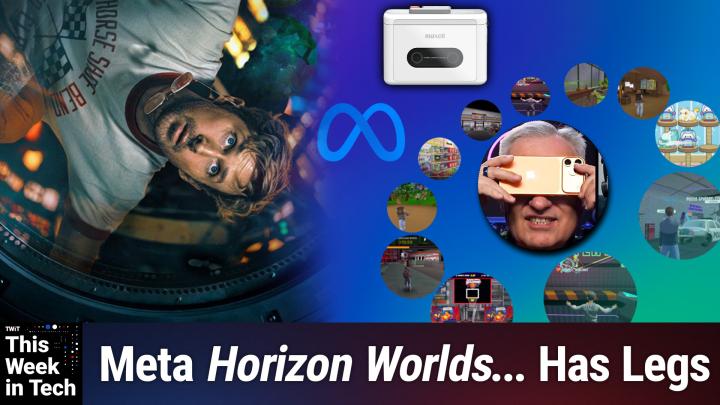
Use your imagination. Speaking of changes, well, this is kind of a strange story because earlier this week Meta said, you know that virtual reality world that you guys have been hanging out in your Meta Quest. We're going to shut that down. We're going to have a mobile version. We're not going to have a Meta Quest version. But very quickly, Janko had the story. They changed their mind. What happened, Janko?
Janko Roettgers [01:03:13]:
It was basically a day later they came out and were like, oh, our bad. We're actually going to keep it around. We're just not going to update it anymore, essentially. Oh, wow. You will not be able to create new worlds. And we will also not make any new worlds in VR anymore. But people can still use these existing Horizon Worlds, um, for the foreseeable future, which—
Leo Laporte [01:03:36]:
so what you're saying is Horizon Worlds has legs? It has legs.
Janko Roettgers [01:03:41]:
Yes, very nicely done. Yeah. And, and so it's a, it's an interesting and complicated story, right? Because it's one of those things where people are like, oh yeah, but VR has been dead and nobody's using it. And there's some grains of truth to it in Horizon Worlds in VR has never really been a big hit. I actually used it for a while quite a bit. I, I— did you? I like playing a couple of games. Arena Quest. Is that the— now I'm actually not remembering the name.
Janko Roettgers [01:04:10]:
That's maybe—
Leo Laporte [01:04:11]:
but you had to put on the nerd helmet to do it, the Meta Quest.
Janko Roettgers [01:04:15]:
But I mean, it was fun. And even without, in those pre-leg times, actually, that was— it was a lot of fun.
Leo Laporte [01:04:22]:
Once you're having fun, I had a Meta Quest. I've actually stupidly bought the $1,500 Meta Quest Pro. That was was insane. It was quickly marked down by about 50 or 100%, and, uh, no, I gave it away. But, uh, I played a few games in there. It was fun. I really liked the one where you listen to music and there's a Beat Saber. Yeah, I really enjoyed that, and that was fun.
Janko Roettgers [01:04:47]:
But I mean, so the, the, the bigger trends here is that VR is still around, people are still using VR, but the audience really has shifted. It was the last year or two where before it was a mix of like a little bit of everything. There was people who are doing fitness, like older people actually getting into this and people playing Beat Saber. And like one or two years ago, it really started to shift where now it's all like teenagers and younger, even kids using it. And they're all playing these like crazy, messy, free-to-play games, Gorilla Tag and so forth. Which are like, when you're my age, I just have to throw my arms up. I can't do this, but they're getting a kick out of it and it's actually getting used quite a bit. So that's to stay in VR.
Dan Patterson [01:05:35]:
It'll be interesting. I'm sorry to interrupt you, Janko. It'll be interesting to see, speaking of Steam, how the Steam Frame, their ARM-based VR headset that comes out this summer, how that kind of shifts the market. It, or at least, no pun intended, reframes it onto gaming.
Leo Laporte [01:05:54]:
Did Apple make a mistake not focusing on gaming with the Vision Pro?
Janko Roettgers [01:05:59]:
I think so. I mean, I don't know because it's a $3,500 device, right?
Leo Laporte [01:06:04]:
So those teenagers are not going to buy that.
Janko Roettgers [01:06:08]:
And the adults or their parents are probably not going to hand it down to them, which is what happened to a lot of those Meta Quest heads.
Leo Laporte [01:06:16]:
Meta Quest is pretty affordable if you don't do the Pro version.
Janko Roettgers [01:06:19]:
One for $300, which is actually really good. Uh, some oftentimes it's, it's even you can pick one up for $250 and for that it's like really hard to beat essentially. Um, but like going back to this Horizon Worlds thing, uh, so they say, oh, we're going to shut it down. Then they changed their tune on it because there was enough people in it really protesting and being upset about it because they had created stuff for it. There were, there's comedy clubs in there, there's like music shows in there, there's all these different games in there. People meet there. For Alcoholics Anonymous and those kinds of things. Really?
Leo Laporte [01:06:53]:
They're AA meetings in Meta? Yeah, there's all kinds of stuff.
Janko Roettgers [01:06:56]:
Wow. And, um, interesting, huh? So all of that goes away.
Leo Laporte [01:07:00]:
Great use for that. Yeah, come to think of it, you've got anonymity, you don't have to leave the house, but you can get support anywhere, anytime. I think that's actually kind of cool.
Benito Gonzalez [01:07:10]:
And then Meta gets to grow its list of alcoholics.
Leo Laporte [01:07:13]:
No, they don't. I hope not. I would hope not. Uh, that is strange marketing right there. There's still people playing Second Life. Right. Second Life has gotten weird, but there, I mean, it was always weird.
Janko Roettgers [01:07:25]:
It was always a little weird.
Leo Laporte [01:07:27]:
Uh, but that, so there's enough, I guess, well, not enough for them to keep it up to date.
Janko Roettgers [01:07:34]:
They're not going to work on it. And it also, like, there's some stuff that wasn't actually part of the official announcement, or it was kind of hinted at, but Meta has been moving to their own engine essentially for some of these things, like on mobile and on VR. They were using Unity, right? They were using Unity right now. If you get into Horizon Worlds in VR, most of that stuff is still Unity-based. And so they were going to transition to this new engine both on mobile and in VR. And essentially, I assume they just ran the numbers and were like, well, really not enough people are using it in VR. It's going to be very expensive to bring this new engine to VR, so let's just only focus on mobile with this new engine and let's shut everything down that's, that's not running on it. And then when people protest it, whether they were like, well, actually it's not that expensive for us keep the Unity worlds up and running.
Janko Roettgers [01:08:25]:
So let's do that. But the new stuff is going to be on mobile, essentially.
Leo Laporte [01:08:31]:
Interesting. I mean, if you're doing it for mobile, you might as well just do a Meta Quest version of it. I would imagine it's not—
Janko Roettgers [01:08:38]:
I mean, the mobile strategy I do not understand, to be quite honest.
Leo Laporte [01:08:42]:
Is it VR? How do you do it in mobile? You just hold your phone?
Janko Roettgers [01:08:45]:
No, you use your— it's mobile games, essentially. So when you do the Horizon app on your phone. You can now play games in it. And some of these Horizon Worlds social games where you meet with other people and do all kinds of stuff— strap your phone to your face. But, but so a lot of these games and a lot of games that they're investing in now are mobile only. And I'm still kind of unsure who's going to download the Horizon app to play mobile games because there's so many other places you can play mobile games and get mobile It kind of feels like, um, like meta, like there's still corporations that have a, like a contract in place for the metaverse.
Benito Gonzalez [01:09:25]:
So they can't shut it down.
Leo Laporte [01:09:27]:
You think it's that? Yeah. It's like Ford is using it to design cars or something. Why wouldn't they just shut it down? Well, do people, people don't pay to do Horizon Worlds, right? It's free, right? It must cost them so much money.
Janko Roettgers [01:09:41]:
You know, it must cost them so much money. Generally it's free. I think you can now, or you could buy certain things and they started to introduce some monetization stuff. Yeah, goods like in-game stuff, like everywhere. But also they don't really have a replacement yet, obviously. So they obviously cut back on the VR efforts. They like fired 10,000 people that were part of Reality Labs. They're concentrating more of their efforts on mobile and obviously they're spending a ton of money on AI.
Janko Roettgers [01:10:12]:
So they're cutting back, but they're still also not completely giving up. Up on it. They're still working on future headsets, like two different lines.
Leo Laporte [01:10:19]:
You know what would save it? Actually, it would save Second Life too if they use the new NVIDIA DLSS sexy filter. That would make it so much more fun. So GTC, the, uh, and we covered this on Monday, uh, Jensen Huang's keynote at the, uh, NVIDIA conference on Monday, and among many things they announced announced, one of which made the stock market jump when he said, "We're going to actually make $1 trillion selling our chips next year, up from $500 billion." But the thing that they announced that got the most attention, because gamers hated it, was something called DLSS 5, which takes existing game content and sexies it up. It adds the lighting, it adds some smoother textures, and that makes it more real. I think it makes it more realistic. I think it's actually pretty cool. But gamers just don't like AI, I guess. And there was a kind of a general sense of revulsion.
Janko Roettgers [01:11:18]:
There's also some problems. I think The Verge wrote about it, where in some of the sports games that use— actually, you have one up right there— that use actual characters based on likenesses of real athletes, when you add VR to it, it doesn't really understand who's who. Oh, they're just going to turn into this other good-looking dude, not a real athlete. Now a lot more detail but doesn't look at all like the person who is associated with the number on his shirt. Right. So that's a little problematic.
Lisa Schmeiser [01:11:45]:
I think honestly, uh, the, the, the skeets about this are, are absolutely hysterical. Um, oh, I think it with the before and after contrasts.
Janko Roettgers [01:11:55]:
Oh my goodness. Yeah, yeah, yeah. That's true. It was a good, good meme.
Leo Laporte [01:11:57]:
I think it looks pretty good. Uh, I'll be honest with you. Let me see if I can, uh, the Yassify filter, the Yassify. AI.
Dan Patterson [01:12:04]:
Look, I'm a gamer, but I like the— the gaming takes have all been, uh, pretty basic and boring. Like, it's— they—
Leo Laporte [01:12:16]:
gamers just have this kind of knee-jerk, yeah, revulsion to anything with AI. I got bad news for you. It's gonna happen no matter what you think.
Benito Gonzalez [01:12:24]:
Yeah, I gotta speak up for the gamers here.
Leo Laporte [01:12:26]:
It's okay.
Benito Gonzalez [01:12:27]:
I said this, I said this, I said this last week on Intelligent Machines, but it's about changing the art direction of the game. Like, this changes the art direction of the game, period.
Lisa Schmeiser [01:12:36]:
I think this changes the consensual reality, huh?
Leo Laporte [01:12:39]:
Don't you think this looks more like me than me? I mean, I think that that DLSS version of me is pretty— Hi there.
Lisa Schmeiser [01:12:48]:
So Leo, I have a question for you on that. You know, the Yassified version or the hello version. Is we already have this body of work that shows the negative self-esteem or the mental health effects when people spend way too much time scrolling through on Instagram or TikTok and they're seeing these AI-tweaked people that don't look like real life. Don't you think something like this, if you're also seeing in your games, don't you worry about how that might affect people's experience?
Leo Laporte [01:13:24]:
People know. I mean, I mean, we've— for a long time there was this thought that cartoons would make kids violent, but kids know the difference. That's a cartoon. Yeah. And even movies don't make people violent, even violent movies. I think people will know it's a game. I'm not expected to look as handsome as Leo Laporte.
Lisa Schmeiser [01:13:42]:
I think I can buy—
Dan Patterson [01:13:46]:
I can buy Benito's argument.
Leo Laporte [01:13:48]:
At least it is different. At least some, right?
Dan Patterson [01:13:50]:
Okay. A specific art direction or artistic intention, I can understand that argument. But I don't think that is every use case in gaming. I think that are— that is particular use cases. And especially when you apply this to older games, I think this— or games that don't have the budget of a AAA studio— I think this can provide It's one path.
Leo Laporte [01:14:20]:
It's going to be an option in the game too. If you don't like it, you go into your video settings and you just turn it off. It does have some potential risks. Here's a DSL— DLSS SpongeBob. And that's damn creepy. I don't think that's really what DLSS will do. I can't help it.
Janko Roettgers [01:14:40]:
But I think it is with the participation of the game publishers, right?
Leo Laporte [01:14:44]:
It's not like— Yeah. No, I think if you have an NVIDIA video card, you can turn it on on any game. Oh, I thought that publishers had to consent to this. Well, maybe they do, but that would be an artificial constraint because it's built into the card. You could do it without their permission. I mean, that's also the whole thing. That would be smart of NVIDIA to say.
Lisa Schmeiser [01:15:04]:
Well, you've raised an interesting question about consent then, haven't you? Because who gets to consent to this stuff?
Leo Laporte [01:15:09]:
Well, maybe NVIDIA is smart enough to say.
Janko Roettgers [01:15:11]:
Yeah, I mean, one could then— the counter-argument is, yes, the publisher may say do it because we like that everything looks so shiny now, but the artists who actually worked on the game may still be really upset.
Dan Patterson [01:15:22]:
But could you make the same arguments about ray tracing? Like, yes, I mean, that fundamentally changes how your game looks. It fundamentally changes how it looks. It's a setting and you can turn it on and off depending on your performance, but all that stuff is programmed in by the game designers. That's true, but it's also a button I can click to turn it on.
Benito Gonzalez [01:15:40]:
Yes, but they intended that.
Leo Laporte [01:15:41]:
They intended that. It's a, you know, I have machines that do AI upscaling. My Nvidia TV, my Shield, has an AI upscaling feature, and it actually does a very good job taking HD content, making it 4K, and it looks great. And, you know, Nvidia, it's probably the same technology, just a later generation. Or earlier generation of DLSS. Um, I don't know. I think we're gonna— I think the initial reaction will fade and we're gonna get used to this kind of thing.
Benito Gonzalez [01:16:11]:
There's also the whole—
Leo Laporte [01:16:12]:
take a break here. Listening to This Week in Tech with Dan Patterson, Lisa Schmeiser, and Janko Redkers. A great panel. Good to have you. We'll have more in just a bit. Elon's going to be paying some money, maybe some big bucks. Uh, this version, this episode, this segment of This Week in Tech is brought to you by OutSystems, the number one AI development platform. OutSystems helps businesses bridge the enterprise gap to their agentic future, where the constraints of the past give way to unlimited capacity and scale.
Leo Laporte [01:16:49]:
OutSystems enables them to build AI agents that can actually do work, such as take actions, make decisions, and integrate with data rather than just answer questions. OutSystems provides the only AI development platform that is unified, agile, and enterprise-proven. It's unified because you can build, run, and govern apps and agents all in one platform. It's agile because you can innovate at the speed of AI, importantly, without compromising quality or control. And it's enterprise-proven, trusted by enterprises for mission-critical AI applications and durable innovation. OutSystems, it's the secret weapon behind the world's most successful companies. Not just for small apps, no, these are, these are also for the massive complex systems that run banks and insurance companies and government services. OutSystems even helps companies with aging IT environments bridge the gap to the AI future without a rip-and-replace nightmare.
Leo Laporte [01:17:47]:
OutSystems provides the safest and fastest way for enterprise to go from, we need an AI strategy, yikes, to we have a functioning AI application. Stop wondering how AI will change your business and start building the agents that will lead it. Visit outsystems.com/twit to see how the world's most innovative enterprises use OutSystems to build, deploy, and manage AI apps and agents quickly and cost-effectively without compromising reliability and security. That's OutSystems, O-U-T-S-Y-S-T-E-M-S.com/TWIT to book a demo. OutSystems.com/TWIT. We thank them so much for their support. I take you back now to, uh, early 2022 when Elon Musk tweeted out, I'm gonna buy Twitter because it's just a mess and it's full of bots and it sucks. And, uh, he even, I think, said funding secured.
Leo Laporte [01:18:52]:
And, uh, he— yeah, no, that was another tweet. He— Elon was big at tweeting at the time. Um, the SEC even looked into his tweets because at some point it— he was so critical of Twitter, it looked like he had initially said he was going to pay $44 billion for Twitter, and it looked like maybe he was trying to drive the price down down by driving the stock price down. The SEC took a look at it— stock manipulation— and declined to do anything about it. Well, uh, a class action lawsuit from shareholders did do something about it. On Friday, a jury in California determined that Elon Musk had misled investors via public statements that depressed the price of the company's stock ahead of his purchase of the service. I mean, it was pretty— to me, it seemed pretty obvious that that's what was going on. A number of investors started a suit certified as a class action saying we've been defrauded.
Leo Laporte [01:19:59]:
The jury— and that Musk made them intentionally, those tweets, as part of a larger scheme. The jury rejected arguments about the larger scheme but did find him liable. Damages is not yet determined. That will happen later. But the plaintiffs are seeking as much as $2.6 billion, which I guess Elon could afford. He's worth much more than that. But even when you're worth $100 billion, a few billion starts to add up. Is this justice? Dan?
Dan Patterson [01:20:39]:
I'm curious, maybe I just haven't Googled this deeply enough.
Leo Laporte [01:20:42]:
I'm curious about which shareholders joined this. Steve Garrett, Nancy Price, John Garrett, and Brian Belgrave sued him in October of 2022, the month before he actually closed the deal. I mean, is it justice?
Dan Patterson [01:20:57]:
I think you said it yourself, it seemed his tactics it, it seemed like he was trying to do something very particular. So I think that if you— if you— you should know who you get into bed with. Ah, good point.
Leo Laporte [01:21:13]:
Uh, so he tweeted in May of 2022 saying, I'm going to put the Twitter deal on hold pending details supporting calculations that spam and fake accounts do indeed represent less than 5% of users. Twitter had asserted that He said, I don't buy it. I think it's a lot more than 5%. Now that he's the owner, we know it's a lot more than 5%. He also said in a May 16th comment at a conference that he believed that 20% of Twitter users were fake accounts. When the then Twitter CEO Parag Agrawal said, uh, there's no way for a third party to even know this. We don't make that information visible to third parties. Elon tweeted a poop emoji.
Leo Laporte [01:22:03]:
This might be the first time a jury has found a poop emoji misleading. Uh, Elon loves the poop emoji, by the way.
Lisa Schmeiser [01:22:11]:
Wasn't this the same case where they had a hard time finding a jury because so many people were like, I hate that guy?
Janko Roettgers [01:22:17]:
Maybe they didn't It's been a little while, but I also remember, vaguely remember that him making the point about the bots was like really back of the napkin math. He's like, well, I tweeted something and then I read all the retweets and comments and they're all bots. And really that only proves that all your followers are bots.
Leo Laporte [01:22:40]:
You know, it doesn't mean anything. Are you the— it says more about you than it does Oh, uh, so, uh, Twitter ultimately sold, uh, for, for a lot more than, uh, probably it was worth— $44 billion, uh, after, uh, Elon was forced by a Delaware court to buy it at the price that he had quoted. He didn't want to. He was trying to get out of it. The jury deliberated for 4 days, so that means it was It wasn't like an instant, like, oh yeah, this guy's guilty. It took them 4 days, but they did unanimously find that the tweets from May 13th and May 17th were materially false or misleading. But they didn't hold him liable for the press conference or the comments at the conference from May 16th. And they said even though the plaintiff's part of the lawsuit was that there was a scheme going on, they didn't, they didn't agree with that.
Leo Laporte [01:23:43]:
But they are going to award damages per share of Twitter stock for each day of the class period, which goes from May 13, 2022 to October 3, 2022. So it could be, could add up to quite a big deal.
Janko Roettgers [01:23:59]:
And the irony of all of that is that his, if there was a scheme It clearly didn't work because he had to pay the original price. And now he has to pay on top of it for some stupid tweets that he did.
Leo Laporte [01:24:14]:
Elon had taken the stand during the trial saying, I really did have concerns over the bots and I didn't intend to drive the stock price down. I was, that wasn't my meaning at all. I guess they were not persuaded.
Janko Roettgers [01:24:32]:
Maybe some of it. But at the same time, you argued that he should pay less for it. So, right. Kind of undermined his argument a little bit.
Leo Laporte [01:24:38]:
Good point. He was trying to get out of the deal at the time. Yeah. In other news, Samsung is ending sales of its $2,900 tri-fold phone. This on the heels of news that Samsung is, is really suffering in its phone business, that it's, that it's losing money hand over fist, which is a surprise since it is the number one Android handset, I believe. Yeah, that is a surprise. I think that the trifold sold well. Buyers were paying above retail on the, on the, on eBay and other secondhand markets.
Leo Laporte [01:25:24]:
Um, there's Ars Technica speculates it might have more to do— Ryan Whitwam, Ryan Whitwam, sorry, writing in Ars Technica— it might have more to do with the cost of the components, with RAM prices doubling and so forth, which could also explain why they're losing money on phones in general, right?
Dan Patterson [01:25:42]:
Yeah, yeah, yeah, yeah, absolutely. Yeah. And, and storage and processors.
Leo Laporte [01:25:50]:
It's all gone through the roof.
Dan Patterson [01:25:52]:
All gone up. And I have to say— I think you're right.
Leo Laporte [01:25:56]:
That at this point, the Iran war, the resulting oil crisis is going to hit a lot of companies really hard.
Janko Roettgers [01:26:07]:
And helium, right? Yeah.
Leo Laporte [01:26:10]:
A helium plant was destroyed. This is a— besides, it's not just for balloons anymore. No. It's used in semiconductor manufacturing and medical devices, I might add. And that's going to really hit the helium supply. So we're economically, we're in a world of hurt, I think.
Janko Roettgers [01:26:29]:
Except for Party City. Yeah. Party City. Party City got hit by the vulture capitalists.
Lisa Schmeiser [01:26:40]:
Oh, it's gone, huh?
Leo Laporte [01:26:41]:
Yeah. We used to have one.
Lisa Schmeiser [01:26:42]:
We don't have one. Private equity rode again. That's where I got all my balloons. Yeah, you have to go to a dollar store now because I think they still do them there, or a grocery store.
Leo Laporte [01:26:53]:
That's sad. I, that, yeah, we used to get those big Mylar, you know, 70th birthday balloons, things like that. Yeah, you can't get them anymore, I guess. Um, speaking of the war, uh, there has been some concern with the slashing of CISA, our national security organization. They had a leader who left after a year of turmoil, and they have a temporary leader now, and many, many cybersecurity experts were fired. That with the war in Iran, there's some concern about Iran hacking activity. So far, there's only been one, I don't know, kind of minor event. Maybe it's not so minor if you're one of the 200,000 devices were erased.
Leo Laporte [01:27:44]:
A medical equipment provider called Stryker was hit by a hacking group, Handala, claiming to be pro-Iran. They say they erased data from 200,000 devices, including servers and mobile phones used by their Stryker employees. I mean, if that's all— that's not—
Lisa Schmeiser [01:28:05]:
I mean, as bad as it is that we know about right now, right? Yeah. I mean, this is—
Dan Patterson [01:28:10]:
we're working with an incomplete data And as the conflict intensifies and perhaps prolongs, asymmetric attacks will likely increase. That, I mean, that's just geopolitics, and it's, it is one tool that somebody who is an actor that's on the defense is like, especially—
Leo Laporte [01:28:32]:
what do you mean by asymmetric in that?
Dan Patterson [01:28:34]:
Well, I mean, the US has greater kinetic capabilities, and we have greater economic capabilities, meaning we can just fund things for longer. There will be some attrition, but we can fund— we can fund our kinetic activities longer. So an actor on the defense will, will use tactics. I mean, this is a time-tested— in every war ever, this is what happened in Vietnam, in Vietnam for sure.
Leo Laporte [01:29:03]:
Yeah, yeah, absolutely.
Dan Patterson [01:29:05]:
So So we saw guerrilla warfare in Vietnam, and cyberattacks are the new form of that. And Iran is one of the most— they are not up there with the US or Israel in terms of their cyber capabilities, but I would put them— they're certainly as good as North Korea, and much better than most of the other—
Leo Laporte [01:29:30]:
their peers.
Dan Patterson [01:29:32]:
They, they are very cyber capable and they learned a lot from Stuxnet. So again, I wouldn't expect we see massive cyber attacks targeting critical infrastructure right now, but perhaps the likelihood would increase as the duration of the conflict extends.
Janko Roettgers [01:29:49]:
And adding to that comes physical attacks on infrastructure, right? I think just this morning, Iran said when there was this whole back and forth about that Strait of Hormuz and Trump said he wants to blow up power plants. Now Iran mentioned a bunch of targets that they would retaliate on, and interestingly, uh, IT infrastructure was part of that. And there was like early on in the war, there was the attack on the Amazon, uh, cloud data center in— was it in Dubai? I don't remember exactly. One of them, there was one of them exactly, one in Bahrain I think, and one in, uh, UAE. And all those countries are— a lot of those countries are trying to become havens for AI companies, right? They're investing heavily into it.
Leo Laporte [01:30:32]:
You'd be nuts to build a data center in the Middle East right now. You'd be nuts to build anything in the Middle East right now, actually. Is it just me? I've, I'm made very nervous. I have not been sleeping well. I'm very nervous about all this. I know it's far away from us in the United States.
Lisa Schmeiser [01:30:48]:
It's not though, because the Strait of Hormuz Controls of the world's oil.
Leo Laporte [01:30:53]:
Yeah.
Lisa Schmeiser [01:30:54]:
Yeah. So it's threatening everything from, from, from how we move goods and services because the price of diesel is going to shoot up to whether or not we will be able to have genuinely global networking and data movement. Because when cloud centers go down, that's going to hit people in different places. And if you have hackers coming in and targeting targeting medical service companies, that's the beginning of an iceberg. What about utilities? What about hospitals?
Leo Laporte [01:31:27]:
How complex is that? I'm very nervous. And I'm also nervous about the use of tactical nuclear weapons. Oh, Jesus. Yeah.
Lisa Schmeiser [01:31:34]:
Yeah. No. I don't think there's any such thing as a tactical nuclear weapon when the effects are shown to be global in nature anyway.
Dan Patterson [01:31:44]:
Yeah. Launch on warning status with all of our nukes. Oh God, yeah. Um, but I, I mean, like, I would be surprised if we— I, well, I won't be surprised. I, I don't know. I mean, this talk of tactical is— you're right, Lisa, it— tactical becomes strategic very quickly, especially with nuclear conflict.
Leo Laporte [01:32:05]:
Um, I just— and there's the huge humanitarian cost. Now, I did say that tremendous— we're in the U.S., but many of our listeners are— we have listeners all over the I'm always glad when I see Galia in our Club Twit Discord. She lives in Tel Aviv, and I'm terrified for her. I have— we have many listeners in the Middle East right now. The humanitarian cost in Iran alone is heartbreaking. Heartbreaking. It's a nightmare. Galia says she was in a shelter during the show.
Leo Laporte [01:32:40]:
Oh, already. She was down there. And she came back up to join us. I just— it's gonna be good news for the box office on Project Hail Mary, however, because escapism, as you know, when times are tough, people go to the movies. Japan has decided as of October 1st, to allow what they call proactive cyber defense. That's called hacking back. Yeah, yeah. This is something we've always eschewed.
Leo Laporte [01:33:19]:
From time to time, I think our FBI and others have, for instance, put out malware that removes malware, but it's always a very risky thing, and there's always this nervousness that this will escalate as well. You know, we know nukes escalate, that that's a bad thing to use a nuclear weapon. We know that very well. And as a result, no one's used a nuclear weapon since World War II. And we were the only ones who've ever used a nuclear weapon. But I think sometimes I think that cyber attacks could escalate to that level of risk as well. You attack their infrastructure, they attack our infrastructure. And I don't know if we're very, very vulnerable.
Leo Laporte [01:34:03]:
This is happening all the time.
Dan Patterson [01:34:05]:
You know, there were very well-documented cyberattacks on gas infrastructure in 2021, '22. Look, everybody is hacking everybody all the time. But Leo, to your point, we had a policy that was, Stuxnet was an interesting event for a number of reasons. It certainly was an interesting cyber event, but it also shifted our policy. And you're right, Leo, we—
Leo Laporte [01:34:32]:
Just as a little bit of history, Stuxnet was created by the Israeli and American forces to break—
Dan Patterson [01:34:40]:
Under the Obama administration.
Leo Laporte [01:34:43]:
During the Obama administration, to attack the SCADA devices that were used in the Iranian centrifuges. To control the speed. To basically break them, to turn them up so fast that they'd break so that they could enrich uranium as a precursor to making an atomic weapon. And it was very effective, except it was really interesting, by the way, the hack, because those SCADA devices were air-gapped. So they had to figure out some way to get them on there that was very clever, except it leaked out and was widely used in attacks by hackers against us.
Dan Patterson [01:35:23]:
Yeah. And it also shifted her policy from defensive to maybe it's okay to do a little offensive.
Leo Laporte [01:35:32]:
Well, Japan has now decided that the time is right to allow offensive ops because online the nation faces, quote, "the most complicated national security environment since World War II." The chief cabinet secretary Minoru Kihara explained the threat from cyber attacks are having a huge impact on people's lives and economic activities. This is quite an important threat to national Japanese national security. So they're going to enact the proactive cyber defense actions, allowing, if authorized, and it looks like it will be, Japanese police and the security forces to attack and disable infrastructure infrastructure. Only— we're only going to attack the infrastructure that's used to run cyber attacks. But I guess that could include SCADA devices.
Janko Roettgers [01:36:30]:
Uh, I—
Leo Laporte [01:36:31]:
this is just one more step in a kind of a weird escalational spiral that frankly terrifies me, especially when you look at Cuba, uh, where the power has been out now all week. The whole island. Imagine what would happen if we lost— well, you wouldn't have a TWiT podcast if we lost power for a week. That wouldn't be the worst of it, I know, but everything we do, our entire lives rely on electricity. That's enough Americans.
Lisa Schmeiser [01:37:05]:
Think of all the medically fragile people who would die. Think of all the people who are on ventilators. Think of all the babies in ICU. Think of all of the the people who depend on medical equipment to live.
Leo Laporte [01:37:17]:
Not to mention the fact that our food supply, we really only have 5 days worth of food without food deliveries. And if that falls apart, mass starvation ensues. I hope you have a victory garden. I bet you're growing tomatoes, Lisa.
Lisa Schmeiser [01:37:35]:
I just feel like you must be growing tomatoes. I do. We, we, I was actually going through going doing well, we could probably barter a lot of citrus. But in California, we have that, we have an apple tree. I do garden, but not enough to support everybody who lives here. Right.
Leo Laporte [01:37:51]:
It actually isn't that hard to do that. You wouldn't need that much space to do that.
Lisa Schmeiser [01:37:56]:
No. I saw something on social media today, and I can't credit who it was from, where they were like, look, we can't micro-garden our way out of 2026, but this is a great opportunity for us to start having conversations about what the food systems in the US look like and how people can live in high-density places and still have a little bit more food autonomy than they have. So, I mean, this is the other thing too, is it's one thing to be like, "Oh, I grew everything on my own backyard." And there were books about that through the 2000s. Do you remember? Yeah.
Leo Laporte [01:38:30]:
Like Animal, Vegetable, Miracle. I kept meaning to do that.
Lisa Schmeiser [01:38:33]:
Well, like the thing that they point out is you have to have an enormous amount of time and an enormous amount of space. Yeah, I mean, there's— I wanna do a—
Benito Gonzalez [01:38:42]:
There's a reason humanity stopped doing that.
Lisa Schmeiser [01:38:46]:
I have a friend— But what we can do is we can take a look at some of the models we've seen, like in Europe where they do have community gardens and people have their little sheds to hang out.
Leo Laporte [01:38:54]:
I have a friend who's really into aquaponics. He has a greenhouse and they have fish. The fish fertilize the vegetables and fruit and then you can eat the fish.
Lisa Schmeiser [01:39:02]:
So I was a microbiology undergraduate my undergraduate research was actually in recirculating aquaculture where the engine— it was a huge cross-departmental collaboration. And my job was honestly just to assay bacteria because that's what you do when you're 21. And the whole point was it was supposed to be a self-contained recirculating facility for growing tilapia. And then the nitrogen can be used for fertilizer and things like that. Those are incredibly incredibly complex and finicky systems. It's not just a matter of sticking some fish in a tub and putting in a pump and calling it good. There's a lot of chemistry involved. And modern agriculture is really data-driven.
Lisa Schmeiser [01:39:48]:
A lot of these tractors are tied into satellite services that tell you when to do everything you need to do in the fields and exactly how much fertilizer to put down and when and how to water and things like that. And farmers know what they're doing, and asking us all to upscale to that level in a hurry is probably not going to be as successful as we would like it to be. Yeah. You know, but yeah, I think everyone should try growing tomatoes. Go to the store, get a 5-gallon bucket from Home Depot, look it up on the internet. You can grow tomatoes in like a little patch of sunshine on your front porch or your back porch.
Leo Laporte [01:40:23]:
There's nothing better than homegrown tomatoes. Oh my God, they're amazing.
Lisa Schmeiser [01:40:26]:
Yeah. Is it too late?
Leo Laporte [01:40:28]:
Is it too late to plant them or is this the right time?
Lisa Schmeiser [01:40:31]:
No, no, no, no, no.
Leo Laporte [01:40:32]:
Now's the time. Yeah. Jakob, you live in an apartment. Do you have somewhere you could plant tomatoes?
Janko Roettgers [01:40:37]:
No, I do. I actually live in a house here. We do a little bit of gardening. Yeah. Oh, good. I'm not very good at it either because in part because our backyard is sort of shady. Yeah. And then it gets warm suddenly and I forget to water and all those things.
Janko Roettgers [01:40:51]:
But the plan B is just go to your local farmer's market. Market. Yeah, I think so. If you want to, uh, you know, reduce the use of fossil fuels, not getting your apples from South America is a good start.
Lisa Schmeiser [01:41:05]:
Yeah, there's— there— I think there's a lot to be said for eat local.
Janko Roettgers [01:41:09]:
Um, it also tastes better. Yeah. Oh yeah.
Lisa Schmeiser [01:41:14]:
And I would argue that— would it be nice to have strawberries in November sometimes? Sure it would, but they're going to taste terrible. And And like, just wait. I mean, I can say this from a position of California privilege. And sorry about that, Dan. I'm sorry about that, Dan.
Leo Laporte [01:41:31]:
We have to relearn canning and making of jams and all of that stuff, right? And salting our beef. We're going to all need to learn how to salt meat. And do you have a potato cellar? I'm just saying, if not, start digging.
Lisa Schmeiser [01:41:47]:
If he— oh my gosh, you guys should look up potato sack because I kid you not, we grew 50 pounds of potatoes one year. One of those things was life-changing. That's like The Martian. Oh my God. Love that movie. I cannot wait for Project Artemis.
Leo Laporte [01:42:00]:
I have to go soon. We have learned you can grow potatoes in space. Yes. We just learned that. It was a fictional trope. But in fact, they were able to grow potatoes on the International Space Station. So there. Let's take a break.
Leo Laporte [01:42:21]:
We have more to talk about, and we have a wonderful panel to do it with. Lisa Schmeiser from nojitter.com, Janko Rekkers, lowpass.cc, and of course, Dan Patterson, blackbird.ai, another radio refugee. Our show today brought to you by Modulate. This is really cool. This is a really interesting use of AI. Every day, enterprises generate millions of minutes of voice traffic, right? Customer calls, agent conversations, and sad to say, fraud attempts. Most of that audio is still being treated just like text, basically flattened into transcripts which strips tone, intent. Frankly, it strips out the risk.
Leo Laporte [01:43:11]:
But Modulate exists to change that. First proven in gaming, Modulate's technology supported major players like Call of Duty and Grand Theft Auto. And where there's all that chatter going on, Modulate was used to separate, you know, just playful banter from intentional harm at scale. And it works. Today, Modulate helps enterprises, including Fortune 500 companies, understand 20 30 million minutes of voice every day by interpreting what was said and what it actually means in the real world. This capability is powered by Modulate's newest ELM. It's called Velma 2.0. Velma is a voice-native, behavioral-aware model built to understand real conversations.
Leo Laporte [01:43:57]:
It's not just a transcriptionist. It orchestrates 100+ specialized models, each focused on a distinct aspect of voice analysis. This is such a triumph of AI to deliver accurate, explainable insights in real time. It works so well. Velma's ranked number 1 across 4 key audio benchmarks, beating all the large general foundation models in accuracy, cost, and speed. Velma's number 1 in conversation understanding, number 1 in transcription accuracy and cost, cost, number 1 in deepfake detection, number 1 in emotion detection. It's really not a surprise. Velma is built on 21 billion minutes of audio.
Leo Laporte [01:44:40]:
Velma is 100 times faster, cheaper, and more accurate than LLMs at understanding speech, and this includes the top frontier models like Google's Gemini, OpenAI, and xAI. Most LLMs are a black box, not Velma. Velma doesn't just assess a conversation as a whole but breaks it down for greater accuracy and transparency by producing timestamped scores and events tied to moments in the conversation, meaning you can see exactly when risk rises, when behavior shifts, or intent changes. With Velma, you can improve your customer experiences, reduce risks like fraud and harassment, detect rogue agents, and more. Go beyond transcripts. See what a voice-native AI model can really do. Go to Modulate's live ungated preview preview of Velma at preview.modulate.ai. You'll be blown away.
Leo Laporte [01:45:33]:
That's preview.modulate.ai to see why Velma ranks number 1 on leading benchmarks for conversation understanding, deepfake detection, and emotion detection. Velma, check it out at preview.modulate.ai. Really, really good. Speaking of Sears and voice fraud, it all ties together in the end. Exposed AI chatbot phone calls and text chats. They were saving them to a wide-open database on the web. And of course, when you talk to a customer service chatbot, you may be giving personal information, contact information, phone numbers. Now, Sears department stores, as we were talking about earlier, are gone, but They still have brands and they still have an appliance repair business still going on.
Leo Laporte [01:46:30]:
And in fact, they're even so up to date, they have an AI chatbot and a phone assistant named Samantha. Unfortunately. Always named after women. Samantha. Hello, Sam.
Lisa Schmeiser [01:46:43]:
Yeah. Always, always a woman that's helping you. It's always. Well, because you know why?
Leo Laporte [01:46:50]:
And this is true of fighter pilots too. We listen to female voices. We ignore men. In. Yeah. Right?
Lisa Schmeiser [01:46:55]:
Actually, what's really interesting, I don't remember the— What? Sorry, did you not hear me, Dan?
Leo Laporte [01:47:01]:
Are you not listening?
Lisa Schmeiser [01:47:03]:
I don't remember the vendor off the top of my head, but we recently got pitched by a company that was telling us about the different specialized AI agents it was building for different lines of work. And what I noticed when they did the pitch was for HR and for marketing, they had given the agents female names. Names and for IT troubleshooting. Oh yes. And procurement. Yeah, no, they were. Um, more troublingly, the IT troubleshooting was like named Vikram. And oh no, I was like, have you rebooted the computer?
Janko Roettgers [01:47:35]:
I was like, this seems—
Leo Laporte [01:47:36]:
I can't believe they named it Vikram.
Lisa Schmeiser [01:47:37]:
I was like, this seems vaguely problematic. Yes. Oh my God.
Leo Laporte [01:47:44]:
And when you call up to get recipe advice. It's always a nice Italian voice. Mario Antic.
Lisa Schmeiser [01:47:51]:
I actually assigned a reporter to look into and talk to people about, hey, how is agentic AI enforcing and introducing systemic bias into workplace interactions? Because if this is what vendors are putting forward, how is this shaping the way people perceive people named Vikram in real life? I'm sure all of you are IT geniuses. Or You know, well, the way they're saying this seems to be a female role or a male role. Yeah.
Leo Laporte [01:48:21]:
Jeremiah Fowler, security researcher, found 3 publicly exposed databases from Sears containing massive troves of chat logs, audio files, and text transcriptions from Sears Home Services customers. 3.7 million chat logs. 1.4 million audio files, all public. Fowler said, I found a CSV file that contained 54,359 complete chat logs with Samantha. Nobody with no Vikram chats though. No. Anyway.
Janko Roettgers [01:49:02]:
Do you want a CSV file that tells you 50,000 times to turn it off and on again? You don't need that.
Leo Laporte [01:49:10]:
You don't. That's right. You don't really need that. You need that one. Let's talk about prediction markets, 'cause this is a really interesting growth market. We've all heard about Kalshi now. What's the other one? Polymarket, right? Polymarket, yeah. These are basically gambling, right? It's obvious.
Leo Laporte [01:49:37]:
For— but they call it a prediction market, so it's not illegal in many states or any states because I guess it's kind of a loophole.
Lisa Schmeiser [01:49:44]:
Wait a minute, Nevada just outlawed—
Leo Laporte [01:49:46]:
well, Arizona just filed criminal charges over at Cal-SHE over illegal gambling. Nevada, which is the home of course of all those casinos, has been, uh, and made them illegal. Um, nevertheless, there's billions of dollars being traded back and forth, and the problem with these prediction markets is you can bet on anything. And we've seen this, insiders from the Pentagon who knew something about the Venezuela extraction of Maduro would place a bet right before it happened saying, "Yeah, I think Maduro's going to be captured in the next 2 weeks." And then it happened and the person made $300,000. The other thing about these prediction markets is they're basically anonymous. You can use crypto and so forth. Of course. Good news, Major League Baseball, which I guess FanDuel and DraftKings was already taken by football.
Leo Laporte [01:50:45]:
Major League Baseball struck a deal with Polly Market, the official event prediction platform. Major League Baseball is already, you know, I mean, remember Pete Rose was kept out of the Hall of Fame for betting on a baseball game. Those rules are kind of long gone.
Dan Patterson [01:51:05]:
And they've prosecuted, or at least come down pretty hard on players who were clearly throwing—
Lisa Schmeiser [01:51:13]:
Throwing games.
Dan Patterson [01:51:14]:
Yeah, throwing games, throwing in the dirt, or predictions on particular pitches, right?
Leo Laporte [01:51:20]:
Major League Baseball, there actually last year was a case of two players facing federal charges for manipulating their on-field performance. So what's the best way to ensure the integrity of the game? Do a deal with Polymarket, right? Because then you could do prop bets on anything.
Dan Patterson [01:51:41]:
Look, there's a lot of reasons to dislike Pete Rose, but it's, it's really— the league really has to confront that hypocrisy. It's fair.
Leo Laporte [01:51:53]:
It's fair. It's just unbelievable. I just— but I guess there's so much money Well, I'm wondering how long until we're going to see some legislation around this. Well, and you know, the sad thing is most of the time that legislation comes from lobbyists with the casino operations who say, if you're going to defang it as much as possible to our casinos.
Dan Patterson [01:52:16]:
This really feels like, I mean, there are conversations, especially in the media world, about how this is an interesting and new emerging technology, and there are reasons to consider it. But this really, to me, feels like the, like, 2000, 2001, 2002 era of crypto where there was a rush to the space and we saw massive companies doing massive deals with crypto companies, uh, before regulation came in and we found out there was— oh, surprise— there was a ton of fraud going on.
Leo Laporte [01:52:51]:
So poly market.
Lisa Schmeiser [01:52:53]:
No, it's, it's, it's, I think you're right. Crypto is a really great analysis for that where people like to— Makes it easy. Well, people like to make it sound like they know what they're talking about too. And they've gamified the experience. And all you have to do is give someone the quick dopamine hit and like, oh, there is nothing wrong with this ever. Donk.
Leo Laporte [01:53:13]:
So what is the, what is a particularly masculine thing that we men do. We are standing monitoring the situation, right? With our arms folded, just watching it go down. We're monitoring this. Well, Polly Market has created the Situation Room in Washington, D.C., where you can monitor the situation. It's got big screens with the world, you know, the war, everything. You can bet on anything. It's not a sports bar. Live X feeds, flight radar, Bloomberg terminals.
Dan Patterson [01:53:50]:
Where you can sip your bourbon and smoke a cigar.
Leo Laporte [01:53:53]:
And monitor the situation.
Lisa Schmeiser [01:53:56]:
Men's spaces, men's activity zone. You can tell.
Leo Laporte [01:53:59]:
Look, there's a cigar, there's some whiskey. It's opening March 20th on K Street, just up the street, K Street. On K Street. That's where all the— that's where all the— yeah, that's— isn't that where all the lobbies—
Dan Patterson [01:54:15]:
all the lobbyists are?
Lisa Schmeiser [01:54:16]:
Yeah, this is like the most 2026 thing ever, isn't it? It just—
Leo Laporte [01:54:20]:
yeah, if I could get this napkin for Christina Warren— she collects this kind of memorabilia— meet me at the Polly Market Situation Room News Bar.
Benito Gonzalez [01:54:29]:
This is just DC's version of watching a construction site. You know how men can't stop, can't help but stop? Yeah, look at this.
Lisa Schmeiser [01:54:37]:
But this is not just construction.
Leo Laporte [01:54:39]:
You can monitor the world situation, everything going on. And you can make— and because it's a poly market, you can make a bet on any of this. Will his hair catch on fire when he's lighting the Olympic torch? 6-to-1 odds.
Dan Patterson [01:54:57]:
There are other places I would like to spend my time.
Leo Laporte [01:55:02]:
I'm monitoring the situation. Jeez, I'll flip. What a world we live in.
Benito Gonzalez [01:55:07]:
Also, prediction markets are like the wrong name for this. It should be prophecy markets. Markets, because like, yeah, when you watch this, like the election, like the elections in the last week's elections, like they were all wrong. It was all what the people who are betting wanted to happen, not were thinking, wishful thinking.
Lisa Schmeiser [01:55:23]:
Well, there was no story where that journalist got threatened. Oh yeah, where they were reporting on, um, what, bombing in, in the Middle East?
Leo Laporte [01:55:33]:
They were gonna kill him because he had people—
Lisa Schmeiser [01:55:35]:
they're like, I bet this and you said that, and, and you Well, first they reached out and tried to do the more flies with honey thing with, hey, there's an inaccuracy in your story. If you could report this instead, that would be great. Thank you. And like a good journalist, this guy was like, oh, did I get something wrong? And then he's like, no. And then he was like, why am I getting so many messages from people whose social media handles are all about online betting? And then he realized that what was happening was these guys had bet against what he reported, and they wanted him to change, change his story, change his story so they could recoup their losses. And they began threatening him when he wouldn't do it.
Leo Laporte [01:56:13]:
Wow. Yeah.
Lisa Schmeiser [01:56:18]:
No, it was a— it's a genuinely disturbing thing because it's, it's another way where, you know, you're going to have under-resourced reporters who, whose names are attached to reporting the facts who are going to get threatened by institutional bettors. And, uh, you know, what kind of backup do they have? What kind of protection will they have? And it's easy to find your address with data sold by data brokers or given to you by Kash Patel. Yes. Hi, here you go.
Leo Laporte [01:56:43]:
This is reported, it's bugging me. And of course Kash goes, yeah, is he, uh, is he a liberal?
Lisa Schmeiser [01:56:48]:
Well, don't these guys also— don't these markets also advertise on podcasts? Isn't it all just one giant—
Leo Laporte [01:56:53]:
oh yeah, not on mine. Yeah, no, not on mine. Uh, In fact, we've turned down not an insignificant amount of money from crypto investments and prediction markets and all this stuff.
Lisa Schmeiser [01:57:06]:
Well done, Leo. Well done.
Benito Gonzalez [01:57:07]:
But this is the reason why they don't allow sports teams in Vegas before, right? Is because like the mob would threaten the players.
Leo Laporte [01:57:14]:
There's nothing bigger now than the Knights and the Raiders. Vegas is Sports City USA now.
Lisa Schmeiser [01:57:22]:
Although if you ask, every time I go to Vegas, I'll ask a Vegas driver, you know, hey, how are you feeling about the Oakland A's? They're like, we don't want them.
Leo Laporte [01:57:30]:
I was just gonna say, except for the A's. Yes, to a person. No one asked for this. Poor Oakland wanted them. Nobody wants them.
Janko Roettgers [01:57:41]:
We have to—
Leo Laporte [01:57:41]:
ballers didn't want their owner. What are they called, the Ballers?
Janko Roettgers [01:57:45]:
Yeah, it's the Oakland Bees. The Oakland Ballers are fantastic.
Lisa Schmeiser [01:57:48]:
The game—
Leo Laporte [01:57:49]:
are they playing at the Coliseum?
Lisa Schmeiser [01:57:50]:
No, no, no, no, no, they played a completely different venue one It's a little bit closer to Emeryville, actually.
Leo Laporte [01:57:56]:
And it's AAA or is it Single-A? Is it, is it good? It's fun. Uh, we used to have a, uh, No-A minor league baseball team in Sonoma called the Crushers because it was like grape crushing grapes. Yeah, yeah, yeah, yeah. And it was, it was so much fun because there it's like handymen and high school teachers. Now these guys are pro, but they're like Well, they're pros. They want to be pros. Yeah, it's an independent league. They got Kevin Mitchell, the former San Francisco Giant, to manage them.
Leo Laporte [01:58:29]:
So it's called the Pioneer League.
Lisa Schmeiser [01:58:30]:
They're part of what's called the Pioneer League. They play at Raimondi Park. It's so much fun. Like, one of my favorite things from last summer is I went during the day that they teamed up with the Oakland Zoo. And awesome. Oh my gosh, no, they were giving out like possum hats. They had Oakland, they had Oakland's docents there to give you animal facts. The Oakland Bees mascot is actually a possum as well.
Lisa Schmeiser [01:58:54]:
So it was just this great synergy of two really classic, you know, pro-community Oakland teams.
Leo Laporte [01:58:59]:
They have to do this stuff because otherwise they wouldn't sell tickets. So the Crushers, they would have, they have like a Bark-A-Lounger right behind home plate that you could win the right to sit there during the whole game and watch the game, which sounds That's deadly. They would always, they would have amusements in between every inning, right? I'm sure the possums do the same thing. Oh yeah, yeah, yeah. Like with the one where you bring 10 kids out and you have them put their forehead on a baseball bat and run around in a circle on the home plate until they get really dizzy and see if they can run to first base. Oh, I love those.
Lisa Schmeiser [01:59:33]:
That's a barrel of laughs. Yeah, no, like one of my goals for this year is to get up to a Humboldt Craps game. I love independent baseball. But the Oakland Ballers, they were such a good time last year. I also go to the Oakland Roots games because I'm for all of the small non-NFL. And no, I would say if you are in the East Bay, do yourself a favor and get to an Oakland Ballers game this season.
Leo Laporte [02:00:00]:
It's going to be amazing. It used to be farmhands and stuff. That's what baseball used to be. Be. Yeah. Um, yeah, so it's too bad it got so corporatized and—
Lisa Schmeiser [02:00:11]:
yeah, but anyway, so expensive.
Leo Laporte [02:00:13]:
We're all about the Oakland Bees now.
Lisa Schmeiser [02:00:14]:
Las Vegas hates the Oakland A's. Oh, betting is happening. Betting is coming for us all, Leo.
Leo Laporte [02:00:20]:
The Bees replaced the A's. I get it. Yes, yes, now I get it. Uh, that took a while. The whole world started going downhill. I could tell you the exact date, March 21st, 2006 was when it all started going to hell. That was the day Twitter launched, 20 years ago yesterday. Oh, no kidding.
Leo Laporte [02:00:41]:
The first tweet, Jack Dorsey, the first tweet. And it wasn't called Twitter with an E, it was Twitter without the E.
Lisa Schmeiser [02:00:50]:
That was the fashion, because you had Tumblr. Like Flickr.
Dan Patterson [02:00:53]:
Flickr. And remember, and you can only interact with sending a text to 404. 404.
Leo Laporte [02:00:59]:
That's right, because it was originally— it was the only way you could do it before.
Dan Patterson [02:01:03]:
Only way you could interact.
Janko Roettgers [02:01:04]:
Yeah, and that's why it was 140 characters, right? Yeah, that's why.
Dan Patterson [02:01:07]:
Yeah, I remember I was on, uh, Odeo, which is a podcasting platform started by Biz and Ev and, and some of the others who co-founded Twitter. And we logged in one day and they said, we're shutting down Odeo to start this new site called TWTTR. So A bunch of podcasting nerds signed up. That's right. Yeah, right around now, 2006. Yeah, yeah, yeah.
Leo Laporte [02:01:30]:
Actually, they did a good thing. They— Biz paid back the Odeo investors, gave them their money. Oh, no kidding. Yeah, which was— Odeo was really great too.
Dan Patterson [02:01:38]:
I mean, it was— I loved Odeo. Podcast— like, it took— I, I think it was kind of killed by iTunes 4.9, which is exactly what happened. It was the, the first podcast directory mainstream, but Odeo was a great directory. It had Ajax, which was big at the time. You could drag and drop stuff.
Janko Roettgers [02:01:55]:
They also had this interesting idea of people leaving each other personal voice messages to become part of their RSS feeds or something, right?
Dan Patterson [02:02:02]:
Yeah, that's right.
Janko Roettgers [02:02:03]:
I don't know if anybody ever did it, but I thought, well, that's kind of cool.
Dan Patterson [02:02:06]:
Oh, that's such a blast from the past, right? That's— yeah, I think I filed a couple reports back then using that. That's— yeah, I mean, bring that back. RSS. Yeah. I have my plaque.
Leo Laporte [02:02:17]:
Wait a minute, let me get my plaque. I have a plaque here.
Dan Patterson [02:02:19]:
Hey, what do you guys use for RSS readers, by the way? I'm using Feedly right now.
Lisa Schmeiser [02:02:25]:
There's one that just launched this past week. I'm trying to look it up.
Leo Laporte [02:02:29]:
When Elon took over Twitter, and remember he took away all the blue checks. So I got this plaque. It said, in honor of Leo Laporte, who had a verified Twitter account before they were available for purchase, November 2022. Yeah, it's got like— but now I have a blue check because Elon gave it back. I got a— I got a— what they— what Cory Doctorow calls a non-consensual blue check.
Dan Patterson [02:02:55]:
I have a consensual non-use of Twitter policy.
Leo Laporte [02:02:59]:
Yeah, well, I don't want people to think I paid for it or anything. Anyway, 20 years ago yesterday, uh, Twitter, it all started. Actually, that's, uh, in South by Southwest in 2007. 2007 when, uh, Foursquare launched.
Dan Patterson [02:03:15]:
Twitter launched. Blew up at South by. It was so cool back then. Yeah.
Lisa Schmeiser [02:03:19]:
Oh, South by was this week, wasn't it?
Leo Laporte [02:03:22]:
Yeah, that's when internet was, uh, was new and exciting and fun.
Benito Gonzalez [02:03:25]:
You can use all those, all the platforms to cross-post onto all the other platforms.
Dan Patterson [02:03:30]:
Oh my goodness. Yeah, absolutely.
Janko Roettgers [02:03:32]:
Yeah. And then use Yahoo Pipes to bring them all together. Yeah.
Leo Laporte [02:03:38]:
Oh yeah. Oh man, there's so much irrelevant nonsense with Yahoo Pipes. All the young people are going, who are these old people talking about? Old stuff. You're watching This Week in Tech with old people, not so old as me, but we're not as young as you either. We're glad you're here, Dan and Lisa and Janko. And I'm very glad you're here, you Club Twit members. We thank you so much. For making TWiT possible.
Leo Laporte [02:04:09]:
We started the club during COVID when we realized, you know, we were going to have to really go to our listeners and help get them to help us stay afloat. And you've done it. And I really appreciate it. If you're not a club member and you like what you hear, if you want us to keep doing shows, if you like the club shows that we do, a whole bunch of them in our club Discord, if you want ad-free versions of our shows, Twitch.tv/clubtwit, $10 a month gets you all of that and more, but mostly gets you that nice warm fuzzy feeling that you're supporting quality programming that doesn't spy on you, that doesn't talk down to you, that delivers good content with as much integrity as we can muster. I think that's pretty important. And it's frankly an endangered species these days. Twitch.tv/clubtwit. Sub, twit to show your support.
Leo Laporte [02:04:59]:
Thank you. Thank you in advance. So I did go see Project Hail Mary on Thursday. I went to see it in a format— it's available on IMAX. I'm kind of against IMAX because it becomes all about the screen, you know, and the movie kind of loses, comes in second place. I've seen enough movies now in IMAX. I'm thinking, like, I saw everything ever— yeah, One Battle After Another, rather, uh, an IMAX And I thought it was better on a normal-sized screen, because it was so big, you know? But I saw it in this new ScreenX format, which is a little weird. It's movie theaters trying to find some way to get you to come in, something that they can do that you can't.
Leo Laporte [02:05:42]:
So our local movie theater has, you know, the Barcaloungers and the food that they bring to you and all that. But they also have taken the sidewalls of the theater and turned them into screens. Screens, and they have laser projectors on the sidewalls. And some movies, including Project Hail Mary, are made so that in some scenes it extends around the wall. So it's like, almost like watching in virtual reality, you know. Um, and it's a gimmick, but actually worked pretty well in Project Hail Mary. It was mostly the space scenes, so they could— and you could tell they'd made— the moviemakers made content for those sidewalls. And it's foveated, just like the Vision Pro, because you're, you know, it's your peripheral vision, so it doesn't really need be in focus, but you just get a feeling like it's the space expanding around you.
Leo Laporte [02:06:26]:
But, and, and, and Benito said, don't, no spoilers. And I said, Benito, you read the book, how can I spoil it? He said, no, I don't want to have any movie spoilers. I will tell you this, this isn't a spoiler. Great movie. They lived up to the book. If you loved the book, which I did, you will still love the movie. They were pretty true to the book. As always, there's a few differences.
Leo Laporte [02:06:52]:
They added a little more action to make it an action movie, but I think in general, it's really good. I remember talking to Andy Weir, the author, the guy who did The Martian and now Project Hail Mary, when the book came out and he had already signed movie rights. And he told me, "Yeah, Ryan Gosling's gonna star." And I kind of went— And then he mentioned that the The direction, the team of directors, it's two directors, Phil Lord and Christopher Miller, were known for The Lego Movie, which I thought, well, okay. So I was a little nervous. Andy said, no, no, no, this is going to be great. He was very much involved in the production of the movie. He has a producer credit. And I think he was sitting there the whole time because they were, it's a great script.
Leo Laporte [02:07:41]:
They did a good job. And it's a, it's a, it's a feel-good movie. As Salon said, it's movie medicine. And in these troubled times, it's nice to see something that makes you feel good. So that's my review.
Benito Gonzalez [02:07:57]:
So for the IMAX thing, Leo, for most films that are shot on IMAX, you'll probably want to shoot it on IMAX. You want to watch it in IMAX. And Project Hail Mary, the thing with, the thing with it is that it changes aspect ratios. And that's what the wall thing is. Yeah, I hate that. It doesn't have to be on the walls. It could just be like a longer, a longer landscape.
Leo Laporte [02:08:14]:
I mean, that's, that's sort of another thing I don't like about IMAX, when it sometimes fills the screen and sometimes doesn't, like when it goes back and forth. They did that with—
Benito Gonzalez [02:08:21]:
that's the filmmaker's choice.
Leo Laporte [02:08:22]:
That's not— I don't like doing that. Yeah, one battle after another was full IMAX the whole movie, but it's just, it's too overwhelming. It becomes about the screen to me. And I really just want to see the story. I don't actually honestly think I needed ScreenX either, but that I was able to get good seats for it. So I don't think anybody wanted to see it in that format. So I was able to go see it. I watched a really good YouTube with an astrophysicist who said it's— the science is very good.
Leo Laporte [02:08:54]:
And there's some— they take some liberties. They have to. To make the story work. But I think in general, it's quite good. There is— I won't say anything because I want to protect you, Benito, after you see the movie. There's one thing— You can say it.
Benito Gonzalez [02:09:09]:
I'll just mute you. For myself. I'll mute you for myself.
Leo Laporte [02:09:13]:
No, I don't want to spoil it for anybody. I'll wait. There's one thing where they make a statement about the ability the perceptive abilities of a character in the movie that they don't follow through on. That's really kind of opaque. But other than that, it's fine. It was— that didn't bother me that much. I think it was very good. I think Project Hail Mary is superb, and you're gonna enjoy it.
Leo Laporte [02:09:44]:
It's a feel-good movie. Take the kids. There's no swearing because the star of the movie is a schoolteacher. Not Ryan Gosling, the character he plays, Ryland Grace, is a schoolteacher.
Benito Gonzalez [02:09:57]:
Right, that's a whole thread in the book. I forgot.
Leo Laporte [02:09:59]:
Yeah, it's in the book too.
Lisa Schmeiser [02:10:00]:
He says, "Fudge." I don't know if you've ever met any actual teachers in real life.
Leo Laporte [02:10:04]:
They don't swear like sailors.
Lisa Schmeiser [02:10:06]:
I was going to say high school teachers anyway. Well, I mean, the teachers—
Leo Laporte [02:10:08]:
It's a very funny part of the book, actually, because at the beginning of the book, he can't remember who he is. And he says, "Fudge." And he goes, "Why am I saying fudge?" Anyway, it made me want to reread the book. Casting is excellent. And actually, Ryan Gosling is perfect as Ryland Grace, because as we know from the book, Ryland Grace is a wimpy coward. Perfect. They did the Spider-Verse movies. That's right, Lord and Miller. And they actually are very good directors.
Leo Laporte [02:10:45]:
I am anti-animation, Alex. You're right. I don't like comic book movies and I don't like animated movies. But I did like Project Hail Mary and I think you will too. The only thing I didn't like, it's an Amazon production and they say it in big letters and there's a smile. It's like, oh yeah, Jeff Bezos.
Janko Roettgers [02:11:07]:
And they finance millennia or something.
Leo Laporte [02:11:10]:
Home. They had— yep, somehow. Very nice. Uh, we were talking about South by Southwest. Normally I do an in memoriam. Nobody, nobody, uh, as far as I know, nobody died this week, so I will do the in memoriam on Amy Webb's annual trend report. She has been doing this with their Future Institute, uh, for many years. She said she had a funeral at South by where she announced Things are moving way too fast to do an annual trend report.
Leo Laporte [02:11:41]:
Her Future Today strategy group was going to stop. That was the last one. She put on a black cloak. We're going to get Amy. Are we getting Amy on soon, Benito? I think she's coming soon. Yeah, I'm trying.
Benito Gonzalez [02:11:52]:
She usually tries to come on after South by Southwest. Yeah, she does this great thing.
Leo Laporte [02:11:57]:
She says, "We are gathered here today to celebrate and remember the life of the trend report." 1500 people to see her. She's famous for her South by talks. And then it's very somber. Then the University of Texas marching band comes in and they pepped everybody up. So good on you. Actually, I guess Chuck Norris did pass this week, but he's not a tech leader in any way, but we can acknowledge that. And Xander from— Buffy. Buffy.
Leo Laporte [02:12:28]:
I guess that's sort of nerd adjacent. Should mention that. And finally, speaking of nerds, I like to do a pick every week. This is a cassette player with USB-C and Bluetooth. So if you still have your old cassette collection, your mixtapes from when you were 19, this is— this sounds pretty cool. This is from Maxwell, not Maxell. And Maxwell used to be like— no, it is Maxell, right? It's Maxell. Yeah, it's the— where they had the hair going back.
Leo Laporte [02:13:05]:
Yeah. Yep. This is Maxell's new cassette player. Uh, it has a USB-C port, so it's rechargeable. It has an audio jack, so you can use wired headphones, and Bluetooth 5.4, so you can play it through your Sonos speakers. Just weird. Looks like a Walkman. I might actually buy that.
Leo Laporte [02:13:26]:
I don't have any cassettes, but I might actually buy that.
Janko Roettgers [02:13:29]:
I have a whole box of cassettes in the basement.
Leo Laporte [02:13:30]:
Can I borrow some cassettes, Janko?
Janko Roettgers [02:13:33]:
My fear is that they're all like, the tape is degraded at this point.
Leo Laporte [02:13:36]:
Yeah, they're going to fall apart the minute you put it in the cassette player.
Benito Gonzalez [02:13:40]:
Cassettes coming back is the weirdest legacy tech to come back.
Leo Laporte [02:13:44]:
Next it's 8-tracks, and then we'll know that we are in a very dark world.
Lisa Schmeiser [02:13:48]:
I think it's the romance of the mixtape. Yeah, that's a highly personal, tangible artifact.
Janko Roettgers [02:13:54]:
CDs are so much better, but getting it to 45 minutes and then having a perfect transition when it switches, or when you have to turn it over, yeah, that was such an art.
Lisa Schmeiser [02:14:06]:
So, so one of the things that I'm— among the teens, anthropologically speaking, like, they will use Spotify playlists as sort of temporary social watering holes where they'll collaborate on a playlist together to send each other messages or be mean to each other or be nice to each other or to like process or like, because my daughter was recently making one with friends after a particularly harrowing test where they were all like, this is how I felt about that French test. But for them, Spotify is this really transient liquid environment and they are all super into the romance of fixed music media, like vinyl. Well, vinyl is something that you collect for the aesthetics. For them, mixtapes are a way for you to demonstrate your personal flair in an artifact. I agree. But CDs, do they have—
Leo Laporte [02:14:57]:
they don't do that with sets. They do it with Spotify. They—
Lisa Schmeiser [02:15:00]:
no, Spotify is too fluid. Spotify is online.
Leo Laporte [02:15:03]:
So they do do it on cassettes very quickly, you know.
Dan Patterson [02:15:05]:
Spotify, right, it's an ephemeral. They can come and go. A cassette You have to listen. You can try to fast forward and rewind and fast forward and rewind.
Lisa Schmeiser [02:15:13]:
You can hand it to people. It's not just texting a link. There's— But CDs. CDs. But they don't have CD burners though. And it doesn't have that nostalgic pre-internet thing. They don't have cassette players either.
Leo Laporte [02:15:26]:
They don't have cassette players either. Well, they do now, thanks to Maxell. Yeah. Now just can they get some cassettes? The other thing, bringing us full circle from the beginning of the show, When's the last time you recorded a song off the radio trying to avoid the DJ talking? 1994? Yeah.
Lisa Schmeiser [02:15:47]:
Oh my gosh.
Leo Laporte [02:15:49]:
That's the true mixtape. Great movie, High Fidelity with John Cusack. It's all about mixtapes, making the perfect mixtape.
Dan Patterson [02:15:58]:
Oh, that was a great movie. Yeah.
Leo Laporte [02:15:59]:
Great movie if you want to learn about the The Ancient Art of Mixtapes. Janko, it sounds like you made a few mixtapes in your time.
Janko Roettgers [02:16:06]:
I made quite a few mixtapes.
Leo Laporte [02:16:08]:
Did you woo your spouse with a mixtape?
Janko Roettgers [02:16:11]:
Uh, you know, that was a little too late at this point because— but that was why we did it, isn't it?
Leo Laporte [02:16:18]:
To get girls.
Janko Roettgers [02:16:20]:
I mean, we pretended to have other reasons too.
Leo Laporte [02:16:24]:
It was one of the ways you could have a conversation with the music you you chose, right?
Dan Patterson [02:16:28]:
Yeah, yeah, yeah, yeah, that's right. A conversation with the music you chose and to extend your personality, right?
Leo Laporte [02:16:35]:
As Burke says in our chat room, the true mixtape is about who it's for, who you're making it for. You don't make it for yourself, you're making it as a message to somebody.
Benito Gonzalez [02:16:46]:
And then you get to do all the art.
Leo Laporte [02:16:48]:
Maybe somebody—
Benito Gonzalez [02:16:48]:
you have to do all the art and all that stuff.
Leo Laporte [02:16:53]:
Now I want to make some mixtapes. Yeah, thank you so much. You guys are great. Dan Patterson, uh, Blackbird.ai. Things going well? Yeah, things are good. You're a little scratchy.
Dan Patterson [02:17:04]:
Yeah, yeah, health is good. My daughter had strep last week, and so a little bit of it this week. Antibiotics are wonderful, but I didn't notice.
Leo Laporte [02:17:11]:
You sounded fine. A little scratchy here.
Dan Patterson [02:17:14]:
Yeah, and the, uh, radio voice, other stuff is— yeah, that's right, that's right. Uh, no, it's wonderful to be here and wonderful to see you, young It's great to see you, and I'm glad your health is good.
Leo Laporte [02:17:24]:
Dan had a little health scare, and I was nervous. I'm really glad everything's going well. Yeah. You'll find him, Senior Director of Content at Blackbird.ai. Take a look at Raven. That's the new thing, right? With a—
Dan Patterson [02:17:37]:
Yeah, we just released an API.
Leo Laporte [02:17:40]:
Ooh. So I can use my Claude to—
Dan Patterson [02:17:44]:
Oh yeah, we have— I mean, API feels like, yeah, we have NCPs. And yeah, that's the hotness, the new hotness.
Leo Laporte [02:17:51]:
Yeah, yeah, we will talk to your Claude. Your Claude and my Claude can talk. Yes, I've been having so much fun getting my agent all, uh, all hooked up, installed on your new Mac Mini. Yeah, it's an old Mac Mini, but yeah. Thank you, Dan. Thank you, Schmeiser. Thank you for your Girl Scout cookies and your longtime friendship. Editor-in-chief at No Jitter Anything you would like to plug at all, please do.
Lisa Schmeiser [02:18:21]:
Just say please come read us. That will be something. We're doing some great work taking a look at automating workflows at this point and what AI does well and where there are still opportunities to excel and how this will impact everything from the way we work together to the way that we interact with corporations. Oh, you have a lot of AI stuff now.
Leo Laporte [02:18:45]:
Yeah, we do. Oh, this is good.
Lisa Schmeiser [02:18:47]:
Yeah, we're also beginning to focus a lot more on how the raw material of AI, i.e., data, is really going to end up shaping the ways in which it's used and the emerging problems that we're seeing with enterprise-level data.
Leo Laporte [02:19:03]:
Oh, that's a big one. I know.
Lisa Schmeiser [02:19:05]:
Yeah, man, data discovery was already a— was a problem well before for this, and it's only become more amplified over time.
Leo Laporte [02:19:12]:
Well, and with AI, garbage in, garbage out, right? It's all about the quality of the data.
Lisa Schmeiser [02:19:16]:
See, you want to say mixtapes are classic and retro? Garbage in, garbage out is— that's very retro. Absolutely foundational.
Leo Laporte [02:19:25]:
Thank you so much, Lisa. Yanko Records, thank you. Everybody should subscribe, lowpass.cc. Yanko is one of the— you know, he's still doing journalism. Wow, that's amazing, man. That's older than mixtapes in a way. Yes, it's great to see you. Uh, subscribe.
Leo Laporte [02:19:48]:
It covers AR, VR, streaming media every Thursday. lowpass.cc. Thank you.
Janko Roettgers [02:19:55]:
And 3-year anniversary coming up, so really gonna be some fun stuff. Yeah, fantastic. That's, that's, that's so great.
Leo Laporte [02:20:03]:
It's $8 a month. It's great. It's well worth it. And you have a lot of free posts too, so people don't have to—
Janko Roettgers [02:20:08]:
I do have free posts, yes. Yeah, so sign up for free, and then if you like it, maybe you will pay.
Leo Laporte [02:20:13]:
Thanks to all of you for joining us. We do TWiT every Sunday, 2 to 5 PM Pacific, 5 to 8 Eastern, 2100 UTC. You can watch us live as we do it. Of course, if you're in the club, you can be in the Discord with us, watch on the Discord, or, uh, and anybody can do this, watch on YouTube, Twitch, x.com, Facebook, LinkedIn, or Kick. 6 different platforms. But that's only for the live show. We only do it because it's fun to have a live audience. Frankly, you can listen and watch anytime you want.
Leo Laporte [02:20:41]:
We stream live, but then take the show, we put it on our website, twit.tv. There's a YouTube channel dedicated to the video. Go to youtube.com/twit to find that. And you can subscribe on your favorite podcast player, even Spotify if you want, and listen or watch at at your leisure. We thank the Club Twit members for making this show possible. We really appreciate your support. Inviting you all to become a member of the club. We would love to have you.
Leo Laporte [02:21:10]:
Um, I guess that's all I need to say except thanks for joining us. We'll see you next time. Another Twit is in the can. Bye-bye.