This Week in Space 235 Transcript
Please be advised that this transcript is AI-generated and may not be word-for-word. Time codes refer to the approximate times in the ad-free version of the show.
Tariq Malik [00:00:00]:
Coming up on This Week in Space, NASA has a new X-plane, the X-70 Fractal. The Earth has a mini moon, but will it stick around? And what is the future of planetary exploration, maybe even the search for life on Mars or Europa? Well, former NASA Chief Scientist Jim Green joins Rod and I to get down to brass tacks. Tune in and check it out.
Rod Pyle [00:00:32]:
This is This Week in Space, episode number 235, recorded on November 6th, 2026: Robots in Dark and Scary Places. Hello everyone, and welcome to another episode of This Week in Space, the one we like to call the Robots in Dark and Scary Places edition. I'm Rod Pyle, editor-in-chief of Ad Astra Magazine, and I'm here with my pal, the scion of space stuff, Tariq Malik. How are you, sir?
Tariq Malik [00:00:59]:
Uh, Scion. I thought it was Scion. That's the car. I'm doing well. I'm doing well, Rudd. Happy podcast day. Happy podcast day.
Rod Pyle [00:01:08]:
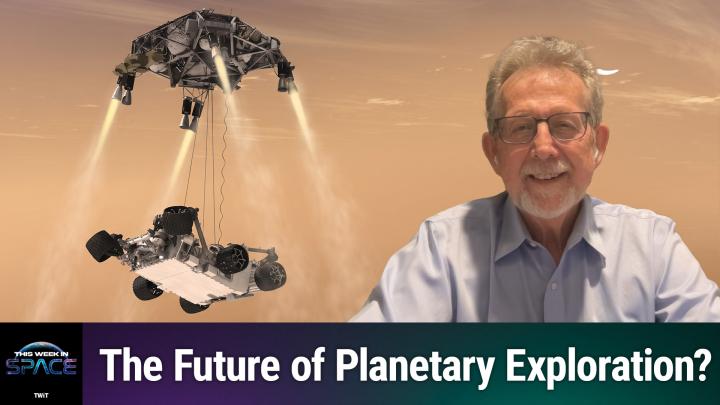
Happy podcast day, Mr. Word Picker. Our guest this week is going to be Dr. Jim Green, the former chief scientist at NASA and present director of Meta Visionaries US. Uh, he's a return guest. He's a lot of fun, and we're really looking forward to it. But first,
Tariq Malik [00:01:25]:
But first,
Rod Pyle [00:01:26]:
I'm sorry to say we have a space joke from Tom Melton. Well, I'm not sorry that it's Tom, I'm just sorry that we, we pummel you with our space jokes, but this is a good one. Hey, Tariq.
Tariq Malik [00:01:36]:
Yes, Rod?
Rod Pyle [00:01:37]:
What does every astronaut notice when they look into space?
Tariq Malik [00:01:40]:
Um, I don't know, what?
Rod Pyle [00:01:42]:
They sing, I can see clearly now the sky is gone.
Tariq Malik [00:01:47]:
Oh, okay. Oh, okay, okay.
Rod Pyle [00:01:51]:
A little bit of a reach. Tom, sorry, maybe it was in the delivery, I don't know. But I've heard that some folks want us, You even
Tariq Malik [00:01:57]:
sang the tune though. You even sang the tune. I did. You did. You did.
Rod Pyle [00:02:01]:
Just to double up on the pain. Yeah. Okay. Wow, John.
Tariq Malik [00:02:05]:
Wow.
Rod Pyle [00:02:05]:
I've heard that some folks want to stop seeing us when it's joke time in this show, but you can help just like he did by sending us your best, worst, or most indifferent space joke at twist@twit.tv, and we will give you, you credit or blame on the air. But now it's time for the fun stuff. Let's go on to Headline News!
Tariq Malik [00:02:34]:
I nailed it. Everyone knows I nailed it.
Rod Pyle [00:02:37]:
I felt it right there. So in an ongoing tradition of, gosh, 65 or 70 years now, NASA has a new X-plane. What is it?
Tariq Malik [00:02:48]:
Well, we don't know what it looks like or ever, because they just announced it this week. But Jared Isaacman and NASA NASA unveiled their plans to build a new X-plane called the X-70 Fractal. And we have like— there's an image, but this image, I'm going to warn everybody, it's an AI-generated image. So they don't have like a sketch of what they think it's going to look like. They used AI to make this rendering. If you're watching the, the, the, the, the, the recording, that, uh, so it's got like some, some fins and some long wings and stuff like that.
Rod Pyle [00:03:27]:
Well, it kind of looks like the F-22 straight Yeah. And
Tariq Malik [00:03:30]:
that's actually what our writer and managing editor Brett Tingley, who is kind of an expert on military kind of space and aircraft and stuff like that, said. He says it's got tail fins that are reminiscent of Lockheed Martin's F-22 Raptor or the Boeing F/A-18 Super Hornet. But what NASA has said is they're going to build this X-70 plane with a, quote unquote, rapidly reconfigurable flight control technology so they can swap out internal and external parts.
Rod Pyle [00:04:00]:
So basically, it has the shape Shifter.
Tariq Malik [00:04:02]:
Yeah. And it seems like they want to, to kind of push the limits of how maneuverable or maybe not maneuverable you can make a crewed flight, a crewed flight vehicle, you know, so to kind of see like what, where those limits are there now. So it sounds like pure experimental plane stuff, where as opposed to the X-59, which NASA will be showing off this weekend as we're recording this at the first ever Max Power Air Show at the Kennedy Space Center, that is designed for like a use case, which is it's going to be You know, testing plane body shapes to create supersonic vehicles that have quiet booms, like the supersonic booms, so that you can fly them over the land and therefore have maybe less disruptive commercial travel that's faster, more convenient, etc., etc., etc. So it'll be very interesting to see. I did not see like a specific timeframe that they're going, but they do want it to kind of top out in max speed at about Mach 75, this X-70 plane.
Rod Pyle [00:05:03]:
0.75.
Tariq Malik [00:05:05]:
What did I say? Did I say 75?
Rod Pyle [00:05:08]:
75, which is really fast.
Tariq Malik [00:05:09]:
That's really fast. No, Mach 0.75. I'm going to correct myself there. Thank you. And then it can fly up to 45,000 feet, so a bit higher than a commercial jet, and have a range of like 1,700 miles or so and carry about 2,000 pounds of experimental payloads. So whatever kind of experiment, like instruments, that kind of thing, to do atmospheric tests or load tests on the vehicle itself, they can carry that too. Very interesting to see.
Rod Pyle [00:05:37]:
Just a couple other points. They, they did say, and I'm not sure if this is a quote from NASA or just, uh, from your article, uh, that the fractal arrangement would allow— the design would allow NASA to, quote, swap both external and internal components on the fly.
Tariq Malik [00:05:54]:
Yeah.
Rod Pyle [00:05:55]:
Now I assume that doesn't mean while they're actually flying, but maybe it does.
Tariq Malik [00:05:59]:
No, you know,
Rod Pyle [00:06:00]:
it should be kind of a A metamaterial sort of thing.
Tariq Malik [00:06:02]:
Yeah, it's not clear. What's really interesting too is that Brett pointed out that the kind of notional design or silhouette of the vehicle looks really, really similar to Northrop Grumman's Model 437 Vanguard experimental plane. Um, so, you know, depending on if it's really going to look like the AI image that NASA put out. So,
Rod Pyle [00:06:23]:
and, and unarmed, I'll note that this is about a third the weight of the F-35. So it's, uh, kind of revolutionary in that sense too.
Tariq Malik [00:06:30]:
Unarmed? Are you, are you suggesting that NASA's gonna build an armed version of their X-70.
Rod Pyle [00:06:35]:
Just saying, let the rumors start here. Okay, speaking of such, we have a new mini-me mini-moon.
Tariq Malik [00:06:41]:
That's right. I'd like to introduce everybody to Asteroid 2026 QQ8. It is a, a space rock that is now traveling in tandem with the Earth around the Sun, about 110,000 miles beyond the orbit of the Moon. So not like super close, not an impact risk, but it is our traveling companion. which has led astronomers to call it a mini moon. And it's going to be with us kind of as part of— it's being influenced by Earth's gravity because it's really— it's so close as it orbits around the Sun for about, you know, 2 more months. So through like Christmas, it's going to be near us. And it's— it was, it was discovered back in August of 2026.
Tariq Malik [00:07:29]:
And it entered our frame in April, actually. And now it's, it's a bit closer. to us than before. So you can probably see it with a telescope. And it will break away in 2027. So it's only here all the way through December. And then, you know, in January, we'll say goodbye. But, and by the way, its orbit around the Sun, 359 days, if that sounds— if that sounds familiar, it's because our year is 365.
Tariq Malik [00:07:55]:
We go a little bit faster. It's not going to leave us, we are going to leave it behind.
Rod Pyle [00:08:00]:
So that's mean of us.
Tariq Malik [00:08:02]:
Actually, no, that's, that's wrong. I did the math wrong. Our day, our year is 136. So ours takes longer. So it's moving faster. It's going to leave us behind. Well, you heard it here first, folks. I don't know how space works.
Rod Pyle [00:08:17]:
That's why we have people like Jim Green on the horn.
Tariq Malik [00:08:20]:
I tell you, man. Wow. I'm so glad I'm the worst astronomer, like, ever. Next
Rod Pyle [00:08:25]:
up, it's NASA Max Power.
Tariq Malik [00:08:28]:
Max Power.
Rod Pyle [00:08:29]:
What is Max Power?
Tariq Malik [00:08:31]:
Max Power is the alter ego of Homer Simpson in The Simpsons. thing.
Rod Pyle [00:08:35]:
Thank you.
Tariq Malik [00:08:36]:
No, that's true. That's true, by the way. That's true. But Max Power is NASA's first ever air show, and they're holding it this weekend. So for folks who are listening to the podcast afterward, it's November 6th, 7th, and 8th, 2026, that they're doing this. And it's like they're celebrating all things kind of space and like NASA, but also it kind of puts the aeronautics in NASA on full display and then all of the cool technology. And so what's happening right now, and we've got 2 reporters reporters down there is they're showcasing kind of everything from the Artemis program. The Artemis III astronauts will be riding in like kind of vintage Corvettes in parades through the NASA Kennedy Space Center, uh, visitor complex.
Tariq Malik [00:09:20]:
You know, like, you know, kind of like old school, new school stuff. Uh, and then they're also gonna make some big moon base announcements, actually a couple. There's gonna be a student announcement on Sunday, and they're showing off the nuclear mission, the SR-1. Freedom mission to Mars that's supposed to launch in 2028. They're going to talk about the X-59. We were just talking about that earlier, the supersonic plane. It's going to be there. And there's a lot of other companies that are there.
Tariq Malik [00:09:45]:
SpaceX will have a scale model of Starship, the human landing system one for Artemis. New Glenn's rocket will be there. They'll have a Blue Ghost moon lander from Firefly there. And it's very interesting to see Kind of like what NASA is doing on display. And if you come back to space.com next week, we'll have a whole recap of that, plus whatever announcements that they're doing as well, too.
Rod Pyle [00:10:13]:
Very good. Have
Tariq Malik [00:10:14]:
you ever been to an air show, by the way?
Rod Pyle [00:10:17]:
Oh, yeah, of course. Haven't you?
Tariq Malik [00:10:19]:
Yes. But I should point out that NASA Chief Jared Isaacman will be flying his MiG jet as well as other planes in the aerial demonstrations that they're doing there.
Rod Pyle [00:10:29]:
Uh, I went to an air show last year that Vast hosted, uh, a lounge area for down in New Jersey. Oh, that sounds nice. It was very cool. That was fun. All right, wrapping it up before we get on to our main act. It is the 30th anniversary of Deep Space Nine's Trials and Tribulations.
Tariq Malik [00:10:48]:
Yay!
Rod Pyle [00:10:49]:
Which was a pretty amazing episode.
Tariq Malik [00:10:52]:
You know, I, I didn't work on, uh, on Star Trek: Deep Space Nine. If I knew someone who did, who might have been involved in that, who could that be, right? Tell us about this episode, Roddy, because this is a fun one.
Rod Pyle [00:11:02]:
If I was on the credits, which I was not because I was the last crew person to be added to the effects department, you'd see me way, way, way down at the bottom.
Tariq Malik [00:11:11]:
Everyone, that's not true. He punched the director in the face. This is a true fact.
Rod Pyle [00:11:15]:
There we go. But it was, you know, the order was go dig up the negative from the '60s of the original Tribbles episode because None of that stuff had been digitally transferred.
Tariq Malik [00:11:29]:
And that's the original series episode, The Trouble with Ghosts.
Rod Pyle [00:11:31]:
Original series episode. And we all grew up, if you're my age, seeing it on, on 480i television off of 3/4-inch U-matic tapes. I mean, it was terrible. When you look at it now, it was smeary, it was awful, the color was unsaturated. Then you pull up this 35mm negative, which is what they shoot used to shoot movies on. And it was, you know, we just sat there like gobsmacked looking at this footage. You could see coffee stains on their tunics and everything. The detail was astonishing.
Rod Pyle [00:12:06]:
And then to shoot this new stuff in 35 and put that in there, that was the work of Gary Hutzel, the visual effects supervisor on the show. This was the very beginning of digital compositing. Mm-hmm. So you had to sort of shoot the replacement characters a little larger to sort of stamp them over the ones already there. So like that scene, if you remember the original Tribbles episode, where Kirk's walking back and forth yelling at his crewmen about who threw the fir— I wanna know who threw the first punch! And Gary stuck 2 of the crew members from the new show in there. Anyway, it was just astonishing. It was fun to be around. I ended up— because we had to rebuild period props, I paid to get an extra communicator and phaser.
Rod Pyle [00:12:47]:
from the prop department, which I treasure. One of them's back there in the alien's belt. And, uh, it's long been a crowd favorite. I will say the one thing—
Tariq Malik [00:12:58]:
It's like Star Trek did Back to the Future. That's like Back to the Future II. It's exactly like what they did, you know?
Rod Pyle [00:13:04]:
Next time it's on, if you happen to watch it, near the end, uh, Sisko walks up to Captain Kirk and hands him a clipboard, right? That was originally in, uh, an earlier episode, I think Mirror, Mirror, where Marlena Maroon Ro, uh, played by Barbara Luna, walks up and hands Kirk that clipboard. And it's so, you know, we composited— Gary composited Sisko over this woman. But as Sisko turns and walks away, there's just a moment where you see Shatner kind of going, hmm. It's like, wait a minute, that's not what was intended there. Anyway, it's a lot of fun. Small thing to look for. All right. We are going to go to a quick break and we'll be right back with Dr.
Rod Pyle [00:13:49]:
Jim Green, former chief scientist at NASA, to fill us with exorbitant information. So stand by. And we are back with Dr. Jim Green, who among many other credits, all of which are impressive, was the chief scientist of NASA for a number of years and now runs MetaVisionaries, which we're going to talk about before we close out today. But Jim, I just wanted to give a very brief recap, if you would, of your career, if that's even possible, because it's, it's been pretty, pretty stratospheric.
Dr. Jim Green [00:14:26]:
All right. I graduated the University of Iowa with a PhD in 1979 and fortunately had 5 job offers at a time when it was also quite hard to get a job in this field. So, I felt very lucky. But part of that was because I was doing all kinds of fantastic science. And so, I went to Marshall Space Flight Center. Now, Marshall was just beginning a program of scientists to help with Skylab, the end of Skylab, but beginning with Spacelab, which are the laboratories that go into the shuttle. And so they needed a number of scientists. So I was in the solar system branch there from '80 to '85, and I had a wonderful opportunity to get involved with human exploration, not just because of the Spacelab systems, but because I was a scuba diver.
Dr. Jim Green [00:15:24]:
I ended up in the neutral buoyancy tank. So I pushed astronauts and engineers around, made about 150 dives, and it was just It was just really inspiring to me to see what humans were doing in space. It really gave me a new perspective. I then went to Goddard Space Flight Center for probably about 25 years as a scientist working my way into various management positions that I was asked to do, running branches and then divisions. And then I was asked to go down to NASA headquarters, for which I went down on a detail, but I, uh, uh, as head of planetary science, uh, from, uh, at 2006. But I liked it so well, I went ahead and applied for the job, and they selected me. So I became head of planetary science from 2006 to 2018. And then I was asked to be the NASA chief scientist, which I then did from 2018 to 2022 when I retired.
Dr. Jim Green [00:16:30]:
So all during that time period, I worked on more than several dozen missions, um, at various positions, not only from a programmatic perspective, getting money, finding, securing missions, working on mission concepts, but developing instruments, uh, being project scientists, working on various aspects of all the way from acquiring the data, managing the data, storing the data, but analyzing the data in addition to a lot of the interactions with the international community. So we did— in the 12 years I was head of planetary, I was involved in 13 launches, not just only planetary from NASA, but planetary connections that we'd made with other agencies. agencies and was involved in, as I mentioned, more than a couple dozen missions that I had to keep running and going. So I've had a wonderful career. It's, you know, when I look back at it and somebody will ask, well, if there was something you would change, what would it be? And I would say not one thing. It just, you know, I just seemed to just enjoy everything I was doing. NASA gave me fabulous opportunities. And I think the science community benefited from a lot of what was going on during that time period.
Dr. Jim Green [00:18:05]:
And I just happened to be one that helped facilitate that.
Tariq Malik [00:18:09]:
Oh, that's awesome.
Rod Pyle [00:18:10]:
That's pretty cool. Tariq, is there one thing you'd change in your career path?
Tariq Malik [00:18:14]:
I don't know, be a journalist?
Rod Pyle [00:18:16]:
I wasn't choosing what it was. Okay, moving on.
Tariq Malik [00:18:22]:
No, this is the part, Jim, I know you probably remember in the past where I usually ask our guests, you know, what their first exposure to space was. But, you know, you've been pretty comprehensive in your past appearances on the show for that. So I am curious, though, if there's one place that you feel we have not explored enough in terms of like, baseline stuff. Obviously Mars, we've got a lot of stuff there for Mars when it comes to planetary science. You know, I'm very partial to Venus. Is there a place that if you had the bajillions of dollars and like the, the rubber stamp and all of the rockets that you would just send mission after mission after mission there to go, to go, you know, see all the things?
Dr. Jim Green [00:19:09]:
Yes, of course there is. And that would be a submarine
Tariq Malik [00:19:16]:
Oh, yeah.
Dr. Jim Green [00:19:17]:
Yeah, no question about it. In fact, as head of planetary, I was also involved in supporting and funding astrobiology. And we were working on a whole variety of aspects of astrobiology, and one of which was actually doing some concepts on submarines. And in fact, we funded a couple prototypes, which were really fantastic. I would love to have been able to see that to fruition and get a submarine, slide it through a crack, drop it down there, and let it do its thing.
Tariq Malik [00:19:59]:
Oh, wow. That would be amazing.
Dr. Jim Green [00:20:01]:
It would be. It would be. And I can tell you what it would find.
Tariq Malik [00:20:06]:
Well, what would it find?
Dr. Jim Green [00:20:07]:
All right, I believe it would find that at the interfaces in particular between the ice and the water, it'd be teeming with life.
Tariq Malik [00:20:18]:
Yeah,
Dr. Jim Green [00:20:19]:
and I think Europa has benefited from many aspects of the Jovian system in terms of the tidal forces that's continued for billions of years that have enabled complex life to have evolved. So that's one of the reasons why I think going there would be great, because I think that's the place where more complex life would be found.
Tariq Malik [00:20:46]:
You're not afraid of the warnings from 2010 from the aliens that said all the worlds are ours except Europa, right? We're not supposed to attempt a landing there.
Dr. Jim Green [00:20:54]:
I would debate Arthur C. Clarke on that. And I might win.
Rod Pyle [00:21:00]:
Okay, let's break out our Ouija boards and we'll ask him. Um, Tariq, before we go to the next question, I think this is going to be a big one. Shall we just, uh, break early?
Tariq Malik [00:21:11]:
Yeah, I think so.
Rod Pyle [00:21:12]:
All right, let's, uh, despite our Mr. Dr. Clark's warnings, let's break early and we'll be right back. So stand by.
Tariq Malik [00:21:18]:
Well, Jim, I think the last time that we had you on, uh, or at least one of the last appearances that we had you on, we were talking about the state of planetary exploration in terms of kind of a bit of a dire status. Is that how you call that? Dire situation? You know, when it comes to funding with the current administration and everything. And this week, things have changed, at least in terms of the control of Congress and Senate and the House. Yeah. And of course, there's so many committees and subcommittees that watch over NASA and the National Science Foundation, like all of the people that get the science done. And one of the things I wanted to kind of tag up with you about in your experience, because you have been in your career, as you just outlined, witness to these kinds of changeovers in the past, like what types of impacts, if any, you know, can such a dramatic shift in control of the kind of government leadership have on the potential for, you know, either new funding or whatnot for planetary science and astronomy, that kind of thing?
Dr. Jim Green [00:22:32]:
Well, I firmly believe that Congress will step in and help NASA's budget be healthy again. I recognize the current administration is cutting back its budgets virtually in every agency, and consequently, Congress has to then step in and make decisions that would supersede that. That's the role of our federal government, the checks and balances. Now, you have to recognize that if Congress restores the funding in the president's budget from the large cuts— you know, last year it was $24 billion, this year the proposed budget is $18 billion, that's $6 billion less— Mm-hmm. And Congress puts that back in, which I believe they will, and the president signs it, then the president agrees with that budget. it, and they move forward. Mm-hmm. All right? So, uh, that's happened on many occasions.
Dr. Jim Green [00:23:40]:
Uh, it's not during just this administration. There's been previous administrations, uh, for which Congress has, uh, upped the budget in many areas. Uh, I remember planetary was, um, suffering greatly, uh, right after we landed Curiosity. The administration at the time, the Obama administration at the time, was cutting the Mars program significantly, almost to the point where we would have to turn Curiosity off early. Wow. And Congress restored that. You know, that— there were always threats to the budget. That's part of the process.
Dr. Jim Green [00:24:17]:
You need really good people at NASA headquarters that can go over to Congress and explain the program as they require and they request. And get them to recognize what is, uh, fundable in terms of, um, uh, the effects of, uh, cutting back and, and, and what should we do, uh, in terms of moving forward. We have a lot of missions that are extended missions doing fantastic science. Curiosity is an extended mission, you know, as an example, and making fabulous measurements. Uh, Perseverance Perseverance is still almost done with creating all the samples it needs before we return them. And yet, you know, this administration has cancelled sample return, but said that sample return could be done if it was linked more with human exploration. And there's a couple ways to do that that would be really exciting. So there's always a bright future for NASA because both the House and the Senate in both parties, Republican and Democrats, have really helped NASA along the way.
Dr. Jim Green [00:25:32]:
And I'm just delighted that that has happened. It's really made NASA a well-recognized brand around the world doing remarkable things. That's what we want to do. Yeah.
Rod Pyle [00:25:48]:
So do you see a pathway Since you mentioned it, I was going to mention it, but you did first. Thank you. Do you see a pathway for Mars sample return being reinstated in a reasonable timeframe?
Dr. Jim Green [00:26:02]:
I believe that if the administration— or sorry, if NASA is allowed to turn its attention not just to the moon, but a little bit of Mars, we could actually make some progress in that area. and then in a matter of a handful of years, uh, be able to land a Mars Ascent Vehicle and allow it to gather samples and bring those back. Now, why do I say that? Well, Mars, of course, is a difficult place to land systems. Our first sample return concept, and I helped Uh-huh. —develop this is well over 10 years old. And at that time, we could only put 2 metric tons down on the surface. And so the, the return rocket was really actually very anemic. It could hardly get a handful of samples up into low Mars orbit.
Dr. Jim Green [00:27:00]:
And then you needed another spacecraft to hunt them down and bring them into a larger system to then carry them back to Earth. Well, as humans are going to Mars, they're gonna need a far more capable Mars Ascent Vehicle to bring humans back. They're going to land and test smaller versions of that Mars Ascent Vehicle. We have the ability right now with the SLS and some of the new technologies, uh, such as the, uh, uh, hypersonic supersonic inflatable aerodynamic decelerator, we call that the HIAD, to land 20 metric tons. And in that 20 metric tons, a MAV can actually— a 2-stage Mars Ascent Vehicle could be acquiring those samples in first stage, get it into orbit, second stage, line it up, and then fire it back to Earth, uh, when, when the opportunity comes back. And so we can greatly simplify bringing the samples back, but also link it to human exploration. They're gonna need to test these MAVs. I don't— I don't know if you saw The Martian, but if you did— Oh, yes.
Dr. Jim Green [00:28:19]:
One of the biggest problems Andy Weir ducked is, uh, that there was a huge Mars Ascent Vehicle. On the surface. Well, how the heck did that get there? Just waiting. Not only that, but 2 of them. 2 of them. So, uh, we have to make that a reality, and we're gonna have to do a variety of testing, and that testing can bring back samples. So linking them together is possible. The key is when are we going to get started on, on a more aggressive human exploration of
Rod Pyle [00:28:55]:
Okay. And just a quick follow-up. When Mars sample return got canceled, I remember Bill Nelson coming on the tube and saying, you know, it's going to be $11.5 billion. That's too expensive. We can't support that, blah, blah, blah. I thought, wait a minute, that number wasn't quite chiseled in stone there. Last I heard, The range JPL gave was $6.5 to $11 billion. And I was really a bit flummoxed that he picked the higher number and then just put an arrow in it.
Rod Pyle [00:29:29]:
And I mean, I'm just guessing as a civilian with some connection with all this, small connection, that there was a political dynamic going on there. But it was a bit of a head-scratcher, and not just for me, but for a lot of people at JPL at the time.
Dr. Jim Green [00:29:46]:
Well, bottom line is that rocket capability that was planned was really underpowered. It was really more— it's not evolvable to what we really need to bring humans back. So if we're going to spend the money to bring humans back in the first place, bringing the samples back is just obvious. Um, in fact, the National Academy, uh, more than a decade ago, put out a report called Safe on Mars, which talked about, um, what you need, uh, to understand that area where humans are going to be living and working. And some of that requires getting those samples back to look at the toxicity of the soils, to understand the mineralogy, to Understand the things at a level you need to bring the right equipment for using resources and extracting water and, and all that that has to happen is gonna require samples. Well, the samples we have have been carefully selected in Jezero Crater, and I am tremendously excited about what we're gonna bring back and what we're gonna find. And I think we're going to really enjoy the results of that, the fruits of our labor of getting there and getting the samples carefully selected and then bringing them back into our laboratories. It's just going to reap enormous benefits.
Rod Pyle [00:31:23]:
All right. Well, let's reap ourselves into a break and we'll be back in a second. with our next exciting question, so don't go anywhere.
Tariq Malik [00:31:31]:
Well, you know, I did want Jim to kind of take something that you just mentioned earlier about the kind of next steps for NASA as well as for other science agencies in this post-election environment and ask about the challenges for the public at all. I was at an event last night with a crop of new or future science writers and was surprised that they asked me the question, about like why, like what your answer is, what my answer is, pardon me, when people say, so what, right? And it's as someone that has been not just NASA Chief Scientist, but a scientist, you know, like, like a lifelong learner, I'm curious about how you relate the, you know, like the benefits of the science, explaining that to people, you know, these things that can be like nitty-gritty, Evolutions on past science, but then have a big revelation on either like the field or our understanding of Mars or its history. You know, there's a challenge in that kind of science communication there and how you explain the relevancy to people, you know, on the ground going about their daily life. And, and, you know, how do, how do you approach that? Or— Or how do you keep it fresh, you know, to explain like what the, what the payoff is, I think, for all of us when it comes to, you know, science and space exploration?
Dr. Jim Green [00:32:59]:
Well, you know, we're constantly learning new and tremendously exciting things, not only about our solar system, but how our sun moves around the galactic center. You know, we're, we're finding out that we're leaving the, the, the local cloud and moving into an adjacent cloud that's called the G-cloud. And the G-cloud is a couple of— 30 times, I think, more dense than the local cloud that we're in. That's going to push in the heliosphere. That's going to create an opportunity for cosmic rays to penetrate deeper. We may end up with a very dusty environment where more dust settles in and through our solar system, which scatters sunlight, which changes the albedo of our planet because of the dust that falls on our atmosphere, which pushes us into a cold phase, not a hot So those kind of things have affected this planet in the past, and we're just discovering they're also in our future. So as we really wake up and decide that we can't survive on this planet in ignorance about where we are in the solar system, how the solar system and Sun evolves and where the Sun is going that's taking us there. We have to factor all that in.
Dr. Jim Green [00:34:43]:
That's just tremendously exciting. New science is being found all the time. Even the search for extraterrestrial life has now been energized in some really important ways. It used to be that SETI was the only one looking for radio signals. But in the last several years, as chief scientist, I had the opportunity to work with the science divisions to begin the process of investing research money into looking for technology signatures from intelligent life, you know, in the galaxy somewhere. Mm-hmm. And what could we really find beyond the concept of just radio waves? And there's just a ton of things that they're doing. We're also realizing that maybe we're not always looking in the right spot.
Dr. Jim Green [00:35:41]:
Now, I'll give you an example. Most recently, we have found out through major modeling and calculations where the L1, the Lagrangian point of the Sun and the galactic center is. Now we know where the L1 Lagrangian point is of the Earth and the Sun. We use that all kinds of ways to— That's where James Webb is, right? Yeah, well, Webb is actually at L2.
Tariq Malik [00:36:15]:
Oh, I'm in the wrong one. I got the wrong one.
Dr. Jim Green [00:36:17]:
Yeah, well, that's okay. That's all right. But But those are really gravitational nulls that allow the movement of anything that's in that location to match that of the Earth. And when you match that of the Earth, then you can actually carry things along. Well, what's happening at the L1 of our Sun and the galactic center? That's a region where material can float into it and be captured permanently by the Sun. That could be a rogue planet, that could be, you know, these interstellar comets that we see. The ones that are passing through don't pass through the L1 point or L2 point, but if they do, then the Sun will capture them. This is also a great place To recognize that it's part of a gravitational road.
Dr. Jim Green [00:37:16]:
You know, we talk about roads here on Earth, but extraterrestrial life are going to use gravity roads.
Tariq Malik [00:37:24]:
Wow.
Dr. Jim Green [00:37:26]:
You know why? Because they pull you along. They save your fuel. Space and time change as you change your velocities. And so you can manipulate time, you can travel in these roads. And, you know, maybe there's extraterrestrial life observing our solar system at the Sun-Galactic Center L1, because they can just sit there and do that, not spend any fuel whatsoever, study, study our planets and say, not interested, and go to the next system.
Tariq Malik [00:38:03]:
I can understand that sentiment, I guess.
Dr. Jim Green [00:38:06]:
Now, what I just mentioned is part science and part science fiction, no question about it, but it enables us to start thinking differently about the influence of our star in, in the galaxy and other stars in the galaxy as part of the evolution of stars And also the evolution of life on those associated planets around other stars and how intelligent life might be able to use gravitational roads to get around.
Tariq Malik [00:38:40]:
That sounds awesome. So,
Rod Pyle [00:38:42]:
so I'm going to shift gears here a little bit, but a big part of what you kind of mastered during your term as chief scientist, and I think before that too, was really communicating what could often be viewed as complex sentiments to the public, these difficult ideas, particularly when I met you was during the landing of Curiosity. And that was a big one, just trying to get people to understand this is complicated and it may not work perfectly. Same with James Webb. There's a lot of things that have to go right and only one has to go wrong. So I wonder if you could just kind of talk about that challenge and sort of how you addressed it philosophically.
Dr. Jim Green [00:39:22]:
Well, I had a wonderful career of teaching. That's very unusual for a NASA employee to be associated with a university and teach. But the International Space University in 1992 asked me to come and teach, and I started teaching a variety of space science topics. To me, I realized right then and there, if you really want to know a subject, you have to teach it. And when you teach it to a group of top professionals, that really, uh, you have to up your game. You have to recognize what their background is and leverage and use it. And that requires understanding your audience, whether it's the public Or whether it's graduate students or PhDs or you're giving talks at conferences. You know, science isn't done until it's shared.
Dr. Jim Green [00:40:22]:
Now, we say that scientifically, and many scientists think, well, that just means I go to a conference and talk about what I did. But that's not true. That's right. It extends beyond that. You have to tell the public some of the things you're finding out. You have to get them excited. excited about what's happening. And you can easily do that because our scientific community is making all kinds of wonderful progress.
Dr. Jim Green [00:40:49]:
In fact, you know, I'm towards the end of my career, clearly semi-retired. I'm doing a number of things that I'd like to do, but I really wish, if I had one wish, It would be that I just graduated from the University of Iowa knowing what I know now and having another 50-year career in front of me. Wow! I mean, when I graduated, you could forget about the idea of finding a planet orbiting another star. Just forget about it, all right? You had no idea of the importance of dark energy or dark matter. I mean, you could just list a dozen or more really unbelievable concepts that we just were clueless about. And now we're entering a phase of more detailed science that's really going to reap even more benefits. It's not just about knowing, it's about knowing how that affects us, how it affects our life,
Rod Pyle [00:42:00]:
So we have another break to jump to, but I just want to ask very quickly before that, did you ever see the book that JPL put out for about 10 years called Technology Highlights?
Dr. Jim Green [00:42:12]:
No, I didn't. But I do know that some of that did feed into the NASA version called Spinoffs. So NASA put out every year the Spinoffs Yeah. Book, and I religiously look through that. There's some fantastic stuff that come out that NASA's been doing. And so I'm sure that encompassed many of those things that were developed at JPL.
Rod Pyle [00:42:37]:
I think so. I don't think the JPL book started till like 2010 or 2012. I was on it for about 5 years, but my instructions were, number one, make this accessible to congressional aides, and number two, make it accessible to the public. But it really was a wonderful exercise. in trying to make science interesting and engaging and exciting to people that aren't scientists. And digesting the work of this person who's been working on an inflatable parabolic antenna for the last 12 years into 300 words, which was often kind of torturous. Okay. Speaking of torture, we're going to take one more break and we'll be right back.
Rod Pyle [00:43:16]:
So don't go anywhere.
Tariq Malik [00:43:17]:
Nice one. To kind of follow up on that discussion about engaging the, like, the, the public attention and to explain, like, the science. And you were just talking about JPL, and, you know, Rod had a note here all about— I think what was one of the biggest sea changes that I had seen in my career was, you know, NASA's always very much, oh, we're gonna do it, we're gonna try, we're gonna try. And then they— JPL releases for Curiosity this, this 7 Minutes of Terror video about how exciting and yet perilous and, and uncontrollable the Curiosity landing is going to be because, you know—
Dr. Jim Green [00:43:50]:
I have to tell you how that came about.
Tariq Malik [00:43:52]:
Yeah, well, please, yes, because that's what I wanted to ask about.
Dr. Jim Green [00:43:57]:
Yeah, the 7 Minutes of Terror video, which JPL produced, was really brilliant. But the seed of that started in my office when my boss, Ed Weiler, came into my office and Wow, you're doing so many things in outreach. You're really selling the heck out of landing this 1-ton rover. And I'm going, yeah, I want everyone in the world to know we're gonna do this. This is just absolutely unbelievable. I was really excited. Well, Ed, I would classify as a pessimist, and he would classify me as an optimist. And Ed, during his career, Ed Weiler, was also head of the optical, the UV optical branch of astrophysics, for which their one top mission was Hubble.
Dr. Jim Green [00:44:53]:
Mm-hmm. And he was there when Hubble was launched, it had a mirror problem, and he was beaten up in the press mercilessly. And so his question to me was, you're drawing so much attention to this. What do you think is going to happen if it crashes? Okay. Because you're making it look easy. You're selling the heck out of it. All right? You're making it sound like, hey, it's just a walk in the park. And I then realized I was making a mistake, that I was so enthusiastic enthusiastic about it that I exude that so much that I didn't put it in the context of how difficult that really was.
Dr. Jim Green [00:45:43]:
Hmm. And so I talked to my top person in this area, in our outreach activities, who was Kristen Erickson, and we talked about this, and she goes, I think I know what to do. Uh, we, we, you know, and I also told her, uh, I'm really getting tired of, uh, of, of, of showing the JPL movie of, of MSL hitting the top of the atmosphere, the, the heat shield, the parachute, and the sky crane, and, and, and then narrating that. Mm-hmm. We need to— we need some sort of movie that can talk over that. And so she, you know, and she goes, I can take those ideas and work with JPL. And what came out of that was 7 Minutes of Terror.
Tariq Malik [00:46:29]:
Yeah.
Dr. Jim Green [00:46:30]:
Now, as soon as that came out, I actually had a great sense of relief because what I told Ed in my office was that I know or realize that if Curiosity crashes, someone will be fired, and I know who that is. It's me. It's my mission. It's a strategic mission. This division and this division chief, me, is solely responsible for it. And I'm okay with being fired. And now I felt, well, look, I might actually, if curiosity cranks, make it through this. Because, you know, it was really difficult to do and it really showed that.
Dr. Jim Green [00:47:22]:
But I then constantly use that internally to recognize not to oversell things, but to try to put things in context. Mm-hmm. NASA, you know, does miracle after miracle after miracle. And in fact, I also recognized that Curiosity had like 10 miracles. Now, the philosophy then I had changed, and that is one miracle a mission. Don't give me 10, you know, give me one. All right. And that began to serve us well from there on.
Tariq Malik [00:48:00]:
You know, I think that it's just such a visceral response that a campaign like that that says, here's a really hard, like, like mission thing that we're going to do. You know, I, I know, I know we've been talking about it, but it can go way wrong, and here's every way that it can go wrong.
Dr. Jim Green [00:48:18]:
Yeah.
Tariq Malik [00:48:19]:
But then if it goes right— Yeah.
Rod Pyle [00:48:20]:
And starting off with, with, uh, Adam Seltzner lit from below like a monster movie. I mean, I spent a lot of time talking to John Beck, who, who did that thing, and he, you know, he, he co-wrote it, he shot it, he edited it, he did the score, he did the visual effects. I mean, this guy was a one-man band. And then of And of course, 6 months later, he's off working for National Geographic, and I don't think he ever looked back. But I've seen them try to recreate, sort of put the lightning back in the bottle— wow, that was a mixed metaphor— with that, and it's hard to do. You know, there was something sort of a place and time of that show, and I think it's a hard one to recapture. But, you know, your statements are well taken, Jim. I mean, it was— a brave thing for you guys to step out and say this thing may not work.
Rod Pyle [00:49:12]:
And I don't recall that ever happening before in quite that way, either with JPL or really any other NASA media product that I saw. This was kind of a first.
Dr. Jim Green [00:49:22]:
Well, Ed was— his perspective was really what would happen to NASA, you know, even though, yes, it's a planetary problem and it would be a disaster for planetary science. But it also tarnishes NASA's reputation, which is, uh, something that we all in the, in the agency, uh, don't take lightly. We really want the agency to do well, uh, in all its aspects, you know, from JWST's launch, you know, to human exploration, Artemis I, Artemis II, and the next one coming up, all those just tremendous strides moving forward that makes not only the activity important and executable, but NASA looked really good because it needs to. It does miracle after miracle. It's unbelievable what happens in the agency. It really is.
Tariq Malik [00:50:21]:
And then, of course, you had the sequel with Perseverance, right?
Dr. Jim Green [00:50:23]:
Yes, yes, yes. Well, that wasn't easy either. You know, I had to convince a lot of people that's a strategic mission. Yeah. So that means it's a division mission. I put together the program to go after what was in the Decadal, which was create samples, and then the next mission, bring them back. So that job is to first get the samples. And so the whole concept of sample return became then something on my top agenda right after Curiosity landed.
Dr. Jim Green [00:50:58]:
Yeah. Or Perseverance landed. Sorry, after Curiosity landed, and then we could go for Perseverance, which is going to be doing the samples, making the samples. So that took several years to really get that whole idea together, get it sold, not only in the building in NASA headquarters, but OMB, OSTP, getting the president's administration behind it, and then going to Congress and talking about, this is our next big step. And of course, the National Academy was behind it as the top thing to do is to start making samples on Mars. And so, uh, I was fortunate to be the one that helped, uh, make that happen. And, uh, it's, it's doing fantastic. Yeah.
Dr. Jim Green [00:51:46]:
And as I said, some of those I am just in awe of. I mean, what, what, what we think we have in those samples will be historic. Let's bring them back and analyze them.
Tariq Malik [00:52:00]:
Exactly, exactly.
Rod Pyle [00:52:01]:
Well, let's bear in mind, Tariq, before your next comment, that we do have the Chinese aiming for a sample return mission possibly before ours. But if I understand it properly, it's basically a land where you can grab a sample sample and come home, as opposed to this extensive work that Perseverance has already done. And fortunately, Perseverance is at the wrong altitude for the Chinese lander to land nearby and grab our sample tubes. All right, good talking there.
Tariq Malik [00:52:29]:
Yeah, you know, I, I did have another, another kind of a bit of a different tack, but it's, it's, it's related to some pressing events because this week, as Rod, yourself, and I are recording The European Space Agency's Hera spacecraft is getting up close and personal with the asteroid Didymos and Dimorphos system, which of course NASA smacked in the face with the DART impact. And I know that you had a pretty critical role in the creation of the Planetary Defense Office at NASA, and that DART mission was— which is Double Asteroid Redirect— Redirect. Yeah, so to smack it in the face. where they punched into the Moon to see if they could change it, and the success— it was a very successful mission.
Dr. Jim Green [00:53:13]:
Very.
Tariq Malik [00:53:14]:
And I'm curious, when it comes to planetary defense, how, how you go about, you know, explaining the importance of that, because maybe people don't think about how, you know, space killed the dinosaurs. We were talking about that last night too with these, these new writers, and, and if it's exciting to kind of see that handiwork of that mission, you know, up close with these new images. So,
Dr. Jim Green [00:53:39]:
well, DART was one of my last new starts. New start meaning bringing money into the agency at the division level to execute a strategic mission. So DART and the, and the increased money into planetary defense Mm-hmm. Uh, was one of the critical things that I was, uh, in— enabled to do. Um, DART is really a— the first planetary defense mission, uh, where what we've been doing is finding them. You know, we have to know what the problem is. And in 2006, when I started, uh, as head of planetary, uh, science Division, we had $4.5 million to find all the planet killers. Oh,
Rod Pyle [00:54:30]:
my God.
Dr. Jim Green [00:54:30]:
Find the really big ones, all right? And we were falling behind in that because we just didn't have enough money. We were— the authorization bill that Congress passes says, you are authorized to spend money in this area. But then the appropriations that give us money only give us $4.5 million to do Mm-hmm. Woefully inadequate. And so we struggled with that for years. And so finally, finally we got the uppers that we needed to be able to really beef up the program. In 2016, I created the organization called Planetary Defense Organization, the office itself, naming Lyndon B. Johnson and the Planetary Defense Officer.
Dr. Jim Green [00:55:18]:
Mm-hmm. And that organization had significant roles and responsibilities in 3 areas. One, finding them, finding all near-Earth objects that are potentially hazardous, uh, understanding their size, understanding the potential threats. Uh, and then a modeling organization that would, uh, examine the impacts of these potentially hazardous objects if they would hit the Earth. And then finally, a part of the organization that would do something about it. Mm-hmm. Now, since then, since 2006, we've done a fantastic job. We've really, we've really looked around our area.
Dr. Jim Green [00:56:03]:
We've recognized we're actually in a horrible orbit. There's near-Earth objects all over the place, things that cross our orbit that are going to hit this planet. It's not a matter of if, it's only a matter of when. And so we're really getting a handle on that and everything we— we're not done finding all these objects that we need to. In fact, since Jupiter is moving the asteroid belt back and forth and throwing things inward, we're going to constantly be finding new objects that come into the near-Earth area. Yeah. That we'll have to monitor over time. So that's, that's something we know we're going to have to do at some level.
Dr. Jim Green [00:56:42]:
But I have come to the realization that we have another threat in this area that we cannot ignore. Okay. And can produce what I would call a black swan event.
Tariq Malik [00:56:58]:
A black swan event.
Dr. Jim Green [00:56:58]:
Now, what are, what are black swan events?
Tariq Malik [00:57:00]:
Well, that's the next question
Dr. Jim Green [00:57:02]:
I
Tariq Malik [00:57:02]:
had.
Dr. Jim Green [00:57:02]:
Next question. All right. Well, those things are things that are extremely rare. Mm-hmm. But the probability is not zero. Now, here on Earth, we have them all the time. Stock market crash of 1929, COVID-19, 9/11. These are all things that after it happened, we look back and say, oh, well, they are preventable.
Dr. Jim Green [00:57:31]:
We knew that could happen, but we didn't do enough. Mm-hmm. And we didn't put in place what we needed to, to be able to accommodate that kind of problem. In planetary defense, we have a black swan event capability, and that is with an Oort Cloud comet coming in from an odd angle, not coming in the plane of the orbits of the planets called the ecliptic, but well out of the ecliptic, coming at us from a polar region. Not only is that extremely hard to get to, but we only see these comets when the light from the Sun starts the sublimation process. Mm-hmm. So they're already at Jupiter in terms of distance, 5 AU, before we start seeing Mm-hmm. And that gives us a handful of months to be able to react.
Dr. Jim Green [00:58:27]:
All right, now this really hit me hard when Comet Siding Spring, an Oort Cloud comet, in 2014 passed right in front of Mars. Mm-hmm. Okay, now we don't talk about it much, But all the Mars community knew it, and the reason why is the entire planet ended up in the inner coma of the comet, not the outer coma, the inner coma. All right?
Tariq Malik [00:59:00]:
Yeah, we thought that it might make a meteor shower on Mars from the— I remember that.
Dr. Jim Green [00:59:04]:
Well, it did. It just inundated Mars with all kinds of dust. It changed the chemistry of the atmosphere. It took a month or so for the atmosphere to settle out, and it would have been worse if it was closer. It would have been a disaster if it hit the planet.
Tariq Malik [00:59:21]:
Yeah, yeah.
Dr. Jim Green [00:59:22]:
But that comet came at a tremendously high angle, all right? And we only had a handful of months, I think maybe 8 months. Well, Curiosity took 6 years to build. DART took probably 4, maybe 5 years to build. We're not gonna be able to put together a mission that quickly and launch it in time. Now, why do I say that? Well, because as the comet comes closer to the Sun and it sublimates more, the sublimation is done in jets. And so as the comet comes at you, it actually wobbles like this. And the wobbling gets greater as it gets closer to the Sun. Now you're trying to hit something that's moving all over the place, it's even more difficult.
Dr. Jim Green [01:00:12]:
Let alone the fact that the closer it is, the harder you gotta hit it to move it.
Tariq Malik [01:00:17]:
Yeah.
Dr. Jim Green [01:00:17]:
So when we see it, and there's a high probability of hitting the Earth, we need to hit it. And so we really need something in orbit, ready to go, a planetary defense mission that we can use at a moment's notice, And some work has been done on that, and I think we know where that needs to go. It needs to go into lunar L2, the Lagrangian point L2. And that way, it can either use the Moon or the Earth as a gravity assist to get at any angle you want and put a huge mass in, in, in the way of that comet and hit it and try to move it. Wow. So these black swan events are still out there, 'cause right now we sort of ignore it, we sort of, well, it's a really low probability so we don't have to worry about it. Well, yes, that's true except when it happens, then it's devastating. These comets move at an enormous velocity, like 50 kilometers per second.
Dr. Jim Green [01:01:24]:
Okay, 50 kilometers per second. All right, I mean, the Beltway around Washington, D.C., the diameter of that is 70 kilometers. So imagine, uh, you know, 1.2 seconds, it's already crossed the Beltway. All right, I mean, and so when it hits the Earth, the enormous momentum it has will be, uh, devastating for the entire planet.
Tariq Malik [01:01:51]:
I just, I just looked it up. 50 kilometers per second is 111 12,000 miles an hour. That is crazy.
Dr. Jim Green [01:01:58]:
Yeah, that's crazy.
Tariq Malik [01:02:00]:
Oh man.
Dr. Jim Green [01:02:00]:
Yeah. And, and, and, and how are you going to stop that?
Tariq Malik [01:02:04]:
Yeah,
Dr. Jim Green [01:02:04]:
well, you got to hit it and hit it early. Um, so, uh, these are things that we now have to start thinking about. This is actually the next level of thought. Uh, you know, we, we now know, we, we think we can handle a lot of the near-Earth objects in the next 200 years, we look really pretty good, pretty safe, unless a new one appears that Jupiter throws at us. Okay, fine. But the, but the Oort Cloud comets, we get one a year on the average. There's one year we got 4 Oort Cloud comets. Mm-hmm.
Dr. Jim Green [01:02:38]:
Okay, so yes, low probability each year, but, but man, if we find one and it's heading our way, We got to do something about it. And, and, and don't look up. Well, yes, I had to
Rod Pyle [01:02:53]:
say it.
Dr. Jim Green [01:02:53]:
Yeah, I had to say it. And that's okay. Bottom line is we need to now think of that next level and prevent these black swan events in these kind of fields, in, in, in, in planetary science in particular, to save the planet.
Rod Pyle [01:03:11]:
Well, that sounds like an incredible engineering project, especially given the the thing's got to be ready to go at a moment's notice after maybe being parked for a number of years. On another topic, we touched very briefly on alien technosignatures, and I'm afraid we've run out of time. So we're going to have to bring you back just to talk about that because that's one of— Sure. That's one of the greatest stories of all time that I ever heard from you. I do, with the time left, I'd like to hear a little bit about space science endeavors and meta-visionaries, if you would.
Dr. Jim Green [01:03:43]:
Sure. Well, as soon as I retired, I'm not going to sit home, drink beer, mow the yard, and watch TV, you know, although that's what my wife thought I was going to do. I don't do any of those things. I, you know, once you're a scientist, you're going to do that all your life. And so I created a company called Space Science Endeavors. And since then, since I retired in '22, I've actually written about 12 papers. So I've been very prolific and, and really have enjoyed that and continuing to work on several other concepts and science missions, etc. But I also love outreach.
Dr. Jim Green [01:04:23]:
And, and the other company I started is called the Meta Visionaries US. There's a Meta Visionaries that was started in England quite a few years ago Maybe 6 or 7 years ago, and I liked what they were doing. They were building games and doing a number of things, and we started talking about, hey, can you use the metaverse for education? Can I put on a 3-dimensional virtual reality system and walk into a spacecraft or walk on the surface of the moon or walk on the surface of Mars? And the answer is, oh yeah, that's easy. And so we teamed, and I then have started a whole series of courses for kids that are from 13 to young adults that are up to 20, where they can just put on their VR systems. I give them a code and they can walk into a room of a spacecraft orbiting the Earth and talk to the former NASA Chief Scientist about science. And since '22, when we really kicked it off, there's probably been about 5,000 participants in that particular program over the last 4 or 5 years. I mean, it's— we do it during the summer, we do it during the school year on the weekends, and it's going really— it's going really good. Now, it turns out with that, I don't make any money.
Dr. Jim Green [01:05:54]:
I lose I lose money, okay, but I don't care because my science research, you know, is still something that provides a little income. But those 2 fit really well in my expertise, and so I'm going to continue to do those.
Rod Pyle [01:06:13]:
Well, thank you for that, Tariq. Sounds like you and I need to enroll.
Tariq Malik [01:06:17]:
That's right.
Rod Pyle [01:06:17]:
I want to thank everybody for joining us today. Everybody listening, and especially you, Jim, for episode 235 that we're calling Robots in Dark and Scary Places. Uh, Jim, where's the best place for us to follow your work online other than MetaVisionaries?
Dr. Jim Green [01:06:33]:
Ah, well, uh, I have written a number of papers in ResearchGate. You can always look up some of the latest papers I've done. One is on a black swan event that could be in planetary defense. I also have done a number of movie consultings. If you look at the end of Hail Mary, Andy Weir was generous enough to say, thank you, James Green. And I'm still involved in that on a very low level, but Hollywood every once in a while calls me and I have a chance to talk about science and some really neat upcoming
Rod Pyle [01:07:13]:
That's fantastic. Uh, Tariq, where can we find you?
Tariq Malik [01:07:18]:
Well, you can find me at space.com, as always, on the socials at Tariq J. Malik, and then also living vicariously, uh, through my colleagues, uh, Chelsea Goad and Josh Dinner, who are at the NASA Max Power Air Show Exposition Extraordinaire, uh, at the Kennedy Space Center. So that'll be really fun to see how that goes over the, the weekend. And of course, if you like video games, you'll find me at @spacetronplays on YouTube doing all the fun things there that are fit for that.
Rod Pyle [01:07:47]:
And for a saner and more somber alternative, you can always find me at pilebooks.com or at astromagazine.com or the National Space Society at nss.org. And remember, you can drop us a line at twis@twit.tv. We welcome your jokes, comments, suggestions, whatever you want to send us. Praise for Jim, as we already have on Discord, with which we heartily agree. New pub— new episodes of this podcast publish every Friday on your favorite podcatcher, so make sure to subscribe, tell your friends, and give us reviews. We love reviews. You can also follow the TWiT Tech Podcast Network @twit on Twitter and on Facebook, @twit.tv on Instagram. And you can write— just, uh, excuse me, you can go to our website at Thank you, gentlemen.
Rod Pyle [01:08:33]:
It's been a pleasure and an honor, and it's always fun to have you on, Jim.
Tariq Malik [01:08:36]:
Thank you so much.
Dr. Jim Green [01:08:37]:
Thank you, guys. Oh, my, my pleasure. Thanks very much for the invite.