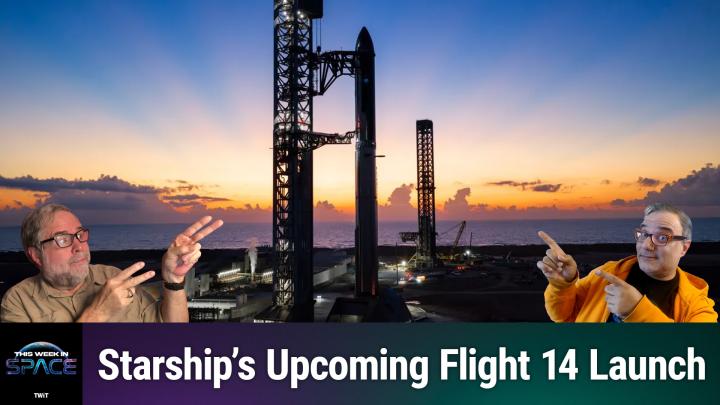
This Week in Space 229
Tariq Malik [00:00:00]:
Coming up on This Week in Space, the stage is set for SpaceX's big orbital Starship launch, Flight 14. SpaceX has plans to sunset their Falcon 9 rocket too. And why is Jared Isaacman, NASA's chief, happy that China delayed their Mars mission? Well, it's a close call. You'll find out why on This Week in Space. Tune in and check it out.
Rod Pyle [00:00:29]:
This is This Week in Space, Episode number 229, recorded on July 25th, 2026: Is It Starship's Time? Hello and welcome to another episode of This Week in Space, the Is It Starship's Time edition. I'm Rod Pyle, of course, editor-in-chief of Ad Astra Magazine. And as always, I'm here with the inimitable Tariq Malik, editor-in-chief of space.com.
Tariq Malik [00:00:56]:
Hey, Rod, how's it going? How's it going? Hey, hey, hey. Oh, what? Before we begin. Yes. I forgot to do something last week and I'm going to have to do it this week. Okay.
Rod Pyle [00:01:08]:
Now, is this something we're legally—
Tariq Malik [00:01:10]:
we can see on camera?
Rod Pyle [00:01:12]:
Hmm.
Tariq Malik [00:01:14]:
Happy birthday to you. Happy birthday to you. Happy birthday, dear Rod. You belong in a space zoo. Woo! It was Rod's birthday last week, everybody. It was Rod's birthday last week and I forgot to sing, so I'm singing now. Happy birthday, buddy.
Rod Pyle [00:01:29]:
Hey, 70 is the new 40, they tell me.
Tariq Malik [00:01:32]:
Thank you, room. Thank you.
Rod Pyle [00:01:35]:
I'll be here all week. Thank you, Tariq.
Tariq Malik [00:01:39]:
I appreciate it. You are welcome. You do not look 70. I know I told you this offline. I love that. I love that horn. But you do not look 70 at all. I'd say you don't look a day over 69, my friend.
Rod Pyle [00:01:49]:
Oh, there we go. You've only seen me once early in the morning, so there we are. Um, but I won't go into details. All right. But speaking of details, today we're going to be—
Tariq Malik [00:01:59]:
Promise never to speak of that again, Rob.
Rod Pyle [00:02:04]:
The Dead Truckers Inn in, uh, in Houston. Uh, today we're going to be doing all headlines all the time, but before we do, we have a space joke from Scott English in Australia. Wait a minute, let's get down for Australia.
Tariq Malik [00:02:18]:
Are you getting down under?
Rod Pyle [00:02:19]:
Yeah, getting down under. Hey, Tard.
Tariq Malik [00:02:22]:
Yes, Rod?
Rod Pyle [00:02:23]:
What did one starship say to another starship after refueling in space?
Tariq Malik [00:02:27]:
Uh, I don't know. What?
Rod Pyle [00:02:28]:
Tanks.
Tariq Malik [00:02:30]:
We have not used that joke. You were worried about it. Yeah, we have not used that joke before.
Rod Pyle [00:02:35]:
Well, very good.
Tariq Malik [00:02:36]:
I can confirm that has not been used.
Rod Pyle [00:02:40]:
Because you didn't barf in your mouth a little bit last time.
Tariq Malik [00:02:43]:
All right.
Rod Pyle [00:02:43]:
Now, I've heard that some folks want to fill our tanks with battery acid when it's joke time in this show, but you can help by sending us your best, worst, or most innovative space joke to, to us at twist@twit.tv. Now, I'm looking at you, Discord. You guys are falling down on the game here. I've gotten a few good ones from you in the past, but it's been kind of slim lately. And, you know, when I have to dig into my internal volume of jokes, that's a bad time because they're all like, well, they're not even dad jokes, they're granddad jokes at this point.
Tariq Malik [00:03:16]:
I know.
Rod Pyle [00:03:17]:
So, yeah, we need your help. But let's move on. Now, we're not really going to headline news because this is a headline show. So let's just get into the headlines.
Tariq Malik [00:03:28]:
Yes, John? No, no, no, no. Headline show. Headline news. Okay. Oh, I was early. I was early. I wasn't expecting it. John surprised me.
Rod Pyle [00:03:41]:
Craig Newmark. Okay.
Tariq Malik [00:03:45]:
Let's go.
Rod Pyle [00:03:46]:
Show me the ice.
Tariq Malik [00:03:47]:
Well, no, no, no, no. Let's talk about Starship. That's the name of the thing, right? So we should just talk about Starship. Okay.
Rod Pyle [00:03:51]:
Okay.
Tariq Malik [00:03:51]:
Okay.
Rod Pyle [00:03:53]:
We'll go straight to Starship. All right, so SpaceX Starship orbit, maybe. When?
Tariq Malik [00:03:59]:
How? Who?
Rod Pyle [00:04:00]:
What?
Tariq Malik [00:04:01]:
This is it. This is it, Rod. It's all coming. It's all happening at last. At last, right? So this is probably going to be our big story this week. It's probably also going to be our big story next week. But Rod, SpaceX says that they're going to reach orbit with Starship on September— on Monday, next Monday as we're recording this. So like in In like 3 days.
Rod Pyle [00:04:20]:
I hope they're right.
Tariq Malik [00:04:21]:
Yeah. And, and so, so the launch is set for September 28th out of Boca Chica, of course, from their— I think it's from their Pad 2 version right now. And, and this is a long one. It's a 10-hour flight because they're gonna try to do a whole orbit of the planet.
Rod Pyle [00:04:41]:
And more than one.
Tariq Malik [00:04:43]:
Well, yeah, hopefully several times because they're gonna, they're gonna do a like a launch in the morning. The liftoff is set for 8:15 AM. I don't, I don't even put my face on before 8:15 in the morning, you know. Wow. So we're gonna have to get up early. But, but they're gonna, they're gonna carry something like, like over a couple dozen Starlink V3 satellites, operational ones. So they're actually going to carry up official ones. There are 26 of them.
Tariq Malik [00:05:14]:
That's right.
Rod Pyle [00:05:14]:
So they gotta hit orbit.
Tariq Malik [00:05:16]:
They have to, right? Because it's— it is now like a commercial mission, if you will. And, and so, you know, it will follow kind of that similar scheduling for the test part of it. The launch, they're not going to try to, I believe, to land anything and capture it, but they're going to try to do the soft landing in the Gulf for the Super Heavy about half an hour into the flight. As with Flight 13, they'll try to do the Starlink deployments, and then they're just going to stay up there. They'll do their orbital corrections, their relights, etc., to have a 10-hour flight in a 275-kilometer orbit. And if, if everything goes well, they're going to orbit the Earth 6 times, Rod, 6 times. So, you know, I guess, I guess come back for more. They're actually going to splash down not in the Indian Ocean, but in the Pacific Ocean west of Chile.
Tariq Malik [00:06:15]:
Which is, I guess, better than Chile.
Rod Pyle [00:06:17]:
So that's not the graveyard zone. That's—
Tariq Malik [00:06:19]:
no, it's a different spot. It's— yeah, it's— I guess that's where their end up is. Uh, better than east of Chile because I think that's like— what is that? That's more Chile, right? So I think it's Argentina.
Rod Pyle [00:06:30]:
Yeah, Argentines might be upset about that.
Tariq Malik [00:06:33]:
That's right.
Rod Pyle [00:06:34]:
Excuse me. It's— this is great. Glad to see it. A little late. You know, compared to what was planned. We really, really need to see orbital refueling and rapid staging of a second launch soon.
Tariq Malik [00:06:50]:
Yeah. Because it would not—
Rod Pyle [00:06:52]:
it's ticking.
Tariq Malik [00:06:53]:
It would not surprise me if we don't get— wait, it would not surprise me if we do get a Flight 15, like, discussion about when that could happen. during this 10-hour period, uh, you know, during this, this flight test.
Rod Pyle [00:07:11]:
Yeah, good time to hold a news conference.
Tariq Malik [00:07:13]:
Yeah, well, not a news conference, but to say that we're ramping up. I'm actually expecting— and I can't say like I have any insider knowledge at all, I'm not Eric Berger, you know, with my ear to the, to the rail about, about all the things that are happening on—
Rod Pyle [00:07:25]:
but I think he's got bugs at headquarters. Yeah, headquarters.
Tariq Malik [00:07:29]:
But whatever, it would not surprise me if SpaceX didn't take this 10-hour captive audience time where we're all watching this mission to, to say, okay, this is in space. Here's, here's an update on the Gigabay, which is the giant hangar that they've almost completed— factory, actually— in Kennedy Space Center. You can't miss it because SpaceX has off— like, as you're driving out to the launch pad at the Kennedy Space Center, they have this facility. It's like a shed where they keep all like the flown boosters. you know, the Falcon 9s, et cetera. And they've been building what is essentially like a supersized VAB for Starship there so that they can build all of the things to launch out of Florida. And, and it wouldn't surprise me if they're going to talk about that when we're going to see their first Florida launches from Starship. What they're— I think they're building at least 2, if not more pads in Florida.
Tariq Malik [00:08:26]:
So like, like an update on all of that stuff that's going on. And then, you know, maybe we'll finally see a good final design or a like some completion stuff inside for their, their moon lander, which they have a mockup of at least like the cabin at the Johnson Space Center for astronauts to work on. But, but like, we need to know all the other things about it.
Rod Pyle [00:08:48]:
So the cabin is for that. The life support pressurized area has got to be— I mean, are they actually doing the full nose cone or is it just an Apollo capsule size pinch at the top?
Tariq Malik [00:09:01]:
It's, it's, it's, it's really unclear. I mean, you, you and I were there, you know, when we saw the Blue Origin one. I think it's gonna be at least that size, if not bigger than that.
Rod Pyle [00:09:10]:
The Blue Origin one we saw was the lander.
Tariq Malik [00:09:12]:
Because it will have windows in the, in the front, so they have to have windows in the nose cone itself to show. So it could be, it could be a substantial size, Rod, because how wide is it? It's like 20 feet wide, something like that. What, 13 feet?
Rod Pyle [00:09:25]:
Starship? Yeah, 33.
Tariq Malik [00:09:27]:
33 feet wide. Yeah.
Rod Pyle [00:09:28]:
So I mean, diameter of Saturn V.
Tariq Malik [00:09:30]:
Yeah, that is, that is massive, you know.
Rod Pyle [00:09:32]:
Yeah, that's a lot of empty space for 2 astronauts to be going down the surface. Hello, hello, hello. All right, um, speaking of which, let's, uh, go down to our own surface on a break, and we'll be jetting back to you in just a moment. So go nowhere. So as long as we're talking about Starship, I just spotted something by friend of the show Leonard David.
Tariq Malik [00:09:52]:
Leonard!
Rod Pyle [00:09:53]:
that I'm calling the Starship Resort, but NASA apparently is calling long-term habitat. So as should be a surprise to absolutely nobody, there are plans, although they're just now appearing in official documents, so it's said, haven't seen them yet, to convert a Starship into a long-term habitat. Now, worth remembering that the pressurized volume of a Starship is about the same size as the pressurized volume of the entire ISS, but in one big chunk. So that's a big deal.
Tariq Malik [00:10:24]:
It's massive.
Rod Pyle [00:10:25]:
But I have to say, Tariq, I don't know, I don't think that art came from you guys, but whoever did the AI art for this thing, yeah, needs to be kicked out of the club because it's horrible. It looks like that 1970s stuff of O'Neill cylinders, except O'Neill cylinders had gravity caused by centrifugal force. This has gardens and fountains and stuff up in the nose cone. It's like Yeah, but it'll all be floating. You know, you can't plant in dirt and so on and so forth. So anyway, the art was a little wonky, but the idea seems sound. Do you know anything about it?
Tariq Malik [00:10:58]:
Well, no, I mean, this is actually new because you just said that Leonard just shared this. So I'm trying to actually get caught up, but it would not surprise me, right? Because as you mentioned, Starship is enormous. And we know from just, I think, recent rumblings. In fact, I think it's one of the things that you have flagged for later discussion today, that SpaceX is going to be leaning much heavier into Starship than they already are now. And I know that sounds hard to believe, but that means that like they are kind of winding down Falcon 9. We've heard that Crew Dragon might be on the cut list.
Rod Pyle [00:11:40]:
Yeah.
Tariq Malik [00:11:40]:
Once they get an operational Starship kind of crew version going, And so having a multi-use case for Starship so that you've got a launch vehicle so that you have a destination for it, you know, where you can outfit it all. I mean, what's the difference there, right? You just cut some more window holes in the side of it so that the crew can look out in a few things or add a few— add docking hub in the nose cone so that you can have other visiting vehicles up to it. It would not surprise me that they would pick something like that as well to see. So I mean, it'd be pretty cool to see.
Rod Pyle [00:12:18]:
And that came— I lost the listing, but that came apparently from a California congressman. I'm not sure why that was part of the story, but there you have it. Well, let's see. Well, as long as you brought it up, why don't we roll over to line 44 and 43, which are the Falcon 9 panic and the Crew Dragon panic.
Tariq Malik [00:12:44]:
I was going to say the Gizmodo story.
Rod Pyle [00:12:47]:
Yeah, so, you know, what happens to customers— I mean, Falcon 9 is the bigger one because so many people use it. So 165 flights last year. Um, it's weird, you know, I know that SpaceX is all in on Starship.
Tariq Malik [00:13:01]:
Wait, to be clear, are we— we're talking about Jeff Foust's Space Review piece, right? Coming to Terms with the End of Falcon 9.
Rod Pyle [00:13:07]:
Uh, is that what it's called?
Tariq Malik [00:13:09]:
Yeah. Just so that, so that, so that, so that Jeff gets like his due, because you know that man works hard.
Rod Pyle [00:13:14]:
So he does. He works hard. He shows up at every conference, and I don't think we've spoken for 3 years. But, um, you know, they have a lot of customers. A lot of people count on it. It's the most flown rocket in the world. It's the most successful rocket in the world. It's the most recycled rocket in the world.
Tariq Malik [00:13:30]:
That's right.
Rod Pyle [00:13:31]:
And I would ask that SpaceX be darn sure that Starship is going to work as planned before they cancel Falcon 9 and Crew Dragon, but Last I checked, they didn't care at all what I thought. But Gwynne Shotwell was being interviewed and she said, if we don't obsolete our own products and services, someone's going to find a way to obsolete them for us.
Tariq Malik [00:13:53]:
Yeah.
Rod Pyle [00:13:54]:
And then my favorite quote was regarding under the Crew Dragon discontinuation, talking about Boeing Starship, quote, they should fly their capsule.
Tariq Malik [00:14:05]:
You mean Starliner? You said Starliner.
Rod Pyle [00:14:06]:
Starliner.
Tariq Malik [00:14:07]:
Starliner. Sorry.
Rod Pyle [00:14:08]:
They should fly their capsule. The government paid a lot of money for that. They should be able to use it. Ooh, sharp words talking to a competitor. But let's stick with Falcon 9 for a second. So, yeah, you know, we've got Rocket Lab, we've got a couple of other competitors, but not many boosters the size of Falcon 9. So, yeah, what do you see in your crystal ball there?
Tariq Malik [00:14:31]:
Well, it's, it's really interesting because that's kind of the point of Jeff's story. And, you know, for folks who haven't checked it out, it's at thespacereview.com, and it's a very detailed look at a bit of the angst that's going on in the launch need community, not like the launch community, right? Because—
Rod Pyle [00:14:52]:
Not the launchers, but the launchees.
Tariq Malik [00:14:53]:
The launchees, right? Because over at, uh, as Jeff kind of makes the case for it, in Paris last week was the World Space Business— I think it's called Forum, is that what it is? That's— it's like the big conference. And one of the overarching messages there is that despite the mind-boggling number of Falcon 9 launches that SpaceX is able to do, you know, hundreds and hundreds of launches, there is still a need for more launch upmass, right, of a certain size. SpaceX's Falcon 9 is a medium launch vehicle. It can launch a crew capsule, it can launch a cargo ship for NASA, it can launch, you know, like mid-range satellites into orbit for a variety of customers, or just massive numbers of satellites for their transporter missions. There's one scheduled for next week, actually.
Rod Pyle [00:15:40]:
And how many Starlinks, like 12, 20?
Tariq Malik [00:15:44]:
Uh, it can carry about 20 of the V2s. The V3s are bigger, that's why there's only 20 of them on a Starship. So, but it can carry like 20, 26 of the V2s. But SpaceX doesn't want to do that anymore. It's not big enough to launch their V3 Starlink, so that's why they're building Starship. And, and so who picks up that slack? Without Falcon 9, you don't have Crew Dragon, you don't have your Dragon cargo ships now. So NASA needs to, to go all in? And we're going to talk a little bit about Starliner for that, because there's some news that we're expecting to come down the pipeline. Uh, I guess I was expecting it this week, but it sounds like we have to wait another week.
Tariq Malik [00:16:18]:
And, uh, and then what happens to all those other satellites that could have been launched? You know, now SpaceX is its biggest customer right now, so for them, maybe it's not as big a hit because they're just replacing their own rocket with their own rocket for their own—
Rod Pyle [00:16:33]:
But if you're, if you're a smaller customer or a a medium-sized country that's trying to get into the space market, and you've been used to the idea of what Falcon 9s cost versus what Vulcan costs, if that ever gets back online, it's going to be a severe shock to the system when you have to fly somebody else's rocket.
Tariq Malik [00:16:51]:
Yeah, yeah. And so, so you mentioned Rocket Lab, and they are developing a medium launch vehicle. It's called Neutron. It's going to launch out of Wallops. I'm so excited. It's going to be the biggest rocket to launch out of there, uh, in a long time. And, and so that is one. You have a few other kind of smaller range rockets.
Tariq Malik [00:17:08]:
Isar Aerospace, you know, we talked about them, that German company that just reached orbit for the first time out of Norway. So there's some launch stuff there. Up in Scotland, another company, Rocket Factory Augsburg, is developing their own vehicle to launch as well. But you mentioned SpaceX obsoleting their own product, because that way they can control the next product, right? Right. And They're not wrong, because as we have seen in just like the last 6 months alone, China has not only landed one rocket, they've landed 2 rockets in 2 different ways, and they're testing a Starship clone as well to do vertical landings and vertical launches as well. So, so that is coming. And, and if SpaceX doesn't iterate to another, like, like a more affordable— which is what Starship is supposed to be. fully reusable, so you're not throwing away an upper stage, and fully repeatable over and over and over again.
Tariq Malik [00:18:05]:
If they don't get to that point, there's, you know, China is there waiting, because they're, they're developing things as we see fit. Now Europe has their own stuff. They've got Ariane 6 now. They can, they can scale that up. They're developing Callisto and a few other reusable rockets too. But those are still really far off, at least in my opinion, right? Because we haven't even seen a lot of like really get-go for that. They're just trying to catch up.
Rod Pyle [00:18:28]:
Yeah.
Tariq Malik [00:18:28]:
Even on their own crew, capable, like, like approach. You know, we've seen a lot of interest now from Europe there to develop that so that they're not as dependent on Falcon 9 should SpaceX decide to get rid of it. Uh, so I think that there's going to be a lot of launch constraints and a lot of people like really trying to find a ride for a while until either Starship has— we haven't even seen like what a payload version of Starship is going to look like with, you know, payload bay doors to deploy satellites and stuff like that.
Rod Pyle [00:19:00]:
So, yeah.
Tariq Malik [00:19:01]:
All right.
Rod Pyle [00:19:02]:
Well, we've got to launch into a break here, so stay with us. We'll be right back. So along with the Falcon 9 discontinuation, of course, that implies, and they have said, that they will also stop making Crew Dragon. They will fly out enough flights to finish their duties to the ISS if it comes down to 2030. Yeah, I didn't say anything about the 2 or 3 years that it might be extended, but, uh, NASA quite intelligently bought— what was it, 6 more flights from SpaceX?
Tariq Malik [00:19:31]:
6 more, yeah.
Rod Pyle [00:19:32]:
And then they bought a couple more from Boeing.
Tariq Malik [00:19:36]:
Well, we— that's what we're hearing. That's— I think that's what we're going to talk about, right? Yeah, that's what we're hearing. So, because it's not official yet, uh, at all, as, as, as far as I know.
Rod Pyle [00:19:45]:
So, but, uh, you know, some interesting thoughts about Crew Dragon. I mean, You— I'm wondering if they could potentially— it would— it might be a stretch to sell Falcon 9 boosters to have another private operator run them, but—
Tariq Malik [00:20:03]:
Mm-hmm.
Rod Pyle [00:20:04]:
Might it make sense because the Crew Dragons don't fly— refly as often as the boosters do, and they're very robustly built and sophisticated and have proven themselves incredibly well. Uh, to possibly fly the Crew Dragon on another booster if they contracted it out to somebody else. I can't imagine SpaceX letting go of it, but what if, you know?
Tariq Malik [00:20:27]:
Well, I mean, that, that's, that's very interesting. Now again, if SpaceX goes that route, then they have to cede their technical, uh, know-how to someone else. And, and as you said, I don't think that that's right, but you raise a really good point. Because that is exactly what, again, friend of the show Eric Berger, as well as Gizmodo, is reporting that NASA is looking at with Boeing's entry, Starliner. Because as we talked— I think we touched on this a little bit.
Rod Pyle [00:20:56]:
Yeah.
Tariq Malik [00:20:57]:
Last, last week, because it was very fresh at that time. But Eric has some sources that have been telling him over at Ars Technica that NASA will be soon announcing plans to buy a couple more, at least, Starliner flights beyond the original commitment. And, and then also committing some funding to both fix the thruster issue, which again, is kind of like paying them to fix their own problem. Right. And crew rate, and an adapter that will allow them to fly it on different rockets. So, right, you know, maybe on a Starship, maybe on a Vulcan, on a Vulcan rocket, maybe on something else. Yeah, well, Falcon, well, some other medium lift, right?
Rod Pyle [00:21:40]:
Yeah, Starship, you'd have to put it inside.
Tariq Malik [00:21:42]:
I know, I know, but who knows, right? Who knows what—
Rod Pyle [00:21:45]:
Well, hey, you wouldn't need life support that way. That's true.
Tariq Malik [00:21:49]:
And so, and so, so this is— it's really interesting because, like, I, I don't see SpaceX doing that because they would have to release their own IP control over that if they're gonna contract it out to someone else, unless there's some other deal that— that on how aerospace works that I'm not aware of. But—
Rod Pyle [00:22:06]:
Well, and that's a lot of trust to put into a partner or an assignee. Yeah, to keep your hardware up to snuff and not embarrass you by having it fail.
Tariq Malik [00:22:14]:
But this Boeing— yeah, this Boeing thing makes a lot of sense because Boeing doesn't have a lot. Boeing is part of the United Launch Alliance, a lot with Lockheed Martin, and they had designed Starliner to fly on Atlas V, of which there is a finite number, as this Gizmodo piece reminds us, left of the Atlas V. There's like 6 rockets left. So NASA needs more flights than that for Starliner. So they need to adapt it to fly on a Vulcan rocket or fly on a Blue Origin New Glenn or, or something like that so that it can still have a life to fit NASA's needs one way or another. Now, are they going to fly 8 of these Starliners by the end of the, the ISS program? in what, 4 years? I don't know. That does— that seems like a lot of flights given the delays in the state of the program.
Rod Pyle [00:23:08]:
Yeah.
Tariq Malik [00:23:08]:
You know, for this. But it does give Boeing a bit of a lifeline for what is an extendable product now, so that maybe NASA uses it to fly, you know, astronauts to a Vast station or, or an Orbital Reef station, you know, some— somewhat an Axiom station. Now they have an extra vehicle that is not SpaceX's Crew Dragon, of which the days are numbered, you know, and who wants to pay for an entire Starship launch to get up there or entire Orion launch?
Rod Pyle [00:23:36]:
So, yeah, that's an interesting point. And what I haven't seen out of the conversation recently, other than, yes, we might be doing uncrewed flights in the next few years, is Sierra Space and the Dream Chaser.
Tariq Malik [00:23:51]:
Well, I mean, Dream Chaser is an interesting one. I mean, we've been waiting for that first Tenacity flight for quite some time, and I don't think that it's coming until next year at the earliest now.
Rod Pyle [00:24:01]:
Right?
Tariq Malik [00:24:02]:
And I just— I read something and I felt a bit out of the loop that Dream Chaser may not even be ready for the ISS retirement. Did you read that?
Rod Pyle [00:24:09]:
Yeah, yeah, yeah.
Tariq Malik [00:24:10]:
I was really surprised by that because I thought it was further along. And, and so I'm very curious at what's going on at Sierra Space because of all of that.
Rod Pyle [00:24:19]:
So, all right, let's talk Louisiana.
Tariq Malik [00:24:24]:
Louisiana SpaceX.
Rod Pyle [00:24:27]:
Oh my lord. So they just put up a hiring notice for the first 4 jobs for their $100 billion launch and construction facility. Now, in Brownsville, South Texas, Starbase was originally 350 acres, which is a little smaller than Disneyland.
Tariq Malik [00:24:44]:
I think we should point out, by the way, this story comes from Claire Taylor over at nola.com. That's New Orleans, Louisiana.
Rod Pyle [00:24:51]:
And they have added a bit over 7,000 more acres or trying to for Starbase. But they're not messing around. Louisiana, 125,000 8,000 acres. I thought that was how big Louisiana was, not just Vermilion Parish. Um, so that was kind of amazing. So they're hiring, in case anybody's interested: senior construction project manager— makes sense, Starship infrastructure— civil engineer, land development— Starbase infrastructure— and perhaps most importantly, government affairs manager, senior counsel, real estate and infrastructure.
Tariq Malik [00:25:28]:
You're, you're, you're a lawyer. To make sure that you can get all the land, right?
Rod Pyle [00:25:32]:
Yes, well, and, and that it's free and clear and you don't have to worry about the, the spring-footed crawdad or something, which, you know, could very well come up there because that, again, is a heavy wildlife area, I think. So, um, you know, it's kind of exciting. They're gonna build— I thought they said they're gonna build 20 launch pads. I'm seeing now only 5 are planned.
Tariq Malik [00:25:51]:
So there's 5 launch complexes, and as I understand it, each launch complex will have 2 towers. so you can have a catch for both vehicles, right? So, so, so from, from what I've seen, this is what SpaceX released in their image. It's 5 complexes, 5 pads that each has 2 towers on it. Uh, so that's a total of 10 pads, which makes sense for the scale they're talking about.
Rod Pyle [00:26:17]:
Right.
Tariq Malik [00:26:17]:
Elon was saying eventually 30, 30 launches a day or something like that, 10,000 flights a year. which seems crazy, you know, still to think of. But you know, how, how many flights, uh, commercial airline flights are there a day, right? So think about that. I guess that's kind of what they're shooting for. Um, and this is really interesting because, by the way, nola.com, if you're looking for Starbase or Starbase Louisiana news, very good to be watching. Because not only do we have this new job posting, but there's a really great story about how of this $100 billion that SpaceX is investing, they're getting a 25 or a 0.6 billion, $26.7 billion, uh, tax credit on it, you know, which is— that's a pretty big savings, you know, credit for, for buying everything else there. So there's this— we're going to be seeing a lot of these types of announcements as they ramp up. That senior construction project manager, they're going to be based at the Starship base in, in Brownsville, you know, until they get the, the actual stuff up and running by 2027.
Tariq Malik [00:27:19]:
So that they'll—
Rod Pyle [00:27:19]:
Why do you know that?
Tariq Malik [00:27:20]:
Did you apply? No, it's in the story there. So sometimes, sometimes I'm actually, I'm actually up and reading. This is one of those things that I had poked out about because I just, I'm really fascinated with, with this whole thing. Plus also the fact that NOLA seems to run everything in like a centered formatting type of story rather than left justified. I don't know if you noticed that. So they could just be like a glitch there, but, but it's, it's, it's very interesting to see that they're starting to do all the breadcrumbs. So they just announced this like a week or two ago, right? And now they're doing the hiring for it. And then, you know, pretty soon, you know, we can expect in the next year they're gonna probably break ground and start things, you know, going to start pouring the concrete wherever they're gonna send.
Tariq Malik [00:28:07]:
So they clearly have a very friendly environmental relationship with Louisiana to kind of get this stuff going as fast as they're getting it to go. Plus the experience they've had at Starbase, at Starship.
Rod Pyle [00:28:19]:
Or perhaps it's comfortable Non-environmental relationship.
Tariq Malik [00:28:23]:
I guess what's the right word? I'm just saying regulatory environment. A comfortable regulatory environment. Yeah.
Rod Pyle [00:28:27]:
All right. Well, let's pour ourselves into a break and we'll be right back. So go nowhere. Jared Isaacman, our hero. Sometimes, maybe not. People are blowing hot and cold on Jared these days. But he did come out and say recently that he was— well, let's just say he expressed relief that China is seeing some delays in their lunar program. So Chang'e 7 was supposed to launch in August.
Tariq Malik [00:28:53]:
Mm-hmm.
Rod Pyle [00:28:53]:
It didn't. Rocket went to the pad but didn't go anywhere. No reason was given officially. Isaacman was quoted in saying, we dodged a bullet, as they are also headed towards Shackleton Crater, which is in the South Pole region of the Moon. And his feeling was they could have denied access. Now, this is all based on that land a robot, claim an exclusion zone thing, which I have to confess I don't still fully understand all the legal implications, but, uh, I guess the general agreement is that's your backyard once you're there and operating, so other people should stay a certain range away. How big that zone is, I don't think has been officially declared yet. Um, then he went on to talk, uh, very nationalistically, so probably pleasure to lots of boomers' ears, about someone coming down the ladder on a lander without an American flag, and that would call— American security agreements and soft power into doubt.
Rod Pyle [00:29:45]:
Well, Jared, I think we're already there, but okay. Then further going on to— and I don't know if he talked about this, but it was in the same piece— the Chang'e 8 instruments were announced to be placed on other missions in the 2030-31 timeframe instead of 2028-29. And actually, I found that more interesting.
Tariq Malik [00:30:05]:
Yeah.
Rod Pyle [00:30:05]:
You know, the rest of it's kind of like rah-rah, sis-boom-bah nationalist rhetoric. which may or may not have some, some real teeth to it. But the fact that they— I mean, that kind of— this reminds me what happened with VIPER. Oh, the rocket's not ready, let's scrap the project. Wait a minute, you already bought and paid for the rover and it's gonna work. Put it on a rocket, which they finally did.
Tariq Malik [00:30:26]:
Yeah.
Rod Pyle [00:30:26]:
Why do you have any reason why they're splitting up Chang'e 8 and placing them on different missions?
Tariq Malik [00:30:32]:
Well, because right now, as I understand it, Chang'e 7 is like a pretty hefty mission. It's got a lot of different things on it. It's got like a rover, it's got an orbiter, it's got a hopper. So it has all of these things. And so it's gonna, it's gonna do a lot at the South Pole. And Chang'e 8 is gonna do like even more of that. And so I think limited space.
Rod Pyle [00:30:54]:
Chang'e 8's claim to fame besides the instrumentation is they're going to do their first ISRU experiment, right?
Tariq Malik [00:31:00]:
Yeah, yeah, exactly.
Rod Pyle [00:31:02]:
And so in situ resource utilization, so basically making lunar dust into bricks and stuff.
Tariq Malik [00:31:06]:
Or, or getting, getting rid of, or finding the water and trying to show that they can do stuff with that.
Rod Pyle [00:31:12]:
Good luck.
Tariq Malik [00:31:12]:
But by the way, we should point out, and, and if you want to show more, John, you can from line 39, because they're, they're both touching on the same, the same thing. But, uh, and, and that, that is the— this is, this is the story that, that, that Rod is talking about is from Space News, uh, but also, uh, Ars Technica and Eric Berger did a version of this too. And, uh, Jared Isaacman was speaking at the Offworld Conference, which is a conference put on by Payload Space, as I understand it, uh, In space. They're like another publication type of organization.
Rod Pyle [00:31:43]:
Oh, we should be doing a conference. Oh, wait, we do.
Tariq Malik [00:31:45]:
Never mind. Yeah, there you go. There you go. Coming up in October, right, Rod?
Rod Pyle [00:31:50]:
Well, and the Settlement Summit coming up in October, and then June is the ISDC. Or no, maybe it is late May. It's Memorial Day weekend. That's May, right?
Tariq Malik [00:31:59]:
Yeah, that's, that's May.
Rod Pyle [00:32:00]:
And you're going to come, right?
Tariq Malik [00:32:02]:
Why you got to put on the holiday weekend, Rod? We'll see. We'll see.
Rod Pyle [00:32:05]:
And all, all our Discorders are going to show up, right?
Tariq Malik [00:32:08]:
I could go last year because it wasn't on the holiday weekend.
Rod Pyle [00:32:11]:
I know, I told him the same thing yesterday.
Tariq Malik [00:32:15]:
Anyway, so, so, so what is interesting, like a lot of the discussion from Jared is like, what a close call the United States and its reputation as a first in space, or a leader in space now, right? Because remember the early days of the Space Age, we weren't the first in space, we collectively, right? Because the Soviet Union had the first you know, person in space, the first woman in space, the first, you know, this, that, and the other, first space station, all that. Oh yeah, first spacewalk, all that, all that stuff. So, so he says that because they delayed— Chang'e 7 was supposed to launch in August of this year, so last month, and it's been delayed now until no earlier than the 27th, January of '27. And, and for some reason, we don't know why, Right? We're probably not going to for quite some time. But because of that, he says that now, like, this is the chance for the United States to catch up, catch up, quote unquote, right? As if we're behind.
Rod Pyle [00:33:14]:
Sounds familiar.
Tariq Malik [00:33:16]:
Well, to launch, there's like a bunch of other missions. You mentioned VIPER. That's one of them. We have also Astrobotic. They're delayed with their, with their, their Griffin lander. We also have Firefly and a few others that are all supposed to—
Rod Pyle [00:33:28]:
Mark 1.
Tariq Malik [00:33:28]:
Blue Moon Mark 1, supposed to launch by the end of the year. So you have all of these things. that are all set in the, in the, in the hopper, if you will, to fly in the next, in the next few, the next few months. And, and then that can, that can kind of reclaim the leadership role there. Now, a lot of it is, like you say, it's like, it's like saber rattling and flag waving for that. And, and if they don't make the case that the next flag waved on the Moon could be Chinese or red, right? And the hammer and the sickle, you know. So if they don't make that case, then Congress doesn't fund it for whatever reason, because, oh my gosh, like, why do we have to keep funding this, this, that, and the other? So, you know, by the way, we should point out that, that, uh, uh, the president of China is meeting with the president of the United States like right now to talk about a lot of stuff. And one of the big things they're talking about is AI too, which we're not even talking about here.
Tariq Malik [00:34:24]:
So, but, but that's all going on in the background. And this administration wants to say we're ahead in space to that administration. And, and so, so I think that, like, I understand, like, the rah-rah mentality, but there is a case to be made about preserving that prestige on the national stage, especially as you—
Rod Pyle [00:34:47]:
Well—
Tariq Malik [00:34:47]:
Like, what's ahead? You've got the— you don't have a space shuttle, the only winged flight spacecraft to ever carry, carry humans anymore. Looks like we're not going to get another winged one. for a while to carry astronauts from Dream Chaser. Crew Dragon, you know, might, might be limited. Orion's gonna fly hardly ever, right? Maybe once a year.
Rod Pyle [00:35:05]:
Starliner.
Tariq Malik [00:35:07]:
Right. And, and so meanwhile, you've got that, you've got a lot of plans that, that China is already executing right now. And not just that, by the end of this year, India will have launched hopefully their first crew capsule. Not— no astronauts on board. Yeah, right. And then Japan is developing their own, you know, like a lot of things are going on.
Rod Pyle [00:35:26]:
So I think the soft power argument is legit. I'm not sure it's quite as powerful as he puts it. But we did have, I should add, in Ad Astra magazine, last 2 issues, we had articles by John Cross, who won the Ad Astra Writers Award last year, our first, about the first half of the— these are when John writes articles. It's like, okay, John, we got to slim down from 5,000 words here. But they're great articles. I mean, he does these great deep dives. And the first half was on what if China lands first?
Tariq Malik [00:35:57]:
Yeah.
Rod Pyle [00:35:57]:
What happens, you know, the United States and soft power and all that. And the second one was what if China builds the first lunar base? And as I understand it, copies of those are circulating through Congress right now and are probably raising some eyebrows. I hope we did that once before. But yeah, it's, it's, it's, it's— I try to be careful because If you grew up during the Space Age, it was a very rah-rah environment, you know?
Tariq Malik [00:36:26]:
Yeah.
Rod Pyle [00:36:26]:
We beat the Russians to the moon, and oh, they were ahead of us, and oh, we pulled up even with Gemini, but it was nose and nose there for a while, and then they defaulted to their little space stations and we did the moon landings. So it was a big deal. It was a big victory, you know, 3 channels, 3 TV channels, 6 radio networks, uh, 3 basic news anchors, blah blah blah. So it was very focused and centralized, and the message was very carefully controlled, and that's that's different now. So it's hard to make the same argument. But I think there is an argument there. But it's not for you or I to decide.
Tariq Malik [00:36:58]:
Today, as we are speaking, is the anniversary of China's first spacewalk in 2008 on Shenzhou 7. You know, it was their first live televised launch. And no, no, no, it's not the anniversary of the spacewalk. Sorry, it's the anniversary of the launch of that mission, the Shenzhou 7. But it was their first live televised launch. That was their first mission that had this first spacewalk that they did, and, and it set the stage for their dockings, for their space station, for all of the stuff that they're targeting now to do on the Moon. And, and it showed that they had a stepping-stone approach that is working for them. A lot of it is iterated, but a lot of it is their own stuff.
Tariq Malik [00:37:37]:
They had, they had their own Feitian spacesuit that they spent $15 million on. I think NASA's spacesuits cost a lot more than that, by the way.
Rod Pyle [00:37:44]:
Oh.
Tariq Malik [00:37:45]:
And we don't even have moon cities right now. But, but as we're talking about it, I think in the last week and a half they have debuted a new version of their, their moonwalking spacesuit.
Rod Pyle [00:37:56]:
They're being Axiom?
Tariq Malik [00:37:57]:
Oh no, China, right? Oh, well, NASA doesn't have one yet, even though we've seen a lot of, a lot of updates on it.
Rod Pyle [00:38:05]:
Well, and even though we did it before.
Tariq Malik [00:38:07]:
Yeah, well, I mean, I go to a break. Yeah. So I need a break. I need a break from not being on the moon.
Rod Pyle [00:38:13]:
So let's take our frustrated selves off to a break and, uh, stand by. Exciting news!
Tariq Malik [00:38:19]:
Yay!
Rod Pyle [00:38:20]:
Vast, our friends at Vast that are in, in beautiful Long Beach, California, about 4 miles north of my boat in a questionable part of town but in a beautiful new facility, uh, have announced they have a new Lunar Programs Division.
Tariq Malik [00:38:33]:
Now you've been there? You've been in their facility?
Rod Pyle [00:38:36]:
I have not. I was invited. I haven't gone yet. I have to go, and, and I wish you would come to LA for some reason so we could go together.
Tariq Malik [00:38:43]:
Hint, hint. Yeah, that's the plan. That's the plan, Stan. One day, one day. Oh, that's true.
Rod Pyle [00:38:47]:
Yeah, one day, right? Um, but, uh, you know, Vast is famous for their, their Haven-1 station. So they've flown hardware. Uh, they're going to launch a station this year, right? No, next year.
Tariq Malik [00:39:00]:
I think it's next year. I think it's next year.
Rod Pyle [00:39:02]:
Yeah, but that'll be the first commercial space station. It's kind of small compared to what the other guys are doing, but But it was this independent, out-of-the-blue, didn't-get-contract-money-from-NASA thing when they started out.
Tariq Malik [00:39:15]:
Yeah.
Rod Pyle [00:39:15]:
So that's pretty impressive. Now they're planning to use their vertically integrated abilities to support a US Moon base. Now, exactly what they'd be doing, you'd expect, oh, okay, they're going to build a habitat, but they're very careful to talk about phased deployment of power support, building an airlock, and maybe eventually a full habitat and a bunch of other stuff in between.
Tariq Malik [00:39:38]:
Yeah.
Rod Pyle [00:39:39]:
sounds to me like they've got this, this idea of a phased arrangement of, okay, we'll develop what you pay us to develop and send it to you for a lunar integration.
Tariq Malik [00:39:49]:
Yeah, this was interesting because it showed that they're looking beyond the, like, the space station approach for some sort of ongoing or sustainable product line that they can then sell not just for orbital flights but for planetary flights, because whatever they build for the Moon, they could build for Mars, they could build, you know, whatever, because you've got a space station habitat, you could use that for whatever, you could put it under the ocean, for all I know, you know, and have like some kind of the opposite pressure problems.
Rod Pyle [00:40:22]:
But yeah, but you know, they could conceivably build modules for a Mars spacecraft, because you're gonna need a lot more room.
Tariq Malik [00:40:28]:
And so what I find very interesting, and I don't know, John, can we show the illustration of their proposed lunar systems? Right now it was on that, that page at the top. Yeah. So, so for folks that are watching the, the, the, the, the stream, this is very interesting because it takes their, their design for a habitat and it—
Rod Pyle [00:40:50]:
An orbital habitat.
Tariq Malik [00:40:51]:
For an orbital habitat that has docking ports. And now you have a hub-based version of it where you can kind of attach with, with like Lincoln Logs, basically with little spokes and whatnot. And I don't know, do you see the wheels? Rod, on these habitats?
Rod Pyle [00:41:06]:
Yeah, yeah, yeah.
Tariq Malik [00:41:06]:
So, so it could be a mobile habitat. You could just like carry it around like a caravan or a camper on the moon.
Rod Pyle [00:41:13]:
Notice that the wheels are on— there's 2, 2 modules visible. One has wheels on one end and one has wheels on both ends, but they're really small. So the impression— now that's assuming these renderings are accurate, right? The impression is that that would be enough to drag them around the immediate vicinity, but you're not going to go roving with those unless they make larger Larger wheels.
Tariq Malik [00:41:34]:
But the concept is there. Yes. All I'm saying is that really cool for a camper on the moon, right? Or, uh, or on Mars or something like that.
Rod Pyle [00:41:43]:
Now, of course, that's their beauty shot. So what they didn't do, what they didn't show, was what they would ultimately have to do if they're really going to keep people in an aluminum tube on the surface of the moon, which is it's got to be covered with lunar dirt. Yeah. You know, having, having—
Tariq Malik [00:41:57]:
For radiation concerns, for people who are wondering. Yeah. Yeah.
Rod Pyle [00:42:00]:
Like, like between— I've read everything from 1 meter to 3 meters, but most commonly 3 meters. That's 10 feet of dirt. Besides being heavy, even on the Moon, that's a lot of scooping and moving and shoving. And having run the National Space Society's art program for the last 4 years, where we're acquiring artwork, um, space artwork, it's really hard to make a dirt-covered habitat look cool. Yeah, because it's either gonna be loose or it's gonna be sandbags or maybe sintered blocks, but it's just— it's hard to make it look cool.
Tariq Malik [00:42:33]:
Yeah, well, we should point out too, like, if, if, if we— people are interested, it's not just like a lunar habitat, it's also a power station. So imagine kind of like a little trailer with a vertically deployed sail-like lunar, like, solar array. They've, they've got that kind of a product line that they're trying to do. And they've got like their own special wheels for driving that on the Moon. So they actually been cutting metal to make prototypes of it to show what it could look like as well. You talked about the lunar airlock, so you would need a way to get in and out of your habitat. And then they're looking at ways to provide communications too. So you would have a flat satellite, like a comm system, Mm-hmm.
Tariq Malik [00:43:16]:
as part of the— an offshoot of their satellite bus program that they're developing as well to support their private space station program. So it seems like they're trying to take the technologies that you're developing for the space station and find as many other use cases in space for it. So that'll be very interesting to see. And there is— there are some new images if we can share there. And John, one more time, if you scroll down a bit, you can show— you can see their vast— their Haven-1 habitat that they've already built, that they've been putting together. So, and, and so that's nice to kind of see. So, but new solar arrays, it'd be interesting. I mean, a whole, whole product line.
Tariq Malik [00:43:51]:
And if they're first out the gate, Yeah, yeah, with this big— that's like, like, like SpaceX has proven. We were just talking about them earlier with reusable rockets. If they are first out the gate with all this stuff and they are building it on their own, right, then their customers are gonna come and say, yeah, I need this now, I need this, because you already have built it. There's the wagon right there on the stream for things. And so it'll be interesting to see.
Rod Pyle [00:44:17]:
And we know that they work fast. And quietly, which is something I've always really admired about them. John, time to the next break. What do we have?
Tariq Malik [00:44:29]:
What breaks?
Rod Pyle [00:44:29]:
Oh, we're past the last one?
Tariq Malik [00:44:32]:
Yeah.
Rod Pyle [00:44:32]:
Good. Let's rock and roll. Tariq?
Tariq Malik [00:44:35]:
Yes, Thread.
Rod Pyle [00:44:36]:
I'm going to allow you to indulge yourself.
Tariq Malik [00:44:38]:
Yes.
Rod Pyle [00:44:39]:
As Kirk once said to Zulu, I know you love juice. In particular, the JUICE mission. And I know you love Ramses, so tell us about some Ramses juice.
Tariq Malik [00:44:49]:
Yeah, okay, well, well, I got a couple things. So, so, and we talked a bit about the big SpaceX Day on September 28th, and that is gonna be obviously what we're all watching. Well, in Europe, they're gonna be watching their JUICE spacecraft, the Jupiter Icy Moons Explorer, because it comes back on Monday the 28th for a direct flyby of Earth. It's actually its 3rd planetary flyby of its mission. JUICE, for folks who don't know, is a flagship mission that the European Space Agency launched a while ago, on about, about almost 4 years ago, 3 and a half years ago, in April of 2023. And it's on this looping path through the solar system to get to Jupiter, because it's so hefty and massive. So it's doing all these planetary flybys. And this This is— it's already done like a lunar Earth flyby.
Tariq Malik [00:45:39]:
It's done a Venus flyby. And now it's going to come back to Earth to then, you know, get ready to set it up for its last Earth flyby in 2029. So it's taking a long road to Jupiter to get there in 2031. But this one is going to set it up for that 2029 Earth flyby. And then, and then we're going to see. So they'll probably turn the cameras on, do some trials on the way through to check it out. But But we'll see how this goes and hopefully it gets its nice third gravity boost and it's going to slingshot its way off there. And then we were talking about Ramses, the European space station.
Rod Pyle [00:46:12]:
Can I do it?
Tariq Malik [00:46:13]:
Oh, sure, sure. Go ahead.
Rod Pyle [00:46:14]:
Go ahead. Was it the Ten Commandments when what's her name? Oh, God, I just messed it up. It wasn't. I was thinking that Anne, what's her name, said Ramses, Ramses, Ramses. But she actually said Moses, Moses, Moses. Charlton Heston. So I apologize. Guys, for that complete left turn into nowhere.
Rod Pyle [00:46:37]:
Please continue.
Tariq Malik [00:46:38]:
This is a really fun one. Oh no, he got like the trombone. Oh, that's so sad. Uh, but no, just— it's, it's just a little bit of a, a, uh, we would call it a quick hit at space.com. It's like a little update, a blurb. But the European Space Agency has, uh, switched on the, the instruments to start doing testing for the RAMSES mission. And RAMSES is actually an acronym, not just like an Egyptian icon for Rapid Apophis Mission for Space Safety.
Rod Pyle [00:47:08]:
That's hot.
Tariq Malik [00:47:09]:
Yeah, right. But the key term in that name is Apophis, because you know what Apophis is, right, Rod?
Rod Pyle [00:47:16]:
It's like an apotheosis.
Tariq Malik [00:47:18]:
It's the asteroid that's gonna kill us all when it swings by Earth in 2029, and then it comes back again, I think, in 2036. And so 38. Yeah. And so, so the European Space Agency is building the Ramses spacecraft so that they can fly by Apophis and get up close and personal with it to understand the, the asteroid and see exactly how dangerous it actually really is. And it's going to deploy a couple smaller CubeSats around there. And, and we're gonna see like all sorts of up-close things. And then hopefully everyone can confirm that it's not going to kill us all. And I was telling Rod earlier, for everyone listening online, that I was very surprised about 2 things.
Tariq Malik [00:48:01]:
Number one, because it's September, that we haven't seen a story go viral about how Apophis is going to come kill us all. Because every September, we usually get one of those, those viral stories that have gone out the gate about how they've— it's going to come and it's going to, it's going to hit the Earth. And that's right, you know, wow, my gosh.
Rod Pyle [00:48:20]:
Tomorrow night, Mars will be the size of a manhole cover held a foot from your face.
Tariq Malik [00:48:24]:
That's right. And that Mars will be the size of the full moon in the night sky. Those are the 2 things that used to always come back every September. And we are wrapping up the month. We're not out of the woods yet. But if we can get to at least our next episode without having either one of those 2 stories go viral, then I will consider 2026 a win, at least for—
Rod Pyle [00:48:42]:
Okay, so this, this coming from the guy who invents new and clever names for every full moon there is, the full worm werewolf.
Tariq Malik [00:48:52]:
I never invented those names.
Rod Pyle [00:48:55]:
Oh, come on. Sure you did.
Tariq Malik [00:48:56]:
Hey, by the way, if we're talking about the moon, this weekend on Saturday is the harvest— is the harvest moon. Everyone should check that out.
Rod Pyle [00:49:01]:
Harvest worm eating your guts moon.
Tariq Malik [00:49:04]:
Yay. No, no, it's gonna be good. It's gonna be— I didn't make those things up. Those are like colloquial names.
Rod Pyle [00:49:09]:
I know, but still, you're kind of dragging them up out of the little garbage disposal of time.
Tariq Malik [00:49:15]:
The moon is the easiest thing for anyone to look at skywatching-wise. It's free. You just got to look up. So, right.
Rod Pyle [00:49:22]:
All right, well, very good. You know, we're getting those ugly gestures from John that we get towards the end of the episode because he wants to go eat lunch or something, which is when I of course enjoy extending the episode as long as possible. Did you have anything else besides Pokémon that you really would like to get to?
Tariq Malik [00:49:42]:
Well, I mean, the Pokémon one is just a fun picture because Pikachu was in space. We should, we should at least mention from line 42 that NASA has actually picked a new space telescope. the Prima mission, they have actually put together a brand new classification, a class of, of space missions called Probe Explorers. And these are not like cheap and dirty. We're on line 42 now.
Rod Pyle [00:50:08]:
And they're not Pokémon either.
Tariq Malik [00:50:10]:
Yeah. So is it 42? Yeah, 42.
Rod Pyle [00:50:15]:
Gotta find all those black holes. That's right.
Tariq Malik [00:50:17]:
You got to catch them all. You got to catch them all. But this, this is the— it's these Probe Explorers are— it's a new class of NASA astrophysics missions. So they're kind of They're not flagship missions, but they are not like dinky cheap ones. And so the PRIMA mission is going to be— it's called Probe Far-Infrared Mission for Astrophysics. And it's like a $1 point— I think it's $1.3, $1.2 billion. And it's going to be launching in 2033. It's a nearly 6-foot-wide space telescope to do deep, sensitive surveys of the universe in far-infrared light, helping to bridge the gap gap between existing infrared observatories like, like the James Webb and radio telescopes.
Tariq Malik [00:50:57]:
So it's kind of like that really deep stuff. It's not going to be an optical telescope at all. And that kind of energy is, you know, Big Bang signal type territory, you know, like, like the oldest signals in the universe. And so, so this will be very interesting to see like what other types of studies can be served by this new class of missions. And for folks who don't know, NASA has these different benchmarks. Like you've got your Discovery-class missions, you've got your cheapo missions, you've got your, you know, your flagship missions, which of which Hubble is one, JUICE would be another one. For example, Europa Clipper is a flagship mission. That those are the ones that cost multiple, multiple billions of dollars for them.
Tariq Malik [00:51:37]:
And this one's going to be like in the mid-range type thing, a billion-dollar thing. On the like $1.2 billion around the the Perseverance rover type cost. Those are like $2 billion missions, right? Or a trip to the moon. No, they're on Artemis is about $2 billion, right? So that's what for—
Rod Pyle [00:51:55]:
so for an Artemis flight, actually an Artemis flight's $4 billion, but that's just the SLS too.
Tariq Malik [00:52:00]:
Oh, the SLS. Yeah. It's the cost of a moon rocket, $2 billion. Space shuttle launch was—
Rod Pyle [00:52:06]:
Speaking of great big hard to comprehend numbers, our last one called Show Me the Ice, A long, I guess, sort of a longitudinal study of satellite observations of ice loss across various regions.
Tariq Malik [00:52:20]:
But this is a sad story. Yeah.
Rod Pyle [00:52:21]:
Yeah. Across Greenland and Antarctica show 12.5 trillion tons with a T trillion near polar ice observed to have vanished since the 1970s.
Tariq Malik [00:52:34]:
And this is both in Greenland and Antarctica combined.
Rod Pyle [00:52:37]:
So the poles, early as 1972. in Greenland and '79 in Antarctica, extending up to 2023, using data from 42 satellite surveys and 27 missions, has found that number, which is 11.3 metric tons— trillion metric tons, in case anybody wants to know— of ice has disappeared. Most of that mass coming from Greenland, which is interesting because it's further from the pole than Antarctica. But there you go. This has driven over 3 centimeters of sea rise, putting another 69 million people at risk of coastal flooding. As I say this, of course, a few miles from Long Beach, California, where we're seeing the entire coastline get destroyed by king tides and the Kelvin wave and the other surges that are causing massive tides. Now, mind you, you know, I looked at coastal property there once, then saw the prices and thought, oh, maybe not. But, you know, if you bought down there, you had to know this was coming.
Rod Pyle [00:53:35]:
Especially because for the last 20 years, the city of Long Beach has been bulldozing up these big sand berms to try and stop the incoming tide. At any rate, we're finally beginning to really see this now domestically. It's always been something we sort of saw elsewhere, or maybe just in parts of the East Coast. So this is a big deal. So it's not all caused by, by ice, but it is definitely caused by climate change.
Tariq Malik [00:53:56]:
Well, and then I think that's, that's the, the key here. There's a lot of people that like to put their heads in the sands, you know, so to speak. We're not talking about beaches, uh, about climate change.
Rod Pyle [00:54:05]:
It's not real. It's not this.
Tariq Malik [00:54:05]:
I mean, the Like, you know, we hear that a lot from political statements. Well, but this is, this is, this is hard proof of the climate change impact on the planet.
Rod Pyle [00:54:18]:
Well, so it's said, it's, it's, you know, there is still that school that says it's not manmade. I don't happen to agree with them because the evidence is overwhelming. And if you ever worked at JPL, you talk to a lot of really smart people that are scared to death of what's happening and do think for the most part it's manmade. But regardless of where you stand on that, what is not up for debate is the fact that it's occurring and we're in trouble.
Tariq Malik [00:54:40]:
This is, this is 42 different satellite surveys, 27 different satellite missions since 1979 to 2023. I think that this study went to, or actually, no, they looked at the records from '72 for Greenland and '79 for Antarctica. And then they compared them over like 50 or so years for that. And it shows you 2 things. Number one, obviously, the dramatic impact of ice loss and the effects that that can have on the planet over time. But number 2, the value of having an Earth monitoring mission in space tracking, like, like how our planet is changing, including the parts that are really important to make it habitable for the rest of us to have water and to have air and all that stuff. You know, this is— It's just a, it's a, it's a very good object lesson about why these kinds of missions are important.
Rod Pyle [00:55:36]:
So. And this doesn't include, at least not in the brief write-up I saw talking about, you know, besides coastal erosion and flooding and all that, you've also got saltwater incursion into freshwater reserves, which is, which is risky. So until we get non-fossil fuel energy coming in through space solar power or whatever way we're going to do it to operate massive numbers of desalinization plants, We also have a freshwater crisis staring in the face.
Tariq Malik [00:56:04]:
And if you want to see the data, you can look it up. This is a NASA and an ESA study that was in the journal Scientific Data. So check it out.
Rod Pyle [00:56:11]:
So next time you crunch down on a single almond, you're eating about, what is it, 3 gallons of water per nut or something to grow those things. It's like California, the drought state. What are 2 of our biggest crops? Almonds and rice.
Tariq Malik [00:56:26]:
Yeah. Almonds.
Rod Pyle [00:56:27]:
Rice, where you have to flood the fields, and almonds that require water. Anyway, I digress.
Tariq Malik [00:56:33]:
We used to have a canning factory for almonds in Stockton when I was growing up.
Rod Pyle [00:56:36]:
Because Stockton is sexy town.
Tariq Malik [00:56:38]:
Blue Diamond. Blue Diamond had a factory there.
Rod Pyle [00:56:41]:
Oh, that's actually not canning almonds. That's canning salt with almonds mixed in. Well, I want to thank everybody and you, partner, for joining us today for episode 229, Is This Starship's Time? Tariq, as I ask every week, where can we find you blasting the space termites or whatever it is your favorite game does?
Tariq Malik [00:57:02]:
Well, you can find me at space.com as always, on the socials at Tariq J. Malik. On Monday, you'll find me riveted to this computer screen, uh, trying to track the, the Starship launch, uh, over time. But, uh, on the weekends and whatnot, you can find me on YouTube at Spacetron Plays, where we're playing, um, uh, Marvel Rivals. We're playing, uh, Fortnite as well as Fallout 76 and Starfield right now, as well as other games. So come check it out if you like games.
Rod Pyle [00:57:29]:
So what do you battle in Fortnite?
Tariq Malik [00:57:31]:
Other people and my own, my own mismatched coordination when it comes to eye-hand coordination.
Rod Pyle [00:57:38]:
Okay, I thought there were critters. And of course you can always find me actually expanding my cerebrum at pilebooks.com or at astromagazine.com. Although not as far as Tariq, because his is—
Tariq Malik [00:57:50]:
I think that's Rod speak for he has a big head, right? Is that— no, I do.
Rod Pyle [00:57:56]:
My hat size is like 8 and a quarter. It's insane. I go to hat stores and tie these hats on and they look like a little monkey hat, you know. Of course, that may be a comment about my looks as much as anything else. Finally, remember, you could drop us a line at twis@twit.tv. We welcome your comments, suggestions, ideas, jokes, and insults. New episodes published every Friday on your favorite podcatcher, so make sure to subscribe, tell your friends, and please give us reviews. We love reviews.
Rod Pyle [00:58:23]:
We love you. 5 stars, thumbs up. Yeah, buy merch. I forget what— it's, it's off the Twit. Do you know what is there?
Rod Pyle [00:58:32]:
It's the Spring Store on the Twit website, right, John?
John Ashley [00:58:34]:
Yeah.
Rod Pyle [00:58:35]:
Yeah. Okay, the silent board tech is nodding. Uh-huh, Rod got it right for once. What a surprise. And, and join Club Twit because it's important and that's where the cool kids hang out and all that stuff. Finally, you can follow the Twit Tech Podcast Network @twit on Twitter and on Facebook and twit.tv on Instagram. Thank you, friends, neighbors, Romans, countrymen. Thank you, Tariq.
Tariq Malik [00:59:02]:
Thank you.
Rod Pyle [00:59:02]:
Thank you, John. And thank you, Twit and Lisa and Leo, for allowing us to continue. continue to, to engage— indulge ourselves on this podcast. We appreciate that. Thank you.