This Week in Space 178 Transcript
Please be advised that this transcript is AI-generated and may not be word-for-word. Time codes refer to the approximate times in the ad-supported version of the show.
Tariq Malik [00:00:00]:
Coming up on this Week in Space, Ukraine destroys a giant vintage radio telescope. Is China really pulling ahead in the race in space? And it's Rod's birthday, so let's sing. But more importantly, Terry Virts, former astronaut and Senate candidate for Texas, is going to join us to explain all of that and more. So tune in.
TWiT.tv [00:00:20]:
Podcasts you love from people you trust.
TWiT.tv [00:00:25]:
This is TWiT.
Rod Pyle [00:00:28]:
This is this Week in space, episode number 178, recorded on September 19, 2025. Tell it to the Mountain. Hello, everyone, and welcome to another episode of this Week in Space, the Tell it to the Mountain edition. I'm Rod Pyle, editor in chief, Bad Aster magazine, and I'm with my good pal Tarek Malik, editor in Chief for Space.com and Fairy Den godmother or something.
Tariq Malik [00:00:53]:
Hey. Hey. Hello, Rod. How are you doing today?
Rod Pyle [00:00:55]:
I'm good. And you're about to take off to take your daughter to Girl Scout camp, you lucky fellow.
Tariq Malik [00:01:00]:
Well, yeah. Hey, can I. Can I. Can I say something really quick?
Rod Pyle [00:01:02]:
Do I have a choice?
Tariq Malik [00:01:03]:
Well, my name is Tarik, and I'm here to say happy birthday, Rod, in a major way. He's got mad skills when it comes to space, and he's going to share it with us all, all over the place. Happy birthday, Rod. It's Rod's birthday, everybody. Thank you.
Rod Pyle [00:01:19]:
Oh, my God, I'm blushing. That's. That's way better than the AI what I did for you last time.
Tariq Malik [00:01:27]:
Happy birthday, Rod.
Rod Pyle [00:01:28]:
Thank you. I gotta put that.
Tariq Malik [00:01:29]:
I wrote it myself.
Rod Pyle [00:01:31]:
So, happy birthday. And what do we decide? I'm two years older than your dad.
Tariq Malik [00:01:35]:
No.
Terry Virts [00:01:35]:
Or something.
Tariq Malik [00:01:36]:
Or my dad is a lot older than you are.
Rod Pyle [00:01:38]:
Oh, okay. That was somebody else. That was some other co host I was talking to.
Tariq Malik [00:01:43]:
And in just a few minutes, Rod is 25, everybody. You look great, Rod. You look right.
Rod Pyle [00:01:47]:
I'm 25 times three. In a few minutes, we'll be joined by former astronaut and US Senate candidate for the great state of Texas, Colonel Terry Virts. So go nowhere, because this is going to be a good one. Before we do, of course, please don't forget to do us a solid and make sure to, like, subscribe and all the other podcast activities you do to let people know you love them. Because we need your love and we love you. And now another. Another attempt at humor by loyal listener Trey Harmon, whose joke last week.
Terry Virts [00:02:19]:
Hey, Tarek.
Tariq Malik [00:02:20]:
Yes, Rod?
Rod Pyle [00:02:22]:
Why won't the colonists on Mars need to worry about food to eat?
Tariq Malik [00:02:25]:
I don't know. Why?
Rod Pyle [00:02:27]:
Because of all the sandwiches there. Oh, pretty Clever, huh?
Tariq Malik [00:02:33]:
I got it. Yeah, I like it.
Rod Pyle [00:02:35]:
There's more, said the Ginsu knife salesman. Here's one from Andrew Logan.
Terry Virts [00:02:39]:
Hey, Turk.
Tariq Malik [00:02:40]:
Yes, Rod?
Rod Pyle [00:02:41]:
Why were the Enterprise's engines powered by antimatter?
Tariq Malik [00:02:45]:
I don't know. Why?
Rod Pyle [00:02:46]:
Because Uncle Matter was off taking a nap.
Tariq Malik [00:02:50]:
Yeah, I saw that email, Andrew, and I thought it was really funny when I opened it. I do.
Rod Pyle [00:02:58]:
I probably said it right. I should have said antimatter, but there you go. Now, I've heard, I have heard that some people want to see us spontaneously annihilate when it's joke time in this show. But you can help by sending your best work, worst or most indifferent space joke to us at twistwit tv, just like those people did. Thank you very much, everyone.
Tariq Malik [00:03:19]:
Thank you.
Rod Pyle [00:03:20]:
And now I just said that. On to headline news.
Tariq Malik [00:03:25]:
Headline news.
Rod Pyle [00:03:30]:
Craig. Craig. Craig. Newmark. So Ukraine attacked a giant radio telescope that was used for cross purposes by the Russian military. What's the story there?
Tariq Malik [00:03:43]:
Yeah, this is a good one. This was a surprise story by actually@space.com by one of our contributors, Theresa Polterova, who, who found out that last month Ukraine attacked the RT 70 radio telescope in Crimea, which if. If that's not familiar to anyone, they. It was used by Russia for missions to Venus to transmit messages to potential alien life across the cosmos. It had a role to play in space exploration and Ukraine actually destroyed it last month because Russia was using it for military communications. So it's another bit of space history that has kind of fallen to this conflict. And if folks don't recall, the. The Tupolev carrier plane for the Buran spacecraft, which was built in Ukraine and was housed there, was destroyed very early on in the war and then along with a lot of space industry for the Zenit rockets, etc.
Tariq Malik [00:04:42]:
But this was just like another. Another bit of technology that had been gone because for folks that don't recall, when Russia kind of annexed the Crimean Peninsula, it carried a bunch of upgrades on this structure about it's a 5,000 metric tons, how large it is, it's a very large telescope and to upgrade it for military communications. And so they decided it was too useful for Russia to let it standing. And I guess we got some video of them actually attacking it with drones.
Rod Pyle [00:05:16]:
Yeah, I hadn't seen this. This is quite dramatic.
Tariq Malik [00:05:18]:
I hadn't seen the video itself either. I KN that they had done it but. But they took out. Looks like the whole facility there.
Rod Pyle [00:05:24]:
Boy, drones have changed the way war does business, haven't they? Yeah, it's a Little chilling. And as we don't need to tell our loyal listeners, China is pulling ahead, but in a new way.
Tariq Malik [00:05:36]:
Yeah, that's right. This is from Eric Berger over at Ars Technica, who was writing about a new report that came out of the Commercial Spaceflight Federation that, that basically says that China's advances in space flight across the board, you know, we've got human spaceflight, they've got their own space station, we've got missions to Mars, to the moon, they've got plans for their own crewed moon landings as well as, and you can see it in the image there at the top, plans for starship esque types of fully reusable rockets that if, if the United States does not really step up its game in the aerospace market, that in the next five, ten years they will seed the ground. So this space race kind of that you've been hearing politicians really talk about, this report really says, look, it's not just a political tool to try to rally support. It is a technology. I'm a technology gap. Oh, my gosh. It is a technological gap that is widening or that it's closing right now. So that, you know, they will still be on par with, with U.S.
Tariq Malik [00:06:48]:
industry and, you know, if, depending on what we do in the next five, ten years, surpass it so well, and at.
Rod Pyle [00:06:55]:
The rate that they vacuum up intellectual property from the west and then repurpose it to their own ends. Now, I haven't been to a space flight museum in China for about seven years, but I'll be going back there soon and if I get a chance, I'll have to swing by and see if. I'm basically looking at a display of SpaceX and NASA rockets with red flags and yellow stars on them the last time I was there. I've told this story before, but my favorite moment was looking at their display of scale models of rockets where the long March 5th and the Saturn 5 were scaled so they were exactly the same height, which is a little off.
Tariq Malik [00:07:34]:
Well, now they've got the long March 6, you know, which is like their moon rocket equivalent. So.
Rod Pyle [00:07:39]:
Well, and the 10.
Tariq Malik [00:07:40]:
Right, you're 10. Yeah, 10. Pardon me.
Rod Pyle [00:07:42]:
Yeah, yeah, yeah. Which. But it's, it's a moon rocket, but it ain't no Saturn 5. No, it's still pretty punitive. You can be right where they got to do two launches. All right. Stunning black hole imagery. Tell us all.
Tariq Malik [00:07:55]:
Well, I wanted to get a science story in here and this was one that really took off for us by my, my colleague Rob Lee. You Might recall a few years ago, we got our very first look, actual picture of a black hole by the Event Horizon Telescope. And that was the, the black hole, the supermassive black hole at the center of the Galaxy M87, back in April of 2019. Well, now we've got new and better images where, of the black hole where we can actually see some weird stuff, things like there, the magnetic fields, the polarization of the magnetic fields reversing over the last four years and other times of jets and stuff emerging for it. So these are just new and better images of the black hole, more refined. So before it was a bit of a kind of a smudge now in space. Now we can actually see some of the magnetic lines. We can see a lot of the effects about it.
Tariq Malik [00:08:47]:
And there are images that over time will only get better of an object that at one point they called it unknowable because it was such a dense and gravitationally heavy type of object that we couldn't get any light from, from it at all. So, you know, it's just a huge achievement that they not only were able to photograph this thing the first place, but also just keep refining it over and over again. And it will be very interesting to see how this Event Horizon telescope technology does change over time if they do get more installations, which they've been working on to get more little points, because this telescope is spread out all around the planet basically, and they look at this one spot from these different places to create such a large image. So.
Rod Pyle [00:09:35]:
So it's actually a number of telescopes there.
Tariq Malik [00:09:37]:
Yeah, there's like observations, I think there's two, if not three, and they want to add some more to get better, more refined observations so they can keep looking at the same spot over and over again to really pinpoint it down.
Rod Pyle [00:09:48]:
So, all right, and finally you have a story on here about solar a solar eclipse on Sunday, which will be viewed mainly by penguins.
Tariq Malik [00:09:57]:
That's right. That's right. This is just a reminder, everyone, that the equinox eclipse is coming up on Sept.21st. We will have coverage@space.com but if you're in Australia, the South Pacific, the South Atlantic, even in Antarctica, you'll be able to see up to 86% coverage of the sun by the moon as it kind of toe dips across the disk as seen from Earth. Not a total solar eclipse. We're not going to have another one of those until, I believe, August of 2026. And that's for Iceland and parts of Spain and Europe. But, but, you know, this is the last eclipse of 2026, sun or otherwise.
Rod Pyle [00:10:37]:
25.
Tariq Malik [00:10:38]:
No, 2025. What year? Did I say 26? Yeah, 25. 2025. It's the last eclipse of the year, Everybody. So it's 2025 right now.
Rod Pyle [00:10:45]:
When is the one. There's a total eclipse happening in Egypt soon, isn't there?
Tariq Malik [00:10:49]:
That is in 2027. And not only is it happening in Egypt, but it's going to be flying over, you know, the valley. It's going to be passing over the Valley of the Kings. So that's going to be really exciting for just the site of a total solar eclipse over the great pyramids. And it's going to be one of the longest solar eclipse totalities in memory and really, really long, seven plus minutes, I think is what they're saying. So I could be wrong, but I.
Rod Pyle [00:11:14]:
Know we get to pay for us to go.
Tariq Malik [00:11:16]:
Well, I don't know, man. You know, I'm taking applications, you know, everybody. So. For financial support, you mean? Exactly. But there will be, there will be a really large competition I think@space.com for who gets to go to that.
Rod Pyle [00:11:29]:
So are you going to send somebody?
Tariq Malik [00:11:31]:
Well, if we can get the coverage arranged, we'll see.
Terry Virts [00:11:34]:
So.
Tariq Malik [00:11:36]:
We'Ve got people going to Iceland. Yeah. And maybe Spain.
Rod Pyle [00:11:40]:
I just, it always surprises me because, I mean, I guess you need that firsthand account. My first hand account of the last eclipse was clouds. Clouds. Oh, they're clearing of the clouds. That's the totality of clouds.
Tariq Malik [00:11:55]:
That's the risk. My, my, my colleague is going to Spain, I think as vacation for it, like along the coast. And I thought that that was great that he's going to watch the eclipse from the coast of Spain because as we know, the rains in Spain fall mainly on the plains. And so he'll be all right and the weather will be great for that. So.
Rod Pyle [00:12:14]:
All right, we will be back shortly with Colonel Terry Virtz, astronaut and Senate candidate. So strap into your ejection seats and go nowhere. And we are back with Terry Virts, our favorite astronaut of the week. How are you today, sir?
Terry Virts [00:12:29]:
Doing good. Thanks for having me on.
Rod Pyle [00:12:31]:
We're very glad to have you. So we would love to get kind of a capsule summary. I mean, the exciting news is that you're running for the Senate, which is great because we need space people in positions of some political authority and influence. But would you, Mike, giving us just a kind of a backgrounder on, on who you are and what you've done, because it's, it's a long resume and it's hard for me to pick out the really important stuff.
Tariq Malik [00:12:57]:
Sure.
Terry Virts [00:12:59]:
Well, I joke, you know, Arizona has Mark Kelly and I've talked to him about this. So Texas can't go without an astronaut, Senator, if Arizona has one. So my, my basic background, I was an air force pilot, F16 pilot, became a test pilot out at Edwards Air Force Base, home of the right stuff, and came to NASA as a space shuttle pilot. At first I flew on STS130 as the pilot of Endeavor. We actually finished building the iss. Then I went back a few years later, flew with the Russians on a Soyuz capsule, and ended up being the commander of the International Space Station. And overall, I spent a little over seven months in space since I got back to Earth. I've written a few books, worked on a few film and TV projects, and for the last four years, really I've been working in the energy industry as a consultant doing energy transition work.
Terry Virts [00:13:50]:
So kind of a diverse background. And as I looked out at the country and I saw the things that were going on, like right now we're losing our First Amendment, for example. I just couldn't stand by and watch this happen and just be mad at Twitter for another cycle. So I decided to throw my name in the hat and run for US Senate here in Texas. And I think I'm running as a Democrat, and I think the background that I have as a fighter pilot and astronaut is the kind of background that can actually win here in Texas. Democrats haven't won here in over 30 years. And so that was my decision. I joke that people are like, terry, you have a great life.
Terry Virts [00:14:28]:
Why the heck are you getting into politics? And my joke is I lost a bet, but the reality is I care about the Constitution too much. Spent 30 years in the Air Force to support and defend the Constitution, and I can't sit by and watch it be destroyed. So that's why I'm in this race.
Rod Pyle [00:14:46]:
Well, it's very common for people to say to folks that have done what you've done, thank you for your service. But I suspect your service so far has been nothing compared to what you're about to face. So hats off to you for this endeavor. A question which I asked people that have flown in the Soyuz. We see pictures of the shuttle, main deck and mid deck and so forth. And you know, they're, they're kind of taken with a slight wide angle lens. Every time I see a picture of Soyuz is taken with damn near a fish eye because I think it's really Small. Is that really as cramped as it looks with all that stuff packed in there?
Terry Virts [00:15:23]:
The Soyuz is even more cramped than you think. It's like, I'm trying to picture it, you know, like you're. You're wedged in with your buddies. You're. You can't stretch your knees out because your knees. The capsule is not that big. And. And then right before you land, the seat actually goes up.
Terry Virts [00:15:42]:
It's called stroking. It raises up like a foot so the. The cockpit is kind of here. And then all of a sudden it's there right in your face. And I. I'm not a claustrophobic person like astronauts. A bad career if you're. If you are, yes.
Terry Virts [00:15:56]:
But the one time in my life, right before we touched down in Kazakhstan, when we did that stroking like you're smack.
Tariq Malik [00:16:02]:
My.
Terry Virts [00:16:02]:
I was in the right seat, so my arm was smashed against the wall. And I remember thinking, okay, I can either panic, in which case I'll be strapped in, unable to move, unable to do anything about it, or I can just sit here and be calm and be unable to move. And I. So I actually had to consciously go. I'm not going to be panicked because you're in the spacesuit, which is constricting. But, yes. Long answer to your question. The Soyuz is small.
Terry Virts [00:16:29]:
The Soyuz is small.
Tariq Malik [00:16:31]:
Well, we have a number of questions, both about your spaceflight experience as well as your Senate bid coming up. But I have a bit of a traditional question for all of our guests just to kind of ask where or when their spark of interest in space really began. I'm curious, was it an outgrowth of your experience, you know, as a test pilot with the Air Force? Was it something that was before that in school or. Or college or something? So.
Terry Virts [00:17:03]:
So the first book that I can remember reading, I was maybe pre kindergarten. It was a cardboard book with like one line per page. And it was about space. It was about Apollo. And I remember thinking as a little kid, man, I want to do that. Like, those astronauts went to the moon. I want to do that. So I grew up.
Terry Virts [00:17:21]:
As I grew up, I had pictures of. I had an M31, the Andromeda Galaxy picture. I had the M42 Orion Nebula picture on right above my bed. I had the old all white Columbia space shuttle picture. I had a YF16, the original red, white, and blue F16. I had all those posters on my wall when I was a boy and very, very, very lucky. I actually got to do the things that I wanted to do when I was a kid. So that desire started very early.
Tariq Malik [00:17:49]:
Oh wow, that's great. So. But you know, you flew in space. Like you mentioned, STS 130, Expedition 42 and 23.
Terry Virts [00:17:58]:
42 and 23, yeah.
Tariq Malik [00:18:00]:
And now you're running for Senate in Texas and you kind of touched on it a bit about like your thoughts for doing that. But that seems like a big decision for someone that's already had kind of a life of service like yourself to, to decide, you know, I think I've got a lot more to give. I'm gonna jump into this. Can you kind of walk us through that, that, that decision you touched on, David? But just, you know, why, why now? I guess, yeah.
Terry Virts [00:18:28]:
You know, if things were normal, if it was just, you know, the 90s or the 2000s and it was just kind of normal life, I would definitely not be doing this. If there was a candidate I thought who could win as a Democrat in Texas, I would just support them. In the last race I supported a guy named Colin Allred. He just lost the Ted Cruz by almost 10 points. I don't think there's a Democrat who can win in Texas. We haven't won in over 30 years. Ann Richards was governor. Pearl Jam was at the top of the charts the last time a Democrat won here in Texas.
Terry Virts [00:19:02]:
And I've been traveling the state in the last couple weeks. I've been in Midland last night. I drove to Fort Worth to do an event and drove back to Houston last night alone. I've been in Austin, San Antonio, we're down in the Rio Grande Valley, we're going back there next week. So it's a big state by the way. Texas is, I see, a real threat to the Constitution. Our First Amendment is under direct attack. I mean, ABC and CBS have basically canceled the First Amendment.
Terry Virts [00:19:31]:
They're not allowing their on air talent to say basic things that they should be allowed to say. And that's a huge threat. And like I said, when I was 17 years old, I went to the Air Force Academy as a kid. As a teenager I was an exchange student in Finland. I lived on the border of the Soviet Union back in 1984 with a, with a Finnish family. So I saw the Soviet Union up front and I saw how things worked. And I joined the Air Force when I was 17 to defend Europe from the Russians basically and raised my right hand, swore an oath to support and defend the Constitution against all enemies, foreign and domestic. And what I see right now is very much not normal.
Terry Virts [00:20:11]:
And that's why I joined, that's why I Joined the race.
Tariq Malik [00:20:14]:
Yeah. I was going to ask what you. What you thought was the biggest challenge, but it sounds like it's kind of like all of it is the biggest challenge right now. Or is. Is there, like, really like a. Is there like a linchpin? You know, I guess I'm trying to think of a different word than challenge. Rod, help me out. You know, a legend for me, a target for.
Tariq Malik [00:20:38]:
For. For you that you really want to. To hone in on to. To. To. To fix, I guess.
Terry Virts [00:20:44]:
Yeah. Well, so the things that I want to do, I. I kind of put them in three buckets. I want to focus on the future. I want to have hope. You know, everything that we hear is just anger and depression and this terrible tragedy is happening. So I want to focus on the future. I think we need to fix our democracy.
Terry Virts [00:21:00]:
I think things like gerrymandering, the disaster that Texas just had here. We need term limits. We need to get the presidential powers and the executive branch back under control. We need to get money out of politics. Trust me, as a Senate candidate, the money situation is. I know things now that I never wanted to know.
Tariq Malik [00:21:21]:
Oh, dear.
Terry Virts [00:21:21]:
It is a mess. So democracy is one of my buckets. The big focus I have is on strengthening the middle class. I think the Democratic Party has lost its way. I'm calling for new leadership. We need to get back to focusing on economic issues, on education. I'm a product of public school. We need to strengthen public schools.
Terry Virts [00:21:39]:
We need to get health care costs down. I just had this blue light treatment on my face. The bad news is it looks awful today. The good news is next week, I should look 10 years younger. So that's what they tell me. But the cost.
Rod Pyle [00:21:51]:
And let's not forget that that was because of all the time you spent in space serving your country.
Terry Virts [00:21:55]:
After both of my space flights, I did get skin cancer, so you never know what it's caused it. But being, like, above the magnetic field, getting galactic cosmic radiation is probably not the best thing. So democracy, middle class issues, and then human rights, human rights are very important to me. Things like protecting LGBT rights, things like not having masked men dressed up like Navy SEALs yanking people off the streets of Houston. Things like women having rights. I mean, I live in Texas. It's the Handmaid's Tale here with a guy named Ken Paxton, who's our attorney general, who's likely to be my opponent. So democracy, middle class, and human rights, those are the.
Terry Virts [00:22:35]:
That's how I want to focus on the future as a senator.
Tariq Malik [00:22:38]:
And I guess, oh, I think we're going to go to a break, right?
Rod Pyle [00:22:42]:
Yeah, we're going to run to a break real quick. So let's pivot to a break and we'll be right back before you know it. Go. Nowhere.
Tariq Malik [00:22:48]:
Good. Well, I had another question because it sounds like as an astronaut, also as a colonel in the Air Force, I mean, you've been around a lot of the country, let alone the world, I guess the entire planet, come to think of it.
Terry Virts [00:23:03]:
That's true.
Tariq Malik [00:23:04]:
But I'm curious how that career, both in the military and as a NASA astronaut, you know, have. Have prepared you for. For. For like a. For like that. A Senate role there. Because I assume that you would have seen a lot of the country, a lot of. A lot of different folks and whatnot, and heard from a lot of folks.
Terry Virts [00:23:26]:
Yeah, absolutely. So I think my life experience is very unique. I think it's prepared me perfectly for the job of senator. So, first of all, I've lived around the world. I. I spent a year in Korea, defending South Korea from North Korea, flying F16s there. I've lived in several countries in Europe. I've lived basically in Russia off and on for a decade, spent.
Terry Virts [00:23:48]:
I got 45 combat missions flying in the Middle East. So that international experience is very important. The job of a senator includes national security and international relations. It's very important for a state like Texas, where we do $900 billion in imports and exports. $900 billion a year in trade is massive. And so the senator from Texas should understand those things. Just meeting people and talking with people. I do guest lecturing at several universities, teaching risk about the space shuttle accidents that we had.
Terry Virts [00:24:20]:
So I talk to international business people all the time. And that gives me a really unique perspective. I've spoken in probably hundreds of schools and I'm passionate about education. So that gives me a unique perspective. So I have this really weird career of. I've done all these different things, but I think it's prepared me perfectly for the job of United States Senator.
Rod Pyle [00:24:47]:
Tarek, do you have another.
Tariq Malik [00:24:48]:
No, no. That was great. That was great. That was my. My main one.
Rod Pyle [00:24:51]:
I guess it's inevitable that I pivot to this. But when you get into this new position, which we're all sure you're going to, of the levers you can pull once in government, which NASA lever do you pull? I mean, we're in a very odd place here now with the space agency. We're looking at possibly the lowest budget since the 60s in terms of real numbers, spendable money, we're looking at massive cutbacks on robotic space flight. We're looking at some very, some kind of head scratching adjustments on the human space flight side. So there's a lot going on. And at the same time we have what appears to be China running away with a very Apollo 11 like mission while we're still kind of trying to get our shoelaces untied. If you'll excuse me for using that image on Artemis 3 on getting our return to the moon done. It's a really big topic, so, you know, kind of jump in anywhere you see fit.
Rod Pyle [00:25:54]:
But what do we do about this?
Terry Virts [00:25:56]:
Sure. So I've got four priorities that I would have for NASA. Number one, I've restore space science. In the military, they have this concept of reinforcing success. Like if you've got a big front line and some units are struggling and then somebody breaks through, you put your reserves where you're having success. And I think NASA's biggest success for several decades has been in space science. And these probes, the rovers on Mars, probes going to Jupiter and Saturn and beyond Pluto, we need to strengthen those. This insane Trump budget is going to cancel over a dozen missions that are working, like Juno for example, or New Horizons.
Terry Virts [00:26:35]:
All the money has been spent. They just need a few million dollars to keep a few engineers working on it. And they want to cancel those things, which is insane. So I think we need to strengthen our space science. We need to protect Earth science. The this administration's goal is to cancel Earth science. I just heard two days ago that they may want to shut down noaa, the national oceanic and Atmospheric Administration. So there's a whole list of Earth observation satellites that are looking at the oceans and the atmospheres and land use.
Terry Virts [00:27:04]:
We have to protect those because understanding what's happening on Earth is probably the most important thing that comes from our space. I think we need to accelerate the CLDP program, the commercial, basically commercial space station program. Some of the things that is in the Trump budget delays it and these there's, you know, maybe five or so companies working on private space stations. They can't just do this forever. They can't just do equity raises, you know, go to the VC market or the private equity market and try and raise capital. They need to get a contract or they need to not get a contract and be done right. And so stringing them on is very inefficient. It doesn't work for the business model.
Terry Virts [00:27:42]:
So I think we need to accelerate that. But the biggest thing, and I want to Talk about Artemis. I want to tell you a story first. I was in Corsica, France. It's a little island in the Mediterranean. I flew an F16 there. I was an F16 pilot at the time. And I speak French.
Terry Virts [00:27:57]:
I went to the.
Tariq Malik [00:27:58]:
You minored in French, right?
Terry Virts [00:27:59]:
Yeah, I did. I went to the French Air Force Academy for an exchange. So this little old guy comes up to me and we have this. Was that the American? He's like, you're American. You landed on the moon. And in that moment, the light bulb went off in my head. That man, the moon landing mattered. This peasant in the Mediterranean island, the one thing he knew about America was the moon landing.
Terry Virts [00:28:21]:
If China beats us back to the moon, it is a disaster for humanity because all of humanity will look and go, well, America was a great 20th century power. China is the future. Yeah, they're authoritarian, yeah, the Chinese Communist Party is a surveillance state, but they're the future. They're, they're the ones succeeding and America's not. And the Artemis program needs a complete revamp. It needs a bottom up review. This program was born in 2004. George W.
Terry Virts [00:28:51]:
Bush gave his Vision for Space Exploration speech after the Columbia accident. It was originally called Constellation. Obama tried to kill it. Congress wouldn't let that happen. And it got renamed to Artemis. It's, you know, the same. Ares 5 became SLS. Orion is still around.
Terry Virts [00:29:09]:
We have been spinning our wheels for over 20 years. We haven't even launched humans yet. On, on this capsule. I, I watched the first Orion capsule on board the space station. I was on the iss. We watched it on a laptop launch on the Delta rocket. This program is taking way too long. The lunar lander, the, the, the SpaceX lunar lander landing system.
Terry Virts [00:29:33]:
Yeah, is the HLS. Yeah, it's, it's too big there. I, the people I've talked to at NASA are like, this thing is ridiculous. From what I've been told by engineers, if it, if it has 1 1/2 degrees of tilt, it falls over while it's landing. If there's any horizontal drift, it falls over and kills Everybody. It's like 100ft tall. It's this huge thing. The last number, I've heard different numbers.
Terry Virts [00:29:57]:
The latest number I've heard is it requires 12 starship launches. Full of.
Tariq Malik [00:30:02]:
Oh, only 12? Only 12.
Terry Virts [00:30:05]:
There you go. You guys have a break.
Rod Pyle [00:30:07]:
I don't know how recent that was. Last I heard, they were ranging 16 to 24. And that's a lot of ground choreography for launches.
Terry Virts [00:30:16]:
I was the SLS guy in 2011 astronaut. I was the astronaut assigned to the SLS.
Rod Pyle [00:30:20]:
I was going to ask you about that. Yeah.
Tariq Malik [00:30:22]:
2011 years ago, and for our listeners.
Terry Virts [00:30:27]:
It launched unmanned, but it still hasn't launched with astronauts yet.
Tariq Malik [00:30:31]:
Yeah, I was going to say for our listeners, to put it in perspective, Terry, when you were in space, watching that, that, that first Orion fly exploration flight test, one that was December 5th of 2014, over 10 years ago, you know, and since then, we have to.
Rod Pyle [00:30:49]:
Still using the pacifier.
Tariq Malik [00:30:50]:
Then we were on BlackBerry.
Terry Virts [00:30:52]:
We watched it on our BlackBerry, but.
Tariq Malik [00:30:55]:
And then. And then we waited until 2022 for Artemis 1 uncrewed, actually on SLS. And so Rod and I's opinion on the pace is well documented. Right, Rod?
Rod Pyle [00:31:11]:
Well, I was going to mention that again, if I might for just a second. So, as everybody who listens knows, because I bore them with this all the time, I'm currently working on a book from the space race era. It's like, I don't know, the seventh one I've written about that era or something. So I'm going through the Apollo program again and I'm looking at these numbers and these timelines again. It is so painful to see the Saturn V basically arisen from the dust of something unmade in about five years, if you don't include the development of the F1 engine, which is a little longer. The whole program was roughly eight years, seven and a half years.
Terry Virts [00:31:49]:
We went from Alan Shepard to Neil and buzz in eight and a half years.
Rod Pyle [00:31:52]:
Alan Shepard's 15 minutes of suborbital flight. Yeah. Now, admittedly, they had a lot more money at their command than this program does, but the rate things are going, you know, you were part of the SLS program for a while. I shouldn't paint you with that. You were attached, embedded with the SLS program for some period of time as the astronaut looking at it, scratching your head, going, hmm, probably. And by the time this is all done, those numbers will of course go up. But I did want to ask, you know, at its very core, on the one hand, the SLS is monikered as a Senate launch system, and we've got lots of reasons to dislike it. On the other hand, it's the moon rocket we have right now that we could use for the first few flights, because it does seem to work.
Rod Pyle [00:32:40]:
On the third hand, though, we have people laying out designs for programs that would use things like the Falcon Heavy and the new Glenn as an alternative launch system with or Lunar Orbit Rendezvous and so forth. What do you think about all this?
Terry Virts [00:32:54]:
So I think a lot about a lot of that. One of the most important lessons from Columbia, I was a family escort for the SES 107 mission. Those are seven of my friends that got killed in that mission. The most important lesson from that was separate crew from cargo. And when Obama canceled Constellation and started this new program, they took the Orion capsule and put it back on the cargo rocket without anybody saying a word. I was an astronaut. I wasn't allowed to speak up at the time. It appalled me.
Terry Virts [00:33:28]:
Here's what I would do. And I think we need a serious review of the program. If the Apollo 1 fire had not happened in 1961 and they didn't have that revamping of the Apollo program, we never would have made it to the moon by 1969. We need that type of moment without the tragedy that was Apollo 1. They need to separate crew from cargo. They need to get Orion off of the sls. If that means launching on a Falcon Heavy, that's what that means. If it means getting the Boeing capsule or the SpaceX Dragon capsule lunar certified, that's what that means.
Terry Virts [00:33:59]:
Maybe New Glenn, maybe Vulcan, whatever we need to get crew off of cargo. Use the SLS rocket. To your point. You go to war with the army you have, and the army we have is SLS works. We have an N of 1 showing it works. Starship, little more iffy. I hope it works. Eventually we'll see.
Terry Virts [00:34:18]:
And you can use that SLS to launch a smaller, more sane lunar lander. One SLS mission, one lunar lander with a transfer, you know, vehicle, and then you launch the crew on a separate rocket. So two missions, two launches is all that's required. And then you can send crew to the moon. We don't need to worry about Gateway. That's just money and time and distraction. We need to get astronauts. We need to be able to use the moon, I think as a testing ground to eventually in the future decades get beyond where we're at.
Terry Virts [00:34:50]:
But we've got 37 and a half trillion dollars of debt. The NASA budget is not going to be exploding like it did in the 1960s and then with that new program either we continue down that path. If Starship starts to work, then competition is a good thing. Maybe we switch to starship, maybe we stick with sls, but that we go to war with. Army you have, and the army we have is an SLS that looks like it works well. An Orion capsule that has a iffy heat shield. They got to get that figured out. And the lunar lander program is untenable.
Terry Virts [00:35:25]:
We need to get a smaller lunar lander that can take, I don't know, I won't say the number, but it needs to be smaller and faster and we can't let the Chinese beat us. Chinese beating us to the moon is a global catastrophe for humanity.
Rod Pyle [00:35:42]:
Very well said. And I think you find a lot of sympathizers here. We're going to sympathize ourselves into a kick break and we'll be right back. So stay with us.
Tariq Malik [00:35:51]:
Well, there, you know, one of our questions was what your thoughts were on the space race. But I think you've kind of made.
Terry Virts [00:35:56]:
It clear over the, I'm not subtle. I spoke at the White House in 2018, actually at the National Space Council.
Tariq Malik [00:36:04]:
No. Well, that's really great. One of the questions I wanted to ask you about kind of your experience as an astronaut, you know, and working on all these programs is what advice you would have not just for, like, the, you know, like the kids that are out there. Like, like I was, you know, yeah. Five, almost five decades ago. But, but, you know, next, Next, next week, NASA's unveiling a new, a new crew of astronauts. It's going to be the, the, this is, I was looking at the dates the first class to officially be, you know, announced since NASA has returned to the moon with the Artemis 1 mission, because the one before that was in 2021. And, and I'm curious, based on your experience and kind of where you think NASA needs to go or the country needs to go, what advice you would have to give a newly minted astronaut, we should say, as they're just at the start of that career, to keep in mind going forward, because I imagine the weight to fly is just one part of it.
Tariq Malik [00:37:00]:
Right.
Terry Virts [00:37:00]:
So it is so advice to people in general. The one piece of advice I give kids, I give adults, is don't tell yourself. No. And I, I tell the story about, I was at test pilot school. NASA said they're going to have this astronaut class. And of course I, I wanted to be an astronaut. And so pretty much everybody at Edwards as test pilots or flight test engineers wants to be astronauts. But a lot of my classmates didn't apply because we were still students.
Terry Virts [00:37:27]:
But, like, I hadn't even graduated yet and I didn't have any experience. And they all assured me that I had no chance of getting picked. And long story short, I got picked. I was the youngest pilot. I was very, very fortunate, very blessed to get selected. But the bottom line is I didn't tell Myself, No, I put my name in the hat and I went for it. So I think for anybody that might be thinking they want to be an astronaut or they want to be a doctor or they want to be a CEO, whatever it is you want to do, the first step is don't tell yourself no. And then you got to do a lot of work to figure out all the other dots you have to connect.
Terry Virts [00:37:57]:
But that first step is very important. As far as advice for the new astronauts, be patient. During my era, because NASA had hired too many astronauts, I think there was like 150 of us when I got to the astronaut office. And then there was a problem on STS 99 with Columbia, and then there was the Columbia accident in 2003. And then the bosses decided that space station was too complicated. They wouldn't fly rookies. So everybody in that era had to wait between 8 and 12 years to fly. It was painful, yeah, but it was worth it, man.
Terry Virts [00:38:29]:
It was worth it. So I would tell the nuke, you know, the space station missions are shrinking. There's going to be one less astronaut flying every year. They're basically not doing science. They're not doing very much science. It's a tragedy what the damage that this administration has done to science. Even if Congress restores the budget that's already baked in, they're already laying people off, they're already canceling missions. So these new astronauts might need to wait.
Terry Virts [00:38:55]:
If the cldp, the commercial LEO space station program, doesn't happen, there's not going to be a lot of flights to the moon. I mean, those seats are going to be few and far between. So be patient. It's worth it. When you see the beautiful planet, it is life changing.
Tariq Malik [00:39:10]:
Where were you when you got that phone call after you applied and got accepted? Where they're like, hey, you know what, Terry? Don't fly with us.
Terry Virts [00:39:16]:
I was in. I had just flown an F16 test mission, and everybody knew, like, and we had been waiting for months. We basically. We had to wait until the service module launched, remember, like, to be launched in 98. And then the Russians were late, late. The service module finally launched a module of the space station in July of 2000. And I was sitting there debriefing the mission, and you knew if you got a call from Charlie Precourt, who was the chief astronaut, that you got picked up. And you knew if you got a call from Dwayne or Teresa, the HR people, you didn't get picked.
Terry Virts [00:39:49]:
So there was this. The phone rings, and I pick it up and it was Charlie Precourt. He's like, hey, Terry, how's it going? And I turned red. I'm like, my face is red right now. I started turning red like this. And he's like, do you still want to move to Houston? And I was like, let me think about it. Yes. And he was like, well, don't tell anybody.
Terry Virts [00:40:07]:
Congress has to approve it, but, you know, congratulations, blah, blah, blah. And I just like. But he said, don't tell anybody. And I'm surrounded with a room full of engineers. I'm like, okay, bye. And they're like, what they say? What they say? And I was like, nothing. And then one minute later, the loudspeaker comes on. Party.
Terry Virts [00:40:23]:
Congratulations. Party for Captain Vert said, whatever time. So, anyway, that's how I found out. It was pretty cool.
Tariq Malik [00:40:30]:
Wow. Wow.
Terry Virts [00:40:31]:
That's awesome. And then I flew 10 years later. Yeah, but that was. It was well worth it.
Tariq Malik [00:40:37]:
But.
Rod Pyle [00:40:37]:
But you're in a. You're in a virtual room with a couple of guys that. That have wasted a lot of years not getting that far. So you guys need to start a.
Terry Virts [00:40:44]:
Hedge fund, and then you can get. And then you.
Tariq Malik [00:40:47]:
Terry studied mathematics in college, which means he passed differential equations. Rod.
Rod Pyle [00:40:52]:
We studied mathematics. We just didn't excel in it. I wanted to step back the China thing for a second because we. We talk about that fairly often on the show, mostly because I get into my. My first space age spawned rants, but, you know, like, that first space age, because people will ask us, well, does it really matter? And as I have said before, it might not matter that much, except in the first Trump administration. When we started Artemis, we being the administration, said we're going back to the moon and we're going to do it before anybody else, and we're going to this and we're going to that. So we kind of threw down the gauntlet, as Kennedy did in 61. And so now we're in this position of, you know, had we not said that, and China went and did their land grab and come home mission to be like, oh, good for you.
Rod Pyle [00:41:40]:
You know, we're going back to stay. But we're kind of in a different situation here where at least I feel like the geopolitical considerations are almost the biggest ones. There's economic and technological and all that, but the perception of us as failing to innovate on something that we've already accomplished and failing to lead in that area and having all this financial confusion when the Chinese just, you know, they just pour money into their program in a Metered way for decades at a time. There's a lot of. I wouldn't call them non aligned nations in this particular time period. But for instance, I was in Ecuador a couple years ago and there was this massive freeway construction thing going on, and it was the Chinese who had come in and said, if you sell us your oil for the next 30 years at today's rate, we'll build you all this infrastructure. And they went, great. So China's making a lot of inroads in infrastructure.
Rod Pyle [00:42:33]:
I mean, from your perch, how does this matter and why does this matter?
Terry Virts [00:42:37]:
Yeah, we need another hour podcast to talk about.
Rod Pyle [00:42:42]:
Yes, we do. And we'd welcome you back.
Terry Virts [00:42:45]:
Yeah, well, the, the geopolitical implications are huge in America. Honestly, it probably wouldn't be that much fuss about it if you're in your. Whatever ecosystem you're in is the news you're going to get, and people here wouldn't care about it. But like I said, around the world, the entire rest of the world would pivot to look, kind of looking at America, you know, like we're. We're the number one. And they would start looking at China like they're number one. And that's going to hurt. That's going to affect jobs in Texas.
Terry Virts [00:43:13]:
Like that's going to affect Texas workers. So it matters to me. The, the shift that's happened in the last decade, but especially in the last, since January 20, is profoundly terrible for America. The Japanese don't trust us. The Koreans don't trust us. Europe certainly doesn't trust us. The president of the United States had our military on their knees rolling out a red carpet for Vladimir Putin. We should have arrested him and threw him in jail and let the Ukrainians guard him.
Terry Virts [00:43:43]:
The man is a war criminal. He is a threat. He's a threat to global peace. If Ukraine wins this war. War. This will be the last battle of World War iii. If Ukraine loses this war against Russia, it's the first battle of World War iii. And we need to be looking at it with that seriousness.
Terry Virts [00:44:00]:
The president, United States is running around with this picture that Putin sent him of the two of them holding hands and frolicking in Alaska. He's like a teenager at a Taylor Swift concert that got a signed picture of Taylor Swift. That's the way Trump treats this war criminal. Russia has been sending armed drones into NATO airspace that NATO aircraft had to shoot down a few hours ago. They just sent three make 31s into NATO airspace over Estonia. And we're not responding. So we're drawing New lines in the sand, and that that line is moving in the wrong direction. So the geopolitical situation today is horrendous because of this administration.
Terry Virts [00:44:39]:
We can talk about corruption, too. I'd love to talk about corruption. That's another thing. But the Chinese beating us back to the moon, I feel would be the nail in the coffin of Pax Americana. Yeah, let's not let that happen.
Rod Pyle [00:44:55]:
Big sigh.
Terry Virts [00:44:55]:
Let's slap ourselves in the face, throw some cold water and get back to work. And let's go to war with the army we have. We have sls. We need a smaller lunar lander. And let's get there first. And not just to go plan a flag. Let's start exploring the moon. And robots can do a lot of exploration now that they couldn't do in 1969.
Terry Virts [00:45:15]:
This is really about, can humans land on other planets? Can humans set up shop on other planets? And the moon is just the first step. Look, I'm a test pilot. They taught us to do a build up approach. So, you know, you start with the moon and then maybe Mars is next, maybe the moon's at Jupiter next. But the moon is a. Is a good first step. But let's get off our butts. It's been 20 years of several billion dollars a year and nobody has even flown.
Terry Virts [00:45:41]:
Not one astronaut has flown yet.
Rod Pyle [00:45:44]:
All right, well, let's fly into another break. See what I did there. Let's fly into our last break and we'll be right back. Tarek, I think it's time for you to get on to Star Trek.
Tariq Malik [00:45:54]:
Yeah.
Terry Virts [00:45:55]:
Oh, yeah. I have so many Star Trek stories, it's crazy.
Tariq Malik [00:46:01]:
Well, that's a great segue into it. Yeah, I was gonna say the moons of Jupiter, man, I would love to see that. You know, except for Europa, right? Rod, we can't go to Europe.
Rod Pyle [00:46:11]:
Do not land there.
Tariq Malik [00:46:13]:
But. Well, since we've kind of pivoted to it, I was really tickled years upon years ago when I was watching the finale of Star Trek Enterprise and it was like, there you were in the end, letting Mike Fink have all the speaking roles, I might add. Right. But still, it was the first time, I guess I was a space reporter that I saw astronauts there. I know that it wasn't the first time, but I want. I was really curious about how that happened. We got, I got a picture on line 57, Anthony, for. For of Terry there on the set.
Tariq Malik [00:46:53]:
But how did that happen? I mean, were you just a lifelong fan and they called you up and they're like, hey, you want to come on or did you have to lobby to get on or. What was the deal there?
Terry Virts [00:47:00]:
Yeah, so I, you know, Spanky, Mike Fink got paid twice. He got, he got twice my rate.
Rod Pyle [00:47:08]:
That's right.
Terry Virts [00:47:09]:
Two times zero. So he, yeah, there you go. For. It was a decade. If you googled me, the only thing that came up was that I was on Star Trek Enterprise. It wasn't that I was an astronaut or Mike. When you're in space, you get to pick who you do events with. You know, you can do Skypes with famous people.
Terry Virts [00:47:28]:
I did the, the cast of the Middle, this, this funny sitcom called the middle. I had J.J. watt. I did a thing with J.J. watt that was cool and smacky did Scott Bakula, who was the captain of.
Tariq Malik [00:47:41]:
I remember that.
Terry Virts [00:47:42]:
Yeah, he was the star. And so, and I was assigned to help Mike out. I was a rookie and so I kind of helped him during his mission Expedition 9. And after that flight. And I'm a pilot, he's a mission specialist. So we flew out to la, did some post flight work at Boeing and then they were like, hey, come on out, we'll, we'll, we'll get you on the, on, we'll do a cameo. And so we met Scott and it was the last episode. So they had the original Star Trek the.
Terry Virts [00:48:12]:
Or the second Star Trek that was very famous. I forgot what it.
Rod Pyle [00:48:15]:
Next Generation.
Tariq Malik [00:48:16]:
Next Generation, yeah, Next Generation.
Terry Virts [00:48:18]:
All those guys were there, it was so cool. And we had In N Out Burger. We, we ate with all those people and they were trying to get me on. We were on set for like 10 hours. It was painful and finally the producer was super cranky. He's like, I think fine. As soon. So they let me.
Terry Virts [00:48:32]:
I got this three second cameo at the last second. And when we flew out there, it was funny. We were in Hollywood at some diner for breakfast wearing our NASA suits, you know, the blue suit, the flight suit. And the waitress comes up and she's like, oh, are you guys astronauts? And I said no, but I play one on tv. He was like, oh, okay. And she like, it was not a big deal. We're in Hollywood. She just thought so.
Terry Virts [00:48:54]:
That's another I've ever used that line. And it worked.
Tariq Malik [00:48:57]:
It's interesting because it's a, it's a very select club of astronauts who have been on, on Star Trek. Mae Jemison was also at a cameo. And there's a small select club of astronauts who have become senators as well. So you could like cross both clubs there. And you Need a secret handshake, Terry. Right.
Terry Virts [00:49:18]:
Probably N1. I'll probably be the only one. I don't know if John Glenn was ever on Star Trek or if Mark Kelly was but. Or Harrison Schmidt I think was also.
Rod Pyle [00:49:27]:
Yeah, I don't think any of them now that I think of it. But you may also need a decoder ring.
Tariq Malik [00:49:31]:
I do have a swagger, but he didn't get the service. Right.
Rod Pyle [00:49:34]:
I do have a quick question about your time with the Next Gen crew. Did Jonathan Frakes come over and yank on your hair as he is known to do?
Tariq Malik [00:49:41]:
Nobody did.
Terry Virts [00:49:42]:
We talk, you know, it was just fun. We were talking and Scott and I are roughly the same age or at the time I was coaching Little League. You know, I coach my kids, boys and girls, all different sports. So we basically talked about Little League for nine year olds. It was a lot of fun.
Rod Pyle [00:49:58]:
So the guy who, who played number one on Next Generation when he's in a small setting, likes to go around, tell the guys and tug their hair and say, you wearing a rug like Shatner? You wearing a rug like Shatner?
Tariq Malik [00:50:08]:
It's kind of.
Rod Pyle [00:50:10]:
It hurts actually when he did that.
Terry Virts [00:50:12]:
There's so many Star Trek things. I went on this great white shark boat in, in Mexico and Rod Roddenberry, Gene Roddenberry son was on the boat. Just randomly, I didn't know. So I got to know him. I talked to Mr. Shatner after his. He did his Jeff Bezos, you know, space tourist flight. I talked to him briefly about that when they did these new movies came out with Chris Pine in 2009.
Terry Virts [00:50:41]:
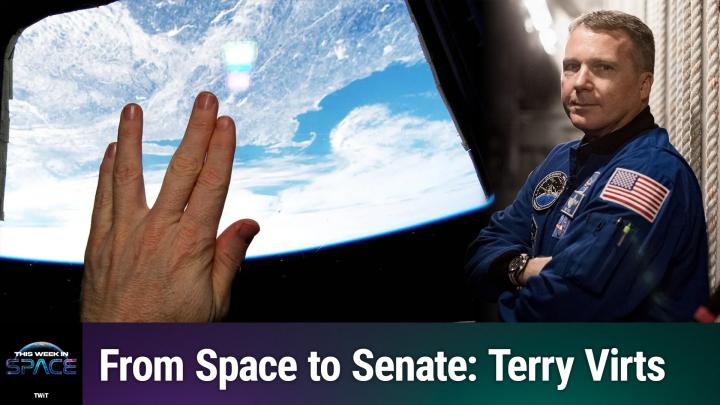
I helped make like the DVD bonus DVD for the box set. So I did all that content for that when I was an active astronaut. So I have all these weird. And then of course the biggest One is when Mr. Spock died. When Leonard Doy passed away, I did a. I did the Vulcan salute in.
Rod Pyle [00:50:59]:
In the cupola, which is on line 56.
Terry Virts [00:51:02]:
Very. It's very popular. You can find it. And it was like NASA's most popular tweet up to that date or something. Had no one knew it was me. It was just because everybody loved. There you go. Everybody loved.
Rod Pyle [00:51:15]:
Yeah, Is that great?
Terry Virts [00:51:16]:
But look at that picture. See in between my fingers? That's Long Island. And just that little hook is Cape Cod. And Leonard Demoy was from Boston.
Rod Pyle [00:51:26]:
Oh wow.
Terry Virts [00:51:27]:
And I had no idea I was, I was doing. It was the third EVA in a week. We were going out the door the next day. I was EV1. I was the lead spacewalker. So it was so busy. I had and Pao wanted something so I just got this picture and it's hard to get your hand and earth in focus and it's hard to get your hand and earth exposed the same. So anyway, so we got it done and I just randomly it, it was a, you know, I'd rather be lucky than good as we used to say in the F16.
Terry Virts [00:51:56]:
No, that was definitely a case of getting lucky. But it was, you know, Leonard was the best.
Tariq Malik [00:52:02]:
Did you watch Star Trek as a kid, Terry? I forgot to even ask that. Is that something that like.
Terry Virts [00:52:07]:
Well, when I was a kid it was in reruns so it was before I was born. But like my dad used to watch it so I would see it and it was kind of scary. I remember like being five watching it and it was pretty scary, all these creatures. But yeah, we watched it and at the Air Force Academy, ironically we would use it as like leadership lessons, like how's Kirk leading his crew now?
Rod Pyle [00:52:29]:
That interests me because, you know, the Prime Directive was at most a slight inconvenience for him half the time and only applied until he found some cute female down there, whether she was in a rubber suit or not.
Terry Virts [00:52:42]:
Right.
Rod Pyle [00:52:42]:
And then all bets were off. Even as a kid I remember thinking, wait a minute, that's not how it's supposed to. Mr. Spock has a point. But.
Terry Virts [00:52:50]:
Well, Star Trek was very progressive for the 1960s.
Rod Pyle [00:52:53]:
Oh boy, was it?
Terry Virts [00:52:54]:
Yeah, you know, there was a black female in power and different races were there, you know. Anyway, it was. Oh, and here's another Star Trek. Mr. Sulu, I was at this event at the Kennedy Space Center. We got to talking and do we have time for a long story? Before my launch in Russia, we had this press conference and I was there with Samantha Cristoforetti, who's amazing astronaut, and they asked her what it was like to be launching with such strong and handsome men. And I was like, this is the best thing that's ever happened to me. Literally this is the best thing because I knew she would just get really mad about it.
Terry Virts [00:53:38]:
So whenever I get a chance, if Samantha's doing a talk or something, I always plant that question in the audience and somebody has to ask her what was it like to be with such good looking guys just to give her a hard time. And I had George Takei film a video like Samantha. What was it like to be up there? Anyway, so that was another random Star Trek connection that I ran into George Takei in the Hilton lobby and we started talking and I Was like, george, you got to do this video for me.
Rod Pyle [00:54:05]:
That's fun.
Tariq Malik [00:54:06]:
Also, Samantha Cristoforti dressed like Captain Janeway on the International Space Station with coffee too. So I was like, we're all full of Star Trek.
Terry Virts [00:54:16]:
Science fiction fan. She was the Hitchhiker's Guide to the Galaxy. That was her thing. And so she's a big science fiction fan. I'm reading Isaac Asimov foundation right now, actually.
Tariq Malik [00:54:25]:
Oh, wow, I have to read that. I've never finished it, so I better get.
Rod Pyle [00:54:29]:
I read foundation twice. I remember as a kid that's probably 10 or something, I thought, this is kind of puzzling as an adult. I reread it and said, oh, I get it. He just doesn't like human beings very much. He's kind of like if you, if you watch any Arthur C. Clarke movie, especially as they went along, they were very much a cold touch. But I digress. Tarek, you've got one more question.
Tariq Malik [00:54:51]:
I just have one last question because you kind of touched on it when we were talking about Lena Nimoy and just being on the space station. And you mentioned that you, you know, you were in that week of three spacewalks in 2014 and 2015. And I thought I would ask just because this year in November, which is not, not very long from when we're recording this, it will mark the 25th year of continuous human habitation in space. There are people out of college now who have grown up and gone all through academic life with their never like, never living in an era where there wasn't somebody in space. And I'm curious. Yeah, and I'm curious what you, what you see as someone that not only has worked in part and pro, but has lived up there, done the science, done the maintenance work, you know, what you feel has been one of the biggest lessons or roles the International Space Station has played in our Earth observation, in our exploration of space. Kind of the gamut there. The biggest contribution that it has for.
Terry Virts [00:55:57]:
The exploration of space, I think it's shown that people can live and work in space for a long period of time. They did a X ray before I launched, and 200 days later after I got back and I had lost 0% of my bone density and I did 20 0. It was rare. Most people lose some. I was very religious about doing my two and a half hours of exercise every day so people can live and work in space in weightlessness, not indefinitely. The radiation we haven't solved, as we're looking at my face now. But, you know, the the weightlessness, we've solved that. The engineering challenges of building something complicated and operating it, we're pretty darn good at that.
Terry Virts [00:56:35]:
With the iss, the science has been prolific. You know, there's been thousands of PhD level papers written from ISS Science. The International relations aspect I think was the most important. We had very different countries came together and have worked to keep this program going. I think in some ways there's been this naivete that if, if we can work together that'll make, you know, then we won't have war on Earth. Obviously that hasn't worked with Russia. Three of the cosmonauts I was with on the space station have come and up several others that I wasn't with have come back to Earth, joined Putin's political party. Many of them are supporting the war in Ukraine.
Terry Virts [00:57:19]:
So that's been like the most disappointing thing in my professional career is to see these men and women who know better do the wrong thing and support. So there's, you know, there's been pluses and minuses there. But you know, we worked with Japan, we worked with Europe and those have been great relationships. So there's a lot of benefits to iss and it was an honor of a lifetime to be a very, very small part of it.
Rod Pyle [00:57:44]:
Well, this has been a real pleasure having you here and I want to thank you for joining us today for the episode number one 178 that we like to call Tell it to the Mountain. Terry, where's the best place to keep current with your work? I know terryverts.com is, is our number one stop. Anywhere else we should be looking?
Terry Virts [00:58:02]:
Sure, yeah, the website is great. We're looking for support in a political campaign. You can sign up to volunteer there. Also, my, my social media is Astro Terry or Astro underscore Terry, depending on which platform you're on. You know, Twitter, blue sky, LinkedIn, we're on all the above. So follow the things I'm doing. Like I said, I was in Fort Worth last night, 10 hours of driving yesterday and going somewhere different in the state constantly. So keep up with me on social media and the website.
Rod Pyle [00:58:34]:
Terrymirch.com well, and we, we appreciate you being a road warrior today to join us here, which was probably quite a drill.
Tariq Malik [00:58:43]:
It was a big inconvenience to Terry, but thank you so much.
Terry Virts [00:58:47]:
That forced us to drive home last night, which is great actually.
Rod Pyle [00:58:49]:
Okay, good.
Terry Virts [00:58:50]:
Got a ton of like, we brainstormed all this First Amendment disaster with Jimmy Kimmel. So we got a lot of content at midnight last night. On Interstate 45 here in Texas. So it was good.
Rod Pyle [00:59:01]:
Tarek, where can we keep up with your digital tomfoolery?
Tariq Malik [00:59:04]:
Well, it's not astronaut level service, but this weekend I am taking my Girl Scout troop out camping. So there is that and and then I'll be in in your neck of the words. Terry. Very excited to see the announcement next week of the new astronauts on on Monday and our big upfronts on Artemis 2. So hopefully next week, dear listeners, we'll have an Artemis 2 centric episode. We'll talk about all that fun stuff.
Terry Virts [00:59:31]:
So that'll be awesome.
Rod Pyle [00:59:32]:
And of course you can always find me at pylebooks.com or at astromagazine.com or perhaps most of my importantly nss.org for the National Space Society, of which Terry is a card carrying member.
Terry Virts [00:59:45]:
I think it was awesome being on with you guys. This is great.
Rod Pyle [00:59:50]:
We really appreciate it. Remember everybody, you can drop us a line at Twistwit tv. We welcome your comments, suggestions and ideas. Notions and I or we will answer each and every email because we love you. New Episodes this podcast publish every Friday on your favorite podcaster. So make sure to subscribe, tell your friends and give us reviews. We'll take whatever kind of reviews they supply, whether it's thumbs in the air or winks or kisses or whatever. Just, just make sure you give us as many as you can because we're counting on you.
Rod Pyle [01:00:20]:
We're also counting on you to join club twit in 2025. Besides supporting this show, you'll be supporting the network in general and my ability to keep bringing you great guests and terrible space jokes. So make sure to sign up. It's $10 a month and I can tell you from as of yesterday, 69 years of experience on this planet. You're not going to get anything better for 10 bucks a month. Finally, you can follow the Twittech Podcast network at Twit, on Twitter and on Facebook, @Twit TV, on Instagram. And we are available on all social media and other platforms, podcasting platforms. Thank you very much sir.
Rod Pyle [01:00:56]:
It's been a pleasure having you and we'll see everybody next week. Bye bye.
Terry Virts [01:01:00]:
Bye bye.