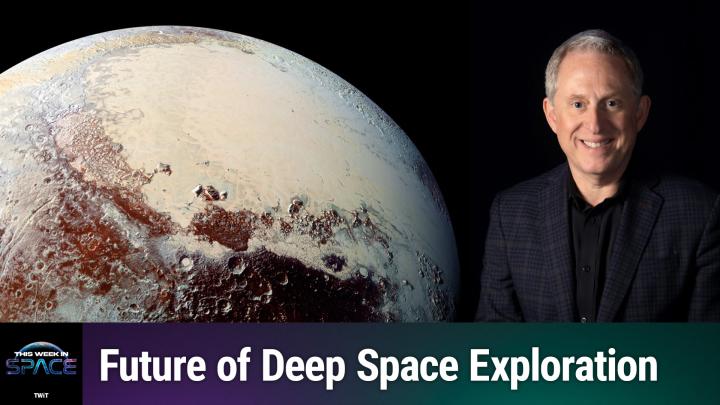
This Week in Space 176 Transcript
Please be advised this transcript is AI-generated and may not be word for word. Time codes refer to the approximate times in the ad-supported version of the show.
Rod Pyle [00:00:00]:
On this episode of This Week in Space, we're talking to Dr. Alan Stern, the principal investigator of the New Horizons mission to Pluto in the Kuiper Belt about Pluto science and the future of planetary exploration. Check us out.
Rod Pyle [00:00:23]:
This is This Week in Space, episode number 176, recorded on September 5, 2020 25: Beyond the Solar System. Hello, and welcome to another episode of this Week in Space, the beyond the Solar System edition. I'm Rod Pyle, editor in chief at Ad Astra magazine, and I'm here with our downright respectable guest host, Dr. Rick Janet. Hello, Rick.
Dr. Rick Janet [00:00:45]:
Hello. Hello. Good to see everyone. Good to see you, Rod.
Rod Pyle [00:00:48]:
Thanks for coming today. I appreciate it. It's fun to be with somebody really smart on the show for a change. Oh, shot just a few minutes. We're going to be joined by Dr. Alan Stern, a planetary scient commercial suborbital astronaut, and most of you probably remember him as being the principal investigator on the New Horizons mission. And we're going to talk about all that stuff. But before we do, we need to ask you to do us a solid and make sure to, like, subscribe and click any other buttons you see on the podcast, because we live and die by your button clicking.
Rod Pyle [00:01:21]:
And now another space joke, this one from Anonymous. Jupiter, Saturn and Pluto walk into a bar after sitting down. Jupiter says, I'm the biggest planet. Give me the largest beer you have. Saturn says, I'm the best looking planet. Give me the fanciest drink you have with an umbrella. Pluto says, I know I'm not a planet, but give me a shot. Everybody laughs but Rick.
Rod Pyle [00:01:51]:
All right, Rick, your turn.
Dr. Rick Janet [00:01:53]:
Okay, I think I have one worse than that. Here we go. What did Pluto say when New Horizons finally showed up?
Rod Pyle [00:02:00]:
I don't know. What did it say?
Dr. Rick Janet [00:02:02]:
About time everyone else ghosted me after 2006.
Rod Pyle [00:02:07]:
Wow. The room laughs before the punchline. So for anybody who's scratching their head like I was when I saw this, 2006 is when Pluto was demoted from planethood unceremoniously by Mike Brown at Caltech, who I worked with briefly and who proudly has the Twitter handle Pluto Killer and wears it like a red sash of honor. Now, I've heard that some people want to beat us with the Kuiper belt when it's joke time of this show, but you can help send us your best, worst or most indifferent space joke to twis@twit.tv. And we're counting on you. You know the volume of space jokes have slowed down. Tanya and Lur Ow. And all you other guys here on Discord, I'm looking at you, man.
Rod Pyle [00:02:49]:
Space jokes. We need space jokes. So I'm going to be checking my email hourly for the rest of the day, looking to see what comes in. And now, ladies and gentlemen, it's time for headline news.
Dr. Alan Stern [00:03:05]:
Headline News.
Rod Pyle [00:03:10]:
Kind of catchy, isn't it? So this first story I like to call losing space race 2.0. So we've seen a few articles recently in notable publications saying, hey, it's probably over. China's tested every major piece of equipment they've got. They've tested their lunar lander, they've tested their EVA suits, they've tested the capsule, although it hasn't hit orbit yet. And they look to be ready to make their 2030, or as I keep saying, I think 2029 deadline. So last week, a panel of notable space experts addressed the Senate Commerce Committee, sounding the alarm over the pace the Artemis lunar landing program, which we've talked about a lot on the show. These expert witnesses included former NASA administrator Jim Bridenstine, Alan Cutler, President and CEO of the Coalition for Deep Space Exploration, Mike Gold, president of Civil International Space at Redwire, and former Deputy Commander of the U.S. space Command, Lieutenant General John Shaw.
Rod Pyle [00:04:12]:
Major topics included China's rapid pace of development as described. And what I found refreshing was that Bridenstein directly addressed the advantages of the Chinese authoritarian system, as he put it, consistent uniformity and clarity of purpose under a centralized government. I added that part and Bridenstein referring on the US side to the to and fro of US administrations that have damaged the Artemis effort, which he worked so hard to help the Trump administration put into play. Rick, what happens now? Tell me the future. Eight Ball.
Dr. Rick Janet [00:04:51]:
I know, right? I guess at the moment I'm extremely confused about things this happened like a year and a half ago as well, a similar Senate hearing where they were trying to figure out or the people were testifying. And I think a former NASA administrator, Mike Griffin, was on that about what was going on with the Artemis mission and that we're losing the space race and all this kind of stuff. And back then people were, if I remember this right, people were saying, well, you know, the current Artemis architecture isn't going to cut it. We got to do something else. All of this kind of stuff. Sls, we've had people arguing, sls, isn't it? We got to do something different. And now I'm hearing people saying, well, the whole starship architecture is the wrong architecture. We got to do something different and so forth.
Dr. Rick Janet [00:05:32]:
And so Forth. So to me it just sounds like kind of like what you just said. We are just so confused about what it is we're going to do and what we should do.
Dr. Alan Stern [00:05:41]:
Yeah.
Dr. Rick Janet [00:05:42]:
And the Chinese are just like well this is what we're going to do and we're going to do it. So. And the other thing is they're telling all the international people, it's just like if you want to come along, sure, come along, we're happy to have you.
Rod Pyle [00:05:53]:
And people are listening. And this is very much a replay of the first space race where Russia and the US were kind of vying for unaligned powers to come in and work with them on their efforts. And I think it's important to differentiate. I mean Artemis at least notionally is about sustained lunar efforts. Although the way things are going it doesn't look like that's going to happen anytime soon. Whereas at least the first Chinese mission is really a land grab and go six hour excursion much like Apollo 11, but shorter. But they do have a long term plan and with their robotic probes operating as well as they have, they look to be in a good position to see that through. So this is a very real thing.
Rod Pyle [00:06:39]:
But a little bit of good news. An associate administrator, I'll get that right, was finally appointed for NASA Amit, excuse me, Amit Kashtria, I think it's pronounced. He's a 20 year NASA veteran. So he's the highest position in NASA senior management. The that is actually a civil servant and the only one that has any space background I might add because the current administrator temporary doesn't, nor does the chief of staff. He was previously a software engineer at NASA. Flight director for the iss, deputy manager for the ISS vehicle office and deputy associate administrator for NASA Headquarters Moon to Mars program. Which is kind of a big rangy thing.
Rod Pyle [00:07:30]:
But as I said, perhaps most importantly he actually has experience in this and knows what he's talking about when you're first these efforts and isn't probably going to say things like we need to conquer the solar system as one of those other guys did. Rick, do you know much about this guy and does it give you hope?
Dr. Rick Janet [00:07:48]:
I don't know, I don't really. Just looking at it now. I think it's fantastic of course that they're promoting within and they're bringing people that know space. As it's been said, I am the only question I would have and I would have this for anyone that would that that was in this path and put in this position how long is it going to last. Given the, given the current way things are going in the current administration, I hope that he's able to keep his position and keep NASA moving in a good direction.
Rod Pyle [00:08:20]:
Well, me too. And now we've got a story that actually is right in your wheelhouse that I like to call because I'm a crude low row individual and I was so good this week. John Ashley. Oh, don't roll your eyes. I like to call this one three I atlases Flatulence. So we have an interstellar comet slinging through the solar system. And recently the Sphere X Space Telescope spotted a cloud of carbon dioxide around the interstellar visitor. Now let's not forget this is the third interstellar visitor that we tracked.
Rod Pyle [00:08:52]:
And Avi Loeb, of course, as he is wont to do, came out and said maybe it's a machine. Now, a little less stridently than before, but maybe it's a machine. It could be an interstellar probe from aliens. It's slinging around the backside of the sun and we'll be out of view of Earth. It might release little probes to relay information about us back to the aliens that are light years away and you know, they'll see how much disarray we're in and come make us lunch or something. I should say make us for lunch, but the word for the astronomers have been looking at this data, say they're seeing a CO2 cloud as well as water ice in its nucleus. And they note that it's very similar to comets we observe within the solar system. Specifically representative of the type of comets that have spent time near a star being shaped and baked, or at least baked, and is thought to be possibly three times as old as our solar system.
Rod Pyle [00:09:46]:
That's kind of cool.
Dr. Rick Janet [00:09:50]:
Yeah. Well, these types of objects, these interstellar interlopers, if you will, I think are totally fascinating. And it's something relatively new. Right. The first one was found, what was it, 28, 18, 2019, something there, a.
Rod Pyle [00:10:05]:
Little something along 2015 maybe.
Dr. Rick Janet [00:10:07]:
Yeah. And well, what I see here is the neat thing is we just started looking for these things basically, and we were just looking for them because we were looking for near Earth asteroids. So things that could potentially hit Earth. And then all of a sudden they're like, what's this? They were speculated to exist, of course before, but it was always thought that it was always low probability. We'll never see anything like this, blah blah. And now we've seen, since we had the capability, we've seen three of them in a decade. And so now What I see, especially with this last, this one coming, it means that there's going to be a lot more that we're going to discover, especially when the Vera Rubin starts to be fully commissioned and turned on and is doing everything it needs to do. We're going to start discovering hundreds of these things.
Dr. Rick Janet [00:10:54]:
Maybe every month we're going to have a new one coming in, which means we're going to learn an awful lot about our galaxy. We're going to learn an awful lot about other solar systems with like looking at the stuff that's coming off of them and the similarities and dissimilarities and so forth. So I think it's just, it is literally just the tip of the iceberg in the discovery of these type, of, these types of objects, which is pretty fascinating.
Rod Pyle [00:11:21]:
So is the big tell with these things, the speed they're moving and if they come in out of the plane of the ecliptic. Ecliptic or the solar system's equator, if you will.
Dr. Alan Stern [00:11:30]:
That's.
Dr. Rick Janet [00:11:30]:
Yeah, that's my, that's my understanding. That's all we have really is kind of like, what was the, you know, you trace it back and like what was the, what was the incident? Vector. Velocity vector. And you kind of look well where it could have been coming from and so forth. And that kind of gives you a rough idea of age and, and so forth. But all this is just, you know, it's, we have three, we have three of these objects right now. It's really the beginning of a whole new field of astronomy and astrophysics.
Rod Pyle [00:11:57]:
All right, ladies and gentlemen, you heard it here first on episode 176, True Science from a co host, which is a first for us. We'll be right back with Dr. Alan Stern speaking of talking about real science. So stay tuned. Welcome back. We are here with Dr. Alan Stern, friend of the show, making his second appearance. And I want to read your resume because it just wipes me out when I read it.
Rod Pyle [00:12:23]:
You are the principal investigator on the New Horizons mission to Pluto. You are a commercial suborbital astronaut. You are responsible for at least eight instrument packages on various missions. You've conducted research on a number of space telescope missions. You were the associate administrator of NASA's Science Mission Directorate in 2007. You were an astronaut candidate for the space shuttle, which really gets me. And you dove on the Titanic. So welcome Alan Stern, thrill seeker and overachiever.
Dr. Alan Stern [00:12:55]:
Well, scientist anyway. Okay, well, you left out the important part, dad to three kids.
Rod Pyle [00:13:01]:
Oh, well, that's an adventure beyond conversation. Can you just give us. Tarek likes me to ask this question. Kind of a throwback to how you got interested in doing this when you were young and what your pathway was.
Dr. Alan Stern [00:13:15]:
Yeah, my story is kind of a sick story, but I think a lot of people in your audience will appreciate it. I was a little boy during the time of Apollo, during the earliest part of that, like Mercury. I don't have any recollection of it. I was too young. Even the early Jiminy Flights. But. But somewhere in the late 1960s as a little kid, I just got swept off my feet. You know, I think it's true what Arthur C.
Dr. Alan Stern [00:13:42]:
Clark said, that the 1960s were truly a decade of plucked out of the 21st century and plopped down in the middle of the 20th. And all I ever remember wanting to do was to grow up and be involved in space exploration. So I was hooked from from that time on and never thought about doing anything else. And it worked itself out.
Rod Pyle [00:14:06]:
It really was an amazing time to be alive. And you and I could talk about it all day long while these two kids with us don't remember. But it was truly exceptional to see those things firsthand. My first memory is probably around the time of Gemini 7 hearing. I remember being disappointed by the fact that the audio was so poor because kids don't appreciate things like that. But certainly being old enough, I think I was 12 when Apollo 11 landed. And I just never looked back after that. Unfortunately, Calculus and I had a difference of opinion of how things should be solved.
Rod Pyle [00:14:43]:
So where you continued, I made a right turn. Rick, over to you.
Dr. Rick Janet [00:14:49]:
Sure. Well, first of all, Alan, it's great to see you again. We met at an ISDC several years ago. I think you were getting an award where you're definitely a keynote presenter back then, but big fan of all your work. Of course you mentioned just now kind of how you got into space. But of course your big thing, one of your big things right now is Pluto. I'd love to know why. Why were you a big advocate for getting a mission to Pluto?
Dr. Alan Stern [00:15:13]:
Oh, well, we could go on about that for a long time, but I want to put you through that much. I think that there were really two things that come to mind looking back on it. One was that as a scientist, a planetary scientist who's working and writing research papers and doing observations and modeling in the computer, it became pretty obvious that Pluto was an unchecked box that had a tremendous scientific potential, that we were learning that it had a lot teach us about solar system. And in fact, when we got to Pluto. That came true in spades. In fact, I think Pluto was an overachiever, really exceeded our expectations. But the other thing is more of an exploration vein. And I've always been hooked on exploration as much as the science.
Dr. Alan Stern [00:16:08]:
And, you know, the United States was first to every planet solar system swept across the entire solar system between the 60s and the 80s, starting with the Mariners that went to Mars and Venus, and then Mercury, and then the pioneers and Voyagers that went to the giant planets. And unfortunately, none of the two pioneers or the two Voyagers was targeted to go to Pluto. And the reasons for that are partially orbital mechanics and partially betting on a bird in the hand in the studies that they wanted to make of Saturn and the Saturn system, particularly its large satellite type that prevented Voyagers from going to fly. But in any case, when the Voyagers wrapped up at Neptune in 1989, I. I felt like Pluto was some unfinished business and a bit of a dare, and started asking with colleagues, you know, why aren't we going to Pluto? And the older generation was just staring back blankly like, well, they really thought about that. And we got NASA interested in the study of doing it. And it took 16 years, but eventually we found a way to actually get a spacecraft to the launch pad and go explore Pluto. Fortunately, in between, the Kuiper Belt was discovered.
Dr. Alan Stern [00:17:37]:
And we realized that Pluto wasn't alone in being sort of unfinished business. But that really the harbinger, a whole new class of planet we call dwarf planet. And the outer solar system is teeming with that. And so by going to Pluto, we were able to open up the exploration of both the Kuiper Belt and this new class of body called dwarf planets. So it's been triply effective.
Dr. Rick Janet [00:18:03]:
Well, awesome. I'd like to ask, you know, all right, so you spent a large part of your career building this spacecraft, getting this thing through. And I know, you know, that takes. That's not just the engineering. There's also the politics that's involved in that. So your life. And so this was your thing. You were New horizons.
Dr. Rick Janet [00:18:21]:
And so it goes through its different motion. Right. Does it? Gravity assist gets itself out there, and finally, you know, it's there and everything's happening. And now the data is downloading. Can you tell us a little bit about that moment, like when you were, you know, what was going on when, like, all right, we're now getting the telemetry. It's happening. You're about to see the data for the first time.
Dr. Alan Stern [00:18:41]:
Yeah, but I want to correct what might Be a misimpression, you know, or my voice. But state, space flight's a team sport. Nobody does this alone. I guess I'm pretty well known for, you know, working hard to get a mission to Pluto. But I did it with 2,500 of my friends or my best friends, men and women who worked on this for years and years and years. And no single human being can do any space flight. It really comes down to teamwork. And regular people working very hard in big teams can do things that are larger than life.
Dr. Alan Stern [00:19:22]:
And that's what is so magical to me about being in spaceflight is it involves this big team efforts. So let's give credit to all those people that worked on it. I'm just one of those. I think when the time came, particularly for those of us who've worked on it since the 80s and have 2015 and we were bearing down on Pluto and the high resolution data was just coming in, there was a whole mix of feelings and emotions ranging from, wow, this is better than any of us thought it would be. This has so much potential scientifically, to it was all worth it. And, you know, combining that with a lot of pride for this country and the amazing things we do in space and the leadership that we show and the example that we set for people around the world, all those things at once. And a couple of other emotions too. You know, for younger people particularly, who hadn't seen anything like that, they had either been born since Voyager or they were too young when Voyager wrapped up in the late 80s to remember any of that and to reintroduce them to the excitement not of going back to Mars over and over or going back to any given place over and over, which is exciting, don't get me wrong.
Dr. Alan Stern [00:20:37]:
I've been on lots of those missions and they're great. But to do something for the first time way out in the wilderness where no one has ever been before, for me, that's. That's the cherry on top.
Rod Pyle [00:20:49]:
Well, I have to say that. And we're about to go to a break, but when we come back, I'd like to know how the heck you aim a spacecraft past a bunch of gravitational slings and then managed to skim Pluto at that distance. But let's take a break real quick and we'll be right back. Stand by. So, Alan, at the distance that Pluto is in the outer solar system, and this is a very simplistic question, but how the heck do you calculate that kind of trajectory with such precision?
Dr. Alan Stern [00:21:23]:
And you get really good people who Know what they're doing. That's the answer. And in our case, it was a combination of tracking by the Deep Space Network and some work that we did to refine Pluto's orbit to exactly where we needed to go. And then this amazing team at Kinetics Corporation that were our navigators, backed up by Jet Propulsion Lab jpl, who were providing checks on what was done to make sure that we, we're sure we're going to the right place at the right time. But really it's just a process of honing in where you make successive approximations and you fire your engines to correct for any targeting error either in time, that is arrival day, the moment of arrival, or if you're off target a little bit. And fortunately we were able to stand on the shoulders of all the giants that developed this stuff back in the 60s and 70s and turned what was then pioneering into just good solid engineering practice. And it all worked out speculatively.
Rod Pyle [00:22:30]:
It sure did. What altitude? I mean you just got one shot. This is a flyby, not an orbiter. So at what altitude did you skim Pluto?
Dr. Alan Stern [00:22:39]:
We flew 12,000 kilometers from the center, about 10,000 kilometers in altitude if I remember right. And we had a very large trade study of different distances and arrival dates that Leslie Young on our science team was responsible for leading. And you know, there were arguments for going closer. For some instruments and some types of observations, going even closer was better. For others it was worse. And if you get too close, you blur the images as you speed by sort of like, you know, a fighter airplane that like be charged with making a reconnaissance of a building. If it comes too close, it just whizzes by and it's a, the sensors can't, can't do their job quick enough, but you don't want to go too far either. So we looked at really dozens of different arrival dates and many different arrival closest approach distances and selected this combination of date and arrival distance as the, the best one for a single shot flyby.
Dr. Rick Janet [00:23:43]:
So following up on that, what, what was kind of the most surprising thing that came up on this flyby and you saw in the data your own personal favorite.
Dr. Alan Stern [00:23:53]:
It's a great question. And you know, I think we made dozens of really first order discoveries about dwarf planets and particularly about Pluto and the Pluto system. You know, there's five bodies there, but I would say the two headliners, and I would place these equally or that number one, we had found a kind of rule of thumb as we explored outward in the solar system that smaller and smaller bodies Typically run out of energy. Their geologic engine burns out earlier and earlier in the history of the age of the solar system. And objects much larger than Pluto, like the Earth's moon, that their geological engine ran out long ago. So we, we were surprised to find that Pluto is vastly geologically active today, 4 billion years after formation, which pretty much rewrote the textbooks on, on how that all works. And then also there was a general correlation or rule of thumb that as you go to smaller objects or they get simpler, there's not as much going on. But Pluto turned out to be very, very complicated, from its atmosphere, to its seasonal cycles, to its satellite system, to its origin, to its geology, to its interior.
Dr. Alan Stern [00:25:13]:
And the likely presence Of a global water ocean Beneath the surface ice. All of that wrapped into, you know, one little package. And in both those respects, complexity and activity, Pluto just blew the doors off paradigm and has caused us to rethink a lot of what we thought we knew from all that earlier exploration by the mariners, pioneers and voyagers.
Rod Pyle [00:25:38]:
So were you surprised with the smoothness of the surface? And I guess that indicates substantial geologic activity, right?
Dr. Alan Stern [00:25:45]:
Well, we saw areas that were very smooth. That's absolutely right, Rod. But we also saw areas that are extremely rugged and we saw lots of topographic variation, and we saw evidence for ice, volcanoes and brand new terrains the size of the state of Texas that were created yesterday geologically. And we found ancient terrains and we found all different kinds of compositional units and evidence for this interior, water, ocean, lots of tectonics. It's really almost mind bogglingly complicated For a world that's got about as much surface area as the continental United States.
Dr. Rick Janet [00:26:24]:
And then after Pluto, you went to Arrakoth, if I'm pronouncing that properly. Oh, awesome. I, I so what was the decision to go there? Was it just because it was nearby or was there something that was interesting about it at first?
Dr. Alan Stern [00:26:38]:
Well, as background, the mission objectives for New Horizons Are to explore the Pluto system, but also and equally importantly, to explore the Kuiper belt, this third region of the solar system out beyond the giant planets. No one had ever sent a spacecraft to any object in the Kuiper belt. And we did a search. We used the Hubble Space telescope For objects that we could get to within our fuel supply. And we found several in 2014. And we didn't know much about either of them, any of them, I should say, except for their orbits, Very, very rudimentary information. So from a scientific standpoint, there wasn't, there wasn't a Strong push for any one of those objects. And so ultimately I made the decision and NASA approved it to go for Air Cough because it was the easiest to reach from a fuel standpoint.
Dr. Alan Stern [00:27:35]:
And that left the most amount of fuel over, you know, for a possible second. Fly my target out in the pueblo, which we're now looking for. So it turned out Air Cough was spectacular and taught us a lot about planetary formation and, and it saved us that all that fuel. So we could Hope to have another five I out here in the late 20s or in their 30s.
Rod Pyle [00:27:59]:
Well, and we probably shouldn't shortchange Pluto's largest moon, which you also managed to get a good look at. And I assume that was just part of the same as you were flying by. You didn't do a course change, did you?
Dr. Alan Stern [00:28:10]:
Well, we designed that flyby to study Pluto, which is really a double planet. Pluto, Charon. Charon's half the size of Pluto and also the four small moons. We looked at all the objects in the system and we searched for other moons too. We didn't find any, but we were sure on the lookout for that. Charon turned out to be spectacular itself. It's at least as interesting as most of the icy satellites of Saturn, Jupiter, Uranus and Neptune.
Dr. Rick Janet [00:28:40]:
So you kind of hinted at this. Is there a third flyby in the works or where are we with that?
Dr. Alan Stern [00:28:47]:
Well, I sure hope so. We don't have a lot of fuel, so we're looking very hard. We've been using this very large telescope on Mauna Kea in Hawaii called Subaru. It's a Japanese telescope which has the best combination of large aperture and wide field camera that has been available. It did not yield a flyby target despite six years of searching. Now I should say it took four years to find Arrokon. And this is harder because we're looking farther out. But we've now migrated to using other facilities.
Dr. Alan Stern [00:29:21]:
We just started to make the case to use the new NSF Vera Rubin Observatory, which can do about eight times better than Subaru. It gives us a much better chance of finding target. And then in a couple of years, NASA is going to launch the Nancy Grace Roman Telescope, which is a Hubble sized telescope with a wide field imaging capability. And we need that wide field to look all around our trajectory where we're going and spot anything down to very faint, faint, faint brightness limits. Because we're looking for things that are more than twice as far out as Ericov. And the way it works is if it's twice as far out, it's 16 times fainter. So you have to look more than a quarter of magnitude harder than it was in the air. Cough was hard to find.
Dr. Alan Stern [00:30:13]:
It took, it took the Hubble. Nothing else could do it. This has to do 10 times. Actually 16 times better than, than the Hubble. So we're using these new facilities and it's going to be a long shot, you know, but I can guarantee you this, we have the best team of people in the world for looking for these things and we're looking for every rock and if it's there, we, we will find it and go to it if I have to go have a bake sale to raise the money.
Dr. Rick Janet [00:30:41]:
So is there, mission wise, politics aside, is there a mission issue that puts a time, you know, a ticking clock on this or it's when it shows up, we'll be able to. You'll be able to go there as long as there's.
Dr. Alan Stern [00:30:55]:
That's a great question. The spacecraft is in perfect health. Everything on it is working and working well. Nothing. We're not using any backup systems because something's broken. And this is 20 years after launch. We have the power and the fuel to run New Horizons out into mid century, roughly 2050. But the thing is, we're going to run out of Kuiper belt before we run out of power or fuel.
Dr. Alan Stern [00:31:21]:
So somewhere, and we don't know how far out the Kuiper belt goes. In fact, we're learning it goes further out than we thought, which buys us more time. But somewhere in the mid or late 30s, I think we'll be beyond the Copper Belt. And at that point, if we haven't found a flyby target and done the flyby, everything will be in the rearview mirror and there won't be a chance to do one. But that's a long way off still. It's 20, 25. That's a decade from now, maybe a little further. And like I said, we're looking under every rock.
Dr. Alan Stern [00:31:51]:
We're using the best tools as they become available and we have the best team of people doing it and they work on it 52 weeks a year.
Rod Pyle [00:31:59]:
That's amazing. All right, we are going to amaze you with a quick break and we'll be right back. So go nowhere. So at least for, for those of us in the peanut gallery, our first view of Arrokoth was, was kind of a shock because it looked like a snowman. And so I guess the immediate assumption was, oh, that's a contact binary. But I'm sure you've learned more since Then what lessons did that teach?
Dr. Alan Stern [00:32:23]:
Yeah, well, it is a contact binary. That's absolutely right. And that alone was a surprise. But when we saw it up close, we can look at the geology and the detailed shape. What we found is that those two objects that comprise the contact binary individually were aligned with one another. All three of their principal axes had aligned, which told us that the objects used to orbit very close to each other before they coalesced and merged into the contact binary. We see. And when we look at the geology, we can see that the process that formed the two individual lobes, the two pieces of Arakat and the process of their merger, all of that was very gentle, which meant that the accretion processes, that the seeds of planets, objects like Erica are formed by, it's very gentle.
Dr. Alan Stern [00:33:22]:
And for decades. You know, Rod, you'll remember mad magazine, Spy vs. Spy, where one spy would outdo the other with the better tools and the better, better techniques, and then the other guy would get better, and then they would just compete forever. Well, we had these two theories of high speed accretion and low speed accretion. And two models kept getting better and better, but we couldn't decide between them until new horizons flew by Arrokoth and it became obvious the way these things form is by low speed accretion. And we completely knocked off the other theory in one fell swoop. Fifty years after that debate began, probably the biggest discovery we made at Arikon.
Dr. Rick Janet [00:34:06]:
So how.
Rod Pyle [00:34:07]:
Sorry, go ahead.
Dr. Rick Janet [00:34:08]:
All right, I'm curious about. Okay, so we did these observations of Kuiper Belt objects, which is amazing. Pluto and Arrokov, how did this. In your mind, how did this actually feed into solar system formation models, especially in light of, you know, what we're doing with extrasolar planets and what we're learning there?
Dr. Alan Stern [00:34:29]:
Yeah, well, of course, what we're learning with the extrasolar planets is that, is that our solar system is far from typical, that there's a lot of variety, that they're not all carbon copies of one another by a long shot, that there's this huge diversity in the architectures and the populations of planetary systems that they can form around almost any type of star, even binary stars. We don't see much evidence for dwarf planets like Pluto in other planetary systems, primarily because we can't detect those things yet, except in very special circumstances. But in most cases, we see much larger objects, even much larger than the Earth. So little planets are pretty much just the domain of planetary science. And that in ericoth, we learned how the seeds of planets form and from Pluto, we learned how double planet systems, which we'd never been to before, form. And so those are very important bricks in the wall, if you will, of getting a full understanding of how planetary systems form. There are lots of other things that we learn in planetary science from other missions and from ground based techniques that contribute to that too. And then in astrophysics, they're seeing all these examples and learning more and more about these other solar systems, and even now getting to the point where we can do spectroscopy and learn about the compositions of the atmospheres and surfaces of these worlds so that the picture gets fuller and fuller and we can test our theories better and better over time.
Rod Pyle [00:36:07]:
So when you got back these early pictures of Pluto and did your processing and color correction and all that was there kind of a huh? And then aha moment when you realized why it was kind of reddish.
Dr. Alan Stern [00:36:20]:
Well, we'd known it was reddish since literally the 1970s. And there was a pretty good idea of why. It just has to do with the fact that the things on Pluto's surface, the methane and nitrogen ice, primarily when exposed to ultraviolet sunlight, make reddish compounds automatically from photolysis. And we can reproduce that in a laboratory, in a vacuum chamber with a cold finger, where you deposit the frost and you shine a solar like source on the frost and it'll start to turn red after some time because the chemistry is making these mostly hydrocarbon and nitrile products, they're characteristically red. And in fact that's what we found was going on. So that confirmed what would have been a pretty solid idea since the 1980s. And that's a big part, I think, of every first mission to a new planet or a new type of object, is you confirmed some things you had a pretty good idea about, but you couldn't really clinch the case until you have the up close data. And then you learn some things you never expected because the up close data teaches you so much that you could never have done in fuzzy, low resolution things you do back from the Earth.
Dr. Alan Stern [00:37:37]:
And New Horizons was no different than the Voyagers and the Mariners in showing us Pluto had a lot of unexpected characteristics. And it had also confirmed a lot of what little we knew before we got there with New Horizons.
Dr. Rick Janet [00:37:53]:
So what are your thoughts on. And I'm asking this because space enthusiasts love these types of questions, which is Kuiper Belt objects like Arrokoth and you know, even Pluto, it's called Kuiper Belt objects, but they have delivered prebiotic materials to the inner solar system. Like could this, you know, could they be in Some sense, part of the whole panspermia hypothesis ideas.
Dr. Alan Stern [00:38:23]:
Right, right. It's a great question. I think it's pretty much settled that we know that, that the outer solar system contributed some of the water to the Earth's inventory and a lot of the organics. And we know this from a variety of both Earth based and space missions that have made a case that I think is hard to refute now. Panspermia is really about the transfer of biology between worlds. And I don't think we have any evidence for that. There may come evidence from that in the future, but we don't have it yet. The raw materials, the organics and the water that's needed to start the chemistry towards biology.
Dr. Alan Stern [00:39:10]:
That's for sure coming from the outer solar system, but not exclusively because there's a lot of water and organics we've learned in the asteroid belt, particularly in the adoras going belt. And it's pretty clear that Earth's inventory of water and organics came from a variety of different locales in the solar system. Some of them closer like the asteroid belt, some of them much further. And they all contributed. There was a lot of mixing that took place. Stuff from the inner solar system got all the way out and was incorporated in comets in the Kuiper Belt. And we know that for a fact now, thanks to missions that have made samples of comets. And we also see outer solar system materials come to the inner solar system.
Dr. Alan Stern [00:39:58]:
And thank goodness for all of us here, we wouldn't be having this show if it wasn't for those raw materials that led to the development of biology on the Earth.
Rod Pyle [00:40:08]:
So in one of the written items I was reviewing before the show, you referred to what made places like Pluto special as a planet being a destination. And I kind of long held that one of the things that makes somewhere like Mars appealing is that you have a sense of place when you're there. There's a horizon, there's a sky. On the Moon there's a sky. It doesn't have an atmosphere, but you still have a horizon. And we evolved and grew up on a planet where we're used to those kind of things. Is that part of what you meant by that? Or was it something, something else?
Dr. Alan Stern [00:40:42]:
It is, it is. And you know you have the same at Pluto. If, if we send astronauts, or when we send astronauts to Pluto someday, they will see a world with a horizon and some familiar kinds of topography. Mountains for example, and glaciers and a blue sky just like you see at home on the Earth. And moons that hang in the sky and the familiar constellations like Orion and Sagittarius and Cassiopeia overhead, a very bright sun, not as bright as here, but plenty bright enough to do exploration. And even just by Pluto's moonlight. From Sharon. You could read a book from that alone.
Dr. Alan Stern [00:41:28]:
So I think that when people finally go to Pluto, they'll find lots of things that are, that are familiar and that we would find on other planetary surfaces, just like Mars, you know. And in fact, some of the geologists on our team who had worked on Mars earlier in their careers took, took a page from the Mars book and noticing that both Mars and Pluto are red, they started calling Pluto the other red planet.
Rod Pyle [00:41:57]:
I like that. All right, we're going to go to a quick break and we'll be right back. So go nowhere. So you've shown mastery of navigating all the way out to the edge of the solar system and around the last planet and Kuiper Belt objects. What appears to be a little more challenging is navigating budgets. And we had a near miss with an attempt to scale back New Horizons, I guess, what, about two years ago now to a point that, well, just speaking subjectively would have been shameful because this is, you know, it's one thing if you have a conversation about Voyager, it barely works. There's a few instruments still going, but it's really reaching, nearing the end of its life, Whereas New Horizons is still basically a new car. And that felt like a near miss.
Rod Pyle [00:42:45]:
And I'm glad to say that the National Space Society played at least a small role with the petition to try and keep that going. But do you see this happening again with this new budget?
Dr. Alan Stern [00:42:56]:
Well, first, Rod, thank you to the nss. I think I won't be bashful. The NSS played an enormous role in rescuing New Horizons from that fate. And I'll never forget it. Very thankful. And I think the whole planetary science community owes the NSS a huge thanks for its very important and upfront role in that rescue in 2023. But now we're faced with a different situation, which is that the president's budget request plans at face value to turn off, I believe, 55 different working space missions orbiting the Earth and all across the solar system. And, you know, this president was very supportive of space in his first term.
Dr. Alan Stern [00:43:52]:
He appointed a wonderful NASA administrator named Jim Bridenstine who did a spectacular job. He spoke about space in his campaign. He spoke about it in his inaugural address in the State of the Union. And from all that, you can tell, he's a space supporter and knows the importance of space in the global economy in our future, even in soft power projection. And yet that budget, whether he's aware of it or not, at his very high level, threatens to summarily abdicate leadership in space by turning off all these working spacecraft that the taxpayer paid for well north of $20 billion in assets that we're just going to turn off. And when you turn these spacecraft off, by the way you turn off their receivers, you can never reach them again. If you change your mind or you have another election, that's it. They're done.
Dr. Alan Stern [00:44:51]:
It's a guillotine. They are done. Like a lot of people, I'm hopeful that the President will be made aware of this. I don't think he is. And that the Congress will also fight this because we need to be in first place, not fourth place in this country. And if you turn off those 55 spacecraft, we are behind the Europeans, we are going to be behind the Chinese, we're probably going to be behind a couple of other countries and voluntarily. So for essentially no money saved. If you want to save money in the NASA budget, then you should work on getting the cost overruns to zero because that's ten times more money that we could throw at going faster with Project Artemis to get us to the moon before the Chinese.
Dr. Alan Stern [00:45:41]:
There's no money in this. This turning off a bunch of inexpensive robotic spacecraft. It's just abdicating the field. And I'm an optimist. I think that between Congress and the administration that this won't come to pass. But if it does, New Horizons will be done in just 100 days from now or maybe 120 days from now. And I hope that NSS and that your listeners will write the President and write the leaders of the Appropriations Committees and tell them you don't want to see this. My guess is even in the people who are most ardently for the President that they see NASA and space exploration as part of this country's world image and our image, world, our self image as leaders.
Dr. Alan Stern [00:46:32]:
And we need to be doing more of this, not less of this. And we need to protect the investment that's already paid for, not throw it away.
Rod Pyle [00:46:40]:
That's my wonderfully said and I just want to make the point. Years ago I went to Voyager Mission Control which was off the JPL campus and I think what was an old insurance office and it was a couple of old sun workstations literally sitting on a banquet table and a staff of, I don't know, eight or Ten people, people tops. Obviously not an expensive mission to run anymore. And on New Horizons, aren't you in kind of a similar position? I mean, the big spending's done. This is just a maintenance issue.
Dr. Alan Stern [00:47:08]:
We spent close to $900 million to design, build, test and fly that thing, the Kuiper Belt, New Horizons. And now we spend about what it costs to run the staff of a McDonald's every year to operate it. We literally have about 40 people that work on New Horizons, and every one of them, myself included, is part time. In fact, only a couple of people are even half time. We all work on other projects and the cost is really de minimis. That's the interesting thing about this, is that it's no savings because we spent all that money to get it here. And the cost to keep doing it and to milk it now for the taxpayer and for American prestige and leadership is virtually almost free. Not completely.
Dr. Alan Stern [00:47:57]:
It's, it's money, but it's very, very little. And I know that some in the administration, much lower level than the President, are saying we need to go faster to the Moon, and I agree with that. But the only way to go faster to the moon is to pour more money onto the Artemis project. The thing is, you can't get it from canceling New Horizons and, and others like it. There's not enough money there. The money either has to come from a larger NASA budget or from private infusion in a public, public, private partnership, or by getting rid of the waste and the overruns. But none of those. All of those, I should say, they all dwarf the kind of money you can get from canceling a bunch of missions that hardly cost anything to run.
Dr. Alan Stern [00:48:46]:
That's why I hope people will make their voices known, because these decisions are going to get made in September. We are September 5th today, and this is all going to be over in three or five weeks when the Congress votes on a continuing resolution or on appropriations for 2026 through new new spending appropriations bills. And we got to get this problem fixed or we're going to see us walk off a cliff and abandon missions around Mars, missions in the outer solar system, New Horizons, all but a few of the astronomical telescopes. Everything that we work so hard to get up there and that we paid for is going to be summarily executed before the year is out.
Dr. Rick Janet [00:49:34]:
Well, hoping to end on a slightly higher note, I wanted to ask in your. While in your wildest dreams, of course. I know obviously the best is beyond wildest dreams, but in your wildest dreams, New Horizon continues on and it discovers something. What is that, what is that sort of thing you would love to see, see it do is sort of its last, its last thing?
Dr. Alan Stern [00:49:57]:
Well, we have two big things that we're looking to do. One is a slam dunk as long as we're funded. And that is we're carrying much better instrumentation than voyagers did to, to study the edge of the Sun's heliosphere and then interstellar space, where New Horizons is now headed, that's called heliospheric science. We're, we're doing a great job at that, very productive. And we're going to cross all those boundaries in, in the late 20s and in the 30s. And the spacecraft can do that. And it's the only one out there. Nothing is even being sent to come after New Horizons.
Dr. Alan Stern [00:50:38]:
Very precious science with really spectacular instrumentation. But at least as importantly for me as a planetary science IT scientists is the hope that we'll find another flyby target and get to study something like Arrokov performed twice or three times as far from the sun to find out how it's different and how it's the same so that we can understand how everything came to be in our solar system and so that we can set records and inspire kids to go into, you know, exploration and science and engineering careers by doing these amazing things and at record distances and high speeds and almost no light that, you know, really only the United States has done. The whole outer solar system is made the domain of the United States and we will always and forever go down in history for having done the first reconnaissance of it. And I hope that New Horizons has one more chapter in that reconnaissance if we can keep the funding and if we get lucky and find a flyby target, and I aim to do both.
Rod Pyle [00:51:41]:
Well, that's an excellent note. And you know, I have to say I kind of see you as an Ed Stand Stone type, where you're probably going to be doing Pluto or the outer solar system until you're about 100. Will part of that be potentially an orbiter?
Dr. Alan Stern [00:51:59]:
You mean a Pluto orbiter? Yeah, I'd like to live to see a Pluto orbiter. I don't think that's going to be need. As I get more and more senior in my career, I tend to think about missions that don't take so long to get there. So I'm very interested in lunar science. I'm very interested in terrestrial planets, asteroids and comets. I love the outer solar system, but realistically, with today's technology, it takes a decade to get out there. After you build it and launch it.
Rod Pyle [00:52:27]:
Right.
Dr. Alan Stern [00:52:28]:
But the other thing I'm very interested in is in traveling in space to higher altitudes and on longer missions. And as you know, Earth to Earth orbit only takes eight or nine minutes, so I'm up for that and hoping to find opportunities to personally be involved in space exploration on human space flights.
Rod Pyle [00:52:49]:
So you've been to some of the highest heights and you've been to some of the deepest depths. Do you have any plans to go back down into the ocean?
Dr. Alan Stern [00:52:57]:
I don't have a plan to go down the ocean, but that's, you know, I never really planned to make any deep sea exploration until it was offered to me. And within six months I'd been to the Titanic. But. But I do have plans to fly in space next year on Virgin Galactic a second time as a NASA funded researcher doing astronomical work. And I hope that a lot more of that comes to pass and even some things that are farther afield than suborbital, orbital or who knows, maybe the moon.
Rod Pyle [00:53:33]:
Well, it was really bright.
Dr. Alan Stern [00:53:34]:
I, I am so excited the way the 21st century is shaping up for space and, and I think I only wish that the, the biologists hurry up with life extension because it's going to be a hell of a ride in the next few decades.
Rod Pyle [00:53:50]:
Yeah, I'm really kind of counting it week by week, hoping it comes just in time because I'm getting up there. Well, I want to thank you from the very depth of my heart for joining us again. This has been a real pleasure and for coming along for episode 176 that we like to call beyond the Solar System. Alan, where's the best place for us to learn about your ongoing efforts and keep apprised of the status of New Horizons?
Dr. Alan Stern [00:54:14]:
Well, thanks guys. You guys made this a lot of fun. I appreciate it. You can just Google Pluto New Horizons and it'll take you right to the mission website. If you want to follow what I'm doing, I'm on X, which is Twitter and on Facebook and on Instagram, all of them with my name. It's pretty simple. Just Alan Stern and Alan's four letter word. A, L, A N.
Rod Pyle [00:54:40]:
I wonder if anybody else has ever said that. And another four letter word is Rick. Rick, where can we keep tabs on what you're up to?
Dr. Rick Janet [00:54:47]:
Sure, just go to the Expanding Frontiers website, www. Expandingfrontiers.org and also keep up with the work that we're doing with the United nations under the National Space Society's International Committee and you can find that on nss.org well said.
Rod Pyle [00:55:04]:
And you can of course always find me at pylebooks.com or at adastromagazine.com, which also takes you to the National Space Society's website. Remember, you can always drop us a line at twis@twit.tv. We welcome your comments, suggestions and ideas and we answer each and every email. At least I will new episodes of this podcast publish every Friday on your favorite podcatcher, so make sure to subscribe, tell your friends, and give us reviews. We live and die by your loving reviews. And don't forget, we are still counting on you to join club TWiT in 2025. Besides supporting TWiT, you'll help keep us on the air and you'll help keep me bringing you horrid space jokes. You can get all the great programming with video streams on the Twit Network ad free on Club Twit, as well as some extras that are only available there.
Rod Pyle [00:55:48]:
It's a secret for just $10 a month and yearly subscriptions are available. Finally, you can follow the TWiT Tech Podcast Network it on Twitter and on Facebook and Twit TV and Instagram. Rick Alan, thank you very much. It's been a real pleasure being with you today and I hope to see you both again soon.
Dr. Alan Stern [00:56:05]:
Thank you Rod. Thank you all.
Leo Laporte [00:56:08]:
Get tech News at your pace with twit.tv's perfect pair of shows for quick, focused insights. Tech News Weekly brings you essential interviews with the journalists breaking today's biggest stories. But maybe you need more. That's why I'm here. Dive deep with me on this Week in Tech. Your first podcast of the week and the last word in tech industry. Insiders dissect everything from AI to privacy to cybersecurity in tech's most influential and longest running roundtable discussion. Short or long, streamlined or comprehensive, TWiT TV keeps you well informed.
Leo Laporte [00:56:44]:
Subscribe to both shows wherever you get your podcasts and head over to our website twit.tv for even more independent tech journalism.