Tech News Weekly 435 Transcript
Please be advised that this transcript is AI-generated and may not be word-for-word. Time codes refer to the approximate times in the ad-free version of the show.
Mikah Sargent [00:00:00]:
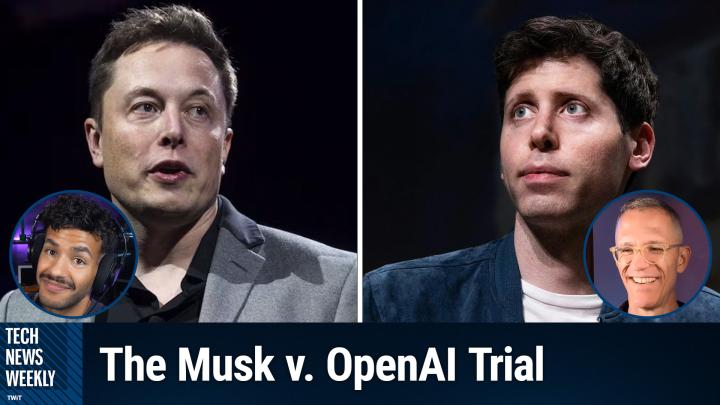
Coming up on Tech News Weekly. I am so excited because Jake Ward is here and Jake was actually in the room where it happened. That's right. Elon Musk versus Sam Altman trial. Jake was in one of the 30 seats reserved for the public. So we talk about that. We also have Patrick Holland of CNET stop by to give us the lowdown on Razer's latest foldable lineup. And I talk about Microsoft's efforts to continue to open source early DOS development. All of that coming up on Tech News Weekly. Stay tuned.
Mikah Sargent [00:00:41]:
This is Tech News Weekly. Episode 435 with Jacob Ward and me, Mikah Sargent. Recorded Thursday, April 30, 2026: Inside the Musk-Altman Trial with Jacob Ward. Hello and welcome to Tech News Weekly, the show where every week we talk to and about the people making and breaking that tech news. I am but one of the hosts of this show. I am Mikah Sargent and we are joined today by Jake Ward! It's been a while, happy to have you back.
Jacob Ward [00:01:20]:
What's up, Mikah? Great to be with you.
Mikah Sargent [00:01:22]:
Good to have you here. I am, actually. I may or may not have done a few curse words in our email exchange due to my excitement about what's going on with you. In fact, for the show today, we're going to be taking sort of the first half of the show talking about your experience because you went to court.
Jacob Ward [00:01:44]:
Sure did.
Mikah Sargent [00:01:44]:
You didn't, but you did, right? Tell us all about it. I'm so excited.
Jacob Ward [00:01:47]:
So, as anyone who's following the news right now knows, Sam Altman and OpenAI are being sued by Elon Musk. And I knew this case was coming, but I hadn't understood until about a month ago that it was coming to Oakland, California, that it was coming to the federal courthouse, the Northern District courthouse here in Oakland. I live in Oakland, and as a result, I could bike to it, which is an amazing thing. So it's like I rode my bike and the reason I was starting a little bit later than I intended today is because I had to ride my bike back from the courthouse and. And the. Great. So I'm going to start with just what it is to go to the courthouse in the United States and how awesome it is, especially when you're doing it around billionaires. So, right, it's Elon Musk, richest man in the world.
Jacob Ward [00:02:36]:
Greater personal wealth than the GDP of 140 nations. Like, you know that guy?
Mikah Sargent [00:02:41]:
That big guy?
Jacob Ward [00:02:42]:
Yeah, that Big guy had to like, had to take his belt off to go through the metal detector.
Mikah Sargent [00:02:48]:
Right. The humbling.
Jacob Ward [00:02:50]:
He gets asked for id, and this is the best part is he's like, I don't have id.
Mikah Sargent [00:02:55]:
Did he actually say that?
Jacob Ward [00:02:57]:
According to the reporter who saw it happen, who was in the security line around the same time as him, yes. He was like, I don't have id.
Mikah Sargent [00:03:04]:
That is wild.
Patrick Holland [00:03:05]:
So great.
Jacob Ward [00:03:05]:
Cause I guess he just, you know, the guy lives in this bubble and so like, why would he ever.
Mikah Sargent [00:03:10]:
Your own world.
Jacob Ward [00:03:11]:
Yeah, he's not getting carded very often, I think. And so, you know, and there's no. So the great thing about American courthouse is that there's no VIP section, there's no velvet ropes, there's no green room. And so, you know, yesterday during a break in testimony, I like all of us went and used the facilities and I stood awkwardly in line the way one always has to in a, at a, at a public restroom that's over taxed next to Sam Altman. So he and I are standing shoulders, like right there. There we are, you know, together as he's like waiting to use one of the two urinals. Like, it's so great. I just think that's so great.
Jacob Ward [00:03:50]:
And the really cool part is if you're a member of the public, you can just go. As long as you show up early enough to be in line to get one of the 30 spots they reserve for the public, you can just go sit. So for me, I'm a CNN contributor these days, but I didn't use CNN's name. I just lined up. I was with all these reporters. I knew all these people, but I just lined up. And then you get upstairs and you've gone through security. I went through security next to Greg Brockman, the President of OpenAI.
Jacob Ward [00:04:20]:
He and I were each putting our keys and our watches and everything into the, into the bins. So. Great. And then you get upstairs and the, and the, the, the media relations person is like, and who are you here with? And I could have been like, CNN or I have a Substack or whatever. And I was like, I'm a member of the public. And she was like. And she was like, right this way. And you just get to go sit in there and breathe the same air as that guy.
Jacob Ward [00:04:41]:
So, you know, last thing I'll say is, is, is pro tip. The overflow room where there's an additional 50 seats is actually better. It's cool to be in the same room with Elon Musk for a Moment. But then pretty soon you're like, oh, man, this bench is really uncomfortable. I'm not allowed to eat in here. Oh, no. And then you're like, what am I gonna have for lunch? As this guy you've been hoping to get next to is going on and on, you're like, man, let's get it moving here. You know? So today I did the overflow room, which is much more comfortable.
Jacob Ward [00:05:14]:
I could drink coffee. I could hang out, and you still get to listen to the testimony. So, anyway, so. But the case. You want to talk about the case? I could go on and on about
Mikah Sargent [00:05:22]:
what I do, but not yet, because I. I just. So, yeah, let's talk about. Because this is. There is sort of like this leveling, right. Of the. Of the playing field that's taking place here. And my first.
Mikah Sargent [00:05:36]:
You said you were in line or you were in the restroom. We saw Altman recently publishing or posting about his family. There were the vi. There was, like, calls to violence or whatever that made me wonder, what did you do? Any of them have any, like, personal security that they're allowed to bring to a courtroom?
Jacob Ward [00:05:58]:
Oh, yeah. So that is certainly the case. And the funny part is they. So, yeah, they absolutely do. Right. Because as you mentioned, right, Altman has had his house got firebombed, his house got shot at. You know, he's definitely the somebody who has, you know, I mean, the. The fair way to say it is like the guy's been talking some big, scary rhetoric around his product for a long time.
Jacob Ward [00:06:22]:
One of the marketing pitches of AI has been how upending it's going to be for the world economy and for everything else. And so I don't know that anybody who's been talking like that about his own industry should be that surprised that he's going to get crazy people coming out of the woodwork. But are you gonna. What are you gonna do? But, yes, they've absolutely got security. So there's. There's. There's all of the U.S. marshal Service that is there anyway, and they're there to keep everybody safe.
Jacob Ward [00:06:50]:
I mean, that's. Those are. Those are guys who are there to keep everybody safe, and they're there to keep you from recording. You're not allowed to record anything inside the courthouse. You're not allowed to take out your phone and wave it around in almost in any way that would suggest that you were gonna record any kind of audio or video. And in fact, a couple of people, not journalists, I will point out, but ranDOS who lined up, they did It. And they got hauled out and yelled at by the judge. They got handed a mic and stood in front of the judge, and she yelled at them to say, you're not allowed to film in here.
Jacob Ward [00:07:21]:
The next time you do it, I'll be kicking you out. That kind of stuff. So there's a lot of rules anyway. And normally in a tiny, tight corridor full of reporters, New York Times, CNN, BBC were all there. You would imagine they'd all like, jump Musk and Altman to try and get comment from them.
Mikah Sargent [00:07:40]:
Right.
Jacob Ward [00:07:40]:
But in court, you're not supposed to do that. These are the petitioners. And so you're, you know, you're really not supposed to do that. Oh, that's so funny. A friend of mine just texted me literally a second ago and said that he spotted me in a New York Times photo of the trial. So that's really funny because that's the thing is, like, you're all in the mix.
Mikah Sargent [00:07:56]:
Like, everyone's part of what's going on. Yeah, totally.
Jacob Ward [00:07:59]:
And so what was so funny is that Musk, with his incredibly dense security detail, he's got a bunch of guys with him, he just kind of like, during the breaks, he just kind of like went up and down the hall with them because there's no place to hang out. There's no, like, chill, chill space. Unless you want to sort of stay in the courtroom, I guess.
Mikah Sargent [00:08:18]:
You know, I need Ethernet in here so I can run my business.
Jacob Ward [00:08:22]:
Yeah, I mean, you know, the guy has other things to do that day, and I'm sure he doesn't want to be just sort of hanging out with anybody, so. So it's a funny. Yeah, it's a wonderfully. It's a. It's just made me. There were many. There are a few things, fewer and fewer things these days that make me deeply patriotic. But that.
Jacob Ward [00:08:37]:
That was a patriotic thing to see that. I love that this literally. This guy who is literally the richest man in the world has to, like, awkwardly find a place to hang out during the 20 minute break. Is. Is great. And the. And the judge, Yvonne Gonzalez, she did the Epic vs Apple case, and now she's the judge here is just like, terrifyingly authoritative, you know, and we love.
Mikah Sargent [00:09:05]:
We love.
Jacob Ward [00:09:05]:
Yeah. Oh, and she turns on Musk a couple of times and is like, let's try and get through this. And let's answer this in a simple way, Mr. Musk. And to see the world's richest man turn to her and be like, yes, your honor. You know, it's just great. You're just like, this is so great. This is so great.
Jacob Ward [00:09:20]:
Meanwhile, meanwhile, she's way nicer to the jury, right? She's like, ladies and gentlemen, you have worked so hard and I really appreciate you being here and I don't want to keep you waiting. You know, these are people, these are random people, random civilians and they get so much nicer treatment than Musk and his lawyers do. It's great. I just, just, it really, it filled my heart.
Mikah Sargent [00:09:40]:
I want to say, like, I'm really glad that that is something that you A, picked up on but B, are, you know, talking about because I do think that that tends to get missed whenever it comes to sort of the, of oh, what's going on is this aspect because I never done anything like that, but I, for the first time, few years ago, maybe even just a year ago anyway, got called in for going on a jury and didn't end up getting sat. But going through even that process, yes, there was the annoyance and there was the stress involved but that was my first time ever doing it. And even just like being in the courtroom and seeing how that all plays out was really cool. So I can only imagine, as you said, sort of the, the, the, the part that makes you proud is like, yeah, this process is the same. Well within those bounds. This process is the same for everyone. And I think that's really.
Jacob Ward [00:10:37]:
I do too. I mean, you know, it's still rich people throwing their lawyers at each other.
Mikah Sargent [00:10:43]:
Right, Right.
Jacob Ward [00:10:44]:
But, but the idea that, that you can show up in court and, and you're not going to get treated really almost any differently than anybody else is so different, is so different than how these guys live the rest of their lives. And I really, yeah, I liked that a great deal. I was excited about that.
Mikah Sargent [00:11:02]:
So let's talk then about this trial. Musk, the Altman and what all is involved. It's a nine person jury. Right.
Jacob Ward [00:11:11]:
So yes, nine person jury. I'm sure there's some alternates out there and they are, they are basically. Okay, so, so let's do, let's do what the, what the, what the case is. So this is, this is Musk and Altman began. They founded OpenAI together which is something that is sort of lost to the winds of time. We've sort of forgotten that that was the case. Those two got together back in like 20, as early as 2015. I don't know my dates exactly, but they were talking about let's get together.
Jacob Ward [00:11:45]:
We've agreed that this technology represents a world changing possibility. We want to get to AGI, artificial General intelligence. But we want it to serve humanity and not destroy humanity. So we need to do it together. And the emails and texts that you see between them, which are all in discovery now, which is amazing to watch, how these guys talk to each other in their sort of offhanded moments are all about like, well, we'll do it in some kind of nonprofit. You know, like, it's very casual. And then they settle on the structure of a for profit that would fund the, the main act, which is the nonprofit. And, and there's this amazing.
Jacob Ward [00:12:29]:
Well, so. And what's at issue here is that what Musk is saying is he was basically systematically sort of shut out. Even though he put all the money in, he funded it to the tune of $38 million. And then he feels he was shut out as all Altman and Greg Brockman and Ilya Sutskever went off and formed relationships with Microsoft and with others and began to turn what had been this nonprofit into a for profit. And Musk didn't really have much in the much say into it. And as a result, he is suing, saying, they betrayed me. I was duped in this way. I want Brockman and Altman knocked out of their jobs.
Jacob Ward [00:13:13]:
They shouldn't run the company anymore. He wants like 150, $50 million as restitution, and he wants it converted from a for profit to a back to a nonprofit. So that's his argument. Altman and OpenAI's argument, which I heard OpenAI's lawyer sort of insinuating throughout, is Musk was frustrated that he didn't get as much control as he wanted. And he talks in his, in. In early emails about having unequivocal majority control because it was his money. And that when he lost the control he wanted and his control was diluted, then he began to, according to Altman and OpenAI's case, sort of sabotage OpenAI as much as he could, tried to rate it for talent, tried to slow it down so that Xai Musk's company could catch up. And in the end, they're saying that this lawsuit is just a competitive effort to slow down OpenAI so that Xai can, can gain some dominance.
Jacob Ward [00:14:22]:
So the funny part is just to watch all of this, like, we're going to change the world conversation that they were having in the beginning now devolve into like, the exhibits are like, here's the cap table that they had for their ownership structure and here's how the board would be composed and, you know, like, it just it is, it is these high minded ideals crumbling into board. You know who, who's in charge, who gets credit is, is really ends up being the thing. So it's really, it's, it really solely is the thing. Here's one piece. I know I've been going on and on but, but one thing that I loved about, about one of the pieces of Exhibit 1 of the exhibits where was Musk writes back to Altman and Brockman at one point about the structure of how they'll run it. And he says it's just this amazing combination of like, of like, like change the world like ruler of the world kind of language and corporate jargon because this is how they see the world. And he's like, we should have a 12 member board unless, but, but we should consider expanding it to 16 depending on how much the fate of the world ends up resting on.
Mikah Sargent [00:15:35]:
Oh my God. Oh my God.
Jacob Ward [00:15:37]:
I was thinking to myself, okay, all right, so 12 is just a normal corporate board, but 16 is ready for world control.
Mikah Sargent [00:15:46]:
Yeah.
Jacob Ward [00:15:46]:
So who are the four people in your life that make the difference, that would make the difference between a normal board and one you would trust the fate of the world to?
Mikah Sargent [00:15:54]:
Well, two of them would be my dogs. So that's my two.
Jacob Ward [00:15:57]:
My mom's on mine.
Mikah Sargent [00:15:59]:
Yes.
Jacob Ward [00:15:59]:
You know I'm kidding.
Mikah Sargent [00:16:01]:
I think one of them would be both of my dogs. They would totally together. Yeah.
Jacob Ward [00:16:05]:
This is a spot. This is a Bay Area reference. But Anne Fong would be one of mine. She's a famous lawyer who has these great billboards up and down the 101 that say something wrong. Call Anne Fong. I want Anne Fong on there too. And the Pope maybe.
Mikah Sargent [00:16:19]:
That is so funny because there's a guy in more Northern California that's all over everything. I can't remember what his name is, but he's on. And my partner is originally from NorCal and so he and his friends growing up would always talk about it should
Jacob Ward [00:16:35]:
be one of those, it should be right, you know, crash call Ash. It should be one of those people. I think
Mikah Sargent [00:16:42]:
I want to take a quick break, but I want to come back and talk to you a little bit about the Brockman diary and kind of your take on, on what, what when things get written down and what should get written down and perhaps what should not. But we do need to take a quick break. All right, we are back from the break, joined today by Jake Ward who is here to give us firsthand experience of being in the room where it happens, as it were. As Elon Musk and Sam Altman face off in court. Now, one of the things that we talked about, the judge citing Greg Bachman's, Brockman's, excuse me, personal journal. There were three entries from 2017 that are part of the public record. And in one of these parts, Judge Gonzalez Rogers cited. I cannot believe that we committed to nonprofit.
Mikah Sargent [00:17:42]:
If three months later we're doing B Corp, then it was a lie. I wanted to ask you because a jury is pretty much now, it's like the, it's like that deposition in the sitcom the Office where they pull out Michael Scott's diary and have everybody read it. The jury's reading the guy's diary to decide whether to actually believe Brockman. So I wanted to ask you as a journalist, how, if at all, does it change how you'd ever write things down? And if so, is there sort of a, hey, be careful, people lesson, oh, my God. In there for the rest of us?
Jacob Ward [00:18:18]:
I mean, I'm so astounded. Like, first of all, I'm all for journaling. I think it's a great habit. It's good for the brain, it's good for the soul. But if you are the head of a company and you are dealing in big amounts of money or anything else, like, you gotta be careful what you're writing down. And like, you know, in the journalism world, like we know, I mean, anybody who works in a corporation, like, if you're emailing somebody something, or even texting them something, something, you gotta assume it's gonna be in the public record some someday. Like, that is the rule of modern life. And I just think there's, there's something I, I, so I, once, this is a discussion, but I went on a, on a, I was on a plane once and I was sitting next to a guy who had like the big 17 inch Mac open as like an early morning flight.
Jacob Ward [00:19:03]:
We're all trying to sleep and this guy's got his screen up, it's like incredibly bright, and he's on there journaling, like, and I can read it because it's like right there, you know, and he's writing this journal about himself where he's like, it's like, literally he had, it had like chapters. And he was on one called no more Mr. Nice Guy.
Mikah Sargent [00:19:24]:
Are you kidding me, dude?
Jacob Ward [00:19:25]:
And he, he was, it was, it was literally, it was like, wait, I missed.
Mikah Sargent [00:19:29]:
Did you say, where were you?
Jacob Ward [00:19:31]:
That this was a flight? I was on a plane.
Mikah Sargent [00:19:33]:
That was the one place I was hoping it wouldn't be.
Jacob Ward [00:19:36]:
Shoulder with this guy, like, I'm looking down, down the pipe of his journal, and it's all about, like, how is he gonna make money? And who are the friends he wants to make? But the. But most of it was about, like, who. Who he was hoping to date. And date is not even the oh, no phrase he was using, you know? And I was like, wow, this guy's like, his journal instincts are weird because they're not. This is not. Like. This is not what he. This is not what I was taught journaling is about.
Mikah Sargent [00:20:03]:
Right.
Jacob Ward [00:20:04]:
This is not about an analyzer.
Mikah Sargent [00:20:06]:
My therapist didn't tell me to do that.
Jacob Ward [00:20:08]:
No, no. And so, for me, I just think there's this sort of like, well, my biographers will need this someday kind of instinct at the top of the Silicon Valley heap that must inspire this.
Mikah Sargent [00:20:19]:
A biographical imperative, if you will.
Jacob Ward [00:20:22]:
You know, posterity will require. My diaries is I'm assuming what Greg Brockman thought to himself.
Mikah Sargent [00:20:27]:
Wow.
Jacob Ward [00:20:28]:
But, yeah, no, turns out, you don't want to do that because, like, the whole reason that Judge Gonzalez moved this into trial was the entry that you read. You know, her ruling back in January was based on, I cannot believe that we committed a nonprofit. If three months later we're doing B Corp, then it was a lie. Oh, my God. He also. Here's a couple other juicy examples. So same month that Musk sent this, like, final straw ultimatum demanding that OpenAI should stay a nonprofit, Brockman seems to want him out because he writes, this is the only chance we have to get out from Elon Musk. Is he the glorious leader that I would pick? We truly have a chance to make this happen.
Jacob Ward [00:21:07]:
So that's pretty damning if you're trying to prove that these guys were planning to cut Musk out. And then this whole thing about, like, so Musk is arguing, you know, these guys betrayed the nonprofit ideals that we began with. Well, he wrote also in his diary, financially around that time. Financially, what will take me to $1 billion? Brockman asks himself. You know, so, you know, that's. That's evidence that he's in it for the money.
Mikah Sargent [00:21:36]:
Yeah.
Jacob Ward [00:21:37]:
You know, and so there's just, like, this stuff that that is. Is. Yeah. Again, like, I'm all for journaling people, but careful what you write down. And maybe don't. Maybe don't save it to the cloud. You know, maybe. Maybe.
Jacob Ward [00:21:52]:
Maybe be. Do a journal burning every year or something. I don't know. I mean, you know, as a journalist, I would say, please do upload it to the cloud, but. But I. It is amazing to me, the stuff that people write down.
Mikah Sargent [00:22:04]:
One of the things that seems to be rather interesting is that Musk seemed to not. Maybe this is the part where his sort of smug, better than you, I don't know, came forth. Was not answering yes or no questions. Yeah, like, why can't you just say yes or no? You said Musk came off as a man whose self image is built on being a technical genius, but who couldn't really demonstrate any of it in this case. Do you think the jury clocked that, or do you, if you did get a chance to kind of look at the jury, were they all going, I wonder what Subway sandwich I'm getting for lunch?
Jacob Ward [00:22:50]:
They're all feeling, if my butt's hurting sitting on the bench, then their butts are hurting as well? No, I think so for context. Yeah. He was getting. It was the. It was like, literally like out of, like a bad movie about, you know, a courtroom drama. It's the lawyer being like, just. This is a yes or no question, Mr. Mr.
Jacob Ward [00:23:07]:
Musk. And Musk being like, you know, oh, you know, I can't possibly answer that. It's too complicated. And what. Eventually the lawyer was. He was clearly trying to, you know, as any good lawyer would, he's trying to knock him off his game. And the way that he really got under Musk's skin was to suggest not only that he hadn't actually put that much money into OpenAI at the beginning and thus didn't deserve much credit. He also didn't contribute any sweat equity.
Jacob Ward [00:23:33]:
That he didn't. He said at one point, you didn't really make any technical contributions, did you? And of course, nothing will make Elon Musk's head pop off like that. And so he was like, I did this and I, you know, I, I got Satya Nadella to give them compute, and I. Blah, blah, blah, blah. You know, clearly this. It actually worked. Oh, yeah. Needing to prove that he was an important part of the beginning because it's all about credit.
Jacob Ward [00:23:56]:
It's all about that stuff right now. And so I think that there's, There's. It was, it was great. That part was. Was very interesting to see just how brittle these folks are. And does the jury care about the cap tables and, you know, technical contributions and blah, blah, blah, blah? I don't think so. I think it's a vibes competition. And, and clearly the OpenAI's lawyers know that because at the end of yesterday's cross examination, they tried to bring up Musk's Connections to Trump.
Jacob Ward [00:24:27]:
We're in front of a Northern California jury. Clearly, that's not going to go over well. The Musk's counsel objects, says this is irrelevant. The judge agrees and strikes it. But, you know, the whole point is to basically be like, this guy sucks, and our client's much more sympathetic. You know, that is fundamentally what. What the. What the task is here.
Jacob Ward [00:24:45]:
And then the question will be, when Altman testifies next Thursday, can he be more sympathetic? He is, I would argue, a very smooth guy in public, but under cross examination, I don't know what he's like. He might be.
Mikah Sargent [00:24:58]:
Oh, I can't wait.
Jacob Ward [00:24:59]:
Yeah, it's great. I mean, as a piece of journalism, it is great to watch these guys duke it out. Not least because, as you and I have talked about so many times, it's such an undemocratic moment in tech.
Mikah Sargent [00:25:10]:
Yes.
Jacob Ward [00:25:11]:
We have so little input into how this stuff goes forward. And it's not like I want the regulation of OpenAI to be at the hands of Elon Musk.
Mikah Sargent [00:25:19]:
Right.
Jacob Ward [00:25:20]:
But I do want, I do like the idea that nine jurors have some say, and not specialists, not academics, not journalists, but, you know, random people chosen in an American process. They get some input into how tech progresses or doesn't. And we just haven't seen that, really, until now.
Mikah Sargent [00:25:41]:
Wow. Really well put. Look, there's a lot to dig into, which is where I'm going to tell everybody to go check out your Substack because you have been documenting it very well, multimedia, which is exciting. So for folks who like video and audio, you can hear and see, and of course, great photos. Thank you for taking the time to be here with us today. And of course, yeah, now's the time to tell everybody where they can find more about this case and all of your work.
Jacob Ward [00:26:11]:
I really appreciate it. So I do all of this at theripcurrent.com. it is a Substack, it is a podcast, it is a YouTube channel. It's all those things the rip current.com and I just, as of last week, became a contributor at CNN. So you can see me on CNN if that's something that you happen to have on in the background. But not to worry, I have it in my negotiation with CNN that I get to continue to be part of this week in tech, which I'm really to do, because you guys are a really welcome home for me. You took me in at a. Had a quiet time in my life, and so it's really been great to be with you Mikah.
Mikah Sargent [00:26:44]:
Oh, that's wonderful. Thank you so much. Yeah. It's funny that you bring up the CNN thing because one of our, one of our engineering team, whenever you had first started to appear, I would see in our slack, hey, look, Jake's on CNN. Jake's on CNN. So I was like, oh, you know, they must. But now, now I understand where that's, that's so great. And yeah, we thank you so much and we'll see you again soon.
Mikah Sargent [00:27:10]:
All right.
Jacob Ward [00:27:10]:
Appreciate it. Thanks, Mikah. See everybody.
Mikah Sargent [00:27:13]:
All righty, folks, we're going to take a quick break before we come back with my interview with the wonderful Patrick. All right, we are back from the break. And Motorola has announced its 2026 Razer flip phone lineup. And frankly, there's a lot to dig into. Battery tech finishes, perhaps a camera feature that's turning heads. But the rollout also comes with price tags that might give shoppers pause. Joining us today to break it all down is CNET's own Patrick Holland. Hello, Patrick.
Patrick Holland [00:27:43]:
Howdy. How's it going?
Mikah Sargent [00:27:45]:
It's going very well and it's always a pleasure to get to chat with you. Thank you for being here today.
Patrick Holland [00:27:50]:
Absolutely. I love talking with you too.
Mikah Sargent [00:27:53]:
So let's kick things off by talking about Motorola's 2026 Razr lineup. How did the company kind of expand on what it has been doing with Flip Phone? Flip Phone foldables, which is difficult to say. And then is there anything that stands out truly about this year's refresh?
Patrick Holland [00:28:10]:
Yeah, I think that the big thing to know about what they're doing this year is they're adding a whole new category. So there is the Razer Fold, which is a book style foldable. So for I'm sure your audience is very familiar, there's usually kind of two main styles. We have the clamshell or the we call them flip phone foldables that fold the phone in half that way vertically. And then we have the book style that kind of open up into a mini tablet. So they've dipped their foot or toe or whatever you want to part of the body you want to say into this market. And what's neat about this is they announced it at CES and then got to see a little bit more more of it at MWC and finally learned the price about it for the product. And it will be $1,900, which is right between the Google Pixel 10 Pro Fold starting price, which is $1,800, and of course the Galaxy Z Fold 7's price, which is 2,000.
Patrick Holland [00:29:00]:
What I'm most excited about is I got to play with this a little bit back in January. And it's a lot more like some of the Chinese foldable phones that we seen before. And meaning, like it's more almost like a really nice wristwatch. It's like there's a little more of a, I wouldn't say luxurious feel, but more premium feel and look. And if you've been following Motorola, you know they're not the best maybe at the cameras, they're not going to be your top three. Right. The cameras are supposed to be outstanding, so we haven't had a chance to test it, but I would say that's the big news. But then there's the regular RAZR Flip phone lineup.
Patrick Holland [00:29:36]:
And what's neat about Motorola is that they have a lineup. There's three different price points. So we have the Razr 2026. That's going to be your entry level. A step up from that is the Razer plus 2026. And of course the premium one, the ultimate one, is the Razer Ultra. And that's their top of the line flip phone.
Mikah Sargent [00:29:56]:
Wow. Okay, so yeah, the Razer ultra launching at $1,500, that is that price jump. Where's this Bryce hike coming from and how does it land? I think this is important at a moment when last year's Razer Ultra, which I believe was pretty well lauded, is still on shelves, but now at a steep discount.
Patrick Holland [00:30:18]:
Yeah, there's a couple things to break apart here. In fact, if it's okay, I actually have a statement for Motorola that I can read on air, if you don't mind.
Mikah Sargent [00:30:25]:
I would love that.
Patrick Holland [00:30:25]:
Yeah. So, okay, before I do, I'll just to say that the prices on all of the RAZR Flip phones, the clamshells, have gone up. The base Model Razer's up $100, so it's 800. The plus is now 1100 for the price. And the Razer Ultra, which already was pretty high at 1300, is now $1500. And for those like nerdy Razer foldable fans, you might remember when they launched the first Razer flip phone foldable back in 2019, that it started at 1495. So we're back to 2019, 2020 pricing here. Why did they raise it? I think an easy assumption is we've seen this with other companies is this RAM shortage, the demand from AI companies driving data centers.
Patrick Holland [00:31:10]:
Those data centers need ram. That has just driven the price up for products like laptops and phones. And we See this in other ways. We saw this, this with the Pixel 10a earlier this year. It's largely the exact same phone as the previous year, but they were able to keep the price the same. We saw Samsung already increased the pricing of its Fold and flip that they released last year. So not a huge surprise. But here's what, when we asked Motorola about it, they didn't directly say the RAM shortage, but let me just read what they said they told cnet.
Patrick Holland [00:31:42]:
Pricing is always subject to a change based on market conditions. Hold that thought. We regularly access pricing to remain competitive while continuing to deliver strong value to consumers. Pricing for this generation of Razer reflects a balance between the value of the Flip form factor and meaningful upgrades like larger batteries, faster charging and improved camera systems. Each model is tiered to meet different customers, different consumer needs, offering clear options and, and strong value across the portfolio. But it's that, that first sentence, that's I think kind of where maybe that RAM shortage might come in. Pricing is always subject to change based on market conditions. That's what's going on.
Patrick Holland [00:32:22]:
So I, I, I believe that's what's going on. And now we have to wonder, is it worth the, are these, are these phones worth the increase? That's the big question.
Mikah Sargent [00:32:32]:
Yeah. And one of the ways that they're kind of talking about this increase and as you said, you haven't had an opportunity to dig in too much. But the, the new camera sensor, can you tell us a little bit more about it? What in the world does it actually do for the photos and what could make these stand out as, you know, something that people would want to go after, especially when it's added to a Flip phone.
Patrick Holland [00:33:00]:
Yeah. So here's what's kind of neat about it. So the Razer Ultra, which is their, their fifteen hundred dollar model, the main camera, if you look at the specs, it's largely the same as the previous year. But it's got this really new image sensor called lofic. And I'm going to read this because I want to get it right. It stands for Lateral Overflow Integration Capacitor. And I think that explains it all right there. But if you didn't get it, because I had to look this up.
Patrick Holland [00:33:25]:
So really what this does is it's a sensor. I don't know if this is actually a Sony sensor, but, but Sony was the first to have this. And the idea is that this sensor is able to extend the dramatic range on a photo without doing an HDR pipeline, which has been kind of the way like whether it's the iPhone or Galaxy phones, most phones, that's the way they optimize these really small cameras that are in our phones now on a flip phone, the cameras are even smaller because there's this lot, there's half the space because you have to flip, fold it up so that cuts the body in half so you have less depth to have that. Things like lens elements and a larger sensor, larger sensors the better. But even on the biggest phones we don't see this. But here's where it's really cool. We've already seen this lofix sensor in another phone, the Xiaomi, or it's called the Leica Lights phone by Xiaomi. Also there's a version called the Xiaomi 17 Ultra.
Patrick Holland [00:34:22]:
And, and this was our favorite phone camera CNET has ever used, not only because of the lofix sensor, but what's neat about it is seeing it come to something like the razr, where that's a lot of people aren't buying this phone to be the photographer to be, to have the most pristine image. But what's neat about it is you're getting a significant upgrade to the image quality. I have not had a chance to use the new Ultra, so I'm going to leave some of that back and maybe I can come back and talk after I have.
Mikah Sargent [00:34:53]:
Yeah, I'm in. As you were talking about loic, I of course had to do a little search and look at some of the, just the, the diagrams and it's a really, I mean, interesting idea of, of being able to capture more in highlights and shadows to, to get that hdr. It's, it's a, it's really cool. And as you said, needing to do that in such a small package is also pretty neat. Now another, correct me if I'm wrong, but I believe battery tech is another sort of highlight of these devices. Tell us about why battery technology matters in a foldable and a clamshell foldable. And are we looking at more capacity because of the battery tech or how does that work?
Patrick Holland [00:35:40]:
Yeah, what's neat about it is there's not really been a huge breakthrough in battery technology in like a decade. We've had optimizations. Right. But over the last couple years there's basically, if you look at the parts of the battery and I won't get too nerdy on you, but the negative end, there's a positive negative end of battery used to be made of graphite. And so what some companies have been doing lately is using a silicon carbon material. And what that does is, is you could have the same exact size battery, but just by switching out that anode, which is the negative side, it's going to allow for more capacity. And that means you, you get more energy stored in the cell, but you also can charge faster and things like that. So what's neat, what Motorola did is they didn't just put that in the Ultra, they put it in the base model and the plus model.
Patrick Holland [00:36:27]:
So all of a sudden the battery capacities for each model went up, I think for like the RAZR Ultra. It's like a 13% increase just by changing that one part of the battery out. Again, we haven't tested it yet. And it's not a, like, if you double the capacity, it's double the battery life. We, we've already learned that. But when we were testing phones, like we did a big test last year or earlier this year with last year's phones, over 30 phones we tested in the top five. While there were some that did not have this, any phone that had a Silicon Valley carbon battery was pretty much consistently in the top five. So we're so excited to see this.
Patrick Holland [00:37:04]:
And what's neat about it is since you're not needing a physically larger battery, they're able to optimize the space they have in these really tiny flip phones. Again, you're basically taking a regular phone kind of cutting in half. So when you fold it, it's kind of like the thickness of a regular phone. So it's kind of like, imagine having a closet that just kind of expanded one and a half times, but you're not really having any more floor space. It doesn't work in real life, but that would be amazing if it did.
Mikah Sargent [00:37:31]:
The Razer plus one that you called the biggest head scratcher of the three, what's actually new compared to last year's model and well, more than $1,000. Tell us about that.
Patrick Holland [00:37:45]:
Yeah. Okay, well, here's why. It's a little bit of a head scratcher. So it came out the version that came out in 2024. This is basically the same version. Right. They updated the hinge last year on the 2025 version. And then this year they have the silicon carbon battery they swapped out.
Patrick Holland [00:38:05]:
They took away the 2x telephoto lens, which a lot of people will be happy with, and they added a new Ultra wide camera. And then they raised the price. So I'm still using largely a 20244 phone. Again, the battery life, that's nice, having the Ultra wide. A lot of people prefer that, but is that worth that increase? And that's where it gets hard to decide. But here's what's kind of brilliant about what Motorola's doing is I could go on their website right now, at least I did before the show when we recorded this, and you can get the 2025 model for a couple hundred dollars off. So you're savings a couple hundred dollars for almost the same exact phone. And that's true with the Ultra as well.
Patrick Holland [00:38:50]:
The Razer Ultra, the fifteen hundred dollar phone was, is discounted down to eight hundred dollars the last year's model. And you're just like. And you get a free pair of headphones as well. So what Motorola has beyond a really good take for having different price tiers is they build in those discounts. And we, we know that these phones are designed to be discounted by carriers and third parties. And since Motorola as a brand has been around for decades, they have these really deep relationships with retailers. So if you're seeing like the $1100 price on the Plus, I'm hoping you're not actually paying for it. I'm hoping you're able to get a discount or deal with it through your carrier or Best Buy or something.
Mikah Sargent [00:39:31]:
All right. Now you also talk of course that there on the other end of the line more upgrades, some of them not great. Can you tell us where did Motorola kind of pull back in ways that buyers should know about and what has improved when it comes to that standard razor of this year?
Patrick Holland [00:39:55]:
Yeah, so one of the neat things has happened to Motorola the last year is because of their approach with these having the three tiers and having the funds be the phones have like fun design and different materials and stuff on the back. They've grown quite a bit. In fact, IDC reports that they make up over 50% of the phone market in the US meaning Samsung is like number two on this. And Motorola hasn't had a book style foldable yet. So I can only imagine it to grow. But in order to do that they've had a very affordable phone, the baseline Motorola razr. And this year it's gotten some neat updates. Right.
Patrick Holland [00:40:31]:
We got that new ultra wide camera, it's up from 13 megapixels to 50. We got that silicon carbon battery also very exciting. We got a new processor. So again we haven't had a chance to test it yet but hopefully that will make it future proof a little bit longer. Right. The downgrade though is while we did increase the price $100, they did decrease the storage level. So as opposed to getting 250 gigabytes of storage, we're getting 128. And I'd already argue in 2026, like, that's not a lot of storage.
Patrick Holland [00:41:01]:
I mean, just go on your phone right now, go to Settings and see how much of your phone storage you're using right now. And could you squeeze that onto this phone?
Mikah Sargent [00:41:09]:
Yeah, that's a good point. Lastly, Motorola, you know, carved out roughly half of the foldable market in the US Which I kind of find surprising, but good for them. A big part of that has been the kind of playful design language. The, dare I say, Alcantara, the Wood fin, the Pantone colors. As a, as a recovering graphic designer, gotta love a Pantone. As we head into the 2026 cycle with higher prices across the board, how much do you think that design forward, maybe a little bit quirky approach can keep carrying this lineup and keep them at least as, you know, half of the market in the U.S. yeah, that's been the formula.
Patrick Holland [00:41:52]:
Is that fun, approachable design, it's more expressive, it's more unique for a lot of people than like, if you think of our typical phones like iPhones and Galaxy phones. In fact, I'm going to answer your question with a question yourself. So this is the OG Motorola Razor from 2024. Was happy to bring this as a cameo. Tell me, what do you remember about
Mikah Sargent [00:42:14]:
this, Mikah, what do you remember about this phone? I remember the sound that it made when it closed. That's so good. I remember everyone and their mother and father having it. I don't know what the thing is that you're wanting me to say, though.
Patrick Holland [00:42:34]:
No, I'm not looking. You're making my point for me. Okay, so you don't remember the camera specs, you don't remember?
Mikah Sargent [00:42:39]:
No, I don't remember specs or anything like that. I just remember everybody having it and the delightful sound that it made when it closed.
Patrick Holland [00:42:46]:
I'll do it one more time without talking. It is so delightful. Right. Part of it is like, you know, we had colors like this hot pink color, the iconic one, the Paris Hilton one color, right. But they had all these different colors and shades and over time there's different versions and stuff. And part of the reason it was just fun, it was expressive. And I think they've found that with these new foldable phones. Now, these phones cost a lot more than that RAZR probably did comparative to when it came out.
Patrick Holland [00:43:17]:
But I'll just say this, I think that approach is still going to drive it right so these funds have so much fun when you, you pick them up and look at them. We're not talking about a glass back, we're talking about a wood back on the Ultra Alcantara fabric. Right. On one of them, the Razer Baseline one has four different pantone colors. And these aren't just colors. These are like, like textures almost too. Like it just looks fun and expressive and unique and then their accessories go off the charts. So while they have raised the price of the phone, there's still that appeal, there's still that uniqueness and it is amazing.
Patrick Holland [00:43:58]:
I think for a lot of people, we've kind of dismissed Motorola or over the years they got better known for their budget phones which are still very popular. But now they're finding this in with these kind of more of a premium and more of a high end audience. In fact, they told me, I don't know again, I have not been able to vet this information. Information. They'd said that about a quarter of the people coming to the Motorola RAZR of the past couple years have been coming from iPhones. So it does show you that there is interest in something that's fun, something that's relatable. And while there is moto AI on these new phones, they're not pushing that as the main selling point. They're pushing the pantone colors, the wood background.
Patrick Holland [00:44:35]:
Right. So yeah.
Mikah Sargent [00:44:37]:
Wow. Well, I want to say, Patrick, always a pleasure to have you on the show to get to talk about the latest interesting gadgets and gizmos. Of course people can head over to cnet.com to check out your work, but where else should they go to keep up with what you're doing?
Patrick Holland [00:44:55]:
Yeah, you can find me on Instagram. Erectedbypatrick, former theater director here. I'm also on Twitter. You can find me there as Trick Holland. So, Patrick Holland, about the first two letters.
Mikah Sargent [00:45:06]:
Awesome. Thank you so much.
Patrick Holland [00:45:09]:
Thank you. Good seeing you. Bye.
Mikah Sargent [00:45:10]:
Good to see you too. Bye. Bye. Alrighty folks, we're going to take a quick break before we come back with my final story today. All righty. We are back from the break. I very excited. I think this is a super cool story.
Mikah Sargent [00:45:25]:
Scott Hanselman of Microsoft along with some other folks have been working on what has sort of been dubbed software archaeology. And there's some recent work to open source more of the code that was the basis of computer programming back in the day. So let's kind of talk about this post on the Microsoft Open Source blog where Stacey Haffner and Scott Hanselman announced that Microsoft Working with a team of historians and preservationists has helped bring the earliest known DOS source code to the public. The materials come from Tim Patterson, who is the original author of DOS, and they were released to mark the 45th anniversary of 86 DOS 1.00, the operating system. That sequence of acquisitions and rewrites would eventually become the foundation of Ms. Dos, PC DOS and ultimately Windows. We're not just talking about clean release versions here. This is what's really cool about it.
Mikah Sargent [00:46:33]:
It's a stack of continuous feed printed paper assembler listings, working drafts, handwritten notes preserved by Patterson himself for more than 40 years, then scanned, transcribed and published to GitHub under an MIT license. It's effectively a printed commit history of how the PC era actually got built. So here's what's in the release, why it matters and what makes this drop different from the DOS source code Microsoft has put out before. It's hosted, by the way, in GitHub repo. That of course will include a link in the show, notes to the blog and everything. So you'll be able to check it out there. It's the third DOS source drop that Microsoft has been involved with. This though is the earliest material and that's what I think makes this really cool.
Mikah Sargent [00:47:19]:
So in 2014, Microsoft donated the source code for Ms. DOS 1.25 and 2.0 to the Computer History Museum. Then in 2018, Rich Turner republished that same source code on GitHub for easier browsing. In April 2024, Microsoft and IBM then open sourced Ms. DOS 4.00 under that MIT license. And that came out of what's called an Aussie drop where beta binaries Former Microsoft CTO Ray Ozzy had kept on floppies from his Lotus days. This new release actually predates all of that. The bundles have the source code to the 86 DOS 1.00 kernel.
Mikah Sargent [00:48:00]:
Several pre release development snapshots of the PC DOS 100 kernel utilities like chkdsk and I don't know how this is pronounced Edlin E D L I N. We'll go with Edlin for now. Somebody out there is gonna be like. It means this. It might be Edline, like edit line, I don't know. And even. And I think this is the part that makes editline. Thank you Wizardling.
Mikah Sargent [00:48:20]:
So yeah, it is that. And this is the part that makes engineers grin. Listings of the Seattle computer products assembler that was used to build DOS in the first place. The earliest dated material in the bundles. Can we guess the year? 1981? June of 1981 and then the latest goes into early 1982. This is history. The thing that stuck out to me the most about this and the thing that I said, are you serious? What it's that it's not just a source tree that you've cloned, right? It's 10 bundles of continuous feed dot matrix printer paper totaling more than. That was my foley for a dot matrix printer totaling more than 870 pages that Tim Patterson kept in a stack for decades.
Mikah Sargent [00:49:22]:
Stacey Haffner Scott Hanselman put it well in the Post. They said this represents the point in time, working states and handwritten notes preserved by Tim Patterson himself. It's printed commit history of a git repository. If you think about it, each bundle has a creation timestamp and a print timestamp embedded in it so you can literally see which features were added, when, what bugs got fixed, what mistakes were made along the way. And then there's a revision history that's visible in the snippets. There are entries like 122980 general release updating all past customers, 0258132 byte directory entries added 032781 variable record and sector sizes. It's a changelog that's literally been scratched onto paper. Before change log change logs were a concept and standardized in the industry.
Mikah Sargent [00:50:17]:
How does this go in terms of where has this archive made it? Well, it didn't come out as I mentioned, this Microsoft Archive. Microsoft didn't have it in some cold storage tank somewhere. It was out of Tim Patterson's personal collection and then it made it all the way to GitHub because it. Well a. It takes a long time for software archaeology to work in the first place to, you know, get through. And so the Microsoft Post specifically thanks a dedicated team of historians and preservationists who located, scanned and transcribed the listings. And there's also Joshua Carsbrook who did the OCR work on the printer output. So that was converting decades old print into something that a modern assembler could compile.
Mikah Sargent [00:51:07]:
Scott Hanselman listed as a contributor on the repo itself. And Patterson reportedly donated the physical stack of paper to the interim computer museum so that it's not just the scanned versions that live on and are protected. Very cool stuff. What's really neat, dear listeners, if you're out there, yeah, you can actually do something with this because the repo is structured in three folders Transcription, which are the robot raw transcribed printer output files, printed files which are reconstructs of the original files that were printed and then source code which contains compilable source. So if you want to assemble it, you need a copy of Seattle Computer Products ASM assembler, which conveniently you can pull from any release of 86 DOS or Ms. DOS plus their HEX2 bin utility to convert the. This is wild too. Convert the Intel Hex output into a binary.
Mikah Sargent [00:52:09]:
I'm not going to go into more details about that, but the point is you can actually rebuild the kernel of the operating system that became Ms. DOS on a modern machine in about as much time as it takes to install Node. Very fun stuff to be able to see that and go back and, you know, run code from 1981 if you'd like. Now, again, this is all about computer history and software history. So what's still missing? Well, two of the ten bundles have yet to be transcribed. Bundle nine is reported to be a 459 page listing of the Microsoft Basic 86 compiler runtime library, again from 1981. And there's also bundle ten which contains assembly source for graphics primitives from early 1982. So you those will also be added.
Mikah Sargent [00:53:02]:
And I think this is a really cool effort because so often it's very easy for us to look at the physical manifestations of our history. Right? You can go to a museum and see loads of pottery that has been collected. But. But that's like most of the museums you go to. You got to go to specific museums to see the history of the computer. I like that this stuff is being made available to the public and is open source so that you can check it out. Microsoft's pattern here going back to 2014 is that Microsoft is slowly opening up the historical record on the operating system that built the company.ms.DOS 1.25 and 2.0 in 2014, ms.DOS 4.0 in 2024 and now the Patterson listings in 2026 earlier than anything that came before. It's all about.
Mikah Sargent [00:53:57]:
I mean, in fact, the post explains why Microsoft is doing it. These releases are about making historically important systems software available for study, preservation and plain old curiosity. Sometimes that's enough. Just some curiosity. Right along with this, Microsoft does get goodwill with the developer community and also kind of an acknowledgement that the company's origin story, the IBM deal, Patterson's qdos, the licensing arrangement that made Bill Gates famous, is interesting enough to deserve primary sources rather than just kind of being retold as this legend for a tech audience in 2026. Look, we're always talking about AI agents, we're talking about AI generations and all that kind of stuff, Right. What about a reminder that the code that ran the original IBM PC is the foundation of what we have today? I just think that's so cool. So, you know, hey, if you're feeling lately like all the conversation is about AI and all the conversation is about what's happening now and you, you want to kind of like ground yourself in the reality of how quickly things move, this is a great place to check out kind of what's going on and being able to think about how at one point we didn't have this ability to track the changes that we were making with code in such a programmatic way and instead you had to print it out dot matrix style and just write in the margins about the code changes.
Mikah Sargent [00:55:48]:
That's so cool. This is so cool. So be sure to check it out. We'll have links in the show notes for that and hopefully soon have an opportunity to have Scott Hanselman on to talk about his efforts in documenting this code. That brings us to the end of this episode of Tech News Weekly. Goodness, I love doing this show and talking with these wonderful journalists like Jake Ward who is here with us today. If you like this show, be sure to subscribe. If you're not already, head to twit.tv/tnw to get the show in audio and video formats.
Mikah Sargent [00:56:27]:
If you would like to follow me online or check out the work that I'm doing, you can find me @mikhasargent on many a social media network. Or head to Chihuahua.coffee, that's C H I H U A H U A.coffee, where I've got links to the places I'm most active online. Thank you so much for being here today. Check out my other shows which we'll publish today, including iOS today and Hands on Apple plus Hands on Tech which publishes every Sunday. You can join us this Sunday for the recording of the episodes of Hands on Tech for the month of May and also tune in on Sunday for This Week in Tech as I will be a guest on that show too. Thank you, thank you. And I'll catch you later this week.