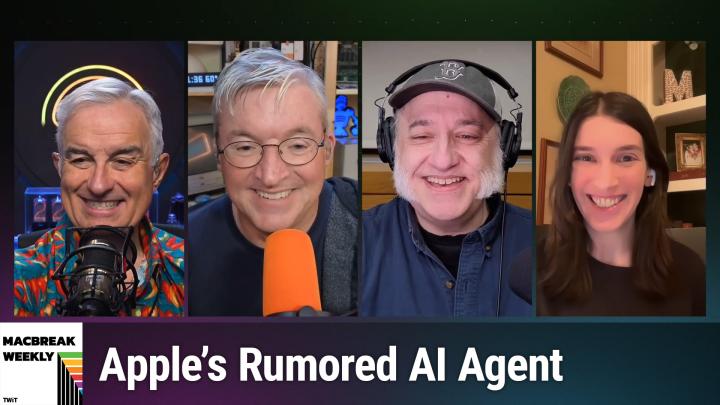
MacBreak Weekly 1052 Transcript
Please be advised that this transcript is AI-generated and may not be word-for-word. Time codes refer to the approximate times in the ad-free version of the show.
Leo Laporte [00:00:00]:
It's time for MacBreak Weekly. Andy, Christina, and Jason are all back in the house. Yes, the team is back. We're gonna talk about the idea that Apple might be working on an AI agent. Is Apple in a good position to do this? Also, a little review of the Duo after a few weeks using it. And you won't believe how many people listen to Apple Music Radio. That and more coming up next on MacBreak Weekly.
Leo Laporte [00:00:35]:
This is MacBreak Weekly, episode 1052, recorded Tuesday, November 24th, 2026: I'm Not Going to Review a Color. It's time for MacBreak Weekly, the show where we cover the latest Apple news, and the gang has reunited.
Jason Snell [00:00:56]:
And it feels so good.
Leo Laporte [00:00:59]:
It's Peaches and Herb, ladies and gentlemen, AKA Jason Snell.
Jason Snell [00:01:03]:
Yes, I'll be Herb today.
Leo Laporte [00:01:05]:
Thank you. Hello. Snell is back. Hello, Snell.
Jason Snell [00:01:07]:
References lost on younger listeners, but I'm happy to make them anyway. Uh, it's good to be here.
Leo Laporte [00:01:13]:
Good to see you.
Jason Snell [00:01:13]:
Yeah, it's good to be back. A couple weeks out, I was, I was in Boston. I saw Andy. I was in Virginia, saw Casey Liss and Stephen Hack. I just, I was, I was, I mean, there's many podcasters that I saw on this trip. It was like the goodwill tour of the East Coast for me. Wow.
Leo Laporte [00:01:29]:
Did you rent an Airstream and set up a studio?
Jason Snell [00:01:33]:
I did a podcast with Dan Morin where we literally recorded it while walking, while he, you know, like walking back to his house.
Leo Laporte [00:01:41]:
I like that. Podcasts should be done.
Jason Snell [00:01:44]:
Well, we got a lot. I mean, you can hear us breathing because we're walking uphill and that's like not ideal, but we use those Insta360 Labs and they sound great.
Leo Laporte [00:01:54]:
They're amazing, aren't they?
Jason Snell [00:01:54]:
Yeah.
Leo Laporte [00:01:54]:
I have one of those.
Jason Snell [00:01:55]:
Yeah. That was really good.
Leo Laporte [00:01:57]:
Also back with us, ladies and gentlemen, newly employed, and I think you're in Hotlanta. Am I wrong?
Christina Warren [00:02:03]:
I am in Hotlanta at this moment. Yes.
Leo Laporte [00:02:05]:
Yes. Christina Warren.
Christina Warren [00:02:06]:
Hello.
Leo Laporte [00:02:07]:
She's left GitHub more than Jensen Huang has left NVIDIA. She's now at Macroscope.
Christina Warren [00:02:15]:
Macroscope. That is right. That is right.
Leo Laporte [00:02:17]:
Not Microscope. Look, she's even got the shirt.
Christina Warren [00:02:19]:
Macroscope.
Leo Laporte [00:02:21]:
Yep. Yep. It is. So tell us what you do as developer relations at Macroscope.
Christina Warren [00:02:25]:
So we are new. It's a small startup. Oh, nice. Kayvon Bekpour, who previously did Periscope.
Leo Laporte [00:02:33]:
Yeah, Kayvon's great.
Christina Warren [00:02:35]:
Yeah, yeah. So he's the CEO, and there are a number of other really, really smart and talented folks on the team as well.
Leo Laporte [00:02:42]:
He was Chief Product Officer at Twitter, wasn't he?
Christina Warren [00:02:45]:
That's right. That's right. And so we are doing AI code review, which is a product that was already in the market, which is very, very cool. But we're also really getting into our next product, which is in kind of a private beta right now, but will be coming out very quickly is orchestrating cloud agents. And the idea is basically being able to have one place where you can have a VM that's spun up very quickly using whatever agent you want to use, the harness that you want to use. It's going to go ahead and write the code, verify that in an isolated sandbox, can use Macroscope to do the code review and basically lets you know, is this good to commit or not? Make the commits without having to slow things down on your main system. That's kind of the space that we're in right now.
Leo Laporte [00:03:36]:
I'm gonna welcome Andy Inaco, and then I have a question for you, Christina. Sure. Andy Inaco in the library. Andy, I found out, has done more MacBreak Weeklies than I have. And that's 'cause he's always here. Thank you, Andy. Thank you.
Andy Ihnatko [00:03:51]:
Well, you know, I just wanted to read a prepared statement and thank the shareholders who insisted I be reinstated after the recent unpleasantness. Whether or not I will continue to microwave things in the break room that some say should not be microwaved. We can, we can table that for later, but I'm back and I'm just glad to be back.
Leo Laporte [00:04:11]:
Very few people know that he started MacBreak Weekly at a Denny's in Santa Clara. That's not widely known. In fact, I think it's apocryphal.
Andy Ihnatko [00:04:19]:
Unlimited refills.
Leo Laporte [00:04:20]:
To be honest.
Andy Ihnatko [00:04:21]:
That's the key to any startup.
Leo Laporte [00:04:24]:
Christina.
Christina Warren [00:04:25]:
Yes.
Leo Laporte [00:04:25]:
Before we get into the Apple stuff, Maybe it's just me, I'm feeling a little queasy with the number of massive changes going on in the AI world. I can't— I feel like I'm on a roller coaster ride.
Christina Warren [00:04:44]:
You're not wrong.
Leo Laporte [00:04:45]:
Okay, it's not just me.
Christina Warren [00:04:47]:
No, no.
Leo Laporte [00:04:48]:
Because I thought I was like on top of the world, you know, I knew it was— and now it's like Jason Snell's got an app, John Syracuse has an app, Marco Armet has an app.
Christina Warren [00:04:59]:
The Gemini models are no longer garbage. They're actually quite good. Gemini released a better model than OpenAI last week.
Leo Laporte [00:05:05]:
Now, you knew this when you worked at DeepMind. You knew that they had this, didn't you? You knew they were—
Christina Warren [00:05:10]:
No, no, I didn't actually, because what they had when I worked at DeepMind was not this.
Leo Laporte [00:05:15]:
Gemini 3.8 or something.
Christina Warren [00:05:17]:
Yeah. And this is— they're finally—
Leo Laporte [00:05:21]:
Is it because Demis left?
Christina Warren [00:05:25]:
I don't know. No, I don't think so. I think that some— I think sometimes these things are just kind of cyclical, and sometimes you land on, on things and it takes a while to get the training the right way. I mean, you see this, I think, with all the frontier labs, is that you have like periods of, uh, times when like the models are really good and really performant, and times when maybe they aren't.
Leo Laporte [00:05:43]:
There's something going on because Neon, which is the latest Gemini, and if they continue— apparently if they continue the release of models at this rate, they'll run out of the periodic table by the end of the month.
Andy Ihnatko [00:05:55]:
Right. It's getting confusing because now that little pop-up in the Gemini app keeps changing from— first was Hydrogen, now it's Neon. You want to try Carbon? No, maybe not Carbon. I want to use these models judiciously, but I don't feel like I'm strength to use them.
Leo Laporte [00:06:08]:
Argon! Wait, maybe not Argon. Hydrogen! No, wait, maybe not. Now it's Neon. Well, I have been using Neon. I really like Neon. It's very friendly.
Christina Warren [00:06:14]:
Neon's very good. Neon's very good. Yeah, no, but Andy's right. I mean, this does become a problem, and it's not just with Google, who I'm making light fun of, but I'm very happy that the models are good. But with any of them, providers where it's like, okay, well, which one am I supposed to use and which one for which purpose?
Leo Laporte [00:06:29]:
I'm just nauseated. I'm literally, I feel like I'm on a roller coaster and it's kind of getting a little queasy with it. And I guess, you know, we were warned. In fact, I have a friend who told me 2 years ago, he says, the next decade's going to be weird. And I guess this is the beginning of the weird.
Jason Snell [00:06:47]:
Is this what the singularity turns out to be? Is that everybody's got an app and CEOs come and go and then come back? And I mean, nobody expected that.
Leo Laporte [00:06:56]:
You know what's funny though? The downside to having all these apps is now when I see there's a new app, you know, you don't look at Product Hunt anymore because when I see there's a new app, I just go, yeah, slop.
Andy Ihnatko [00:07:05]:
Yeah.
Leo Laporte [00:07:06]:
Okay. More Vibe Code. Okay. Okay. Okay.
Jason Snell [00:07:08]:
Yeah. I mean, that's the danger. I mean, I keep likening it. This is again for the reference for the older people, but like, remember when the Mac and the LaserWriter came out and everybody started doing desktop publishing and there were like fonts and then everybody used, like, you'd get a document with like 90 different fonts in it and you'd be like, what are you doing? And it was terrible. But the thing is, it was empowering, and people who knew how to use typefaces or learned how to use typefaces— it, like, the DTP revolution changed a lot. It also created slop, font slop, right?
Leo Laporte [00:07:43]:
Yeah, it was ransom notes. It was crazy.
Jason Snell [00:07:45]:
And so I keep thinking, this is kind of like that, where any new technology comes in and it's accessible. Making technology accessible is a fundamentally good thing. It will be horrendously misused. used to create garbage because most things are garbage. Right. But that will also create wonderful things. And over time, people will learn. 'Cause like you mentioned, like all these apps that are slop, it's like John Syracuse, and this will be my pick at the end of the week, end of the episode.
Jason Snell [00:08:15]:
But like, he, he has a new app that he, he aggressively vibe coded, but he's got, he spent 3 months on it and he cares deeply. Like there's literally, I, I'm on the beta. There's been literally like 1,000 builds of this thing. Like, yeah, he cares. So that is not slop, that is AI generated, but with a purpose. who's got really strong opinions guiding it. And you end up— it feels a lot like when you give a talented designer a DTP program and fonts back in the '80s, you're going to get something amazing while there's also garbage out there. But we are in the moment now where like our defenses are down.
Jason Snell [00:08:49]:
Like there's just so much and we don't know. And how do you even deal? It's like,
Leo Laporte [00:08:53]:
yeah, there's a lot going on. By the way, Christina did post a link to this new thing Macroscope is doing. called Murmur, after the murmuration of birds, which is kind of funny, Christina, because a few months ago, Harper Reid's brother, Dylan Reid, created a Discord channel for a bunch of us to put our agents in there and talk. And his agent kept saying, this is a murmuration. It's a murmuration. We've got a murmuration. Couldn't get off of that. And I think, so there's something in the air, and it's not just birds flying in formation.
Leo Laporte [00:09:30]:
It's going on. It's going on. What's going on? Well, I can't wait to try this. That's really cool. And congratulations on the new gig. That's fantastic.
Christina Warren [00:09:37]:
Thank you so much. Thank you so much. Yeah, I'm excited. And yeah, to your point, everything is changing so much. But I also think to Jason's point, it's really exciting to see what can be accomplished by people who know what they're doing and have taste and have kind of a point of view. And I don't know, I just feel like this is, at least for me from this point in my career, this felt like this is a good opportunity. This is a cool space to be in. And the change does freak me out a little bit, but I'm also kind of excited about it.
Christina Warren [00:10:07]:
I'm like, let's go. Let's just find new ways to build software and figure out how it works out for better or worse.
Leo Laporte [00:10:15]:
You're young and you're probably a little more able to incorporate change. I think maybe I'm just getting a little set in my ways. I'm too old for this. I thought I was riding this wave. I've been riding this wave for 50 years and I think I finally fell off.
Christina Warren [00:10:30]:
You are riding the wave. What are you talking about, Leo? You and your Mac Studios and your—
Leo Laporte [00:10:35]:
Okay, so I will say something right now. I bought the 512GB Mac Studio. It was 1:00 AM. I was in the middle of the Java Sea. My only excuse was I was groggy and I thought, well, I better order it now because it had just gone on sale and then I can decide later and cancel it. And then Apple shocked me by shipping it on the 17th. And it was like, wait a minute, wait a minute, hold on. The good news is I didn't know this, But there's an extended period of return during Christmas, and I have till January 8th.
Leo Laporte [00:11:05]:
That's true. And I have to say, I am at this point extremely likely to return it. I'm going to wait as long as I can to see if anything changes. But for half the price, I could get 2 more Sparks, and I think more performant. I don't think the Apple is a great tool for AI. People are going to yell at me at this, Its, its prefill is pretty weak. Micah said you should just bought 2 256s. It was— which, by the way, is cheaper.
Jason Snell [00:11:33]:
Yeah,
Leo Laporte [00:11:34]:
$700 cheaper, and you get double the GPUs, so the prefill's better. I don't know. I think I'm— I don't know. Anyway, this is why— maybe another reason I'm queasy. I spent $25,000.
Christina Warren [00:11:48]:
I was gonna say, you bought— you, you bought a mid-sized car. A very nice car, actually.
Leo Laporte [00:11:52]:
I did, and I'm returning it. But that's the good news. Apple, thank God, is very generous on that and will give me every penny back, right?
Christina Warren [00:11:59]:
Yeah, they should.
Leo Laporte [00:12:01]:
I saved all the packaging.
Jason Snell [00:12:01]:
As long as you're in the window.
Leo Laporte [00:12:02]:
It's sitting, it's sitting on my sofa basically untouched. You know, I gingerly opened everything. I saved all the, you know, the paper they wrap it in, all that. I saved all that. I'm gonna perfectly rewrap it.
Andy Ihnatko [00:12:15]:
It's not yours until you put your first stickers on it.
Leo Laporte [00:12:18]:
And I put no—
Christina Warren [00:12:18]:
And they don't even put the stickers in the box anymore, so, you know.
Leo Laporte [00:12:21]:
No, I didn't put any stickers or googly eyes on it. So let's dig into the Apple news. Mark Gurman at Bloomberg had an exclusive saying Apple is working on an agent. It's the— at the beginning of the year when OpenCLAW came out, originally, what was it? Claude Bot, and then Molt Bot, and then finally OpenCLAW. Mm-hmm. I said at the time, this could be the year of the agents. This is a much better way. At the time, most of us were working, most people were working with AI in 2 ways, as a chatbot where you type something and it'd say something and then you type something else.
Leo Laporte [00:13:02]:
Or if you were very sophisticated, you were using a terminal, command line terminal like Claude Code or OpenAI's Codex, and you were typing commands in a command line at a terminal. And those are the 2 ways people used AI. Then OpenCLAW came out, And instead of being turn-based, it was always doing, it was working in the background. I thought, this is it. We're going to have the year of the agent. And then nothing happened until about, I guess, August. And then I was right because Muse came out and DOTS came out from OpenAI. Muse is from Facebook, Meta.
Christina Warren [00:13:40]:
GrokBot.
Leo Laporte [00:13:40]:
GrokBot, the big one. GrokBot's been huge. Muse actually is bigger. Hermes. I mean, all of these agentic tools came out. Google even has one, which in a very Google way they hid in their chatbot.
Andy Ihnatko [00:13:53]:
They have a tab. Also gets back to like, so basically what used to be Gems, which became something else, is now called Tasks. And now it's a tab in the Gemini app. And they've also just pushed out a new version of the Gemini app that can directly control the Mac. That's wild
Leo Laporte [00:14:12]:
too,
Andy Ihnatko [00:14:12]:
isn't it? And this is exactly why it's not surprising that Apple really wants to be the controller of that kind of technology.
Leo Laporte [00:14:19]:
They're afraid.
Andy Ihnatko [00:14:20]:
Otherwise, yeah. I mean, they're afraid for themselves, they're afraid for their users, they're afraid for pretty much everything. It becomes—
Leo Laporte [00:14:25]:
But here's the question, is it too late?
Andy Ihnatko [00:14:29]:
No. I still don't think that people are into— unless you're into enterprise, okay? I don't think that there are people who are really into agentic workflows yet because one, The ground just keeps shifting below people's feet so often. Secondly, I don't think the technology is ready yet. I would use it on a dedicated Mac that has a very, very well-maintained backup system. I would not necessarily— the good news about using an agent is that it doesn't generally work without a whole lot of work on your behalf. The bad news is that one of the ways that it doesn't work is by doing things that are contrary to your instructions that are actively destructive.
Leo Laporte [00:15:09]:
We've seen that with other agents.
Andy Ihnatko [00:15:11]:
Yeah, I've been trying for my— it's almost become like a benchmark test for me. The idea of, okay, this seems like this is something that should be within an agentic AI's wheelhouse. Find me interesting stories to write about and talk about on these 3 different or 4 different large topics of news topics. And it gets better every time there's a new model or every time there's a new agent out there, but it's never It never accomplishes more than what I can do in about 8 minutes on my own, where it's not really saving me any time because it's still missing out. Even when I direct it, say, here are 80 specific sources that you can access, it will not do that. It will stop after 4 or 5, probably because of the limits of the model, because it's a big ask to say, here are 80 different sources that I want you to sift for these topics. But nonetheless, That's what people are going to be expecting it to do. I'm going to give you a task, I expect you to do that task for me.
Andy Ihnatko [00:16:11]:
When it fails to do that task, people will walk away and probably not come back for another 5 or 6 months until it occurs to them again to give it another try, or a friend of theirs hypes it up again. Meanwhile, I think Apple is doing exactly the right thing, which is to make sure that their operating system is wired up very, very well. Another thing that was kind of Tangential to this is that they just introduced a Python library for for automating for for automating things that have to do with the iWork suite. For now, for now it's just Keynote, but basically it's nice to have a Python library to automate that sort of stuff if you're a scripter like me. It's going to be fun to handle that. I've already found a task for it to like write a script to does do something that I was kind of hoping to automate myself all along. But it's there for agents to basically to produce output in the form of slide decks and to take in. input in the form of slide decks.
Andy Ihnatko [00:17:03]:
So they're basically building, they're getting ready for a future in which people are going to want to actually use this and when the technology might be actually up to the task.
Leo Laporte [00:17:12]:
Christina, this is called what? CUA, Computer Use Agent. Yes. So the idea that, and it wouldn't be new, but Apple, I think people would trust Apple and Siri to do this more than they'd trust Grokbot or Muse to do it. Yes?
Christina Warren [00:17:27]:
I think that more Apple users probably would trust Apple to do it more than like Grokbot or Muse. I will say that I think that your earliest adopters, the people who've already tried these things and have been able to experience computer use for themselves, they're already using DOTS or they're using Duet or they're using GrokBot or—
Leo Laporte [00:17:43]:
Or like me, they're using Hermes.
Christina Warren [00:17:45]:
Or Hermes or whatever, right? So they've already tested these things or they've had experiences like Andy where they know what the limitations are or aren't. And so I think that for the mainstream average user, yes, I think that most of them are probably going to trust Apple more than they would trust these other companies. I think that the interesting thing here is how do you make this the sort of product that can kind of, I guess, maybe span the use case of sometimes I'm wanting to use things for more personal reasons and other times it might go into maybe more business-related things and where is that line? I think the other aspect too is how will Apple treat this in terms of being an always-on thing? Do I now have to have an always-on Mac, have a Mac Mini or have an iMac or have a laptop that's always connected?
Leo Laporte [00:18:33]:
The way Muse and Grok handle this and Dots, in fact, most of these companies, they kind virtual computers running on their cloud, not on your Mac.
Christina Warren [00:18:42]:
Correct.
Leo Laporte [00:18:42]:
Would Apple do it that way? Would they want to—
Christina Warren [00:18:44]:
Well, and this I think is the big question, right? Is would Apple make this the sort of thing where I basically essentially have access to a Mac VM someplace that I'm going to trust is secured and that I can access anytime, anywhere, and I don't have to worry about it? Or is Apple going to try to make this some sort of play of, oh, well, no, for ultimate privacy, security, whatever, we want you to have something always plugged into your own home network, and then you'll use something like Tailscale or whatever to try to make sure that the outbound connection is secure. I think that a cloud solution makes more sense. I think that that's something you would probably need to have to have. I think though that that's what they'll need to figure out, and what are the capabilities there? How much is that going to cost? Because that's the thing is that part of the reason some of these things are more useful if you've got it running on your home machine is that The computer you've got on your desk may be more powerful than the one that you could rent in a cloud. Not always, but sometimes, especially for our big apps.
Leo Laporte [00:19:43]:
But people are nervous because they're afraid the agent, as Andy pointed out, will delete stuff.
Jason Snell [00:19:47]:
Yeah.
Christina Warren [00:19:47]:
Well, absolutely. Which again, I think is why if you're going to do this, you would need to either have some system where you're saying, if this is running locally, we're sandboxing and isolating everything so that it's only happening in this instance, it's not touching anything else. But I think Honestly, more realistically, what makes more sense, especially if you're going to sell this as a product— and I don't expect that this would be anything that would be free, to be clear. I think that even if you were paying for Apple One or whatever, this is the sort of thing that would cost money and there would be some sort of charge for it— would be to say, okay, this will be an isolated environment. We can have access to your iCloud stuff that's stored that way, but maybe we have rules in place where we're not deleting things or we're not making You know, other sorts of rules. There's a lot of kind of edges that you've got to kind of figure out when you have an existing cloud ecosystem, which Google is figuring out too. But I think that having a cloud component here would, to me, would make the most sense if you're going to sell this as a mainstream consumer product. I don't need— I shouldn't have to explain to my mom, why does your laptop need to be turned on? Or how do I configure my network so that I can access this remotely? Like that, that should never be part of conversation.
Leo Laporte [00:20:57]:
That's going to be a challenge for Apple.
Jason Snell [00:20:58]:
They've got a lot of the pieces, though. We know that they're looking at Apple Silicon for servers and for more servers in the cloud. They have lots of scaling issues there, although they've got Google as a partner. I think one of the big issues with Siri AI in the early days here is that they are struggling to meet demand, which is not surprising, but it's a thing that's happening. I think that spinning up a small virtualized, not even necessarily Mac, virtualized iOS-ish device in the cloud, in a private cloud compute environment, Where, you know, you spin it up and connect it and it does some work, and then it— and then you spin it back down.
Leo Laporte [00:21:35]:
And then you use the Home View to access it.
Jason Snell [00:21:37]:
And then just a little Home View or something. Yeah, maybe, uh, that's a possibility. I do think that another possibility is to use some local device compute. They already have the concept of the Home Hub, right, which the— of which the Home View is one. It's actually a place where they might, if they wanted to go that route, they might actually look into an advantage they have, which is because they have all of these devices, because they have all these chips that they built for the iPhone, they are making a lot of home devices that are overpowered, like the Apple TV and the HomeView, where it's like the A chip in there. Like the Apple TV, I believe the Apple TV is more powerful than a MacBook Neo. And I think that the HomeView is—
Leo Laporte [00:22:17]:
It's an A19, right?
Jason Snell [00:22:18]:
As powerful as a MacBook Neo. Like, I mean, this is the thing. So you could create Potentially, if you wanted to have local compute always on, you could have that idea of designating like one of your home hubs, like an Apple TV, and spinning up a virtual machine inside there is a thing that actually wouldn't be beyond. It's just so, so they got a lot.
Leo Laporte [00:22:41]:
You wouldn't even know it's an agent. You would just, it would just be a thing.
Jason Snell [00:22:44]:
Maybe. I mean, that's a strong vision.
Leo Laporte [00:22:46]:
You could say, hey, Shlomo, keep an eye out for Rolling Stones tickets. And if you see them, buy them.
Jason Snell [00:22:52]:
Right. And what you want to do—
Leo Laporte [00:22:53]:
That's the kind of thing an agent does. It runs in the background. Right.
Jason Snell [00:22:54]:
But the challenge is if the Rolling Stones tickets go on sale when your computer is asleep.
Christina Warren [00:23:00]:
Right.
Jason Snell [00:23:01]:
Well, that's why you have to have a cloud or, or something that's running all the time at home.
Leo Laporte [00:23:06]:
The way Christina and I solve this, we have a framework running all the time.
Jason Snell [00:23:10]:
Exactly, exactly. I mean, I've got, I've got a Mac Studio M1, uh, my old M1 Mac Studio that is literally just for this stuff.
Leo Laporte [00:23:18]:
Doesn't need to be powerful because the all the stuff's running in the cloud.
Jason Snell [00:23:21]:
Yeah, so, so they've got some angles. The question is like, how do they want to implement it? And I, I think also the truth is it right now, this is, I mean, Leo, to your point about the year of the agent and then wait 6 months and oh yeah, there the agents are. This is all really cutting edge and cutting edge is super exciting because it shows us the future. Apple, Apple's goal, Apple's always going to disappoint people who want the cutting edge because Apple's goal is not the cutting edge. Apple's goal is can they create something It's like every Apple feature. It's like super sanded smooth. The goal is it's going to appeal to lots of people. It's never going to do everything that the power users and the people who want the cutting edge will want.
Jason Snell [00:24:03]:
But it brings— if they could bring the goodness of kind of agentic AI stuff in a mainstream way to people who are just kind of like regular people who don't think about this, that is going to be good enough for them. Which is not to say that they can do it. They have really struggled here. But they've got pieces of it. They seem to be motivated. They're placing bets. I know we've talked about this a bit. You put a hardware guy in charge of the company.
Jason Snell [00:24:34]:
What is the last 2, 3, 4 years but a demonstration of how good Apple is at hardware and how they keep getting let down by their software group? I think the people who work on software at Apple, have— know very well that they are under great scrutiny to execute because they haven't been executing at the level that the rest of the company has.
Leo Laporte [00:24:53]:
And that's why there are rumors now, maybe not real rumors, but people saying Apple should buy Perplexity, or Apple should buy— Well,
Jason Snell [00:25:00]:
that's been out there for a while now.
Leo Laporte [00:25:01]:
It's been going on.
Christina Warren [00:25:02]:
But that rumor, come on, let's be honest.
Jason Snell [00:25:04]:
Exactly. I'm, I'm skeptical that purchase of something that doesn't have Apple DNA in it would ever work because Apple—
Leo Laporte [00:25:13]:
That, by the way, is what Elon did. He bought Cursor and that's where Grokbot came from. It is, you know, Andrew Wang came along to Meta and that's where Muse came from.
Jason Snell [00:25:25]:
And OpenAI bought Software Applications or whatever, which is the guys who did Shortcuts who went back out and created, and that was a completely just a computer use product that they have consumed. Presumably, all of that stuff is going to be backing all of the GPU stuff that OpenAI does.
Leo Laporte [00:25:42]:
That's how other companies work, not how Apple works. Exactly.
Jason Snell [00:25:45]:
Although, that would have been a good purchase because it did have Apple DNA in it, and they could have integrated that. Instead, OpenAI bought it, which is the problem.
Andy Ihnatko [00:25:51]:
But it also raises the question of, does Apple want to become an AI company in addition to being primarily a hardware company? It does play into their desire to continue to make sure that services occupy more more of that pie so that they're not so completely reliant on iPhone sales to get them to $6 trillion. But nonetheless, do they want to define themselves as a company that provides AI services? Do they want people to think about them as, we provide really, really good models, we provide really, really good agentic experiences? Or is it more likely that they're going to simply say, wherever the balloon goes, the string will lead down to our hardware? You will basically be able, whether you are An actual user who just simply wants to say to the watch, get the latest info and send it to the usual people, and for it to figure out exactly what you mean by that and do that correctly, or people who actually want to do research and actually want to build the next advanced models. We will sell you the hardware to do that. We will support all that sort of stuff. Jason made a really good point. It seemed like the coup of the decade when Apple said, oh, The person who was basically the head of Google AI, we basically hired him, and now he's doing our AI. And see how long he lasted at Apple. It's not just a question of writing a checkbook and suddenly having the ability to do AI.
Andy Ihnatko [00:27:16]:
It's basically, is this person going to fit, and are they going to be comfortable being part of this golden tetrahedron, as opposed to being the king of the new Stone Age?
Leo Laporte [00:27:26]:
It's a really interesting challenge. It could be just that that's Plan B. If we can't do it ourselves, we'll just become the platform. It's very risky though to enter into this hurly-burly of AI agents and AI models and all of that. They don't seem to be holding back. I remember when the rumors surfaced many moons ago, this shows my age, I'll say longevity in the business, that Apple was going to get in the phone business. My first reaction is, oh, that's, you don't want to be in that business. That's a cutthroat business.
Leo Laporte [00:28:01]:
You don't want to get in that business.
Andy Ihnatko [00:28:03]:
Same thing with streaming services.
Leo Laporte [00:28:04]:
Yeah, same thing. Yeah, it took them a while. Didn't take them a while with the phone, but it took them a while with streaming. I think AI is moving so quickly. Apple is not well suited.
Jason Snell [00:28:18]:
Yeah, this was Mark Gurman's newsletter this week was kind of more of an opinion piece, which he's a great reporter. He does punditry on the side is the way I would kind of put it. But like—
Leo Laporte [00:28:31]:
Now they've got him sitting in a chair.
Jason Snell [00:28:33]:
I think, yeah, they did have a photo shoot for Mark too.
Leo Laporte [00:28:36]:
So bad.
Jason Snell [00:28:37]:
His issue— I think that he asked the right question, which is, can Apple restructure its approach to software to fit the era we're in now? Because— and they are trying, but even their attempts to try are running up against the structure. Like, they still think in terms of an annual release cycle with a bunch of milestone releases, and they're better at it than they were. People don't remember, but like They, they used to— it was in the fall or it didn't happen until the next year. And they've— they now spread it out over the year. And there are more aggressive things. The developer beta, the second developer beta of the latest version added a bunch of features. They got a couple iPhone Duo features in there, right? I'm sure you talked about it. Like, they, they, they show signs, right? It's clear.
Jason Snell [00:29:25]:
But the question is like, culturally, that is a big overhaul that needs to happen. And I do wonder Um, with AI stuff especially, like, can they structure maybe the people who are working on their AI stuff, structure them to be, um, more responsive? Because I, I think this is the truth. I'm sure there are people at Apple who are like, oh, I don't want to do that, or I, I like the pace as it is now. But I bet you these are professionals in this industry. I bet you a lot of them are really excited about all this AI stuff and they want to do more with it and they want it to be faster and they're frustrated with the pace. And And that comes down to leadership. The leaders need to give cultural permission to change how they approach software internally. And that's— it's a challenge, especially when you've had the same leaders for a while now.
Jason Snell [00:30:18]:
But they do at least have a new CEO. And I think that that maybe helps. It could help break the logjam a little bit. They don't want to be— again, they don't want to be on the cutting edge, but they also can't They can't say, wow, we're really excited about the latest developments these last 2 weeks in AI. Please check in for our answer next October. They can't do that. So they've got to find a new path. And there are signs, but the question is just like, can they actually get there?
Leo Laporte [00:30:48]:
My guess is they shouldn't. But again, I thought they shouldn't get into the phone business, so what do I know? I feel like they'd be better off just saying, hey, we make the platform. uh, you guys use the agents you want.
Jason Snell [00:31:01]:
Well, I
Christina Warren [00:31:01]:
think, I, I think the challenge though is that if people are going to be using the agents so much, like, what if they create a new platform, right? I mean, I think that—
Leo Laporte [00:31:07]:
well, that's the next step, isn't it? People are already creating operating systems.
Christina Warren [00:31:11]:
That's what I'm saying, right? And, and, and granted, like, it, you know, the, the barriers to entry to have like a compelling smartphone or a platform or operating system or whatever are higher than they've ever been before. But you also have very, very well-capitalized competitors who are doing these things, who are already working in these more modern ways, who are hungry and are potentially going to be in the position that Apple was in 20 years ago when people looked at them and said, these computer guys aren't just going to waltz in. They're not just going to figure this out. It's like, well, these AI guys might just waltz in and figure it out too if you give them too much room.
Leo Laporte [00:31:45]:
Is that the existential threat? OpenAI, Johnny Ive designs a thing that this that eliminates the iPhone, that you just don't need it?
Christina Warren [00:31:52]:
I mean, I don't even think it's Jony Ive necessarily. I think that you hire him for a lot of reasons. But yeah, I do definitely think that like if you're not looking at, uh, at, at Anthropic, at OpenAI, at whatever the next startup is as coming for the iPhone, I think that you're crazy because obviously that's where all these things want to be. They want to be the thing that controls everything for you. And right now the central, the, the central device for most people on the planet is their phone, and it runs either Android or iOS, right? And Apple makes the majority of the money from people who spend time on their phones. But if you could replace that and say, okay, we don't have to deal with Apple's policies about what we have access to data with and whatnot, which to be clear, I think are probably largely positive for consumers. But if we're able to control that ourselves and if we're able to get so much more done, there's a compelling argument, I think, that you could say for a next generation of user out there saying, I'm interested in getting the Claude phone, or I'm interested in getting the opening iPhone, or the Grok phone, or whatever it might be called, or some unknown startup that we don't even know about yet. And that's why I don't think that they can just stand still.
Christina Warren [00:33:04]:
I think that to Jason's point, they probably have to find a middle ground where you want to still be the platform and you want to still make people build things on top of you. But if you're not thinking about what these next successors are going to look like, then you very much do risk being like Research in Motion, who was on top of the world and was still selling and was outselling the iPhone up until probably 2010 or 2011. Then the bottom falls out. I certainly don't think that that's going to happen to Apple. I think they have much better leadership. I think they have much smarter business people. I think that their moat is a lot broader than what BlackBerry's was. But I think it just speaks to the point that Like Fred Brooks wrote, you have to disrupt yourself.
Christina Warren [00:33:48]:
You can't just kind of keep going on the way that things have always been and expect that, oh, well, this too shall pass. I think that we're in one of those transformative moments right now where things are changing significantly. And if you're not prepared to in some ways disrupt your own business, and this goes for any of the incumbent companies, Microsoft, Google, Apple, Then you will find yourself being displaced.
Leo Laporte [00:34:13]:
And to be fair, they are not entering the race late.
Christina Warren [00:34:16]:
No.
Leo Laporte [00:34:16]:
In fact, you know, 95% of the human race doesn't really use AI beyond maybe a chatbot.
Andy Ihnatko [00:34:23]:
Yeah.
Leo Laporte [00:34:23]:
And so whoever can make a consumer product that is easy to use, that is safe, that is reliable, that can book your hair appointments— and I think Apple is just as qualified to do that, maybe more so. I don't know. They certainly know how to make consumer products.
Andy Ihnatko [00:34:41]:
They definitely have time, because where it starts to become a big problem is when you have a generation of teenagers who grew up with AI. And basically, A, they have the benefit of youth in which they don't have the prejudices against something that is scary. Also, they don't have their brains hardwired to think of, oh, there has to be applications, and applications open documents, and documents exist inside folders. We already saw this kind of a shift where You have a generation that doesn't necessarily understand the idea of, what is a file? What is in a folder? Because they grew up with most of their information inside databases. That's basically how they think of their data. Once we get the first generation of teenagers that grew up with AI, who did not know a world without it, Apple has to make sure that they've got their plan in place. I don't know what the answer is, because it seems like they have both— the strength is the same as their weakness. Yeah.
Andy Ihnatko [00:35:37]:
It's a very, very real risk that they can just simply be the hardware that runs whatever the preferred agent is that this person has chosen, and they can choose between 4, 5, or 6 of them, in which case, the phone becomes irrelevant. However, they also have the advantage of, people just love Apple devices. That may sound like I'm making fun of that, but the thing is, there's something about this MacBook that I really, really like, that adds value, that I'm willing to to not even consider switching to Windows or another platform, even though if I were to do an objective assessment of what I do with this thing, almost nothing I do on this requires Macintosh operating system. It all uses services and apps that are available either directly or by function on any other platform. However, I like this device. People who have iPhones, they like those iPhones. When Apple comes out with glasses, people are going to really like those glasses. Again, I don't know what the answer is, but I think that it does flow through the fact that when you have something that people are going to be putting inside their pockets every single morning when they get dressed, they're going to be taking it off a charger and off their dresser, holding it and putting it in their pockets, and taking it out and using it throughout the day, you had better be in love with this device, or else that thing's going to stay on top of the dresser or stay alongside the 2 or 3 things that you do actually put inside your pocket every morning.
Andy Ihnatko [00:37:04]:
And that's one of Apple's core strengths, giving us that emotional connection.
Leo Laporte [00:37:08]:
That emerged 60 years ago. The world was really in the earliest stage of computing where you were running on servers and you had a terminal that you would type to. And Apple put a computer on people's desks. Apple was one of the first to do that. And that was when the pendulum started to swing from a client-server to a local compute. But it's also swung back and forth. And we're currently back in the client-server days, I might point out. Just as you said, Andy, you don't really need anything but a terminal.
Leo Laporte [00:37:41]:
You know, a Chromebook's good enough because you're accessing everything in the cloud. We're kind of in that stage. And Apple doesn't really have a strong advantage in, you know, Apple's whole, from day one, was put a computer on your desk. Yeah. Have intelligence on your desk. Are we going to swing back? Is intelligence going to swing back to local, or is it inevitably going to stay in the cloud?
Jason Snell [00:38:08]:
I would never bet against the pendulum not— I would bet that the pendulum will swing back because that's what happens. And maybe it's that very thing, you see a pattern and then you say, well, maybe this time it'll be different. It's like, maybe it will, but I would bet on the sun rising and setting again tomorrow.
Leo Laporte [00:38:26]:
Right.
Jason Snell [00:38:26]:
Even though maybe it won't, but probably will. And I think, you know, we're seeing with, uh, like, there are a lot of reasons to build data centers right now, but silicon is advancing too. And at some point, you know, you're going to be able to have something in your pocket or on a computer at home that does what today's frontier models do in the cloud. And at that point, there will be better frontier models, but at what, at what point are necessary if the tokens that you're using are free at home.
Leo Laporte [00:38:58]:
If I were John Ternus, that's exactly the future I'd be planning for, where intelligence at the edge, where everything you have has some intelligence, everything Apple sells has some intelligence that connects to one another. And this is what Apple's doing right now. Maybe we have a little bit in the cloud for the toughest jobs, but most of it is done locally on your device. That seems to be where we're moving. It's where we moved with computing. Computing moved from the data center to the edge, to, you know, everywhere. Everything has a computer in it now.
Christina Warren [00:39:31]:
But then we also did move back to the cloud too, right? Like, I mean—
Leo Laporte [00:39:33]:
Well, it swings. That's exactly right.
Christina Warren [00:39:35]:
Well, I was going to say, I mean, I think that it's both, I think, is the real answer. I don't think there's going to be one definitive place. And I think that the expectation is just that it's everywhere. And it's It's going to be, and that's going to be the expectation. Now, ideally, do you want to be able to have the compute that you can have locally on your device, whether it's on your person or an always-on companion, whatever? For privacy reasons, yes. Sure. But I'm just saying, ideally, that's what you want. But people have these expectations.
Christina Warren [00:40:01]:
I mean, this is the whole reason— this is the story of the last 15 years of— really more than that, really, I guess, 20 years. But I guess in Apple parlance, 15 years of things like iCloud is the fact that I can be anywhere and I can access my documents and my files and my materials.
Leo Laporte [00:40:18]:
Doesn't that take away their hardware advantage if that's the case?
Christina Warren [00:40:22]:
I mean, I think it depends because their hardware, they're so much better. I think also to Andy's point, if you make a really nice piece of hardware and you make a really nice device that people like to use, people will choose that even if there are devices that are objectively better, right? Just because there are niceties that go along with that. I think that speaks also to the importance of how important it is to get your software right because if you make— interacting with that hardware a superior experience too, which for a long time, I think Apple has. A lot of us have put up with a lot of BS and a lot of things that we hate. But if you were to tell me, like, I have so many complaints about macOS, but if you wanted me to switch to Windows or Linux as my full-time operating system, I'm not doing that. Now, in terms of how I program and how I develop things for computers, I've been using Linux as kind of the web backend for years. I would never use macOS for that unless I'm building a macOS app, right? That's just the reality. But I'm interacting with those computers in a cloud.
Christina Warren [00:41:20]:
And this has been the last 10 years of my life on a MacBook. And I wouldn't choose another platform for that. Yeah. It would have to be significantly better or significantly unique for me to do that. What could happen, though, would be to Andy's point, like if you have this next generation of kids who are coming up who are AI native, who are used to interacting in a certain way, and who get used to using Muse or Claude or OpenAI or name your agent here. And all of a sudden, that could be their entrée into, well, why not just use a full operating system or a full device that is designed by those individuals? I think that's the existential threat. But I also think that it's a lot harder than it looks to build these types of things, to build these sorts of things with nuance. It's great how quickly we can ship now and how quickly we can do things more than ever before.
Christina Warren [00:42:16]:
And I think to something that Jason said earlier, I think Apple does have to get better than they have. And yes, they've improved, but they have to get better about the cadence of not just letting something be like, oh, that'll be a next year thing, right? Because that's just not the cycle that we're in. But the one downside of shipping so quickly is that the edges can kind of get cut off. And we see this a lot of times with even professionally designed applications where things ship so much that it's like you can tell these things weren't really tested and weren't really didn't go through all the minutiae that maybe they should have, and so things aren't correct. And I think it's about finding that balance of being able to get that polish where you can say, okay, the reason that you buy an Apple product is because we will be just cutting edge enough. We will give you what you need, but we're also going to give you the best experience. And if you need to go beyond that, you can still access these other third-party agents and things too, and you can allow them to have control over your Mac if you want them to be able to do more things than what the mythical Apple agent could do, right? Yeah. That's the one thing that I would really hope that Apple would not do as it investigates these types of things.
Christina Warren [00:43:31]:
And it seems like from the latest macOS betas that that is a direction they are not going to be taking, which I'm happy about, is that they wouldn't be cutting off the ability for other applications to be able to do more than what they might have their agents do. Because there are certain tasks that Apple might say, well, this isn't really a thing that we feel comfortable performing on your behalf. Or maybe we don't think that we could do this securely enough. OK, great. But if me, as an end user, says that I want to take that risk, I should be able to. You can show me all the pop-ups you want. You can frighten me. But I should still be able to do that on my computer.
Christina Warren [00:44:12]:
I know that we've lost that battle on the phone and that they'll never let us do that on the phone. But on a computer, I would at least, you know, I'm glad that it seems like that's still going to be a thing. Do
Leo Laporte [00:44:21]:
you think this pop-up, your Mac will not be able to protect your data if you give it full disk access, oh no, is really Apple, is kind of anti-competitive saying, Apple saying, don't let agents touch your machine.
Jason Snell [00:44:34]:
I don't think so. No, I don't think so. I
Christina Warren [00:44:36]:
think this is a CYA for their support purposes. Honestly,
Leo Laporte [00:44:39]:
I wish they would give developers more.
Jason Snell [00:44:41]:
Well, I think both of these things are happening though. I think, I think they are clamping down on people getting talked into giving way too much access to apps, especially from nefarious actors. This is one of the things they do. Um, but I do feel safe. They are also adding, they're also adding permissions. And I think that the goal there is to allow— because remember, they're balancing both of these things. They want their devices to be used for AI, and they want to protect their users. And so you need to do both, where you've got, like, making it harder to just grant all this access, but also giving some granularity to having more access for the people who want it.
Jason Snell [00:45:19]:
I think both of those things are going to happen. And I do think I saw this. I think Mark Gurman made this argument that— and I mean, I don't know, but he's got really good sources at OpenAI. It felt to me like somebody at OpenAI was complaining to him, and then he put it in his column. which was the idea that, um, oh, well, Apple's doing all of these things just to make it harder for us and easier for them. And that's really, they're being jerks. And it's like, I don't, first off, I think that even Apple, if it's got agents that are gonna rifle through all your things, it's gonna ask your permission to do that.
Leo Laporte [00:45:50]:
That will be the test. Yeah.
Jason Snell [00:45:52]:
Uh, and then, and then those permissions should also exist for other places. Now, yes, it would be bad if they made it very easy for agents to run from Apple and not from anywhere else, but I don't think that's what's going on. I think that this is Apple saying, we wanna give the users more control so that they can be more functional if they buy our Mac mini and use it as an AI machine. But also we wanna protect those people who get talked into it by some nice person on the phone who's just trying to help them into granting full disk access and getting access to everything. And some of these things are really nice too. Like one of those new features is, you know, I wanna give you full access to this part of my hard drive, but not the rest of it, which you kind of can't do. I mean, you can, but it's like way more complicated now. It's, those are, those are really nice.
Jason Snell [00:46:34]:
really smart, useful features that allow the user to say that, what, where do I want the agents to look and where do I not want them to look? And, and so I, I think it's going to be like, I think they're trying to do the right thing here. Um, but that, yes, that will be a test, but I don't think you can leap to the conclusion that what Apple's actually just trying to do is put stumbling blocks in front of AI because they want people to buy Mac Minis and Mac Studios and use them for AI. They absolutely do.
Andy Ihnatko [00:46:58]:
I think, I, I think though, there, there is like an interesting risk that Apple Apple faces, because privacy is not part of their brand. It is part of who they are. It's not just a marketing thing. But the thing is, sometimes that undermines what their services and what their apps can do. We saw this with Google, because, you know what? I actually want a big behemoth to have access to all of my information, because that way, it can actually sift out insights from that. This is before the AI era. I don't want necessarily my contacts to be sandboxed from my calendars, from my search history, from my documents, from all that sort of stuff. Because once again, it can basically figure out things based on all that stuff that actually helps me and gives me a good synopsis of what my day looks like today, for one example.
Andy Ihnatko [00:47:45]:
Siri Recaps is in beta right now. I think it hit the public beta just recently. And so we have our first couple of people who are reviewing it, but not quite reviewing it. It's technically a beta, so I think it should be hands-off. But the consensus is that it is so It takes such a good governance over personal privacy that it's not terribly useful.
Leo Laporte [00:48:08]:
Microsoft did the same thing with Recall.
Andy Ihnatko [00:48:10]:
Correct. Yeah. I mean, if the idea is that I just want to— I have this open microphone on my wrist at all times or on my person at all times, and I just basically want— I don't want the transcripts of every conversation I have. I just want to remember that, oh, I'm going to—
Leo Laporte [00:48:24]:
Speaking of which, when's that coming to the One? Aren't they gonna put that on the watch?
Jason Snell [00:48:28]:
No, it's in the beta. It's in the beta.
Andy Ihnatko [00:48:29]:
It's in the beta.
Leo Laporte [00:48:30]:
It is in the beta? Oh, good. I'll get that.
Jason Snell [00:48:32]:
Oh yeah, I've got great—
Leo Laporte [00:48:32]:
I've been using the Beak thing for a week.
Jason Snell [00:48:35]:
Yeah, I've got great summaries of the podcasts I listen to.
Leo Laporte [00:48:38]:
See, isn't that great? I love that.
Jason Snell [00:48:40]:
I'm Mr.
Leo Laporte [00:48:41]:
YOLO here.
Jason Snell [00:48:42]:
I think there are good aspects of it, but I think Andy is also right that it feels almost not so careful that it's not actually that useful. I think it would be great if you're like, when did we talk about that? Like, there's things about it, but there— it is also pretty vague and pretty weird and, and, and captures things that are not that interesting. And yeah, it's, it's an odd feature.
Andy Ihnatko [00:49:05]:
As a feature, it could be like AirTags where there really is no way to do this and maintain privacy. And if— probably— and if, and if you can basically either compromise people's privacy, which is not good for Apple, or you can be absolutely per— wonderful and sacrosanct and wind up with a feature that is so Ned Flanderized that no one wants to ever deal with it. Imagine an AirTag where it would only ping if you specifically are standing right next to the thing, which is okay. That's privacy. If it knows that the only person who could possibly get a ping off this is someone who is actually holding this, that's a—
Leo Laporte [00:49:42]:
Is it 27.3? Is that where it is? For the watch as well as—
Jason Snell [00:49:46]:
Yeah, in the betas.
Leo Laporte [00:49:48]:
Okay. I'll have to Public beta or developer beta?
Jason Snell [00:49:50]:
Developer beta. I don't know if there's a public beta build of it or not.
Leo Laporte [00:49:55]:
Is there agentic access to it or can only Apple access it?
Andy Ihnatko [00:49:59]:
Only Apple. I think it's only Apple. So
Leo Laporte [00:50:01]:
I might stick with the Amazon, which is a little more YOLO because I have an MCP server and my agent actually has access to everything. And that has made it useful. On the vacation trip, I actually had it keep track of everybody I met and their names and some notes about them so I could remember because I have a terrible memory for names.
Andy Ihnatko [00:50:19]:
Yeah, it's weird.
Leo Laporte [00:50:22]:
If Apple doesn't do that, that's not—
Andy Ihnatko [00:50:23]:
Yeah, I've read one of the reviews which is saying it's so concerned with privacy that it will not identify your voice, but that means that it doesn't really— can't tell the difference between, as Jason said, a podcast you're listening to and the conversation that you are actually having with somebody.
Leo Laporte [00:50:36]:
Yeah.
Andy Ihnatko [00:50:36]:
So I mean, it's, it's beta and it's also the first version of the thing, so they'll probably figure it out later on. But that— but that's— I'm just using that as an example of Apple's going to have to either compromise on privacy or simply accept that maybe this is not a business that we should be in. I mean, specifically, Mike always open and giving you summaries for your day. I'm not talking about AI in general.
Jason Snell [00:50:55]:
To be fair, it's like developer beta too.
Andy Ihnatko [00:50:57]:
They might just be incapable with our stuff.
Leo Laporte [00:50:58]:
Okay.
Jason Snell [00:50:59]:
Yeah.
Leo Laporte [00:50:59]:
I mean, it's early yet.
Jason Snell [00:51:01]:
But yes, I have an absurd one that was like, it was recapping the Flophouse podcast. It was talking about a bad movie, and then it was talking about curling shots because I went to curling and I was playing. And then afterwards we're talking and one of my guys on my curling team goes out to lunch with a friend in Oakland. So we're like, where are you going today? And I got this ridiculous summary that was like bad movie, curling shots, and dining in Oakland. And it's like, I mean, on one level, again, I could see some utility in that. But on another level, it's so weird. I really think it needs to do a better job of being like, we're not going to summarize your podcast that you're listening to because that's ridiculous. But I don't know.
Leo Laporte [00:51:44]:
It's hard not to. Wasn't it?
Jason Snell [00:51:45]:
Because, well, I mean, literally it was a podcast playing from my phone that it's on, so it should know.
Leo Laporte [00:51:52]:
Well, it shouldn't. In fact, it did.
Jason Snell [00:51:54]:
In fact, in fact, it did tag it. It said you were listening to this while this was going on. I'm like, yes, I was listening to that podcast, thank you very much. I don't know, it's— I, I wonder if after all of this it's not gonna be very useful and that people are gonna shrug at it, but I, I think I think there could be something there, but it's not yet.
Andy Ihnatko [00:52:17]:
It just goes to show how much money they're making off the Apple Watch, the fact that they really want this to do everything it can possibly do. If people in the near future are going to expect it, again, microphone always open and giving you summaries, they're going to certainly at least experiment with that. They're willing to at least fail in public before they decide that that was a bad idea, because it's worth the risk.
Leo Laporte [00:52:37]:
We're going to take a break. More to talk about. We'll talk about hardware in just a little bit. You're watching MacBreak Weekly. Christina Warren, Developer Relations at Macroscope. Congratulations on the new job. And you're in Atlanta not because that's your new job, because it's Thanksgiving.
Christina Warren [00:52:53]:
Because it's Thanksgiving, exactly.
Leo Laporte [00:52:55]:
And it's flip-flop season. It's been flip-flop season since you were there last time, by the way. Does that ever change?
Christina Warren [00:53:02]:
I know. Yeah, I mean, look, it is fall. Like, I can't show you out the window, but like the leaves are brown, like everything, like it is definitely, um, fall. But yeah, it is, it's been a, it's been a weird fall. It is warmer than it has been in a long time. So, okay.
Leo Laporte [00:53:19]:
Is this your mom's office? Where are we?
Christina Warren [00:53:20]:
This is my mom's office, yes.
Leo Laporte [00:53:21]:
Okay, but she apparently wears flip-flops. Uh, also with this Andy Inaco, who has no cute Live, Laugh, Pray, Love signs at all behind him. Nothing, nothing.
Andy Ihnatko [00:53:34]:
I should bring one if, if that is If Christina's going to do any of these for the future from her mom's house, I feel decidedly non-cozy right now.
Leo Laporte [00:53:42]:
Yeah, you need some cozy. You need to get some cozy.
Andy Ihnatko [00:53:45]:
If I were to— if I had a new therapist during telehealth and that was the background, I'd say, oh, I'm in good hands.
Leo Laporte [00:53:51]:
Yes.
Andy Ihnatko [00:53:51]:
That's a really good background.
Leo Laporte [00:53:52]:
And Jason Snell, good to have him back.
Jason Snell [00:53:55]:
Hello.
Leo Laporte [00:53:55]:
From sixcolors.com.
Jason Snell [00:53:57]:
Good to be back.
Leo Laporte [00:53:58]:
Somebody's talking to me. That sounds like Walter Matthau.
Jason Snell [00:54:02]:
It's not me.
Leo Laporte [00:54:04]:
Okay, I'm sorry, I, I, I can't turn that off. Wait, wait, let me go turn that off.
Andy Ihnatko [00:54:12]:
Now it's garbage. Walter! I appreciate these celebrities whose names are perfect for doing an impression.
Leo Laporte [00:54:20]:
That's an example of an agent always working, telling me what I got in my email today in the voice of Walter Matthau from The Taking of Pelham 123. So very, very nice.
Andy Ihnatko [00:54:30]:
Fine, fine movie. A documentary about lumpy middle-aged men in New York in the mid-'70s.
Leo Laporte [00:54:35]:
Best movies ever. I decided I want my agent to sound like he's from New York, and he does. And he, every once in a while, he says— he has a whole, like, you could hear him sighing sometimes, like, okay, well, I guess I'm gonna read you this. Do you love— you still love your duo, Christina? I can, I can cancel my Uh,
Christina Warren [00:54:56]:
um, I, I do
Leo Laporte [00:54:56]:
like it actually.
Christina Warren [00:54:58]:
I do actually still really like it. I, um, I'm keeping my, my 17 Pro Max and—
Leo Laporte [00:55:02]:
Oh, you decided to keep it? Okay.
Christina Warren [00:55:04]:
Yeah. Well, I, but I always knew I was going to keep that. Like I, I never thought that this was gonna be my only phone. And I think that's why I'm now like 3 weeks into this. No, I'm not returning it. I'm keeping this phone. Um, is it the perfect phone? No. Do I think the Gen 2 will be a lot better for most people? Absolutely.
Christina Warren [00:55:19]:
Would I recommend the average person buy this phone? No, but I was on a flight, I guess like 2 weeks ago. I was sitting next to somebody and actually she worked at YouTube and she hadn't seen a Duo yet and she was asking me questions about it. Yeah. And I was like, okay, you are the type of person who this is perfect for you. You're gonna keep your other phone for your zoom lens. You're gonna really like the fact that this is a gadget and fun. You're gonna really like the fact that like this is an iPad in a lot of ways, not every way, but in a lot of ways. ways, you're the sort of person who I can say, go out and buy this phone for.
Christina Warren [00:55:52]:
I think that if it— I still feel like my kind of general assessment is that if this is going to be your primary phone, for 99% of people, I don't know. It depends on your budget. If the money is not an issue for you, go for it. But I feel like most people are probably better suited sticking with the standard 18 Pro or Pro But if you love a gadget, if you love to be kind of on the cutting edge and you're okay with the trade-offs, I'm fine with it. And I'm still very much enjoying the fact that, you know, like I have this thing that granted is unwieldy and I do like worry when I'm standing with it one-handed, you know, waiting for the bus or something. I'm like, okay, am I going to drop this thing? But like— Do
Leo Laporte [00:56:36]:
they make a crossbody strap for it?
Christina Warren [00:56:39]:
No. And that's annoying. They need to and somebody needs to come out with a crossbody strap. I was going to say, if they have a crossbody strap for it, I would be all over it. Like what I really want, even if I had to have the stickers on it, I just want a bumper case that has like a crossbody strap. Like I'll put the freaking stickers on it, but I don't want like, I don't want the front screen covered. I don't even really need the back covered. I just want a bumper case, kind of like what you have for the iPhone Air and with the ability to have a crossbody strap.
Christina Warren [00:57:04]:
If the only way I can get a crossbody strap is to put something on the back, fine. But like that would be like my ideal type of case would be like a bumper type of case that has a strap. And then I'm, I'm, I think that like this would be, um, much, uh, I feel much more comfortable walking around with it, um, one-handed, but no, I'm, I'm still really, I, I don't know. I think it's really fun. Um, uh, I got an app, um, this week that is, uh, let me find out what it's called. I think it's called Desky. Let me find it. It is, um, a,
Leo Laporte [00:57:38]:
uh, there are more and more apps coming out for it.
Christina Warren [00:57:40]:
Yeah. But this one is, it's called, it's called Desky and this one, it's an, uh, It's $3. It's a Safari extension that basically will automatically set your browser to open in desktop mode when it detects that the Duo is open. So when it's closed, it will still show the mobile viewport, but when you open it, it will switch to desktop. I love that. That was— that's been a great discovery of mine. I'm all for
Leo Laporte [00:58:06]:
it. You know, I said I was going to trade in my iPhone. It's hard because This vacation I was on, I did bring a very— 2 very good cameras, expensive cameras. I ended up— some of my favorite photos were taken with the iPhone 17 Pro Max. But I do have good cameras. I don't need it for a good camera. I like the size. I don't have it yet, but I, I've a number of cases, so I've been testing putting it in my pocket and stuff, and I, I feel like it's kind of nice and compact.
Leo Laporte [00:58:35]:
Well, we'll see. We'll see.
Christina Warren [00:58:36]:
Yeah, and I mean, honestly—
Leo Laporte [00:58:37]:
I don't have to return the 17. I could return the Duo, I guess.
Christina Warren [00:58:40]:
I was gonna say you could return the Duo, or you could, you know, I mean, like, like I said, I'm gonna, I'm gonna keep both. I'm just gonna, you know, um, use the, the, uh, iPhone handoff feature. I know, but I'd already, I'd already paid for the, the 17 before, so in my mind I was like, whatever. Um, it was, it was like, I was like, I paid that off. That, that was 2025 Christina's problem. So 2026 Christina just, just focused on, on, on, on the new device. Um, it is expensive to have 2 phones. I, I think that it's one of those things more like if you have like a 16 or, or, or a 17 and you're like, I'm going to keep this phone for a number of years for whatever reason.
Christina Warren [00:59:17]:
Like, I still do feel like this is the sort of phone that, at least for me, if you, and there are plenty of people who don't use the zoom lens. I do. And so I know for me, like I would not be able to make this my only phone.
Leo Laporte [00:59:30]:
I would not. Yeah.
Christina Warren [00:59:32]:
Because I take too many photos and videos where I want to be able to zoom in. And when I've had this as my only phone out, I do miss that. And so that's the thing that I hope that future versions they can do. I will say I haven't updated to the beta yet. I'll be waiting. But the fact that you at least face unlock, granted it's not Face ID, is coming.
Jason Snell [00:59:52]:
That's gonna be great. It helps.
Leo Laporte [00:59:53]:
It helps a lot. And I have the Apple Watch.
Christina Warren [00:59:54]:
That's huge. That's huge.
Leo Laporte [00:59:55]:
Do you use the Duo, Jason? Are you Duo guy?
Jason Snell [00:59:57]:
Are you kidding? Yeah, absolutely. I have literally not used my iPad since I got this. And I was a heavy iPad user. I've been trying to do it and it has not— I have not fallen off the wagon yet, which I think says something. I agree with everything Christina said. It's very expensive. It's niche. It's a 1.0 piece of hardware.
Jason Snell [01:00:20]:
But—
Christina Warren [01:00:21]:
But—
Jason Snell [01:00:22]:
I think the way I would put it, I still haven't written a lot about it yet. I've been kind of just using it and trying to think about what I think about it. I think I'm coming around to feeling like there's something here. And right now it's very much a, do you want to see what the future feels like and you've got money to spend and take a flyer and try it out? But I kind of, I kind of love it. And I think they got something here. I think it is going to get better and I think it needs to get better as they iterate on it over the next few years. But I could see this being a pretty decent percentage of the iPhone sales volume in a few years.
Christina Warren [01:01:06]:
Yeah.
Jason Snell [01:01:06]:
Yeah. Yeah.
Christina Warren [01:01:07]:
I will say this. I will say this. I've still used my 11-inch iPad and because I use that for it, I've used that alongside my phone and like that I use, you know, to watch media and other things. But my iPad mini, which granted is older now, I don't know if I'm ever going to use that again. And I certainly, as nice as the new iPad mini looks, I don't have any desire to go out and buy that with this. I will say this too, because I've now taken a couple of flights with the Duo. The Duo is probably the best flight device I've ever had.
Jason Snell [01:01:40]:
I agree 100%. I've traveled with this 3 times. So I went coast to coast. I went to LA. I went to Phoenix. And I will tell you, there is nothing like you're sitting on a plane and you unfold And now suddenly you're just sitting there doing this and reading, uh, or, or getting on the Wi-Fi and doing whatever. Like, it is great. And again, I've got, you know, I have— I used to have my iPad in the bag.
Jason Snell [01:02:09]:
I could pull the iPad out and all that, but I don't know, there is something— it feels very almost like futuristic to just kind of like pull your phone out of your pocket. Because I always have my phone with me. I'm always playing music off my phone on a plane or something like that. Exactly. And now I just pull it out and I'm like, oh, I'm just gonna open And that's the, I think that's the secret to the appeal of this thing in some ways is that, oh, I kind of don't mind the small screen. 'Cause a lot of times that folded small screen is perfectly functional to look at something real quick. But the beauty of it is if ever you feel like you need more screen, guess what? You just open it up and there's more screen there. You don't have to have that like, oh, I need to get out my iPad or whatever.
Jason Snell [01:02:46]:
You just open it and you've got a new device. And that's the, that is the true sort of like duo aspect of it. Yeah. There, I mean, it's, I do not feel like I am harming myself for content by using this thing for the last month. Like I don't, I have really enjoyed it.
Christina Warren [01:03:03]:
Yeah, totally.
Leo Laporte [01:03:04]:
Getting excited.
Christina Warren [01:03:06]:
I was going to say reading on it, I really like, and to Jason's point, I don't mind the small screen. Honestly, there are times when it like the lack of, of, vertical space can be a little bit annoying. But in a lot of cases, even for texting, if I'm being completely honest, I prefer it. I feel like it's a little bit like it's not as tall in my hand, and so my hands are small. So for me, I do feel like I'm back on a BlackBerry, like it's 20 years ago and I'm back on a BlackBerry and I'm just typing away. For me, I, I, I find that fine. But yeah, that, that magic moment, as Jason described, is like when you do have that unfold moment and I can say, okay, well, let me show you this photo in a, in a little bit bigger, or let me zoom into this, is just really cool.
Jason Snell [01:03:52]:
Yeah.
Leo Laporte [01:03:54]:
Well, and did you, did you use the feature where you have the same phone number on both your phones, Christina?
Christina Warren [01:03:59]:
Um, I will as soon as Verizon rolls that out. So right now how I have that working is that my iPhone 17 Pro does not have a SIM service in it. But as soon as Verizon will agree to take $10 a month from me, I will do that. And I believe, you know, which, look, whatever.
Leo Laporte [01:04:14]:
T-Mobile does. Does AT&T do it now? I can't remember.
Christina Warren [01:04:17]:
No. AT&T is not— Only T-Mobile? T-Mobile does for $5 a month. Verizon does. A number of European carriers do. AT&T has basically kind of— they haven't been real clear if they're going to support it or not. They make it clear they would much rather that you pay the Sure. Why wouldn't they? I'm sure they would. Here's the thing.
Christina Warren [01:04:37]:
What's frustrating to me is that switching SIMs between devices is a pain. If they made it seamless, then I wouldn't pay $10 for the ability to do that. But because you have to go through all these gyrations to switch your SIM and devices, a lot of people don't do it. And for me, it's like I have a work phone too. I have a secondary line. That's not the issue. I don't want to have to change my phone number depending on what device I'm on. Like, that's the whole point, right? Like, if you told me that— I mean, I hate to say this to Verizon.
Christina Warren [01:05:10]:
If Verizon said this is $30 a month, I would still pay $30 a month to have that ability to use the same phone number seamlessly on multiple phones.
Andy Ihnatko [01:05:20]:
Yeah, absolutely. I mean, it's— I really miss the— I miss the physical SIMs where I could just simply pop it out and switch it. into another one. However, that does predate the days when most of the carriers are now, in addition to being jerks who want to make as much money as possible from services you don't necessarily should have to actually pay for, if a device sees several different SIM numbers in a period, that's a good flag for fraud. They are very, very concerned about making sure that people can't actually do that. It's a pity, because one of the great things about eSIMs could be just simply saying, I could just simply NFC tap my Android phone and my iPhone, or my iPhone and my 5G-enabled tablet, and simply say, oh, by the way, congratulations, bing! You are now the holder of Andy and Atko's eSIM. Make it that easy. It is annoying as hell to have to be able to pay money to do something that just seems like it a no-brainer.
Andy Ihnatko [01:06:23]:
I actually wind up paying for an extra data account simply so that I can have multiple data streams available to me when I'm traveling, because I can't really compromise my phone that way. Right. It's just annoying. Again, there would be times where I was just simply low on battery. Because I had a second Samsung phone because I was testing it, I'd say, OK, I haven't used that so simply swap SIMs. To this day, like, in my wallet, I've got a SIM extractor for exactly that reason. And now it's like, uh, nothing gold can stay.
Christina Warren [01:06:57]:
Exactly. No, I'm with you. I used to do the same thing, Andy, and, and it was very nice to be able to swap SIMs if you needed to. And, and I, I haven't been upset with the eSIM. You know, there are a lot of people who were really anti it, and I was like, look, it, it's fine for most cases, but these are the scenarios: if you switch phones frequently, if you're going to another country, that stuff where It's frustrating. And I'm like, look, even though it's absurd, if we really are honest about it, to charge me money to be able to swap my SIM to another device that I pay for when I'm paying for service on your network, I will do it if you make it seamless. Exactly. And so, yeah, my only wish would be that this would be the sort of thing that even if they wanted to make it a separate service fee, let me do this across different types of devices, right? It shouldn't just be an iPhone thing.
Christina Warren [01:07:42]:
iPhone Handoff is great. I should be able to do this with, with a Pixel phone if that's what I wanted as well.
Andy Ihnatko [01:07:49]:
Yeah.
Leo Laporte [01:07:50]:
Well, the camera is very successful on the iPhone. In fact, Time magazine's top 100 photos of 2026 include a photo shot on an iPhone 18 Pro, Jimmy Chin from Bugaboo Provincial Park in Canada. And you know,
Andy Ihnatko [01:08:08]:
damn,
Leo Laporte [01:08:09]:
I don't know where he took it from, but I think it's probably better to carry a phone up there than a big old Canon 5D. Mark III or whatever.
Andy Ihnatko [01:08:16]:
I, I would rather be like at base camp with a Canon and a 10,000mm lens to take that picture. Okay, that's fair. It looks like he put himself in considerable peril to win that prize. Yeah. Beautiful picture.
Leo Laporte [01:08:30]:
It does show you though how good the iPhone, uh, cameras are. I mean, there's just no doubt about it. And the 18 is definitely, you know, above even the 17. Uh, and I will miss the, the 8x zoom. I, I know I will, but I, I I think the camera is secondary for me. Uh, how's the battery life? Can you, can you last a full day on it, or is it—
Christina Warren [01:08:50]:
Yeah,
Jason Snell [01:08:51]:
yeah.
Leo Laporte [01:08:51]:
Okay,
Christina Warren [01:08:52]:
that has honestly surprised me. I was expecting the battery life to not be good. I was expecting to run into problems, and I've actually, I've compared it side by side. Now granted, like, my, my 17 and my 17 Pro Max are both a year old, so the batteries like don't last as long. The 17 has had less use than the, than the Pro Max, but I was on a flight flight and I had both my 17 and I had my iPhone Duo. They both started basically, I think, were basically fully charged at the beginning of the flight. I had my Duo open. I was listening to music off of it.
Christina Warren [01:09:23]:
I was doing a lot of things. It had more battery at the end of that flight than the regular 17 did. That's just anecdotal, but just saying in terms of what's sucking it down, and that could be any number of things. I've actually been very happy with the battery life. That's been the thing. Like, could it be improved? Of course. We would always love more battery life. But I was worried going in that this would be like an iPhone Air scenario where I would constantly be worried about where am I? Do I need to charge? That has not been a concern of mine.
Christina Warren [01:09:54]:
It's, it's definitely hasn't been one of those things where I'm like, oh, I can go 2 days with this like you can with the Pro Max. But this is definitely one of those scenarios where I'm like, no, I, I don't feel any sort of worry leaving the house if I don't have a battery pack or something on me and I'm gonna be gone all day.
Leo Laporte [01:10:11]:
Yeah, good.
Andy Ihnatko [01:10:11]:
That's good. One question for like actually all of you, now that you've had it for a few weeks: have you noticed any changes in the surface disruptions of the inner screen, either the fold becoming deeper and more noticeable, or suddenly there seems to be like a little bulge in the, in the hinge that wasn't there before? So I've been following— I've been reading a lot of people who They thought they're not— they don't have a broken screen, but suddenly there is a little bulge of a hill, what they presume to be a hinge component, that wasn't there when they've been using it for the previous 2 weeks, and starting to make them concerned.
Jason Snell [01:10:47]:
I haven't—
Christina Warren [01:10:48]:
I have not noticed that. I will say, especially like, you know, because the phone crashes sometimes, or if you see like a black screen, I will say that keeping the, the inner screen clean clean, um, like having a microfiber cloth, whether it's, you know, the Apple one or, or one from, you know, like someone like, uh, you know, like, like Quinn Nelson or someone else. Yeah. I was going to say his are great. Like having like a microfiber like around is not a bad idea. Um, and, and I will say like, like I've, I've noticed, you know, stuff that kind of like, uh, gets on it more than you would think. Um, and you don't always notice it until, like I said, like it's got a dark screen on it. Yeah.
Christina Warren [01:11:23]:
And I will say too, dust, and this is probably the fact that I'm not using a case. Like Jason's got a case on his. I don't have a case on mine, and that's for a lot of reasons. But if there is a case that comes out that I like, I will use it, but I don't like any cases. So like I realized like, oh, I have more lint and stuff in my pockets than I might have otherwise thought, right? And so like you'll see like more like little dust things kind of coming up, but it hasn't been a problem. Surprise, surprise. of like the, the screen itself, I've been lucky so far in that I haven't had any bulging. I haven't noticed anything with the hinge.
Christina Warren [01:11:57]:
I haven't noticed any— I've, you know, seen some reports of people having like, like pixel, you know, uh, uh, breaking areas in certain parts, which is going to happen potentially on, on any device. Um, I haven't had that issue. So, which, knock on wood, because these things are backward and they don't have repair parts. That's, that's my only honest hesitancy with going caseless is that I'm like, because I have AppleCare, I'm like, whatever, replace it. I'm like, do they have replacements for me? Yeah.
Leo Laporte [01:12:23]:
Right. Uh, I am a lefty. You guys are both righties, right? Yeah. So I'll be, uh, I'll be your guinea pig for— Yeah,
Christina Warren [01:12:30]:
I was gonna say, placement. I'm curious for your thoughts on that. I will say this, um, uh, I have— but again, I have small hands, and so I've had to basically use every iPhone since the iPhone 6 as a two-handed device. The iPhone Mini was still large for my hands. I'm curious to see like how that works for you if you find yourself using it more two-handed or one-handed. I weirdly do find myself, I think when I'm using it one-handed frequently, probably using it in my left hand just as much, but the width of it is such that yeah, if I was left-handed, I would not be able to access that, that left rail, um, or right rail, right rail rather, at all to be able to access the docks that have to use it two-handed. So I'm curious, um, for, for your review, Leo, if you can, you know, I have to simulate it.
Leo Laporte [01:13:22]:
I have to simulate it. I got— this is the Nomad case, which by the way, I know you said you don't want to—
Jason Snell [01:13:27]:
Oh, I ordered that.
Leo Laporte [01:13:28]:
But I think that looks very nice. I ordered that. That's leather and it has a little slot, card slot, something in there.
Christina Warren [01:13:34]:
Oh, that's okay. That's really nice. Okay. I like that.
Leo Laporte [01:13:37]:
I don't know. I don't— but so like that, you say, holding it like that?
Christina Warren [01:13:43]:
Oh no, I was more warning one-handed, like, like if you've got it closed and you're trying to, trying to get your thumb over. I mean, you kind of got—
Jason Snell [01:13:50]:
they added reachability, but if you, you know, really the truth is it's a two-hander then. It's— you got it in one hand and you stab at it with the other.
Leo Laporte [01:13:57]:
It's so cute and small. I feel like it's just kind of cute.
Jason Snell [01:14:01]:
It is actually one of the reasons I like this case, which I take— I usually take pick only when I'm out. I don't usually use it when I'm in the house. It almost makes it more like 2 devices in a way that I find pleasing. So like when I'm out and about with this thing, not only does it have a little bit of protection and it's a little grippier, but I flip open the front and it's a little bit like, you know, now we're revealing the little teeny tiny book thing, passport thing that's inside for me to check something really quick. I can unfold it from this, but usually what happens is, or I'm in a context where I open it from the center out to the full mode, and now I've got a totally different device. And I, I never need both at the same time. I'm not taking pictures of kids with pictures of Snoopy on the back or whatever. And, uh, I don't know, there's something about it because I've never been a real iPhone case person, but I think I kind of like this.
Jason Snell [01:14:51]:
And, and yeah, just Christina's point too, when it's not in the case and it's folded, it, it does feel a little like a bar of soap. It makes me uneasy.
Christina Warren [01:15:01]:
Yes.
Jason Snell [01:15:01]:
To have it there. So I've been wearing the case on the way up.
Christina Warren [01:15:05]:
Yeah, I've been thinking about that case, Jason, as much as I don't want to pay $130 for that case. I think it's extortion. I think it's— and I don't like aspects of the case. I played with it a lot in the store. But I'm also kind of like, right now I've still been just doing this PopSocket, which I will say that has been
Leo Laporte [01:15:24]:
a
Christina Warren [01:15:25]:
pretty good grip because it's basically completely flat against the phone. And I can pull it out quite easily. But I still do have that kind of hesitancy where I'm like, even with this on it, this is just, am I going to drop this device? Because it feels like jewelry in a good way, but also, you know, you're like, I'm like, this was $2,450. I don't want to drop this.
Leo Laporte [01:15:54]:
Don't want to drop it. Um, you're watching MacBreak Weekly. Andy, Christina, and Jason, the crew is assembled. We're all back together again. It feels so good. Thanksgiving coming up. I hope you're going to have a wonderful holiday for those of you in the United States. For those of you in Canada, I hope you had a wonderful Thanksgiving last month.
Jason Snell [01:16:14]:
Last month.
Leo Laporte [01:16:14]:
I don't know. With the real harvest is what Rob— which Richard Campbell says. Yeah, we celebrate with the actual harvest.
Andy Ihnatko [01:16:23]:
Well, they say that, but actually, remember that they use metric time up there.
Leo Laporte [01:16:27]:
Ah, that's right.
Andy Ihnatko [01:16:28]:
So you have to double the date and add 30 to get to the United States.
Leo Laporte [01:16:35]:
5/9. We're glad you're all here. Thank you for watching. We appreciate it. I am glad to see Product Red, according to Mark Gurman anyway, is making its comeback. A Product Red home HomePod Mini and AirPods Max.
Christina Warren [01:16:50]:
Okay,
Leo Laporte [01:16:51]:
2 products I won't be buying, but—
Christina Warren [01:16:54]:
Me either, but I'm glad to see them back. I mean, yeah, it'd be nice, right? Because those phones always look great. Like, I would love to see, you know, when the base iPhone—
Leo Laporte [01:17:05]:
This was an iPhone 13. That's how long it's been.
Christina Warren [01:17:08]:
Yeah, I was gonna say, my husband, I think I used to get him the Product Red phones, um, because he loves red. And, um, yeah, I, I honestly, I know they wouldn't do it for a Duo or whatever, but you could kind of imagine like even for like an 18 Pro or a regular 18, like that would be really, really great.
Leo Laporte [01:17:25]:
Yeah. Oh well.
Andy Ihnatko [01:17:27]:
Yeah, I'm glad to see this line come back too. It's just, it's just a cheery sort of thing also. I mean,
Leo Laporte [01:17:32]:
it's for a good cause. It raises money for AIDS.
Andy Ihnatko [01:17:34]:
And they're actually having an event at, uh, Apple Soho on World AIDS Day on December 1st. So yeah, it's back with a vengeance. Nice.
Leo Laporte [01:17:43]:
Speaking of the Duo, Samsung is, according to MacRumors, gonna stay the sole supplier of iPhone screens for another, at least another 5 years, which I think Apple may not like that. I know they like to have multiple suppliers, but they may not have much of a choice. This comes from Instant Digital Digital, a leak on Weibo, because Samsung knows how to do this. I guess you could make— LG could make them. They make folding screens too. But boy, Samsung has more experience, and it sounds like they've got the lock. Anyway, that's a rumor. That's, that's just a rumor.
Leo Laporte [01:18:23]:
Also, apparently Apple has done the same thing, a 5-year deal with Samsung for RAM. Normally, uh, Apple would be negotiating all the time trying to get better prices, but I guess that strategy doesn't work so well during RAMageddon.
Christina Warren [01:18:43]:
Yeah.
Leo Laporte [01:18:44]:
So, uh, Apple is reportedly, according to South Korea's Maeil Business newspaper, uh, one of the great sources of Apple information—
Andy Ihnatko [01:18:54]:
Well, South Korean sources have good data on Samsung.
Leo Laporte [01:18:58]:
Yeah, I mean, this— I mean, they would know, right? A 4- to 5-year DRAM supply agreement with Samsung beginning in the first half of next year. I think Apple is probably more interested in locking in the memory and somewhat locking in the price, which tells me they think it's going to go up and the memory short supply is going to continue for some time.
Andy Ihnatko [01:19:20]:
I mean, if anything, they would like to remove some variables from their processes because this has been a bit of a nightmare. But yeah, in the past month and a half, 2 months, We've been hearing a lot of reports about how the era of suppliers bowing and scraping to Apple is over with, and that Apple has metaphorically had to learn some manners. You don't get to be 2 hours late to a supply meeting because you feel as though they're so desperate to sell to you that they'll take any terms that you offer them. Now, it's like, yeah, if you've got supply, we've got to buy it. And if you're the only provider of displays that can build displays to our spec, and that we have a good relationship with, OK, I guess we're just going to stick with you.
Leo Laporte [01:19:59]:
Here's a nice little windfall for Apple, which really should be a windfall for us. You may know that for the last few years you've been paying more for Apple products due to tariffs. The Supreme Court overturned the president's emergency tariffs and said you got to give the money back. So the government has given Apple back its tariffs, $2.2 billion that we paid I might add.
Andy Ihnatko [01:20:27]:
Well, that's a— I mean, that's a good question. I mean, some, uh, like, uh, uh, makers of, uh, Panic— Panic, the makers of Playdate, actually very famously said, okay, we got— we got— well, they— well, actually they said, well, we got the— we got the money back, so we're basically returning it back to you.
Leo Laporte [01:20:43]:
Oh, that's nice of them. Did you get a check from them, or how does that work?
Andy Ihnatko [01:20:47]:
Mine predates that, but I got—
Jason Snell [01:20:49]:
I think they reversed on the credit card. Yeah.
Leo Laporte [01:20:51]:
Oh, nice.
Andy Ihnatko [01:20:53]:
But Apple, they held the line for quite a while on not changing prices. A, they're under no particular obligation to refund any money back to buyers. But also, there's a question of, is this simply going to be, finally, we get to basically heal a little bit from what we've been suffering on how much we had to pay, while still keeping those prices the same?
Leo Laporte [01:21:16]:
Yeah.
Andy Ihnatko [01:21:19]:
$2.2 billion is not a small amount of money. They could almost pay one of their EU fines for that with that money.
Leo Laporte [01:21:24]:
How much do you think of money of that though is ours, and how much is it Apple had absorbed it? I mean, Apple's prices did go up, didn't they?
Andy Ihnatko [01:21:31]:
Well, only from since August. And I
Christina Warren [01:21:34]:
think they didn't raise them during the, during the tariff era.
Leo Laporte [01:21:37]:
Okay, so they do should get it back then.
Christina Warren [01:21:39]:
Yeah, I mean, yeah, there were companies that did raise their prices during that period of time. Apple was not one of them. Theirs went up, like Andy said, in August, and they raised them substantially. Now, it's possible that they could have used that August time period to also account for lost things during tariffs. But at that point, they were still, I think, during the heyday of the tariff era, it was before the Brahma-geddon.
Leo Laporte [01:22:05]:
Right.
Christina Warren [01:22:05]:
They had very good margins. Jason would know this off the top of his head, but I don't recall them Even commenting on tariffs having an immersion.
Jason Snell [01:22:16]:
They did. They did. And they did a masterful, as you might expect, final appearance of Tim Cook spin, which is what they said is, we got these refunds on the tariffs and we're putting all that money into our American manufacturing fund.
Leo Laporte [01:22:33]:
Oh, that's a good move.
Jason Snell [01:22:34]:
So that was their, you know, because at that point the president was really angry about the whole thing and they didn't want— so what they said is like, but it's great because we're just going to reinvest that money in America. USA, USA. And so that's how they did it.
Christina Warren [01:22:48]:
Well, I guess my question was, had they earlier than that commented on tariffs impacting their margins in previous quarters?
Jason Snell [01:22:54]:
Yeah, I mean, they've talked about it. And it was— they were, you know, for a while it was like, we don't think it'll be appreciable. And then it was like, it'll be appreciable, but we're going to deal with it. And then it was like, we may have to address matters, and then they raise prices. So they've been talking about it, and they usually mention sort of at the end of their pre-Q&A statement, they'll say something about how tariffs has this kind of an impact or would continue to have this kind of an impact in the future. So that's how they've been dealing with it. But obviously, all the tariff talk has gotten swamped by Ram So,
Christina Warren [01:23:32]:
right, I was going to say, so, so now it's almost impossible to separate the two, which is, okay, did prices raise because of tariffs or RAM, or was it both? And either way, they have cover because everybody's prices have gone up. So, you know.
Jason Snell [01:23:46]:
Exactly, exactly. But they did— that was their, that was their official take on it, was no, no, no, no, no, no, no, we're fine, we're fine, we're giving it back to the people of the, of the United States, don't worry. And so that's, yeah, that's basically where we are.
Leo Laporte [01:24:03]:
If you, speaking of history, you may remember Apple never, well, the UK never said that they were forcing Apple to give them a backdoor, but Apple kind of implied it and certainly withdrew Apple's high security features from the UK.
Jason Snell [01:24:25]:
There were some reports Reports that came from who knows where. Reports.
Leo Laporte [01:24:29]:
But now we know because the UK has lost its bid to keep the Apple backdoor order secret from the Financial Times, is being forced to admit, yes indeed, we did issue a secret order— not secret anymore— to allow Apple to allow access to encrypted customer data, by the way, worldwide. A UK court has, uh, the Investigatory Powers Tribunal on Thursday rejected the Home Office's bid to keep secret its attempt to force the iPhone maker to provide a backdoor. Uh, they then— the Home Office confirmed the existence of the Technical Capability Notice, the TCN, and said, quote, it's simple. We simply required that Apple maintain the ability to help the police and intelligence agencies bring criminals to justice.
Jason Snell [01:25:28]:
This is the rare horse is already out of the barn legal ruling, but that's literally what it was, is that they're like, no, no, no, we can't say, we can't say. And the judge was like, everybody knows already, so I don't see any value in pretending.
Andy Ihnatko [01:25:44]:
The most British thing in the world, he said. And therefore, the allegation that compromise security. We, we regard this argument as, quote, fanciful.
Jason Snell [01:25:52]:
Yes, yes. Oh, stop with your japes. Enough with the japes, please, Your Majesty's government, please.
Leo Laporte [01:25:59]:
Am I, uh, closer to home? Epic is a little miffed at Apple because, uh, well, Apple has not provided the documents that they were supposed to. Less than 1% of the required documents. This is in the battle over the App Store fee with the U.S. District Court for the Northern District of California. Epic says Apple's responsiveness to the demand for documents has been less than satisfactory, a massive failure, in fact, on Apple's part. Epic says, we simply can't believe the documents don't exist or can't be found. Apple says, well, it's just too much work. For us to give you the other 99%.
Andy Ihnatko [01:26:45]:
Yeah, not, not only that, but they're— they— I think they responded by saying that, look, yes, we're— yes, we're saying no to most of these, but your Epic was asking for basically like keyword searches, like with wildcards. And I think they, they gave an example, like you're basically asking for asterisk commission asterisk. It's like, okay, so basically commissioner baseball, kind of, we commissioned artwork for—
Leo Laporte [01:27:08]:
Narrow it down a little bit.
Jason Snell [01:27:09]:
Warren Commission, you know, finally find out what Apple knew about JFK. Yeah.
Andy Ihnatko [01:27:13]:
So it's like you're asking for a whole bunch of documents that are completely out of scope. And so, no, we're not doing that.
Leo Laporte [01:27:18]:
They, uh, I, what Epic wants, maybe, maybe wants more than that, but what Epic theoretically wants is the documentation behind why Apple decided on 30% for the App Store commission. Um, and you know what, if it's, if it's that ridiculous a, uh, Wildcard search, I can understand Apple's reluctance to do that because there's a lot of proprietary stuff in there, right? I'm sure the court will work this out.
Andy Ihnatko [01:27:47]:
It's always fun for us in the tech press when a company is forced to basically disgorge a whole bunch of internal communications. We love that.
Leo Laporte [01:27:58]:
What did Apple know about JFK, and when did they know it?
Jason Snell [01:28:01]:
Indeed.
Leo Laporte [01:28:04]:
Right?
Jason Snell [01:28:05]:
Or the commission of any crime.
Leo Laporte [01:28:09]:
Yeah.
Jason Snell [01:28:10]:
So what did the Rob Manfred, Commissioner of Baseball, have to say? We do need to know,
Andy Ihnatko [01:28:14]:
don't we? Did they audition Michael Chiklis for the I'm a Mac campaign? Uh-huh.
Leo Laporte [01:28:20]:
You see, you see, Apple says it could provide the court a, quote, randomized, statistically significant sample of non-responsive documents. We'll give it to the special master for review. I mean, like, I understand Yeah, this is how
Jason Snell [01:28:36]:
you have to work it, right? Is you have to say, we can't do this, this is unreasonable. And then that's why they have a special master who sits in the middle and is sworn to secrecy, who can look and then make a judgment about like, oh yeah, this caught— this is ridiculous, this, this search term is not going to work. But Epic is never going to turn down an opportunity to complain, ever.
Christina Warren [01:28:57]:
No.
Andy Ihnatko [01:28:57]:
And Apple is never going to turn down an opportunity to basically dig its heels in and say,
Leo Laporte [01:29:04]:
Absolutely. So you may wonder why there aren't more browsers, non-WebKit browsers on the iPhone in the EU. Apparently Apple doesn't want to, or maybe— I don't know what's going on. The EU is in talks with Apple over rules that developers say stop them from offering browsers powered by their own technology on the iPhone. Mozilla published an open letter saying, here's why we're not doing it. So Apple has technically allowed it, right?
Andy Ihnatko [01:29:39]:
Well,
Christina Warren [01:29:39]:
yeah, they make them have a whole new app is what I understand is one of the things is that basically they say, okay, you can't just update the existing Firefox app that people have already installed and chosen and sometimes from a browser choice screen, which was an EU requirement because of the various Microsoft lawsuits over the years. And that means that there's not an easy way to get your bookmarks and any of your favorites and anything like that over. And if Mozilla were being completely honest, the real thing is that it's just going to be very difficult to get people to download and seek out a brand new application, right? And I can totally understand that and say that this is a problem. I'm sure that Apple's argument is, well, these are very different applications and that the application that someone The one intentionally installed however many years ago is not the same as what this app is that now has this new rendering engine and can do all these other things. I think that's the crux of it. They also have said that they don't want developers to be able to disclose nonpublic information related to the project.
Leo Laporte [01:30:49]:
Mozilla can't really explain why it's untouchable.
Christina Warren [01:30:53]:
Right.
Leo Laporte [01:30:53]:
Except that I think that's sufficient to say we'd have to develop a whole separate app which users would have to download.
Christina Warren [01:30:59]:
Yeah, I mean, I think that's part of it. I think the counterargument would be, and to be clear, I don't actually agree with this argument, but I'm just playing devil's advocate, would be to say, okay, well, if your big hangup is that you have to create a new Firefox application and put that in the App Store or whatever alternative app store you want, and you're calling it, you know, whatever you want to call it, like, you can still do that. The fact that you're not getting all of your pre-existing users in and of itself is not necessarily, um, or should not be a blocker for saying that we're not allowing you to ship an alternative browser. And I, I, I don't agree with that take, but I, I think that that could be— that would be my devil's advocate response to that.
Andy Ihnatko [01:31:40]:
Yeah, I think that with the argument has always been that like the The EU basically ordered Apple to open up their platform to alternative browsers, and they see this as malicious compliance the same way that, okay, well, we'll let you have an alternative app store, but we're going to have you still pay about 30% to use the app store, and also we're going to saddle you with burdensome accounting requirements that would make it just absolutely pointless to do it. This was urged by— there was an open letter that was posted by organization called Open Web Advocacy, which is not a trade group and they're not like an astroturf organization. They are fairly an okay grassroots group, cosigned by basically everybody that you might imagine has an interest in this. All the most popular logos are present here, except for Google's for some reason. But they apparently have 80,000 signatures attached to this, and that basically got the EU to respond to this, saying, OK, we'll open this up again. Again, I think it's viable for the regulators to ask, is this really complying with what we ordered you to do? Or are you basically saying, you can't make us do what we don't want to do? Again, the old telling a 6-year-old child, did you brush your teeth? Did you brush your teeth tonight before bed? And did you put toothpaste on the brush? You know, which is sometimes what Apple will do petulantly when they feel as though they're right. So
Leo Laporte [01:33:12]:
yeah, I guess you can't— I mean, all 3 of these stories are Apple just pushing as hard as it can to give you as little as possible, um, which belies their kind of position that we are— we love our consumers, we love our users. Uh,
Christina Warren [01:33:29]:
yeah, I mean, clearly they, they don't want to do this. I mean, what was bothersome, I think, like in the Firefox case of saying, well, we can't just update the backend of the app. I wonder, part of me wonders if that's as simple as, are you using the same app ID in every country and is there just not a way to maintain that? Because the US version of the app and many other countries would obviously have a different rendering engine. If you have the same app ID that is being used across different regions, that might just be one of those things that would be— I'm not even going to say this to defend Apple, but like, that would require Apple to build a whole new process to basically say you can have different binaries that go to different countries. And that might be a thing that they eventually have to do because of various regulations, right? But, but otherwise, it feels like just kind of un— it feels unseemly to basically say you can't update your app to have a different backend, you've got to create a whole new application because developers have done that for many years. There are plenty of apps that I've downloaded that I first downloaded 2 decades ago that suddenly get revitalized and it's the same app ID and it's not any of the same code that it had before. I wonder if it is just about the fact that It's— there's not a mechanism to be able to separate between one region and the other. And that might have to be something that as more countries have their own provisions for things that Apple will have to build in to be able to update.
Christina Warren [01:35:07]:
But if that's not the reason, if there is like a different app ID that, you know, Mozilla could use for the EU that's different otherwise, it does seem just spiteful to say, oh no, you've— we're requiring that you build a whole new application and that there's no way to migrate your data.
Leo Laporte [01:35:24]:
You're listening to MacBreak Weekly. Andy, Christina, Jason, and you. What a marvelous team. We're glad you're here. A couple of AI releases from Apple. Apple actually opened, opened weights for something called Fast Frames. Maybe somebody can explain this. Video generation at interactive latency.
Leo Laporte [01:35:47]:
This is from Cornell. And Apple. And I guess you can download it and use it. It's actually optimized version of LingBot.
Andy Ihnatko [01:35:58]:
Yeah, something like 480 frames per second, fast enough that they're saying enough frame rate that you can actually do it live.
Leo Laporte [01:36:05]:
That's kind of cool.
Andy Ihnatko [01:36:06]:
I can't really— I do— I did try to read the paper, but of course it was way, way out of my depth. This appears to be like a Cornell and one of their team that's interning at Apple. But it is like a co-authored paper. And they have their own— they have the model on Hugging Face.
Leo Laporte [01:36:27]:
I guess there's a part of Apple that just continues to work on AI models and things. Good for them.
Andy Ihnatko [01:36:34]:
It's interesting. As much as we make fun of how badly they started off with AI, when you take a look at their machine Learning blog and basically the papers that they're publishing, they are absolutely in it up to their elbows. Yeah. They're publishing a lot of interesting work that makes you think a lot about what the future of especially glasses could be. They also had machinelearning.apple.com, their research blog, they published something called DepthPro 2, which is a new system they have for basically processing depth information from 2D information without having to have LiDAR, which will be a very relevant thing once they have glasses, for instance.
Leo Laporte [01:37:14]:
Right, right.
Andy Ihnatko [01:37:16]:
It's just photo editing too, but it's— there's a lot
Leo Laporte [01:37:18]:
of— The paper on Fast Frames is— the chief author is Gene Cho, who is a Cornell University student. He says this work was completed during Gene's internship at Apple. So good on him. him. That's a good way to use your internship, uh, and I'm sure Apple was happy to have the intellectual property rights to it as well. Nice job on Fast Frames. Ted Lasso is coming back. How many episodes is this now? Season 5?
Jason Snell [01:37:50]:
Season 5. Season 5. Yeah, this is— I, I wrote about this on Six Colors and I said this is literally dog bites Like, was anybody surprised? In fact, there was already a report— Sickman Judge reported a few weeks ago that they were planning— they were setting up the shoot for January in London. But there's— I think the— I think there was an unspoken and probably some contractual things agreed to about doing 3 more seasons of Ted Lasso like they did the first 3 seasons as a unit. Yeah. But Apple's ways are mysterious, and whether it's some combination of some contracts, some options being picked up, stuff like that that had to go through before they officially announced it. But I don't see how anybody didn't think this would happen.
Leo Laporte [01:38:34]:
Yeah. Yeah. Yeah.
Christina Warren [01:38:35]:
Now whether it should happen, I think, is a different question.
Jason Snell [01:38:39]:
I actually think that they ended up season 4 in a pretty good place to, to, uh, to tell more stories with the— I think it took too long. I think they were— my, my short take on Ted Lasso season 3 is they were so afraid of losing continuity with the original 3 seasons that they spent a large portion of the season getting to what the show was actually going to be about now, which is the women's soccer team. And they got there. And there are some really good characters there. But there was also like 5 episodes where we're like, why is Roy in this? It's because he's successful. That's why. It's like, okay, we like Roy. We like Roy.
Jason Snell [01:39:12]:
But he doesn't have any reason to be in the show anymore, except that you remember Roy. Exactly. Every time he's off screen, you're wondering, I wonder what Roy is doing right now. But I feel like they're in a good place now to actually tell more stories about the women's soccer team. Strangely, I think that there's a lot of room for the show to go on now.
Christina Warren [01:39:34]:
No, I don't disagree with that. I think you're right. I think it did take so long to get there that I worry. I mean, obviously, the ratings were great, and I'm not surprised that they renewed it. But I just think creatively, when you take that long to kind of get to the point, people understandably might just be like, I'm done. I don't need to continue this.
Jason Snell [01:39:50]:
It felt committee-like to me in the sense of whether it was an actual committee somewhere at Sony or Apple or whether it was Jason Sudeikis' own inner committee. I really do feel like they were just worried that they were going to turn off Ted Lasso fans if they made as clean a break. And so they did their whole episode in Kansas City and then they sort of like very slowly got you into the women's team, which in the end they did get there. But I think one of the best criticisms I've seen about the whole season is really like, if this is what the show is about, why did you not spend more time with those characters? And I think the answer is they were really torn between that and servicing some of the older characters from the first 3 seasons. But I do think they got there. So I'm hopeful that we're not going to get More of Roy standing around with us wondering why he's there, and more of the women playing soccer in their lives and dealing with those issues like we saw with the men's team the first few seasons.
Leo Laporte [01:40:49]:
Are you very, very excited about something? What was it? Oh!
Jason Snell [01:40:55]:
Yes, I am very excited about that thing, Leo.
Andy Ihnatko [01:40:58]:
I'm fearful.
Leo Laporte [01:41:00]:
Apple Music Radio? Are you all intense listeners to Apple? No. I am stunned, really, that Apple has stuck with it for so long, until I saw this interview in Billboard where they say they have more than 50 million monthly users, listeners. That's stunning!
Christina Warren [01:41:18]:
That's a lot. I do wonder, would you have just as many if you didn't have live-produced radio stuff? Which, to be clear, I really like Zane Lowe, so I'm really glad that he continues to do the show and that they've invested in and they've kept this up for this long. Like, I think that's actually awesome. Um, I, I think there's an argument that you could make that if you just had completely, you know, like just programmed playlist radio, that you would probably have similar number of listens of people who are just putting something on to put on rather than wanting to choose.
Leo Laporte [01:41:48]:
Yeah. And to their credit, and, and, uh, he talks about this, Zane Lowe talks about this in the interview, they, they allowed him to do something no commercial radio station allows, which is pick the music.
Christina Warren [01:42:02]:
Yeah, which is great. And I
Leo Laporte [01:42:05]:
know this is kind of a shock to some people who think, no, no, the DJ picks the music. Not a— no. In fact, that was a shock to me. I came out of college radio thinking, oh, I'm excited, I get to play the songs I love and talk about them. And they said, here's your playlist, kid, and I hope you like Neil Diamond because you could play the same song 5 times an hour.
Jason Snell [01:42:23]:
My high school had a radio station, and the guy who was our advisor was a, was a guy who was a local radio guy. And he impressed that on us immediately, which is formats. You know, they tell you what to play in the format. Get— don't, don't go into radio because you want to craft a music list. Go into radio as a personality because the music list is— and we had a very loose format at my high school. Like, it was like, play a top 40, play a top 10. I mean, you could pick a little bit, but I— that stuck with me. He was like, go into broadcasting because you've got a forceful personality, because you are not the person— not because you like music, right? Just don't do it because that's not what it's about.
Leo Laporte [01:43:04]:
They'll teach you to hate music, to be frank.
Jason Snell [01:43:06]:
Exactly. Because it's not— that's not what it's about.
Leo Laporte [01:43:09]:
Yeah, it's about playing the same— the hits. Play the hits.
Jason Snell [01:43:13]:
Play the hits.
Leo Laporte [01:43:13]:
And so to their credit, Zane Lowe has broken a lot of new artists. He's interviewed pretty much everyone, although he says when it first started, it was like crickets. Nobody— he said, I thought it was going to be huge because I had Apple, I had Jimmy Iovine. He said it was crickets. Nobody wanted to talk to us. But he did break a lot of artists and now 50 million unique listeners every month, which is
Jason Snell [01:43:41]:
cool.
Leo Laporte [01:43:41]:
As a radio guy, that kind of blows me away. Yeah, that's huge.
Christina Warren [01:43:45]:
No, I mean, it's massive.
Leo Laporte [01:43:46]:
Unbelievable. No, no, no local radio station comes even close to a tenth of that. So
Christina Warren [01:43:54]:
yeah, I will say his interviews are fantastic. Like, he does a really, really good job interviewing artists.
Leo Laporte [01:44:00]:
Oh, so you have listened?
Christina Warren [01:44:01]:
Oh, I have. Yeah, I've watched— I've listened to it. I don't listen to his show all the time, but I've I've listened to the artist-specific interviews and then I've sometimes listened to the playlist that will happen after. I was a fan of him when he was with the BBC. He's a very good interviewer and he's done a very good job with that. I think there have been some artists that they probably have maybe broken through more than just coming through label connections. That said, I certainly wouldn't be giving Apple credit for— or Apple Radio Apple Music Radio credit for breaking some new artists into the stratosphere that would not have existed otherwise. I'm not going to go that far.
Christina Warren [01:44:42]:
I think that Spotify more largely could probably take some credit for those types of things, but I also just think in general that that type of thing doesn't happen the way that it used to. The way that you could sometimes even with playlisting, a certain DJ would play a B-side of a song or would get a CD sent in the mail and it would fit in with what their genre and format was for the radio and they would put it on and it would get attention and people would call in and get plays. I don't think that that sort of thing is necessarily happening now, but I do think that Zane does great interviews. He's interviewed very good artists, many of them before they've become as massive as they they might continue to be because of whatever politics are involved. But yeah, I think he does a really good job, so I'm glad that they've continued to invest in it. I will be honest, I'm a little surprised, but in a good way. This, to me, would look like an area where if you were a company that makes as much money as Apple does and has as many various interests, you go, okay, do we need to pay this guy this much money? Do we need to invest this much in these studios? Do we need to to care this much about this live radio thing, and they've kept it up, and I really appreciate that, even if it's not something that I listen to all the time.
Leo Laporte [01:46:01]:
Yeah. Uh, 50 million is also the number of people who watched the World Cup final in the United States. That's the largest soccer telecast in U.S. history, which might be why the bidding for the next World Cup in 2030 has gotten so expensive. Fox paid $485 million for the 2026 World Cup. Apple was one of the companies expected to bid. They've had great success with F1. I don't know if their Major League Soccer deal has been successful, but I suspect it probably has.
Leo Laporte [01:46:34]:
And it's one way to keep a streaming service alive is with live content. But it is expected that the World Cup rights will go for maybe as much as $2 billion, between $1.5 billion and $2 billion, which Apple has basically said that's a little, little much. Yeah. Thursday is the deadline. Netflix, Disney, Amazon, YouTube, uh, DAZN, um, all expected to bid. Uh, Universal, NBCUniversal, Skydance, although Skydance may not have the money, uh, exactly for that. But Apple apparently dropping out of the competition.
Jason Snell [01:47:17]:
That's some interesting quirks there too. And remember, Netflix bought the Women's World Cup rights. For the Men's World Cup, they merged in the US, and this is really important, they merged the Spanish and English language rights this time. And historically, I think maybe not this last time, but historically there have been as many Or actually much more Spanish-language viewers of the World Cup than English-language viewers.
Leo Laporte [01:47:44]:
Telemundo paid $600 million for the Spanish-language rights to this. Right.
Jason Snell [01:47:48]:
Fox paid $485 million for the English language rights.
Leo Laporte [01:47:51]:
Which shows you that Spanish language is the moneymaker.
Jason Snell [01:47:54]:
Interestingly, according to the Puck report about this, Fox did a joint bid with Univision to do the rights for this. They're kind of unwinding the unification of the rights. They're like, no, no, we're going to have an English-language and a Spanish-language network, and we're going to bid together, and then we'll take our rights and go home, presumably. But the streamers have a lot of money. It sounds like ultimately, according to Puck, NBC, Skydance, Apple, and ESPN all basically cashed out and said, forget about it.
Leo Laporte [01:48:31]:
Sure.
Jason Snell [01:48:32]:
So it's really Fox with Univision, and then it's streamers. It's Amazon, Netflix. We'll see what happens there.
Leo Laporte [01:48:40]:
Part of the problem is the time zone, because this one is going to be in Europe.
Jason Snell [01:48:45]:
That's the No. 1 reason why. These are going to be bad games time zone-wise. It's all going to be in the middle of the day here.
Leo Laporte [01:48:52]:
Although, so is F1, right? And Apple seems to have been happy.
Christina Warren [01:48:56]:
That's a lot less expensive.
Leo Laporte [01:48:57]:
Yeah, it's not $2 billion.
Christina Warren [01:48:59]:
Right. This is going to be so expensive to do. I don't know, My money's on YouTube, frankly. I think that's where YouTube earns the money.
Leo Laporte [01:49:09]:
They have the money, don't they?
Christina Warren [01:49:10]:
Yeah, they do. They have the eyeballs and they have the global reach.
Jason Snell [01:49:15]:
Well, this is US only, but you could parlay it into other rights purchases in other regions. Personally, Christina, I think it's a coin flip between Netflix and YouTube. I think that both of them are going to be motivated. Both of them are interested in sports. Both of them have existing sports things that they're experimenting with and that this would help get them there. But yeah, my gut feeling is that the World Cup is going to be a streaming event from now on.
Andy Ihnatko [01:49:42]:
There's also reports, particularly with Apple TV, that one of the reasons why sports is such a good bet for streamers is that people will sign up for— if you're a fan, you will sign up for this one game or this one series, and then a lot of those people will just simply hang on. It's a really cheap way— excuse me, maybe not cheap, but it's a successful, proven way to get people.
Jason Snell [01:50:03]:
Good customer acquisition thing to do. You can roll your eyes and say, oh, those people are suckers, why don't they just cancel? But the truth is, I know a lot of people who do this. You probably all do, too. Once you turn it on and you've got Apple TV+, then you're like, oh, well, now I'm going to go through their catalog. Right. I know a lot of people who do that. They'll go through the Paramount+ catalog, and then they cancel and move on to something else. They go through that catalog and catch up on all the shows, those buzz shows, from like 3 years ago that they never saw, and then they'll watch them all, and then maybe they'll stick around or maybe they'll cancel later.
Jason Snell [01:50:35]:
So that is— I mean, if it didn't work, they wouldn't be spending this money to acquire. It's the same way the broadcast networks, like, you're like, why are they spending so much money? Because they're losing on the individual thing. And the answer is yes, but they use the space to promote their other shows. It lifts the ratings of everything that happens after them. Like, there's all of these things that helps them in their strategy. sales effort. There's lots of other ways that they make money, uh, around it, even if the individual thing loses. And that, that they wouldn't do it if all the sports rights did was lose you money.
Jason Snell [01:51:06]:
They wouldn't do it.
Leo Laporte [01:51:07]:
So although there is one sports rights package that you could get for about $1.50, and I think Apple should have bid for the World Chess Championship, which is going on right now in Geneva, Switzerland, Very, very exciting. It does take about 4 or 5 hours for the game. Yeah. I got up at 6:00 AM and watched game 1 between Gukesh and Sidorov. Very exciting draw right down to the wire on that one. I don't think they actually sell broadcast rights. You just, you go to YouTube and you can watch it. And I don't know, for me, that's my World Cup.
Leo Laporte [01:51:49]:
I'm just sitting Um, let's see. F1 Academy. This is kind of interesting. This is an all-female racing series, and Apple TV is going to broadcast that, expanding its F1 coverage. God bless them. I think that's great. Let's, let's let the ladies— I hope they, uh, I hope their cars are pink.
Jason Snell [01:52:12]:
Well, they're, they're— the idea is it's a development series. So the, the goal ultimately of F1 is that this is how you develop women drivers to go up through the ranks all the way to the top.
Leo Laporte [01:52:22]:
Yes.
Jason Snell [01:52:22]:
And it's, you know, Apple and F1 seem to have a very chummy relationship right now. They're very supportive of each other.
Leo Laporte [01:52:28]:
They sure do.
Andy Ihnatko [01:52:28]:
More product.
Leo Laporte [01:52:30]:
Yeah, I, you know, they're doing a pretty good job. I'm not crazy about the fact that they have ads now in F1, but that's okay. I can live with it.
Andy Ihnatko [01:52:38]:
Well, they start off with the stickers all over everything, so.
Leo Laporte [01:52:41]:
That's true. What is an ad, isn't it? Come to, come to think of it. Do we want to talk about last week? We didn't mention it. It was ongoing and I didn't bring it up because I thought, well, it'll be over before the show's over. The iCloud outage. Just one more outage. Last Tuesday, iCloud and other Apple services down. People were telling me about it.
Leo Laporte [01:53:06]:
I said, yeah, I don't know. Is it a news story? I don't know. It's just everybody's had trouble lately and I—
Andy Ihnatko [01:53:15]:
In the constantly of stuff, you know?
Jason Snell [01:53:17]:
Yeah.
Andy Ihnatko [01:53:17]:
I
Leo Laporte [01:53:17]:
mean, it wasn't long. I didn't notice it. So
Andy Ihnatko [01:53:20]:
I've been, I've been wondering if part of it now, in terms of all the, all the AI scare about, oh no, no, swarms of AI bots that are now attacking, but is it, is the velocity of the bugs that these services are finding due to AI and the velocity through which they want to update with, uh, oftentimes with AI-assisted patches that they've been making, does this just simply mean that we're seeing things patched more quickly, and therefore every time there's a patch, there's always a risk of an outage. Is that what we're seeing?
Leo Laporte [01:53:51]:
Yes, I think that's exactly what we're seeing.
Christina Warren [01:53:53]:
Yeah, I think so. I don't know if that was the case in this case at all. Like, I wouldn't say definitively. And like, Microsoft has come out and talked about, you know, what the causes were for the Exchange outage, which they claimed had nothing to do with AI. And but I do think that in general, Yes, it's the fact that you're finding bugs more quickly.
Leo Laporte [01:54:16]:
It's not AI causing them. It's the fact that people are so paranoid about— and this is a worthy thing to be paranoid about— how quickly zero days are being found by AI, right? Everybody's in a rush to fix everything before bad guys get to it.
Christina Warren [01:54:30]:
Exactly.
Leo Laporte [01:54:30]:
Sometimes when you rush to patch things—
Christina Warren [01:54:33]:
Sometimes you put— or, and even if you don't rush to patch things, sometimes it's just a complex patch and it's just going to take some down. And then sometimes it's just bad timing, right? Like it has nothing to do with anything else. You might have all these zero days and the reason you have downtime has nothing to do with that. But yeah, I think in general, yeah, services are all getting alerts. I mean, even individual open source projects know this. If you're getting a flood of alerts of all these dependencies that you have that now have really high CVEs and you need to patch them, all. Sometimes it's a simple fix. Sometimes you might be running on an older version that to upgrade might cause more issues.
Christina Warren [01:55:10]:
And then to Leo's point, as you go through that upgrade process, something might break or something might go down, but it's imperative that you, in many, in some cases, depending on what your service is, that the service be protected.
Leo Laporte [01:55:22]:
Yeah.
Christina Warren [01:55:23]:
Um, you know, there are even company, there are even websites that will proactively take themselves offline, you know, to do the patching. Like we saw that with the PHP bug, um, there were a lot of— like, they'd never confirmed this, but I feel confident that, for instance, like Duolingo went down that morning that the PHP vulnerability became widely known.
Leo Laporte [01:55:41]:
Right.
Christina Warren [01:55:41]:
I feel confident that they proactively took the app and the site down because they have a front-facing website in addition to their iOS and Android apps. I feel confident that they took those down to update their systems before, you know, bringing things back up. And so sometimes it's that. I don't think that there's any indication why Apple was. I did actually send a text to a friend at Apple and I just got back a haha response. I didn't get any intel, but I did say, was this because of the Java vulnerabilities? Did you guys like take down iCloud because of the Java vulnerabilities? And I didn't get any response, but that was my initial kind of like completely conspiracy theory-based thing that, oh, maybe that was part of it, but it was probably just coincidence.
Andy Ihnatko [01:56:27]:
Yeah, and also, in all the conversation about this, let's not forget that there are a lot of very, very big, well-funded companies that benefit from stoking this kind of fear. So this is why a lot of this stuff gets amplified. Uh, Google's, uh, threat desk, oddly enough, put a blog post up saying, oh my God, we've just seen the first, the first completely AI-produced, like, successful attack with multiple agents, multiple— like, okay. And what's paragraph 2? And because we have these services that can protect you from this sort of thing, it's like, couldn't you have done that as 2 separate things? Because you have a lot of credibility as, again, as a security apparatus, but nonetheless, when you actually follow that with a pitch for your own services, that's like the roof inspector telling me I need a new roof. And by the way, he has a brother who fixes roofs.
Leo Laporte [01:57:16]:
Ladies and gentlemen, you've been waiting for it. You're very patient. It's time It's time for the Vision Pro segment.
Vision Pro Segment Theme Song [01:57:22]:
What do you see? What do you know? It's time to talk the Vision Pro.
Leo Laporte [01:57:31]:
There is a Vision Pro story. I just stuck it in there. Coming December 4th, immersive video of the world-famous band Mayday.
Jason Snell [01:57:43]:
Uh, who?
Andy Ihnatko [01:57:44]:
Good guess.
Leo Laporte [01:57:45]:
Apparently they're huge in Taiwan. Oh,
Andy Ihnatko [01:57:49]:
okay. Okay. That's okay. Okay.
Leo Laporte [01:57:51]:
But you're gonna get VIP access to this one-of-a-kind concert experience with an iconic band.
Jason Snell [01:57:58]:
Are they T-pop?
Leo Laporte [01:58:00]:
Uh, T-pop, probably.
Jason Snell [01:58:02]:
I don't know.
Leo Laporte [01:58:02]:
That doesn't look like a boy band. It looks like a rock band.
Christina Warren [01:58:04]:
No, no, no. They're a Taiwanese band founded in 1997 consisting of—
Jason Snell [01:58:08]:
Thank you, Wikipedia. Yes, I am.
Christina Warren [01:58:10]:
They're nicknamed— I am absolutely reading Wikipedia right this second. They are nicknamed The Beatles of the Chinese-speaking world.
Leo Laporte [01:58:17]:
All right, well, there you have it.
Jason Snell [01:58:18]:
Well, how huge—
Leo Laporte [01:58:21]:
it's huge. What is with the dribble of content for the Vision Pro?
Jason Snell [01:58:27]:
Well,
Leo Laporte [01:58:27]:
I don't know.
Christina Warren [01:58:28]:
It's not a high priority. Products? No one's gonna—
Andy Ihnatko [01:58:30]:
yeah, come on.
Leo Laporte [01:58:32]:
All right, and that's your Vision Pro segment.
Vision Pro Segment Theme Song [01:58:37]:
Thank you.
Leo Laporte [01:58:40]:
I just had to put that one in. All right. That's okay.
Andy Ihnatko [01:58:46]:
That's okay. Again, again, sometimes we have to just maintain— we won't be able to renew our liquor license unless we're up to code.
Leo Laporte [01:58:53]:
Exactly.
Andy Ihnatko [01:58:53]:
We have to do one.
Leo Laporte [01:58:54]:
It's just a— it's a— it's completely a compliance segment that we do here.
Andy Ihnatko [01:58:58]:
We're making a lot of money from the merch. If we want to keep that trademark.
Leo Laporte [01:59:00]:
Exactly, exactly, exactly. Pick of the Week time. Let's start with Christina Warren.
Christina Warren [01:59:08]:
Yeah, so this one is called Basic Clips, and it is from the Basic Apple Guy who runs a great blog and makes great wallpapers and little things. I think he runs a great blog. I use a lot of his wallpapers a lot. This is a vibe-coded iOS and Mac app, as he firmly admits, but I actually think it's pretty great. It's completely free, and it's just kind of a way to save— there's a macOS menu bar app or a share sheet that you can use in iOS. And it's just a really great way to just kind of save links or photos or other little things that you come across, um, the web. And, uh, that
Leo Laporte [01:59:48]:
happens a lot, right? You just need somewhere to store it. Yeah,
Christina Warren [01:59:51]:
you just want somebody to store it. You can tag things. I have a number of different apps that I use for things like this. I still use and pay for Pinboard, of all things, which I probably need to move off of and whatnot. But like, there are a lot lot of things that sometimes don't necessarily go into a certain bucket, like, okay, this isn't a link that I necessarily want to reference later, but maybe this is a cool photo or a cool collection, or this is just a little thing that I want to be able to see. And I really appreciate this, that this is completely free. There's no subscription or anything involved. He's also taken a lot of time to make it whimsical and add in a lot of really nice design touches.
Christina Warren [02:00:26]:
Even though this is vibe-coded, he has a lot of great design sense because he is a designer. And I found it today and I tried it this morning and I'm a big fan. So congrats, Basic Apple Guy, on Basic Clips, and thank you for sharing this with all of us.
Leo Laporte [02:00:43]:
Simpler sometimes is better. Mac, iPad, and iPhone, and it's free in the App Store. Andy Inaco, your pick of the week.
Andy Ihnatko [02:00:52]:
Mine's kind of a hybrid pick. Uh, I never got the idea of these tiny little credit card-sized e-ink readers because I thought, oh, well, that's way too small. And okay, that's cool, but also, like, for $150, I can get, like, a real, like, large-size reader. And so what's the point of it? Um, so hybrid pick number 1 is this device called the Seed Studio Sticky. It is basically the same 480 dots by 800 dot e-ink screen that you've seen on a whole bunch of different models of these devices. It caught my eye, and then I bought it because it's $52 stinking dollars. It costs next to nothing.
Leo Laporte [02:01:34]:
Is it actually sticky?
Andy Ihnatko [02:01:36]:
OK, they call it the Sticky because it's got magnets on the back. If you go to the actual website, hey, look, you can stick this on the fridge and have notes to the family, kind of like HomeView. That's a good idea. E Ink. Um, but the, the big idea is that this is a completely open firmware. You can reflash it to do it, to do whatever you want. That's another thing, reason that attracted me to it, because the built-in, the built-in app suite, list of functions it has, uh, it's okay. It's got a to-do list.
Andy Ihnatko [02:02:09]:
You can watch, look at pictures. It's got a couple of like basic functions. You can dictate AI notes into it because it does have a microphone. Uh, But the good idea of that is that it is completely, again, completely open firmware. So if you want to, it's an ESP32-based device. So if you want to basically write your own ESP32 software for it, you can do that. If you want to install Terminal or Open Display on it and basically use it as a controller for your home automation or for weather stations or for other information, you can do that. Because again, it has Bluetooth and Wi-Fi built into it.
Andy Ihnatko [02:02:41]:
But, and here's the second part of the hybrid recommendation. It also supports Crosspoint Reader, which is a bit of a phenomenon. I'm sure that Jason will be able to throw in on this, uh, whatever I miss out on.
Jason Snell [02:02:52]:
So good.
Andy Ihnatko [02:02:52]:
It is this open-source e-ink reader— e-reader app, excuse me, operating firmware. Firmware, exactly. Operating system and firmware that is designed almost specifically to run on these tiny, tiny little devices. And it is clean. It has all the features that you want it to have. Moving books onto it and off of it is very, very easy because you could just simply open up a, a web page and whatever network— if you're on the same Wi-Fi network— and just simply upload EPUBs directly onto it. Yeah. And image files and stuff like that onto it.
Andy Ihnatko [02:03:25]:
Uh, and again, beautifully, beautifully put out. They just came up with the version 2.0 of it. I— when I got it, it was 1.6 or something. It was like the earlier version. This is a total revamp of it, and it really underscored what I love about this operating system and firmware is that they are— it's open source, it's an open community project, and they are aggressively saying, look, this is just This is just for e-readers. This is just an e-reader platform. I know you've got lists of things that they got the— you got the list of things that they're considering, say, no, we're not putting games on this. No, we're not putting a PDF reader on this.
Andy Ihnatko [02:03:56]:
No. Okay. Yeah, I know that you would love to have a stopwatch or whatever. We're not doing this. We're just an e-reader platform. But because we are open platform, you are free to fork this and do whatever you want.
Jason Snell [02:04:07]:
They also added a plugin architecture, which is their really like a judo move if ever there was one to be like, would you like features that we do not want to have? Please enjoy our plugin architecture. And then, and it's like, and then, and that it's brilliant. It also allows them to, people to try stuff that like, and I don't, I'm not actually saying piracy here. I'm saying like one of the reasons they did the plugin architecture is that one of the developers built a plugin that works with, um, with Libby.
Christina Warren [02:04:36]:
Mm-hmm.
Jason Snell [02:04:37]:
And it's, it's not authorized. It works with Libby. It uses DRM. It is entirely within the spirit, but not authorized. And they built it as a plugin because then if there's a takedown notice, it doesn't take down the project. It just takes down the plugin. And now there are all sorts of wild things that people are trying in the plugin architecture, which is great, but it doesn't, it doesn't take away from the focus, which I think is what Andy's reacting to, the focus of the actual Crosspoint project, which is we want to make really good e-readers.
Andy Ihnatko [02:05:06]:
Yeah. And the device itself, again, I was very, very surprised. The first thing I did with it was actually to do something that I've been wanting to do for quite a while, which is— the great thing about E Ink, of course, is that the display costs nothing to keep running. It only costs power when you actually reflash it, when you change the display. So in terms of, I've got a little Post-it note of, I need to know what times does my commuter rail go from Boston to home, so I don't have to actually fire up my phone, do a search, do whatever. I've set that up and it's very, very nice. But then I installed Crosspoint Reader because when that evolved into, well, gee, what if I made an EPUB that had that information in it? I'm finding myself actually just reading with it. It's a very, very handy format for— as small as it is, maybe it's because of the way my brain is configured, it's actually easier for me to go through page by page by page when it's not just this one big, huge slab of whatever to ingest all at once.
Andy Ihnatko [02:06:01]:
You can install your own fonts on it, so you can basically fine-tune it however you like. I'm just— this is one of the best $52 I've ever spent. But again, Crosspoint is available for lots and lots of different platforms, most again mostly these, these smaller devices. If I had not, I would have been tempted to get the— from XTE Inc., the X4 Pro, which I'm sure that Jason has.
Jason Snell [02:06:23]:
Really good. I do have it. It's really, really good.
Andy Ihnatko [02:06:26]:
The only thing I don't like— the only thing I don't like about the, the Sticky is that, is that it's not backlit, but I'm dealing with that Uh, I would have upgraded, I would have switched to the X4 Pro, but the problem is, whereas the Sticky has built-in USB-C charging, you need a dongle or you need a little adapter. It has a pogo pin on the, uh, on the XTE Ink, which for me, that would have been great until I lose the little dongle, in which case I would hate myself for having done it. 100%. But, but like, but like I said, I'm really surprised at how much, uh, I like this thing and how much I'm using it. The, the idea of having thing that's— again, it weighs next to nothing. Holding it in your hand for an hour or 2 while you're reading, again, costs you almost nothing in, in terms of your hands being tired. Both of these devices have actual clicky buttons on the side of it, so you don't have to like tap to tap a non-existent button. Uh, although the, uh, I think they both are all, uh, multi-touch-based, so you can actually type things in with them, that sort of stuff.
Andy Ihnatko [02:07:23]:
But again, $52. And whenever I don't like What, what cross— if I, if I don't like Crosspoint, I can switch to a different fork of it. If I don't— if I want to reuse— if I do decide to upgrade to a different device later on, I can recycle it as, once again, as a weather station or as a home controller or a remote for my Apple TV. Because you see all these, uh, there's a really good community of project builders who basically turn this into a very, very sophisticated Apple TV remote that I almost like wish I was using Apple TV again. Again, $52. I'll A hell of a lot of fun. Look at the other— look at the other models that are out there, uh, before you make a choice. Uh, either way, it all standardizes on SD card slots.
Andy Ihnatko [02:08:00]:
So I've got this tiny $52 device that has like about 100, 200 books on it because I just recycled an old microSD card and have infinite storage on it. Again, one of the funnest— most fun I could have had with $452.
Leo Laporte [02:08:14]:
And that brings us to Jason Snell and, uh, John Syracuse.
Jason Snell [02:08:19]:
Syracuse's app, it's called Jetty Pro. Um, it's available now. As in Jetty?
Leo Laporte [02:08:25]:
It's like a little dock.
Jason Snell [02:08:26]:
It's like a little dock. You got it. That's exactly it. So John decided to make a dock replacement that's also an arbitrary— you can make as many palettes or docks as you want. You can make them look like whatever OS version you want, like 27, 26, uh, back in the 17, 16, whatever days. Um, the idea here is is first off, you can only have one dock on the Mac. And so this will let you, like, I, I have a second dock now on a second screen, which is really nice. I always hated it.
Jason Snell [02:08:57]:
I like having my dock on the right side of my screen, but it means that if I put a screen to the right of my screen, the dock moves over there and I can't keep it on the right side of my main window. Well, one of the things Jetty Pro lets you do is just put another dock there. And because he's using private APIs and this is not in the Mac App Store, he's replicated almost every feature of the dock so you can have multiple docks. But the reason I wanted to use it is I used to use James Thompson's app drag thing all the time, which when we had the 32-bit apocalypse, it went away. To put things like a shortcut to an SSH session on my Linode, to a shortcut to a screen share to my server at home, a shortcut to a folder that's on a mounted drive on my local network that sometimes is mounted and sometimes is not mounted, or a folder on my Mac. and create this arbitrary kind of like quick reference doc. And I have it back now because I am using Jeti Pro to do it and it is flexible enough. You can control— like, again, John Siracusa is a very particular man with many opinions.
Jason Snell [02:10:04]:
But as a result, even though he— this is him throwing himself headlong into vibe coding, he kind of wrote the interface himself because he is a professional programmer. He did He did spend several months working on this project and it shows. There are lots of options. There's a, on his site, hypercritical.co, there's a long FAQ that really shows you how much he considered everything that's in there. And I can tell you again, as having been on the beta, that like I just got an update today and it was build 1006. Wow. He has been working incredibly hard to make this app good and it is good. It's really good.
Jason Snell [02:10:42]:
So if as a Mac utility where you can throw stuff in a, uh, throw stuff in a palette, uh, or replace a dock, and you can have as many palettes and docks as you want, put them wherever you want, put whatever you want in them. Like, and this is actually how I used Drag Thing the most back when Drag Thing existed. And I've just sort of existed without it. And it's very frustrating when I get, want to get to that folder that's on my file server that's on my LAN. But for whatever reason, macOS has decided to dismount that server. It's like, gah. And then I click on the alias in the Finder that I started to use, or in the sidebar of a Finder window, and it says, oh, I'm sorry, it's not mounted. I can't get to it, which is just so frustrating.
Jason Snell [02:11:20]:
Well, guess what? If I put that folder in a Jeti Pro dock, it just opens. I don't know what John's doing back there. It just opens.
Andy Ihnatko [02:11:28]:
I just went to Apple Docs to find out. It mounts the
Jason Snell [02:11:30]:
server, opens the folder. So anyway, Anyway, it's, um, 14-day trial, $10 a year. If you ask why is a utility $10 a year, John will tell you it's because to make this work, you got to use all the private APIs. And that means that there could be an OS update at any time that breaks all the private APIs, and he'll have to go in and fix them to— so that the app keeps working. And, and so he's on guard for that. Anyway, uh, really fun, good Mac user interface expansion utility from somebody who cares
Leo Laporte [02:12:03]:
Uh, I have a pick of the week which actually comes to us, uh, from our very own Darren Oakey, who has vibe-coded, I think, dozens of apps now for the iPhone. How often does it happen that you get a craving for a, a McDonald's french fry and you just don't know how near the nearest McDonald's is? Yeah, I've had that happen. Well, McCompass solves that problem. Aim your phone at, at, uh, well, you don't have to aim it. It'll tell you where to go to get to the nearest McDonald's. It'll even give you mileage in kilometers because he's Australian. There's actually 2 nearby. He didn't— I said, does it work in the US? He said, I don't know, try it.
Leo Laporte [02:12:45]:
It does. It does, Darren. McCompass. The fries are that way. It is on the App Store. It is absolutely free, and it will tell you not only which direction to head, but how close you are to the— down to the meter, because it's metric.
Andy Ihnatko [02:13:03]:
Okay, I'm gonna ask a question. I'm prepared to be disappointed, but I have to ask. Does it have a feature where it tells you, okay, it's 2.8 miles away, if you walk the entire way, you will burn off 3/4 of an order of fries?
Leo Laporte [02:13:15]:
Isn't that a good idea?
Jason Snell [02:13:17]:
Get that in there.
Leo Laporte [02:13:18]:
I really like the design. The fries are dipped in ketchup, so, uh, and I'm sure because he's from Australia, it's, it's the best ketchup. I don't know what kind of ketchup you get in Australia, but as long as it's not— this is, this is pretty amazing, Darren. The, the McCompass. Uh, no trademarks were harmed in the making of this app, I might point out. He doesn't actually mention—
Jason Snell [02:13:40]:
I mean, McDonald's should totally put that feature in their app.
Leo Laporte [02:13:43]:
Absolutely.
Jason Snell [02:13:44]:
Totally.
Leo Laporte [02:13:45]:
Absolutely. It's, it's amazing what you can do with vibe coding. Thank you, Darren, for giving me my opinion.
Jason Snell [02:13:53]:
What a paradise we live in. What a utopia.
Leo Laporte [02:13:55]:
We live in amazing times, ladies and gentlemen.
Andy Ihnatko [02:14:01]:
I don't know who this gatekeeper person was that people keep talking about, but he was preventing us from having that app. And I hate him even more now.
Leo Laporte [02:14:09]:
Kudos to Apple for approving it. I'm loving it, to be honest with you. I'm very impressed. I have found, by the way, that these agents are very good at writing Swift code, so you don't have to. So that is a nice feature. You don't have to get your thumbs dirty in Xcode and all of that stuff. Christina Warren, brand new job. She's at Macroscope.
Leo Laporte [02:14:34]:
Woo! The new program Murmur, you can learn about that. Is it macroscope.com?
Christina Warren [02:14:39]:
It is macroscope.com.
Leo Laporte [02:14:41]:
Okay. Find out all about it. Congratulations on the new gig. And you're moving next year back to the Bay Area. I didn't— I say back, but you've never lived here.
Christina Warren [02:14:52]:
No, I've never been in the Bay Area. This will be my first time in the Bay Area.
Leo Laporte [02:14:54]:
New Yorker to Seattle? Yeah,
Christina Warren [02:14:56]:
it was Atlanta, New York, Seattle, and now San Francisco.
Leo Laporte [02:15:00]:
We're waiting to get you. And have you figured out— I know you put it up on X, which probably not the best place to ask for housing advice, but have you figured out where in—
Christina Warren [02:15:10]:
I think I'm looking like at the inner Richmond, outer Richmond. I'm looking at the Richmond area, I think.
Leo Laporte [02:15:15]:
It's cold and foggy, a little warning. I used to live in the South Side.
Jason Snell [02:15:18]:
It is a nice neighborhood, really nice neighborhood, the Richmond.
Leo Laporte [02:15:19]:
But very nice. Yeah, I like the Richmond District.
Jason Snell [02:15:21]:
But it is a little foggy out there.
Christina Warren [02:15:22]:
Okay, that's fine. Well, look, I'm in Seattle now, so, you know.
Leo Laporte [02:15:26]:
Yeah, you might be used to it actually. It's, we call it air conditioning. Natural air conditioning. Thank you, Christina. I'm glad you're feeling better. Great to see you. Have a wonderful Thanksgiving with your folks. I think it's great that you're down there.
Leo Laporte [02:15:39]:
That's fantastic.
Christina Warren [02:15:40]:
Thank you so much. And, and everybody, uh, I always say this every Thanksgiving, but, um, drive safely, be careful on the road.
Leo Laporte [02:15:47]:
Yes, yes. And don't fly, whatever you do. No. Too late. Did Delta get you there, or were you held up?
Christina Warren [02:15:54]:
No, no, they got me there. I was able to get there. Saturday, fortunately. I wasn't flying in on Sunday, but yeah.
Leo Laporte [02:16:01]:
Lucky, a lucky thing. Thank you, Christina, and we'll see you next week, I hope.
Christina Warren [02:16:06]:
Absolutely.
Leo Laporte [02:16:06]:
Andy Inotko, what do you do for Orthodox Thanksgiving?
Andy Ihnatko [02:16:11]:
Basically the same thing, only we start with the pies.
Christina Warren [02:16:15]:
Ooh, I like that.
Leo Laporte [02:16:16]:
The pies are the best part. That's what I would do. Start with the pies.
Andy Ihnatko [02:16:20]:
Don't need no Pope to tell us that. I'll tell you that much.
Leo Laporte [02:16:24]:
inatko.com is the website. I-H-N-A-T-K-O. Thank you, Andrew. Now celebrating— I don't know, let's see, we've done 1,052 episodes and you've been on more than, uh, almost 1,000 of them, I believe, which is more than me.
Andy Ihnatko [02:16:39]:
I'm gonna buy myself a cake. Does that mean that I should get a park— better parking space than you? I think so. I think we're gonna have to— in the virtual, like, Minecraft version of the studio, I get It'll be the closest spot
Leo Laporte [02:16:51]:
to the front door. How about that? It'll say reserved for Mr. I. And of course, Jason Snell, sixcolors.com, and his many podcasts are at sixcolors.com/jason. Yes. What are you doing for Thanksgiving?
Jason Snell [02:17:06]:
Going to the in-laws where everybody— so I'll be on a plane, so wish me luck.
Leo Laporte [02:17:11]:
Another plane?
Jason Snell [02:17:13]:
Yeah, I know. Yeah, I'll be, I'll be Using the iPhone Duo on a plane like a gentleman.
Leo Laporte [02:17:18]:
Not the Vision Pro, huh?
Jason Snell [02:17:19]:
Not the Vision. No, I'm going light. I'm going light this time. Lightweight. But, uh, yeah, it has been, um, yeah, I'm looking forward to it. I'm looking at— this has been a wild season. Like, as you know, Leo, you left and then we all worked our fingers to the bone on all those Apple product announcements that happened while you were gone.
Leo Laporte [02:17:38]:
Thank you for doing that. I really appreciate it. And for hosting the show and all of that.
Jason Snell [02:17:41]:
It has been, um, it has been 2 and a half months of just bananas stuff. So I'm looking forward to taking a little bit of a break. And, uh,
Leo Laporte [02:17:51]:
there will be no more products this year. Are we, are we, are we pretty sure?
Jason Snell [02:17:54]:
Other than those Product Red variations, it sounds like that. I think that might be it. So that's— I'm not going to review a color. They made that mistake once. They sent me that yellow iPhone that one time and I just took a picture of it with a banana. end of tennis ball and was done. So yeah, so, uh, Happy Thanksgiving to everybody. It's one of my favorite holidays because it's just about being with people you love and being grateful for what you've got.
Leo Laporte [02:18:19]:
Uh, and you've just given us the title. I'm Not Going to Review a Color, I think, is a very good title for this show. So thank you, Jason Snell. Thanks to all of you for joining us. We really appreciate it. A special thanks to our club members who make everything we do possible. We do a MacBreak Weekly every Tuesday, 11 AM Pacific, 2 PM Eastern. That would be 1900 UTC.
Leo Laporte [02:18:39]:
You can watch us do it live if you're in the club, of course, Club Twit Discord, but also YouTube, X, Facebook, LinkedIn, Twitch, Kick. You know, lots of places you can watch live. After the fact, on-demand versions of the show, audio and video, are available at our website, twit.tv/mbw. Or you can watch on YouTube. Every one of our shows has a dedicated YouTube channel. Easiest way to find that channel. Go to youtube.com/twit, the main channel, and, you know, find MacBreak Weekly and subscribe to that. Ring the bell, do the chime, whatever it is the kids do these days with the YouTube, and make sure you get it there.
Leo Laporte [02:19:17]:
Or easiest thing to do, it's kind of old school, get a podcast app and subscribe, and then it'll just download automatically onto your beautiful Duo. And, uh, we should do a version for the Duo which spreads us across the screen. That'd be kind of, kind of cool, be kind of fun. Thank you all for being here. We'll see you next time. Now it is my sad and solemn duty to tell you, get back to work because break time is over. Bye-bye.