MacBreak Weekly 1023 Transcript
Please be advised that this transcript is AI-generated and may not be word-for-word. Time codes refer to the approximate times in the ad-free version of the show.
Leo Laporte [00:00:00]:
It's time for MacBreak Weekly. Andy's here, Christina's here, Jason's here, and I'm here in Hawaii. But we're going to do the show anyway. It was a very big quarter for Apple. We'll talk about their quarterly results and some maybe negatives. A lot of talk about what Apple's going to do with iOS 26 and 27 just around the corner. Plus, you'll love the new Porsche for Laguna Seca. All that coming up next, MacBreak Weekly.
Leo Laporte [00:00:35]:
This is MacBreak Weekly, episode 1023, recorded Tuesday, May 5, 2026: Don't be Contemptible. It's time for MacBreak Weekly, the show. We cover the latest Apple news. Hello, everybody. I am, as you might be able to tell, in Hawaii right now, but I'm going to still do the show because I care.
Leo Laporte [00:01:00]:
That's how much I care. Jason Snell cares. He's in beautiful Marin County. Hello. Hello.
Jason Snell [00:01:06]:
Aloha to you, Leo. I wish I was there. I mean, literally, I wish I was there, but I'm not. I'm here. It's fine.
Leo Laporte [00:01:15]:
It's really beautiful. It's very nice. It's also 8 in the morning, but other than that, it's beautiful. That's Christina Warren wearing her Met Gala out.
Christina Warren [00:01:26]:
No, no, no, no. I'm not wearing my Met Gala outfit. I'm wearing, like, just standard, like developer chic. Right. If you could even call it that. I don't even know if we can call it that.
Leo Laporte [00:01:32]:
But, yeah, you're at work today, which is great.
Christina Warren [00:01:34]:
I am, Yeah. I. Not only am I at work, I'm not even at the GitHub Seattle offices, which is where I would normally be if I went into the office, but I meant the. The HQ in San Francisco.
Leo Laporte [00:01:45]:
Oh, nice.
Christina Warren [00:01:46]:
Yeah.
Leo Laporte [00:01:46]:
Rats. I wish I were back in the Bay Area.
Christina Warren [00:01:49]:
Well, I know. I was going to say the three of us would be there. Honestly, Leo, I think all of us would rather be in Hawaii where you are.
Leo Laporte [00:01:54]:
It's pretty nice. It is really a beau day. And it's just. It's lovely. We're on the Big island and I'm on the dry side, so there's no rain. We went over to Hilo yesterday and it poured. Was really cool. You get your choice on the Big island, dry or wet.
Leo Laporte [00:02:10]:
Also here from the library, where it's always dry because the books need it. Andy and Ako, dry.
Andy Ihnatko [00:02:16]:
As is the humor.
Leo Laporte [00:02:18]:
Right. So when we last met, we were preparing Jason's typing fingers and color ink charts. Because Apple's revenue was announced. Actually, it was a earnings palooza. Last week, Wednesday, Amazon, Microsoft, Alphabet and Meta Thursday, Apple and everybody had a great. I just want to say everybody had a great quarter.
Jason Snell [00:02:45]:
Good job, everybody. Congratulations to everyone.
Leo Laporte [00:02:47]:
Congratulations.
Andy Ihnatko [00:02:48]:
My financial analyst, again, I'm not a financial reporter, so I basically say, if Alphabet or Apple were a human being and they were ordering a burrito, would they be able to say, yes, add guac to that? Without asking first, how much is the add on? They could simply say, you know what, I feel as though I can swing extra guacamole and take the whole mocha potted.
Leo Laporte [00:03:08]:
Yes.
Andy Ihnatko [00:03:08]:
Good, good, good for you, Tim. Another, another, another guacamole quarter for Apple,
Leo Laporte [00:03:11]:
although the market wasn't completely unanimously happy about it because, well, Meta, to be specific, spent so much money, lost so much money on AI that even though they were profitable, the market said, that's a lot of money. Yeah.
Andy Ihnatko [00:03:28]:
And Apple was, I think Apple, end of the day, like down by 1% because they mostly like Met Guidance. And where they exceeded it, they didn't exceed it by enough to get people excited. They had a great quarter, but it's always about, did you grow as much as we guessed that you were going to grow? And if you didn't, that's your fault and we're going to, we're going to tank your stock a little bit for the day.
Leo Laporte [00:03:46]:
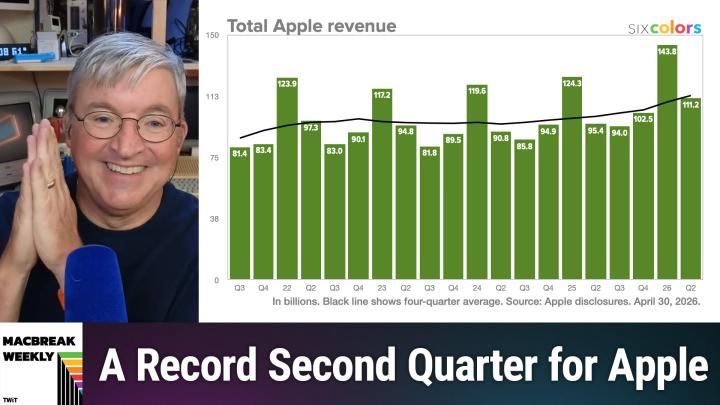
So because Apple's fiscal year is different than the calendar year, this is their second quarter, their Q2 results. But it's January, February, March. Right, right. And it was a very good 17% up year over year, year over year is what matters.
Jason Snell [00:04:01]:
Yeah, I mean, that's what people are looking at as they're looking at the growth number versus the year ago quarter, especially since the things can be seasonal, like last quarter is the holiday quarter. So if you go sequential, then this is what happened every year at Macworld. My boss would come to me and say, traffic numbers are down from the beginning of the year. And I would say that's because Macworld Expo is in January and they announced all the new products then. And then we never get that number again. And that's why it's seasonal. You don't do that. You say how they do Q2 last year.
Jason Snell [00:04:29]:
And everything was up, every category. In fact, in terms of all my little charts and all that, you could argue that it was pretty boring. Just in the sense that everything went up. Like literally every category went up, every region for Apple went up. I Think the, the fact that they did $111 billion in a non holiday quarter for the second straight non holiday quarter is bananas because these are the boring quarters, right? These are the quarters where they're not killing it on the holiday season. And the boring quarters that used to be, you know, not too many years ago, like in 2021 they were in the 80 billion range, are now over 100 billion. And this is 111.2. It's not a little over.
Jason Snell [00:05:11]:
It's a lot over. And some of that, I mean what Tim Cook said is this is the best debut for an iPhone in two quarter debut for an iPhone series ever. Like the 17 really has killed it and obviously it's 50% of the revenue. So the iPhone does well, Apple does well. But like to, to. I think Apple is a machine now that just generates $100 billion a quarter whether you ask it to or not, which is just kind of staggering.
Leo Laporte [00:05:36]:
Wouldn't that be nice? Yeah. Services up. Now that purple sector of your pie chart is 28% on services. That's, that's pretty good. Even though they're going to give a billion dollars of that back to Google, that's still looking, looking pretty good at profit. Well, you know, for three months to make $29.6 billion. It's about $10 billion a month, two and a half billion dollars a week. That's okay.
Leo Laporte [00:06:03]:
That's a decent look.
Jason Snell [00:06:05]:
I am not kidding when I say, when I describe Apple as a, the world's greatest cash generation machine, I mean it is true they are throwing off enormous amounts of cash on a very, you know, on a quarterly basis, enormous amounts of profit.
Leo Laporte [00:06:20]:
And this number is really interesting. Their gross margin, how much profit out of their revenue? It's almost half. That's a huge number. I think some of that's got to be because services is almost all profit.
Jason Snell [00:06:32]:
Services is almost entirely profit. And in fact I do a chart, it's the next one on my webpage there. I'm trying to chart the moment it's going to happen when Apple's going to have a quarter where they actually make more profit in services than from products. Which will lead to a lot of think pieces where people are like oh, because the margins on services, like you know, you make a TV show once and then you can sell it a million times and it doesn't cost anymore, whereas you make a MacBook. Every single one of them has a profit margin built into it because there's a cost to make it that's separate from like the cost to design it. But I will say we can over talk services too, because services are driven by people who bought Apple hardware. Like it's extra revenue on top of the money you spend on your iPhone or your Mac or your iPad or your Apple Watch or whatever. But like if you didn't own any of those, you would also not be subscribing to Apple services.
Jason Snell [00:07:22]:
So it's a little bit, it's, it's more synergy than you might think when you look at the size of the services number. But remember the services number used to be 9% of Apple's business and now it's a full quarter of Apple's business. So they have done a tremendous job at like literally the iPhone is half of Apple's revenue in this quarter and services was 28%. So more than three quarters of Apple's revenue is in those two lines. It's kind of staggering.
Leo Laporte [00:07:48]:
Yeah.
Andy Ihnatko [00:07:48]:
And I think Tim actually called out of how well Apple Watch did that they had. I don't know if it was a record quarter, but in terms of, in terms of selling Apple Watch people. I'm sorry, I don't have the transcript, but basically he marked out Apple Watch as an indication of the synergy of the entire platform that they're doing a better job of convincing reminding people that hey, we have a whole portfolio of products and that any one entry into the Apple ecosystem as a gateway towards more sales, that was a consistent message they were sending to shareholders.
Leo Laporte [00:08:27]:
Here's the chart with a percentage revenue by product line. Watches in. Wha. What is that? Wearables.
Jason Snell [00:08:34]:
Home and accessories.
Leo Laporte [00:08:35]:
Yeah, home and accessories. You know, as a, as a Mac lover, it's always saddens me to see what a small thin sliver and yet,
Jason Snell [00:08:43]:
and yet the Mac is the best it's ever been. And they are talking about a business that is just throwing off like the Mac is selling $8.4 billion a quarter. Like for the last two quarters it's been 8.4 and then it was 8.7. And like the average here is, it is really a good business, a huge business. It's just not. And this is a challenge for John Ternus, right? Is like you have to manage these different businesses and you can't make every decision about the iPhone because you have these other very large and profitable businesses to manage. But at the same time half your revenue is the iPhone. So you do need to do Tim
Leo Laporte [00:09:19]:
Cook get credit for services. That was really under his watch that they started focusing on ARPU average revenue.
Jason Snell [00:09:25]:
I think so.
Leo Laporte [00:09:26]:
Right.
Christina Warren [00:09:26]:
Yeah, yeah. I mean credit blame. I think there's an argument you can make either way on that. Right. Which is to be like, has the focus on, on services been to the detriment maybe of other areas? But certainly from a financial standpoint, we can't argue with results. And you know, I get you could make the argument as well that part of the reason that they can maybe invest and have the types of hardware products they have and do those things is because they know that they can make up the margin on those services.
Leo Laporte [00:09:55]:
Right. And speaking of Tim and John Ternus, we were taking bets last week on whether John would show up. He did.
Jason Snell [00:10:03]:
He did. He read a 20, like a 250 word prepared statement. That was what he did.
Leo Laporte [00:10:09]:
Did Tim say anything nice?
Jason Snell [00:10:11]:
Oh, I mean it was very much like, oh, let me introduce you to John. John is great. He's visionary. It's all the things he already said in the statement but they said it again and then like, so let's throw it to John. And John is like, I just want everybody to know that Tim is the greatest executive, executive, executive on the face of the earth. Yeah, that was, it was that kind of a mutual admiration study, which is the point. Right. Because this is a direct part of the transition, part of leaking this to the Financial Times.
Jason Snell [00:10:39]:
All of this is about reaching Wall street and saying it's going to be fine. We're all very responsible. John Ternus, the statement was like, you know, we're going to follow in Tim's footsteps. Don't worry, I'm not going to go like start spending money like crazy. And Tim is like, John's the right guy and it's going to be good because that's the message that they're trying to send with this whole transition is like, don't worry because Wall street, you know, that's the challenge there is that you want the, the shareholders feel like Apple's in good hands. So they don't want to, they don't want to take a hit to their stock or anything like that. And I think they've been very diligent in that messaging. Yeah.
Andy Ihnatko [00:11:15]:
Although, although we might talk about this later, but they did announce a really big change to how they basically said that they're going to be not doing net cash neutral business anymore. That's where they were. Tim, one of, one of Tim's earliest thing is that we no longer, we're going to try to get to the go of making sure that our net cash is equal to our debt so that we're no longer hoarding cash. Hoarding cash, hoarding cash as they did under Steve Jobs. And part of that was this is, this is one of the reasons why Tim Cook has given back $1 trillion to shareholders. One of the reasons why the valuation has gone up to 4 trillion. But the what. So there's been a lot of people who have been sort of speculating as to why they're ending that right now.
Andy Ihnatko [00:11:57]:
And one of them is that maybe it's because they really do want to get into not necessarily a spending mode but that if perhaps part of their plans equals we want to acquire some companies that we think we could, that could really strengthen our business a lot. Some people have been speculating about oh well obviously it's going to be a big AI buy in and I don't know if that's really what Apple's going to do. But it does mean that if there is, there's a reason why they're suddenly saying that we're ending this 10 year old policy. And the net effect of we, we basically announcing that we are going to be spending more money invites lots and lots of interesting speculation as to what they're spending the money on. Including as Jason said, like services is racing forward, forward, forward. What if they just simply said we just want, we. What if we were to make our platforms a destination platform as opposed to an add on platform that hey, we've already got you with your Apple watch, we've already got you with your iPhone. We're going to, why not sign up for a cloud service or a streaming service too? Maybe they're going to beef that up to basically say we will want it.
Andy Ihnatko [00:12:56]:
We were going to try to take money from everybody, not just people that we've already sold MacBooks to.
Jason Snell [00:13:00]:
Yeah, the net cash neutral thing is, I mean yeah, in 2018 they, they went beyond just like restoring the, the dividend to talk about this net cash neutral at a point where I think they had like 160 or 180 billion in effective cash, which was ridiculous. Right. But this is the thing is they, they, they were, they make so much money, there's the profit is so great. They're like what do we do with it? And, and it's true, Steve Jobs was much more like let's hoard it. And then they started to spend it and then final like we're going to just say we're going to be cash neutral. That was a Luca Maestri thing. He was the CFO at the time. What they've done though is like they tried to say, look, we're going to still be returning value to shareholders.
Jason Snell [00:13:38]:
The board as a part of this announcement also granted another $100 billion that they can do stock buybacks on over time. And they still hadn't run through the last grant there. So they're like, we're still, don't worry like there's still value that's going to be generated for, for shareholders. But what they said was they wanted to uncouple those two things, right? Which is, which is debt and cash on hand. They wanted to and not try to head, to head for net zero. And the way they put it was they wanted it to be, they wanted flexibility there. And I think, I don't know, none of us know, we all really want to know what prompted that. But it feels to me like when you've got lots of AI spending happening, when you've got issues in your supply chain where like you can't get enough chips from tsmc, you can't get enough RAM chips at the right price from your RAM suppliers, and looking at like a more uncertain future in terms of what investments are going to be required in terms of AI, especially that saying maybe if we're throwing off 20 billion in profit a quarter, we might want to hold more of that back.
Jason Snell [00:14:45]:
Because you never know what we might want to do with it. They could be targeting something specific or it more be. It might be more like the game has changed a little and we need more ability to keep cash on hand so that if we need to do a major outlay, we can afford it. Right.
Leo Laporte [00:15:04]:
They are spending more on R and D. This is actually a lot of them, a huge increase, isn't it? 11.4 billion in R and D. Is that, is that all AI or is that something else? Is that it's not cars? We know that
Christina Warren [00:15:20]:
it's unclear. But what's interesting is that as much like as they're spending an R and D for Apple, right. Like when you look at their capex versus their competitors, it's not even at the same level.
Leo Laporte [00:15:29]:
Google's $180 billion.
Christina Warren [00:15:31]:
Exactly. I think Microsoft is also like the 120, 140 billion Amazon. Amazon too, Right. Meta is increasing next year too. Yeah, yeah. So everybody else is spending many, many times this which I think to Jason's point is like I'm noodle to kind of think about, okay, what are they going to do with this cash? Are they holding it back for a specific purpose? Is it something that's, that's planned for? But yeah, they're spending more than they typically have. But yeah, who knows what it's going to be. I think AI has to be some of it, but because they're not in the data center game, everything that they're spinning, it's just a different math level.
Christina Warren [00:16:08]:
It's just not even in the same stratosphere.
Jason Snell [00:16:09]:
I have, I mean, I have a couple of theories. One theory is that they want to be ready in case there's a moment of weakness where there's something that they could acquire.
Christina Warren [00:16:18]:
Yeah.
Jason Snell [00:16:19]:
Or, or if not, often we talk about acquiring and it's like Apple's going to buy some company. It's like, I don't know. I mean, it's also could be in a moment because if you've got all this cash and then there's a financial hiccup and some valuation goes down or some company needs an infusion of cash.
Christina Warren [00:16:34]:
Right.
Jason Snell [00:16:34]:
You could step in and be a, you know, be a partner and an investor in some company that's like a core AI company or something and that, that they might find value in that. And having more cash as the cash cow of Silicon Valley in some ways. Right. Having lots and lots of cash on hand in a moment where everybody else is spending huge amounts of money or going in debt in promise of future value is an advantage for Apple. So that might be part of it. And also part of me wonders, I keep getting stuck on the fact that, you know, TSMC has all these other contracts from other providers now and the RAM shortage thing, I wonder if they're realizing that like so much cash is being thrown around, that if they want to reassure because Apple's very conservative, they want to, they want to ensure not being surprised by supply constraints. Right. They want to do that.
Jason Snell [00:17:22]:
I wonder if that's part of this too, is maybe they realize that if they can come to some of their partners with cash and say, build us a factory, that they'll be able to do that and like rationalize their component issues for the next five years or something like that.
Leo Laporte [00:17:36]:
By the way, I slated capex with R& D. So Apple's R and D is 11 billion, Alphabet 17 billion, Meta 17.6, Microsoft 8.9. So actually they're not so far off,
Jason Snell [00:17:51]:
but it's a big, it's a big jump.
Christina Warren [00:17:52]:
R and D for them it is. And since they don't do capex the same way, I think it's still, you can't compare, but I still feel like it's a lot. I do wonder, kind of looking at especially with the supply chain constraints, which they even had to address the fact that there are shortages on the Mini in the studio. If this means, maybe to your point, Jason, if they are essentially going to be trying to throw money at the problem, my initial guess was, okay, they're going to do kind of what they're doing with the Mini already, which is effectively, and I know we'll talk more about this later, but they're effectively getting rid of the entry level model, which is not a good thing. And my initial thought was like, they're just going to raise the prices across the board because that's what Apple will do and they will blame the industry and everything else. But I do wonder if there's an opportunity with this sort of cash in addition to maybe keeping it for some investment opportunities. They did that with Didi Shushing, which was a Chinese conglomerate about a decade ago. So that's not like they haven't done that sort of thing before.
Christina Warren [00:18:55]:
But I do wonder if that would be the sort of thing where they're like, okay, we're willing to maybe give up some of our margin and, and buy some of this time to keep our prices consistent and potentially win market share once things settle out or not.
Leo Laporte [00:19:09]:
Every business should be doing this right now. Right. There's potentially all sorts of headwinds that come in. Save some money while you can.
Jason Snell [00:19:18]:
If you aren't spending it right. I mean, all your competitors are spending money like drunken sailors because they're investing so much in those cloud infrastructures and all of that. And Apple's not playing that game at the moment. And I think this is a recognition that they're not playing that game. But maybe they need to keep their powder dry.
Leo Laporte [00:19:33]:
Yeah, yeah, yeah. Because data centers, you know, clearly compute, is constrained.
Andy Ihnatko [00:19:38]:
Actually.
Leo Laporte [00:19:38]:
Let's take a break. When we come back, let's talk about the supply chain issues, the Mac Mini issues. There, there were some. I don't think if they're negatives, they might be actually positives. If you can't make enough Mac Minis.
Andy Ihnatko [00:19:52]:
Storm clouds.
Jason Snell [00:19:53]:
It's a problem. But a good problem to have, but still a problem. Right?
Leo Laporte [00:19:57]:
You're watching MacBreak Weekly with Jason Snell. Christina Warren. Andy and Naka will have more in just a bit. Back to Hawaii. Hello, everybody. Yes, I'm in Hawaii. I'm sorry, my apologies. Nothing I can do about it.
Leo Laporte [00:20:15]:
I'm stuck here. It's, you know, it's a perfect day in the Big island, so. But enough of that. Let's talk about headwinds, not trade Winds actually, you know, this is a blessing and a curse. Tim Cook said on the Call analyst call on Thursday. It could take several months for Apple to make enough Mac Minis and Mac Studios to meet demand. And this is all because of AI, right? Cook said on the Mac Mini and Mac Studio. Both of these are amazing platforms for AI energetic tools.
Leo Laporte [00:20:48]:
See, it's a good thing. And customer adoption of that is happening faster than we expected. So great, great results for Apple. Except that they can't make them fast enough. That's got to be supply chain issues to memory.
Jason Snell [00:21:03]:
Yeah, they said that. They said it's really TSMC that they're having. They're constrained on systems on a chip coming from TSMC because they underestimated the calls of like how they were going to sell and that tsmc I think the implication there is also TSMC no longer has as much wiggle room to supply them with more and so they ended up light on systems on chips.
Leo Laporte [00:21:27]:
Well that would explain the Bloomberg piece yesterday. Apple Explorers using Intel and Samsung to build main device chips. And not only build them, but to build them in the United States. Both companies have US fabs apparently. So that solves two problems. It makes the administration happy, but it also maybe is a backstop to tsmc.
Jason Snell [00:21:50]:
And Apple's already working with TSMC in the United States as well. It's not like on the cutting edge nodes, but they are going to do processors there. And yeah, it may, it kind of makes sense. Like Apple just goes back to why they might be saving cash. Like these are strategic challenges where if you only have one supplier and something happens to that supplier. We've been talking about Taiwan and China. Right. But like also what happens to TSMC if somebody buys all of their other capacity and so you're left with what you had reserved but kind of nothing else.
Jason Snell [00:22:25]:
You get a situation where you might be short on SOCs and that's not great. So being geographically diversified is part of it. But like having intel or Samsung especially keeping in mind it's not going to be like a Samsung silicon here. Right. It's like literally this is, this is
Andy Ihnatko [00:22:41]:
not service stuff we designed for you.
Christina Warren [00:22:44]:
Yeah, exactly. It will just be another supplier. Right. It's just going to be using whatever FAB is available. The same thing with intel. Since intel is not an ARM fab, they have a partnership with them and they can make some of the chips that would go into those SOCs.
Leo Laporte [00:22:56]:
Yeah, well in fact when Pat Gelsinger, the former Intel CEO said we're going to split Foundry and fab. One of the things he said and we laughed at it at the time is maybe even Apple will be a customer. Well, maybe Apple will be.
Andy Ihnatko [00:23:08]:
Yeah, it's, it's a. Oh, I'm sorry. Go ahead, Christine.
Christina Warren [00:23:10]:
So I was just going to say no, maybe, I mean it was not a bad strategy from Intel. I mean I think the only bad part was that they did it a decade after they should have. But yeah, right. You know.
Jason Snell [00:23:19]:
Yeah.
Leo Laporte [00:23:20]:
Stock soared yesterday 12%. Because on this news now this is a rumor, we should say neither Apple, intel nor tsmc.
Jason Snell [00:23:27]:
And it's a soft rumor. Right. Like it was like this is like
Andy Ihnatko [00:23:30]:
they're talking very, very, very, very preliminary. They did Apple tour facility.
Leo Laporte [00:23:34]:
Yeah, yeah.
Jason Snell [00:23:35]:
But I think the strategy seems to be, and this makes sense that they still want to do kind of cutting edge nodes with TSMC because TSMC is at the cutting edge but they got lots of products that don't need the cutting edge.
Christina Warren [00:23:46]:
Right.
Jason Snell [00:23:47]:
And lot, lots of systems, lots of different chips that need to be made that are on the older nodes, legacy nodes, Tim Cook's favorite phrase or are they don't need to be the high performance chips. And in fact as we see Apple diversify its product line, you know there are a lot of Apple products that are using previously cutting edge, no longer cutting edge chips. They could shift their strategy a little bit so that they're instead of the lower end chips being hand me downs from previous high end chips, they could create a whole secondary class of chips that are run on an old, that are designed for a process at intel or Samsung that are going to go in your MacBook NEOs and your generic iPads and your Apple watches and other things that don't necessarily need the chips that are going to be in the iPhone or the MacBook Pro.
Andy Ihnatko [00:24:41]:
That's an interesting conundrum that they're in though. So we're talking about the 3 nanometer process that is being used not just by Apple's SoCs but basically Nvidia uses it too. And that's why all this capacity being eaten up.
Leo Laporte [00:24:52]:
Nvidia's buying all of TSMC's capacity. Capacity that can.
Andy Ihnatko [00:24:56]:
And, and the, but the, but the thing is like the NEO was definitely positioned as look, this is not a high performance MacBook. This is a more than. This is not even. And it's not just a good enough Mac, it's a more than good enough. But the thing is your expectation is that if you need a MacBook Air, go buy a MacBook Air. This is not a MacBook Air. So Apple, but Apple is in a position where this would be a great place to do either custom SoC that is like to the limitations of what capacity they can get. But on the other hand the minute that they release a 2027 model or 2028 model that is not every bit as fast and capable as the one before it, that's can the product line survive that? Would they even write off on that? So they're still kind of constrained on what kind of moves that they can make regarding the Neo, which is not just a really great selling machine but there are also basic timing.
Andy Ihnatko [00:25:49]:
I think mentioned twice that we've got an entire school system that has decided, nope, we're not doing Chromebooks anymore. We're not doing Windows laptops anymore. We are basically now buying MacBook Neos because it now makes sense for us to actually outfit all of our, all of our students with them. So it's an important thing and now it's becoming, it's an important product but it's a low margin product and it's hard to know how that, how that's going to affect the Neo in the next two years.
Leo Laporte [00:26:13]:
Did they give any details besides the school about the Neo that how well it's selling or anything like that today?
Jason Snell [00:26:20]:
They said it, they thought it would be good and it was way better than they thought. And, and that is, you know. Right. And so that they're, they're dealing with that and they did, you know, they cherry pick like Kansas City said that they're going to do it. They, they, they always cherry pick some site that I think
Andy Ihnatko [00:26:40]:
it made sense
Leo Laporte [00:26:40]:
for Kansas City of the Chromebooks is starting to recede into the, the background. I don't even know how committed Google is to it anymore. They're going to turn it to Android, right?
Andy Ihnatko [00:26:50]:
They've got, yeah they've got the new operating system aluminum that's going to debut later this year and it's, it's a very much an Apple sort of play where they're partnering with Qualcomm to develop custom CPUs for it. But let's, let's see how it works out. The things it's not, it's not like
Leo Laporte [00:27:03]:
I don't feel a strong commitment and I think schools are getting exactly a little tired of the whole Chromebook thing.
Christina Warren [00:27:09]:
So I wonder, I mean maybe I think the thing is even if Google's commitment waivers you have such a huge partner ecosystem which this is kind of their, their low end laptop that they can sell in volume to schools, to businesses, to whatever that I don't know.
Leo Laporte [00:27:22]:
If I had the Framework CEO on Wednesday on intelligent machines and they stopped making their Chromebook, he implied it wasn't selling all that well.
Christina Warren [00:27:30]:
Yeah, well, that was a more expensive device. Right. Like the unfortunate thing with Chromebooks is just to go on like a brief tangent and I think this is actually interesting though because it's different than the Neo in some regards is that the Chromebook is simply a volume machine. It's all about what's the lowest selling price we can get and how many can we get them. It doesn't matter.
Leo Laporte [00:27:47]:
They're like 300 bucks or 200 bucks.
Christina Warren [00:27:49]:
Right, exactly. And if you're buying them in mass, if you're buying, you know, thousands at a time, you're getting even better prices than that. You're getting them by the truck full. Can you replace the keyboards and the screens? Yeah, you can, but a lot of times you're just going to kind of, you know, swap certain things out and move on. It's, you know, it's fast computing. Right. Instead of fast fashion, it's fast laptops, except they're kind of slow computers. Yeah, exactly.
Christina Warren [00:28:11]:
Right. And so, you know, a company like, like Framework, who made a really good product and Google tried this too with the Pixel books, you know, a number of times, and drag it, they were
Leo Laporte [00:28:23]:
over a thousand bucks.
Christina Warren [00:28:23]:
Yeah, yeah. HP has made a few as well that internally at Google. You can even choose if you want to get one of like the high end Chromebooks. You can get one with like I think 64 gigs of RAM or something. Right, but who would choose that? I'm not really sure. And that's sort of the problem. Right. It's like if you go out of your way to make it repairable and you go out of your way to like make it easy to, you know, work with and all that, you raise the price to the point that it's like, that's not the point.
Christina Warren [00:28:48]:
At that point I might as well just buy a Mac. And that's, I think, why the Neo is interesting because it sort of is that middle ground where you're not having to be lowest common denominator. But it's still not super expensive. But it is easy to repair, at least for some of the parts. Right. Like if the SOC goes, it goes. But that I think is potentially compelling. But I still see it as just a completely different game than what they do on Chromebooks.
Leo Laporte [00:29:15]:
The iPhone, huge success, they said, again, like the most successful phone they've ever made. The 17, the best seller than the
Jason Snell [00:29:23]:
pro and pro max over those two quarters sequentially. Like, if you define that as an iPhone launch, it's the best iPhone launch ever. And I mean, wow. It's funny because it doesn't always line up like this, but it did line up this time. That I think reviewers in general all said this is very impressive, right? The, the changes in the 17 Pro are really nice. The color is nice. They, they tried to do this weird, you know, interesting product in the air, and then they took all those pro features and put them down in the 17. And it turns out that the sales also followed.
Jason Snell [00:29:52]:
I do. If you look at the China sales, especially because China sales really have bounced back in the 17 era, that, like, in many ways the 17 is just a successor to the 16, 15, 14 in terms of look, but it is a different look. It does have that whole aluminum back. It does have the color options. And I think that we, you know, the story is basically like, make some nice visible changes and China will be much more responsive. And whether that's the reason or not, I don't know. But like, China bounced back and the iPhone sales went up even, and you could see how China was like a little bit below on growth, the rest of the world, and now they're a little bit above it. So I think there was absolutely enthusiasm in China for the iPhone 17 line and that helped drive that iPhone.
Jason Snell [00:30:40]:
But like, it's. It's just a winner of a launch. It's their best iPhone launch, basically.
Andy Ihnatko [00:30:44]:
And it's hard to really pick a. Pick a reason why a certain phone will go, will go, another one won't. It really does come to it. I think they mentioned. I think they talked a little bit about this, about cycles of. People are holding on to hardware a lot longer, and so that really affects it. So. And they sold really, really well with people who are upgrading their phones.
Andy Ihnatko [00:31:04]:
Whether or not that was, wow, gosh, I was going to hold on to my iPhone's iPhone 12 for another two years, but gosh, the combination of style, features and price has won me over and got me to buy early. Sometimes people. It's just time for people to buy a new phone, and if it's orange, that's the reason why they bought it. So it's. It's. I think that's. That's probably one of the reasons why they are now staggering their releases to let's have a spring release and a fall release to. Basically, when you see, when you see some of these charts and it's Always just like these point and then swoop and point and swoop and point and not really knowing exactly how much you're going to be making during that one big.
Andy Ihnatko [00:31:39]:
Those two big sales quarters. It'd be nice to sort of flatten that out and get money over the course of the year as opposed to just during these 1, 2 upgrade cycles.
Leo Laporte [00:31:49]:
the very end, Tim Cook mentioned tariffs. Yeah. So they haven't really talked about this before. They've mentioned previously that the tariff costs ranged from 800 million and a quarter to more than 1.4 billion. Even though they were getting some breaks on tariffs. I know with the iPhone tariffs, they were getting breaks. They announced at the very end of the call that they were going to take any refunds they get because, remember, the Supreme Court said those tariffs are illegal. And, yeah, there will be some refunds that they're going to reinvest into US Manufacturing, which, of course, will make the president.
Andy Ihnatko [00:32:25]:
What a great piece of diplomacy.
Jason Snell [00:32:27]:
Yeah.
Andy Ihnatko [00:32:29]:
Where Trump is sort of discouraging people from take. From taking those tariffs back. Well, we'll take them back, but we'll reinvest them in manufacturing.
Jason Snell [00:32:36]:
They really wanted to make this announcement to the point where an analyst asked a sort of related question, and Kevin Parrack, the cfo, it was like, about product margins. And in the midst of his answer, Kevin Parrack is just like, hey, let me turn it over to Tim for a minute. And Tim Cook appears. It's like, they never do that. And then Tim Cook makes this statement about tariffs. And it's very much like, we're following the established processes. We're not doing anything. We weren't suing anybody, but we're following the tariff reimbursement process.
Jason Snell [00:33:07]:
And if we get that money back, we're gonna put it all into American manufacturing, which is also. Not only is. Makes that kind of unassailable to criticism from the president and others, but it's also like money that they would be doing that with anyway. But they get to say they're doing it for the. Oh, no, that's the tariff money. We're doing that. We're adding that in. It makes it.
Jason Snell [00:33:31]:
Yeah, it clearly was a thing that. And then literally, Kevin Parrack then just continued with his answer after Tim said this. So, like, they really wanted to get it out there. And then it was the most like, no, this is the time. Let's do it right now so that they can say that. Yeah.
Andy Ihnatko [00:33:45]:
I mean, you can almost hear, like, the tip of a big pen being tapped against the post it note, I'm
Jason Snell [00:33:50]:
going to jump in because they're waiting for a tariff question and there still hadn't been one. And they're like, well, maybe this product margin question will do it. Let's just try it. Because they wanted to send that message. And you could see why, right? Like you could see why. And it fits with what they're doing. It's not obviously they're going to continue announcing their contributions to American manufacturing in all sorts of different ways. That's something they've been doing for the last, you know, eight years.
Jason Snell [00:34:14]:
They will continue to do that. And this allows them to frame any, you know, billion dollars. They get back in tariff reimbursement as not a big deal because it just becomes another. They take it away from the US Government and they just invested in America. Hard to be criticized for that.
Leo Laporte [00:34:31]:
They may not be suing over tariffs, but they are going back to court over the Epic. And I mean epic battle. Remember that last week on MacBreak Weekly, the 9th Circuit had said, no, you, you got. Actually, I think they, they found Apple in contempt and said, no, you gotta, you gotta do the changes in the App Store. Apple has now filed with the U.S. supreme Court asking it to stay the 9th Circuit's mandate. So the battle goes on.
Andy Ihnatko [00:35:07]:
Yeah. And, and for, and for interesting reasons. Basically, basically their basis is that. Well, yeah, so the, they, they were hit with this order because they were, they, they, as you'll recall, they were cute with a good. With the judge saying, okay, fine, you're ordering us to allow developers to be great, okay, we'll do that. They can do that, but they'll still pay a 27% the tariff on expenses and we'll basically make it. So they don't want to do that. Essentially with this appeal, they're basically saying that, number one, because the original order didn't say anything about how much we could charge.
Andy Ihnatko [00:35:41]:
Number two, because the order affects all of our operations, all developers worldwide, not just Epic. And they're also saying that the current staying this order won't, won't affect Epic's ability to do basically what we've told. We've been told. They, we have to let them do so basically give us a little time and give us a stay while we, while we try to talk.
Leo Laporte [00:36:06]:
Let me rephrase this in a way people understand. They said, your honors, the 2021 injunction didn't say anything about App Store fees. It didn't say we couldn't make it 27%. What are they talking about? And that Contempt thing that hurts us. Yeah, it hurts.
Andy Ihnatko [00:36:27]:
They also said that having that on the books will affect how they're judged. Like, well, you know what? Past actions actually have future consequences.
Christina Warren [00:36:34]:
Yeah, exactly.
Andy Ihnatko [00:36:35]:
I don't know if you have children, but you might have explained that to them at some point.
Christina Warren [00:36:40]:
If you didn't want the contempt charge, maybe you shouldn't have. You know, don't do anything in the order.
Leo Laporte [00:36:45]:
Don't be contemptible.
Christina Warren [00:36:47]:
Right. Well, and look, there's. There. I fully understand that. As you know, they're doing what they have very well paid legal counsel and house counsel. They have to file the appeals. They have to go through this process. I get it.
Christina Warren [00:36:58]:
But there's a part of me that I'm like, just take the L because, you know the Supreme Court is not going to hear this.
Jason Snell [00:37:03]:
Yeah.
Christina Warren [00:37:05]:
You know that, like, just, just take.
Leo Laporte [00:37:07]:
We know that. I mean, I don't know what we know.
Christina Warren [00:37:09]:
Oh, I don't think this. They've turned down every other attempt that they've done about this. I mean, I just, I don't think
Leo Laporte [00:37:14]:
that they were the ones who sent it back to the 9th Circuit in the first place.
Christina Warren [00:37:17]:
Exactly. And there's also not really an interesting legal question here, which is usually, look, I'm not a lawyer, so I just watch legal shows on Hulu, but. Right, exactly. But usually from my understanding, that would be why the Supreme Court would take on something like this. It would pose an interesting question. I don't think there's an interesting question here. Basically, to your point, like, no, but, but you're on.
Andy Ihnatko [00:37:44]:
It's, it's interesting. It's interesting though because like, so Google got, got the attention from, from Epic just as, just as bad as Apple. Eventually they threw in the towel and said, okay, we're going to. Even though, like we've lost at some point. They lost so badly, they basically, they took the judges. The judge basically said, look, I would love for you two to sit together and work this out before I have to actually enforce or enact this, this thing. And they actually worked out a system where Google basically rewrote all the rules for how they run the Play Store. And it was so like, comprehensive.
Andy Ihnatko [00:38:21]:
And both in their joint filing to the judge to say, once you set aside like what you said before, because we've just come up with this plan. Even the judge was skeptical, saying, so suddenly you've been fighting tooth and nail for the past five years and all of a sudden you've, you've had all these opportunities to solved this before and you Didn't. But I'm wondering what's the difference between Apple and Google such that again, Google also lost, lost, lost, lost, lost. But they decided at some point, at some point we need to have a consistent policy for our App Store that's going to work internationally because we can't continue to fight these battles and have these uncertainties with our developers. I wonder why Apple is continuing to go tooth and nail with this. Maybe it is because they do control the entire widget end to end. They control the, the hardware platform, not just the operating system and the App store and the APIs. But I would love to, I hope that I live long enough for to read like the Apple 75th anniversary book in which they explain exactly why Apple refused to give an inch on this.
Andy Ihnatko [00:39:24]:
I'm sure David Pogue will still be writing it.
Christina Warren [00:39:26]:
Right. Maybe it just comes down to stubbornness. Right. Like different companies have different philosophies and Apple it, you know, is going to be like resolute in their belief no matter how misguided it might.
Leo Laporte [00:39:36]:
How long did they fight Google over the, you know, the Steve Jobs and Google thing? That went on for a decade.
Jason Snell [00:39:41]:
Yeah, I mean, but Steve, I mean I understood it from a Steve Jobs is mad and he's going to not going to take it anymore. If I were advising John Ternus, I would say just go talk, get with Phil Schiller who's been, who's been running the App Store for a long time and who court documents show has been a measured. I mean, Phil Schiller is a company man. Right. But he was even he was like, this may not be wise to go he talk.
Christina Warren [00:40:09]:
He was the only one speaking back. He was any of them.
Jason Snell [00:40:11]:
He was the only one.
Christina Warren [00:40:12]:
One.
Jason Snell [00:40:12]:
Yeah. So I would, I would get with Phil Schiller and I would say let's come up with a strategy that will allow us to try and set a new bar worldwide for how we're going to handle this. Because we don't want every market to be different. We want to have exert some level of control over what's going on and what our fate is going to be. Instead of letting it be chipped away court case by court case, let's see if we can do a reset. Because the thing is, and I'm not saying like, oh wouldn't let's dream on. John Turner's having a, you know, ghost visit him in the middle of the night and have him make a change. No, it's like he's a new CEO, there's a new cfo, there's an opportunity for a reset where you can say, look, let's take a reset.
Jason Snell [00:40:57]:
And I don't. I don't believe in a million years that Apple's going to say, let's just throw the doors open and we don't care anymore. But they could try, and they should have 10 years ago, but they certainly now could try to say, what if we can set some new terms that make more sense, that is sort of tracking what all the regulators want in a way that works for us, but also allows a little more flexibility into the system to make it ultimately to make it harder for people like Tim Sweeney to pick them off in court, because now they will have given enough. Because I think what we've seen in a lot of these cases is Apple ends up constructing its own solution to the problem that still serves Apple while allowing people enough flexibility that it makes it harder to argue that they're being held down and that's kind of where they want to go. And so fighting a tooth and nail, to me, it's like self defeating. And that it's a really ripe opportunity for John Turnus to say, can we do a reset here?
Andy Ihnatko [00:41:53]:
Yeah.
Leo Laporte [00:41:53]:
And interesting footnote to the epic Google case you were talking about, Andy. The judge in that that scolded the two of them and said, you guys work it out. I don't want to see you anymore, was Judge Yvonne Gonzalez Rogers, who is currently the judge on the Altman versus Musk case. And she's been kind of scolding them, too. She said, I don't want to hear anything about AM Doomerism. That's it. I don't want to hear it.
Christina Warren [00:42:17]:
I love her.
Leo Laporte [00:42:17]:
She's pretty strong. That's good.
Christina Warren [00:42:19]:
No, I mean, when her initial order, like, for contempt or what if raffle came out, like, that was one of the juiciest things I've ever read in my life.
Andy Ihnatko [00:42:27]:
It was directly like.
Christina Warren [00:42:28]:
It was. It was. I wanted to do, like, a reading of it because it was so good. Like, it was a. So it was just because it's rare that you see, like, judges who, A, you can tell, really paid attention, and B, just completely cut through the BS and was like, no, I'm actually not going to entertain this complete and total ridiculousness. This. This is what is happening. You haven't pulled one over on me.
Christina Warren [00:42:48]:
You're not actually smarter than me. This is this. It was so good.
Leo Laporte [00:42:51]:
She rules her courtroom with a iron fist. She's good. All right, we're gonna take a little break. Lots More to talk about. You're watching MacBreak Weekly. This is not a green screen. It's real. I'm in Hawaii.
Leo Laporte [00:43:07]:
Although I was a little tempted. I did bring my green screen. I thought I could just take a picture of that and then, and then I sit somewhere more comfortable. But that's all right. I'm out here on the lanai in the beautiful big island, enjoying a perfect day in paradise. Andy Anako in the library. A perfect day in the library. It's always a perfect day when you're surrounded by books.
Andy Ihnatko [00:43:27]:
Not a cloud in the ceiling.
Leo Laporte [00:43:30]:
Christina Warren, who is in a small booth in San Francisco at the GitHub headquarters.
Christina Warren [00:43:37]:
It's a shame because, like, to the right of me, like, it's like this lovely, like, brick facade. Like it's not the background. Yeah, it is cool. It's actually a pretty decent sized little office, echo aside. But yeah.
Andy Ihnatko [00:43:48]:
And neither of us are in danger of getting hit in the head with coconuts, which happens a lot more than you think.
Leo Laporte [00:43:52]:
That's true.
Andy Ihnatko [00:43:52]:
So you're taking your life in your own hand, my friend.
Leo Laporte [00:43:54]:
We were. We were out at a waterfall, Rainbow Falls, yesterday, and there was a guy selling coconuts out of the back of the truck. And he takes the whole coconut. He takes a machete. And in his hand I said, careful, he's chopping the coconut off in his hand. I said, you ever cut yourself? He said, no, I practice.
Andy Ihnatko [00:44:09]:
And.
Leo Laporte [00:44:10]:
And with somebody else's hand, I guess.
Andy Ihnatko [00:44:12]:
Anyway, I suppose at some point you've cut off all the fingers that are in the way.
Leo Laporte [00:44:16]:
Exactly.
Andy Ihnatko [00:44:16]:
And so you're now you're nothing left.
Leo Laporte [00:44:18]:
Nothing left to get in the way. I said, oh, you must. You must have grown up here. Said, no, I'm from Texas. But he does grow his own coconuts. They were. That was delicious. And Jason Snell also here from his garage.
Leo Laporte [00:44:32]:
Yeah, indeed. They are all somewhere.
Jason Snell [00:44:34]:
Not a cloud in the garage either.
Leo Laporte [00:44:35]:
Not a cloud. It's amazing. Amazing. Blue skies everywhere. We'll have more on MacBreak Weekly right after this. Cinco de Mayo, May 5th today. In years past, iOS releases have usually occurred in the middle of May. We are expecting, I think any day now, maybe this week or next.
Leo Laporte [00:44:56]:
IOS 26.5 to be released to the general public. Some big changes, Jason, usually use the betas, right? The developer betas or the I am on.
Jason Snell [00:45:09]:
I mean, it's late betas, so I try not to. I actually by mistake I'm on the Mac beta. But yeah, we're at release candidate now. So my guess is that they'll be pushed out in the next week.
Leo Laporte [00:45:22]:
Right. It's about when they've done it in the past, I think. Chance Miller, writing at the 9-5 Mac, compared previous release dates of 18, 5, 17 5, 165 and 15 5. And it was almost always mid May. Yeah, second or third week in May. So, yeah, it should be soon. What are the new features Apple Maps now has suggested? Places. Ads are coming.
Leo Laporte [00:45:45]:
Sorry. Yeah, sorry
Christina Warren [00:45:49]:
again, though it might make the ma. It might make maps better. Genuinely like that. That's kind of my thought. Yes. Because if people. Because if people like right now, at least my, my philosophy is, one of the reasons that the maps are as bad as they are is that the businesses don't ever prioritize updating the place data because it's not going to bring them any traffic relative to Google. So I don't know, maybe, maybe, maybe ads will, will improve that.
Christina Warren [00:46:14]:
Maybe it'll make it a higher priority, which will then increase the mapping data. Like, I don't like it either, but
Leo Laporte [00:46:20]:
we've been using Apple Maps to navigate everywhere on the Big Island. They work quite well now. I haven't had any trouble with Apple Maps in years since, I mean, Cook admitted that this was not. This was his biggest failure. In fact, I think he said at
Andy Ihnatko [00:46:33]:
one point, yeah, at this, at this point, it's so good that I have. I think that every iPhone owner should have Google Maps installed alongside Apple Maps. But right now it's the platform that you would only use when you need the very best mapping app available. Because there are only, like, I don't know, maybe 3 or 4% of situations in which Apple Maps is going to fall up short. It's an important 3 or 4%. Like when it's like, I need to make sure I know where the door to the emergency room on this hospital is. I don't need to know what block it's on. That's when you say, you know what? Why don't we ask Google Maps that? Apple Maps, you're great.
Andy Ihnatko [00:47:06]:
You're great. Why don't you sit back? We're just gonna have Google Maps. About that. Thumb reattached.
Leo Laporte [00:47:11]:
Yeah. I have several mapping apps actually, on my iPhone just in case. Although Apple has now added download. I don't know when they did this, but you can download maps. I didn't know that. I knew that Google Maps did. So I downloaded the maps for Hawaii because there's a lot of areas in the Big island where you don't have cell reception.
Christina Warren [00:47:26]:
Well, it even Recognizes when you enter in a new area. Like when I landed in SFO last night it said oh you know, welcome to the San Francisco. Do you want to download this map offline? Which was a really nice feature. And I was like, okay. I mean I don't anticipate losing connection, but go for it.
Leo Laporte [00:47:44]:
Well here you need it. There are a lot of areas.
Christina Warren [00:47:46]:
Oh you know, I was going to say in Hawaii you absolutely do. Like that that's actually a perfect like opportunity for that and to recognize. I know you're at the airport, this is the time now that you're there to do it. Like that's smart, right? Like that's actually, that's really slick.
Leo Laporte [00:47:59]:
Another very important feature, end to end encryption in RCS messaging. So they, they started doing it last version but with iOS 26.5 beta 1, RCS encryption has come back to the messages app. So if you're messaging Andy and he's on an Android you and it uses rcs, you'll see end to end encryption. Of course Apple to Apple Messages of course has always had end to end encryption.
Andy Ihnatko [00:48:26]:
Yeah, thank goodness for that. So that was in, that was in a couple of earlier Betas I think 20.4 and even 0.3 but that was for carrier testing. But it's going to be actually widely available in 0.5. Although like all things RCS it is carrier dependent. So it might not be available to everybody all at once. It might take a while for, for all the carriers to update. I expect in the United States most major characters carriers will support it chiefly because, chiefly because of course they're all using Google messages as their standard standard RCS app or excuse me, standard messaging app.
Leo Laporte [00:49:00]:
Right, right. And encryption very, very important.
Andy Ihnatko [00:49:03]:
100% it's way delayed. I'm glad, I'm glad they're finally falling in line because that was one of those things where you just had to say why are you base. Why if you, why are you saying that privacy and security is really important and you're not supporting an open standard for interrupt cross platform encryption.
Leo Laporte [00:49:20]:
And they didn't want it. So the, so the standard didn't require encryption. Right. But Google offered it and I think Apple said well we don't want to use Google's encryption. We want to have it our own in house encryption. Right?
Andy Ihnatko [00:49:31]:
Well no, there was, there's there there. They had, they had a rational argument which was that the standard GDPR had not actually formalized a standard for encryption. Google had basically as a gift to the standards committee said we've developed the standard and we're willing to basically make it make it from a private thing to a public thing so everybody can use it. And I think Apple's official party line was that we're waiting for that to actually be actually be formally integrated into the spec before we will do would have been nice if they said you know what we're going to be given that the Google, the Android platform is 80% of all mobiles out there and that we can basically cover a big swath of those people by supporting this Google standard. Why don't we just be a little bit forward looking. I mean they were even dragging their feet on. Wouldn't it be great if those beautiful photos that we're taking with our iPhones did not look like downscaled garbage when it's sent to a non Android phone. But, but let's, let's we can put that aside right now.
Andy Ihnatko [00:50:31]:
I'm glad that they're however they got to here, they got here eventually.
Leo Laporte [00:50:35]:
Yeah yeah. My daughter said oh she's on Android. Oh, you're using Android phone now? And I said no, no.
Christina Warren [00:50:44]:
I have one friend who I talk to a lot who's, who's a green bubble and it was so nice when RCS was rolled out because finally we could react to messages and photos didn't look terrible and you could send videos and like interact, you know like, like a normal human but not using WhatsApp or Signal. Group messages are still a mess but you know it's better than it was.
Leo Laporte [00:51:05]:
We're getting, we're getting there a couple of weird things you may or may not notice. With iOS 26.5 beta 3 Apple introduced a new way people can pay for subscriptions on the App Store monthly subscriptions with a 12 month commitment. In the past you'd have to pay for the year to get the year price. So now developers and I don't know how many are doing this will will have a choice to say oh we'll give you the price but you only have to the yearly price but you only have to pay month to month but you commit to a year. I don't know. I haven't seen that.
Christina Warren [00:51:39]:
Yeah, I don't that that's what Adobe has been.
Leo Laporte [00:51:41]:
Well it's not in the US or
Christina Warren [00:51:42]:
Singapore, it's just, it's just in other things and I wonder if that's because Adobe has been sued for that in the past now. Now Adobe has to make it very clear when you sign up that you are committing like a 12 month thing right but, but, but. And they have to make it explicit like when you sign up for their, you know, Black Friday promo, hey, if you cancel early, you still have to pay people off.
Leo Laporte [00:52:03]:
They cancel and suddenly they get a bill for canceling.
Christina Warren [00:52:06]:
Exactly, exactly. And so I don't love it from a user perspective. It, it will be interesting to know if, if developers adopted or not. At this point developers don't hugely care that much about what users think about, you know, their, their subscription policy. So we'll see if it takes off or not.
Leo Laporte [00:52:23]:
I don't know. Also this thanks to the eu, Apple's testing live activity support for third party accessories. Not just Apple accessories. Also pairing will be easier to imagine. Keyboard, trackpad or mouse. There's a whole bunch of little things new. And Nicotoet the Nikitut keyboard layout, some new clearing up.
Jason Snell [00:52:47]:
I mean this is literally sweeping the last bits into the.
Leo Laporte [00:52:50]:
So is this the last version of 26?
Jason Snell [00:52:52]:
26 barring A. I mean there'll be like security updates and other bug fixes that can happen. But obviously the bulk of the work being done at Apple already is on 27.
Leo Laporte [00:53:02]:
Yeah. So this is WWDC is when they.
Jason Snell [00:53:04]:
Yeah, we're literally a month away from them telling us what's going to be in it and probably about a month and a week away from, from not only the conference but the first beta developer beta release of 27. So that's where the bulk of the work is going. This is like the last little bits that they're getting out the door in the 26 cycle.
Leo Laporte [00:53:23]:
Here's something that excites me for 27. There will be a button on your iOS 27 wallet that says Create a pass, which means you can create a custom digital pass from any QR code, your gym membership. Now you don't have to wait for them or you know, gyms want you to use their app. Right. That's why they don't allow, allow you to add it to the wallet. But that's a pain in the butt. I want everything in my wallet. So now Apple finally giving up on developers doing this, have added or will be adding a Create a Pass feature in the iOS27 right in there.
Christina Warren [00:53:56]:
I'm glad they're finally doing it. I mean it's interesting because people built, I remember a decade plus ago like people built websites to basically do this exact same thing. Like it's been a relatively easy thing for anybody to do if you just kind of reverse engineer the. I mean it's not even reverse engineering. They document how to do it. People have had ways to kind of create their own passes on websites, but I think it's a really smart thing to, yeah, just build it in, build it into wallet, make it that much easier.
Leo Laporte [00:54:19]:
Our local movie theater, you, they, you buy a ticket, they email you a QR code which you then have to hold under their special machine at the, at the theater. So it prints out a ticket. It's just the worst system. And then, by the way, nobody looks at the ticket. I guess they didn't want to pay for ticket takers, so you just then walk in.
Andy Ihnatko [00:54:39]:
So, yeah, even if this is a good example of like a feature that serves the user but also serves the platform, because when this feature came on Google Wallet a while ago, like, it suddenly went from, okay, I guess my Starbucks card is in there, and I guess when I take Amtrak, my tickets went up there to my library card is in there. Lots of loyalty cards are in there. It's like, why would you not use it if all you have to do is simply take a picture of it and it turns into this beautiful, like little pass that's always there? It's like, I don't care why it took Apple so long to do something that seems very, very basic, but I'm glad that it's.
Leo Laporte [00:55:13]:
Well, Apple made. I think Apple wanted people to use Pass Kit. Apple made a way for developers to do it. They wanted them to do it traditionally. And the developers went, no, no, we want Everybody to have 14.
Christina Warren [00:55:23]:
We want our own apps, which. Which again is frankly kind of Apple's fault because they led for so many years. There's an app for that and there's app intelligence and all these other things. And they really have pushed developers to the point of being like, oh, the only way you can be successful is if you have an application. You can't just have a website. Even though a website would be the better, you know, use case for things,
Leo Laporte [00:55:43]:
it doesn't want to give up any customer information. Right. So if you want customer information, you've got to do an app. Is that right?
Andy Ihnatko [00:55:52]:
Well, I mean, a barcode is.
Christina Warren [00:55:54]:
Yeah, I was going to say these are just, these are just QR codes ultimately. Right? Like barcodes. It's. I don't, I don't know how much of it is that, but I mean, look, I don't like, like Andy, I don't care how long it took. I'm glad that's going to be here. It's a nice feature. I use Apple Wallet for everything when I can, to the point that over the years I have actually created passes myself, you know, using like little one off websites or whatever just to try to make things convenient. But it's certainly much easier to just be able to take a photo of your.
Christina Warren [00:56:22]:
Of your card and turn it into a pass.
Leo Laporte [00:56:24]:
So we'll find out. There'll be a lot more, I'm sure in iOS 27. We will find out at WWDC. When is the keynote? June 6th, 5th. We're going to cover it, of course. Micah and i8 Yep. Is that. Is that a Monday?
Jason Snell [00:56:38]:
Monday.
Leo Laporte [00:56:39]:
All right.
Christina Warren [00:56:39]:
Which is rare.
Jason Snell [00:56:42]:
WWC is always on Monday.
Christina Warren [00:56:44]:
Yeah, I was gonna say WC is always Monday. But usually like releases are these days.
Leo Laporte [00:56:48]:
Yeah. The iPhone things are never on a Monday. Yeah, never on a Sunday. Never on a Monday. Yeah. So we'll be covering that if you're in the club. Now, I should mention that this is a good reason to join the club. We cannot stream those to the public.
Leo Laporte [00:57:03]:
You know, we stream this show to. On YouTube and Twitch and X and Facebook and LinkedIn and Kik and of course not club to a Discord. But we can't stream the Apple events, the Apple keynotes in public because they take us down and they give us strikes and they're mean. So don't tell Apple. But we will do it inside the discord in private. We're gonna have a private screening for club members. So if you want to watch that WWDC keynote, Mike and I will cover that on June 8th and you can watch it in the club Twit Discord. That's the only place we'll be able to make that available.
Leo Laporte [00:57:37]:
I think we're going to do that now with all the keynotes. We're doing it with Google I O as well. It's. It's a club exclusive. Here's a scooplet. I am getting excited more and more about the iPhone ultimate and Sonny Dixon has put out or. And I think he's pretty reliable on this. We know they're probably already making it, right.
Leo Laporte [00:57:59]:
The first dummies of the final look of what the fold will look like as well as the 18 Pro and the 18 Pro Max. And then Unbox Therapy did a little video. They took the dummies and they. And they made a video out of it so that you can kind of imagine what it'll be like to have one of these little. Look at this. I can't wait. Now it's not going to sit flat according to Unbox Therapy, but we don't know. Of course this is, this is not A.
Leo Laporte [00:58:28]:
This is a guess. But anyway, if you want to see the whole video there on YouTube unboxing.
Andy Ihnatko [00:58:35]:
I got to say that I'm sure that a lot of us are going through a little bit of nostalgia because we remember when like the iPhone was announced, but was a long time before you could actually. It was actually shipped the iPad the same way. And so lots of people were. I'm going to make myself one out of foam core. I'm going to paste the picture on it so I can at least hold it in my hand to know what it would be like to hold onto this. And now we're seeing that exact same thing again.
Leo Laporte [00:58:55]:
In fact, I think I might still have the foam core dummies that Burke made up for us. Thank you, Burke. Way back in the day, so we could say, oh, look, I took that
Andy Ihnatko [00:59:03]:
on so many cable news shows.
Christina Warren [00:59:05]:
Oh my gosh. You know what? I think, I think I did you. I think for one, for like an iPad or something. It was a similar thing. Yeah, that. That is a throwback. And what's great is now because like, you know, personal 3D printers are so good that you can actually like print up a mock up.
Leo Laporte [00:59:19]:
Yeah, the inbox therapy one looks like aluminum. It looks really nice.
Andy Ihnatko [00:59:23]:
Yeah, exactly. Go to send, dots, send, cut, send or whatever. They can mill you, mill you, anything you want out of anything you. Anything they can make it out of. It's just amazing. Between this and how good people are at producing convincing still renders and video renders, it's like I'm not going to believe that anything is anything until I'm actually holding it in my hands.
Leo Laporte [00:59:43]:
Now you can't believe anything. Rumors used to be more fun, more. Yeah, I mean, it's now a big, you know. In fact, there was a. This morning, something on X that purported to be an accidental release of an iPhone app from Apple. And I thought, is that real? And I thought, I'm not gonna mention it on the show because I just don't think I can trust it. You just don't know anymore.
Andy Ihnatko [01:00:07]:
Oh, yeah, no, there was a. We mentioned this a couple months ago. Oh, gosh, I can't remember the book guy's name, but we've featured his stuff on the show a number of times where like, he took this concept frog design Mac tablet with a integrated keyboard, disk drive and everything that was just a prop that they made like in 1986, 1987. And he said, I'm going to manufacture, I'm going to make that. And he made it and it actually works, like, with all the design stuff and all the keyboard stuff. And it's like. And if he decided if this showed off on an auction site as a prototype, nobody would question it until they realize exactly how good engineers like this guy are.
Leo Laporte [01:00:44]:
Well, this has been happening in China for a long time. I remember we have a listener who goes to China regularly. He brought me back a bunch of iPhones from Shenzhen.
Andy Ihnatko [01:00:52]:
Oh, yeah.
Leo Laporte [01:00:52]:
That are indistinguishable from iPhones except for the fact they're running Android.
Christina Warren [01:00:56]:
Right.
Andy Ihnatko [01:00:57]:
And you have to. And the thing is, you have to dig down deep. But when I went to China, like, one of the few things I absolutely wanted as a souvenir was I wanted to go to a counterfeit market and get the best iPhone I could. And even back then, it was like, it held up until you got like three or four levels deep into an app and then you saw like, just your basic stock Linux font. And that's. And that's why, like, from now on, like, anytime I buy something, I'm not buying anything from the Apple Store unless I'm not buying any hardware until I can actually break it open right there and verify that it's a real thing. Because if you go to. If I'm sure that at the Apple Store, it's fine, but if you go to Best Buy, like, they're probably just going to take a return re.
Andy Ihnatko [01:01:39]:
Shrink rep that not knowing that somebody basically bought one of these really, really good pro. Exactly. And again, it pairs fine. It shows up everything you need. It isn't until, like, you accidentally drop it and it shares a apart. And he realized that. Does Apple put a lot of, like, steel plates inside these things to make them heavier or, or is that like an impedance thing?
Leo Laporte [01:02:01]:
It's for the antenna. Yeah. Of course. You're watching MacBreak Weekly. Andy Inocco, Jason Snell, Christina Warren, and of course you, especially our Club Twitt members. We're really glad you're here watching the show today. Let's go to AI News. And actually the big news is tonight there's a party.
Leo Laporte [01:02:19]:
Sam Altman asked ChatGPT 5.5, if you were going to plan your own launch party, what would you do? And he said it came out a little bit weird, but guess who got an invite Now, Christina, why are you invited to this party?
Christina Warren [01:02:34]:
Because I replied to the tweet and I filled out the form and, and, and they won the lottery. So I won the lottery. Right? I mean, and, and I'm very grateful. Thank you you very much. Open AI for. And you were going to be in
Leo Laporte [01:02:46]:
San Francisco anyway, or.
Christina Warren [01:02:48]:
No.
Leo Laporte [01:02:49]:
So that's why you're in the city now.
Christina Warren [01:02:50]:
Yeah, absolutely. No. And. And they were. Yeah, they were kind enough to. To cover people's travel if you're in the United States. Yeah. Yeah.
Leo Laporte [01:02:59]:
So now, did you bring a fancy gown, a Met Gala kind of outfit, or what are you going to wear tonight?
Christina Warren [01:03:05]:
No. Well, so the weather is colder than I was thinking, and so I'm having a little bit of problem because I'm. Yeah. But like, I was looking at things earlier and so I had something. The shirt that I'm wearing now, I'm. I don't know. I don't know if I have time to go get a jacket or not is the long story short of it. We will see.
Christina Warren [01:03:21]:
But what are you expecting?
Leo Laporte [01:03:23]:
What's gonna happen?
Christina Warren [01:03:24]:
I don't know. I have no idea what is actually fun. I will share this, and I don't think this will bother anybody. I won't share names, but about 20 or 21 of the women who were invited, I guess we all found each other on Twitter and we created a Twitter group chat because there's so few,
Jason Snell [01:03:40]:
like, the only ladies, basically 100 nerds.
Leo Laporte [01:03:44]:
And you kind of.
Christina Warren [01:03:46]:
Right. And so that's going to be kind of. The funny thing is that. And we're actually a number of. We're meeting up, like, at a. At a wine bar before the party, and then like, all. All the. All the women are gonna, like, pop up to the party together.
Christina Warren [01:03:58]:
But yeah, no, it's very, very kind of them. And. And also very kind of. GPT5.5 to select. I had no illusions that that would happen. I just, like, filled out the form as one does, because why not? And then I was very pleasantly surprised when Friday afternoon, I got an email that was like, you're invited.
Leo Laporte [01:04:15]:
And I was like, you weren't the only one. Sam Altman reached out with an olive branch to Elon Musk and said, hey, you can come too, buddy. You can come too. We'd love to have you Five. Five is out already. So it's a launch party for something that's already been released. Although Altman did say, we might have a surprise for you. So I wonder if there'll be a new model or something interesting.
Christina Warren [01:04:35]:
Well, one thing they did do, which was pretty cool because apparently, like 8,000 people, you know, applied to attend the party and. And they only, you know, had capacity for less than 10% of that. But anybody who filled out the form got 10x Codex credits until June 5th on their account.
Leo Laporte [01:04:53]:
That's nice.
Christina Warren [01:04:54]:
So, and this is not the first time that OpenAI has done things like that. So just kind of approach for anybody out there when they have, you know, things like their developer days or stuff like this, even if you don't want to go or even if you don't think you'll be chosen, fill out the stuff anyway because I have seen like their, their, their devex team does a really good job of, of, you know, making their, their fans feel good.
Leo Laporte [01:05:18]:
And let's be fair, you are in developer relationship at GitHub and GitHub Co Pilot. Is. Is it not based on ChatGPT?
Christina Warren [01:05:25]:
Well, no, we use a number of different models. Our default model is actually Claude right now. Although no, actually it might be 5.353 is our long term model but we use Claude models. We have Gemini models available. Gemini obviously OpenAI models. So you can choose. But yes, the original impetus of Copilot back five years ago when it was first announced was actually it was a joint project between GitHub and OpenAI where we let them scan our public repos and we developed our own kind of assistive stuff.
Leo Laporte [01:05:59]:
Well also the Microsoft GitHub copilot relation triangle.
Christina Warren [01:06:03]:
Well, yeah, it was actually a separate thing. Microsoft had invested in OpenAI at that point, but the GitHub integration thing was a separate agreement.
Leo Laporte [01:06:14]:
So maybe they will mention this smartphone that they are building to compete with the Apple iPhone. In fact, they say they've moved up the date. They were going to try to get it out sooner than they had said. They were saying 2028. They say now because we think there's demand, we're going to try to get it out in 2027. I wonder if Jony I've will be there with this new phone. I think that you're going to have a scoop.
Christina Warren [01:06:41]:
You know what? Maybe. Although it's funny because to go, you know you have to fill out all these things and like they're pretty clear. No, no, no, no. No recording or whatever. But I mean it's a, it's a party. I'm.
Leo Laporte [01:06:51]:
Can you say where it is?
Christina Warren [01:06:53]:
Yeah, well, they have, they fill evil. It's at their headquarters.
Leo Laporte [01:06:56]:
Oh, okay. Which is where? I don't even know where that is. Is it. It's in Mountain View or is it.
Christina Warren [01:07:01]:
No, it was in San Francisco proper.
Leo Laporte [01:07:02]:
San Francisco. Okay.
Andy Ihnatko [01:07:04]:
Actually did that was. Was it OpenAI who said that? I think it was Ming Chi Kuo who basically doubled down on a tweet. He Said last week, last week that first half27 OpenAI appears to be fast tracking its first AI agent for target as early as first half27.
Leo Laporte [01:07:19]:
Ming Chi Quo, right? But he's usually pretty good. He's usually very good Supply chain guy. Other AI stories Xia AI is bringing Gro's voice to Apple CarPlay. This is actually been a nice feature of CarPlay. They've started to allow you to add. I think you can put Chat GPT in there and probably Claude. And you can also put Grok and Grackle Talk, which is maybe not a good thing. I don't know.
Leo Laporte [01:07:46]:
Sure I want to be talking to Grok anymore. Grock's kind of rude. So Grok Voice mode will be coming to CarPlay. So can you do. I haven't tried it yet. Can you do voice mode with Chat GPT?
Christina Warren [01:07:59]:
I don't think so. I think Apple restricts that. I think so. Somebody else, somebody who drives should.
Leo Laporte [01:08:06]:
Should chime in on that complexity also. Is there. It says this is from 9 to 5 Mac with Grok. When Grok voice mode arrives on CarPlay soon it will join Chat GPT and Perplexity to the party. So maybe you can. I haven't, you know, I don't want to.
Christina Warren [01:08:22]:
I feel like there was something with it which might be. Maybe once you activate the app you can use Voice mode, but it might not be one of those things where you can just talk to it if it's running.
Leo Laporte [01:08:30]:
Oh yeah, yeah, yeah. I'm sure you can't say hey Rock. You probably have to press a button on the screen and so forth. And you may not be able to do that when you're driving. Come. Come to think of it, let's hope not. Here's from Apple Insider. If you are using Perplexity Computer, which is like their Claude cowork, it's their.
Leo Laporte [01:08:48]:
It's their app that lets the AI do stuff on your computer. Malcolm Owen, writing at a Apple Insider says Mac Mini is the best platform for personal computer. Good luck getting one,
Jason Snell [01:09:04]:
I guess.
Leo Laporte [01:09:06]:
Go ahead.
Jason Snell [01:09:06]:
Oh, I was just gonna say if you're. If you're done with that there. Mark Gurman broke some AI news I'm done with today.
Leo Laporte [01:09:12]:
I'm done with it.
Jason Snell [01:09:12]:
Mark Gurman broke some Apple iOS 27 news today and then it's very interesting. What he said is, and this is. I mean it makes a lot of sense, but to see Apple or any tech company do this, it's another thing which is According to Gurman, iOS27 will let you swap in whatever AI provider you want, not just for one thing, but for anything. For Apple Intelligence, the whole thing. Like they're going to create a base using Gemini that will be on every phone without you doing anything. But if you're like, I'd rather use Claude, you can, assuming that they provide, I think it's called extension. For this you would be able to just say, use Claude for all my AI stuff. And iOS will just say, okay, now you use Claude.
Jason Snell [01:09:57]:
So basically there'll be a default, that'll be a white label version of Gemini that everybody just gets. But if you have a preference, if you have an account or, or a specific functional preference that you will be able to just pick an AI model and it will be apparently everywhere, according to Gurman. So like writing tools, image playgrounds, Siri, like all of the places, the Apple's goal is they will create the default, or with Google, create the default. But that if you want to swap in someone else's AI model, go ahead. Interesting.
Leo Laporte [01:10:33]:
That raises so many interesting questions. It is the trend. By the way, Cursor announced that last week. More and more companies realizing that the lead model changes from moment all the time, are saying, well, why don't we let you use whatever model you want to use at the moment? But then how do you pay for it is the question. You know, Apple's paying Google a billion dollars.
Jason Snell [01:10:55]:
We hear you log in and I think the app on your device, you're
Christina Warren [01:11:01]:
not getting it for free.
Jason Snell [01:11:02]:
Yeah, yeah, the app is on your device. That's how it gets an extension. And then you're logged in using your account in that app or, you know, whether it's, you know, however they want to do it to the API, tied to the API tied to your membership, whatever it is. And then you, you know, you're, you're charged or credited.
Leo Laporte [01:11:18]:
I'm such a for this because I have subscriptions to, I don't even want to say how many different AI models because every moment, oh, you gotta try Kimmy now. Oh no, glm. Oh no, you gotta try Quim. And then pretty soon you have subscriptions for all of them.
Andy Ihnatko [01:11:33]:
Also I wonder, I wonder if they will allow you to split things like saying, I want Nano Banana as my image generator, right. I want, I want Claude as my general chatbot, I want Gemini for my research stuff. And also I wonder if they're going to be imposing privacy controls that basically have to do. I wonder if they're going to require each of these AI companies to say, you have to provide an API access in such a way that we will allow you in or we will basically forbid you to go in. And also can I have a local run AI like on my network saying I'm, there's, there's some privacy things. I just want to agent. There are agentic stuff that I'm only trusting to this one machine I've got on my network. So for agency stuff, run it through this machine but through nothing else I've got.
Jason Snell [01:12:19]:
Yes. First off, the way they do chat, Chat GPT basically is like there is sort of this understanding that if you're using the base level that it follows Apple's rules. But if you say no, give me full on Chat GPT and I've logged in, then you're following Chat GPT's rules and Apple's like that's between you and them.
Christina Warren [01:12:34]:
Yes.
Jason Snell [01:12:35]:
In terms of the granularity or using a kind of like bring your own model. That's a great question. My guess is that it won't be there on day one, but that they'll feel that, you know, that people will say, hey, you know, my guess is that again it's going to be the App Store model where it's like you got to have an app, you got to be approved by Apple to use the AI extensions and then it appears as an option. That's my guess.
Andy Ihnatko [01:12:59]:
And that it is brilliant. Like, like, like we've been saying for a long time, Apple just has to sell iPhones. And so if all they do, if all they do is basically say we don't care what you bring to the party as long as you're running it on something that we sold you at a 30 to 40% hardware markup, we're good, right? Well, we'll make it easy for you.
Jason Snell [01:13:14]:
Yeah.
Christina Warren [01:13:15]:
The only thing on the privacy issue, and I agree with Jason, I have no doubt that they will do it exactly the way that they do the ChatGPT now, which is that they will say, hey, if you're enabling this third party service, you're following their rules. We are completely taking our hands off of it. And, and I think that's fine. I think that's actually kind of an elegant way to get around the fact that they don't do, you know, mass trainings on things, which is one of the reasons why their local models are frankly not good. But I. So I think this is kind of an elegant inrun around that to still have a good experience. I think the challenge though will be okay, well then how do they, I guess position these Two things. The more privacy efficient, not localized, but hybrid Gemini on device and on cloud model versus bringing whatever else you want.
Christina Warren [01:14:07]:
How they throw that needle will be interesting.
Leo Laporte [01:14:11]:
I don't know if this is related. Apple Research just released a paper with UCSD talking about using multiple models in a diffusion model at the same time to deliver better answers. So maybe, maybe they'll use all. I don't know. You know, a lot of times the AI research Apple's doing is very blue sky. And I think Apple releases these just to remind people, hey, it's not just the other guys we're working too on.
Andy Ihnatko [01:14:37]:
It's always with the narrative of we have, we're doing research that says that our strengths as a hardware maker are 100% applicable, meaning that we're you. If you're telling, if you're telling the world that you need an amazing amount of compute network, compute power to do this. We've got this new method for doing, for running these models that will actually run just fine on hardware or just on a smaller, smaller number of compute compute capability. But it's, it's, you know, isn't it, isn't it ironic? It really does show you the difference between Apple's position regarding position in the world regarding artificial intelligence, the opportunities presented by AI and also how fast AI is moving that this is still a platform where it's like we have, it's, you can't. If you want to use a different chat app, you can't. For SMS messaging, you can't. There's only one. WebKit is like, no, you can have multiple browsers, but it's always going to run in our renderer.
Andy Ihnatko [01:15:36]:
All these different things, like our AirPods are locked to this, our Apple watch, our watches locked to this platform. The fact that they're saying that no, we will allow you to choose whatever you want as an AI platform. Just please, please, please run it on an iPhone.
Christina Warren [01:15:50]:
Just please use our. Just please use iOS. Right?
Andy Ihnatko [01:15:53]:
Yeah, yeah, exactly. That's.
Christina Warren [01:15:54]:
Well, and I think you're right. It's A, because this is moving quickly and B, because I don't think they would do this if they felt like they were in a position of strength or at least a position of parity on their own models, whether they were hosted or local. I don't think, think that they would be this open. But, but you know, because obviously like that was the thing with WebKit. When WebKit, especially mobile, first came out, nothing else was even close. You know, Chrome was, you know, a fork of that essentially. And you know the same thing with like, they built the watch to kind of be part of the ecosystem. This is almost the inverse where they're going.
Christina Warren [01:16:23]:
Okay, we recognize that we don't have this moat just of being Apple, but we don't want you to leave. So we will do everything we can to make it happy for you.
Andy Ihnatko [01:16:33]:
Yeah, they keep. I'm sorry, but I just, I can't. I couldn't resist jumping in where they say, oh, you know what? If you don't like our App Store guidelines, you can switch to another platform knowing that no one's going to do that. Like, if you don't like our AI, you can switch up. Wait, wait, don't switch from another AI. I'm sorry, we said nothing. We're open. Oh, we are.
Leo Laporte [01:16:50]:
Can I make a vote though? There's one thing they've got to do and Siri dictation has now fallen way behind everybody else. It's the worst dictation. And I'm using, you know, OpenAI's whisper, a variety of other tools. Jason, you've recommended many tools, but you can't plug them in to the dictation mode that Apple, at least not on the iPhone that Apple's using. And that would be my number one thing. Just let me use something else to dictate this. Your keyboard sucks. Okay, fine, I understand the limitations of that, but if I could just dictate reliably.
Leo Laporte [01:17:24]:
And Siri, so far behind. There was actually a very good piece on TechCrunch comparing a number of the AI dictation apps. Some of them you've already recommended. Jason, I think you recommended Whisper Flow. There's Willow Monologue, Super Whisper. I suppose that. Yeah, that's the one you like, right?
Jason Snell [01:17:40]:
Yeah.
Leo Laporte [01:17:41]:
Voice typer, Aqua. Handy. I've used typos. Most of these work. Yeah. So look at all of these. They're all better than Siri. Every one of them.
Jason Snell [01:17:51]:
Well, first off, Siri, Siri is not dictation. They're different dictation. Dictation is just dictation. There's a dictation engine that Apple is using. But, but what these tools do is they are using not just a text to speech engine, but they are often then adding an LLM layer where they are kind of like smoothing everything out better. And, and you know, there are some cases where you don't want that, but there are also some cases where you, you absolutely do want that.
Leo Laporte [01:18:17]:
Some of these are local models. In fact, the one I. Yeah, many
Christina Warren [01:18:19]:
of them are local.
Leo Laporte [01:18:20]:
And yeah, so I feel better it's not using any bandwidth, it's not costing me anything. It's running locally and it's better than whatever the hell Apple's using. I guess the iPhone's kind of more limited than a max. All of these are on Macs. Do you expect that 26 or 27 will improve?
Jason Snell [01:18:40]:
I would hope that there are underlying tech changes across all of the stuff that's ML based given how fast it's all moving. The question is do they go above and beyond. Right. Like it would be, it would be really nice like if they, if they made their dictation much better. It would be even nicer if as you said, they let third party dictation engines into the mix. But again, will that be covered in the first round of releases of this? My guess is always to say no because they tend to go out with like a very basic thing and then they start to add the like the details as like as they go. But like this is one of those areas where there's been a lot of advancement and that like not only are the way are the speech to text engines better, but then when you add that proper kind of like transformer model layer. Model layer on top, you end up with better output and you know, and different people, like I said, different people have different.
Jason Snell [01:19:41]:
Like when I'm doing that transcripts of the, of the advisor call, I do not want a language model rewriting what they said because I want exactly what they said. But if I'm just dictating a thing because I need to send a text message and it cleans up my stupid words that I got wrong to have it and I look at it and go yeah, that's what I mean and send it. That's, that's great. That's productivity.
Leo Laporte [01:20:02]:
So I mean there is very good transcription, LLM based transcription that is much better than what Apple's doing that.
Jason Snell [01:20:09]:
Oh yeah, no layers need to be better. I think that for some people that second layer, the which like Super Whisper is a good example of that. Like what they're doing in a lot of those apps is like they're saying well when I'm in email I'm going to run my raw transcription through an email context and it's going to read more like email and that's going to be better and you can do with this double process. But there's also just the straight up the both of the speech to text and text to speech engines are dramatically better than they were a year ago, let alone five years ago.
Leo Laporte [01:20:36]:
I, you know, I use Whisper to talk to my agent, my Claude agent. And on Apple I'm always having to say period, question mark, new sentence.
Christina Warren [01:20:47]:
Yeah.
Jason Snell [01:20:47]:
Apple actually has.
Leo Laporte [01:20:48]:
The funny thing is it doesn't do that. It just knows. So I always have question mark and period.
Jason Snell [01:20:53]:
Well, you don't, you don't. I don't think you have to do that anymore. I'll tell you, there is, there is an API in, in at least Tahoe. I don't know if it's an iOS 26 or not, but in Tahoe there is a new better speech to text API that you can use for transcription and it works really fast and it works on device that is an Apple API.
Christina Warren [01:21:14]:
Yes.
Jason Snell [01:21:14]:
So well, on the Mac, this is the thing on the Mac, there's like an app you can install called Yap and then it'll grab from your microphone, it'll grab from your system audio and it works really great. So like they're, they're making steps here. But, but I think what you're saying is if I'm on an iPhone in core keyboard, press the microphone dictation.
Leo Laporte [01:21:38]:
Yes.
Jason Snell [01:21:39]:
I want it to be much smarter about that context and know that I'm not doing an old Dragon dictate kind of hello comma, I have a question question mark kind of stuff. You want it to just be there. And I think there. I would be surprised if that's not improved. Yeah.
Leo Laporte [01:21:54]:
We're going to take a break. The Vision Pro segment coming up on the nation's number one vision pro podcast. Just a little bit. You're watching MacBreak weekly with Andy and Hako, Christina Warren, Jason Snell. I'm in Hawaii. I'm going to go get a little tan while we watch this commercial. All right, on we go with the Vision Pro.
Christina Warren [01:22:16]:
What do you see? What do you know?
Jason Snell [01:22:19]:
It's time to talk to.
Leo Laporte [01:22:27]:
There isn't much to say, actually.
Jason Snell [01:22:29]:
No.
Leo Laporte [01:22:30]:
But I have to do it anyway. Otherwise how are we going to keep our status as the number one vision podcast?
Andy Ihnatko [01:22:35]:
We got to keep our liquor license.
Leo Laporte [01:22:38]:
Vision Pro has been used for hundreds of cataract surgeries. This is Marko Zivkovich writing at Apple Insider. That's interesting. Surgeons are using it.
Jason Snell [01:22:50]:
Yeah.
Leo Laporte [01:22:51]:
To I guess augment their vision.
Jason Snell [01:22:54]:
Yeah. This is happening. I got an email from somebody who's using it for arthroscopic procedure procedures as well. Like there's. Yeah. This is not surprising. Right. Like Microsoft found with Hololens, like there are lots of high end applications.
Jason Snell [01:23:09]:
Yeah.
Christina Warren [01:23:09]:
Epson was doing stuff. This was 12, 13 years ago with you know, kind of their like AR type of glasses where you could. Because I remember looking at them at CES probably in 2014, maybe 2015, where you could look at someone's arm and you could be able to view the veins much more easily. And they were aimed at nurses and things like that. So healthcare being that was also a big place that things were adopted for HoloLens, some of the other, I think the Samsung stuff. So. So I'm not surprised at all to see that this is an area where there's getting some use.
Leo Laporte [01:23:47]:
The first Vision Pro ophthalmological surgery was done by Eric Rosenberg of Sitemd. This was back in October of 2025. He has since made software to do this. Co authored something called scope XR for extended reality, designed for ophthalmic surgery integration with 3D digital surgical microscopes via HDMI, USB and wireless NDI. They get a stereoscopic feed from a surgical microscope. Diagnostic data is also shown in the Vision Pro. It can also be fed to remote professionals for consults, for mentoring for students, which is pretty cool. They wear the Vision Pro.
Leo Laporte [01:24:33]:
They are able to do the surgery using an ophthalmic microscope. 3D microscope. Wow, that's very, very cool. So that's one good use.
Christina Warren [01:24:46]:
It's almost like this wasn't really a consumer product.
Jason Snell [01:24:50]:
Interesting.
Andy Ihnatko [01:24:51]:
Yeah, I mean back when it was a rumor, like the table stakes for those kind of headsets are always any industry that can afford to write their own software for it and basically customize the hell out of it for a specific use case they're going to be buying it as long as it's good hardware. The challenge was always going to be as a general interest, general use device for people who do not bill at $8,000 an hour for architectural services or whatever. That was always going to be the challenge.
Leo Laporte [01:25:21]:
Let's talk about the rumor that MacRumors wrote about last Julie Clover. The headline, apple has given up on the vision Pro after M5 refresh flop Maximus has learned.
Jason Snell [01:25:35]:
Let's, let's, let's start with the headline because the story, the story does not back up the headline.
Leo Laporte [01:25:40]:
You know, so maybe we shouldn't blame Julie Clover because she probably didn't write that.
Jason Snell [01:25:44]:
Yeah, I mean the story's a little, a little bit hypey, but like the headline is definitive in a way. The story is not. And then hours after that story broke, Mark Gurman went on Twitter and basically said, no, I reported, I mean I reported about this a year ago. There's nothing new here. And Jon Gruber and other people. And I've heard through the grapevine too, like, it's not true. What, what Gurman reported a year ago is they used to have a group that did Vision Pro because it was a new product. And now the people who do the Vision OS software are part of the software group, and the people who do the Vision OS hardware are now absorbed into the hardware group.
Jason Snell [01:26:27]:
They're. What they did is say we're not actively developing another big heavy headset because they're worried in the short term about more things like the meta glasses and doing a response to those lighter weight things. But that's not the same as saying the whole thing is dead. It's more like the M5 is like, do we expect that in a year or two they'll be able to come out with an $800 headset? I mean, it's not going to happen. Right? So, right. They're, they're working on some other stuff. I think what Dan Moran said on six colors that I thought was good is if we get to the 27 OS release and Vision OS 27 is kind of like tumbleweeds. That's a bad sign, right? That's a really bad sign.
Jason Snell [01:27:09]:
But I don't get the sense, like, they're investing. Our friend Alex is gone to Apple, right? Like, they are investing in content, they're investing in the os. They're investing in it in, as a platform in a lot of ways. But they also, I think, are aware that they aren't going to sell any of these. And the framing of that headline is being M5 refresh flop. Like, did literally anyone think that the M5 version of the Vision Pro was going to, at 30 $500, was going to stoke up more sales? Like, they did that for inventory reasons because they were running out of M2s and they needed to switch it to an M5. But, like, nobody expected it to be anything so that, that somebody would like, say, let's do an M5. And if that doesn't sound like hotcakes, it's out of here.
Jason Snell [01:27:54]:
It's like, that's just a ridiculous narrative. Like, we all are well aware at this point of the limitations of the Vision Pro and I processor. The processor, it's not the processor even, not even on the list, right? And, and like, I, I enjoy the Vision Pro and I think it's impressive in a lot of ways. But like, I would never advocate for them to consider it like a product that is important right now. I think at this point they've shipped It So they should keep it around and think about the future and think about where all that technology might be applicable in an, in a product that would reach a large number of people. But I don't think even its biggest fan would say that product is going to exist in the next five years.
Leo Laporte [01:28:36]:
So that as Jon Gruber points out at Daring Fireball, it was just, you know, last week we even mentioned this last week that John Ternus and Greg Jaswiak talked to Tom's Guide and talked about the future of spatial computing. And I don't know what spatial computing means without some sort of XR device. I don't even think you could do that with spectacles. I think you need a, a helmet, a nerd helmet.
Andy Ihnatko [01:28:59]:
And remember that the, that the Vision Pro uses Sony display modules that they were of that were only going to be able to ship in terms of like several hundred thousand a year. So it was never going to be mass market. I think that, I think it's going to be. What I, what I'm, what I'm keen to see is that if at some point we will see a $1200 rethink of it, something that is more along the lines of a MacBook Air version of this where.
Christina Warren [01:29:23]:
Or an Apple TV. Remember when they did the refresh in 2010 on the Apple TV and they took it from being, you know, kind of like the Mac Mini type of device to actually be in a set top box that, that had integrated applications.
Leo Laporte [01:29:35]:
So if they're all in on spatial computing, what do you need for spatial computing to work?
Jason Snell [01:29:40]:
Well, look, that, that thing, I mean first off, spatial computing as a concept implies a level of like Mac performance and windowing and stuff that I think you could revisit and say maybe that was a bit much. But I think, I mean the way I read it is there was a real internal struggle over designing this thing and they decided to get really kind of high end with it in a. But making a bunch of decisions to ship sort of like no, no, you know, no regrets, highest end. And you know, I remember when the rumor was that it was going to be 3,000. I was, I was blown away because I assumed it would be 2000 at most and 3000 was too low. And so I and John Ternus was involved in a lot of this and I would imagine that there, there will be a time when they say, okay, we are close enough now that we could probably do a product that. Also close enough in terms of the content because the content's very slowly coming. But if you imagine maybe three years out, four years out, if they could get $1,000 one of these and suddenly they have the infrastructure to do sports and theater and they've got a bunch of movies and they've got a bunch of other content and some apps have been developed and like they have a better sense that starts to sound like maybe it's an interesting products.
Jason Snell [01:30:54]:
So maybe, you know, maybe they will get there eventually. And I think that would be really encouraging. I just think unlike every other Apple product, they have to think long term and as this is a, like a direction that they're going in and that this is all just for exploration because, like it doesn't make sense otherwise. Right? Like it doesn't make sense. Yeah.
Andy Ihnatko [01:31:14]:
I mean, I could see again, I realize that we're, that I'm looking with, with, with in hindsight, it's like if they, if Apple found itself in two different, two different modes as they're designing this, we can either develop a very basic model and then do the Super Deluxe model. The ultimate expression of this, like building upon the success of this first, like more, more MacBook version of it rather than MacBook Pro or Mac mini versus Mac Studio. And then we'll, we'll make that, we'll make the, the Pro version, the Vision Pro, like in a couple years. That would be predicated upon the idea of this first version being a big enough success to merit that kind of development versus, you know what, let's go out guns a blazing. Let's basically make the best version of this we possibly can. Because the people who are going to be buying this are going, we're not going to get the people who are buying meta quest sets. We're going to get people who want the finest thing. And then later on, based on the success of the Vision Pro, we will make a more affordable version of it.
Andy Ihnatko [01:32:12]:
I could see Apple making that second decision, but either way, you could, you can feel all of the arguments that went on, like the development team about how to do it. The fundamental question of, again, who are we selling this to and what are our expectations of it. It was, you could, you could see the claw marks on the side of it for all the fights that probably went behind the scenes.
Christina Warren [01:32:34]:
And you can see it at launch, right? Like, I mean, I was, I got like hammered online. Like on all the, on all the social media networks. It wasn't just Twitter. Like the Mastodon people came at me too, which was funny because I was like, I'm not gonna buy this. This is a dev kit Being masqueraded as a mass consumer product. And it's not a mass consumer product. This is a dev kit that they are, you know, not positioning the right way. And, and that's exactly what it was.
Christina Warren [01:32:56]:
Right. And, and I, I will, like, gloat now because I was like, I was exactly right as soon as I saw it announced, as soon as I learned more. That's what it is. And you can see to your point, like, there were lots of tensions inside. How do we position this? Who is this for? How do we do the exploration and look? The content strategy, I think, makes sense to continue to go after that. What I do think we should be prepared for, though, is that no matter what platitudes they say about the importance of spatial computing, I think that we have to think about the fact that Apple, I'm sure, is looking at different modalities and different form factors for where this content could be displayed and how it might work that are completely different from what the Vision Pro is now. And maybe they are able to reuse some of the work and content. Maybe they're not.
Christina Warren [01:33:42]:
I'm sure they've taken a lot of learnings, but if they're going to continue to invest in this. The one thing I will say that does probably ring true about the Mac Rumors report, which was kind of an amalgamation of other things, is that in this current iteration of where the product is now, this is not what anybody is working on. And it shouldn't be. It should not be because. Because it's not a good product and it's not a seller. Right. Like when you have, you know, you're constrained by resources. You should not be doubling down on this, of all things.
Jason Snell [01:34:11]:
Yeah, I, I think it's like, I think it's not a product. This is the thing. I mean, I'm with you, Christina, about the Dev Kit thing. I think when I wrote my review of it, I basically said it reminds me of the early days of a computer where you'd spend $6,000 on an Apple II and then say, what does it do? And the answer is, you tell us. You. Yeah, you tell us. Write a basic program and, and play blackjack or something. Like it felt very much like that.
Jason Snell [01:34:38]:
And the problem is, and I really do believe this, I wrote a piece about this at some point that Apple doesn't know how to market products that are not mass consumer products anymore. And that Vision Pro is the example where they used, they used like an iPad playbook for the Vision Pro. It's like, no, no, no, no, that is not what that product is. It is a, it is an entirely like theoretical conceptual developer kit. Let's, you know, we're out on the edge, let's try this out. And, and I think it hurts the, I think it hurts the product that it was ever sold as anything other than that. I will say this though. Ben Thompson at Stratacher said something last week that has stuck with me that I think was really good.
Jason Snell [01:35:13]:
He tried the new meta display stuff and he said he felt like he liked the new meta display. That's a very light, like little tiny thing in your eye with some basic overlay information. And he also got the demo back when of that tech demo of the Gemini, like AR specs. And he said his realization was lightweight overlay is a thing and VR is a thing. And they, and his take was they don't really go together. That like there's like a lightweight overlay, which is what the meta specs are trying to do and there's like what the Vision Pro is trying to do. And I thought that was a really interesting idea because I think it says to me that, you know, maybe these aren't two. Maybe this isn't one thing, maybe it is two different things.
Jason Snell [01:36:02]:
Maybe, maybe really there was a place for something and remember there's a rumor that they were trying and then they put it on hold or they killed it. Making a version of this Vision Pro that was instead a tethered to a Mac.
Christina Warren [01:36:15]:
Yep.
Jason Snell [01:36:16]:
And it did two. And so think about it. You could do extended display, which is a good feature of the Vision Pro. And if you're tethered to an Apple device, it probably would give you access to, for example, all of those great videos that you want to watch on a Vision Pro. And that makes me think what Andy was saying, like there's probably a product, not now, but in the next few years that's not a Vision Pro. It is a severely cut down thing that is maybe a Mac accessory, but that lets you do some level. And what it's not doing is it's not a spatial computer. It's not its own iPad with its own apps on it and a bunch of windowing.
Jason Snell [01:36:58]:
It's a simpler concept. There are fewer. There's no display on the front, there's a lot less chrome. There are maybe some fewer sensors and it's lighter and you know, maybe it's tethered or maybe it's. It's not. But like whatever it is, it's a product that you could look at and a price tag that you could look at it and say actually that's worth buying, but it's not what the product is today.
Christina Warren [01:37:21]:
No, I agree with you. I think that maybe like if I, you know, if I were to do a post boredom or whatever, I think that they made the decision to not make it a tethered product, to make it an independent product and they made that for the reasons that they, that they made that. I think in, in hindsight that was probably at this point maybe not the correct move. I think that, you know, maybe.
Jason Snell [01:37:40]:
Yeah, that was Johnny, I've by the way.
Christina Warren [01:37:42]:
Yeah, oh, I'm sure. Right. But, but, but I think like treating it more like CarPlay, treating it more like, like an accessory. And again, you could have it wireless, you could do whatever and saying look, we already have these great, you know, Macs and, and even phones that can power this sort of thing. Why are we going to double down and build this into the device itself itself? Because that adds to battery, that, you know, decreases battery, that adds weight, that adds a heat, that does all kinds of things. Not to mention that the cost. It's like instead you could have a very good situation because if they sold for fifteen hundred dollars, just a dumb display that connects your Mac or you know, a high enough end phone, I feel like more people would buy that than, than being like, oh no, I have to be $4,000 and it's still not even going to be as good as my Mac or you know, or whatever. And I'm not going to have access to all my things.
Christina Warren [01:38:30]:
The storage on it is weird and all of that.
Jason Snell [01:38:32]:
It's a very Jurassic park product in the sense that they asked if they could without anybody asking if they should. And I mean it really is because so many of the decisions they just decided, well, we can make it a standalone computer, we can put a screen on the front in order to facilitate human connection. And all of these decisions. And like, and you know, Jony, I've this has been reported a lot. Like they were going to do a version where there was like a box that sat on the table that did all the processing and that made it a lot lighter. And Johnny, I was like, no, we must do it all on the device. And it's like, well, so much for that box. And like, yes, I wonder with John Ternus and maybe even with Mike Rockwell if he sticks around at Apple if they will take another run at a product.
Jason Snell [01:39:17]:
Because look, say what you will about the Vision Pro, but even on day one it was apparent we're going to learn A lot. Apple's going to learn a lot. Users are going to learn like we're going to learn a lot about what this thing does and doesn't do from it existing and boy have we.
Andy Ihnatko [01:39:31]:
Yeah, I'll just, I will just say that it is like the, it is such a perfect sister product to the Apple car because I really feel as though the same generation, the same institutional thinking maybe we just, we are a company that is, we are great at design integration, we read software, we're great at hardware. What we, if we build this, they will come.
Leo Laporte [01:39:53]:
The only mistake they made, unlike the Apple car, they released it.
Jason Snell [01:39:56]:
Did you, did you. I mean here's the thing. Andy, do you remember there was a report that came out about Project Titan that said and again not to beat on the guy because he did some amazing work but like late, late Apple Jony I've I think was just a big bag of mistakes because he was bored. He was so bored. They were trying to make a self. They were trying to make at some point in Project Titan they were trying to make a Rivian basically or a Tesla. They were trying to make a really good computer assisted luxurious car. And then there was the report that they had pivoted and that they were only designing a car with no steering wheel where everybody like and no driver's area because it was totally going to be full self driving.
Jason Snell [01:40:38]:
And that was the moment that I was like oh no, they're so high on their own supply now and it's like what are you even doing? And I agree both of those products seem to go on a path which was what is the most we could do? What is the maximalist like because Apple is a giant astride the world, we can make anything happen. And with Vision Pro they did get to a thing that they could ship. With Titan they literally couldn't ship it because you can't ship a car that doesn't have a steering wheel. Right. You just, it doesn't even level.
Andy Ihnatko [01:41:09]:
Level five is three at least far worse than level one. They were at the point of the engineering standards for self driving technology.
Jason Snell [01:41:18]:
I love the optimism and like the forthrightness. Like let's not have any limits. Let's imagine what this product could be. But at some point part of the product discipline is, is putting the limits there. And I do think that in his last years at Apple Johnny was surrounded by luxury goods, felt that he did that they could do anything and made a bunch of product decisions that you look back on and you're like why would anybody pay for that. But you know, that was so. I wish open AI all the best is what I'm saying.
Andy Ihnatko [01:41:52]:
I like, I got to, I got to say that I like Christina's comment that you could just tell how bored he was. Like, which is, which is not, not the same as having. Not wanting to put an effort. It's like I'm bored with the stuff that is sensible for this company. I want to design things that Apple really should not be making on the edge.
Jason Snell [01:42:07]:
I want to be on the edge.
Andy Ihnatko [01:42:09]:
And I'm so important to this. Whether he had no editor. I'm so important this company that if I suggest let's at least put, put together an exploratory group on a satellite.
Leo Laporte [01:42:18]:
Like, who's going to say no?
Jason Snell [01:42:20]:
Who's going to tell John, Sir Johnny, I've no right.
Christina Warren [01:42:23]:
Well, that's the problem. Right. I mean, and ultimately I think this is why he was pushed out and whatnot it took to get to that point. But this is, is why he and Steve Jobs did work so well together. Because Steve Jobs was able to be an editor. Right. But when you're bored, when you don't have an editor, when you don't have anybody really directing you and you can do whatever you want, it can lead to really ridiculous, ultimately not great products, even if they're beautiful designs, even if they're interesting experiments. And I'm not taking anything away from like the brilliance of Jony I've, who's probably the greatest living industrial designer we have.
Christina Warren [01:42:53]:
But yeah, you could just tell the guy really wanted to design futuristic things and was tired of making, you know, like actually, like MacBooks. That actually made sense.
Jason Snell [01:43:04]:
Yeah, he, he's the kind of person who looks at the, the steering wheel and the dashboard and is like, it's been done. Can we do something different? And it's like, okay, but look at
Andy Ihnatko [01:43:15]:
all the clutter on this dashboard. Yeah, yeah. Again, we just have this one sign that says brace for impact.
Leo Laporte [01:43:23]:
The Ferrari has a lot of switches that he does.
Jason Snell [01:43:26]:
But Steve was his great editor. That's why they were just like Woz and Jobs were a great combination. Steve Jobs and Jony, I've were a great combination because they pushed each other and they could say no to each other. And then when Steve died, they needed to keep Johnny around to keep some credibility. They felt they really needed to keep him around. But yeah, I think he was burned out and I think he wanted new challenges and was interested in new stuff that was not necessarily, necessarily practical. And you know, I do think The Vision Pro is a product from that era. And that's why I, you know, I hope after technology advances and after they've spent some time updating Vision OS and creating new, you know, spatial video and coming up with lots of other ideas and learning what works and what doesn't work on this platform, I hope they do eventually get another crack at it because I think there's probably a pretty great product that's an actual product that people would buy there, but it's not there now.
Jason Snell [01:44:23]:
And I actually don't blame them for taking some time off to let that cook while they do something like make some sunglasses that are AirPods. Like, I'm okay with it.
Leo Laporte [01:44:34]:
And I say, and that's your Vision Pro segment for the week.
Jason Snell [01:44:39]:
This is why we were so good at this. We're done talking. The Vision Pro.
Leo Laporte [01:44:43]:
Give me a second slice of bologna and I can make a sandwich.
Jason Snell [01:44:47]:
We can solve anything. That's right.
Andy Ihnatko [01:44:49]:
But it's good baloney. Stephen King said I make baloney, but it's good baloney.
Leo Laporte [01:44:55]:
Just a word of warning. You might have seen Notepad plus plus for the Mac. This is a very popular PC program by a guy named Don Ho. No relation. The Notepad plus plus for the Mac is not by Don Ho or anybody even Don Ho knows, but by a Russian fella, Andrei Letov, who is kind of stealing the name, shall we say. It is not and, and Don Ho is very clear about this in any form or fashion related to the original. And you can ignore the the app and I'm glad we never recommended it as a pick the week. Notepad is awesome on Windows.
Leo Laporte [01:45:39]:
It's a much needed app on Windows.
Christina Warren [01:45:41]:
It's a great app on Windows. But no, well it was, it was interesting when I saw it kind of get linked around like I even like made a point to try to point out. I was like hey, it's cool that someone did this, but this is not officially related in any way. You should know that. And frankly if you're a Mac user, you should just use bbedit. And that is going to be my standard advice, right? Because Notepad is a fantastic open source project. It's under the GP gpl. The developer is really responsive and it's fantastic.
Christina Warren [01:46:06]:
But just because it was ported over like it's still had all the same
Leo Laporte [01:46:09]:
menu things and it's also purely purely vibe coded.
Jason Snell [01:46:12]:
It wasn't any ported. Yeah, Guy has changed announced he is going to change the name to Next Pad plus plus. So yeah, again just use BB Edit
Christina Warren [01:46:22]:
the free Version is great. The paid version is great.
Jason Snell [01:46:24]:
Yeah. There's a new version of BB Edit coming out in the next couple of weeks. And like for those who don't know, they used to do Text Wrangler, they don't do that anymore because the base version of BBEdit, like 90% of the features are available for free. So you should just get it.
Andy Ihnatko [01:46:37]:
BBEdit should be on every Mac.
Christina Warren [01:46:39]:
Yeah, it should. Like it's literally, it is one of the first applications to download every single one.
Jason Snell [01:46:43]:
It's free.
Leo Laporte [01:46:43]:
Unless you use Emacs, in which case you don't need it.
Christina Warren [01:46:46]:
Well, okay, but like if you're a
Jason Snell [01:46:48]:
sane person, bbedit has Emacs key bindings. You can use Emacs.
Christina Warren [01:46:51]:
It does.
Andy Ihnatko [01:46:52]:
And even if you, and it doesn't even assume that you, you want Emacs, if you want vi, that's fine. If you want vi, it'll help you.
Jason Snell [01:46:58]:
It's there. Yeah, it's true.
Andy Ihnatko [01:47:00]:
At some point over the past 20,
Jason Snell [01:47:02]:
I think that's the next version that adds the VI.
Leo Laporte [01:47:05]:
Porsche's vehicle in the next Laguna Seca will be stealing from your six colors.
Jason Snell [01:47:11]:
Last weekend, it was last weekend they ran that.
Leo Laporte [01:47:14]:
Yep.
Jason Snell [01:47:14]:
And they did. They did a retro six colors to reference their race livery that they had back in the 80s. And it is gorgeous. It is the six color Apple rainbow in the proper sequence and it's got the rainbow apple logo on top and it's got Apple computer in modern Tectura, the old Apple II font. So good, good job, Porsche. Yeah. Also, by the way, John Ternus has a Porsche and is a fan of Laguna Seca raceway. So like he's totally driving that car sometime.
Leo Laporte [01:47:49]:
Yeah.
Andy Ihnatko [01:47:50]:
If he doesn't, if he hasn't bought
Jason Snell [01:47:51]:
it already, he hasn't. If he didn't drive it last weekend, he'll drive it next week.
Andy Ihnatko [01:47:55]:
So, so like, like, like a certain double digit percentage of all Apple fans everywhere. As soon as I heard about this, like I went to, I went to the Porsche website, went to the press site and like downloaded the entire image package. But the poster is not there. There's like a poster that they put in the, the Instagram post, in the social media post, like two garage projects on one track in the vintage Garamond condensed font on a background of like original Macintosh beige.
Leo Laporte [01:48:22]:
So they must have had Apple's approval for this. I mean you can't use Apple's logo. Yes, Apple must have said absolutely.
Jason Snell [01:48:29]:
Oh yeah, yeah. This is a, this was like celebrating. It's like two, it's a Porsche anniversary and an Apple 50th anniversary and they. This is a joint thing that they're doing. Yeah. Apple Music is I believe is actually a sponsor of their, of their cars now too. So there's like existing deals there.
Leo Laporte [01:48:45]:
So. Yeah. Yes. I'm sorry. Laguna Seca was Sunday. I apologize for getting that.
Andy Ihnatko [01:48:49]:
I'm just shocked that the poster isn't available for sale. I can't tell you how many different websites I hit to just. There must be some. I'll be rewarded if I keep clicking through, clicking through, I'll find some sort of like Porsche store dot, home dot, whatever that will have like a link that nobody knows about.
Leo Laporte [01:49:05]:
Because I saw this post, I thought I'd just pass it along. David Gelfman, worked for Apple for 12 years, was on the team that delivered the iPad. The very first iPad, in fact, had the original iPad before it was released. Had a friend who was terminally ill in the hospital and thought I would really like to show this person the iPad and show them some photos on the iPad. But I know I'm not supposed to show it to anybody. So on March 23, 2010, a month before the iPads, actually not even a month, a week or two before the iPads officially debut, he wrote an email to Steve Jobs explaining the story that he wanted to show his friend the ipod. He said, I know, you know, I have carry permission but I can't show it to anybody. I take Apple security very seriously.
Leo Laporte [01:49:57]:
I was hoping to get permission from you, sir Jobs to show her photos on the iPad even though it's not to be released until April 3rd. To which he got a two letter reply from Steve Jobs. Okay. And I thought he shared this with us because that's a little insight into. Nice Steve. And his friend was dying of liver cancer, which of course Steve, I think maybe even by then had had a liver transplant. Certainly was aware of the, of the consequences of all that. All right, I think without further ado, we can skip right to the picks of the week you're watching MacBreak Weekly.
Leo Laporte [01:50:41]:
Andy, Christina and Jason. And okay, I got a kind of cookie pick of the week. I'm just going to throw this out there. If you've ever been annoyed by a cat dancing on your keys, you'll be interested in this app. It's called Furwall. It blocks catastrophes. Believe it or not. The app, which is available on the Mac, you can also view the source on GitHub, watches the camera locally for a kitty.
Leo Laporte [01:51:11]:
And when they see the cat on the Keyboard, it will, it will kill those keystrokes so that the cat. And who hasn't had a cat for some reason, when you're paying attention to something, cats get jealous. And who hasn't had a cat walk on their keyboard typing and inserting junk?
Jason Snell [01:51:28]:
I've literally had it happen during MacBreak Weekly.
Andy Ihnatko [01:51:30]:
So yeah, there I got a wall. Can I, can I, can I share my experience? I was visiting a friend of mine in Queens. I do not live there. He does not have an iPad. He does not even have a notebook. And I was like, I got up before everybody else and I said, oh, I'm going to get some work done. I put my iPad and my Bluetooth keyboard on the kitchen table, turned away from the kitchen table to get a drink, turned back. And one of the cats was sitting on the keyboard looking at the screen like, what? You've never seen this before? This instinct?
Leo Laporte [01:52:01]:
You didn't want to type here, did you? It is, it must be instinctive. What is it? That's so weird. Christina, Pick of the week.
Christina Warren [01:52:07]:
Yeah, so this is one. This app has actually been around for a while, but I need to coordinate with people in different time zones from time to time and it can be frustrating to do that. And I've even built tools before and then I remember that this app exists and I was like, why? Why did I do this? I should just have have used Clocker. It is a free menu bar world clock where you basically if you want to use it to display your calendar, you can. I don't use it for that because I use Fantastical and that just works better for me. But you can basically just set like whatever time zones you need to see. And in your menu bar you can just, you know, either invoke a shortcut or pull it down, see what time it is around the world. But what I really like about it is that you can basically scrub through forward to see.
Christina Warren [01:52:50]:
Okay, if I need to see what time is 7:00am in Paris for me in on the west coast and I'll be like, oh, okay, it's midnight. Or it might be 11pm depending on the trade off, it'll be 11pm I guess. So anyway you can do that. It's just a really simple app. It's updated regularly, it's completely free. Big fan.
Leo Laporte [01:53:14]:
I can tell you how old is this is because in his calendar announcements in the screenshot it says pre order the new iPhone SE. So you get some sense. This might have been around for a while. What a good idea though. Very simple. Just in the Menu I like menu bar utilities. The problem is there's limited space in the menu.
Christina Warren [01:53:32]:
There is but what I like about this is you can, you can designate it to just like look like a clock or one or two time zones but then you can click on it and then see all the different time zones that you need.
Leo Laporte [01:53:42]:
So it's just another clock and then it doesn't take up any extra space. Andy, your pick of the week My
Andy Ihnatko [01:53:47]:
pick of the week is an Android app, believe it or not. But it is absolutely Apple related. A lot of people have, they might have AirPods and they might also have an Android phone and they were happy sad to realize that yes they will work as Bluetooth headphones earbuds, but a lot of the features just are Apple specific and will not work. LibraPods Libre has been around for a while and adds restores a bunch of those functions to using them on Android devices.
Leo Laporte [01:54:16]:
However I could use this on my Linux machine.
Christina Warren [01:54:18]:
Yes, yes, exactly.
Andy Ihnatko [01:54:19]:
So it's a couple of different things recently happened to make this app even better. There are two problems of getting compatibility with a bunch of features. One of them was that Android itself had a bug in its Bluetooth stack. And also like all headphones, Apple did something kind of weird with how they implemented Bluetooth. And basically because Android Google put out an update a couple months ago to fix that bug. Finally the developers were able to finally address those problems. And now number one, you don't need to have a rooted Android device in order to run it. You can basically run it on most regular phones.
Andy Ihnatko [01:54:56]:
And secondly you get features like accurate battery status. I'm reading off the list here, immediate ear detection. So like when you take the buds off or off conversational awareness is enabled listening mode, you don't have to actually control it from the buds, you can actually do it from the app or from a widget or from the quick settings panel. And like you said, it's compatible with Android, compatible with Linux and I believe it is actually free. So it really is nice to see developers step into the breach and figure out how to fix things when Apple or any other company will take it across take it to take the product to compatibility to a place but not all the way to the finish line. I think there's still a few features that don't quite work but for somebody who like again I I haven't I want to buy AirPods because in terms of earbuds they are just so exceptional but I've always had okay, I better get the Sony's or big at something else because I just can't. I'll. I'll use, I will spend most of my time with these.
Andy Ihnatko [01:56:01]:
Between the, the, my, my Apple stuff and my Android stuff, I can't have just 40% of features on my Android stuff. But now it basically means that yeah, maybe the next time I buy earbuds I will buy the AirPods Pro. Because there I've always just sort of like really, really, really good envied the noise cancellation and the sound quality and all the other little features.
Leo Laporte [01:56:21]:
It is GPL licensed, it's open source and as with all good open source projects, it is hosted on GitHub. GitHub. Thank you, GitHub. Jason Snell, your pick of the week.
Jason Snell [01:56:33]:
Yeah, I'm going to Pick Pedometer version 8. It's an iPhone app, but even more importantly, it's an Apple Watch app. David Smith Disclosure A couple of friends of mine do this company run this company. David Smith is the primary developer. It is labor of love.
Leo Laporte [01:56:54]:
He's the one doing the maps on iOS too, isn't he?
Jason Snell [01:56:57]:
So this is what David has done is yeah, he is a hiker. He's like an extreme hiker. He goes up into Scotland and just hikes all over the mountains in Scotland all the time. And so he built this new version. It's got a bunch of new features. The one that impresses me though is he wanted a map that looked good on his wrist on his Apple watch, even in a dark mode. And so he worked with a cartographer to generate good maps so that if you're going on a hike, you can set the hike and you can see where you are on the trail map and you can see it in either mode. And it's like it is, it is a person who cares because he uses this and this is not his biggest app widget.
Jason Snell [01:57:41]:
Smith is undoubtedly his biggest app.
Leo Laporte [01:57:42]:
Oh yeah, yeah, yeah. That's.
Jason Snell [01:57:43]:
But Pedometer++ he uses it and they, they also because he does these super ultra long hikes, they introduced a new mode in Pedometer++8 where it gets vastly better battery life on the Apple Watch by reducing the amount of time that it measures your heart rate and stuff like that. It goes into like a super low power mode for all of that. So like it is if you're a hiker or somebody who does a lot of walking, it is more than just a pedometer. That's what the pluses are for there. So like great maps.
Leo Laporte [01:58:17]:
I want this.
Jason Snell [01:58:17]:
This is great. Carefully, like not just taking Stock maps, but like working with a cartographer to do good maps, good design and even the simple stuff like the, you know, your, your step count on the Apple Watch especially is gorgeous. So it's just a, it's a huge update. It is, I think, clearly the best pedometer app out there on the, on the iPhone. And the Apple Watch made with care by a very small team. It's David and a couple of people he's brought on board since then. I think he has a new designer on this app. So it looks really good.
Jason Snell [01:58:47]:
It's one of those indie apps where when it starts out the programmer is the designer. It's like, well, that's okay. But eventually you get to the point where you get some other people involved. And so him working with a designer and a cartographer and doing all this stuff. And if you go to David's blog, he actually has a whole post about, you know, how he is a hiker and that is why he was working on this is he's been, he spent what he said six years trying to get better maps on his Apple Watch for these hikes and he feels like he's done it. So just it's worth checking out. And I, I also just love. Since I know David a little bit, he recommended some hikes when I went to Scotland last summer.
Jason Snell [01:59:23]:
Like, he cares about this like, deep. Like he uses his own product. And as a result, this product is so much better than it would otherwise be because it's made by people who use it and care about it and want it to be better.
Leo Laporte [01:59:36]:
So Pedometer++ there's a free version, but there's also a paid version, the pro version. And I would get the pro version for the expedition mode alone. Yeah, this looks fantastic.
Jason Snell [01:59:47]:
It's definitely made with great care if you're, if you're. And I think MacBreak Weekly users are like this. You know, you're. You're not just an Apple Platforms user. You're somebody who like, likes and appreciates when the, when somebody sweats the details.
Leo Laporte [02:00:00]:
You know, this was saying because we went all over the place, we saw waterfalls and stuff. She said, I wonder how many steps we took. And it's not the easiest thing on an iPhone to figure out how many steps you took. This is. I need this totally. I'm going to download it and use it today.
Jason Snell [02:00:13]:
It's really good.
Leo Laporte [02:00:14]:
Yeah. Pedometer plus plus 13 years in the making.
Jason Snell [02:00:19]:
Version eight. Like this is. David Smith stands behind his apps. Sometimes he launches apps and they don't go and then they disappear. But like the ones that click. And this one is, like, obviously near and dear to heart.
Leo Laporte [02:00:31]:
Well, I subscribe to Widgetsmith, too, so I'll add that to my. To my list. Thank you, Jason Snell. You'll find jason sixcolors.com. All his podcasts at sixcolors.com/jason. And of course, you talked a lot about the Apple results on Upgrade and any other podcasts.
Jason Snell [02:00:51]:
I updated that 6colors.com Jason Page just for you, Leo, because I know you say it every week. So it's got a new picture of me. And I reordered the podcast. I put MacBreak Weekly or higher up because I want you to feel good.
Leo Laporte [02:01:02]:
I wasn't paying attention to that. I didn't. I didn't. I'm not that kind of guy.
Jason Snell [02:01:06]:
You weren't asking, but I had that moment. Well, when I. When I last revised this page, it was just when I started on the site or on the. On this podcast. And so I put it. I stuck it in there, but it's now it's rising in the. In the. It's rising in the charts.
Jason Snell [02:01:17]:
It's. It's floating upward.
Leo Laporte [02:01:19]:
Are you playing a game on this? You've got a button in front of you. What is this picture from?
Jason Snell [02:01:24]:
Oh, this is a. I was hosting a game show on stage in London.
Leo Laporte [02:01:28]:
I love it.
Jason Snell [02:01:29]:
That. That's the relay 10. So that's me as a game show host, basically, instead of what everybody knows me as, which is a game show contestant. There I am. Look. I can also be a game show host if I need to be both.
Leo Laporte [02:01:41]:
Thank you, Mr. Snell. Always great to see you. Andy Ihnatko. I H N A T K O. I have no idea how to spell. And I go, except I do because of that mnemonic.
Andy Ihnatko [02:01:52]:
You're in the club.
Leo Laporte [02:01:53]:
Anything you want to say about your life next week?
Andy Ihnatko [02:01:56]:
I might have something to say about my life.
Leo Laporte [02:01:58]:
His life begins next week, ladies and gentlemen. So very exciting for you, Andy and Christina Warren, who has to quickly go and get her gown on. Yes. For the big chat GPT 5.5 launch party. So nice to see you. Developer relations at the Great GitHub. Film Girl. Film Underscore Girl.
Leo Laporte [02:02:20]:
On many, many platforms. She tried to change it, but she couldn't because.
Christina Warren [02:02:24]:
No, you know, I did. And then I was just like, I just gave up. And you know what? At the Met gala last night, Sabrina Carpenter, I thought, had one of the best outfits. It was custom Dior and it was made out of film reels. From the movie Sabrina.
Leo Laporte [02:02:38]:
Oh my God, it was incredible.
Christina Warren [02:02:41]:
It was so good. And a friend of mine texted me. She was like, she's literally film girl. And I was like, you know what? She's stealing my bit. And I don't even care. I'm not even mad. I'm just so happy because I was. The outfit was so good.
Christina Warren [02:02:54]:
Everything was so good about it. I was like, I don't even care that this is usurping the username that I've had for, you know, two thirds of my life.
Leo Laporte [02:03:01]:
Hey, give me some advice. Are you all excited about the new Christopher Nolan film Odyssey?
Christina Warren [02:03:07]:
Odyssey, yes.
Leo Laporte [02:03:08]:
Which is in July on IMAX. It's 70 millimeter film. Film versions filmed mostly at sea in a Viking longboat. You know, our local movie theater in Petaluma has a sign out front that says IMAX now. I don't know, I guess they're going to put an imax.
Jason Snell [02:03:25]:
A lot of things mean IMAX now, right?
Christina Warren [02:03:27]:
That's. This is the problem.
Leo Laporte [02:03:28]:
Laser IMAX. So that's not the. Obviously the 70 millimeter film. I have to go to the city
Christina Warren [02:03:32]:
for the still be incredible.
Leo Laporte [02:03:34]:
I think the laser IMAX is good, isn't it?
Christina Warren [02:03:36]:
It is good. It's just not that. The same formatting.
Leo Laporte [02:03:40]:
Yeah. Oh, it's not even the big square screen. It's a.
Christina Warren [02:03:43]:
No.
Andy Ihnatko [02:03:44]:
I love that someone referred to it as the latest movie in the Bring Matt Damon Home saga.
Christina Warren [02:03:49]:
Yes. It's so true.
Andy Ihnatko [02:03:50]:
He's made a lot of those movies.
Leo Laporte [02:03:52]:
He gets home, though.
Christina Warren [02:03:53]:
This time he does get home. It's an epic. Right?
Jason Snell [02:03:56]:
Well.
Christina Warren [02:03:56]:
And look like Oppenheimer was such a big moment. It'll be interesting to see like it's
Leo Laporte [02:03:59]:
going to be the summer movie, right?
Christina Warren [02:04:01]:
Yeah.
Jason Snell [02:04:02]:
Let me give you the. So my friend Todd Vaziri, who works at Industrial Light and Magic, he did a post on his. His blog about, and this is literally like last month about what IMAX means. So I'm just going to run through it here. IMAX means large format film cameras, but it can also mean large format film. But it can also mean a big digital camera. But it also means a very big theater screen. But it also can mean a regular sized theater screen.
Jason Snell [02:04:21]:
But it can also mean a movie on a home streaming platform that has the exact same pixel dimensions, data rate, file format and encoding specs. But it also means film projection. But it can also mean digital production. But it also means a tall aspect ratio. But it can also mean a different tall aspect ratio. But it also can mean a mixture of Aspect ratios. But it also means a movie that was shot with non IMAX cameras that alternates between aspect ratios that can be played in big or regular theaters. But it can also mean a movie that was partially shot with imax cameras and 2K digital with 35 millimeter.
Jason Snell [02:04:50]:
But it could also mean a movie that was fully shot with IMAX cameras that has a consistent aspect ratio like the Odyssey. But today IMAX most frequently means a movie shot on digital cameras and mastered in 2k, potentially uprest of 4k for certain shots that sometimes has a taller aspect ratio seen in a regular size theater. So it's super clear. Todd says what?
Leo Laporte [02:05:08]:
So in other words, pay no attention to that sign up.
Jason Snell [02:05:11]:
It's a brand. That means it should be a brand. That means the quality. Yeah, but it does mean nothing. I find it funny because Disney just announced a new format and it's basically like fake imax. And IMAX is like harrumph, I never. And it's like look, do not accuse
Christina Warren [02:05:26]:
someone else
Leo Laporte [02:05:29]:
Dolby completely.
Jason Snell [02:05:30]:
What are you doing?
Christina Warren [02:05:31]:
It is it. Dolby is the exact. Exactly what it is. Right. Benolin is one of the few directors who actually will shoot for the format.
Leo Laporte [02:05:38]:
He shot it on imax.
Christina Warren [02:05:41]:
So if you have the opportunity to see exactly. For this particular IMAX format, 70 film would be. Yeah, but if you have the opportunity
Jason Snell [02:05:47]:
proper IMAX to do it, it will
Leo Laporte [02:05:49]:
be incredible because I saw Oppenheimer in. In San Francisco at the Metreon and on the 70 millimeter film. Yeah, it really was.
Andy Ihnatko [02:05:57]:
A quick tip if you are interested. Oppenheimer like sold out everywhere and it's 70 millimeter.
Leo Laporte [02:06:01]:
I think the Odyssey is also the same. So no, you can't.
Andy Ihnatko [02:06:03]:
Basically, if you're interested, get your tickets, book it now.
Leo Laporte [02:06:06]:
Yeah, yeah. Oh well, I guess I won't go see it in Petaluma. This is why I bring this up because I know your phone.
Andy Ihnatko [02:06:14]:
Come on, be so stuck up like a normal human.
Leo Laporte [02:06:17]:
Yeah, yeah. Thank you everybody for joining us. We do MacBreak Weekly every Tuesday, 11am Pacific, 8am Hawaii time. I'm gonna go that way instead of that way this time. Actually it's 2pm East coast time. It's 1900 UTC. You can watch us live. As I mentioned in the club Twit discord, but also YouTube, Twitch, TikTok, Facebook, LinkedIn, Kick.
Leo Laporte [02:06:41]:
If you don't want to watch live, don't worry. It's a podcast. That means you can get audio and video downloads from our website, Twitter, TV, MBW. We do have a dedicated MacBook Wheelie channel on YouTube. That's video, of course, and you can use that to share clips, which I think you should tell the world about this show. We've been doing it for a little while now, but still, some people don't know about it. Easiest thing for you probably. Subscribe in your favorite podcast, Catcher, and you'll get it automatically as soon as we're done.
Leo Laporte [02:07:11]:
Thank you, John Ashley, our producer and technical director. Thank you to everybody watching, and a special thanks to our Club Twit members. We'll see you next time. But now, even though I don't have to go back to work, You need to go back to work because break time is over. Bye bye.