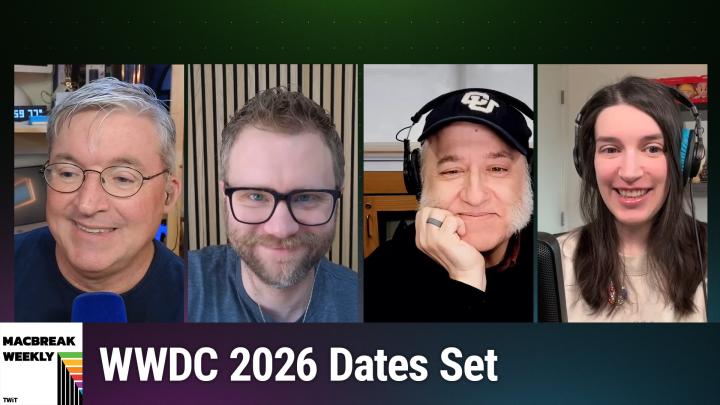
MacBreak Weekly 1017
Jason Snell [00:00:00]:
It's MacBreak Weekly. It's Jason Snell, your pal. I'm sitting in for Leo Laporte, who's not here, but we've got a great panel. We're gonna talk about WWDC. Apple announced the dates. It's happening in June. Will there be AI announcements? There better be. The MacBook Neo.
Jason Snell [00:00:14]:
Steven Hackett joins us. He's got two of them. He bought two. What are the colors? Why did he buy two? We'll find out. John Ternus got a lavish profile in Bloomberg. Is he Apple's next CEO? And what's that? What stuff did he like and hate in his job at Apple? Really interesting questions. And, uh, what's going on with Apple's home strategy anyway? I don't know. Maybe we'll find out this week on MacBreak Weekly.
Jason Snell [00:00:50]:
This is MacBreak Weekly, episode 1017. Recorded on Tuesday, March 24th, 2026: We Found a Google, and Put It In. It's time for MacBreak Weekly. I am your guest host, so often panelist, but today guest host, Jason Snell, sitting in for Leo, who is, I don't know, doing his taxes or something. He's busy, he's busy, but we got a great show for you anyway, talking about Apple stuff like we do every single week. We have familiar faces and filling in for Leo, who are filling in for me, who's filling in for Leo. I don't know how the line of succession works here, but let's introduce him now.
Jason Snell [00:01:27]:
Our guest, our special guest from 512 Pixels, from The Connected Podcast, from Relay FM, it is Stephen Hackett. Hi, Stephen, welcome.
Stephen Hackett [00:01:36]:
Hello, everybody. Thanks for having me on, Jason. I can see you. You're just right there.
Jason Snell [00:01:40]:
I'm right here.
Christina Warren [00:01:41]:
Weird.
Jason Snell [00:01:42]:
Yeah, no, we see each other a couple of times a year. It's not that weird. Don't— Yeah, thank you for having me.
Stephen Hackett [00:01:47]:
We are humans.
Jason Snell [00:01:47]:
It is good to have you here. Of course, Here, as always, Andy Ihnatko coming to you live from the library. Hello, Andy.
Andy Ihnatko [00:01:55]:
Hello. And I'm going to— as a fan of like all the podcasts that you and Steven do together, I'm looking forward to seeing like, will the vibe between you two be different when you have actual visual facial cues to go from?
Jason Snell [00:02:06]:
It's possible. It's possible. I do know some podcasts record video— don't record video, but they use it while they're talking, which I always think is cheating because then the listeners don't see the facial expressions, so they're missing an entire level of communication there. Also here, a regular and definitely has seniority over Stephen Hackett, it's Christina Warren. Hello.
Andy Ihnatko [00:02:27]:
Hello.
Christina Warren [00:02:28]:
I don't know about that. I don't know if I would go as far to say I have seniority over, over Stephen Hackett. We still got to figure out the succession thing, but, but happy to be here.
Jason Snell [00:02:35]:
It's just a guest. He's expendable if we need to. If we don't have enough oxygen to survive the rest of the show, do you have a red shirt?
Stephen Hackett [00:02:44]:
Yeah, why am I catching strays this early? We've been recording for 4 minutes.
Jason Snell [00:02:48]:
It's, it's, it's because we, uh, love you.
Andy Ihnatko [00:02:50]:
That's why you're a guest. You're a guest.
Jason Snell [00:02:52]:
It's—
Andy Ihnatko [00:02:53]:
yes, you fit, you fit, you fit right in, Stephen. That's, that's, that's— take that as a sign.
Jason Snell [00:02:57]:
So, uh, off the top, because I have follow-up from last week, I just want to say thanks to everybody who sent me a zillion emails and social media posts. Yes, indeed, I am a one-time Jeopardy! loser because I ran into a buzzsaw named Jamie Ding, who is on his way to the Tournament of Champions and has defeated, you know, as of this recording, all who have attempted to beat him. But I had a great time. And if you haven't seen it and you're in the U.S., you can watch it for the next— I think they stay up for about a week. So you've got a couple of days to catch up on Hulu or Peacock. You can scroll through the Jeopardy! archive and find March 19th episode, but I had a great time and all this time I've been promoting it. I knew what happens. Go ahead, Andy.
Andy Ihnatko [00:03:44]:
What were you saying? I was going to say it must be an honor to be part of that pile of bodies. Yeah, you know, I didn't appreciate like the scale of your— the magnitude of your challenge until like I was reading like, oh, okay.
Jason Snell [00:03:56]:
Yeah, he set records on Jeopardy! and we all knew that, right? It's like all this time I've been saying, oh yeah, I'm going to be on Jeopardy! I'm like, the closest I could come to spoiling it is I sort of told everybody, watch the whole week. Because it really goes places. And where it goes is that he comes in and sets a bunch of records and it properly frames our change. Like, by the time we got to Thursday, Jordan, who I played with, she and I were like, let's just have fun out there. It was really— and we actually played a real— I think we played a really good game and against a very tough opponent. And I actually had the higher buzzer percentage. I got in on more clues, more attempts than he did. But he knows everything.
Jason Snell [00:04:35]:
Jamie does. So that's tough because I I don't know anything about composers, which is why I failed at Final Jeopardy. The worst, the worst category for me is classical music. So that was, uh, pretty amazing. Anyway, it was very nice to hear from people who saw it. Um, and you always catch somebody who, who somehow, despite my barrage of Jeopardy promotion, did not know I was gonna be on Jeopardy and was surprised to see me there. That's always a treat. So thank you for everybody.
Andy Ihnatko [00:04:58]:
You're high, I imagine.
Jason Snell [00:04:59]:
But I, I'm not retiring from the show cuz I did not win $200,000 on Jeopardy. They paid me, Or they're going to pay me $2,000, which basically covers your hotel and airfare to go be on Jeopardy. But it was still a lot of fun. Now let's go to some real news. Um, in news that will kind of not surprise anybody, but it is actually important. Apple announced that, guess what everybody? Hold on, hold on tight. In June, they will be holding a developer conference.
Andy Ihnatko [00:05:28]:
It's true.
Jason Snell [00:05:29]:
WWDC 2026 has officially been slotted for June 8th, through the 12th. You know, like we, like we all expected, you never know. Apple sometimes, you know, zags when you think they're gonna zig, but you can put it on your calendar now. June 8th will be the big news-breaking keynote at WWDC.
Andy Ihnatko [00:05:48]:
Yeah. And, and this could be pretty, like I, I was, when I saw the announcement, I'm like, it suddenly occurred to me like how excited I am for this WWDC more than like so many others, mostly because of all the hard, not a, let's see them talk about, uh, Gemini-based, uh, AI. Also, all the hardware that's rumored for imminent release that would require some sort of developer support. So, hey, just for fun, developers, let's talk about what happens if you have a phone app and suddenly the window suddenly becomes much bigger than the phone. Or let's— what if a user would want to touch the screen of a MacBook? We can't announce anything, but let's just hype it.
Christina Warren [00:06:28]:
But what if? What if?
Andy Ihnatko [00:06:29]:
Yeah, exactly. We're spitballing here. We're, we're all fun, just having fun, you know, just around the campfire, around the fire pit, having to, having a White Claw, talking about things that we're absolutely not working on right now.
Jason Snell [00:06:40]:
Wow. That got, this got dark real fast. Um, it is, um, going to be interesting, right? I mean, again, they didn't say anything about it. There's a glowing logo. I saw people who are like Kremlinology-ing the glowing logo. It doesn't mean anything. It's just an art direction decision. There's generally not, not hardware that gets announced or not very much hardware that gets announced anyway.
Jason Snell [00:06:59]:
Somebody was trying to, sell me on the idea that it means they're going to bring the light-up logo back to laptops. And I'm like, they just released all their laptops. What would they— what? Yeah, it just doesn't make any sense. But, but to Andy's point, we are going to hear Apple's story for the next year. And there is this big— it's like reading like the third novel in a series. And the second novel kind of ended with a cliffhanger, or really the first novel ended with a cliffhanger that wasn't resolved in the second novel, which maybe was a prequel. We're going to get like, there's a lot loaded into WWDC '26 because of the AI question, right? That's one of the, the real mysteries here is what, what are they going to do to make good on those old, if they can, those old Apple intelligence promises? Yeah. Yeah.
Stephen Hackett [00:07:42]:
Because it's a hole that they dug themselves, right? Two years ago, hey, we're going to do all this stuff. It doesn't come. It doesn't come. Last year they sort of addressed it a little bit. But this year, like right in the press release, they say AI advancements. And so Hopefully they're going to be able to move on this stuff.
Andy Ihnatko [00:07:59]:
Because they can hardly retreat any more than they already have. So they're at fault.
Jason Snell [00:08:03]:
We're going to do this again for a while. You know, let's go.
Christina Warren [00:08:06]:
Well, and again, to your point, they dug this hole themselves. You know, they announced vaporware because that's what it was. And, you know, I think that like 2 years later, we could all like— everybody should at least be able to admit that like, no, none of that stuff existed. It wasn't real. And it will be interesting to see if they still try to have any of those ideas that they showed 2 years ago. I think they're just going to continue to kind of memory hole that and kind of be like, no, no, this is, this is what we're doing now. And this is great. And yeah, forget about that, that, you know, tech demo of, you know, Final Cut and motion graphics that we put together before.
Christina Warren [00:08:43]:
Pay no attention. This is, this is the real AI plan. But yeah, but they, they can't not mention AI, right? Like even in the press release, like you have to. This is like table stakes now. But it'll be interesting to see how they how they try to tell that story and thread that needle. And I think they're very, very fortunate that the hardware has been so unstoppable that it is able to overcome the deficits that the software has had, not just from, you know, the Apple intelligence failure thus far, but the, you know, some of our complaints on the OS side that, you know, I think that the momentum, especially with how good the hardware has been just in the first quarter of the year, is, is going to really, really, um, like I'm excited, like, like Andy is about what we'll see just because the hardware has been so unstoppable that you get excited just about the possibilities about what software, um, options will be just around that.
Jason Snell [00:09:36]:
We so rarely see Apple grapple with failure, right? Like even when they have failures, they can usually escape and, and like replace the failure with a, oh, well, we did a new thing that, that's great. And the, the, you know, the undertone is the old one, everybody hated it, but the new one is great. Um, like, oh, the touch bar, I don't know I don't know what you're talking about, but aren't function keys great? Or, you know, look at this neat keyboard.
Andy Ihnatko [00:09:59]:
What? Butterfly keyboard?
Jason Snell [00:10:00]:
That was the old keyboard.
Andy Ihnatko [00:10:01]:
And the next one's going to be even better.
Jason Snell [00:10:03]:
Even better. Exactly. This is one where they have to grapple with their failure, like straight up, straight up. They got to do it. And I, boy, they, they, they do. So they take so much pride in their marketing. And this is one of those cases where they will come out marketing it hard, but they also have to acknowledge. Where they, where they failed in the past.
Jason Snell [00:10:23]:
It's gonna be really interesting.
Andy Ihnatko [00:10:25]:
But will, but will they? That's, that's the, I mean, the messaging is gonna be interesting because they, I mean, I, I was joking earlier, but that is absolutely the approach they take. It's like they, the, the actual pre, the actual statement in the first draft of the talk is be, okay, the feedback on our new like 0.5mm depth keyboard was awful. So therefore we're addressing their concerns cuz we want people to like our product. They will phrase it like this is one of the greatest designs we've ever done and now we're making it even better than that. So I mean, they can, it is an unusual position because this is one of the few areas probably since like the Performa line of desktops where Apple can say this was an absolute failure. Our first attempt at Apple intelligence, they do, they might even actually win some hearts and minds by saying we are basically starting over with a clean slate. Don't necessarily, we've, we're, we're glad that we've put out some, some models that a lot of individual app developers are taking advantage of. That's been working great, but we have a plan and you're not gonna You're not gonna be sorry for being excited about what we're telling you this week because we acknowledge that we are doing a rebuilding of everything right now.
Andy Ihnatko [00:11:31]:
So how, I wonder how explicit they're going to be about, yeah, we're starting all over again.
Jason Snell [00:11:36]:
It'll be a soft touch, I think. Yeah. But the fact is they can't not, I mean, they will acknowledge it in some way. They're not gonna emphasize it, but they know what everybody is gonna be thinking is the challenge there. Right. It's, you can't escape the fact that they need to reframe. This is a complete reframing of what their AI strategy is. And, and, uh, and so, you know, I don't know.
Jason Snell [00:11:56]:
It seems to me to be a level above saying, well, isn't this a nice new keyboard? Or aren't those function keys great? It has to go further.
Christina Warren [00:12:03]:
Yeah. I mean, I think that the one thing that they have at their advantage a little bit, because I agree with you, I think it'll be a soft touch. I would love to see more of the transparency and be like, this isn't what we planned. We've had to, you know, take some reassessments and whatnot. I just don't think Apple's the type of company that will do that. But what they could do is they could comment on how much has changed in research and development. In AI in the last 2 years and say that this is the future and where things are now. And that's why this is what the next generation of Apple Intelligence is going to look like.
Christina Warren [00:12:33]:
That could be maybe one way of getting around it is just to take advantage of the fact that the research that the other frontier labs have been doing and the involvements in the consumer space that have been happening in the developer space too, but especially in the consumer space where they can say, this is going to be now our vision of what AI will be for the next X period of time.
Andy Ihnatko [00:12:56]:
Yeah, and this is unusual. I think it's kind of unusual for them because they're used to it. WWDC— obviously they're talking to developers every time they do a WWDC. Usually they're saying, this is how things are going to be. You can either get on the bus or get off the bus and stop developing for Mac and iOS. And we know— we think we know how that'll turn out for you. So this is how things are going to be. I think that this is gonna be the first time and first discussion they're gonna have had in a while where they have to say, please trust us, please come on board with this.
Andy Ihnatko [00:13:26]:
We know that we talked you into a lot of, maybe you made a lot of decisions 2 years ago thinking that we were going to come through with this and we failed to come through, but we hope to win you back and we hope to win you over as developers of Mac and iOS apps that build upon our foundation models because We know we have to win you now.
Jason Snell [00:13:47]:
Yeah. What do you think, Steven? One of the things we observed was Apple last year had this very much an attitude of like, we're not going to announce anything that we can't ship basically by the end of the year. Do you think that's going to continue to be their plan going forward is just not to get burned like they did in '24?
Stephen Hackett [00:14:06]:
Yeah, my guess is that this will be a lesson they remember for a long time. And I don't think they want to be in a position that they're in now. Not only could they not deliver what they promised. But it's actually a level worse than that for, from Apple's perspective, because now they're relying on Google for the foundation models and the underlying technology to build these, these features that they've promised, right? That's another situation Apple doesn't want to be in. So my guess is they're going to be conservative about what they, uh, what they promise. I think this is going to be a, um, they're aiming for the under-promise and over-deliver kind of scenario because, uh, they don't, they don't like being in this position. And I think it's one reason that, that, that keynote a couple years ago stands out so much, that they were showing things that, you know, oh, it's not that, oh, it's not quite ready yet. You'll get it in the, you know, in, in the late fall with the 0.1 updates.
Stephen Hackett [00:15:05]:
Like, this stuff didn't exist. It didn't work.
Leo Laporte [00:15:09]:
Yeah.
Stephen Hackett [00:15:10]:
That's a big difference. I don't think they're going to go down that road again.
Andy Ihnatko [00:15:14]:
Yeah, like Christina said, it was— I think it took a lot of people by surprise. That I know, I know that like you, uh, you shouldn't be— you shouldn't, you shouldn't just simply trust everything that even Apple says. However, I think that they built up a— they built up a trust with developers and users that, okay, if they're showing this off, I'm sure it's nowhere near ready to ship, but they probably threw something together that would actually work. Kind of like the first demo of the iPhone where it's like this thing is fragile as hell, but it is doing what Steve Jobs seems to be doing with it, even though he's, he's doing a demo on Rails because again, this is gonna crash at any moment. I don't think anybody expected that. No, this was essentially a fantasy film that they showed, right, everybody. So they gotta crawl back from that too.
Jason Snell [00:15:58]:
Yeah, you, you can see in hindsight what I keep thinking of when I think of WWDC 24 is how desperate Apple was to say the, you know, say that they had an AI answer because that was that moment where everybody else was talking about AI and Apple had gotten caught flat-footed. And so they were desperate to show that they got it. And it did. Like, it worked in terms of like the market and stuff where everybody's like, oh good, what a relief, Apple's got it. But the problem is they were not only desperate, but they had convinced themselves that it was going to be a lot easier than it was. Bad combination.
Christina Warren [00:16:37]:
That was the thing that stuck me at WWDC24. And I kept asking myself at the time, because I was there, and I was at a group watching party for the keynote. And I went to see the talk show live. And I was talking with people and trying to get a sense of people's excitement. And because of my space and what I do professionally, none of it made sense. And I kept kind of like asking myself, I was like, okay, am I just a hater? Like, am I just like, am I wrong? But like, I couldn't get past it. I was like, no, this doesn't check out. The things that are being said are not accurate to the state of the industry right now.
Christina Warren [00:17:15]:
And I don't believe this. This isn't coming across as likelihood. But because, you know, they have so many decades of goodwill built up, even me, somebody who, and I was, you know, with someone who used to work at Apple and we were like texting back and forth and it's another, AI person, and we were texting back and forth about, this doesn't make sense. None of this is adding up. We were even like, well, maybe they've just done something that no one else has. And really literally coming out of like, I was trying to gaslight myself into not seeing what was very clear in front of my face and what became clear as it went further and further on. And I think to your point, Jason, that's exactly it. Like, they convinced themselves that they could, that they had this.
Christina Warren [00:17:57]:
And they didn't. And I think that that's going to have to be the real lesson. I think developer trust— I think developers know that you have to buy in or not, that Apple is not going to grovel for you. But I do feel like there will be— it'll be definitely, I think, between this and Vision Pro, it will be harder for people to make big financial investments without any sort of assurances that something's going to pan out. But if they can come out with some good API and SDK integrations with the Gemini stuff, if they can have some really good ways of being able to bring these sorts of functionalities and customize things to their tooling. People will get over that. I think this is just more of a, like, for the analysts and the watchers who are going to be like, okay, yeah, well, fool me once, now I'm going to, for a while, question in a way that I might not have before.
Andy Ihnatko [00:18:53]:
Yeah. And that's interesting. You bring up something that's kind of interesting too, that Historic— whenever Apple's talked about his partnership with Google, they have really—
Jason Snell [00:19:01]:
you—
Andy Ihnatko [00:19:02]:
the language was terse. Yeah, it's clearly negotiated and agreed upon by both parties, and Apple's position seemed to be to try to identify Google as one of hundreds and hundreds of subcontractors that Google— that Apple hires for all kinds of insignificant things that they would rather not deal with, as opposed to, we do— we had bacon that need to be saved We Googled for who can save our bacon. Number one response was Google. And we made a deal. I mean, they're certainly gonna mention it because that is part of the, it helps their story to say that, no, we are not relying on a half-baked model that we were not able to ship. We are actually relying on one of the premier shops that makes in artificial intelligence. But it's gonna be interesting to see how much they want people to know about it versus how much they want people to forget that they relied on Google to give them the engines that they need to power the ship.
Jason Snell [00:19:58]:
I can see how you approach this from a marketing position and actually from a product position. The issue is going to be execution more than anything else because I think there's a perfectly strong argument to be made that they say, look, we took world-class models off the shelf. With our partnership with Google. So it's, don't worry about that. These are powered by great models. Don't worry about that. But then they need to integrate it, right? And I think that that's always been the secret sauce here is like just tossing an AI model into iOS is, I mean, there are apps that do that now, right? Like it's not that big a deal, but like the, what they were trying to get across with those demos in 2024 was the Apple level of kind of fit and finish of abstracting AI and using it to power features that people actually want. And that's where you actually, that's where Apple has to execute.
Jason Snell [00:20:47]:
They can't just say, we found a Google and put it in and now it's good. You have to actually say the rest of it, which is, no, we made features you'll want to use that are powered by AI. And that they can't just say, look over there, it's Google. They've gotta actually deliver.
Andy Ihnatko [00:21:03]:
Yeah.
Jason Snell [00:21:03]:
Yeah.
Andy Ihnatko [00:21:04]:
Speaking of that though, of features that you wanna use in the last 6 months, I mean, Open Claw is being attributed to massive sales of Mac Minis, not that they're going to like announce, hey, we're doing our own version of OpenCLUB, but do you think that that's going to encourage them to sell macOS and sell Mac hardware as, by the way, this is a wonderful platform for agentic AI. Here are some ideas we have about how we're gonna support it with our own models.
Stephen Hackett [00:21:31]:
I mean, they did a little bit of that with the Mac Studio, the last Mac Studio update where there are features where you can use Thunderbolt and build a little cluster of Mac Studios. And run AI models split across the systems. And I think that kind of quietly Mac hardware, because of that unified memory model, has proven to be pretty good for local AI tasks. And Andy, I think you're right. I do think there is room for them to lean into that, even if it's not their own models of like, look, our hardware is really great at all of these sorts of, of things. And if you're an AI researcher, or you're a developer working on AI, local AI, why would you not go get a Mac Mini or a Mac Studio or something and, and run it on that? I mean, it really seems like there's opportunity there for them to, to stand out a bit from their competitors.
Jason Snell [00:22:21]:
And if there's anything in the OS that's standing in the way, this would be important for them to pay attention to. If, if they look at what people are doing with agents like Open Claw on macOS, And they say to Apple, you know, the thing about macOS that gets in our way is X. If they say we're going to fix X for those people so that this new macOS 27 is way better for people who are experimenting with genetic AI, like that's what you want. You don't want Apple to be like, we're going to do our own little claw, but it's going to not do anything. You want it to be like, we will grease the skids for the people who are out there on the, cutting edge so that the Mac continues to be awesome for them. That's what you want.
Andy Ihnatko [00:23:02]:
Yeah.
Stephen Hackett [00:23:02]:
Yeah.
Christina Warren [00:23:03]:
And I think too, I mean, like what— but I also kind of expect them to, to say in terms of some of the Gemini stuff, and I think this would also help with their overall Mac story in terms of how you can use it for kind of customizing your own AI stuff, is that, yeah, they're going to be using Gemini under the hood. I expect there to be a lot of differentiation about why the Apple models are not going to be the same as the Gemini models that you would get if you were going through Google directly. And I'm sure that they won't be. I'm sure that they're going to be doing a ton of post-training and customizations on top of that. And they might even be, you know, talking about how they were able to use their own hardware to do that post-training to really customize things. And if you could make that argument, I think that from a developer, from a higher-end, like, AI engineer, you know, kind of perspective, as more and more businesses are going to be seeking out customizing some of their own models, especially as, like, the prices from, like, the frontier labs get really, really high, that becomes a really compelling story for using Mac Studios or Mac Minis in clusters because now you're saying, okay, I can spend a certain amount of money on hardware, I can do the post-training on top of these maybe open weight models and then have something that's really, really good. And that's only a thing that I can do with the sort of ease and flow in the Apple ecosystem, which would be much more difficult and in some ways more expensive uh, if I'm using Linux or Windows, just because of our unified memory architecture.
Jason Snell [00:24:28]:
Well, let the countdown begin. 11 weeks until WWDC. So there's time, there's time. We'll talk about this more, I am sure, in the, in the intervening 10 weeks.
Andy Ihnatko [00:24:37]:
Can I bring up one last thing?
Jason Snell [00:24:39]:
Yes, yes, please go ahead.
Andy Ihnatko [00:24:40]:
I'm interested in people's opinions. Uh, I think that Apple realized, knew that the, that the MacBook Neo was going to be successful, because how could it not be at that price point? I'm wondering if the monster success of it, not only in terms of people wanting to buy it like anything, but also being reviewed incredibly well about how well it actually does, is, are we gonna see any type of a faint or any type of a hint in the lectures, the events that happen like 2 or 3 days later that we only find out about 2 weeks later, that Apple's kind of understanding that We are now really absolutely going to have M-series Macs and A-series Macs. And although the, the A-series Macs are not gonna be underperformant, they're not gonna have the same performance profile as the M-series. And therefore developers, we're gonna give you some tools so that you are basically, if you, if you want to optimize for a lesser processor, we are gonna give you the tools to do so. I'm really keen to see if Apple's gonna put anything like that under the hood of macOS.
Jason Snell [00:25:44]:
That sounds to me like a, um, maybe you'll get a session video that's like optimizing for different processor types or something like that, where they talk about like, what if, you know, you may be running on an A processor or you may be running on one of these M5s that's got the super cores and the, you know, performance cores. And like, how do you— that's probably how they would do it. I wouldn't be surprised though if there's a session like that that's just like, Well, there's lots of different Apple Silicon running macOS. How do we deal with it? And that they'll, they'll, they'll do it that way. Um, I do want to talk more about the MacBook Neo and we will do that. But first, uh, I, I love it when this happens. Leo is going to parachute in. If you've forgotten Leo, well, don't forget he's still here and he's going to tell you about our first sponsor.
Jason Snell [00:26:30]:
Leo.
Leo Laporte [00:26:32]:
This episode of MacBreak Weekly is brought to you by CacheFly.
For over 20 years, CacheFly has held a track record for high-performing, ultra-reliable content delivery - serving over 5,000 companies in over 80 countries. At TWiT.tv we've been using CacheFly for over a decade, and we love their lag-free video loading, hyper-fast downloads, and friction-free site interactions.
CacheFly: The only CDN built for throughput! Ultra-low latency Video Streaming delivers video to over a million concurrent users. Lightning Fast Gaming delivers downloads faster, with zero lag, glitches, or outages. Mobile Content Optimization offers automatic and simple image optimization so your site loads faster on any device. Flexible, month-to-month billing for as long as needed, and discounts for fixed terms. Design your contract when you switch to CacheFly.
CacheFly delivers rich-media content up to 158% faster than other major CDNs and allows you to shield your site content in their cloud, ensuring a 100% cache hit ratio.
And, with CacheFly's Elite Managed Packages, you'll get the VIP treatment. Your dedicated Account Manager will be with you from day one, ensuring a smooth implementation and reliable 24/7 support when you need it.
Learn how you can get your first month free at cachefly.com/twit. That's C-A-C-H-E-F-L-Y dot com slash twit.
Jason Snell [00:28:33]:
Thank you, Leo. Uh, weird to do your taxes at the RSA convention. I don't know, Leo's an unconventional guy.
Stephen Hackett [00:28:39]:
He does stuff like that.
Jason Snell [00:28:39]:
It's like, you know, it'll be secure or somebody will break in. I don't know. Let's talk about the MacBook Neo. Now, obviously we've been talking about it for weeks now, uh, for years now. If we go back to the, the, all of those early rumors from the supply chain, we do have, uh, what I like to think of as a very Apple-y, um, Also, John Gruber and I always call these like the Jeff Bezos charts that where there's no numbers, it's just like line goes up. It's great. Uh, on, on X, Tim Cook said Mac has just had its best launch week ever for first-time Mac customers. We love seeing the enthusiasm.
Jason Snell [00:29:16]:
The strong implication here is that this, that they are doing some sort of measurement, which they generally do saying, is this your first Mac? Are you new to Mac? And the strong implication here is that it's MacBook Neo, or at least it's sales-driven in, in part or in whole by MacBook Neo existing to bring in more first-time Mac customers. I, I think this was a statement that they wanted to make and that they were measuring in order to get some data so they could say it. But I also believe that it's true. I, I think all of us think that they, they're gonna make inroads with people who've never really bought a Mac before with a the, the MacBook Neo. And so here we go with Tim Cook's first sort of like shot across the bow saying, yes, best launch week ever for first-time Mac customers.
Andy Ihnatko [00:30:03]:
Yeah. And it probably also helps that they're to message that, hey, analysts, we are not stealing— we are not steering MacBook Air and MacBook Pro customers away from those expensive SKUs and towards those new cheap ones. We are actually bringing in lots and lots of brand new people that we we would not have sold to otherwise.
Stephen Hackett [00:30:21]:
Yeah, yeah, that, that's the, the bet with this machine, right? Because if you, if you make this thing and all the MacBook Air customers are no longer MacBook Air customers, and you've hurt the business. But I think you're exactly right. This is at the price point and the feature set, this is a machine that someone is going to come, you know, maybe they've had an iPhone, now they want a computer where they get their iMessages. Like, oh well, this thing is Not only is it great looking and come in a bunch of fun colors, but I'm a student and it's $500. Like it's absolutely drawing new people to the platform. And I think Apple has seen that as a possibility for a long time. And the technology has now let them make something that can really reach those people, uh, for the first time for a lot of them.
Jason Snell [00:31:09]:
Yeah. I also. I mean, this is just my theory here, but first-time Mac customers, some percentage of that may indeed be people who are lured in by the MacBook Neo and the $599 price and end up buying a MacBook Air. I, I wouldn't put it past them. I, I think the good, better, best marketing will work with some people too, where it's like you got to get considered. And so they consider buying a Mac laptop and they're like, oh, but maybe, maybe we'll put out the money for this, this one too. I will, we'll, there's, this is going to be something we're going to have to follow for quite a while now, but it is an exciting angle to see how Apple, um, is going to make inroads with these, uh, buyers of, you know, mostly just sort of like low-cost PCs who might finally consider— who probably have an iPhone, right? But might finally consider buying a Mac to go with it.
Christina Warren [00:32:01]:
Well, that's the big thing, right? Is that they might finally consider a Mac or a new Mac, right? Like you might have people who have 10-year-old MacBook Airs. Or who have, you know, older like Intel MacBook Pros and that they've been kind of, you know, hobbling along on but have not been in a position to be able to upgrade to a newer Air even though you could get them at Walmart. And even though, you know, there are— there have been specials and things that have been available, those things are for savvier buyers and for people who pay more attention. Whereas this has got a marketing campaign and fun colors and you can go into the store and for $500 you can get it and You know, it's, um, uh, there are things that, uh, you know, like give me pause just in terms of longevity, but I still would never not tell someone to buy this. If this is your amount of money that you say, I have $500 to spend on a laptop, this is the laptop I think that, that, um, I, I would almost universally recommend to someone. And that's going to be interesting because yeah, you might have people who have some experience with macOS, but they're not macOS diehards. They might be coming off of Chromebooks. They might coming up with Windows machines.
Christina Warren [00:33:01]:
And that's exciting. I also, I do wonder, you know, how down the line, like, how do you kind of keep that audience in the ecosystem? And I think that that is, we'll probably see even more of them trying to really kind of push the synergies across the platform so that, okay, now that you've gotten a taste, you're not going to give this up for, you're not going to switch back.
Andy Ihnatko [00:33:25]:
Yeah, I can't wait until independent analysts like Counterpoint and the rest of them can watch this data for a year and give us some insights into who's buying these. Because I think we all knew that $599 MacBook in all kinds of cool colors, it's going to be a consumer hit. No real worry about that. It's going to be cool to see, does Apple succeed in fleet purchases of this? Because the Windows side and the Chromebook side has— it's— I mean, the Mac is— I wouldn't— I don't know what I want to call irrelevant, but it's like they— Windows and Chromebooks offer so many advantages to people who need to buy a couple hundred for schools or a couple hundred for business, mostly because of management and repairability and all this other sort of stuff. I wonder if how many— I wonder if they're going to succeed and people, you know what, let's at least get a bid to see how much it would cost to switch this department over to Macs. Let's see if it's feasible from an IT perspective to support 200 or 300 MacBooks, whereas before before, we used to love Chromebooks because it's not just a cheap, fairly well-made, fairly well, uh, well, uh, very fairly easy to repair device. The administration tools of bulk of administrating these things is also absolutely tailored to our, to our, to our needs. So it's, it's— I mean, that would be the win on top of the win if suddenly Apple can be a force again in fleet purchases.
Jason Snell [00:34:52]:
I'm sure they'll have a story about it at the next, uh, yeah, quarterly. They'll be like, oh, turning to enterprise, we sold— oh, does this school— this one school bought 500 MacBook Neos. And you'll say, okay, but like, Tim, we'd like— is that the only one?
Andy Ihnatko [00:35:06]:
We'd like some color on demographic.
Christina Warren [00:35:09]:
Exactly.
Andy Ihnatko [00:35:10]:
Yeah, yeah.
Jason Snell [00:35:11]:
And that's harder. That's, that's going to take—
Andy Ihnatko [00:35:12]:
what are the levers that you see in the head?
Jason Snell [00:35:14]:
Yeah, verification. Now, staying on MacBook Neo for a minute, I just wanted— Stephen Hackett is here, uh, he bought 2 MacBook Neos for his house. How's that? How's it going, Steven?
Stephen Hackett [00:35:26]:
How is your—
Jason Snell [00:35:27]:
how's MacBook Neo life?
Stephen Hackett [00:35:28]:
It's great. I've got the Indigo here with me, which I think is the best color. Um, it's a fantastic computer. So I bought one for myself for a secondary Mac where when I'm not at work, um, and bought a second one for, uh, one of my kids who is getting ready to enter middle school and is going to need a computer at home for school stuff. And the price made it really easy to, to, to pick up two of these at once. Um, and, you know, having used it a lot now for, you know, personal computer stuff, not work computer stuff, it's absolutely fantastic. Um, you know, there's YouTube and YouTubers and writers like editing video on it. And like, it's awesome that it can do all that stuff.
Stephen Hackett [00:36:10]:
And it's, it's very impressive, but even just like the day-to-day stuff, right? The photos, the email, the browsing, social media stuff. Like, it, it is absolutely incredible. I think if you had been, you know, out in the woods for the last 5 years and you came back to civilization and the first thing someone does is hand you this laptop, um, which would be a weird way to re-enter civilization, but stick with me.
Jason Snell [00:36:36]:
You've got friends.
Stephen Hackett [00:36:37]:
Well, they said, they said this is the MacBook Air. You'd be like, yeah, great, I love it, you know, because it is it's hard to believe that it costs as little as it costs. It's built so well, it's designed so well, and it absolutely can run macOS without breaking a sweat. So I've fallen in love with this little laptop, and I really look forward to seeing what Apple does, not only with this line, but with this concept. Are there other things they can do, other products they can tweak and make them more affordable for people? I think that's very exciting to think about that future.
Andy Ihnatko [00:37:12]:
Yeah, $299 Mac Mini, that would be—
Christina Warren [00:37:15]:
oh yeah, cool. I mean, that would be—
Andy Ihnatko [00:37:18]:
I've always said that what my dream product— I've been saying this for years— my dream product would be take the same tooling and case of an Apple TV and basically even if you had to— I mean, they wouldn't do this, but like even if you could, even if you had to restrict it to just App Store purchases, if you wanted to streamline this, make sure that it was a make sure that it could generate revenue absolutely everywhere you can generate revenue from. If, if that's what it would take to make a $299 Apple TV that I would, that would have connected to a lot of TVs in my house instead of like a dongle, that would be the, the opportunities of putting Macs in places and having to do things that you might buy like a cheap Intel box to do. Uh, it's an— I'm sure an A-series processor would be fine for running like a Plex server so long as As long as you're not transcoding or anything like that, I would love to see that happen. Yeah, I'm sorry, but it is fun. Like, I mean, you mentioned like YouTubers and stuff like that. It's fun to see them. Now we're in the process of the first wave of talk is over, and now you kind of need to get attention. And so you're seeing people do things like, well, let's, let's put up 60 windows and tabs and do that next to a $600 Windows laptop.
Andy Ihnatko [00:38:28]:
Hey, look, the Windows laptop actually shut down when whereas the Neo is not doing great, but it is at least doing it. The most interesting things— and this is— I wish I had an engineering background. A lot of like the more hardware-oriented channels are saying it's kind of weird that there's this gap between the CPU and the aluminum case. What would happen if we were to put a thermal pad between the two and turn the case into a heatsink? And there, again, I'm only repeating like what, what they are saying. I have no way of evaluating this. They're reporting that actually it's throttling a lot less. It's about 10%, maybe 10% more performance, and it's not as though the case is getting substantially hotter. I mean, there has to be— I'm sure there's a reason why Apple decided to do it.
Andy Ihnatko [00:39:15]:
I think they've always been conservative when it comes to like thermals for reasons of— there's a reason why a laptop or a phone does not die after 3 or 4 years for absolutely no reason. Sometimes because It has been throttling a lot and doing a lot of micro damage you don't know anything about. But it's interesting that it's even hackable in that kind of sense.
Jason Snell [00:39:33]:
Or my kid, my kid's laptop burned their skin because it got too hot down there. He's like, well, maybe not. Maybe it's good enough.
Stephen Hackett [00:39:41]:
That's not going to help your fleet sales to schools if that's the case. If that's the case. One thing I really do hope and look forward to seeing is like, I hope Apple does rev this thing every year. I mean, this is the worst MacBook Neo we'll ever have, right?
Christina Warren [00:39:56]:
I hope so. I hope so.
Stephen Hackett [00:39:57]:
If the, if the A19 Pro comes and it's got more memory and maybe both USB ports are 3.0 speed, whatever. Um, but I do think there's also an opportunity here to use color as, as a feature, right? If we think of the reason so many of us love this computer, I think is because it reminds us of things like like that first iBook or the iPod Nano, which got new colors every year for like 6 or 7 years. Like, I would love to see this thing come out with an updated processor and new colors a year from now. Not because this one isn't good, it's great, but Apple— I want Apple to be committed to this, um, just like we've seen with the iPhone 16e and 17e, right? It's not like the old iPhone SE that just languished for years. It's like, well, when is, when is there going to be another one? Like, literally nobody knows. Um, when they, when they put 16 in the name of the 16E, it felt like, okay, there's going to be a 17E. And I hope that that's going to be the playbook they follow with the Neo, because this is a really important computer for Apple and they need to stay on top of it and keep it refreshed, keep it new, and, and keep improving it.
Jason Snell [00:41:12]:
I think Apple has this— is going for the model year thing now. And I think one of the reasons is just because it ends up coming down to the cycle of the parts. Like instead of waiting around for a chip from your chip provider, like they're making a new chip every year for the iPhone regardless. And if they're making a new chip for the iPhone every year and the MacBook Neo uses a chip from the iPhone, feels to me like they're going to make a MacBook Neo every year, like that, that they're going to have the chips. And why wouldn't they do that? And, and I think that makes everybody feel better about any product if it's got the company's attention and is always moving forward. I think that's like a good sign that they care about this product. They're going to constantly be making it better year after year.
Andy Ihnatko [00:41:54]:
You think though that they're going to stick with, uh, we've got the, we've got the CPU that we've, we've got the SoC we built for the iPhone and now we put it into a Mac. You think that as the Neo becomes more impressive, they're going to say, yeah, it's an A20, but it's the A20N. Because we wanted to put more, we wanted to put more I/O in it. We wanted to make sure it doesn't look quite so, from an architectural level, it's not quite so bodged as a, to bodge on all the needs you have for a laptop. It's the success point paints an interesting rosy picture of opportunities that Apple might not have pursued if it were just simply, hey, sold really well, great, it was worth doing.
Jason Snell [00:42:32]:
I mean, I wouldn't be surprised if there are secret chip things that happen. As, and that have already maybe even happened where Apple's like, let's put this in here and it won't be on for the iPhone, but that means we can use that for the MacBook Neo down the road if it doesn't cost too much.
Andy Ihnatko [00:42:45]:
Disable it.
Jason Snell [00:42:46]:
Just like, just like think about like, oh, this is, this, this will allow this chip to serve these extra products if we do this thing, whatever it is, even if they, they like release the iPhone, never say anything about it. Nobody knows that it's there. And then a year later they use that same chip somewhere else and they're like, oh yeah, it does have. 2 USB 3 ports now, even though the iPhone certainly didn't.
Andy Ihnatko [00:43:08]:
Kind of like the modem chips that say, wow, there's actually an FM receiver in this chip that is not being activated or served by any software because that just simply was part of the package. Isn't that interesting?
Stephen Hackett [00:43:19]:
Yeah.
Jason Snell [00:43:19]:
Hmm. Interesting. Interesting. Well, Steven, thank you for the report. I like the Indigo. I think it looks really good.
Christina Warren [00:43:25]:
It does look great.
Jason Snell [00:43:26]:
It's, it is, um, it's not midnight, right? It's lighter. It's, I think it actually looks blue. Yeah. When I saw it in the, um, well, it depends on the light, right? It all depends on the light. But when I saw it in New York, I thought to myself, it's like, so it's like somebody took the Midnight and went tick, tick, tick, and like just brightened it up. So it's like in the family, it does, it is a darker MacBook, but it's very much more blue. It really dark blue.
Stephen Hackett [00:43:52]:
It makes the sky blue MacBook Air, which is my wife's computer, just looks so sad. They were next to each other on the dining room table the other evening. And I was like, I told her, I was like, you know, Apple calls both, like Apple considers both of these computers blue. And when she bought that MacBook Air, she picked sky blue thinking, I think that it was going to be like this. And of course it's a silver MacBook Air where like one molecule of blue paint just floated by in the wind. Um, I think the vibrancy is, is a lot of fun.
Jason Snell [00:44:23]:
If you hold it at the right angle so that the blue of the sky bounces off the sky of the MacBook Air. Yeah. Seem blue.
Christina Warren [00:44:31]:
Yeah, exactly, then it looks blue otherwise. Yeah, no, it's interesting to see as more videos have come up and like see more photography, um, I still like the blush color is probably what I would wind up buying just because of my love.
Jason Snell [00:44:43]:
Come on, Christina, we all knew that.
Christina Warren [00:44:45]:
But no, but I was gonna say though is that I'm actually like, I— when I look at them like just objectively, I'm like, I actually think that the, the blue looks the best because I think it's the one that has strongest color profile. Um, the, the yellow, uh, greenish, like that, that's obviously you're gonna know that's a new one.
Jason Snell [00:45:01]:
Stands out.
Christina Warren [00:45:02]:
It does stand out. I don't, I don't think I love the color hue they picked for it, to be honest with you. Like, I wish they'd gone like what they did with the orange iPhone, uh, this year. Um, but, but it feels like the only one they actually did do the kind of like the— they went full in and was like, okay, this is the color that you're never going to confuse this for, for silver, was, was the blue.
Jason Snell [00:45:20]:
Yeah.
Christina Warren [00:45:21]:
Um, I mean, the yellow, I guess, too, but that could have kind of a goldish hue. But like, but the this, this blue, like, it's not like their other attempts in MacBook colors where it's like, okay, in the right light, this is going to look the same as the silver ones. You're like, nope, this is, this has got a real pop of color, which is nice.
Andy Ihnatko [00:45:34]:
Is the Indigo fingerprinty?
Stephen Hackett [00:45:38]:
It hides them pretty well. I remember the first Midnight MacBook Air, they were like, oh, we have this new coating, and it's like, well, it kind of worked, right? Um, it seems to do a pretty good job. Um, and I think the keyboard is way less fingerprinty than like the black keyboard on the MacBook Air and Pro, 'cause they do that sort of color-matched keyboard thing. So yeah, I've been very happy with it. I don't pick it up and think, oh gross, like this is all nasty.
Andy Ihnatko [00:46:07]:
I haven't had barbecue in 3 days, what's up?
Jason Snell [00:46:10]:
I love that. It is definitely my favorite keyboard of the 4 Neos, 'cause it's that BlackBerry ice cream kind of vibe where it's a white keyboard, but it's not, 'cause it's got that kind of blue hue going on. It's pretty cool. That's pretty cool. I've got mine here and I gotta say, I keep trying to find reasons to use it because it's so much fun to have it.
Andy Ihnatko [00:46:33]:
The throwing gun.
Jason Snell [00:46:35]:
Right? Like it's just fun. Well, I mean, I've got so many other devices that I can use that are better fits for me than this is. And yet I sit here and I'm like, But, but maybe anyway, maybe I should just do it anyway. Uh, just, just to spend more time with it, even though it's the wrong tool for my particular job, just because it's so kind of charismatic and fun. And, uh, it's nice to have new Macs. I think we said this a couple of weeks ago. The Mac, there was a period in the late 2010s when it felt like the Mac was just on life support. Like Apple was just going to let it kind of fade away as they built up the iPad and all of that.
Jason Snell [00:47:10]:
And like in the Apple Silicon era, we've gotten two new entirely new named Mac lines, the Mac Studio and the MacBook Neo. And it's like, who would've imagined in the depths of 2017?
Andy Ihnatko [00:47:23]:
You know what I was thinking? I was thinking about that the other day, partly because I was cleaning out like the cabinet that has all my, all the laptops that need to be weeded out and came across the ThinkPad that I bought, the ThinkPad I bought. Technically, I was telling myself the reason why I bought this ThinkPad like 5, whatever, 5, 10 years ago was because, okay, I need them, I need a Windows 10 device so that when I write about stuff that's Windows 10, it has— part of it, however, was I am also auditioning it as a possible next laptop if MacBooks continue to stink and if the macOS continues to decline. Is this something that I could live with as a day-to-day driver? Not as my— maybe not as my desktop desktop, but as the laptop I carry with me. And it's still— you know what, I will say that it's the— these like mid-range ThinkPads are still like my favorite hardware by far. Better than— I like them more than I like the MacBook in general. However, I don't like them so much that I would consider switching. And now, thank God, I don't actually have to even consider doing so because, as you said, we are no longer wandering through the desert. We have reached the, the land that was, well, not promised to us, but at least we hoped that Apple had not forgotten it existed.
Christina Warren [00:48:36]:
I do wonder what this means for the iPad a little bit because it almost feels like we're kind of in an inverse spot, right? Where a decade ago, Apple was very clearly— they had the terrible "What's a computer?" ad, and they were pushing the other stuff, which has aged so poorly. And now, look, I have an iPad. I just recently bought a new iPad Pro M5, which I didn't need to do, but I I was having some issues with my battery life on my M2 iPad Pro, and so I just took the trade-in so I could do it. But, you know, there are very valid reasons to use an iPad, but I look at something like the iPad Air, for example, and I wonder right now, you know, if you're somebody who just does basic tablet-y things, but you sometimes want to use a computer to type on and have a keyboard experience, like, would you be better served with like a regular iPad? And a MacBook Neo than buying an iPad Air and the Magic Keyboard and all that stuff, you know, which can then get you into like the $1,000 range, right? Because if you're going to spend about the same amount of money and you could probably spend a little bit less doing the two products, it's kind of interesting that we're kind of in that, in this spot where I feel like, okay, the high-end iPad Pro users, which to be clear, I'm not one, it's just what I'm used to at this point. And so that's kind of where I'm at is, is I feel like because the, um, it's almost the inverse. It's like the, you know, what we've talked about for years, kind of the issues with with iPadOS continuing to kind of show up and kind of get in the way when you want to do something that goes a little bit beyond that. Like if you just wanted like a couch computer, I feel like the MacBook Neo is perfect for that. And if I were trying to— if somebody was asking for advice on something, oh, should I buy this or that, my primary thing would be like, OK, well, what are you actually going to be doing? Because if you're going to be watching mostly video content, then yeah, an iPad is obviously going to be your best thing, playing some games.
Christina Warren [00:50:24]:
But if you really do feel like, I'm going to be spending money to buy a keyboard attachment, it does kind of, I think, open up this interesting question, which I certainly didn't expect us to see a decade ago, which is this like, actually, now that we have this low-cost MacBook and we know we can do the full thing, that for a lot of people, if that's really the type of computing you want to do, might be better than trying to shoehorn the iPad or the iPad Air into that.
Andy Ihnatko [00:50:48]:
I agree 100%. I, I used to think it was a very acceptable— when, when I or anybody else asked, geez, why doesn't Apple make an affordable laptop, it's an acceptable answer to say, well, they have an affordable device like that. It's called the iPad. It's called the iPad, and you can get it for as little as $329. And even if you add in the cost of a Bluetooth keyboard and a mouse to kite it up to $400, $450, it is 100% competitive with anything you would buy in the Windows space for under $500. However, you're absolutely right, Christine. It's like there's— there are— it's not as though the iPad is no longer an important product, but it no longer fills such a crucial role, uh, because we used to— I mean, part of the, part of the difficulties I think all of us who are industry observers and commentators and journalists and whatever are that is that the, the Neo covers a market that we're not necessarily instinctively aligned with, meaning that I really don't care about having a powerful laptop for anything. I just need a keyboard, a screen, apps, access to like a modern web browser, and access to 6, no more than 9 apps, none of which are terribly powerful.
Andy Ihnatko [00:51:58]:
So as a result, when you see— when, when it's our job to see, well, what are the limits of this device, oftentimes we end up writing about scenarios that are completely or almost completely irrelevant to the people that this was made for. So this is, again, this is what's You know what, we've— this is— this product is now a few weeks old, and we've spent like an hour talking about it because it continues to be fascinating. This is on the same level as the first Macintosh, the first Apple II, the first iPod, the first iPhone. This is like a foundational moment in Apple's hardware history, and I think that we're going to continue to be talking about it for a long, long time.
Jason Snell [00:52:34]:
Bit of a game changer, potentially. Yeah, very interesting. You are listening and/or watching MacBreak Weekly. I'm Jason Snell sitting in for Leo. We have Andy Enrico and Christina Warren as always. Stephen Hackett is joining us as well. We were talking about the iPod or the iPad. Oh, we are talking about the iPod too.
Jason Snell [00:52:55]:
Actually, we've, we've, we've gone back and forth on different Apple products. I feel like when Stephen is on, uh, history stuff comes up. I wanted to mention something about the iPad though. And I'm an iPad guy. Like, my couch computer is an iPad, and, and I do have a keyboard for it that I attach when I need a keyboard, but I mostly don't. Almost none of the time I do that. And I love not having a laptop when I'm sitting on the couch now and just having the iPad. But, you know, different strokes for different folks.
Jason Snell [00:53:22]:
I did want to point out that Mark Gurman at Bloomberg wrote a profile of John Ternus, who's Apple's head of hardware, who might be the next CEO, and that Gurman has been reporting that for a while. It's an interesting story. It's a lot of stuff we've seen before. Um, I wouldn't say it's the most, you know, exciting. It's sort of like shows his org chart and stuff, but there were a couple details in there that I thought were very interesting. One of which is that Gurman gives Jon Ternus credit for being one of the real drivers on a bunch of professional-level iPad features, which does make me wonder if perhaps he gets the iPad use case at that level and is a fan of it. He, it also mentions, and this is a peculiar part of this story, says as the hardware chief, he was also in charge of the butterfly keyboard and the touch bar. And then the next paragraph is, which were pushed by the industrial design group.
Jason Snell [00:54:15]:
And they're the ones who should be drummed out for this, which I thought was really interesting. I'm like, no, no, no, no, don't blame him. And the fact is, you know, we don't know who gets gets the credit and who gets the blame. But I think it's interesting that the Gurman is trying to dig into sort of like, who is Jon Ternus? What does he care about? And, you know, what, what is he responsible for? And there's an anecdote in there about the, the thing where they had to release a new version of the AirPods Pro 2 because the AirPods Pro 2 lacked the right radio frequency to do lossless or, you know, lossless low latency audio from the Vision Pro. And that he like basically was like, who did this? We wanted to find out who screwed this one up. And it's, it's cast as being like, ooh, he did a mean thing by looking for who was responsible. And I think it's very easy to read it the other way too, which is, hey, he, he tried to figure out why Apple screwed something up and address it and somebody got reassigned. And maybe that's not the worst thing in the world.
Jason Snell [00:55:17]:
I don't know if you all read that Turnus profile. It's not, again, not the most pulse-pounding of things. Profiles, but I thought there were bits to be gleaned from it, if nothing else.
Andy Ihnatko [00:55:26]:
I, you know, I got to say that now, now that you're talking about, I should go back and read it. I, I noted it. I saw like the chatter about it, but at this point, I, it just feels like, okay, he's being— there are, there are factions that are trying to put it in the public eye that he might be the next person to take over as CEO. He might, he might not. There seems to be a lot of storytelling that is happening. And so until and unless there's like some big piece of news, I tend to like not really notice it. Uh, Tim Cook was even asked the question. He was on Good Morning America like last Sunday or the Sunday before, and he was directly asked like the, the question about, oh, there are rumors about— no, no, those are rumors, those are rumors.
Andy Ihnatko [00:56:07]:
I never said I was considering spinning down. And it just, it's, it's, it's such a cluttered landscape right now because Gurman has legitimate credibility. However, you have to always be aware of if someone felt like they wanted to talk on this subject, are— do they want to see this candidate succeed? And are they speaking in a way to— I'm going to make sure I don't talk about the time when he dropped his iPhone and his AirPods in the toilet. And didn't know what to do and had to call somebody to come help him because that makes him look bad. No, no, I'm not going to talk about that. I'm going to talk about how he saved this product 5 or 6 years ago and didn't take any credit for it because that's the kind of guy he is. Again, I don't know what the such— I don't know what the story is, but it does seem like there's some— it does, it does seem like there's some hero building or some storytelling so that if he were to slot into that role, everybody thinks, oh wow, I feel a good confidence in Apple right now. I'm not, I'm not the least bit concerned about Tim leaving.
Jason Snell [00:57:10]:
Yeah, it's, uh, I, I do wonder what the internal motive is. This like people inside Apple who are like, yeah, he's the guy, we need to get him out there. Or is it more like there's a, there's a faction inside Apple that's like, let's get, let's get John out there. Yeah, we need to, we need to, we need to win this one. But I don't know, I, I, you know, he's the guy in charge of hardware, so you could also argue that the entire time he's been in charge of hardware is, uh, it's his ship and that means the good and the bad. But yeah, I just, I liked that iPad story because I I love those features. I love that they did a keyboard. I love that there's a cursor.
Jason Snell [00:57:43]:
I love that there's multitasking. And so to say, hey, John Ternus loved those things. That's why he kind of pushed for them. It makes me feel good. Even if nobody else cares about those features, I care. So I see you, John Ternus.
Stephen Hackett [00:57:56]:
I think that's encouraging because it means he's, while he's the hardware chief and has certainly done a good job at that, he also cares and gets the software side and the whole product right early on. When the, when Gurman was initially breaking the story that Apple was seriously considering Ternus for the next CEO, there were people like, well, he's, he's the hardware guy. Just like, you know, they looked at Tim Cook and said, well, he's the finance guy. He's the operations guy. Like all of these people come from a background. Yeah. His background is hardware, but that iPad story, when I, when I read that section of Gurman's report, I was like, yeah, this is encouraging. Like he, he saw the iPad as a whole product.
Stephen Hackett [00:58:37]:
Not just the aluminum and battery and glass that, that his folks are in charge of. And I think that's good. You know, I think it's good that Apple is looking at somebody who is, is a product person. The other thing I really liked about this, a little bit further down, they're talking about Apple's struggle in the smart home. And as the Echo and Google Home and these other things are coming online, that he opposed adding a camera and more advanced sensors to the original HomePod. So you think about the original HomePod, what was that, 2017, 2018? Um, even then it was really different to have a camera on something you'd put in your kitchen as opposed to now. People are still against it now. I'm against it now personally, but it's more accepted now than it was even then.
Stephen Hackett [00:59:29]:
I think he was kind of reading the room of what people wanted in a, in a product like this. And, you know, now it's rumored all these years later, 8 years later, that Apple is going to be doing some sort of smart home hub that probably will include a camera. And now is a much more correct, appropriate time for that than it was back then. So these little bits of insight we're getting, um, clearly they're coming. Clearly Gurman's talking to people who, you know, uh, at one point someone's like, they called Ternus a nice guy. It's Great.
Jason Snell [00:59:59]:
Uh, right.
Stephen Hackett [01:00:01]:
But if these things are true, and I'm sure they are, then that is, um, that is encouraging to me as someone who sees his role, even though he's the hardware chief, he sees his role as impacting the whole product. And that's what Apple needs.
Christina Warren [01:00:18]:
That is what they need. Um, I was also kind of struck by, but, um, the smart home kind of aspect, Steven. But what also struck me is that, you know, the profile made a point to point out that he was not gung-ho about the car and he was skeptical about the Vision Pro. So we can read tea leaves about whose teams were responsible for planning these anecdotes and shaping this profile. And I think that kind of comes into fruition. But the fact that like those types of anecdotes are shared, I think is also a good thing, right? Because yes, he's the hardware chief, but he's not the CEO. He's not going to ultimately be able to make those decisions so he can express his concerns. And then, you know, I, and I'm sure that some of his decisions, you know, as we talked about, like, yeah, the, the hardware for good and the bad stuff was under his tenure too, right? Like the, the Macs that we hated were under his tenure as well.
Christina Warren [01:01:05]:
So, you know, you have to kind of take the good and the bad, but it is nice to kind of at least see it kind of put out there. Okay, well, this guy was also not gung-ho about these, you know, things that I think some of us would be like like, okay, you spent how many billions and how much time on this? Right? Yeah. Which was your point. Like, he's not a pure product guy, but he's not someone who's just operating from a logistics place. He is somebody who's seeing things more holistically and is actually looking at this about, okay, what's best for the user? What's best for the consumer?
Jason Snell [01:01:38]:
And Gurman points out that, you know, he and Craig Federighi apparently have a good working relationship. But I will point out, like, him championing, or at least being there when the Touch Bar happened. Like, I don't want to rewrite history here. The Touch Bar hardware was an interesting idea. Yeah. But the software never got updated, which to me was one of those signs of the deep dysfunction that was happening at Apple in the 2010s, where it's very obvious somebody on the hardware side thought it was a good idea and the software side was like, forget it. We're not touching this thing. It's a stinker.
Jason Snell [01:02:11]:
We're never going to— and like the Touch Bar, somebody was saying in our member Discord earlier, like it's almost like a little, little Stream Deck. Like you could, you could put, you could program it and stuff and it would be kind of interesting. And the problem is they never did anything with it, which makes me wonder, like, is that, that the hardware group is like, hey, here's a cool thing. And the software group was just like, we don't care. We're walking away. And that's not great.
Andy Ihnatko [01:02:35]:
The big, the big tip-off for me. First moment interacting with it was I'm typing on the actual keyboard and it is making suggestions for autocomplete, complete, right? And I'm like, so let me, let me get this straight. This is why I'm, this is why I'm glad it was not an in-person briefing, because it's like, you're thinking that I'm going to take my hands off of these physical keys and navigate to the button that the visual says that, because I don't want to type the A and the T. You think that that's the reason why you need to put an OLED panel, custom OLED panel, into every single one of these and not give me any physical function keys, including not even an Escape key, a key that is used pretty much everywhere? That, that's what filled me with despair, that this is not— this is the sort of feature that we would make fun of when we spotted it, like, on ASUS, and it never got better.
Christina Warren [01:03:24]:
It never got better. I mean, and, and, and, and then it was that paired. I think it was the fact if you had the Touch Bar and you had a decent keyboard, I think that you would have been okay, right? Like, it still would have— it still would have been bad, but whatever. But it was the fact that, like, the keyboard itself, which, you know, at first we all kind of noted the low travel and I didn't love it, but we didn't have the problems. I had to have mine replaced 3 times under Apple's warranty, you know? Like, they just weren't reliable machines. You've got a speck of dust on under them, they weren't there. And it was, it was the— yeah, so it was But you're right, the software, if they'd ever bothered to actually integrate something where, yeah, you can have an always-on programmable macro-based thing, that could be interesting. Would it replace the fact that there's not an Escape key? No.
Christina Warren [01:04:06]:
Would it get rid of some of the accessibility issues around the Function Row key not being there? No. But you know what? You can make do with that. The problem was that it was launched in October of 2016, and it literally never saw another update.
Andy Ihnatko [01:04:21]:
I don't know. That was the time when I bought that ThinkPad X1 Carbon because I was like, if this is going to be the MacBook for the next 5 years, I refuse to buy this because I delayed my review for the Sun Times for a few weeks because the first line was, this might possibly be the worst Mac Apple has ever made. And it makes me concerned that Apple does not know what they're doing anymore. I stuck with it, but it was like, that is such a harsh thing that I have to delay it. 2 or 3 weeks. And I, I still would say that I would have to dig really, really hard through Apple history to find a worse product, most malicious— no, sorry, maliciously malformed, like no idea of what the purpose of anything was. In addition to the keyboard, they also removed the SD card slot, and they explained that, well, we think the professional photographers are using Wi-Fi to connect their cameras, so it's not necessary. And I'm like, oh, I know I know that you're— I know this is a hostage video and you have to say that as, as head of Apple marketing, but I feel for you, but we all know that's not true.
Jason Snell [01:05:23]:
I have some theories about the design decisions that drove those computers. Uh, but, but anyway, the, uh, the Ternus, just to wrap up on Ternus, we're all over it now.
Andy Ihnatko [01:05:33]:
We have no ill feelings after—
Jason Snell [01:05:35]:
things did change, right? I think, I think Steven made the point and I'll reinforce it, which is is to be the CEO is especially to be a good CEO. You have to be the CEO. Your job is to be the CEO, not to be part of that group that you're in now. You have to be the whole CEO. But it doesn't change the fact that every CEO comes with the baggage or the, the context of where they've been. And that's why I like not knowing much about John Ternus. I've met him a couple of times, like He is a hardware guy. And right now that is the best thing about Apple actually is the hardware.
Jason Snell [01:06:15]:
And he, it also means he's closer to the product design and development group than Tim Cook is. And although Tim Cook brought his own unique ruthless, right, efficiency and, and, and that has benefited Apple's business, um, having somebody who like is closer to the products and closer to the parts of Apple where it really is doing work nobody else is doing. It's not a bad idea. I can see why they might be interested in him. Also, Gurman points out in his story that he's also younger than anybody else at his level by a bit, so he could actually be there for a while because he's in his early 50s. So he's, he's tanned, rested, and ready. That's what I'm saying. John Ternus, get ready.
Jason Snell [01:06:59]:
We'll, we'll see. One more story, uh, before the break that I have in this category of, uh, I've, I've listed it as hot goss. I don't know. This is sort of, I just want to mention this.
Andy Ihnatko [01:07:11]:
There's a lawsuit.
Jason Snell [01:07:12]:
Yeah, there's a lawsuit. So, so the story was that Sebastian DeWitt, the designer of Halide, was going back to Apple. He previously had worked at Apple as a designer. He famously wrote that blog post about how basically liquid glass could be done better. Um, and now guess what? He's working on Apple Design again. And this all— and then Haylide came out when he left and said, you know, we're still moving forward with Haylide, don't worry about it, it's fine. Only now are we hearing, and this I think was broken in, uh, The Information, that Haylide is suing Sebastian DeWitt, uh, saying that he stole secrets and has taken them with him to Apple, and that also that he misused company funds to create like a sham office in Santa Cruz that was a little teeny tiny office and the rest of it was just his swinging pad. And I say that because they list some of the items found in the swinging pad when they went there.
Jason Snell [01:08:10]:
Um, and it's a wild story. It's a— with wild details. Um, the, the part that I find most interesting here, first off, Apple's got to be like, whoa, like just Then again, what apparently happened is Apple wanted to buy this company and, and they felt like they had some stuff in the works that was going to make them more valuable. So they kind of rebuffed Apple and then Apple hired away their designer and now there's a lawsuit. So like Apple is involved in this story regardless. But this idea that this very small company with the two co-founders that are, that are claiming that there's this kind of wild behavior going on. And like, I just read the story that— do you want to file a lawsuit here? Because once you file, anybody knows, once you file a lawsuit, there can be discovery on both sides. And I have a really hard time buying that this very tiny company— there was one person who allegedly was misusing company funds in all of these different ways and that the other person had no idea what was going on and is shocked, shocked to find an apartment in the Santa Cruz business establishment.
Jason Snell [01:09:20]:
But, um, heck of a story. Juicy story.
Andy Ihnatko [01:09:25]:
Yeah, it's, it's— I think that this is a— I imagine this could be a common problem when you have a two-person shop. They built something by hand and suddenly there's a fracture in the relationship. This is where emotions get involved and this is where you decide that, you know what, I I was threatening to sue you, but guess what? It's really, really happening because I'm done, sir. I said good day, sir. Yeah. And, and you're also right that the discovery— I can't, I can't imagine that Apple wouldn't be saying, you know what, uh, we're looking at your contract and we're thinking about maybe we don't have to keep you on as long as we were telling you. We would like you to make this go away because we don't want to have to bring our guys in, our people in, to show you— so people— the communications, the emails we had with you while we were trying to convince you, a very, a very nice designer, to join our— to rejoin the company. Because we just don't— you were not as valuable to us as the blowback of lawyers being able to once again ask our executives any question they want and have to give a good answer.
Jason Snell [01:10:28]:
Maybe.
Andy Ihnatko [01:10:29]:
Although I did go away—
Jason Snell [01:10:30]:
the thought also did occur to me that if you If you were a designer who was going to be accused of all sorts of wild things, maybe the best thing for you to do is to recede into the bushes at Apple Park, never to be seen, only to be, you know, only to do the work in the background and kind of like vanish from public view, which Apple is so good at making people vanish from public view. Um, I, I don't, I, it is like I said, I, I could see Apple being like, oh boy, we don't really want this. But at the same time, I mean, if Apple was talking about buying their company and then hired their designer away, Apple's involved regardless of what the lawsuit is.
Andy Ihnatko [01:11:07]:
They weren't expecting so much rosé to be flung against, across so many tables, I don't think.
Christina Warren [01:11:12]:
Yeah. I can't really comment on this too much. Um, Ben is a, is a good friend of mine, so I can't really, you know, speak of anything, but it's certainly interesting. And there's certainly, I think, to say it's sad.
Jason Snell [01:11:25]:
Right? Because these are two people who work together very closely, and now there's obviously been a horrendous rupture in the relationship. And whoever is responsible and whatever the backstory is, it's really, um, extremely sad that this is happening. And Sebastian is a very talented designer. I think nobody would deny that.
Christina Warren [01:11:43]:
Very talented.
Jason Snell [01:11:44]:
To end up having this relationship end up in a, uh, a lawsuit and accusing Sebastian of taking intellectual property with him, uh, you know, trade secrets to Apple. That's the part that gets the Apple lawyers twitchy, right? Don't say trade secrets, whatever you do.
Christina Warren [01:12:03]:
Well, yeah, I mean, I mean, I mean, part of that, for the lawsuit, was that, um, uh, the, you know, he was, he was fired. He then took the job at Apple, and that in the case of their digital forensics— this is just per the lawsuit, this hasn't been proven as fact— um, uh, materials were erased off of off of company property.
Jason Snell [01:12:18]:
Yeah.
Christina Warren [01:12:19]:
And so, so which, which is never a good idea, regardless of the situation. You should never, like, if you're under any sort of, you know, acrimonious situation with a co-founder, I don't know, I don't, I don't think it's generally a good idea to erase your devices or to do things like that. If it, you know, belongs, something belongs to the company, just because it, when it does come down to discovery, these types of things matter. And it's also not pretty.
Jason Snell [01:12:43]:
If you're thinking of selling your company to Apple or at least considering it, and then what happens is talks break down and they hire away your collaborator, I'd be pretty unhappy that the idea that maybe my corporate value has been, has been wrecked by other people's behavior. I would be unhappy about that too. So it's— I mean, this is a soap opera kind of story, but the Apple relevance behind it, by the way, is according to the information Apple is working very hard to, big surprise, improve the camera on the iPhone this fall and feeling like they need an upgrade to their camera software as a part of it. There have been rumors about things like an actual variable aperture for the first time in an iPhone, things like that, and that they may want to take, 'cause Halide is a very nice pro camera app, to take some of that and build a new version of the camera app. For this fall's iPhone. And, um, that was at least what was behind some of these talks according to the information. Uh, and then it all went wrong, which is just too bad. Um, although, uh, yeah, sounds like a nice place in Santa Cruz, but I'm not going to go there.
Jason Snell [01:13:53]:
Um, you are watching or listening as the case may be your preference to MacBreak Weekly. I'm Jason Snell sitting in. For Leo Laporte, joined by Steven Hackett, Andy and Echo, Christina Warren. Um, I thought we would talk about some product stuff a little bit because that's always our bread and butter here. Mark Gurman is reporting, uh, and then a bunch of other people are reporting too about inventory of HomePods and Apple TVs in stores, that they're a little spotty, that there might be hardware coming. This is interesting because According to, I think, Gurman, HomePod and Apple TV updates were being held for AI features. Uh, not that they require them, but they thought that would be a, that was like the launch plan for them is to have some AI features in them. And it sounds like maybe, just maybe, they've decided those aren't happening soon enough and they might as well just ship the products every way.
Jason Snell [01:14:48]:
I've been, I've been waiting to buy an Apple TV for ages now. I would like. I've got a new place where I could put an Apple TV. I'd like to buy a new one and, and roll the other ones down in my, uh, in my life. And, and there hasn't been one for ages. Um, and similarly with the HomePod, you know, I think they were really expecting that all that App Intents stuff that basically precludes the HomePod with a screen from launching. I think they had a launch plan that included all of that stuff a little bit. And it may be the case now that they've realized that's not happening until the fall and maybe they should ship these products.
Andy Ihnatko [01:15:21]:
Yeah, I'm looking forward to losing an Apple TV remote that has a USB-C charging port and not a Lightning port. And it's been quite, it's been quite a long time.
Jason Snell [01:15:28]:
It's fun, let me tell you.
Andy Ihnatko [01:15:30]:
Yep.
Jason Snell [01:15:30]:
Yeah, yeah, it's a good time. Yeah, good time.
Stephen Hackett [01:15:33]:
So much of this goes back to what we're talking about earlier, right? Apple had these lofty ambitions for their AI initiatives, and not only was it a problem for their software, it was also a problem for their hardware, right? And And look, an Apple TV and a HomePod, like, let it ship as it is, get new hardware out there, and in tvOS 27, whatever, then those features can drop, which I assume is what they're looking at now. But, um, yeah, I mean, the, the Apple TV is, you know, it's one of those things that gets an update every 3 or 4 years, and, uh, it's, it's mostly fine. Um, I'm very interested in what they do with the HomePod. You know, the HomePod mini is great. We have a have a bunch of them floating around our house. Again, like the Neo, you should do more colors more often, make it more fun. But the big HomePod is really interesting to me, right? The HomePod 2 has been around for a minute, and for me at least, I, I don't know how y'all feel, but the, the HomePod mini is so good for what you pay for it that I have not ever considered a HomePod mini 2. Like, I, I don't— I have got a separate thing in my living room for my TV.
Stephen Hackett [01:16:43]:
I don't need it in a bedroom or an office or something. The mini is fine for that use case. And I just wonder what Apple's thinking there is. Are we going to see an update to the full-size HomePod or is it just going to kind of, you know, keep bumping along? Um, I will say the HomePod mini or the full-size HomePod is one of those products like AirTags you should never pay full price for. Like they're on sale all the time, Best Buy, Amazon, Target, whatever, just wait, uh, because they're always discounted somewhere. Um, but yeah, I just, I just don't know the role the big HomePod plays anymore.
Andy Ihnatko [01:17:17]:
That's a, that's a really good point because, and one of the problems with these kind of products is that when you get, when you replace a phone, it's something you handle and you touch and you look at and you put inside and outside your pocket every single day. You notice like all the differences and all the changes, whereas a smart speaker is just where the noise is coming from and the thing that you talk to without looking at it. So I've, I have a couple of different smart speakers that I haven't replaced. I have to— I'm only thinking right now that, gosh, this must be like 6 or 7 years since I've replaced a smart speaker. Because again, does it still produce audio? Yes. Does it still, uh, have an assistant that I can speak to and it'll do things? Yes. So if the update is gonna have to be the, the software behind it, how good is this, uh, this smart thing? And also, uh little things like, uh, one of the biggest features potentially of these smart speakers is simply that it has sensors so that if you want to give it exposure to lots of data, it can know exactly where you are in the room. And the fact that I'm no longer in the office, I'm in the kitchen, and I'm likely to only be in the kitchen for the next about 4 and a half minutes because I'm just making myself a cup of tea, but definitely the next time there's an alert that comes in, send it to this speaker and not the other speaker.
Andy Ihnatko [01:18:27]:
Or here's where your AirPods are inside the house specifically, here's where your phone is inside the house. So it's a hard sell. I'm still— this is another week in which you kind of wish Alex were here because he would have lots to say about like the importance of how what Apple can bring to a streaming box that other companies cannot. For me, I'm basically the MacBook Neo customer when it comes to streaming boxes. It's like, does it stream in HD? Yes. Is it reasonably fast? Yes. Does it have enough storage that I don't have to choose between installing the BBC app or the CNN app when it comes time to install the 7th or 8th app? Yes. Okay, I'm good.
Andy Ihnatko [01:19:04]:
And so whereas there's so much behind the scenes that can produce a much, much better experience, including, including features that Apple can put in now that they're trying to become sports and live event moguls that I might not be aware of if I simply walked into Walmart or Best Buy and said, I got I've got $50, $80 tops to spend on a streaming box. What's the best I can get? So it's really complicated.
Christina Warren [01:19:28]:
Yeah, I mean, I am— like you, Jason, I've been waiting for like another Apple TV because I like streaming boxes, even though I probably don't use them that differently than you do, Andy, to be totally honest. I mean, that's kind of like the dirty secret is that, you know, a lot of these things work well enough. And but, you know, but I try to buy, you know, an Apple TV every couple of years, and I certainly haven't felt any limitations with the one I'm on now, but I wouldn't mind getting a new one and then passing the older ones down. Um, I do wonder though, like without like any of these, you know, software features to kind of take advantage of putting this new hardware, which I have to assume the reason they're putting new hardware in is the same reason that they've updated, you know, like the, the, the monitors, right? It's just, they don't want to make the old chips anymore. They're running out of these things. They have plenty of these other chips lying around. They might as well just shove it in. you know, these boxes or in these HomePods, which fair enough.
Christina Warren [01:20:17]:
I mean, that's, that's, that's fine. But it does then kind of like, you know, open up the question, which is like, okay, but what is the differentiating experience between using this product versus these other products that are out there? And that's the thing that I, that I think that, and I think the HomePod Mini is a great product, especially for its price. And if you are primarily in an Apple, use it kind of ecosystem, I think they work really well. But if you are somebody who uses a number of different music streaming services, if you have multiple users in your house, there are other things where it's like, you know, I think the sound quality is probably better than what you could get from Google or from Amazon, but they might not fit your life as well. And I don't feel like most people are going to be upgrading them as often. But which is why it's a little disappointing that it's like, okay, not that I wanted AI features running amok in these things, but I would like to have seen, okay, well, are we going to see like an actual new version of TVOS? OS that is actually going to be more beneficial, right? That is going to be better than what it is now, which has basically been very, very similar for a very long time, you know, liquid glass stuff notwithstanding, which may or may not fit the needs of what people are wanting to do with these boxes.
Jason Snell [01:21:26]:
Well, and that'll be a, that's a tvOS question, right? For WWDC more than hardware related.
Stephen Hackett [01:21:31]:
For sure.
Jason Snell [01:21:31]:
I mean, it desperately needs, needs an update and, and we should say, I'm just going to mention in passing. The person in charge of Apple's home hardware left Apple to go work for Oura. I, I'm always amused that Mark Gurman at Bloomberg frames every departure as a, as a, as a failure on Apple's part to retain talent. Like, you can't— I will just tell you, as somebody who used to have whatever, 60 people working for me, some departures you're okay with, some departures you're like, no, no, don't go, don't go, don't go. Go, you know, and, um, and, and so we don't know. The Home group has struggled to ship things, although we've also heard that some of that has been because of other parts of Apple leaving them down. I did notice that there was also a report by Mark Gurman about how John Ternus was more hands-on with the Home strategy in recent years, and he didn't connect the dots, but I sort of connected the dots where you've got this new hardware, you've got your hardware head taking an interest in, in the Home group and the guy in charge of the Home Home hardware leaves, right? It doesn't, doesn't surprise me. They have, it sounds like Ternus really wants Apple to be doing a lot more in the home.
Jason Snell [01:22:43]:
And what we have now in the home is the HomePods that are fine, but they've just been around forever and they don't really change. And the Apple TV, which is fine. I would say it's the best streamer box, but it just doesn't, I mean, it just doesn't excite you. It's just around and, and the other stuff has all been delayed. It's a, it's curious, Apple's whole home strategy. Maybe John Ternus is trying to give it a kick in the pants. Yeah, I don't know.
Andy Ihnatko [01:23:07]:
It seems, it seems, I will just say it seems to be fallow, meaning that we know that we're gonna need this product category for something that we haven't really figured out yet in the future. It's doing well and it's not an embarrassment. And so we will keep the price list, but clearly you, you, you see updates to hardware that they're interested in or that they, they know what the plan is. I mean, right now, and not that Apple is an unusual circumstance here, as I said a moment ago, I realized recently that, oh gosh, yeah, it's been 7 or 8 years since I've even considered buying a home speaker. And the thing is, like, a few months ago, I was thinking maybe it's time to do an upgrade. Like, maybe there's some parts of the house that maybe could use a regular smart speaker. And I'm thinking, the thing is, like, in the 10 years since I've really looked at this, Bluetooth smart speakers are, you can pair them together into stereo stereo pairs. Yeah, basically have them in a mesh network.
Andy Ihnatko [01:24:02]:
Like, do I really want a smart speaker versus— do I want to— do I want a $500 smart speaker, or do I want 5 really good $100 JBL mesh speakers? And I'm like, I also wouldn't have to worry about, am I trying to AirPlay from my MacBook, or am I trying to do the Google equivalent of it for my phone? Because it would just all be Bluetooth. I would maybe all just work.
Jason Snell [01:24:27]:
I have, um, another product thing I wanted to get in here, which is we've talked a lot, especially in the fall, about the iPhone Air. And remember that? And like, and then there was sort of like the story of, of like, oh, but it's kind of a disappointment, they're not selling very many of them. And then there was a story that was like, oh, in, in China they were selling more of them, and that maybe it was— and nobody really knew. And we, we still We don't know, and Apple's never going to tell us, but Ookla, the makers of the speed test app, came out with some data based on usage of their app. And what they tried to do was profile the different models. And I'm sure everybody's going to look, everybody's model is going to be a little, little different because it's people who would run speed tests, right? Like that's a different group than, than the people who buy these things. But what Ookla said was that in their view of of modern iPhones in use, the Air is about 7% of what they're seeing. And that, you know, you might say, well, that seems bad, right? 7% isn't that great.
Jason Snell [01:25:32]:
But what they say is that the iPhone Plus was 3%.
Christina Warren [01:25:37]:
Well, and I mean, I think that's very interesting anecdotal data and I'm not trying to take anything away from it. I do wonder if the fact that this has a new modem that is different from some of the others.
Jason Snell [01:25:46]:
The people were more inclined to run a speed test on it. Exactly.
Christina Warren [01:25:50]:
I did. Exactly right. Because that would be the first thing I would do. Right. And I would also be kind of— be more of a consistent thing. We also don't know how long were they looking at this data in aggregate. Right. So is— are you maybe going to have a much higher percentage of all your buyers from like that, you know, that quarter, you know, running speed tests on the new, you know, iPhone Air because they want to know what the speeds are like.
Christina Warren [01:26:12]:
Versus if you have a base iPhone, which did honestly go up. But I would think that most people who are buying a Plus, I don't know if that's going to be as frequent of an occurrence, you know, just, just out of the gate.
Jason Snell [01:26:23]:
And they may be less— they may— the people buying Plus might be less inclined to run speed tests because they're less savvy. They just want a larger phone. We don't— we— there is— it is a desert of data. So I think this is an interesting data point just in that there is at least one data point that says maybe the Air is more successful than you think. I think keeping in mind that more successful than you think is still 7%, not 20%. It's still a fraction of a fraction, but it's possible at least, and only Apple knows for sure, that it's filling that particular slot a little bit better than the Plus did.
Christina Warren [01:26:56]:
We—
Jason Snell [01:26:56]:
but we don't know.
Christina Warren [01:26:57]:
It's possible. And I wouldn't be surprised, especially that it's new, that if it sold more than what the Plus had sold last year, right? Like, that actually wouldn't surprise me. I think the bigger question that a lot of have that I certainly have is, especially since, you know, Steven mentioned earlier when we saw like the iPhone like 16e and we had the number in the name, we're like, okay, we're going to get another one of these. This is not going to be an SE. We didn't get a number with the Air.
Jason Snell [01:27:19]:
Right.
Christina Warren [01:27:19]:
And so that makes it very clear to me that says Apple is not committed to this particular product. Not say that they're going to dismiss it, but it just feels like this, this could be a one-off. This could be something that we evolve into. This could be before we go into the fold or whatever that winds up being called. Yeah, 100%. Right? And so, you know, I feel like how successful it has been, I don't know if it even matters, right? Like, my mom got one. She seems to like it just fine. I will say anecdotally, I don't see them very often.
Christina Warren [01:27:51]:
I see a ton of the Pro and the Pro Maxes.
Jason Snell [01:27:53]:
Yeah.
Christina Warren [01:27:54]:
I don't see the Air. I really don't. You know, I'm not able to take the subway in New York every day like I used to, and that that was perfect, like kind of people watching for being able to do the counts. And then I would be like, okay, how many Samsungs do I see? How many iPhones? What model are you at? So I don't have that sort of like level of anecdotal stuff, but I don't see them. But I also, you know, through reports that we've seen, it doesn't seem like it's a failure, right? Like, I mean, they're selling. I just don't know if they're selling more or less than the Plus. Their margins, I'm sure, are better than the Plus versions were.
Andy Ihnatko [01:28:27]:
But I know, I agree. I think that's a, that's a, that's an important thing to note, that I don't think, I don't think that Apple would, would have created the, the Air solely as a test bed for the super, super flat batteries and the super, super flat build processes they're going to need for the folding phone. However, I think that they found they— it was part of the metrics that said, you know what, this is— we think that there's a niche for this, we think that there's a market for this, we might be really surprised with how popular it is, but it makes sense for this to be as part of the product line. And it will also— if we run it, we will— we're gonna run into so many problems convincing people to spend $2,000 on a folding iPhone to begin with. Let's make sure that everything that we've got is on point about the engineering behind it. And, and it's perfect. I think was this— I think it was one of the smartest things that they decided to go with, like iPhone SE style branding, where we don't have to update this each and every year. I mean, people don't update phones each and every year.
Andy Ihnatko [01:29:21]:
They're on like a 3 or 4 or even a 5-year cycle. And this will attract people that really want a style-forward design. Uh, and the fact that Samsung released their own super, super flat phone with a lot of fanfare, and now it really doesn't look like they're coming out with a version, a follow-up to it, and doesn't— maybe it might be a dead product— shows that it's not as though this was as big a trend to— for Apple to jump on as like, hey, what if we made a phone the size of a Pop-Tart? Which sounds ridiculous until, wow, suddenly everybody expects their phones to be the size of a Pop-Tart. It's no longer necessary for us to call this the Plus because this is kind of the table stakes, uh, for phone design from now on.
Stephen Hackett [01:29:59]:
Yeah, that fourth iPhone slot may just be cursed, right? And then the Plus and now the Air. And I do think the folding phone, whatever that is, the price is going to be so much more. To your point, Andy, it's it's almost a different thing in my mind than the regular iPhone. Um, you know, the Air definitely has its pros and cons, right? It's, it's the, the thinness and the lightness is incredible. Battery life's fine. It's okay. The one camera is what— it was my daily for months. And I ended up switching back to the Pro because of the single camera, but you have compromises in a product like this.
Stephen Hackett [01:30:39]:
And for some people, just like that old 12-inch MacBook, just like the MacBook Neo, sometimes those trade-offs are exactly what you want as a consumer. And the person next to you on the bus is like, no, those, uh, those compromises make no sense to me. It's exactly the opposite of what I want. And I find it interesting to draw the contrast between the iPhone and the Mac, where Apple is willing to sell a bunch of Mac models like Apple sells 4 different desktop Macs in 2020. Well, it's 3.5, the Mac Pro is, you know, whatever. Um, it's, uh, because all those meet the needs of different consumers, right? And the iPhone at its much larger scale, that's a much bigger deal. And it feels like they haven't been able to really find a 4th product that really fits a niche that works for them. Um, but I do hope for the people who love it, and I certainly do, it's just that those trade-offs weren't exactly right for me.
Stephen Hackett [01:31:36]:
that the Air does have a future because I don't think, you know, I don't think they're, they're going to do something and then the, the, you know, and people think, oh, the iPhone, uh, Ultra or the Fold or the Duo or whatever it's called, like slots into that spot because it's going to be so much more expensive that people aren't going to cross-shop that and the base iPhone 18. Like they might cross-shop the iPhone 17 and the iPhone Air.
Andy Ihnatko [01:32:04]:
Yeah, I, I hope that, I hope that Apple always has a slot for a style-forward phone where that they, they're at the point where they have, they absolutely have to have a moderately priced or budget-priced phone. That shouldn't be a special thing, that is just simply what they need to do. But I hope that they maintain a slot for this is you, this is for people who are willing to sacrifice certain features and performance, including the, the most 8 terabytes of storage and the hottest A-series processor we have and 8 cameras. We— they just, again, as an object that you are— is part of something in your pocket day in and day out, almost like a piece of jewelry. I want a beautiful object. When I— the first one of those first things I take off the dresser every morning, I want to be picking up something that's beautiful. Like, I keep comparing it to the way that, like, in the '20s and '30s and '40s, Cartier made cigarette cases. That is like I want to have this beautiful thing in my pocket.
Andy Ihnatko [01:32:58]:
And every time of the 4 times an hour that I need to get a cigarette, I want to be holding something that is beautiful, that makes me think there is joy and design in this life. And so that's why I think that Apple is in an unusual position to really, really slam dunk that, to say this is a style-forward phone. It looks beautiful, it's unusual, it will make you happy every time you pick it up. And so long as you don't want to take a telephoto picture, future with it.
Jason Snell [01:33:23]:
We are going to be doing our picks of the week in just a moment. This is MacBreak Weekly, Jason Snell sitting in for Leo with Stephen Hackett, Andy Ihnatko, and Christina Warren. Okay, it's— we're getting to the end. It's gone so fast, but we do have to end the show eventually. So, uh, who wants to— Stephen, do you have a pick as a guest? Did you get us a pick of the week? I do have a pick.
Stephen Hackett [01:33:52]:
And it's a command line pick. So I'm just going for it here. Lots of ink has been spilled over the inclusion of icons in the menus in macOS Tahoe. Jason, I know you are not a fan. I'm not a fan. I think they're dumb. They're dumb.
Christina Warren [01:34:10]:
They're bad.
Stephen Hackett [01:34:11]:
They're bad. They're inconsistent. They make it harder to scan for things.
Jason Snell [01:34:15]:
Yeah, we can argue if they could have been built Well, they were not.
Stephen Hackett [01:34:19]:
They were not. It was half done. And our friend and now my personal hero, Steve Troutsmith, found a way to disable them in Tahoe. So there's a Mastodon link that we'll share. It's a defaults write thing in terminal. And I logged out and logged back in and they're all gone except for the ones you really want, like the window zoom and resizing, the ones that are actually kind of useful. But all that goofy stuff of like, you know, if you go in reminders and there's, you know, make a new list, make a new task, they'll have like slightly different versions of the same thing. All that clutter can be gone.
Stephen Hackett [01:34:59]:
I hope this proves durable. As we've recorded, 26.4 has come out. I suspect that this will be durable and it will, it will stick around. But I could give Steve a big old hug for, for sharing this on Macedon.
Jason Snell [01:35:12]:
It's very nice. Also, when you shared this with me, my initial thought was, why is there a defaults write command for this and not a checkbox in settings?
Stephen Hackett [01:35:24]:
Yeah, like bury it in accessibility, put it somewhere. Yeah, but, um, I mean, you know, even I, you know, like all of y'all, like we've all used macOS for a really long time and I can do a lot of stuff on macOS without really thinking about it. And I found these icons slowing me down. Because as I was scanning for the word I was looking for, I was also trying to interpret what this little glyph meant. And it's so much better without it. I hope Apple rolls this back in, uh, in 27, but for now, at least you can banish them and, uh, live a happier life.
Jason Snell [01:35:57]:
I love it. Command line, uh, just your defaults writing to a preference file and, uh, it fixes things. I love it. That's a good Stephen Hackett pick. I like it. I like it. Christina, what do you have for us?
Christina Warren [01:36:08]:
All right, so DropZone, which is an app that I've used for a long time that I really like, just got updated to version 5. And so DropZone is an app that sits in your menu bar and it basically lets you, when you want to drag files or other things to it, you can basically set up basically like macros, little actions where it can either put something directly in a folder or it can run an action based on that file. You can group files together. It's pretty pretty handy. I've been using it for a long time. Version 5 just came out. It's, uh, it's on sale right now for $25, um, lifetime purchase if you buy it, um, at launch. If you have— if you're a previous, uh, user then the, uh, from Rapzone 4, it's 50% off.
Christina Warren [01:36:50]:
And I think there are also discounts if you're coming from earlier versions than that too. And it's also available on Setup if you use a Setup. But this is just— this This is a utility that I've used for a long time that I find very, very useful. I set up lots of different little zones to do little things, um, to be able to like shorten a URL or, um, uh, for me it's actually much easier to use DropZone to AirDrop something than to try to deal with like the, the AirDrop menu itself. And so, uh, yeah, that's, that's my pick because this, this just came out. One of the big innovations with this version is that you can set up multiple kind of workspaces so you can have different grids for different tasks. Tasks. So you could have a task for, you know, if you were working, or a task if you were maybe streaming, or a task if you were, you know, doing some other, um, something else, um, which is, uh, which is pretty cool.
Christina Warren [01:37:35]:
So that's my pick.
Jason Snell [01:37:36]:
Love it. I'm gonna give you— we're gonna— I'm gonna save Andy for last because Andy's the best for last, uh, he's gonna be the dessert that, uh, that you get at the end of the meal. Uh, Prompt 3.5 from Panic just came out. Um, it's, uh, they lowered the price, $10 a year or $50 forever. It is It's a terminal app. It lets you across platforms, lets you connect, you can SSH to any device. I use this for my Linux server. I can use this for my Mac server so I can log in via SSH.
Jason Snell [01:38:07]:
It's very useful. It's got some great features over the years that it's done. My favorite feature that they did is they wanted to find a way to keep your connection alive even when you switched away from it on the iPad or the iPhone. And so what they did is they created a feature that is officially, remember where I was when I connected to the SSH to my remote server, which is like, why would you need to know that? You don't need to know that. But that premise allows them to keep the connection alive because they're tracking its location. It's been— and then it gets approved by the App Store. It's just bananas kind of thing. But it does mean you can switch away and you switch back and your connection hasn't been killed by the system, which is really cool.
Jason Snell [01:38:50]:
So, uh, this version has a bunch of new stuff in it. Uh, most amusingly, a Vision Pro— Vision Pro support and a Vision Pro environment that they added so that you, when you jack into the Matrix from your VR headset, you can actually crank up a VR environment of being jacked into the Matrix.
Andy Ihnatko [01:39:10]:
I'm firewalling through their HTTP buffer.
Jason Snell [01:39:12]:
It's so— whoa, I'm in. Uh, oh, there's some ice. I'm gonna have to, I'm gonna surf past the ice, man, in order to get into this.
Andy Ihnatko [01:39:19]:
Shifting algorithms.
Jason Snell [01:39:20]:
Yeah, you could be Neuromancer or Count Zero maybe if you want to be with this. Just, I love the whimsy of it. The fact that you can, yeah, if you ever dreamt of, I will say I've never felt more like I was in a William Gibson novel than using an SSH app in Vision Pro. 'Cause it's like, oh, this is how it works with like a Bluetooth keyboard attached to directly to Vision Pro and that's it. And you're like, yeah, I can see the net now. Anyway, so Panic, great Apple platform developer, especially Mac developer. Prompt 3.5, it's got fun stuff and useful stuff. And yes, you can hack the Matrix from inside the mainframe if you want to do that.
Jason Snell [01:40:03]:
And that leaves us with Andy. Andy, what do you have?
Andy Ihnatko [01:40:06]:
I'm just going to add that definitely look at the YouTube video that Panic posted about that. Environment. It is every bad episode of CSI where they're using a keyboard. It is every 1990s hackers movie.
Stephen Hackett [01:40:19]:
It is—
Andy Ihnatko [01:40:20]:
you can smell the Hot Pockets. It's amazing. Okay, my pick of the week is something unusual. Let me tell you the story about Orson Welles' 1942 RKO masterpiece, The Magnificent Ambersons. Now, like most Orson Welles productions, it was torturous because he was a genius and he had a vision. As a matter of fact, to get it made, he had to give up his rights as a director to final cut. And so when the original cut, his director's cut, screened very, very poorly, RKO used— took advantage of the fact that he was out of the country to cut 42 to 43 minutes from The Magnificent Ambersons, causing everybody to realize that, wow, they've just destroyed a masterpiece. And they didn't, like, save it into a vault.
Andy Ihnatko [01:41:05]:
It is simply gone. It was destroyed. It is burned. As a matter of fact, there's a massive project underway right now to visit the legendary 43 minutes of Magnificent Ambersons that are lost. So many heroic attempts to reconstruct it. This is not an announcement that they have located the missing 43 minutes. However, the next best thing for certain fans has happened. There is a legendary lost episode of Mystery Science Theater 3000, the first series that when they were just— what, they weren't on cable yet, they were just simply a local TV stations, like super, super late night movie program from KTMA, Episode 3, Star Force, which was eventually remade as a main episode, but nobody had a copy of it.
Andy Ihnatko [01:41:47]:
Not anyone in the productions, nobody had it. It was just gone. And, but however, on Reddit, somebody was at a yard sale or an estate sale and saw a box of VHS cassettes. Somebody in Minnesota taped it, and what they bought—
Jason Snell [01:42:02]:
they—
Andy Ihnatko [01:42:03]:
and would turn up at this garage sale, and someone bought it, scanned it, and put it on YouTube. And finally, the, the march of creativity, the march of storytelling of Mystery Science Theater is now complete, because episode 3, KO3 Star Force, has now been created. And now it is absolutely on YouTube. Now, this is not followed by, wow, you should go up and see it, like most of the episodes that they made, like the first, like, dozen times they tried to do Mystery Science. They were still kind of feeling things out. They were kind of just, let's put out this, this movie and we'll just comment on it as it goes. It's not what you'd call real great. It's not like Mr.
Andy Ihnatko [01:42:40]:
B-Natural great. It's not, it's not Ed Wood movie in series, series 4 great. But it's an interesting artifact. And the thing is, like, it's a missing thing that needs to have been found. And I'm glad that that someone didn't say, hey, well, look, a box of old VHS cassettes. I'm gonna erase these and do all my own, like, my stuff on top of it. No, no, no. It was a precious thing.
Andy Ihnatko [01:43:02]:
And God bless you, sir or madam, for having bought this for what probably was $1.80 and then putting it up for the whole box for $1.80.
Jason Snell [01:43:10]:
38 years later, lost. There were, there were a couple Doctor Who episodes found as well from the '60s, not broadcast since the '60s. They were found. But this is the mo— actually, I think even more stupefying because is there just had to be somebody with a VHS tape of this. And yeah, you're right, Andy, this is from that era where it wasn't really a show yet. It was more like some local station trying to figure out a kind of, you know, format to play movies cheaply. And this was the idea and it turned into a thing, but I just— 38 years go by and nobody has seen it. And then it just shows up on YouTube.
Andy Ihnatko [01:43:47]:
That's, that's why these stories are so beguiling, because like there's, there's so many lost films, there's so many lost episodes of Doctor Who. And if you're a fan and you're a historian, you think all we are waiting for is for some storeroom that used to be a theater in 1938 will have a print of this film that just never got returned and it was about to be thrown out, and then someone said, hey, well, look, this is like a fancy look old-timey film film can. I bet I can use that to put my sewing notions in. And then when someone cleans out their grandmother's garage 30 years later, they find this.
Jason Snell [01:44:21]:
Oh, it's the Magnificent Ambersons.
Andy Ihnatko [01:44:23]:
Holy mother of God.
Jason Snell [01:44:25]:
This is— this is— it's actually funny. This is that moment, right, where everything is in peril, right? It's like, does this thing get thrown away, or do— or, or I ought to ask somebody about this, right? That's the moment. There is a— so the Doctor Who episodes actually got saved because there's a now a charity charity in the UK called Film is Fabulous, and their whole goal is outreach to the families of and also the elderly film collectors, because there are people who collected films about all sorts of different subjects. And the goal of the charity is to say, if you want to make sure that your collection is taken care of, if you want us to see if there's something valuable in it, if you want to donate to us in your will they will take care of my collection because my ungrateful kids don't care about it. And they basically want to give a soft landing because they know there's incredibly valuable stuff that's in somebody's attic or basement, which is the case with those Doctor Who episodes, which have been missing for 60 years.
Stephen Hackett [01:45:24]:
Yeah.
Jason Snell [01:45:25]:
So just— it's just wild. So, so I love these stories for that very reason. Also, somebody's trying to remake The Magnificent Ambersons in AI. Oh God, no, we don't want to see it. We don't want to see it.
Andy Ihnatko [01:45:37]:
Yeah, it's, it's, it's weird. And that's— this is not a conversation that I should— we should have.
Jason Snell [01:45:41]:
Yeah, no, it's for another show.
Andy Ihnatko [01:45:43]:
But, but I'm saying that this is where it's like, oh, I'm totally opposed to AI recreating actors, performers, particularly they didn't give permission. It's like, okay, we have— there is a missing critical 8-minute scene. Oh, what?
Jason Snell [01:45:55]:
Yeah.
Andy Ihnatko [01:45:56]:
And, but, and we have the audio from the scene, we have still pictures from it.
Jason Snell [01:46:00]:
Yeah.
Andy Ihnatko [01:46:00]:
And the thing is the actor is dead, but they have an estate that we can negotiate with. Under those circumstances, are you willing to, instead of having a still, you've, I mean, you and I have seen like other—
Jason Snell [01:46:10]:
That's the devil. The devil has come to Andy and this is the deal that he offers Andy.
Andy Ihnatko [01:46:14]:
Just like a still pic.
Jason Snell [01:46:15]:
Again, it's like, okay, what about now, Andy? Would you, would you say yes to my AI plan?
Andy Ihnatko [01:46:21]:
We'll do this for the new film preservation podcast we're about to launch on Relay, the incomparable.
Jason Snell [01:46:28]:
Uh, so great show. Thank you so much. Uh, Stephen Hackett, tell people where they can find your stuff.
Stephen Hackett [01:46:34]:
Yeah, you can find my writing at 512pixels.net, and I co-host, uh, Connected, the podcast over at Relay.
Jason Snell [01:46:42]:
It's great having you here. Thank you for coming. I, I asked John to have you be on, so thank you for agreeing.
Andy Ihnatko [01:46:48]:
Nice.
Jason Snell [01:46:49]:
Andy Ihnatko, is there a thing that I— I mean, how about I say this? I feel a strange, uh, sense, like a movement in the forest, that perhaps Andy Ihnatko's beast slouches toward Bethlehem, but it isn't there yet.
Andy Ihnatko [01:47:11]:
Uh, we are, we are at I will say to people who have been expecting me to make an announcement about a major project that I've been teasing and promising for the past couple years, Jason has been kind and coy because I showed him something a couple of days ago that represented the last big thing that had to be finished in order to do this. And now, yes, now we are—
Jason Snell [01:47:33]:
Soon.
Andy Ihnatko [01:47:34]:
Basically, you will remember that, oh wow, yeah, Jason was kind of coy about that just just within recent memory of this show, I bet this is what he was— and yes, I'm saying thank you, bless you for keeping this alive. No, this is not vaporware. No, this is not something I've forgotten about. It is something that I've been really actually been working on for the past year and intensely for the past 2 or 3 months, particularly as I've solved some very, very crucial problems that I've been wrestling with without success for months. So it's very, very exciting. And so yes, I, I expect that my pick of the week soon, shortly, is going to be something that I will not shut up about because I can finally point some—
Jason Snell [01:48:14]:
keep watching the skies.
Andy Ihnatko [01:48:17]:
Spend between now and then learning how to spell my last name because it'll be handy.
Jason Snell [01:48:21]:
Great, just in case. And Christina, as always, it's just becoming like a regular weekly thing. We get to talk to you. It's so great.
Andy Ihnatko [01:48:28]:
I love it.
Christina Warren [01:48:29]:
I'm so glad to be here, and it's great to have Steven on this week too. So this is a this has been fantastic.
Jason Snell [01:48:34]:
Yeah, everybody here has or had a Relay podcast, so we're all on the Slack, I think, still too. So that's pretty great. It's pretty great. And thank you to everybody out there. I want to also send a positive word to everybody who is a member of Club Twit because we've been seeing them chat about all of this in the Discord. Such a great way to support the show. So thank you to everybody who's a member of Club Twit. You're keeping the lights on for all of us.
Jason Snell [01:48:59]:
And we do video of this show, so that's why we have lights on. Leo will be back next week. He has filed his taxes, I hear, at the RSA conference. And so he'll be back next week. And I'll just be here sitting in a chair waiting to see what Leo does running the show. But until then, I get to tell you that you got to get back to work because break time is over. See you next week.