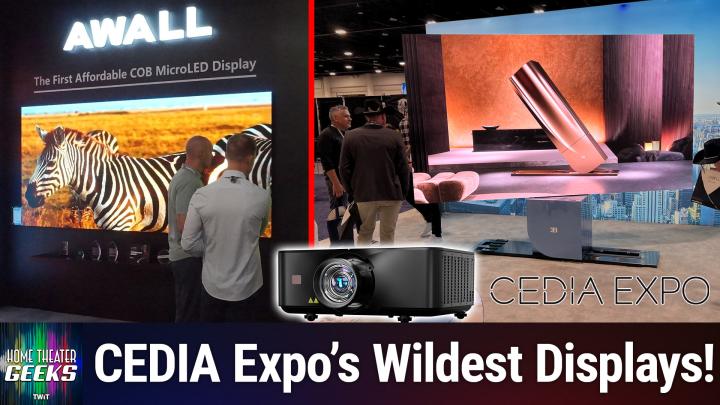
Home Theater Geeks 549 Transcript
Please be advised that this transcript is AI-generated and may not be word-for-word. Time codes refer to the approximate times in the ad-free version of the show.
Scott Wilkinson [00:00:00]:
In this episode of Home Theater Geeks, I talk with Mike Heiss and Joe Klusnik about CEDIA Expo 2026. In this episode, we talk about video products, so stay tuned.
Michael Heiss [00:00:17]:
Podcasts you love from people you trust.
Joe Klusnick [00:00:21]:
This is TWiT.
Scott Wilkinson [00:00:32]:
Hey there, Scott Wilkinson here, the Home Theater Geek. In this episode— well, in the next 3 episodes actually— I'm going to be talking about CEDIA Expo 2026, which just happened a week or so ago. And I've got 2 guests to help me talk about it. First, we have Mike Heiss, who is an industry journalist, a consultant, and a jolly good CEDIA fellow. Hey Mike, welcome back to the show.
Michael Heiss [00:01:01]:
Hey Scott, it's been a while. Uh, great to be here. Thanks for having me on.
Scott Wilkinson [00:01:05]:
You bet. Always a pleasure to have you. Also, uh, joining us is Joe Klusnik, who, uh, was the recipient of the Home Theater of the Month in episode 517. And he's also a home theater designer, CEDIA certified actually. Uh, when— and we showed one of his theaters in episode 547. Hey, Joe, welcome back.
Joe Klusnick [00:01:31]:
Thank you. Good to see you both.
Scott Wilkinson [00:01:32]:
Yeah, great to see you. I hear you guys actually ran into each other at the show, and that's great because you will be able to complement and supplement each other as we talk about CEDIA.
Joe Klusnick [00:01:45]:
Mike was hard to miss in that jacket.
Michael Heiss [00:01:49]:
For those who don't know or haven't, you know, go to my website, michaelheiss.com. I have, let's just say, a very distinctive jacket that no, was not designed by Joe Kane, but, um, it's a faux TV test pattern. And I have a tie that is the test pattern that's, uh, behind me here. Uh, you know, just because my ability, uh, to make a fool out of myself knows no boundaries.
Scott Wilkinson [00:02:15]:
Knows no bounds. Well, and you endear yourself to the entire industry every time you do. So, so we are here to talk about CEDIA Expo 2026, and there was so much to see and hear that we're actually going to split it into 3 episodes. So in this one, we're going to talk about video products. Now, as in years past, the CEDIA Expo was held at the Colorado Convention Center in Denver, Colorado, and I wasn't there this year. I have a hard time at altitude these days, so I'm so glad that Mike and Joe were there. But I do have one photo I took almost 10 years ago of the iconic Blue Bear, which is outside the convention center, uh, staring in at everybody. And I assume it's still there, uh, right, you guys?
Michael Heiss [00:03:10]:
He isn't— he is indeed there. You don't want to be behind him, I'll tell you.
Scott Wilkinson [00:03:18]:
Okay, very good. So we're talking about video products in this, uh, episode, and I want to start with Uh, what is often now called DVLED, direct view LED, which are sometimes called micro LED, although that's now become a bit of a confusing term. Uh, but it's a screen, a wall-sized screen basically, that is direct emissive. You're looking at the LEDs shining, and they have red, green, and blue LEDs, and they form a picture. that way. So, uh, let's start with one I don't think that was there, uh, the Epson LEC-1 series. Um, Mike, it wasn't—
Michael Heiss [00:04:07]:
It wasn't there. And, and I really kind of have to slap myself because it was at InfoComm, and for whatever reason, I just was running— only there for one day— ran through the Epson booth and, and didn't see it. But They are making a big deal about it as it is joining a few of the things that are available from the likes of Samsung and LG, where these are sort of 1 or 2-piece, easy-to-install kits. And, you know, given Epson's reputation, it's expected to make a big hit.
Scott Wilkinson [00:04:42]:
Yeah.
Michael Heiss [00:04:42]:
In that, in that if you have, if you have to ask, you can't afford it market.
Scott Wilkinson [00:04:46]:
Yeah, right. Joe, have you seen the Epson? Uh, DVLED?
Joe Klusnick [00:04:52]:
No, I was in the Epson booth, but it was all projector-based.
Scott Wilkinson [00:04:54]:
It's all projector-based. Well, I wanted to bring it up because, you know, Epson has been known as projector-based all this time, and now they're finally getting into DVLED. Uh, Joe, you, you sent me a photo of the Sony, uh, Crystal LED, I believe, right?
Joe Klusnick [00:05:12]:
Yeah, the CLED was up. I think that was a 212-inch display. Um, this thing was a monster. Amazingly good picture. Um, you've got a lot of attention. And yeah, I agree that these kinds of displays were all over the show floor, and I think they're making more and more inroads, uh, into the multi-use space that people are using for playback in the home.
Scott Wilkinson [00:05:34]:
Yes, they started, I think, as more corporate, uh, type displays, but, but they're now becoming more residential, as seen at CEDIA, I think.
Michael Heiss [00:05:45]:
Well, corporate and also production. And Sony, as, as one might imagine, is promoting, uh, There are 2 different versions of the Crystal LEDs. One has brightness, one has contrast for, you know, content production. And the studios are all using them. You see them on— you don't see video walls anymore. You see those things.
Scott Wilkinson [00:06:09]:
Right. And they're used as a background, as virtual backgrounds when shooting scenes for TV shows and movies. So that's pretty cool. Sony also announced something called the UniFi. Did either of you see that?
Michael Heiss [00:06:24]:
Did not see that one.
Scott Wilkinson [00:06:27]:
Okay, they, they claim that that one is an all-in-one, which, Mike, you had referred to a little earlier. We're going to talk more about them, uh, sort of instead of being you have to install all these tiles separately and wire them all together and it's a big pain in the butt.
Michael Heiss [00:06:41]:
Well, you know, we don't want to get guys like Joe, you know, put them out of business.
Scott Wilkinson [00:06:45]:
Well, that's true.
Michael Heiss [00:06:47]:
But it, it makes it easier and the, the Uh, interesting aspect of that will be to see at what point— and I don't think it's going to happen— will these large DVLED walls kind of become a do-it-yourself? You know, we're trained professionals. Do not, do not attempt to do this, right, boys and girls, right? But, um, to make it easier for, you know, folks like Joe.
Joe Klusnick [00:07:11]:
Yeah, there definitely was a lot of engineering going into these booths. You could see them, you know, these were very well structurally built. This took a long time to set up. It was not a, a quick thing for sure. Um, you know, Sony really had kind of 2 booths at the show, one focused on emissive displays. They had a projection, uh, theater demo that they did with some other folks, uh, a little bit further back in the show, but their main booth was really focused around this kind of stuff.
Michael Heiss [00:07:37]:
Although interesting, and I know you'll get to it shortly, uh, almost all of the sound room, the big demos, which were not as big as they used to be, but for a variety of reasons The big demos are still— or the big enclosed demos, I should say, were all projectors. Unless there was—
Scott Wilkinson [00:07:58]:
Not all of them. Not all. There was one at least that wasn't.
Michael Heiss [00:08:02]:
Well, not counting, not counting Quantum because they're in a different category.
Joe Klusnick [00:08:06]:
Yeah, but Barco was the other one.
Scott Wilkinson [00:08:08]:
And Barco was the other one. But, but, you know, let's not go there yet because that's actually for part 3. We got a lot of COVID a lot of ground to cover before we get there. So let's not, uh, jump the gun too much. One company that I hadn't heard of before is Dreamwall, and they had a couple of things there. They had the Elite Series Platinum P0.7, which I assume means that the pixel pitch is 0.7 millimeters.
Michael Heiss [00:08:38]:
Yep, yep.
Scott Wilkinson [00:08:40]:
Which is smaller than most.
Michael Heiss [00:08:42]:
Well, you know, again, in— it depends on, on the brand and where they buy their their modules from. But this is a reasonably new company that started up. Their first public appearance was back in January at CES, and they're hell-bent to, to make a dent in the market.
Scott Wilkinson [00:09:04]:
Yeah. And then there's another company I had never heard of before called Just Video Walls, and they had something pretty interesting there. They called it Absolute Black. And I think they're gunning for OLEDs with black levels down to 0.001 nit.
Michael Heiss [00:09:24]:
And you see they have that on the wall on that picture that I took. And, uh, I don't know if that one was mine or Joe's.
Scott Wilkinson [00:09:31]:
Actually, that's Joe's.
Michael Heiss [00:09:32]:
Okay, because I had the same picture, but off to the side there, you see it says OLED performance now at scale. And I had to ask the guy, I go, wait a minute, that's a DVLED. Yes, but it's almost as good as an OLED.
Scott Wilkinson [00:09:46]:
Okay.
Joe Klusnick [00:09:47]:
Marketing guys will say anything.
Scott Wilkinson [00:09:49]:
Well, that's true. And they do. Uh, what'd you think of that, Joe?
Joe Klusnick [00:09:54]:
Again, it was a great looking display. They did off to one side of it had looked like 4 different finishes that that display was available with, from kind of a matte, um, to a very, very gloss black. Uh, and I think that did help a lot with the contrast that they were claiming. So again, I think this is a continually evolving space, even more so than the projector side.
Scott Wilkinson [00:10:15]:
Mm-hmm.
Michael Heiss [00:10:16]:
Mm-hmm.
Scott Wilkinson [00:10:17]:
And then yet another company I hadn't heard of, AWOL.
Michael Heiss [00:10:21]:
A-W-O-L.
Scott Wilkinson [00:10:22]:
Not to be confused with AWOL. AWOL, which is a projector company.
Michael Heiss [00:10:27]:
But there is some connection between the fellow that's behind AWOL. AWOL was one of the partners and I think still has an interest in AWOL. And I saw them at the InfoComm as well because that's really the big show for this type of displays. And this is another newcomer looking to make a dent in the market. And you see they got a bunch of awards down there.
Joe Klusnick [00:10:54]:
And I think they're also doing something with XGIMI, another company called XWALL, if I remember right.
Scott Wilkinson [00:10:59]:
Oh, no kidding. Wow.
Joe Klusnick [00:11:01]:
And I think a lot of these are Chinese-based companies that are continuing to make inroads into the global market, right?
Michael Heiss [00:11:07]:
Well, almost all of the DVLED modules are made by, um, Chinese companies that have the word Shenzhen in them.
Scott Wilkinson [00:11:17]:
And because that's where they all are.
Michael Heiss [00:11:19]:
Yes. And Shenzhen so-and-so, Shenzhen company. And, uh, you know, but again, and that's one of the things, you're buying it from somebody like Joe from his company who instead in turn is buying it from somebody whose name we've just mentioned. But you really don't know where the panel comes from. But the key to anybody who's considering one of these is you want to consider the company that is installing it, because anybody remembers Runco projectors— and I'm really bummed Sam Runco was there, but I, I didn't get to run into him.
Scott Wilkinson [00:11:55]:
Oh, too bad.
Michael Heiss [00:11:56]:
Somebody went. And for those who don't know, Sammy was back in the days when I was making projectors at Harman Video. Sammy and Vitacron and Sony and Harman Video, we were some of the big 3-tube CRT projector companies. And somebody, one of the installers, asked Sam, how are you going to explain to a client paying big bucks what a Runco is? And his answer was very simple. He said, don't tell them it's a Runco. tell them it's your company name here because that's what you want to stretch.
Scott Wilkinson [00:12:31]:
Hmm, interesting. So we've got a bunch of new players in the DVLED market. One subcategory of that that I found kind of interesting in, in reading the press releases and the news items that came out of CEDIA, there were a number of companies, Dreamwall and AWOL in particular, Doing portable freestanding DV LEDs. I didn't get any pictures of them. I don't, I don't know if they were even there at the show. Dreamwall had the Monarch, what they call portable, meaning it's on a stand with wheels, and it even folds. There are sections of it that fold out. We're going to see that in a minute with C-Seed.
Michael Heiss [00:13:15]:
The Dreamwall guys were bummed the air freight company kind of brutalized their folding thing. Of course, I asked them, I said, you know, where's the folding one? They said, it's here, but it doesn't work because the air freight company trashed it.
Scott Wilkinson [00:13:32]:
Oh man.
Michael Heiss [00:13:32]:
Which was kind of a bummer. But there were a couple there. And it's not just, you know, for outdoors or whatever, but it's, it's just, you know, it opens and it closes. And if you want it to be there, it's there, and if not, it's not.
Scott Wilkinson [00:13:48]:
Yeah, yeah. Uh, Joe, you got a picture of the Sea Seed Bugatti, and I wanted to show that.
Joe Klusnick [00:13:55]:
Yeah, and this was an amazing looking piece from an industrial design standpoint. This was fantastic. So I got shots of a couple different angles on this, but, uh, just like Mike was saying, this is a TV that folds up and then lays down and could be put, you know, in front of a giant glass window, could be put Maybe on a yacht, I don't know, but it's, it's really engineered to disappear so that that TV is only on display when you want it to be.
Scott Wilkinson [00:14:21]:
Yeah, this— the other picture, I got a second picture from you of the back of it where you can see the hinges.
Joe Klusnick [00:14:27]:
Yes, exactly. And again, this thing looked great from almost any angle.
Scott Wilkinson [00:14:32]:
Which is a highlight of DVLED. It doesn't have the off-axis problems that an LCD TV does.
Michael Heiss [00:14:41]:
And I think it's even worth throwing in, uh, for those who are not familiar with that technology, if you go to a transportation terminal, um, any sports arena, indoors, outdoors, all that signage is now DVLED.
Scott Wilkinson [00:15:00]:
Yep, exactly right. Um, let's see, there was another subcategory called outdoor TV, which has been at CEDIA for years, ever since as long as I can remember going, which is now— I've been— I had been going to CEDIA as much as 25, 30 years ago, and there was always outdoor TVs, uh, and usually they were small, but now they're not. Here is, for example, the Neptune Outdoor DV LED, which is available in 108, 136, and 163 inches. Um, Sitting on a stand at this point, but that has got to be hella bright to be outdoors in broad daylight.
Michael Heiss [00:15:46]:
I mean, that's a big growing category. I mean, in the home building industry, outdoor stuff, you know, outdoor kitchens and all that kind of thing is a growing category. And this is, you know, just an obvious supplement to that.
Scott Wilkinson [00:16:01]:
Yeah. Dreamwall had something called Cool LED. Cooled, I guess. C-O-O-L-E-D. Uh, they have, uh, 115 to 317 inches, uh, 4,000 nits, which is what kind of what you need. But more, at least as important, uh, the specs say that each of the cabinets that make up the, the DreamWall Cooled, uh, consumes only 50 watts of power.
Michael Heiss [00:16:34]:
Um, yeah, but there are a lot of cabinets in one of those big-sized displays.
Scott Wilkinson [00:16:38]:
Well, true, that, that is true. I, I agree. But that's at peak brightness, so I assume that previous generations consumed a lot more than that.
Michael Heiss [00:16:49]:
Well, and, and that's why, as I mentioned, if you go to Dodger Stadium, you go to any, uh, you know, sports arena, uh, indoors or outdoors, that's why they're there.
Scott Wilkinson [00:16:59]:
I mean, Jumbotron.
Michael Heiss [00:17:00]:
Well, if you go back, remember Jumbotron was a bunch of CRTs.
Scott Wilkinson [00:17:07]:
Was it?
Michael Heiss [00:17:08]:
Oh, or Diamond Vision, one or the other. It was a bunch of— back in the way, way, way back machine. And originally it was a bunch of light bulbs.
Scott Wilkinson [00:17:18]:
Yeah, true enough.
Michael Heiss [00:17:19]:
For your scoreboards.
Scott Wilkinson [00:17:19]:
Yeah.
Michael Heiss [00:17:20]:
And that's a major, major advancement to make them that bright. But also the dot pitch is bigger because you're far enough away that you can assimilate it. Your brain can, can put them together. But, you know, if you want to explain dot pitch, you know, when the, when the outfielders are going up against the back wall and the camera zooms in, you can see the dot pitch, which you can't when it's from home plate.
Scott Wilkinson [00:17:46]:
Right, right. Uh, there was one, one company I got a picture of for, um, uh, outdoor LCD TV, again from Neptune TV, called the Full Sun. And that comes in 55, 65, 75 inches, 1,500 nits. Not that great, but you know, if you want an outdoor TV, this— it has come a long way.
Michael Heiss [00:18:13]:
I, I hear they're having a new company, a subsidiary called Full Daughter.
Scott Wilkinson [00:18:22]:
Oh man, oh man, oh man, come on, I gotta get one.
Michael Heiss [00:18:25]:
Oh man.
Joe Klusnick [00:18:27]:
Right.
Scott Wilkinson [00:18:28]:
All right, let's move on to projectors. Um, uh, Joe, you mentioned XGIMI and they had the Titan Noir Max. I don't know if this was new on at the show.
Joe Klusnick [00:18:42]:
Yeah, I think this is, uh, one of their new 8,000-lumen projectors, so, you know, very high brightness. small form factor. This is, you know, it kind of bridges the gap between that, that lifestyle-type projector and the full home theater projector. So you could, you know, coffee table mount this, but they were showing this ceiling suspended, if I remember right. And this was one of the few booths that did not use the Kaleidescape as a source. I actually watched some clips from Mandalorian on this, the streaming show, not the movie.
Scott Wilkinson [00:19:15]:
Mm-hmm.
Joe Klusnick [00:19:16]:
And it was, you know, The lightsabers were very, very bright on this. That room was also really warm. I don't know how well ventilated it was, but it seemed to be putting off a good deal of heat. Uh, yeah, it was, it was a good picture.
Scott Wilkinson [00:19:29]:
Yeah.
Michael Heiss [00:19:29]:
Where were they playing it from?
Joe Klusnick [00:19:31]:
It looked like off of hard drives or something. It looked like all computer files, but, but clearly not a kaleidoscope.
Scott Wilkinson [00:19:36]:
Not a kaleidoscope.
Michael Heiss [00:19:37]:
No, no.
Joe Klusnick [00:19:38]:
Um, but you know, this is kind of one of those things where they're— I think they're trying to gain a foothold into the CEDIA market so they have some more support. So much of this has been brought through Kickstarter Kickstarter or direct-to-consumer. And I think they want to introduce a product that can be installed by professionals and then supported by them also.
Scott Wilkinson [00:19:59]:
Well, that's what CEDIA is all about, so makes sense to me. Um, I saw a press release that SIM2 introduced 3 new projectors— well, sort of one that had several different versions, uh, called Ultra Nero. Uh, there's the 4S, the 4SHC high contrast, and the 4S Duo, which is 2 stacked on top of each other for, for more light output. Did either of you guys go to the SIM2 booth?
Joe Klusnick [00:20:28]:
Yeah, this was in one of the sound rooms.
Michael Heiss [00:20:30]:
Yeah, they were all the way in the back of the room. And it's interesting because back in the heyday of projectors, before, you know, 100-inch flat panels and DVLED, you saw a lot more stacked projectors. And that's just not something that you see a lot of. anymore, as much as anything, uh, due to the competition from DVLED and, you know, '98 and up flat panels. Right.
Joe Klusnick [00:20:54]:
But back in the day, you were stacking those to get brightness, right? And now brightness is not an issue. So it's, it's really a matter of, you know, can it do everything that you need it to do? I still think stacking them, um, and I think they may even had some challenges during the show with keeping everything synced, aligned perfect. So it's, it it's an install challenge.
Michael Heiss [00:21:15]:
You're talking to a guy that used to have to converge dual-stack CRT projectors, so I, I feel the pain.
Scott Wilkinson [00:21:24]:
That's a challenge. Yeah. Um, the big, uh, cinema projector companies were— are there, have been there for years. Christie and Barco. Uh, Christie had a, a new Chorus series, K-O-R-U-S. 4K one-chip DLP with color wheel. They didn't mention lasers at all in any of their materials, so I assume it may be lamp-based.
Michael Heiss [00:21:50]:
No, I, I just can't— I'm sure it's laser.
Scott Wilkinson [00:21:53]:
I have a hard time believing that too. 10,000 lumens.
Michael Heiss [00:21:57]:
That would be one big bulb.
Scott Wilkinson [00:22:00]:
Yeah, yeah. And then the Barco Freya. Uh, I don't know if this was new at the show or not. I think it was used in at least one demo, right?
Michael Heiss [00:22:11]:
I, I think that most of these, particularly something of that size, uh, were at InfoComm again because that is really the primary— the industrial, commercial, institutional market is, is really the big, uh, spot for these guys.
Joe Klusnick [00:22:29]:
I, I know one of the projector companies, and Mike, maybe you can expand on this, but they were showing a dual light source that I think it was using a laser and an RGB uh, type of a setup so that they could kind of shift in between them depending on what was necessary for a given scene?
Michael Heiss [00:22:45]:
Well, it was an RGB plus blue phosphor, and that's what was in the, uh, Accendo demo booth. And the blue was just, you know, to add additional color to the picture, you know, using the blue phosphor. And unfortunately, I didn't get as much— I was really running around this show and didn't get as much information Uh, on that. But it, it's going to be tough. And, you know, when JVC was there, they didn't have anything new unless you saw something that I missed.
Joe Klusnick [00:23:17]:
They introduced a new projector mount.
Scott Wilkinson [00:23:19]:
A new projector mount?
Michael Heiss [00:23:21]:
But not a new projector, for crying out loud.
Joe Klusnick [00:23:24]:
Exactly.
Michael Heiss [00:23:25]:
But, but with D— I mean, DILA is one of the foundational solid-state, uh, imaging technologies along with, with SXRD. And, you know, when they were there, but you can tell, and, and, you know, again, I'm sure this will come up later on, but there were a lot of people that weren't there. But JVC, to their credit, was there with these projectors, right?
Joe Klusnick [00:23:50]:
Yeah. And I did spend some time with JVC, Sony, and Epson. I don't think any of the 3 of them showed a new projector, uh, at this show. Um, and sometimes you'll get years where they're doing software refinements, and it really wasn't even that, uh, for this year.
Michael Heiss [00:24:04]:
Um, but yeah, so, well, and again, if people like digital projection, we're not there at all.
Scott Wilkinson [00:24:11]:
That's amazing. They've been there. They were there every year I was there for years.
Michael Heiss [00:24:15]:
Uh, topic for later.
Scott Wilkinson [00:24:17]:
Yeah, yeah. A couple of UST projectors, ultra short throw, caught my attention, uh, and I think Joe got some pictures of them, both from AWOL, A-W-O-L, uh, the LuxVision Which is an RGB laser, uh, and I think they touted it as the first to have optical lens shift.
Joe Klusnick [00:24:41]:
Yeah, that looks like one of Mike's pictures, I think.
Michael Heiss [00:24:42]:
Oh, that— maybe that's one. Yes, the pictures were really good on, on these. I mean, and you know, there's a category where maybe people are moving away from ceiling mount projectors, but USTs are still a big part of the market.
Scott Wilkinson [00:25:01]:
Mm-hmm. And AWOL also had something called the Aetherion Max.
Michael Heiss [00:25:07]:
Yeah, I have to apologize. I over-brightened that because I wanted you to be able to see the speaker array behind the grill. And that, that was the reason why that was, was overexposed, to use an old film term. But even the thing next to it, and I had to look twice to say, is that, is that the projector? Is that a piece of furniture? And dagnabbit, that was the projector.
Scott Wilkinson [00:25:33]:
Oh yeah, the thing next to it. Yeah, yeah, it, yeah, it's got like wood accents on it or something.
Michael Heiss [00:25:42]:
Well, these things are out in the open, right?
Scott Wilkinson [00:25:44]:
So they've got to kind of look like furniture, right?
Michael Heiss [00:25:47]:
And, and that one again, I mean, that one really fooled me. to say like, you know, that's not bad, that it was a decent projector and it looked good. So, you know, depending upon whose objections you're trying to overcome, when somebody wants a larger screen and, and are going towards a UST instead of a flat panel, you know, that's a way for a little piece in the house.
Scott Wilkinson [00:26:06]:
Yeah, yeah.
Joe Klusnick [00:26:08]:
Well, and that, that overcomes one of the big challenges that you run into is the— a lot of times those projectors need to go exactly where the center channel is going to be, you know, in the SVS They were using an ultra-short throw projector and they just set up 2 TV stands, one in front of the other, and Sandra Chenoweth sat on one, the projector sat closer to the wall on the other.
Scott Wilkinson [00:26:26]:
Yep.
Michael Heiss [00:26:26]:
Mm-hmm.
Scott Wilkinson [00:26:27]:
Mm-hmm. Um, I don't think there was much new in the way of what we might call conventional TVs, not DVLED, but LCD or OLED. Uh, Sony had an interesting demo and, uh, both of you took pictures of that. I forget which one I used, uh, regarding the BRAVIA Sony Bravia 9 II.
Michael Heiss [00:26:52]:
Um, it's sort of a— I mean, every time I see that, I see 9/11, especially, you know, this month.
Scott Wilkinson [00:27:00]:
Yeah, especially this month, a couple days ago. Uh, right, exactly. They also have the Bravia 7 II, both of which are RGB mini LED backlights. And so, um, now this was an interesting demo. I forget which one of you took this.
Joe Klusnick [00:27:16]:
That's, that's a better picture than mine, so it must be Mike's.
Michael Heiss [00:27:18]:
That's mine, yeah.
Scott Wilkinson [00:27:20]:
So tell us what we're looking at here, Mike.
Michael Heiss [00:27:22]:
Well, what they had there were those 3 screens on top, one next to another, is the backlight array without the panel. So you can see the difference of using just a white WRGB or the conventional RGB or the BRAVIA 9 II. And then below the center one shows you the actual screen so you can see the increased precision that you get from being to individually turn on and off the RGB LEDs in the back instead of— exactly, instead of having to filter them. And the picture is, is very impressive. And I'm sorry, go ahead, Joe.
Joe Klusnick [00:28:07]:
They handed sunglasses out before you went.
Michael Heiss [00:28:09]:
Yes, they did.
Joe Klusnick [00:28:10]:
In space. It was really bright.
Michael Heiss [00:28:13]:
So it was really bright.
Joe Klusnick [00:28:14]:
These are your TVs with the front glass pulled off.
Scott Wilkinson [00:28:17]:
Right, right. And, and it's showing you kind of what's happening behind the screen, behind the scene, as it were.
Michael Heiss [00:28:23]:
Yep, yep, yep.
Scott Wilkinson [00:28:24]:
Um, so yeah, that is impressive. Uh, Mike, you also took, I think, the next one.
Michael Heiss [00:28:30]:
Yeah, this was actually a thing that was on one of their promotional, uh, literature things, but that's just, again, a more graphical way of their trying to explain, you know, why this is good, right? And I think it kind of speaks for itself. But if you look at this and compare it to the last one, now you can see how that looks in, in reality when you're looking at the color space.
Scott Wilkinson [00:28:55]:
So of course this is marketing, and, and Sony wanted to show why they're better. Uh, I had on the show some time ago, um, Jeff Urich, who was talking about RGB mini LED backlight LCD TVs. Say that 10 times fast. And there are some problems with color blooming and color bleed from one color to another in such systems. So they're not perfect.
Michael Heiss [00:29:27]:
Well, says Jeff as Mr. QD.
Scott Wilkinson [00:29:31]:
Yeah, Mr. Quantum Dot. It's true. I have to give it— give him, uh, that, uh, caveat. No question.
Joe Klusnick [00:29:39]:
Well, I do want to commend Sony for having such a strong presence at the show. You know, not only did they have a big booth, a smaller secondary booth, but they also sponsored the opening keynote. So they really did show up for the industry in a way we saw a lot of other manufacturers not, or not at all, right?
Scott Wilkinson [00:29:57]:
Right. Uh, Mike, you mentioned Skyworth, which is a company that we see— well, I used to see occasionally at CES. Yep. I don't know that I've seen them at CEDIA.
Michael Heiss [00:30:09]:
Uh, they have been. I think this is their 2nd or 3rd, uh, year at CEDIA Expo. And Skyworth is a huge, uh, Chinese manufacturer. And when I, you know, I haven't been since pandemic, but when I used to go Lucky me, I used to go to Shenzhen every 6 weeks. And, you know, you sort of busman's holiday, you go into the shops and you see Skyworth everywhere. But they are a big global company manufacturer and they have hooked their US wagon to what they call Canvas, which is their iteration of the trend that Samsung started with the art TVs. Right.
Scott Wilkinson [00:30:47]:
The Frame.
Michael Heiss [00:30:48]:
The Frame. Well, the Frame. but also showing artwork when you're not watching TV.
Scott Wilkinson [00:30:55]:
Right.
Michael Heiss [00:30:55]:
And they were pretty good. But the sort of hidden pony in all of this is Skyworth is also going to begin manufacturing and selling Panasonic TV sets. And they were not there at, at CD Expo, but they will begin to roll those out in the US market. starting early next year and presumably at CES, which will be interesting because Panasonic, from a technology standpoint, you know, has always been a big brand. But as the Japanese legacy brands have, you know, changed their corporate strategies— TCL, Sony— then, you know, then that's a byproduct of it. Yep. Yep.
Scott Wilkinson [00:31:42]:
TCL was there with not anything new, but the SQD Mini LED backlight.
Michael Heiss [00:31:49]:
And, and that's their way. When you mentioned Jeff Urich talking about color blooming and those type of artifacts that, uh, you do get from the mini or micro RGB, this is a mini, uh, mini LED backlight, backlight, but not an RGB. And there's some secret sauce into what this SQD thing is. And at demos that they did down in Santa Monica before CES and at CES, they had an RGB LED, an SQLED, and a regular mini LED next to each other. And the SQLED really performed quite well. And it's They're going to make the— they're destined to make their mark. And one of the things that I've asked, I asked at CES, I asked at InfoComm, I asked at NAB, and I asked here is in April when the deal is completed and everything falls into place for TCL to have their joint venture with Sony to combine those 2 technological powerhouses. That's going to be really interesting to see.
Michael Heiss [00:33:12]:
And I was kidding Scott Ramirez, who I think you and I have both known since he worked for Toshiba. We're not allowed to say how many years ago. And there was a booth in between the TCL booth at Expo and the Sony booth. And I said, next year, are they going to bring them together?
Scott Wilkinson [00:33:32]:
They're going to merge.
Michael Heiss [00:33:33]:
In fact, I want to put something on Koushi to say, will Sony even have a booth at CES this year? Because that whole home electronics division is now going to be under the direction of TCL. But the technology from Sony will still be there and the joint venture will be called BRAVIA Inc.
Scott Wilkinson [00:33:54]:
Huh?
Michael Heiss [00:33:55]:
Huh? So over the next however many months, we'll be talking about that one.
Scott Wilkinson [00:34:02]:
You bet, you bet. Okay, let's move on to, uh, source devices, and I can't help but start with the Magnetar Ultima.
Michael Heiss [00:34:14]:
Oh man.
Scott Wilkinson [00:34:16]:
Yeah, man, this is a disc player, a universal disc player, I assume.
Michael Heiss [00:34:22]:
Yes.
Scott Wilkinson [00:34:23]:
And as Mike said, if you have to ask, you can't afford it. But I'll tell you anyway, $12,000.
Michael Heiss [00:34:34]:
And, and I, for the benefit of the audience, I sent the press release for this to Scott when I first got it, and he didn't— hadn't gotten it yet. And I got like just an email back with exclamation points.
Scott Wilkinson [00:34:49]:
Yep.
Joe Klusnick [00:34:51]:
Now, is that $12,000, is that for the, uh, drive or the power supply?
Michael Heiss [00:34:54]:
No, for both pieces. And at first I wasn't quite sure what it was, but what's on the top is the transport and the transport electronics, and what's underneath is a battery so that this is totally isolated. And, and in fact, there are not even any analog outputs on this thing.
Scott Wilkinson [00:35:12]:
We have a picture of the back, actually. I think, Mike, you provided this.
Michael Heiss [00:35:16]:
There you go. And I asked the guy and he said, you want analog, get a damn DAC. And he pretty much said it that way. But you can see that hunker power cable, but they really wanted true isolation. And, you know, good for them. I mean, solid— to suffice to say, really solidly built.
Scott Wilkinson [00:35:37]:
Well, for $12,000, it damn well better be.
Michael Heiss [00:35:40]:
You bet your bootskis.
Scott Wilkinson [00:35:41]:
Jeez. Uh, well, okay, so the big, the big source device that everybody was using, and a lot of people at home use now as well, is Kaleidoscape, and they celebrated their 25th anniversary. In fact, uh, Joe, you and Mike met at the Kaleidoscape party, right?
Michael Heiss [00:36:02]:
Yep. Yep.
Scott Wilkinson [00:36:04]:
So I wish I could have been there. That would have been fun.
Joe Klusnick [00:36:06]:
Anyway, there were a lot of, a lot of industry folks at the party. Yeah, yeah, to start the show.
Scott Wilkinson [00:36:13]:
Yeah, great way to start the show. So here's a picture I think, Joe, you, you gave me.
Joe Klusnick [00:36:20]:
Yeah, this is, you know, Kaleidescape's trophy chest here. They, I think they won something like 11 awards at the show for their new Strato K player. This is the 4K cinematic and 8K capable player. They also introduced the new Terra Prime SSD, 246 terabyte storage unit. So that's a piece that can hold, I think, 4,000 plus of them, you know, 4K cinematic, 4K movies.
Michael Heiss [00:36:48]:
Yeah. In fact, they said in one of their press releases that Terra Prime drive will hold every movie in their collection locally.
Joe Klusnick [00:36:58]:
Yeah, actually 4 of them to do it.
Scott Wilkinson [00:37:00]:
But yes, you need 4 of those to do it.
Joe Klusnick [00:37:02]:
But, uh, you're approaching petabyte at that point. So yeah.
Scott Wilkinson [00:37:07]:
Jeez Louise. I mean, 256 gigabytes— terabytes of SSD. 240, yeah. Uh, terabytes of SSD storage.
Joe Klusnick [00:37:20]:
Yeah, and I think I've got a shot of one of those opened up, and there's dual 123 SSDs in it. And I did talk with, uh, manufacturing side there, and they said that they are trying to move towards a more potentially serviceable. So I don't know if you've ever played with the Kaleidoscape units, but The normal version of the Terra had 4 bays. It was easy to take drives in and out, but anything that was a Strato, usually it was a single drive and it was not user-friendly to take apart. I mean, even from a manufacturing standpoint, it was hard to get that unit apart.
Michael Heiss [00:37:53]:
Mm-hmm.
Joe Klusnick [00:37:53]:
Now it's, you know, it's a clamshell with 6 screws on the top. You take that apart and you see the guts. So, and they're using that same case for both the Strato K as well as their new compact Terras. So it's, uh, I think a smart move manufacturer-wise to make it more serviceable, to have just one type of a piece and, you know, make everything fit into that.
Michael Heiss [00:38:16]:
Yeah, just heaven help them with the price of memory these days.
Joe Klusnick [00:38:19]:
True.
Michael Heiss [00:38:21]:
Jeez.
Scott Wilkinson [00:38:22]:
Um, you mentioned 4K cinematic. Is that a new format for them?
Joe Klusnick [00:38:26]:
Yeah, and that was, that was a really big thing that was going on at the show. They were talking a lot about— so their new Strato K players, of of course capable of playing 8K, but there's not a lot of content out there yet in 8K.
Michael Heiss [00:38:36]:
Mm-hmm.
Joe Klusnick [00:38:36]:
I think they were showing 2001: A Space Odyssey, which had been recently remastered, and they had a mezzanine file for it. There's one other 8K short film on their Kaleidoscape store, but the in-between 8K and what you'd think of as normal 4K is a 4:4:4 version they're calling 4K Cinematic. So, uh, much larger files, uh, higher bitrates, better color. So it's kind of the next step beyond what you can get on a disc.
Michael Heiss [00:39:07]:
And the fact that you don't need the 8K player because that will be in the one below. And, you know, when I heard them announce it with 4:4:4, I said, I got to call Joe Kane right away because that's like, you know, that would make him—
Scott Wilkinson [00:39:21]:
That's the holy grail for him.
Michael Heiss [00:39:22]:
For Joe. Yeah.
Scott Wilkinson [00:39:23]:
Yeah, yeah. By the way—
Michael Heiss [00:39:24]:
And it looked good, by the way.
Scott Wilkinson [00:39:26]:
I'm sure it did. For those of you who aren't familiar with that terminology, 4:4:4 refers to the fact that the color information is not compressed. On a Blu-ray disc or an Ultra HD Blu-ray disc or broadcast TV, it's normally 4:2:0, which means that the color information has been compressed. information has been removed in order to reduce the bandwidth requirements and the storage requirements. But this— and in fact, Kaleidoscape's conventional Blu-ray and 4K titles are also probably 4:2:0. This is 4:4:4, which is uncompressed. All the color information is there, and which means it'll look better, but it's going to be Hella big.
Joe Klusnick [00:40:17]:
And yeah, the 4K cinematic stuff was— the files themselves are typically 1.5 times the size of a standard 4K file from them.
Michael Heiss [00:40:26]:
Uh, but not as big as an 8K file. I have to interrupt you there, Joseph. That's true. That's, that's important.
Joe Klusnick [00:40:32]:
Yeah. Um, and then they also are supporting, you know, Dolby Vision, uh, HDR10, uh, all of those in their 4K cinematic. So it's you know, it's, it's kind of the next step beyond what you can buy from a physical disc. Uh, it's a physical copy, it just sits on a hard drive in your rack instead of, uh, on an optical disc, right?
Michael Heiss [00:40:53]:
And I recall from the event they held down in Culver City that they're not— if you already owned, bought, uh, a title, you don't have to pay extra to get the 444 version of it. And it's approved As a proof point, they held this event. There was— I don't know who the theater owner was, but there's a 6-plex down in Culver City across from the hotel that is the famous Munchkin Hotel in Culver City that is now owned by Amazon. And it's a, you know, it's a theater, but they also use it for screenings, screenings. And that's where they had the intro for this. And on a 20-foot Samsung, what's the name of their theatrical version of Onyx? Onyx. Yeah.
Scott Wilkinson [00:41:42]:
That's a DVLED, not a projection system.
Michael Heiss [00:41:44]:
But like a theatrical 20-foot Onyx version of it.
Joe Klusnick [00:41:48]:
Yeah.
Michael Heiss [00:41:48]:
Playing back in this 444. And I think it was Oklahoma and the winds were definitely whistling through the whatever the wind was because it was It on a big screen in front of a SMPTE meeting where you got to be, you know, there are people putting their, you know, looking right up into the screen. It was— the picture was really, really good.
Scott Wilkinson [00:42:11]:
Oh wow. Wow.
Joe Klusnick [00:42:12]:
Yeah, I think they have over 300 titles in the new 4K cinematic format already on the store, and they continue to add daily, it seems like.
Scott Wilkinson [00:42:20]:
Yeah, yeah, I'm sure. Um, Trinnov was there, of course, with their processor. turning to processors now. We're, uh, we were at with sources, now we're in processors. And, uh, Joe, you mentioned that, that they, among others, are using AI in their user interface.
Joe Klusnick [00:42:39]:
Yeah, so I think in an effort to make this a more customer-friendly piece, they are introducing an AI-native language that you can work with your system to tailor the sound for the content that you're watching. So if you're playing back you know, concert video footage versus blockbuster movie, you can go in, type in, I want this to sound like I'm in the 5th row at this concert location, and it will tweak the audio capabilities on the system to, you know, better mirror what you're looking for.
Michael Heiss [00:43:10]:
Although they— I, I know a bunch of the Trinnov guys because everybody in this business has already worked at 5 other places, and most of them at least once at Harman, and I spoke to a bunch of the Trinnov guys that are buds of mine, and they said that the AI thing that Joe just described is not actually in release yet. Their ultimate—
Scott Wilkinson [00:43:31]:
Oh.
Michael Heiss [00:43:31]:
So I think that that's, you know, in fairness to them, it's important to note that. But their ultimate goal is to have that be almost a voice control thing. So you can say, to Joe's point, make this louder, make this sound like this, make this sound like that, and have the AI Either, you know, kidnap the world or make the correction. And, you know, and they were very positive about it. But they, again, in fairness, they were very straight up to say this is not a release thing, which is why they were also— they were only demonstrating it on headphones, which you saw in Joe's picture down on the bottom. They had a pair of headphones.
Scott Wilkinson [00:44:13]:
And here's a picture of their I guess their current user interface.
Michael Heiss [00:44:17]:
Yeah, the other thing they were big on though was the waveform thing. And that, you know, last— not last year, 2 years ago, when Trinnov was the processor driving the Trinnov, uh, Officino Acustica, uh, Prolisson Storm Barco demo, um, they had like a gazillion subwoofers. And this year they were just as last year, they were in a downstairs meeting room And, and, you know, yo, where are the subwoofers? Yeah, there were 2 of them in the back and 2 of them in the front, but that's all you need. And that's— I agree, that's the secret of their waveform technology that they were promoting, uh, to some extent as much as anything.
Joe Klusnick [00:44:57]:
Yeah, so, so Trinnov was really trying to show off what they call a 2-subwoofer waveform, in that, you know, their traditional waveform uses a set of subwoofers at the front and a set at the rear to absorb so that you get very low decay times. What they're doing now is with 2 subwoofers at the front, they're taking the bounce off the back wall and using those same front subwoofers as both the emitters and the absorber subs.
Michael Heiss [00:45:23]:
That was pretty impressive.
Scott Wilkinson [00:45:24]:
Yeah, pretty impressive. Um, another, uh, thing that I think is we're going to see more of— we're going to talk about this in, in part 3— is what's called Dante AES67 audio over IP, and Storm Audio is a strong proponent of that. And they showed their newest processor, I think called the EVO 1.
Joe Klusnick [00:45:50]:
Yeah, so this was a single rack unit processor that when you initially purchase this, it handles, I think, up to 8 channels. And then you can buy additional licenses in 4-channel increments to go to 12 or 16. But for, for a very slim form factor, does what I believe just about everything that the existing Storm processors used to do. All you have on here is HDMI inputs, outputs, and then you— all the audio is brought out over, you know, a single Cat6 cable.
Scott Wilkinson [00:46:26]:
Cat6 cable. Yeah, yeah.
Michael Heiss [00:46:27]:
You look on the back, there's an RJ45, and you go, where are the outputs? You That's it.
Scott Wilkinson [00:46:31]:
That's it.
Michael Heiss [00:46:33]:
And, uh, AudioControl had one also that was, uh, similar, you know, this 1U high, and you go like, where is everything? You're like, nope, that's it.
Scott Wilkinson [00:46:42]:
That's it. Yeah, that's right. AudioControl, uh, Hyperion APR16, I believe it was.
Michael Heiss [00:46:48]:
Yep.
Scott Wilkinson [00:46:49]:
And, uh, so, so that's, that's a direction that we're going in. We're going to talk about that more in part 3, uh, but first Um, we've, we finished with the video products, some of them anyway. I'm sure there were more, uh, but, uh, let's finish it off here for now. And next week we will talk about audio products in part 2. So, uh, I want to thank, uh, Mike Heiss and Joe Klusnik, uh, so much, uh, for being here. Mike, where can people find you online?
Michael Heiss [00:47:20]:
Oh, you can find me everywhere, michaelheiss.com. hiddenwires.co.uk, tvtechnology.com, and occasionally even in TWICE.
Scott Wilkinson [00:47:31]:
Which is the publication of CEDIA, right?
Michael Heiss [00:47:34]:
No, no, no, no, no, no, that's CE Pro. That's them other guys.
Scott Wilkinson [00:47:37]:
Oh, that's them other guys. Sorry, sorry. TWICE is CES, or Consumer Electronics.
Michael Heiss [00:47:45]:
It stands for This Week in Consumer Electronics, right? And it is one of the longtime industry publications.
Scott Wilkinson [00:47:52]:
Yeah, yeah, yeah. Okay, I gotcha. Uh, Joe, how about you? Where can people find you?
Joe Klusnick [00:47:57]:
Uh, you can hit me up over on AVS Forum under, uh, JSKMDWK is the username.
Scott Wilkinson [00:48:03]:
Very good. That's, that's great because, uh, AVS Forum is a wonderful, uh, resource for people who are interested in all this stuff, who are home theater geeks like us.
Michael Heiss [00:48:14]:
Yeah.
Scott Wilkinson [00:48:14]:
And, uh, and I know, Joe, you, uh, you Keep a close eye on that, and I'm sure you will interact with people who have questions for you. So thanks so much for doing that.
Michael Heiss [00:48:25]:
Absolutely.
Scott Wilkinson [00:48:26]:
All right, thanks, you guys. Uh, we'll see you next week in part 2. Now, if you have a question for me, you can send it along to HTG@twit.tv, and I'll answer as many as I can right here on the show. And if you have a home theater you're proud of, send me some pics. I'd love to see them, and maybe we'll get you on the show to talk about it. Until next time, geek out!