Home Theater Geeks 542 Transcript
Please be advised that this transcript is AI-generated and may not be word-for-word. Time codes refer to the approximate times in the ad-free version of the show.
Scott Wilkinson [00:00:00]:
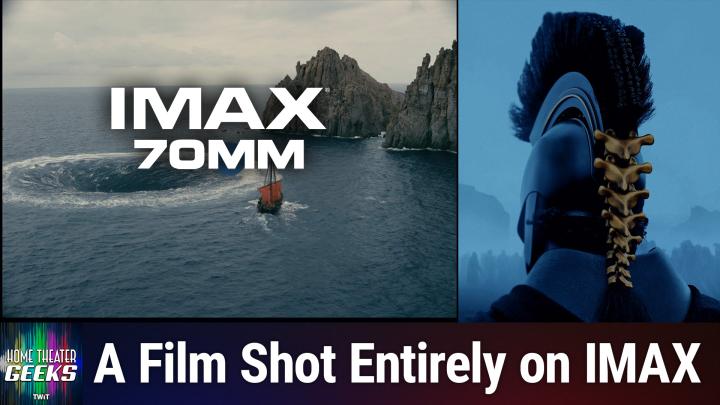
In this episode of Home Theater Geeks, I talk about the summer blockbuster that everyone's talking about and where you ought to see it. So stay tuned. Podcasts you love from people you trust. This is TWiT. Hey there, Scott Wilkinson here. The Home Theater Geek. Now, unless you're living completely off the grid, and you wouldn't be listening to this show if you were, you know that Christopher Nolan's The Odyssey is the huge summer blockbuster of this year. Now, Nolan had shot some scenes in previous movies on IMAX 70mm film cameras, but this is the first movie in history to be shot entirely In that format.
Scott Wilkinson [00:01:03]:
Now, the budget for this movie is said to have been about $250 million, some of which I'm sure was dedicated to developing new models of these film cameras that were a lot quieter because Nolan wanted to, to record the dialogue on set, and he hadn't been able to do that previously because those cameras are really loud. Yeah. So this, this is a new era of filmmaking. Now, I haven't seen it myself. Normally I would report about having seen it, but I may very well not see it in the theater for a couple of reasons. First of all, I gather it includes a lot of graphic violence, and I have no interest in in putting those images in my brain. So it's a strong disincentive for me personally. And from the reviews I've been reading, especially from scholars of Greek classics, not the political pundits, believe me, it's a very different tone than Homer's original epic.
Scott Wilkinson [00:02:16]:
Still, I would consider going. And closing my eyes during the violent parts because it's otherwise a true cinematic spectacle. It's a moment in cinematic history and worth experiencing, I think. But to experience it in its full glory, you need to go to an IMAX theater and not just any IMAX theater, the biggest one you can find. Now, most IMAX theaters show their movies in an aspect ratio of 1.9 to 1. And the aspect ratio, as you probably know, is the ratio of the width to the height of the image. And the movie was shot, as I said, on IMAX 70mm film cameras, which have a native aspect ratio of 1.43 to 1. So they're quite a bit taller than that 1.9 to 1 and just about every other aspect ratio you might see it in.
Scott Wilkinson [00:03:19]:
But that's only available in a very few theaters across the country, IMAX theaters. So one way or another, you should go to an IMAX theater to see this movie, in my opinion. Um, so let's talk about that for a little bit. Most commercial movie cinemas, uh, show their movies with an aspect ratio of 2.35 or 2.39. 1.9 to 1. IMAX 1.9 to 1 is taller than that, and 1.43 to 1, which is the 70mm IMAX film aspect ratio, is taller still. And Nolan takes full advantage of all that extra vertical space. Now there are several different types of IMAX theaters that you might find.
Scott Wilkinson [00:04:16]:
in your neighborhood, and they use different types of IMAX projectors. Uh, unfortunately, the IMAX website does not identify which theaters do which aspect ratios and which projectors, but there's a website called Fandom which does. It's a really cool site. I'll put a link, link to the show notes, into the show notes for it. Uh, and it has a list of all the IMAX venues in the world. It also lists the different types of IMAX projectors. There are 4 different kinds of IMAX with laser projectors. They have a maximum resolution of 4K.
Scott Wilkinson [00:04:59]:
There's GT laser, which is the highest end, and it can actually do 1.43:1. And then there are 2— one's called COLA, C-O-L-A, and one called XT. Which are single projectors, and they can do 1.9:1. And then there's the laser projector for the domes. You might have seen IMAX dome theaters, which are usually in science centers or someplace like that, and they often don't show commercial movies, so it's probably irrelevant to this discussion. Now, there are a few movie theaters, as I said, that can do IMAX Uh, 70mm. It's sometimes called 15/70, which refers to 70mm and the fact that each frame encompasses 15 perforations in the film. That's just how it's, how it's specified.
Scott Wilkinson [00:05:58]:
Regular 70mm has like 5 perforations per frame. And they also have like 5 different types of projectors. There's called— it's— there's one called GT, one called GT3D, which as you might imagine, does 3D. There's one called SR. There's a GT Dome and an SR Dome, which are meant for the dome theaters. So as I said, the Fandom website lists all these different types of projectors, but they also list all of the IMAX theaters in the world and what type of projector they have, what their screen size is in many cases, what the maximum aspect ratio is that they can show. Very, very helpful if you're looking for an IMAX theater, uh, to see this, uh, The Odyssey, or something else. Um, unfortunately, most the websites of most commercial cinemas like AMC or Regal or Cinemark, they don't specify what kind of projector they use, uh, how bright it is, and all the stuff that we home theater geeks are very interested in.
Scott Wilkinson [00:07:13]:
So I like that fandom list very much. So let's take a look at what the different aspect ratios will look like. The original native aspect ratio for this movie that Christopher Nolan used was 1.43:1, and this is what it looks like in 1.43:1. This is off of the, um, Christopher— off of the Odyssey website itself, and they let you see the different— they play the trailer and you can click on the top and see the different aspect ratios. Um, so this is at 1.43:1, which is the original aspect ratio. It's almost square, not quite, but almost. Um, And to see that, you have to go to an IMAX with a 70mm film projector, and there are only about 25 such theaters in North America. I, I heard something maybe 50 or so in the world, so not very common.
Scott Wilkinson [00:08:21]:
You might not find one near you. Um, there's another great website I'll mention here called in70mm.com. Uh, which lists all of the 70mm-equipped theaters in North America, uh, and that includes IMAX 70mm and non-IMAX 70mm, and they identify them here. So at any other theater, you're going to see an image that's cropped top and/or bottom from that 1.43:1. The next best option is 1.9:1, which is available in many IMAX theaters. And here you can see it, uh, and, you know, you don't have as much vertical information, um, but it's still better than most, uh, theaters that you will, that you will find. At other theaters such as Dolby Cinema and other what are called premium large format or PLF venues, The aspect ratio will be 1.85 to 1, which is almost the same as 1.9. So that's, that's essentially identical.
Scott Wilkinson [00:09:40]:
Or 2.35 or 2.39 to 1, which crops even more off the top and bottom. And as you can see here, the tops of the rock cliffs as, uh, the ship is sailing past the Charybdis whirlpool, uh, are cut off. And, uh, so, you know, you're losing a lot of information when you go see it in that 2.35 format. Now interestingly, non-IMAX 70mm is not the same as IMAX 70mm. It has an aspect ratio of 2.2 to 1. Um, which is better than 2.39, but not as good as 1.9 or 1.85 in terms of its height. There are a few theaters showing The Odyssey in non-IMAX 70mm, but the aspect ratio is not as tall as IMAX Laser 1.9. Now, the advantage of seeing it in 70mm film is resolution.
Scott Wilkinson [00:10:46]:
70mm film has more resolution than laser projection, uh, or 35mm film, but you're not going to find much of that now. Uh, regular 70mm is estimated to have a resolution of somewhere in the 8K to 12K range. Um, so you're going to see more detail, no question. But I probably would prefer to see it in IMAX laser at 1.9:1, bigger, taller aspect ratio. And I prefer to avoid the judder of film, the dust particles, and the scratches that are inevitable after it runs through the projector a bunch of times. So I— that would be my choice. not to see it in non-IMAX 70mm. Now I've read that IMAX 70mm, it has an equivalent resolution of about 18K.
Scott Wilkinson [00:11:48]:
Um, now that level of resolution is not very useful except on huge screens, which IMAX has, so it's useful in that case. Um, but keep in mind that each IMAX print— that is, the actual 70mm film print that they ship to the theaters— costs $80,000. Now, does IMAX pay for that, or does the theater pay for that? I don't know. In the case of IMAX, it's one and the same, I guess, so it kind of doesn't matter. Now, the comparison of aspect ratios that I showed you a moment ago comes from a website called MovieWeb, and they show this comparison as well. And I would recommend you take a look at it. It's a pretty cool comparison. Now, unfortunately for me, the nearest IMAX laser theater is about an hour away, and the nearest IMAX 70mm film theater is an hour and a half away in San Francisco.
Scott Wilkinson [00:13:08]:
Uh, it's one of the only reasons I regret leaving LA, uh, is that, uh, I'm not close to such theaters anymore. Now, if I still lived in LA, I'd probably go see it at the IMAX at Universal City Universal Cinema AMC at CityWalk Hollywood. It's the full name of the place, and they have an IMAX GT laser projector that can show 1.43:1, and the screen measures 79 by 58 feet, uh, which is quite big. In San Francisco, if I made the trek up there, I would go to the IMAX at AMC Metreon 16. Which also has a GT laser projector and also a 70mm film projector. And I wouldn't be surprised if they're showing it on the film projector up there. And it has an even bigger screen of 97 by 75 feet. If you're in New York, I would suggest making the trek to AMC Lincoln Square 13.
Scott Wilkinson [00:14:18]:
And they also have a GT laser and a 70mm film projector. And even a slightly bigger screen at 101 feet by 75 feet. Um, so if you want to see The Odyssey as close to Nolan's intention as possible— and I do hear that the visuals are stunning— I would find the closest IMAX theater that you can, uh, that shows the movies in at least 1.9. And if you happen to live near an IMAX 70mm theater, I'd see it there. I normally don't like film over digital projection, but I'd make an exception in this case. Also, be prepared for the soundtrack to be very loud. I've read several consumer reviews that complain that this movie is the loudest they've ever heard. So bring earplugs if you value your hearing.
Scott Wilkinson [00:15:23]:
And if it's like most other Christopher Nolan movies, the dialogue will be difficult to understand, and earplugs will only make that worse. So you're caught between Charybdis— Scylla and Charybdis in this particular case. And I would have to say, be prepared to buy tickets well in advance. Um, to get a good seat, not too close to the front or on off to the sides. Uh, when I looked at the closest IMAX theater to me, uh, they were pretty sold out except for those seats, which I would not want to sit in the front row for this. Um, they were sold out a week in advance, so you're gonna have to plan ahead for this one. But I I encourage you to do so just because it's a historic moment in filmmaking and, and quite the visual spectacle. And if you're like me and you hate blood and guts, uh, close your eyes during those parts.
Scott Wilkinson [00:16:25]:
Um, and finally, be prepared for a 3-hour movie. It's very long. But from most of the reviews I've read, uh, people have said It's exceptionally good overall. A few things here and there— too loud, dialogue intelligibility— but if I were closer to one, I'd probably go. And if you decide to, let me know what you thought. Send me an email. If you have a question for me, send me an email too. Uh, my address is htg@twit.tv, and I'll answer as many questions as I can.
Scott Wilkinson [00:17:02]:
Right here on the show. And if you're— if you have a home theater you're proud of, send me some pics. We haven't gotten any in a while, and I would love to see your home theater. So send them to that same address. Maybe we'll even get you on the show. Until next time, geek out. Geek out.