Home Theater Geeks 533 Transcript
Please be advised that this transcript is AI-generated and may not be word-for-word. Time codes refer to the approximate times in the ad-free version of the show.
Scott Wilkinson [00:00:00]:
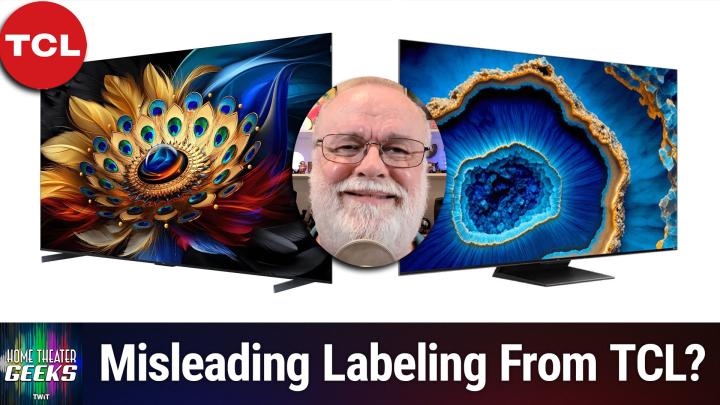
In this episode of Home Theater Geeks, I discuss a court case in which TCL is admonished for deceptive advertising. So stay tuned. Podcasts you love from people you trust. This is Twit. Hey there Scott, Matt Wilkinson here, the Home Theater geek. In this episode I'm going to talk about an article that a friend sent me from a German website called 4K Filma. Now, the article was in German, so thanks to Safari Translate I was able to read it in English. The title is QLED without quantum dots.
Scott Wilkinson [00:00:58]:
TCL loses in court for misleading TV advertising the article is by Dominic Yahn, stated March 4, 2026. We'll put a link to the article in the show notes and if you don't read German, you might want to use the Translate function in your browser or Google now. The article reports a decision by the Munich 1 Regional Court to condemn TCL for advertising so called QLED TVs as being based on quantum dots, which makes total sense, but in fact they do not use quantum dot technology. What? The verdict is not yet final. It's pending appeal, but this is pretty big news if you ask me. As you might surmise, the legal action was initiated by Samsung, which claims that some of TCL's model lines are advertised as QLED without actually implementing the technology, which is clearly misleading. The court said that there's no industry standard that defines what QLED means, but consumers have a reasonable expectation that quantum dots will be involved in some significant way, providing particularly noticeably better color reproduction. Apparently Samsung's documentation sufficiently proved this, while TCL's denial sufficiently did not.
Scott Wilkinson [00:02:57]:
So there were five series of TCL TVs that were included in the judgment. The C655, which we can see here in a product shot, the C69B, the C805, the QLED870 and the QM8B, which is seen here. Now these are all European models, but as I'll discuss a bit later, I found at least one US Model that could be prosecuted for the same misleading advertising. So I looked at the product pages on TCL's website for some of these European models that were cited in the lawsuit. The panel structure of the C69B, which we can see here, and the C805, which is the next one right here, seem to indicate that they use a what's called a quantum dot diffuser plate. This is otherwise known as qdp, and what that means is that the quantum dots are supposedly embedded in the diffuser plate, which is a piece of the LCD TV structure that diffuses the light from the backlight. And it's critically important, it has to be there or else you wouldn't get even lighting across the screen. Now embedding the diffuser plate with quantum dots makes sense in entry level TVs, which most of these are because it's less expensive than adding a separate quantum dot enhancement film it behind the diffuser.
Scott Wilkinson [00:04:49]:
So it would be a separate layer within the LCD structure. And that's how the higher end quantum dot based LCD TVs or QLEDs, that's how they work. Now if there are actually no quantum dots in the diffuser plate, or perhaps a minuscule amount, as is sometimes the case, and I'm talking parts per billion here, way lower than would be effective, TCL would need to do something to convert the light, the blue light from the blue LEDs in the backlight to white. And. And they would have to do that? Well, they wouldn't have to, but most likely they're doing that with phosphors, as has been done for many years. You coat the LED blue LED with red and green phosphors that red and green combined with blue from the LED itself, creating white. And that's how it works. Now the product page for the QLED870 shows more of a QDEF enhancement film structure which you can see here.
Scott Wilkinson [00:06:09]:
I honestly don't know if that's what this graphic depicts, but the QLED870 is one of the models named in the core proceeding and it's got QLED in the name, for God's sake. Now I want to mention a website that can help me and you make some sense of what a TV is actually doing and what is the actual color technology that it's using. And that site is ratings.com r t I n g s dot com. It's a great resource, I use it all the time. Unfortunately, it's now membership based. You can still get some information for free, but if you want to see the ratings and the measurement graphics, which are very instructive, you must be a member. So if you're shopping for a TV or you're a TV geek like me, membership is highly recommended. It costs 10 bucks a month or $45 a year and it's 30% off the first billing cycle.
Scott Wilkinson [00:07:31]:
So I would say go annual, be a lot cheaper. So more recent ratings TV reviews have a section. They're very long and very detailed. One reason I like them, they're also independent. But their TV reviews have a section called Panel technology which reveals The RGB sub pixel layout, in other words, how the red, green and blue sub pixels are laid out and what's called the spectral power distribution. So that's a graphic of where the red, green and blue peaks are in the color coming from the tv. And the text describes the source of colors. Are they quantum dots? Are they phosphors? And the panel technology section in the Art Ratings reviews reveals that.
Scott Wilkinson [00:08:32]:
Now unfortunately the TVs in the German case are not on ratings because they're European models. And I think ratings is more or less European ua, US and Canada based. But I did look at a few TCL US models to see what I could see. So for example, I looked at the TCL QM8K which looked like a very similar model number to one of those cited in the German article. And it does in fact use quantum dots, which is stated in the text. And you can see in the spectral power distribution you can see three sharp single peaks which are indicative of quantum dots. I also looked at the QM6K which is a lower end model and it uses phosphors as you can see here in the multiple peaks in red, there are three peaks in red and a wide green peak, all of which are indicative of phosphorus. And the text in the panel technology description part of that review also reveals that they are phosphorus.
Scott Wilkinson [00:09:55]:
Now, how does TCL advertise the QM6K? Well, you look on its website and it says the QM6K is quote QD mini LED. That quote combines the merits of QLED and OLED. It also utilizes the world's leading QLED technology. Well that, that's the advertising. But the review says something else. The review reveals that the QM6K in fact uses phosphors, not quantum dots. So there's some deceptive advertising going on there if you ask me. So it seems there's been no court case in the US about it, but it's clearly deceptive advertising.
Scott Wilkinson [00:10:59]:
So perhaps someone will bring legal action against TCL for that and other claims, maybe in the US. In any event, it uncovers a disturbing fact in TV marketing. I generally really like TCL TVs. I, I recommend them all the time, especially as low cost alternatives to the more expensive brands. Sony, Samsung, lg. But if they're doing deceptive advertising like this, I would be very careful. If you're considering a TCL tv, I think that's great. But look at the ratings review first and see if it is in fact quantum dot or not.
Scott Wilkinson [00:11:51]:
Are they promoting it as quantum dot or not. This is an important part of your due diligence when shopping for a new tv, and I just wanted to bring it to your attention. Now, if you have a question for me, send it on along to Htgwit TV and I'll answer as many as I can right here on the show. And if you have a home theater you're proud of, send me some pics. I'd love to take a look, and maybe we'll put it on the show for you. Until next time, geek out.