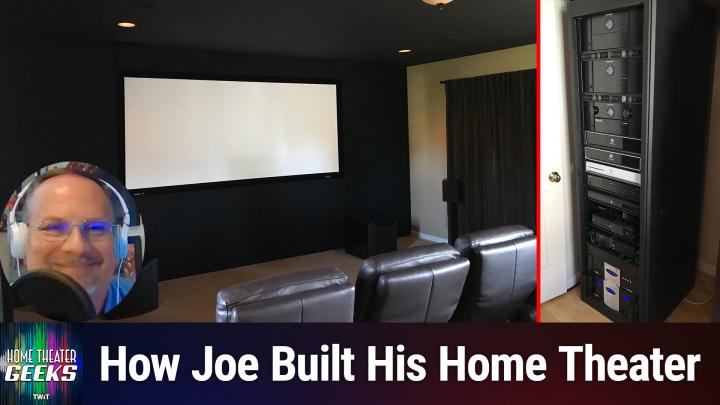
Home Theater Geeks 517 Transcript
Please be advised this transcript is AI-generated and may not be word for word. Time codes refer to the approximate times in the ad-supported version of the show.
Scott Wilkinson [00:00:00]:
In this episode of Home Theater Geeks, it's a new home theater of the month. So stay tuned.
Leo Laporte [00:00:08]:
Podcasts you love from people you trust.
Joe Klusnick [00:00:13]:
This is Twit.
Scott Wilkinson [00:00:24]:
Hey there, Scott Wilkinson here, the home theater geek. In this episode I am introducing a new format for Home Theater of the month where I actually have the owner on the show to talk about his home theater. This month it's Joe Klusnik from Sacramento, California. Hey Joe, welcome to the show.
Joe Klusnick [00:00:47]:
Thanks for having me. Appreciate being here.
Scott Wilkinson [00:00:48]:
Oh yeah, really happy to have you here because you've got a really nice home theater that I'm sure our audience will love to see.
Joe Klusnick [00:00:56]:
Absolutely love to share it.
Scott Wilkinson [00:00:58]:
Great. So let's get started by give me a brief outline of how you got interested in the home theater hobby.
Joe Klusnick [00:01:07]:
So I mean going back to being a kid when dad bought the first VCR and I helped, you know, hook it up and program it all the way through. Huge interest in car audio all through the teenage and college years. Worked at Circuit City and Good guys that turned into working for a local high end retailer which became industry job. Working for SoundStream Technologies, which was a company that was very well known for car audio, but also happened to be one of the founding members of Cedia back in the day. Worked for soundstream for a number of years and then went on to work for a company that had purchased a low voltage integrator. And that's where I got into my Cedia training and certification as well as a lot more of the product side of things and got a chance to work 101 with a lot more of the manufacturers. But all along the way had a huge passion for the movies as well as the technology that brought them to life and the rooms that we got to enjoy them in at home, you know, was, it was a big movie enthusiast as a kid and all product of the 80s. So you know, Aliens and Ghostbusters and the Indiana Jones and all those kind of movies were just ones that, you know, filled our days.
Joe Klusnick [00:02:25]:
So got to combine all of that when my wife and I got our first apartment and you know, with the 27 inch TV and got into surround sound then and kind of kept growing and building from there. And this is probably our third home that has had a home theater in it.
Scott Wilkinson [00:02:41]:
Yeah, it's, it's a story very familiar to me. An awful lot of us got our start with a love of movies and a love of audio and music and the technology that brought them to life and combining them together. So it's a very familiar story to Me. Exactly when did you. When did you get your current home?
Joe Klusnick [00:03:03]:
So we bought this house about 10 years ago. We moved from one part of Sacramento to another. The previous house actually selling that, having the theater. And it helped with it quite a bit because the person who bought it came and saw that and said, I'll take it just the way it is. So one behind. We looked at about 50 different houses up in this part of town until we found that met the family's needs. But also had a big empty bonus room above the garage that everybody in the family knew what we were going to do with that. So.
Scott Wilkinson [00:03:36]:
Right. In fact, we have some pictures of that room before you started remodeling, shall we say? Nice big empty room.
Joe Klusnick [00:03:46]:
Yeah. Start. Yeah. 19ft wide, about 21ft deep with nine foot ceilings. But just a big bonus room above the garage that fortunately has an office, a kitchenette and a bathroom on that floor. And that's about all that's up here. But was wide open. The previous owners looked like they maybe had a flat panel TV on the wall.
Scott Wilkinson [00:04:11]:
It looks like there was a. There was a frame or a mount up there. Yeah.
Joe Klusnick [00:04:16]:
And then there's a spot for a couple of rear speakers that were just blank panels at the time. So we had a little bit of pre wire to start with. Nowhere near as much as we ended up adding to it, but lots of windows, no door on the room, no dedicated H Vac. So there was lots of things that we were going to do to it. But this was the place where it all started for this room.
Scott Wilkinson [00:04:39]:
Boy, all those windows, you had to do something about blocking those, didn't you?
Joe Klusnick [00:04:44]:
Yeah, that was one of the things that we really did need to overcome. So we ended up on the side windows doing vinyl coverings and double blackout out drapes. So that helped get rid of a lot of the light coming in. It stays pretty dark. Now the front window ended up getting covered up when we redid the front wall also.
Scott Wilkinson [00:05:07]:
So what were your primary design goals with this theater? I mean, was it sound isolation? Was it number of audio channels, acoustic treatments, decor?
Joe Klusnick [00:05:22]:
Yeah. So it was really focusing on the experience. It lights off. What's it like watching a movie in there? How immersive can we make this? So to that end, we built it with a lot of the CDA guidelines in place. When we first started, sound isolation was just not something we could take into account because the house already existed. We did end up putting a door on here that helped to seal off the room. We did put in dedicated H Vac so that this part is split from the rest of the house so we can heat and cool this room individually. But one of the other key things was we wanted seating for 11 in our previous theater, that's what we had.
Joe Klusnick [00:06:05]:
My wife got used to that. And you know, from having friends or the kids friends or birthday parties or sleepovers, that was kind of one of the goals that we wanted to achieve was, you know, a full house.
Scott Wilkinson [00:06:18]:
That's very cool. So let's take a look at some pictures of the process that you underwent. First of all was the planning. How long was the planning?
Joe Klusnick [00:06:30]:
So I think the planning started the day I saw the house. What can I do with this room? Right, right. So some of the, the graphics that you're seeing now were we did kind of most of the way through it because we wanted to have finalized drawings of where things all fit into the room. The theater at this time is a 9.2.6 setup. So what you're looking at here shows some of the overhead speakers, the location of the riser, the projector, the counter, the kitchenette, etc.
Scott Wilkinson [00:07:02]:
This is a, this is an overhead view looking down onto the ceiling and through that onto the floor.
Joe Klusnick [00:07:09]:
You got it. But. But the planning process was probably about six months or so because we were, you know, moving into the house, getting everything else. You know, the honeydew list was long before we even moved in. But the whole time we wanted to keep a functional theater or at least a functional viewing experience going. So, you know, I started with a 60 inch Panasonic plasma and a Denon receiver and some speakers on stands and then kind of progressed from there that, you know, we added the in wall speakers, went to a screen, added more speakers, changed subwoofers, et cetera, et cetera. So it's been kind of a constantly evolving process. We didn't have a final destination for the plan in place when we started, just knowing that we wanted to make it as nice of a theater as we could.
Scott Wilkinson [00:07:56]:
Well, that's certainly a common process in home theater design. If we can see some others. This is the front wall.
Joe Klusnick [00:08:04]:
Correct. And there's. This is the LCRS behind the acoustically transparent screen. This is one was 130 inch diagonal, 235 screen. We've gone up from there. We'll take a look at that a little bit later on what the current screen is. But the speaker locations remain the same. Later on we added the wide speakers.
Joe Klusnick [00:08:24]:
You know, the. Originally the rear speakers were in ceiling. Those got switched to Atmos speakers, which fortunately, kind of came out right around that 2015, 2016 time when we were moving into the house. You know, the technology was evolving, so we were kind of adapting the plan as we went along to incorporate all the new immersive mats.
Scott Wilkinson [00:08:44]:
Sure. I think we have the drawings of the sides as well.
Joe Klusnick [00:08:48]:
Side windows, riser counter, right side speaker. Yeah, on that.
Scott Wilkinson [00:08:54]:
And then the next one is, I think, the left wall.
Joe Klusnick [00:08:57]:
Correct. So that was the entry door that we added, lighting switch that we had changed out that went to a Lutron graphic eye with multiple zones. Left side speaker and again the window.
Scott Wilkinson [00:09:07]:
That we darkened and finally the back wall. And you can see the rear speakers there.
Joe Klusnick [00:09:13]:
So I'm speaking to you from inside that office door that you're looking at the left and right rear speakers. That bathroom door is actually a little bit further back. There's. There's quite a bit of space that you can't tell from this particular drawing, but that's where the kitchenette is.
Scott Wilkinson [00:09:28]:
Now, it seemed to me that those rear speakers are a little close together, but there's probably nothing you can do about it.
Joe Klusnick [00:09:36]:
Yeah, it's going to be hard. Well, a combination of two things. One, it was tricky to try and get them symmetrical because if I push that left speaker out much further to the wall, I was going to be in the office door. And, you know, I listened to some of Anthony Grimani's comments and he actually prefers, you know, a little bit narrower location for those speakers. So that was kind of the best placement we could come up with.
Scott Wilkinson [00:10:01]:
Sure. Well, I would certainly listen to Anthony Grimani. I've had him on the show. I've known him for many decades and he knows his stuff.
Joe Klusnick [00:10:12]:
Absolutely. Good guy.
Scott Wilkinson [00:10:13]:
Yeah, definitely. Hey, Scott.
Leo Laporte [00:10:15]:
Hey, everybody. Leo Laporte here to tell you about our sponsor for this show. Yes, for this show, Helix Sleep. Scott, I don't know how you're sleeping these days. I've been reading a lot of information about how important sleep is for health, overall health, for longevity. I just read a story that said night owls are much more prone to early death and illness because they don't get enough sleep. Maybe you need a better mattress. If you're not getting enough sleep, this is the time to invest in a new mattresses.
Leo Laporte [00:10:52]:
We're in the winter and you're probably spending more time inside anyway. Maybe more time. You know, it's not just for sleeping. Your mattress is where you curl up to read a good book. I don't know if you have your TV in the bedroom, but it's a Great way to watch late night TV between the feet. It's also, I like to cuddle up with our kitty cat. She likes to purr. Mattress is more than just sleeping and now is a great time to invest in a new mattress and stay comfortable.
Leo Laporte [00:11:22]:
I want to tell you about our new mattress that we just got. I had seen a study that said I read a lot of studies that you should get a new mattress, replace your mattress every eight to 10 years. They wear out. Who knew? But actually you probably did know because it's starting to sag a little bit, creak. Maybe you're sweating at night. We looked all, everywhere, did all the reviews and I found Helix Sleep and I am blown away. No more night sweats, no back pain from a saggy mattress, no motion transfer with the old mattress. The cat would jump on the bed and I go, earthquake.
Scott Wilkinson [00:11:58]:
Not anymore.
Leo Laporte [00:11:59]:
Don't settle for a mattress made overseas with low quality and question. Rest assured, your Helix mattress is assembled, packaged and shipped from Arizona. And they do it on demand within days of placing your order. So it's brand new, it's fresh, you take it out of the box. It goes, it's so nice and it smells great and it feels great. We also did something that I recommend on the website. They have the Helix Sleep quiz. It matches you with the perfect mattress based on your personal preferences and your sleep needs.
Leo Laporte [00:12:32]:
And they have a very big variety. I'm a stomach sleeper. I like a firm mattress, that kind of thing. My experience, purely anecdotally, is we are sleeping better. I am sleeping sounder. But there's also science behind this. In a Wesper sleep study, Helix measured the sleep performance of participants after switching from their old mattress like we did to a Helix mattress. Here's what they found.
Leo Laporte [00:12:58]:
82% of the participants in the study saw an increase in in their deep sleep cycle. That's the most important one. And it's only for most people, half an hour, an hour a night. It's a small part of the overall, but it's critical. That's when your brain is clearing out all the old stuff. Participants, on average, so 82% saw an increase in the deep sleep cycle. On average, 25 more minutes of deep sleep. I should tell you again, anecdotally, that's exactly I was getting, I was going.
Leo Laporte [00:13:27]:
I went from about an hour to an hour and a half every night. Participants, on average achieved 39 more minutes of overall sleep per night. It makes a big difference. Time and time again, Helix Sleep remains the most awarded mattress brand. It's tested and reviewed by experts at Forbes and Wired everywhere. And they always win all the awards. That was one of the deciding factors for us. The other thing we loved, they deliver the mattress right to your door with free shipping in the US and if you're at all concerned, you can rest easy get it with seamless returns and exchanges.
Leo Laporte [00:14:04]:
It's very easy. But I've got to tell you, you're never getting my Helix mattress away from me. I love it. They're happy with Helix guarantee provides a risk free customer first experience because they care. Ensuring you're completely satisfied with your new mattress. We are now go right now to helixsleep.comtheater for 27% off site wide. It's their President's Day sale Best of Web exclusively for you, the listeners to the home theater geeks. That's helixsleep.com theater for 27% off the President's Day sale Best of Web.
Leo Laporte [00:14:38]:
The offer ends February 25th, so don't delay. Make sure you enter the show name after the checkout so they know we sent you. And by the way, if you're listening after the sale ends, don't worry, they've got great deals all the time. Check them out@helix sleep.com theater and please do me and Scott a favor and use that address so they know you saw it here. Helixsleep.com theater thank you, Scott. Now back to home theater geeks.
Scott Wilkinson [00:15:06]:
Okay, so then we get into the building phase. And again, as you said, this was a long process of things coming and going. You built a riser, for example. We have a few pictures of that.
Joe Klusnick [00:15:19]:
Yeah, the riser was added probably a couple years into the process. You know, we had started with a single front row that we wanted to add the back row and built the riser. This was a combination of, I think two by tens and two by eights. And it's intended to be something that worked as a bass trap but did not was not sealed up. So there's actually air gaps underneath all the stringers there that you can see. They don't go all the way to the floor and then it either end, there's a way for air to come into the actual enclosure itself so it didn't resonate excessively.
Scott Wilkinson [00:15:57]:
And there you can see like a lot of people, you put insulation, what we often call pink fluffy into in between the stringers for, I guess, base absorption.
Joe Klusnick [00:16:10]:
Yeah. And this is my son and I with the, you know, nail gun and saws. And yeah, it was a good weekend project to get that built. And Then one of the only things that we really contracted out was carpeting that. So I think you may have a couple of shots.
Scott Wilkinson [00:16:24]:
I do. We have. I think we do. Here's one with the. The, I guess, poly floor, the. The floor board of the riser. And then the next one shows it actually carpeted now.
Joe Klusnick [00:16:38]:
And you'll also notice that along the way, the seats change colors a couple of different times. One of the big challenges that we overcame in building this theater. Everything was upstairs, Right. This is a bonus room above a garage.
Scott Wilkinson [00:16:51]:
Yeah.
Joe Klusnick [00:16:51]:
And we went through probably four or five different sets of seats in this theater. Now there's 11 seats in that theater.
Scott Wilkinson [00:16:58]:
Getting them up and down the stairs.
Joe Klusnick [00:17:00]:
I burned out more of my kids and friends and favors and guys. Want to come over and help me move chairs this weekend? No, not really. Yeah. We started with one nice row of chairs, but then we wanted two matching rows. Picked these up. This was a row of fortress chairs that we had for a little while. Didn't love the.
Scott Wilkinson [00:17:22]:
I like those chaise lounge ones at the ends.
Joe Klusnick [00:17:25]:
They were comfortable, but little too much lumbar support for me on these chairs. And then they just didn't work with the color scheme in the room. So they lasted a little while until we got some chairs that came out of an actual commercial theater that had shut down down in San Diego, which were all motorized chairs with the numbers on them and everything. So it was kind of interesting, but they were past their prime, so to speak. And I eventually found the chairs that we finalized on. And those were. And I think we have a shot of them coming up a little bit, but they're brown leather cinema tech chairs. We actually purchased 12 of those secondhand.
Joe Klusnick [00:18:06]:
And that's what's in the theater still to this day. Eleven of those. And I have a spare in another room.
Scott Wilkinson [00:18:12]:
Well, we're going to see those in a bit. One of the things that I was interested in learning about was the fact that you ended up painting the ceiling black, which I really, really think is a great idea.
Joe Klusnick [00:18:26]:
Yeah. Which made a huge difference. In contrast, in that room, as it was previously, you walked into the room, you saw this black border that really trimmed out the screen, and then it's got a ton of white reflection when we'd be sitting there watching a movie. So fortunately, one of the things that we did, diy, my brother in law was a painter and volunteered to help out. So we masked off everything in the room. Jump forward a picture and you can see that. And used the tricorn black paint and really, you know, took this was again another weekend project. Go ahead and jump forward one more there.
Joe Klusnick [00:19:03]:
You'll see in process, you have the whole room wrapped in plastic. I was out spray can with the grills and speakers and lights and all that while he rolled the whole ceiling for us which was. Came out fantastic. Made a huge feeling change in the room as well as really helped with that contrast and the huge improvement in.
Scott Wilkinson [00:19:26]:
The visual contrast, the perceived contrast, I'm sure.
Joe Klusnick [00:19:29]:
And I can't thank my wife and daughter enough for letting me do that. I remember asking like, what do you guys think we painted the ceiling? I said, well, I said, what color would you want it to be? Well, I guess black to match the rest. I'm like perfect. That's the answer I was looking for.
Scott Wilkinson [00:19:42]:
Wow. Wow. Having an understanding spouse and kids is really important in this process.
Joe Klusnick [00:19:50]:
100%.
Scott Wilkinson [00:19:51]:
Yep. Exactly. And we saw also some of the images I saw that you have in your build thread on AVS Forum, which we're going to link to in the show notes so people can go see yet more detail. You built your own acoustic panels.
Joe Klusnick [00:20:09]:
Yeah, that was another DIY element of all of this. So using, you know, Owens Corning fiberglass built out frames that were hung on the walls with French cleats and then wrapped those in Guilford of main black fabric. Most of those are either 2 inch or 4 inch depth. So working as both a kind of a mid range and an upper base type of an absorber, but really helped to tame a lot of the reflections in the room. The entire front wall is also covered in 2 inches of lin acoustic, which is another duct liner type of material. But the nice thing about these two front panels is they kind of continued that black framing of that front wall to really help set off that image.
Scott Wilkinson [00:20:56]:
So at first we saw there the frame and now we see with the Fiberglass. Owens Corning 703. Is it? I believe so, yeah. It's stuck in the, in the gaps there. And yeah. So this is a good DIY thing that a lot of theater owners do. And, and it's a good thing too because it really improves the sound, huh?
Joe Klusnick [00:21:20]:
Yeah. And those have about a 2 inch air gap behind the panel too.
Scott Wilkinson [00:21:24]:
Oh, even. Okay, so that goes to a lower frequency frequency then, correct? Yep, yep. Cool. One of the things I wanted to highlight is the, and you've already mentioned it, the evolutionary nature of being a home theater owner. It. Things change. You, you upgrade, you swap out stuff. You did several seats, several sets of seats.
Scott Wilkinson [00:21:49]:
But you also, I, I Saw some pictures of your front lcr left center right speakers, which are behind the screen. You had one set here and then you swapped them out for another. Tell us a little about that.
Joe Klusnick [00:22:04]:
Yeah. So these were some reasonably priced Sonance speakers and these actually matched. All seven in wall speakers around the room were the same at one point. But then had an opportunity to go to another Sonance speaker that had an integrated back box, which really helped with, I think bass as well as the imaging up front. So we pulled out the front ones, cut some bigger holes in the front wall and put those three. And you can see there during the process. Yeah, trimming out the acoustic material as well as opening up those holes. And then you jump ahead another one.
Joe Klusnick [00:22:45]:
You can see kind of what it looks like finished. And then so the front three speakers as well as the two wide speakers that I'm currently using are all identical. So all five across the front of the room are the Sonance LCR ones. Both the in wall and a cabinet speaker.
Scott Wilkinson [00:23:01]:
Super important to have those all be the same speaker for consistency of tonal balance as things pan across the screen.
Joe Klusnick [00:23:10]:
100%.
Scott Wilkinson [00:23:11]:
Yep, exactly. I find that hole at the bottom interesting. That's what storage. I thought that might be like a subwoofer niche.
Joe Klusnick [00:23:20]:
You know, we did consider that that almost became an infinite baffle location. But that is a small amount of attic storage space. That's a kind of just a little crawl space, triangular room back in there above the garage again. So now it just. We end up storing a lot of, you know, boxes and old equipment and things like that down there. So my kids loved it when we bought the house. They thought that was going to be their escape room, but it ended up getting covered up. Yeah, yeah.
Scott Wilkinson [00:23:50]:
All right, all right.
Joe Klusnick [00:23:51]:
Still have access to it though. It's easy to get to.
Scott Wilkinson [00:23:53]:
That's good. That's good. So you alluded to doing a lot of this diy. I assume most of it was right.
Joe Klusnick [00:24:00]:
Yeah. Other than the lubric carpeting work that we subbed out as well as the H vac, everything else was done by myself with help from friends, kids or brother in law. So, yeah, this is all a labor of love kind of thing.
Scott Wilkinson [00:24:16]:
Oh yeah. Oh yeah. I know it well. What would you say were your biggest challenges?
Joe Klusnick [00:24:23]:
Well, I think we touched on a couple of them. One being the windows in the room. You know, if I had built this house from scratch, I think that we would have skipped a lot of the light challenges and issues that we have now. I think being located upstairs, lots of carrying back and forth.
Scott Wilkinson [00:24:43]:
That's a challenge.
Joe Klusnick [00:24:44]:
Yeah, the sound isolation. So like I said, we did eventually put a solid core door on this room to really kind of try and keep the acoustics in, help with pressurization of the bass in the room. But originally that was just an opening into the room and then, you know, coming up with the. The funding of this project. So my wife and I have always kind of had a deal that I can do whatever I want in the room as long as it doesn't materially impact the household finances. So, you know, I've bought and sold tons and tons of gear over the years. A lot of times I'll buy a bunch of equipment, sell off what I don't want, and you keep pieces or use those funds then to buy, upgrade new pieces of equipment. So constant, always turning over gear as we've been building the room.
Scott Wilkinson [00:25:35]:
Speaking of finances, what would you estimate you have spent on the theater, if you're willing to share that information?
Joe Klusnick [00:25:44]:
Yeah, there's probably three different numbers.
Scott Wilkinson [00:25:46]:
Right.
Joe Klusnick [00:25:46]:
There's what I tell myself, what I tell my wife, and what it will cost in retail. No, I kid about that, but I would say, yeah, I'm probably retail. If I look at all of the gear, the seats, the, you know, the installation, all that, there's probably150,000 or so that I've spent. If I would have bought this all off the shelf.
Scott Wilkinson [00:26:12]:
And I was going to mention that because you're in the industry, you can probably get a lot of stuff at cost.
Joe Klusnick [00:26:18]:
Yeah, that. At cost or deals or friends, things like that. I probably used Facebook, marketplace, Craigslist. Yeah, ebay, you name it. I bought almost everything in the theaters is used gear, But I probably, maybe I spent 20% of that if I actually looked at it. And then it also depends on, you know, if I. If I had a Marantz receiver, I sold that one and bought a Marantz preamp, and then I sold that preamp, bought another one. Right.
Joe Klusnick [00:26:46]:
So that. That money keeps getting reinvested or turned over in the system. So it's kind of hard to keep all those numbers straight.
Scott Wilkinson [00:26:54]:
Understood. Understood. Still, it's good to sort of have a ballpark so people who are watching this or listening to this can sort of get an idea of, well, if you, if you go to this level, even if you're doing a diy, you know, it's going to cost a pretty significant chunk of change.
Joe Klusnick [00:27:10]:
Sure.
Scott Wilkinson [00:27:11]:
And then if you hire somebody to install it for you, then you're looking at Several times that amount.
Joe Klusnick [00:27:17]:
Yeah. How much of your own blood, sweat and tears do you want to put.
Scott Wilkinson [00:27:20]:
Into this, which is part of the fun of the hobby? Right?
Joe Klusnick [00:27:23]:
100. I think that this hobby, it's about enjoying the movies, it's about enjoying and upgrading the gear. It's about liking what you have now, but planning for the future.
Scott Wilkinson [00:27:34]:
Right.
Joe Klusnick [00:27:35]:
And I think that's why it continues to evolve and change and grow. I think I've had four or five different Marantz preamps in that equipment rack that I'm looking at in my office here over the time that it's been in this theater. So, yeah, buying, selling, planning for are all part of the hobby, I think.
Scott Wilkinson [00:27:56]:
What would you say are. Was the greatest moment of the. Of the process so far?
Joe Klusnick [00:28:03]:
I think, you know, just being able to spend time with the family and friends watching programs, whether it's, you know, watching a Super bowl game or watching movies for the first time. We watch a lot of TV up here also. So whether it's cheesy reality shows or the Oscars, you know, you name it, it's just being able to spend time with the family watching this system together.
Scott Wilkinson [00:28:29]:
Another critical part of the hobby. Unlike audio files, who typically. More typically tend to have one chair between two speakers and they sit there by themselves. Yeah, it's meant to be shared.
Joe Klusnick [00:28:42]:
And my wife and I do enjoy music up here too. We'll watch videos, things like that. Yeah, but we watch a lot more movies and programs than that.
Scott Wilkinson [00:28:51]:
Right, right. Well, one of the things I've wanted to do for a long time on Home Theater Geeks, the home theater of the month here is to show. Is to give people a little tour. Tour of the current system. And. And I'm really happy that you managed to shoot some video of your room, starting with the entrance, up the stairs. The grand staircase.
Joe Klusnick [00:29:15]:
Yeah.
Scott Wilkinson [00:29:16]:
Which includes a bunch of great movie posters. So tell us about what we're looking at here.
Joe Klusnick [00:29:23]:
Yeah. So you passed through the cd, my awards and certifications on up through movies that have meant a lot to me, whether it was family favorites. So the Avengers movies, Back to the Future is one of my wife's favorites. Some of these posters hung in my college dorm room, the Arnold Schwarzenegger stuff years ago. My oldest son is a big fan of Lego, so we have those in there. You know, the Transformers stuff, the Michael Bay big explosions. And then we get into, you know, the Star wars poster that was in my son's room when he was. Was a kid.
Joe Klusnick [00:29:58]:
The Raiders of Lost Ark, which meant a Lot to me. And like I said, being a product of the 80s, both aliens as well as Ghostbusters. And then the two at the top of the room are actually rotating digital posters. So these are. Yeah, a couple of 42 inch screens that go through about 12,000 digital files.
Scott Wilkinson [00:30:19]:
No kidding.
Joe Klusnick [00:30:20]:
Yeah. And they're set on timers so they run anytime where I think I'm going to be home.
Scott Wilkinson [00:30:25]:
Home.
Joe Klusnick [00:30:25]:
And then there's the door we added to take you into the theater that's.
Scott Wilkinson [00:30:28]:
On the right there. Okay, let's take a look at the next video.
Joe Klusnick [00:30:33]:
So stepping into the room, I think you'll see the fade up from dark and light into the room. So that.
Scott Wilkinson [00:30:42]:
Thank you. Lutron lighting control.
Joe Klusnick [00:30:44]:
There you go. So you'll step in, you kind of come into that back left corner of the room and there's a row of five chairs in the back and six in the front. And you're facing that 150 inch screen. This is a pan of the room kind of going across that back row and you can see kind of everything we talked about. The acoustic treatments, the wide speakers, the new screen, all of Those chairs, the 11 seats, the window treatments to keep things dark, that black painted ceiling and the kitchenette in the back corner there.
Scott Wilkinson [00:31:17]:
It's nice having a kitchenette in the theater.
Joe Klusnick [00:31:21]:
I'll show you some video of that in a sec. But here's the big 150 inch screen. And then this is a pan from the front corner. You see the, you see the wide.
Scott Wilkinson [00:31:29]:
Speaker a little better in this one.
Joe Klusnick [00:31:30]:
Yeah. Subwoofers on the floor up front there. The acoustic treatments on the walls and ceiling.
Leo Laporte [00:31:36]:
Very nice.
Joe Klusnick [00:31:37]:
ABC projector, the 11 chairs, a riser. You know, we have just the walkway down to one side of the room. There's the other wide speaker. But you know, this works out functionally really well for us in that everybody coming in and out. It's, it's, it's limits my subwoofer placements a little bit. There's just not a lot of other room except that front wall. But this is from the other corner of the room. You see the chairs again, the acoustic treatments.
Joe Klusnick [00:32:03]:
That's my office door. You can see the bathroom door back there in the corner. But yeah, this is just kind of the, the view from the front corner of the room. There's two svs subs, one in each front corner. And then that's that big C more screen that we finally upgraded to with motorized masking. We'll see in a little bit back in the Kitchenette, you can see some of the Mission Impossible posters, the thermostat there that controls this entire room. The door we added and then, you know, just kind of pan and see the room from a different angle here.
Scott Wilkinson [00:32:36]:
Yeah. With all those nice acoustic treatments on the wall. I see the side, side surround there.
Joe Klusnick [00:32:42]:
Yeah. And hard to see on that black ceiling. But there is diffusion on the ceiling. As well as six speakers for the Atmos overhead. Four of those are in wall and two of those are hanging from the ceiling because one is right in between some H Vac as well as over a walkway. We'll see that a little bit too. As I mentioned, the kitchenette is stocked with candy popcorn. You know, we've got the microwave there as well as the, the, the soda and beverage refrigerator and the sink to clean up afterwards.
Joe Klusnick [00:33:19]:
So having the kitchen up there, super convenient. During COVID I lived up here for a couple of weeks at a time because didn't need to go anywhere else. These are the other posters in the back of the room that I mentioned. The Mission Impossible. One of my sons worked at a movie theater, so a lot of these came from his time with that employer. But yeah, you just get a different feel for it. This is, like I said, the bathroom is just, just the back of that room. You get a feel for walking across the back row here.
Joe Klusnick [00:33:50]:
This helps me keep those seats away from the rear speakers and gives, you know, a better surround experience.
Scott Wilkinson [00:33:57]:
Yep, yep.
Joe Klusnick [00:33:58]:
On them. And you'll see the screen is in that 16x9 mode right now. We'll look at the motorized masking in just a little bit.
Scott Wilkinson [00:34:05]:
Oh, good.
Joe Klusnick [00:34:06]:
You also, as you kind of pan up JVC projector, the acoustic treatments.
Scott Wilkinson [00:34:12]:
Oh, yeah. See the diffusers up there?
Joe Klusnick [00:34:14]:
Yeah. And then right above where I'm standing, but you can't see is the H Vac return as well as a whole house fan. All it's painted black, so it's hard to get great video of it.
Scott Wilkinson [00:34:25]:
Yeah.
Joe Klusnick [00:34:25]:
There you can see the speakers hanging down in the rear heights as well as the rear speakers in the back wall. But this is just walking across the front of the room. You can see some of those chairs are less than perfectly placed close to a wall. But again, to get 11 in there, it's. You don't have a lot of choices.
Scott Wilkinson [00:34:46]:
Yeah, yeah, yeah, yeah. You wanted 11. You know, you had certain goals and you, you met them. That's. That's great.
Joe Klusnick [00:34:53]:
This is the cinema tech seating that we ended up with. These actually came from a Hollywood producers planned theater that never got Built. We drove down to Southern California and picked these up. Used.
Scott Wilkinson [00:35:06]:
Wow.
Joe Klusnick [00:35:07]:
This was supposed to go into a theater in Ojai that never got built.
Scott Wilkinson [00:35:11]:
It never happened. Wow.
Joe Klusnick [00:35:12]:
Yeah. So they're, they're here now, which is nice.
Scott Wilkinson [00:35:14]:
Uh huh. It's a beautiful room. It's just really, really good.
Joe Klusnick [00:35:20]:
Yeah. And it's, you know, here you can see the H vac to return as well as the whole house fan entrance. But you know, we weren't trying to overdo anything in this room. It's, it's not super fancy, it's not themed. This is kind of the view from the projector onto the little bit darker view of the screen there. But it's, it's a super functional room. You know, it just, it does everything that I needed to and when the lights are off, everything disappears.
Scott Wilkinson [00:35:48]:
Yeah, yeah. Function was the most important thing here, clearly.
Joe Klusnick [00:35:54]:
So that's the top acoustic treatments. Trying to get a shot of those and just kind of panning across.
Scott Wilkinson [00:35:59]:
Really hard to do in a black room like that.
Joe Klusnick [00:36:02]:
Yeah, they blend in pretty well, which.
Scott Wilkinson [00:36:05]:
Is what they're supposed to do.
Joe Klusnick [00:36:07]:
Absolutely.
Scott Wilkinson [00:36:08]:
You're not supposed to see them. Yeah.
Joe Klusnick [00:36:09]:
But it's, it's a very, you know, black and tan kind of brown functional color scheme in the room.
Scott Wilkinson [00:36:15]:
I'm a little surprised you didn't, didn't do a black carpet at the, in the front.
Joe Klusnick [00:36:19]:
So I've got two Labradors that love to shed. So it wouldn't have stayed black for very long.
Scott Wilkinson [00:36:25]:
Ah, okay, now I get it.
Joe Klusnick [00:36:28]:
Yeah, we have considered that, but ruled it out for now.
Scott Wilkinson [00:36:32]:
For now. Yeah.
Joe Klusnick [00:36:35]:
Wow. But yeah, the seating in there is super comfortable. Motorized seats, adjustable headrest.
Scott Wilkinson [00:36:41]:
Oh, here's the mask.
Joe Klusnick [00:36:42]:
Yeah. So this screen masks from 150 inch diagonal 69 down to 235. And then I open it back up to like a 2.0 to 1 and then all the way back up to 16 by 9. Really like this because it gives the ability to watch everything from Netflix to over the air broadcast to Kaleidoscape, all in the correct aspect ratio. I have for a long time ran, you know, a 235 only screen with big black bars on either side. And then the great thing about the motorized top and bottom masking is with a constant image width, everything we're watching fits that screen correctly.
Scott Wilkinson [00:37:21]:
I was going to ask you why did you go constant image width rather than constant image height?
Joe Klusnick [00:37:27]:
So the reason being that the constant image width, it was really more about fitting as much of the programming out there. I'm a Big movie fan. And so being able to watch in 235 we can do. But with all of the movies that are coming out with either variable aspect ratio, a lot of the programming that's in 2.0 to 1, you know, a lot of the stuff on Netflix that we're streaming or watching sports or broadcast in 16 by 9. I really didn't want to have black bars left and right. I didn't want to have black bars above and below. So I picked up this screen, and the great thing about it was that I got it again, used from another AVS Forum member, drove down to the Bay Area, took a look at it. He showed me how to take it apart, brought it home, put it back together, and I took the place of what was 120 inch wide screen.
Joe Klusnick [00:38:17]:
This is 130 inch wide. So even my 235 got bigger and better as part of this whole process.
Scott Wilkinson [00:38:22]:
Mm. And it sounds to me like you prioritized two, three, five movies because that was mostly what you wanted to watch. Right.
Joe Klusnick [00:38:32]:
You know, a lot of what's coming out today is 235, but if you go back to the 80s, so much of it was 185 or 16x9. So I was watching Aliens, for example, and had, you know, big black bars on either side with the previous screen. And now I've got it at 150 inch and it fills the entire screen. So that's kind of what we were doing. Going for the motorized masking I had previously had in another theater, masking panels that we had installed manually, but they never got used very frequently. Right. They would end up sitting on the floor or not getting up and down each time the movie aspect ratio changed. And with my.
Joe Klusnick [00:39:08]:
My individual way of watching a lot of times is on a kaleidoscape and I'll watch scenes and jumping from scene to scene, movie to movie. There's a lot of programs that. That don't fit, you know, one particular type of screen or size of screen. And if you look at something like Sinners or Top Gun, Maverick, where we're jumping, I didn't want to be cropping off tops or bottoms of movies or, you know, I wanted an aspect ratio that would fit everything I could watch.
Scott Wilkinson [00:39:36]:
Yeah, and there are a lot of movies these days and a growing number, I think, that change aspect ratio. Some of Christopher Nolan's movies, James Cameron, I think, has done this as well. And your system adjusts that automatically.
Joe Klusnick [00:39:56]:
So I could. I've. If I'm going to watch something that's Variable aspect ratio. I'll probably just stay in 16 and watch it that way I'll adjust it down. I could. It depends on how often it changes within a movie. Right. So if it's, you know, I'm probably not going to annoy the audience sitting with me by trying to move it during the presentation right now usually that.
Scott Wilkinson [00:40:16]:
Would be kind of distracting. That's true. Yeah, yeah, yeah. You mentioned Kaleidoscape, which is probably your primary source device.
Joe Klusnick [00:40:26]:
Yeah. So if you want to jump over to the video of the equipment now.
Scott Wilkinson [00:40:28]:
We can talk about the equipment. There we go.
Joe Klusnick [00:40:30]:
So the equipment rack starts top to bottom. Marantz 16 channel channel amp. That's the amp. 10 cooling fans. This is the Marantz AV10 preamp oppo UDP 203 which gets little use now. Kaleidoscape Terra, Kaleidoscape Strato disk drive for importing. Couple of tivos, Xbox movies and drawers and then power conditioning some of the older monster power stuff from years ago. But yeah, I think Kaleidoscape and as well as the Apple TV are the two things that we watch the most these days.
Joe Klusnick [00:41:05]:
The oppo and the TiVo are still there and get some use, but nowhere near as much as they used to. All of the movies I've been buying lately have been just the digital downloads from Kaleidoscape.
Scott Wilkinson [00:41:17]:
There are a number of.
Joe Klusnick [00:41:18]:
Go ahead.
Scott Wilkinson [00:41:19]:
Sorry. For those who don't know about Kaleidoscape, it's a service and it's some hardware where you can. Where you buy movies and download them into this massive hard disk server. And then the player piece plays it out to your system and it's the same quality as Blu Rays or Ultra HD Blu Rays as opposed to streaming which is often much more highly compressed.
Joe Klusnick [00:41:50]:
Exactly. And I've gone through several stages of the Kaleidoscapes. Started with an Alto 6 terabyte unit, went into a Strato 10 terabyte, had a Tera 24 terabyte and kept filling that up and running out of space. And I like keeping all of my movies here. I want to have to go up now to the cloud. I don't know if the Internet can be down etc. So finally upgraded to an 88 terabyte for storage. So now have the 10 plus the 80.
Joe Klusnick [00:42:20]:
It's almost 100 terabytes of storage.
Scott Wilkinson [00:42:22]:
Wow. And I'll bet you that's pretty full by now, right?
Joe Klusnick [00:42:25]:
It's about half full. So I got room and I 600 or so movies on there. But yeah, room to Continue growing it.
Scott Wilkinson [00:42:36]:
Oh, I was going to ask you.
Joe Klusnick [00:42:37]:
What'S the seating distance, front row to eyes? Depends if you're reclined or not, but it's 10 to 12ft, depending on which way you're you're sitting. And then back rows, probably about 16, 17ft or so. That is one challenge in the room. I wish I had more space between the rows, but to get as much in there as we could, that's where we're at.
Scott Wilkinson [00:43:04]:
That's part of the game is you have to make compromises. There are very few places that are perfect except if you build it from scratch. Even then you're going to run into compromises. And that's one of the art. One of the things about the art of home theater is how do you get around those compromises?
Joe Klusnick [00:43:28]:
And my preference for viewing, I'm definitely front row center. My wife actually prefers the second row just because she, you know, if we go to a commercial theater, we do sit a little bit further back for some movies because that's where she likes to be.
Scott Wilkinson [00:43:42]:
Exactly. Well, Joe, thank you so much for being here and inaugurating the new home theater of the month on home theater geeks. I really appreciate it. You did a magnificent job with this theater and I wish you all the best and continued enjoyment.
Joe Klusnick [00:43:59]:
Well, thanks, Scott. I got two more videos if we can jump into real quick.
Scott Wilkinson [00:44:02]:
Oh, I'm sorry, I thought we were done. No, no, please, let's, let's take a look.
Joe Klusnick [00:44:07]:
So not only in the office is the equipment rack, but also custom video game system. So this was a present from the family for my 50th birthday. And I talked to you about going to the movies as a kid and use playing spinning quarters in the arcade was always a big part of that. So this is a four player arcade system.
Scott Wilkinson [00:44:25]:
Oh my God, look at that.
Joe Klusnick [00:44:27]:
With custom graphics on this. And it's got hundreds and hundreds of games that all kind of date back to, you know, 80s 90s arcade golden era. And then also in this room, I think the next video will show you some of the poster collection that's in here. So these are remaining movies, Ghostbusters, toys, memorabilia, and then these are the more prized autograph posters.
Scott Wilkinson [00:44:55]:
I was gonna say, I thought I saw in some of the photos you have some really nice autographed posters.
Joe Klusnick [00:45:01]:
Yeah, so the, the Star wars, the Pirates of the Caribbean and the Spider man are all, all autographed by the original cast. So those are all a little more unique and don't change out as much as the posters. In the rest of the theater or kitchenette or hallway. But yeah, so that's, that's.
Scott Wilkinson [00:45:20]:
So there's your. There's your rack in your office.
Joe Klusnick [00:45:23]:
Yep. Everything got wired from that closet to the rest of the theater.
Scott Wilkinson [00:45:28]:
And the nice thing about putting the equipment rack in your office is that it's noise. I mean it, you know, equipment generates noise and it's isolated from the theater.
Joe Klusnick [00:45:40]:
Noise and heat. Right. So I'm able to fan cool this stuff. I don't hear the spinning hard drives. The only thing that makes noise in the theater. Well, the projector hanging from the ceiling, which there's plans for either a future hush box or possibly moving it back into do this room and doing a cut through for a window, but masking motorization, a little bit of noise. And then if you really listen for it, you can hear the refrigerator a little bit. Other than that, it's pretty quiet.
Scott Wilkinson [00:46:12]:
Yeah, sounds good. So did we finish all the videos that you had?
Joe Klusnick [00:46:19]:
Yeah, that's everything we shot.
Scott Wilkinson [00:46:21]:
Okay, good. That's good. Okay. I didn't want to leave anything out because it's. It's magnificent. Appreciate that. I really want to show people what can be done even with a spare room.
Joe Klusnick [00:46:33]:
Yeah. And this, this bedroom is, is on the small side, but it makes for a great office.
Scott Wilkinson [00:46:39]:
Oh, right, the next to the theater room. Behind the theater room.
Joe Klusnick [00:46:42]:
Yeah. Yep.
Scott Wilkinson [00:46:44]:
Fantastic. Well, again, thank you so much for being here. I really appreciate it.
Joe Klusnick [00:46:50]:
My pleasure. Thanks for letting me the first one to talk home theater of the month and really appreciate it and looking forward to continuing listening and watching home theater geeks.
Scott Wilkinson [00:47:01]:
Thank you very much. That's Joe Klusnik in Sacramento, California with his wonderful home theater sitting above his garage. And it's a work in progress as all home theaters are. So I look forward to checking in again later and, and seeing what new additions and upgrades Joe might have done at that point. Now, if you have a question for me, please send it along to HTGWIT TV and I'll answer as many as I can right here on the show. And if you have a home theater that you're proud of, just as Joe is justifiably proud of his, send me some pics and links, little description also to HTGWIT tv and maybe we'll get you on the show to show everybody else the fruits of your labor. Until next time, geek out.