Hands-On Windows 160 transcript
Please be advised this transcript is AI-generated and may not be word for word. Time codes refer to the approximate times in the ad-supported version of the show.
Paul Thurrott [00:00:00]:
Coming up next on Hands on Windows. It's a day that ends in Wye. So we've got some More new Windows 11 features, podcasts you love from people you trust. This is Twit. Hello, everybody, and welcome back to Hands on Windows. I'm Paul Thurad and this week we are going to look at some new features coming to 25H2. As I record this, we're kind of late in the game. Microsoft has acknowledged the name.
Paul Thurrott [00:00:31]:
We talked about that in our earlier episode. They've released it to release Preview. It should be going into kind of like stable preview, if that makes sense. Through a preview update. I would say in September. Nope, actually in October 2025, and then probably broadly to everybody by November. So you'll be able to get it soon. Actually, you could get it now if you don't mind putting a PC in the release preview.
Paul Thurrott [00:00:52]:
But since they announced the name was official and since they pushed it into release Preview, they've actually started releasing more new features. So these are things that will just go out to everybody on a supported version of Windows 11. So if you have 24H2 or 25H2, when that comes out, you should be getting these also. I should just qualify this by saying the unfortunate reality of Windows 11 is that these things don't go out the same time to all computers. So I worked on this list on a different computer, came here, and some of the features aren't on here, of course. So I have screenshots for at least some of these and then we can kind of get through it that way. But that's, you know, that's the nature of Windows. So the first one is lock screen customization.
Paul Thurrott [00:01:35]:
Now, I know that one's not here, but I'm going to check just in case. And so over time, Microsoft has been allowing people to customers to customize this lock screen in different ways. This one is just the old system. If you have widgets, you can have them all. You can have none. These are your two options. So it says weather and more. But I do have a set of screenshots showing the new interface for this.
Paul Thurrott [00:02:03]:
And so. And that is not it. So let me find that. Oh, here we go. So this is what it's going to look like soon if you don't see this already. And what you get here is the ability to determine which widgets are here, which order they're in. You can only have four. You can add a widget, and if you add a widget, it will replace the thing that's on the bottom.
Paul Thurrott [00:02:21]:
And you can see actually these two options here are kind of oddball ones because those aren't the default items. Usually it's weather, today's moment, whatever that is, finances and sports. Right. And so I did two ads and it's much like the widgets interface. That's right on the Windows 11 desktop where you see a list of available widgets. There'll be more soon, hopefully from third parties, et cetera. But this is kind of a nice thing. So you can turn it on or off as before, but now you can also determine which ones appear and the order they appear in.
Paul Thurrott [00:02:53]:
Or you will be able to soon if you don't see that. Yeah, there you go. There's also another suggestion thing down here. I'd recommend turning that off, but I'll leave that one up to you. Okay, so there's that and then this one I don't have a shot for, unfortunately. But they are also changing the widgets interface that's on the desktop. And so basically what you're going to see here soon is a side rail or a navbar where you get a choice between all widget view or a widget view with a Discover feed. When you go into this settings interface, which is about to be much more streamlined than you see here, you'll be able to select other feeds to add those to the widget board as well as other widgets.
Paul Thurrott [00:03:35]:
Of course I checked that today, there are still no third party feeds. So this is more theory than reality at this point. But that is coming, so we'll get there. And that's actually a really nice update. So unfortunately I can't show that to you. So over time, Microsoft has been improving various parts of Windows for people with copilot plus PCs. We talked about semantic search in an earlier episode, Copilot Vision, obviously recall and click to do and all the other features that are there. But one of the best ones to me is just the way they're improving search kind of across the board.
Paul Thurrott [00:04:15]:
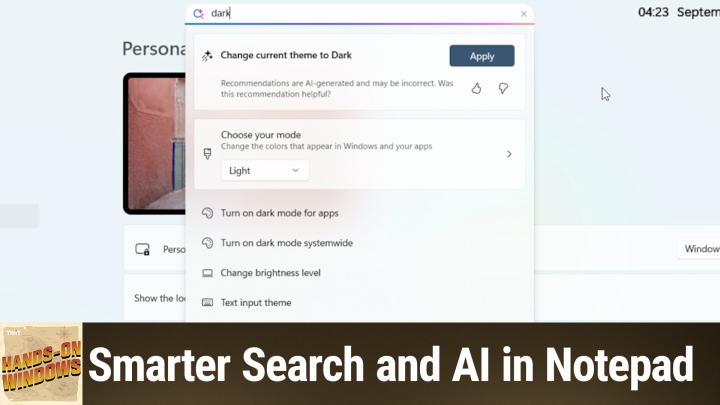
So semantic search, which is available in the file system and File Explorer, it's available through start search, etc. But also now we have this kind of setting search. And so this one is interesting because there's two components. There's the natural language part. So if I type in say something like dark, it understands that, you know, maybe, or tries to understand that maybe I'm looking for this kind of thing or I can type in like taskbar. And then what we're starting to see are these AI recommendations at the top. Now this one I guess it's a reasonable recommendation. That's kind of interesting.
Paul Thurrott [00:04:52]:
But better still than this is a feature that's not yet on this particular computer, which is inline AI based. I think of this as a Do it. Instead of clicking on a link to go to a page in Settings where you can look for the setting that does the change. You can actually just do it right here in line. Right. And so this is a. They call this a settings agent for some reason. This uses a small language model that's running on the computer.
Paul Thurrott [00:05:24]:
It's literally customized and optimized just for Settings and all of the options that are in Settings. That's all it does. So you'll be updating that thing every month for the rest of your life. But useful, right? This is useful. This is a Byzantine app. You shouldn't have to know where things are. It's. It's not a.
Paul Thurrott [00:05:40]:
It's actually kind of a decent idea. More just a better view here for a little while. More changes to File Explorer. So if you have this default home page on I'm getting a recommended file. This is because it's something I've been looking at a lot. Apparently this was a feature that was in File Explorer about a year ago, but only for people who sign in with a work or school account. Now it's coming to consumers as well. If I go into the Pictures folder and right click a photo, there's a lot of changes coming to this context menu as well, which you also get on the desktop.
Paul Thurrott [00:06:16]:
Right. This style of context menu. But there's more stuff if you do this with a file so subtly. They've changed this a couple times. Remember, this used to just be these icons which were kind of like hieroglyphics and then they added the words so you understand what they are now there's a little line between them. So that's cute, but that's not really all that exciting. They're starting to change the icons over here so that they match the way the icons look over here, meaning they're not square. So actually you do see that here on the other system I was using today, these are still square.
Paul Thurrott [00:06:47]:
And that's what it's looked like since Windows 11 came out. I don't know why, but anyway, they're updating that visually. That's not a big deal. The bigger deal is that actually, let me go back to this right here. What we have is a share item that's the same thing as this share up here. One of the other updates brings a share with and Then you get a submenu with all of the applications that are compatible with that thing. And you might ask, well, I could do open with what's share with. What's the difference? And the difference is that the item that could be in here could not.
Paul Thurrott [00:07:19]:
It doesn't have to be the name of just the app. It could literally be a feature in an app. So if it just says the app's name, you'll actually go to the thing that makes most sense in that app for whatever that thing is, for whatever it is you're trying to do. The other thing that's going to be happening a lot is this menu, which used to be delightfully small, is about to be horrifically long. And it's going to be because of the things you see down here. And so these look like standard shortcuts. You know, edit this thing in Notepad, which doesn't make sense for an image, but edit and paint, you see some that actually have a sub menu because there are multiple options that's tied to that thing. I noted above about diving into the actual features, but as we add more and more AI functionality to Windows, you're going to start seeing more and more of those things appear.
Paul Thurrott [00:08:03]:
Third party apps going to do this. And so this is, I don't know how we're going to handle this. This is already almost too big for the screen. So this is going to be an interesting problem. But on this particular computer, we don't see that quite yet. If you are familiar with what they still call the notification center for some reason, even though it's not a center, it's two floating windows now, but they're tied together. So one is this calendar view, which is collapsed by default, actually, but I expanded it. And then the notification pane up here and they appear like they did in Windows 10.
Paul Thurrott [00:08:35]:
You know, you click the time and date, but there's functionality missing from here that was in Windows 10, including the ability to integrate with your schedule in here. So they're not actually adding that. But interestingly, if you go into adjust date in time, there's now an option to show time in Notification Center. And what that does is bring this thing back. Right? And so this is what this looked like or still does look like in Windows 10. So there were a lot of people who, you know, said, look, I kind of like, you know, I kind of rely on having the time there. Why can't I have the time there? So now you can have the time there. So that's pretty cool.
Paul Thurrott [00:09:10]:
The, the Inbox apps have been getting a lot of. Oh, actually do it. Let me go back to this real quick. I guess I did take a screenshot of this. So actually going back to that right click context menu, you can see in this version, those are all squared up. So this is the old style icon. You can also see that this thing has more of these options down below on a similar file and the Share with menu that I was talking about. So there's a whole, you know, this is going to be this convoluted mess of things.
Paul Thurrott [00:09:42]:
And so that's going to be fun for all of us, I guess at some point. But the Inbox apps in Windows 11 have been getting a lot of attention, especially Notepad paint and snipping tool, which is kind of interesting Today I'm just going to show you some stuff that's in Notepad because this app is. Amazes me how much they've changed it and yet it's still really, really good. So I'll just put in some fake text here just so it can do something. So if you're familiar with the Notepad today, you know that it does has this markdown menu. It's got different options before than it had before and so forth. And it has this copilot integration. So write is actually fairly new.
Paul Thurrott [00:10:23]:
In fact, let me clear that out. If you go here with nothing there, write will be the only option. And you could say something like write a blog post about all the changes coming in Windows 11 version 25H2. And if this was working correctly would be this page intentionally left blank. But it's going to try to write something which is taking like, oh, there it goes. So I will keep that. And yeah, I mean, I don't know, whatever. But now that we have this, we have these other options, rewrite, summarize, et cetera, et cetera.
Paul Thurrott [00:11:01]:
So the way this works today is you have to have a copilot or I'll call it a Microsoft 365 subscription of some kind. Right. So if you're a consumer, you have Microsoft 365 family. If you're the account holder, you'll get all of this stuff. If you are not paying for the subscription, you will not. Now what they're doing is if you have a Copilot plus PC, which is a good mpu, where they can do a lot of this stuff locally, most of these options will just be available even if you're disconnected from the Internet. They'll work off the MPU and you'll have some kind of a choice in Here where it will say do you want to do this locally or do you want to use the cloud based version? The cloud based version will always give you better results, but also, you know, it goes against the credit you get every month with your account. So kind of an interesting thing, they're, they're bringing some of this AI functionality to people who don't have a copilot or do have a Copilot plus PC computer and they can run it locally.
Paul Thurrott [00:12:01]:
So that's kind of cool. The other big change in Notepad is this context menu. So just like the version we saw in File Explorer or the desktop, you've got these icons now at the top with a little dividers, right. So that's consistent. You've got access to some of these AI based tools as well. And so this is just this used to just look the way it had for many, many years. Kind of a non Windows 11 style context menu. But this has been nicely updated.
Paul Thurrott [00:12:27]:
So it's good. So this is good. To me, this is good. Like I said, there are other changes coming to paint and to snipping tool. We'll look at those in a later episode. But I would say, as is the case with Notepad, these are interesting examples of Microsoft throwing AI at something and it actually seems to be working like it's, it's these, these are pretty good features. You can turn all this stuff off, by the way. I mean, if you don't like these things, you can turn off copilot, you can turn off everything really.
Paul Thurrott [00:12:58]:
I mean it's pretty much anything. And so if you go back here, you get rid of this and then, you know, you don't have to use it if you don't want it. But you should try it. It's not that bad. Okay. There's probably a lot more. It's really hard to keep track of this stuff. But like I said, between the time that this hit release preview and the time when it's going to go out to the public, they just start throwing features at it again.
Paul Thurrott [00:13:22]:
So there's always going to be more. So I'm sure in the next, I don't know, four or five episodes we'll be back and we'll be doing something very much like this because that's what our life is like these days with Windows 11. So hopefully you found this reasonably useful. We'll have a new episode of Hands on Windows every Thursday. You can find out more at Twitt tv. H O W thank you for watching. Thank you. Especially if you're a Club Twit member, we love you.
Paul Thurrott [00:13:45]:
If you're not, please do check out the club and consider joining. You can learn more about that at Twit TV Club Twit. Thank you. I'll see you next week.