Inside NASA’s Ambitious Dragonfly Mission
AI-generated, human-reviewed.
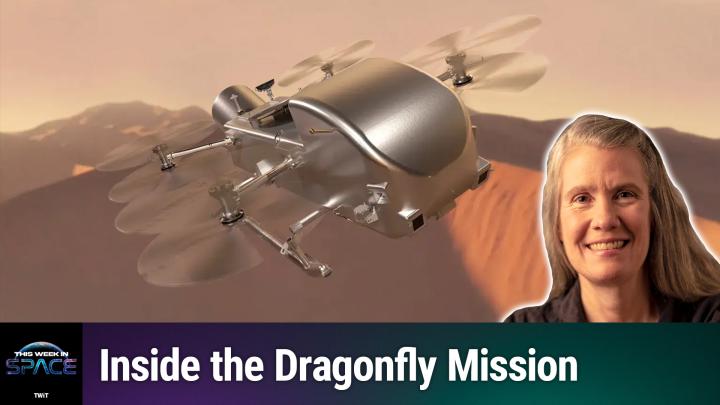
NASA’s Dragonfly mission is set to make history by sending a car-sized, nuclear-powered rotorcraft to Saturn’s moon Titan, offering scientists an unprecedented opportunity to search for the building blocks of life on another world. As explained on This Week in Space, guest Dr. Elizabeth Turtle, Principal Investigator for Dragonfly, provided first-hand insights into how this unique mission will work, what it hopes to discover, and why Titan is the most Earth-like—and yet alien—destination in our solar system.
What Is the Dragonfly Mission and Why Titan?
Dragonfly is a NASA New Frontiers program mission targeted for launch in 2028 with arrival at Titan in late 2034. Unlike traditional Mars rovers, which drive across the surface, Dragonfly is an eight-rotor “drone” designed to fly from place to place—something only possible on Titan because of its dense nitrogen atmosphere and low gravity.
According to Dr. Turtle on This Week in Space, Titan stands apart from other moons due to its thick atmosphere, low gravity, and surface covered in methane lakes, hydrocarbon sand dunes, and water-ice bedrock. The environment is both harsh (temperatures around -290°F) and surprisingly Earth-like, featuring seasonal weather and rain—except here, it's methane that flows.
Flying on Titan is easier than on Earth or Mars; its thick air and light gravity allow a heavier craft to take off with less power. Dragonfly’s design leverages these unique conditions, making it possible to cover large distances and sample a variety of terrains—crucial for answering big questions about prebiotic chemistry and the origins of life.
What Will Dragonfly Do on Titan?
According to Dr. Turtle, Dragonfly will explore Titan’s equatorial regions, especially sand dunes similar to those in the Namib Desert on Earth. The craft’s mobility allows it to avoid hazardous terrain and “hop” from site to site, accomplishing what even advanced rovers cannot.
Dragonfly carries a full suite of scientific instruments, including:
- A mass spectrometer similar to the Perseverance rover’s, for analyzing the chemical makeup of Titan’s surface
- A drill for sampling solid materials
- Environmental sensors for weather and seismic studies (including a seismometer to detect “Titanquakes”)
- Cameras for high-resolution imaging, panoramic views, and aerial reconnaissance
Its primary scientific goal is to analyze Titan’s complex organic molecules, formed by methane and nitrogen interacting under the moon’s harsh conditions, and to investigate whether these molecules mix with water ice to create the precursors to life. This may help scientists understand the steps leading from chemistry to biology—steps erased on Earth by billions of years of evolution and geological processes.
The Challenges of Autonomous Flight on Titan
With a maximum round-trip communication delay of up to 2.5 hours, Dragonfly must be highly autonomous. However, as discussed on This Week in Space, Titan’s sluggish atmosphere (weak winds, minimal temperature variation) actually offers a stable environment for flight.
Dr. Turtle explained that preflight weather checks using Dragonfly’s sensors, careful site scouting, and robust autonomous landing criteria will minimize risks. Most of Dragonfly’s time will be spent stationary, recharging batteries using its Multi-Mission Radioisotope Thermoelectric Generator (MMRTG), the same nuclear power source used on the Mars rovers. Flights will take place once or twice every Titan “day” (~16 Earth days), with each hop lasting about 20 minutes.
Could Dragonfly Help Find Life’s Origins?
While Dragonfly isn’t directly searching for living organisms, its analysis of organic molecules and evidence of past liquid water will provide crucial data on Titan’s prebiotic chemistry. As Dr. Turtle pointed out, Titan preserves a “snapshot” of processes potentially similar to those leading to life on early Earth, offering an extraordinary scientific laboratory millions of miles away.
What You Need to Know
- Dragonfly launches in 2028, arrives at Titan in 2034
- First mission to fly a car-sized drone on another world
- Will explore multiple sites across Titan—unreachable by landers or rovers
- Goals: Study organic chemistry, search for prebiotic molecules, and help us to understand Titan’s environment
- Nuclear-powered and highly autonomous due to distance from Earth
- Scientific instruments include a mass spectrometer, percussive drill, environmental sensors, and cameras
- Titan’s thick atmosphere and low gravity make flight uniquely feasible
- Could offer new insights into how life’s building blocks assemble in the absence of biology
The Bottom Line
On This Week in Space, Dr. Elizabeth Turtle made it clear: Dragonfly is unlike any planetary mission before it, opening new frontiers for robotic exploration and the study of life’s chemical origins. As we prepare for this daring journey to Titan, Dragonfly represents not just technical prowess, but the hope of answering humanity’s oldest question—are we alone, and how did life begin?
Don’t miss future updates on revolutionary missions like Dragonfly. Subscribe now: https://twit.tv/shows/this-week-in-space/episodes/198