Everything You Need to Know About NASA’s ESCAPADE Mission to Mars
AI-generated, human-reviewed.
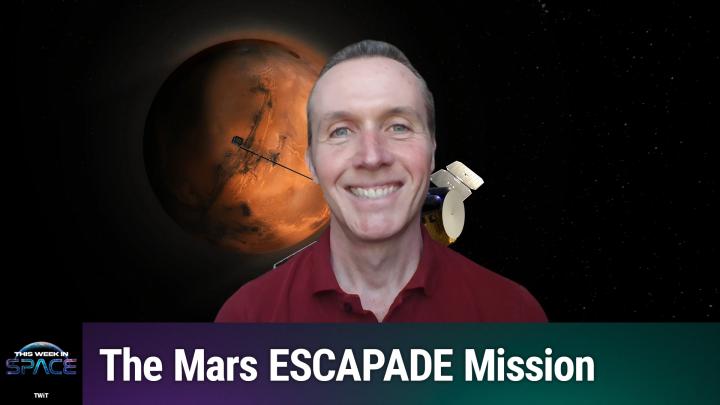
NASA's upcoming ESCAPADE mission promises to solve a decades-old mystery: why did Mars lose most of its atmosphere, and can these lessons shape our understanding of planetary climate—Earth’s included? On This Week in Space, Dr. Robert Lillis, Principal Investigator for ESCAPADE and Associate Director at UC Berkeley's Space Sciences Laboratory, shared how this innovative mission could change the way scientists study planetary atmospheres and inform future Mars exploration.
How ESCAPADE Will Uncover Mars’ Atmospheric Mysteries
The ESCAPADE mission is sending twin satellites to orbit Mars, each equipped to measure the planet’s space environment in unprecedented detail. Unlike previous Mars missions that relied on a single orbiter's data, ESCAPADE's dual-satellite approach will allow for simultaneous measurements at different points around Mars. This setup gives researchers the ability to distinguish global changes from local variations and directly correlate cause (solar wind conditions) and effect (atmospheric loss).
According to Dr. Lillis, Mars once had a much thicker atmosphere and liquid water, but over billions of years, powerful solar winds and the lack of a protective global magnetic field have stripped most of its air away. ESCAPADE aims to determine exactly how this process works, focusing on how the solar wind interacts with Mars’ upper atmosphere and which mechanisms (like ion escape and atmospheric sputtering) are responsible for bleeding the planet dry.
What Makes ESCAPADE Different from Previous Mars Missions?
Most prior missions, such as NASA's MAVEN orbiter, could only measure one location at a time, making it difficult to distinguish whether observed changes were global or simply local fluctuations. The two ESCAPADE orbiters—dubbed Blue and Gold for UC Berkeley’s school colors—will travel in coordinated orbits around Mars, allowing scientists to build a much richer, nearly three-dimensional picture of the Martian environment.
Dr. Lillis outlined ESCAPADE’s mission phases: first, the satellites will follow the same orbital path just minutes apart, sampling identical regions to track rapid changes. Then, the orbits will diverge to capture “upstream” and “downstream” measurements—one satellite in the solar wind, the other in the Martian atmosphere—providing direct cause-and-effect data.
Comparing Mars and Earth: Why This Science Matters
Understanding how Mars lost its atmosphere is about more than Martian history—it could inform Earth's long-term climate future. While Earth benefits from a protective magnetic field and ongoing volcanic outgassing (both of which help to retain its atmosphere), Mars’ lack of plate tectonics and diminished volcanism means once its atmosphere is lost, it’s likely gone for good.
By comparing atmospheric loss processes on both planets, scientists gain powerful insight into the factors that shape planetary habitability and climate evolution. ESCAPADE will also help identify hazards and radiation environments future astronauts might face, offering practical benefits for upcoming crewed Mars missions.
Engineering Innovations and What’s Next in Mars Exploration
ESCAPADE’s mission profile is a showcase of cost-effective engineering and novel launch timing. The satellites are built by Rocket Lab, and their journey will include an unorthodox “loiter” orbit, launching outside the traditional Earth-Mars window to free up global launch schedules. The spacecraft are lightweight but packed with fuel, enabling dramatic orbital changes mid-mission to achieve the mission’s scientific goals.
An added surprise: ESCAPADE carries student-built cameras from Northern Arizona University, which could deliver never-before-seen visible images of Martian auroras and a “family portrait” of Earth and Moon from deep space.
What You Need to Know
- ESCAPADE is NASA’s first Mars mission using twin orbiters for coordinated measurements.
- The main goal: understand how Mars lost its thick atmosphere to space.
- The mission measures the direct effects of solar wind on atmospheric escape.
- Engineers designed a novel launch orbit to allow more flexible, cost-effective missions.
- Learning about Mars’ climate history informs our understanding of Earth’s own atmospheric evolution and habitability.
- The mission will also enhance our knowledge of the Martian radiation environment for future astronaut safety.
- ESCAPADE launches in late 2025 and will reach Mars in 2027, with science operations beginning in 2028.
The Bottom Line
ESCAPADE represents a breakthrough in planetary science and mission design, offering the first-Sever “stereo” look at how Mars’ atmosphere is stripped away by space weather. According to Dr. Robert Lillis on This Week in Space, this mission will fill critical gaps in our understanding of Mars’ climate past, present, and future—and may also inform the search for life and human exploration on the Red Planet.
Don’t miss future insights on planetary science and space innovation—subscribe to This Week in Space:
https://twit.tv/shows/this-week-in-space/episodes/210