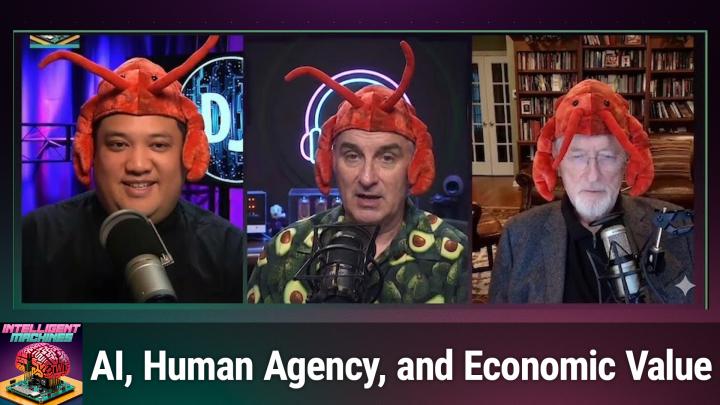
Are We Defining Intelligence the Wrong Way? Insights from Dr. Rumman Chowdhury on AI, Bias, and Human Agency
AI-generated, human-reviewed.
Our modern understanding of intelligence—shaped by tests, productivity metrics, and economic value—may not just limit how we see each other, but also how we design and perceive artificial intelligence. On Intelligent Machines, Dr. Rumman Chowdhury, founder of Humane Intelligence, explained why this narrow definition of intelligence is both outdated and dangerous, especially as AI becomes a core part of society.
Why Our Definition of Intelligence Matters
According to Dr. Chowdhury on this week’s episode, the standard ways we measure intelligence are deeply rooted in economic productivity. Historically, intelligence was formalized during the Industrial Revolution to sort people for jobs, not to capture the richness of human capacities. The development of intelligence tests was less about uncovering unique strengths and more about ranking individuals for workforce roles.
She points out this approach still shapes how we value others—and ourselves—today. AI, as it’s currently built and measured, inherits these biases. When leading AI creators like Sam Altman describe "artificial general intelligence" as the automation of all economically valuable tasks, they’re echoing these old assumptions about worth.
How Intelligence Became a Tool for Economic Control
Dr. Chowdhury explains that throughout history, intelligence has been weaponized socially and politically. Access to rights and opportunities—such as voting, education, and even basic dignity—has often been denied based on skewed intelligence measures. Groups historically marginalized (women, Black communities, others) were regularly depicted as "less intelligent" in order to justify oppression.
AI systems, trained on biased data and framed by these value systems, risk reinforcing the same injustices. Algorithms can deny people jobs, justify unequal treatment, and further entrench systemic bias if unchecked.
Beyond Economic Productivity: Embracing Diverse Intelligences
Dr. Chowdhury urges a rethinking of intelligence—beyond economic measures. She discusses alternative frameworks like Gardner’s Multiple Intelligences, which recognize skills like empathy, physical coordination, and resilience as forms of intelligence. Many valuable human capabilities are missed by standard tests and AI benchmarks.
On the episode, she notes that in fields like animal cognition or astrobiology, "intelligence" isn’t assumed to be human-like or confined to productivity. Instead, researchers look for contextually appropriate behaviors. Why, then, do we insist that AI must emulate only human-style intelligence defined by work value?
Human Agency: Taking Back Control Over AI
At the heart of the discussion is agency—the ability to act with intent and make meaningful choices. Dr. Chowdhury and the hosts emphasize that intelligence without agency is hollow. Today’s AIs don’t have intentions or desires—they aggregate and repeat patterns from their training.
However, a trend dubbed "moral outsourcing" is rising, where companies claim "the AI did it" to deflect responsibility for harmful outcomes. This is a deliberate narrative, Dr. Chowdhury warns, used to shirk accountability as AI systems impact hiring, policing, and other critical areas.
Building Better, Fairer AI: Collective Evaluation & Right to Repair
Dr. Chowdhury’s organization, Humane Intelligence, is tackling these challenges with public AI red-teaming, “bias bounty” programs, and advocacy for independent algorithmic evaluation. She proposes a digital “right to repair” for AI, empowering regular people to inspect and challenge systems that affect their lives.
Public participation and contextual evaluation are essential: If AI shapes our opportunities, then the public must have the means to interrogate, test, and guide these models.
What You Need to Know
- Intelligence as we measure it is historically tied to productivity, not innate human worth.
- AI systems inherit these old definitions, amplifying bias and limiting our agency.
- True intelligence is diverse and context-dependent, not one-size-fits-all.
- Human agency means the right to shape and question AI, not be sidelined by it.
- ‘Moral outsourcing’ by tech companies is a real risk, shifting blame away from humans.
- Solutions include independent algorithm testing, public engagement, and the digital right to repair.
The Bottom Line
Our current definitions of intelligence are not just technical or academic—they have real-world consequences for justice, equality, and personal freedom in the age of AI. According to Dr. Rumman Chowdhury on IIntelligent Machines, reclaiming agency and redefining intelligence is not just possible, but necessary if we want technology that serves humanity, rather than replaces or diminishes it.
Don’t miss out—subscribe to more insightful conversations at:
https://twit.tv/shows/intelligent-machines/episodes/862