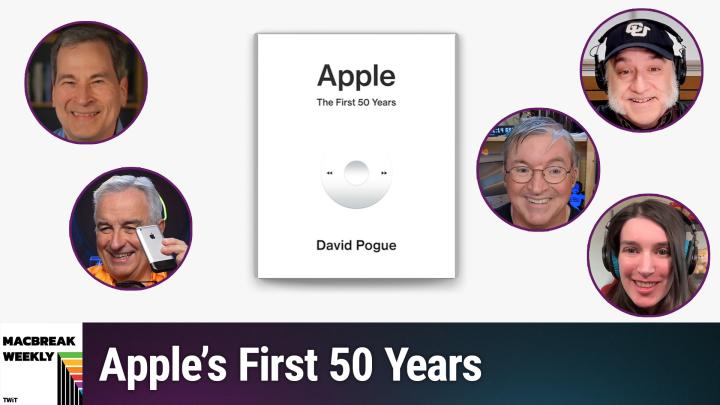
Apple's 50 Year Journey
AI-generated, human-reviewed.
Apple’s longevity and continued impact stem from a set of guiding principles and bold decisions that have defined its culture for half a century. On MacBreak Weekly with Leo Laporte, Andy Ihnatko, Jason Snell, and Christina Warren, guest David Pogue, author of the new book Apple: The First 50 Years, delves into Apple’s evolution, explaining how the company's focus, product strategy, and leadership transformations contributed to its lasting success and some missed opportunities.
What Makes Apple Different: Building the Whole Product
According to Pogue, Apple’s steadfast commitment to creating end-to-end products is central to its identity. Unlike most consumer tech companies, Apple designs hardware, software, and user experience in-house. This “build the whole widget” approach, originated under Steve Jobs, remains their business model fifty years later (08:02). Pogue highlights how this sets Apple apart from companies that license technologies or rely on third-party integrations, citing the IBM PC era as a turning point Apple weathered by refusing to change their model (08:18).
Leadership Impact: The Jobs Effect and Sculley’s Legacy
Apple’s history is punctuated by the influence of its leaders. While Steve Jobs is often credited for Apple’s resurgence, Pogue argues that John Sculley’s tenure brought several overlooked contributions. Sculley launched the PowerBook (Apple’s first successful laptop), transitioned Macs to faster RISC processors, and made a early investment in ARM—a move that would fund Apple’s acquisition of NeXT and ultimately bring Jobs back (14:00).
This episode also sheds light on leadership transitions: Sculley’s decision-making, Jobs’ unpopular move to shrink the product line from fifty models to four, and the rocky path back to profitability. According to Pogue, despite Jobs telling Tim Cook not to imitate him, Jobs’ philosophies persist at Apple today: secrecy, minimalism, targeted acquisitions, and focus (08:35).
Course Corrections: Key Mistakes and Adaptations
Pogue reveals that Apple’s leaders made several missteps—often by keeping systems closed longer than the market demanded. Jobs refused to support slots in the early Mac, resisted making the iPod compatible with Windows, and originally envisioned a locked-down iPhone (16:06). Each time, customers’ feedback and sales data forced Apple to adapt. The realization that openness, when demanded by users, can drive growth is one of Apple’s enduring lessons.
How Apple Survived Near Bankruptcy
Apple’s recovery in the late 90s was not just about products, but also about shrewd financial strategy. Pogue notes the critical role played by CFO Fred Anderson, who restructured loans, renegotiated supplier payments, and bought Apple time during its lowest point (30:18). Combined with Microsoft’s investment and Jobs’ ruthless product consolidation, these moves turned Apple around quickly.
Key Takeaways
- Apple’s core philosophy—designing everything in-house—remains unchanged since the 1970s.
- Leadership transitions, especially Sculley’s and Jobs’, directly affected product strategy and led to pivotal business decisions.
- Mistakes in keeping products closed were corrected only when forced by market feedback.
- Financial strategy and targeted investments (not just iconic products) were crucial in Apple’s survival.
- Many untold stories and nuanced details are uncovered in Pogue’s new book and through interviews with overlooked figures like Ron Wayne and Gil Amelio.
The Bottom Line
Apple’s 50-year milestone is more than a celebration of products—it’s a story of enduring philosophies, continual course corrections, and key business decisions. As explained by David Pogue on MacBreak Weekly, much of Apple’s success rests on its ability to learn from mistakes, persist with its vision, and adapt when necessary. For anyone looking to understand Apple’s enduring impact, these insights offer valuable guidance.
Want more deep dives and expert analysis? Subscribe to MacBreak Weekly and catch every episode:
https://twit.tv/shows/macbreak-weekly/episodes/1018