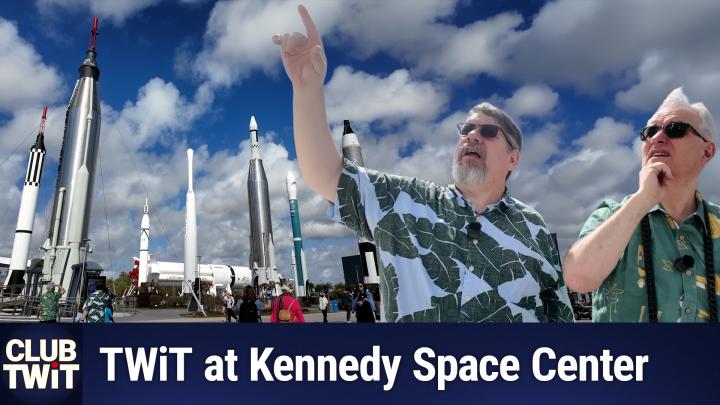
TWiT+ Club Shows 738 Transcript
Please be advised that this transcript is AI-generated and may not be word-for-word. Time codes refer to the approximate times in the ad-free version of the show.
Richard Campbell [00:00:00]:
The Agena was used during the Gemini missions for intercept targets. So they fly— That's the Mercury.
Leo Laporte [00:00:11]:
Yeah, that's what Alan Shepard was in.
Richard Campbell [00:00:13]:
And these— the thing with the Mercury was they were basically unmaintainable. If there was something wrong with it, you had to take it completely apart. They packed it together so tightly and so quickly— remember, they were in the race, right— that it was, it was unserviceable. And Gemini, they went totally the other way. They organized it for maintainability, reliability, like it was Very different. I want to get inside.
Leo Laporte [00:00:33]:
Okay, that was a— yeah, so this is Sputnik goes up, Yuri Gagarin goes up.
Richard Campbell [00:00:40]:
Yeah, and they say, mother, we gotta go, we gotta do something.
Leo Laporte [00:00:44]:
And then slam this together. And that's when, that's when the jet— the Mercury astronauts said, we're spam in a can, we have no control.
Richard Campbell [00:00:51]:
Right. Well, and who was— what was the first creature to fly into Mercury? Ham the Shimp. Yeah, the Shimp.
Leo Laporte [00:00:57]:
Right, get in, baby. If Alan Shepard could do it, you can.
Richard Campbell [00:01:08]:
Well, and it's one of the truths of those, all those early astronauts, they were all test pilots, and test pilots tend to be small.
Leo Laporte [00:01:14]:
They, they're small, but they also want some control, so they put some fake dials in there. Baby, look at me, wave. She's on her way, she's going to Low Earth orbit.
Lisa Laporte [00:01:27]:
I don't know, I should have laid down.
Richard Campbell [00:01:29]:
Now you got to get out.
Leo Laporte [00:01:31]:
This is for kids.
Lisa Laporte [00:01:32]:
Yeah, no, that's what he went down in.
Leo Laporte [00:01:36]:
He went up and down.
Lisa Laporte [00:01:40]:
Okay, you got to lay down, put your legs up there.
Leo Laporte [00:01:42]:
Holy cow. Oh, you'd have to be nuts to do this.
Richard Campbell [00:01:48]:
Yeah, they were. They were test pilots. There's something very wrong with them.
Leo Laporte [00:01:51]:
All right, I'm in a bullet.
Richard Campbell [00:01:55]:
Geez Louise. These two here are Juno 1 and 2.
Leo Laporte [00:01:59]:
What's this payload on that?
Richard Campbell [00:02:01]:
That's another attempted satellite, although all Juno flights failed.
Leo Laporte [00:02:05]:
Oh geez.
Richard Campbell [00:02:07]:
So, and the first stage on the Junos are liquid, but the upper stages were all solids.
Lisa Laporte [00:02:12]:
Why does that have a shark's mouth on it?
Richard Campbell [00:02:14]:
That's a Delta II, and the Delta II is one of the most successful rockets ever made. And it's the last thing added to the rocket garden. So these are all from the '50s, right? The Gemini's from the '60s. The Delta II's from the '80s.
Lisa Laporte [00:02:30]:
These don't look—
Richard Campbell [00:02:31]:
they're not 40, 50 years old. No, they're pretty ancient. So the two big pipes you're looking at, these are the fueling lines. So they would couple to load this thing with fuel, and then they would drop off as it takes off. But you see the three engines here. The center engine is a vacuum engine. It has bigger expansion. It's got more efficient as it gets higher up.
Richard Campbell [00:02:49]:
So these two outer engines will actually drop off. They're the ones It's a stage and a half, right? Instead of a whole separate stage, they just drop off the outer engines. This whole casing falls with it, and then that inner engine finishes the orbit flight.
Leo Laporte [00:03:02]:
Is this part of the casing that falls off?
Richard Campbell [00:03:05]:
Yes.
Leo Laporte [00:03:05]:
Oh, so there's some core in there that stays.
Richard Campbell [00:03:08]:
That's right. That just stays behind in the restaurant storage to reduce the weight.
Leo Laporte [00:03:11]:
Interesting.
Richard Campbell [00:03:12]:
And so they would, when they—
Leo Laporte [00:03:13]:
But that's the only stage.
Lisa Laporte [00:03:15]:
They're there to get it out of the atmosphere, and then that's where they come off.
Richard Campbell [00:03:18]:
There's a booster on the Agena to finish the orbit, so the rest of the tank will reenter., but other than that, that's it. Wow. And so in, during the Gemini series, they were practicing interception in orbit. And so they would launch an Agena alongside the Gemini. Ah. And they would practice intercepting each other. I do remember that.
Leo Laporte [00:03:35]:
Yeah. So this is the lever to release it, actually, it looks like.
Richard Campbell [00:03:39]:
Uh, they, they would stand these up. So this is basically a, a bracing for being able to stand them. Oh, okay. Okay. And then the fairing that drops off the sides. Wow. So it's a very odd rocket design. We never did that again.
Richard Campbell [00:03:51]:
Right. So SA-209, this was the backup flight for Skylab. This is a Saturn 1B laying on its side. It's the last of the species. So this was the precursor to the Saturn V. Right. You know, you see the big cylinders here on the lower stage? Yeah. They look familiar at all? Like the shuttle.
Richard Campbell [00:04:11]:
Well, those cylinders are exactly the same size as Redstone tanks, because they are Redstone tanks. Oh my God. Redstone tanks surrounding a Jupiter tank. They were in a hurry to build quickly. Well, and plus tanks are complicated. They have baffles and things in them to stop fuel sloshing. Yeah. And so this was the fastest way to build this very large stage.
Leo Laporte [00:04:30]:
So they still were in a hurry at this point.
Richard Campbell [00:04:32]:
Oh, absolutely. So there's 4 of these tanks had liquid oxygen in them, 4 of them had liquid hydrogen in them. Yes, because this is the H-1 engine, which is a hydrogen-burning engine. There's 8 of them. Only the outer ones gimbal. The center ones are fixed. So this was the rocket— See, they're tilted a little bit. Yeah.
Richard Campbell [00:04:50]:
This is the rocket they used for testing the Apollo capsule in low Earth orbit.
Leo Laporte [00:04:55]:
Okay.
Richard Campbell [00:04:55]:
And for the missions to Skylab to lift loads. And the Soviet, the Soyuz Apollo mission all flew on this kind of rocket. It's substantially shorter than Saturn V. So when they wanted to fly it, They would put a milk jug stand, basically a big base underneath it to hold it up high enough so it would still work with the same Saturn V tower. Wow. And, uh, there was— there were two of these left over. Um, one of them's in—
Leo Laporte [00:05:22]:
so they were already using the Saturn V?
Richard Campbell [00:05:25]:
This was still— this is the precursor Saturn V, and then they used it after as well. Okay, so it did both duty, but the upper stage is the same. This will end up being second stage of the Saturn V, so they'll attach another 10-meter stage to the bottom of this. Wow. With the F-1s on it. Wow. And there's an F-1 right over there, so we should go see it.
Leo Laporte [00:05:43]:
Okay, so really it's a rocket within a rocket.
Richard Campbell [00:05:46]:
Well, that's, you know, proper staging. This is a 3-stage rocket.
Leo Laporte [00:05:50]:
Each stage has to be a standalone.
Richard Campbell [00:05:52]:
And that in this configuration, the— this upper stage will finish the orbit for them, and then the maneuver unit at the top can get you deorbited. So it's only for low Earth orbit. If you want to go to the moon, you have to add another stage so you have enough power. Wow. Wow, wow, wow. And we'll see a crazy Apollo.
Leo Laporte [00:06:11]:
How freaking crazy.
Richard Campbell [00:06:14]:
But it's just a hint at how fast this— and each one of the stages was built by a different company, so they're designed completely differently from each other.
Leo Laporte [00:06:20]:
So orbital velocity is 25,000 miles an hour.
Richard Campbell [00:06:24]:
That's right, mostly sideways, right? So you take off and you need a higher velocity if you're going to the moon, or no, you just got to get— once you get to orbit, you're good. Then you're going to burn a bit more, you will have a higher velocity. July. So this is, this is the famous anomaly. This engine is insane. It shouldn't exist. Up until the early 1960s, we generally could build rocket engines around 200,000-300,000 pounds of thrust. You couldn't get much more than that, right? 500,000 on the outside.
Richard Campbell [00:06:54]:
This is 1.5 million. This engine— the problem is when you scale engines up your combustion chamber gets bigger and bigger and bigger, right? And you're trying to mix fuel and oxidizer very fast in milliseconds, right? To throw that mass out the back and push the rocket. So as the combustion chamber gets bigger, it's harder to get the mix right. And if you get instabilities in the mix, you get what's called chugging. So a part, part of the thrust is different from the other part inside of the combustion chamber, and it'll simply rip the engine apart. Yeah. So how did they figure it out? They started planting dynamite inside the combustion chamber. Are you serious? Yes, to test the instability effects.
Richard Campbell [00:07:37]:
And they learned to build baffles in the pintle layer. So they created a series of separate reliable burning chambers in the main chamber so that overall it would survive stable. Now it still had problems. This was not a particularly efficient engine. And it did surge, like it had behavior where it would suddenly increase its own thrust from fuel flow and things. And on the Saturn V, they talked about the pogo effect where literally the whole ship would charge and then ease off and charge. Oh God, that's got to feel terrifying, right? There's only, there's a few different approaches to building a rocket engine, and this is a very classic one called a gas generator cycle. Your biggest problem here is you need a pump strong enough to shove that much fuel, millions of pounds of fuel through this engine as quickly as possible.
Richard Campbell [00:08:22]:
And so on the side here, you see there's actually a set of turbines in there that burn the fuel to spin the turbines to create the pump action to feed the main engine. That exhaust comes out here. So it's part of the losses of the engine that it's burning its fuel separately.
Leo Laporte [00:08:38]:
They use it for thrust.
Richard Campbell [00:08:40]:
Yeah, and if you ever see like a Merlin engine test, you'll see this black blast coming off the side of it. That's the gas generator cycle. On the Saturn V, again, very cleverly, They capture the emissions from that turbine and they pump it into the lower half of the chamber here, right? In the expansion chamber. That does two things. One is it saves a bit of the energy, so you're a little bit more efficient. But more importantly, the mixture on the turbine isn't perfect. That's why it burns so black. Yeah.
Richard Campbell [00:09:06]:
Right? Because if it was stoichiometric, it was perfect mix, it would burn up the turbine. Yeah, yeah. So you deliberately go fuel rich to run it at a lower temperature so it doesn't damage the turbine. And that excess fuel then comes in here and it makes a laminar layer on the bell to help protect the bell from the heat of the engine. So now when you watch those slow-mo Saturn Vs take off, you'll see the engine's got this sort of blacky soot blasting all around. That's this, and that's a cooling layer to keep the engine bell from breaking down. Up above, you can see the fine lines up there. They're actually pumping the liquid hydrogen through those pipes, and they're all hand-brazed.
Richard Campbell [00:09:43]:
No two engines were the same to do the cooling close to the chamber. And actually heat up the hydrogen enough to be ready to burn. Holy cow. So the tricky part here is starting this engine, because the fuel starts out too cold and you don't have enough heat from the engine to warm it up. So there's a whole process of slowly getting the engine going. It only takes a few seconds, but it's a very specific sequence, and you get it wrong, the engine rips apart. Wow. It was very challenging to start these engines.
Richard Campbell [00:10:08]:
Unbelievable. And they work. And again, this is what the Soviets never could make. They could make a 500,000-pound thrust engine. They could make a million-pound or a million-and-a-half-pound thrust engine. Wow.
Leo Laporte [00:10:20]:
And how many of these were there on the Saturn V?
Richard Campbell [00:10:24]:
5. And each is unique? They're no two exactly the same because they were handmade, right? No two are exactly the same.
Leo Laporte [00:10:32]:
So this is the turbine exhaust going through here.
Richard Campbell [00:10:35]:
And then vented on the inside. And then the laminar coating to protect the engine. Wow.
Leo Laporte [00:10:42]:
Wow, what engineering.
Richard Campbell [00:10:43]:
It's very clever. Amazing. Amazing.
Leo Laporte [00:10:46]:
And von Braun was gone by then, right?
Richard Campbell [00:10:48]:
Von Braun was— this was one of von Braun's designs as well. So he worked on this. Yeah. This engine was in development for a really long time.
Leo Laporte [00:10:55]:
So what a genius he must have been.
Richard Campbell [00:10:58]:
Yeah. He was an interesting character. He really wanted to go to Mars. Really? Yeah. Oh, interesting. Okay. Last rocket. This is the Delta II.
Richard Campbell [00:11:06]:
So after the Challenger disaster, They realized, you know, the goal had been when Shuttle started flying, all payloads would be on Shuttle. All satellites would be launched from Shuttle. That was the idea.
Leo Laporte [00:11:17]:
It was reusable, so we would save money.
Richard Campbell [00:11:19]:
Yes. And so after the Challenger disaster in '86, there was a realization we need an alternative. We need other ways to lift important payloads.
Leo Laporte [00:11:28]:
As a backup or as a replacement?
Richard Campbell [00:11:30]:
As a backup. But also after Challenger, the Reagan administration said no more commercial payloads on Shuttles. Military payloads, yes, but not commercial. Just because it wasn't worth the risk. Right. And so this Delta rocket is based on— is derived from this older Delta rocket, but it's a much more modern design. It's a 1980s design. And so liquid oxygen and RP-1 up to 9 external boosters.
Richard Campbell [00:11:59]:
These are GEM-46s, which are 46 inches in diameter. They're solid rocket boosters. They run for about a minute and a half on takeoff. And you can— and typical configuration would be 2 or 4 or 6. There was one configuration where you could do 9, and in the 9, 6 of them would launch on the ground and 3 would launch in the— would fire in the air. This type of rocket, this Delta II, is the design that flew most of the Mars payloads. Opportunity and Spirit flew on Delta IIs. Almost all the GPS satellites flew on Delta IIs.
Richard Campbell [00:12:32]:
There's literally hundreds of flights.
Leo Laporte [00:12:33]:
It's pretty economical.
Richard Campbell [00:12:34]:
It was a good, reliable rocket. The last price tag for these was about $150 million. $150 million, which is not that cheap. Only $150 million, relatively speaking, but reliable. So there's only 2 failures in the whole Delta II series. And so they did very well. But the Falcon 9 does everything this can do and more for $30 million, $40 million. So it's just that they couldn't compete.
Lisa Laporte [00:13:01]:
It's going to get better and more cost-effective.
Richard Campbell [00:13:04]:
Well, not always, but it's only better. Only if you work, you know, work to that direction. So this rocket was added in 2003 after it had been retired. But it's just a different generation of rocket design entirely and a lot more mature. After Delta II, they made Delta III but only flew it a couple of times. And then there was Delta IV, which was the big multi-stage, multi-rocket that just recently retired.