Tech News Weekly 426 Transcript
Please be advised this transcript is AI-generated and may not be word for word. Time codes refer to the approximate times in the ad-supported version of the show.
Mikah Sargent [00:00:00]:
Coming up on Tech News Weekly, Emily Forlini is here and has a special announcement, very exciting stuff. And then we get to hear about her time at the FBI meeting a really cool dog. No, I'm not lying, you gotta check it out. I also talk about an AI that's supposed to do your homework and go to school for you. Jason Howell stops by to give us the lowdown on Samsung Unpacked. And I round things out by talking about the latest rumors on Apple hardware. Around the corner. Stay tuned, you do not want to miss this episode of Tech News Weekly.
Mikah Sargent [00:00:47]:
This is Tech News Weekly, episode 426, with Emily Forlini and me, Mikah Sargent. Recorded Thursday, February 26th, 2026. Samsung Galaxy S26, AI, Privacy, and New Buds. Hello and welcome to Tech News Weekly, the show where every week we talk to and about the people making and breaking the tech news. I am your host, Mikah Sargent. And today, I am joined by the wonderful, the ever-talented Emily Forleni. Welcome back, Em.
Emily Forlini [00:01:22]:
Thank you so much. I'm happy to be here as we discuss— this will be my last show in several months. Oh, oh, I'm having a babe, having a baby. So I'll be out for a little bit.
Mikah Sargent [00:01:36]:
Oh, we are very excited for you, very happy for you, and, uh, glad that you get to take some time away, uh, and, you know, wish you all the best. Of course, uh, I'm sure that it will not be long before the live chat is filled with congratulations for you as well, uh, but let us kind of keep going along here. Of course, people By this point, you gotta know how the show works. We kick things off by talking about our stories of the week. These are the stories we think are interesting and important and well worth sharing with you. And oh my goodness, I was so excited when Emily, uh, sent me the story that she planned to talk about today. So, uh, let's, let's get it, let's get it going.
Emily Forlini [00:02:23]:
Let's do it. So yeah, I wrote one of the most fun features ever, which basically involved me going to the FBI to see a dog, a black lab.
Mikah Sargent [00:02:35]:
Hold on, I do have to ask, that's not the lead into a joke, right? Like, that's it, he walks into the FBI to meet a dog. What? That's amazing!
Emily Forlini [00:02:44]:
It was awesome. It was so special and so rare. Like, and we had to go through— we couldn't bring phones, and we had to get all this pre-approved equipment. And so we're going through these, like, metal detectors and Um, then the— I don't know, there's like a visitor's center, but I was like, do you guys get a lot of visitors? Like, because they kind of seemed a little nervous, like they wanted to check all of our bags. They were like, honestly, no, like we never have visitors. I feel like they dusted off some old visitor policy for us. So it was really—
Mikah Sargent [00:03:14]:
what's the protocol?
Emily Forlini [00:03:15]:
Yeah, they were like, um, do we look in these bags? Like, who are these people? Uh, so it was really fun, but basically I went there and wrote a story about The first dog that the FBI ever trained to go out on investigations and do something humans cannot, which is smell technology. I don't know if you can smell tech. Does a laptop smell to you?
Mikah Sargent [00:03:38]:
No, I think maybe I could smell old tech, like a car engine or something that's got a lot of iron in it.
Emily Forlini [00:03:47]:
Like oil, gas.
Mikah Sargent [00:03:49]:
Yeah, exactly. But modern technology?
Emily Forlini [00:03:51]:
No.
Mikah Sargent [00:03:52]:
I didn't know that was possible.
Emily Forlini [00:03:54]:
Yeah, so we, we, our noses are so much worse than dogs. So dogs have this incredible sense of smell and they can do things with their noses that we can't. Like their nostrils can point in different direction and smell two things at once. They can breathe in and out at the same time. So they have really efficient smelling. They never have to stop. And then the big thing is they just have more scent receptors in their nose, like 40 times what we have. And then also more of their brain space is spent cataloging smells.
Emily Forlini [00:04:24]:
So they're like true smell experts. And so, yeah, so basically this one FBI agent, he was working for the Child Sex Abuse Crimes Division. And as you know, someone who's a sex offender might store media, images, videos on a thumb drive or a laptop or a cell phone. And so they were constantly missing evidence because, you know, the human teams, they sweep the house, but if it's in the walls, if it's in the secret compartment, like You can't demolish, you know, an entire house on a search raid. So they were missing stuff. And so this one agent and just a local FBI branch was like, maybe we could train a dog to smell something in an electronic because dogs do explosives. You know, there are dogs at the airport at TSA. Like, we're kind of familiar with this concept.
Emily Forlini [00:05:13]:
But this was like, I think this was back in 2014, 2015. And he kind of just submitted a proposal. Like, I don't know if this is going to work.
Mikah Sargent [00:05:22]:
It could be something, might not be something.
Emily Forlini [00:05:24]:
Could be something. Yeah. And he ended up getting approved. And I talked to his supervisor who just said— supervisor back in the day, I contacted him and he was like, yeah, I mean, it sounded— I like analog crime fighting. Like, it sounded cool. I like dogs. You know, I gave him $20,000 and that's, you know, sounds like a lot, but I've had other projects I've approved where that's just the transportation budget. So I gave him the money and I said, you know, you better make it work quick.
Jason Howell [00:05:52]:
Wow.
Emily Forlini [00:05:53]:
Yeah.
Mikah Sargent [00:05:54]:
I honestly, I, whenever you said $20K, I was thinking that doesn't seem like a lot of money. Uh, that, so I'm, I'm surprised for, you know, the, the sensitivity to be there that he was like, I know that sounds like a lot of money. I'm thinking $20K, is that even enough to be able to hire someone to train a dog for tech? So that feels like a shoestring budget to me.
Emily Forlini [00:06:14]:
A little bit. And I can explain a little bit what it went. Towards— so they're these, they're called electronic detection dogs. And he basically went to, um, the Connecticut State Police actually had the very first one. So he was like, I'll go talk to them. And they train these dogs and they actually sell them for like some thousands of dollars to outside agencies. This was like way back. They had only done this once or twice before.
Emily Forlini [00:06:37]:
So he goes, he gets a dog, he does a training course for 6 weeks, and then he actually is the trainer going forward. The dog comes home and lives with him his whole life, him and his wife and his family. They train the dog 3 times a day. He has to sign, get his friends to agree, hey, can I sign a fake search warrant to come to your house so we can come train this dog? And like local schools, like, hey, are you guys willing to help out? We're trying to train this dog. And so all day, every day, the dog never eats unless it finds an electronic. And it only eats out of his hand. So it's like a food motivation system.
Mikah Sargent [00:07:17]:
Sorry, one more time. Yeah. Did you say that the dog only eats if it finds electronics?
Emily Forlini [00:07:23]:
Yes. And only out of his hand. I talked to multiple vets. It is not cruel. The dogs are not malnourished. It's not a problem.
Mikah Sargent [00:07:33]:
Because there's tech everywhere.
Emily Forlini [00:07:35]:
Yeah. It's real established that these handlers and their dogs form really, really strong bonds. So he actually— hardened FBI agent actually cried multiple times during our interview, uh, just about their life together and how much he meant to her— or they meant to each other. She— the dog says she— is how much she meant to him. And, um, yeah, he just trained her, brought her on investigations. They worked on like huge cases. They helped, you know, with all these kinds of criminals, murderers. You know, they were on standby for Gabby Petito.
Emily Forlini [00:08:09]:
Like, they had national visibility. Wow. Um, so yeah, and then the story ended a year ago almost when the dog, after a routine search at a hoarder house of all things— apparently they do a lot of hoarder house like drug busts because criminals don't stash cash under the mattress anymore, they like put it in crypto on a thumb drive that this dog can find— so she goes into the house, she does her thing, they find the crypto And then the next day she's limping, and he's like, what's going on? And, you know, he's learned some routine medical care. He gives her a shot. He— his wife is like, hey, I think you need to bring Iris the dog to the vet. He's like, yeah, let's just be super cautious. They go in the next day, and the doctor's like, it's cancer, and she has to stop working immediately.
Mikah Sargent [00:09:04]:
So she retired.
Emily Forlini [00:09:06]:
So she retired. He's crying at this point as he's telling this story. He's like, don't record me. Like, it's just the most devastating thing in his life. Like, this dog is everything to him. Not only does she have to retire on the spot, she was 11, she also had to get her front, one of her front legs amputated.
Mikah Sargent [00:09:22]:
No, Emily, when you said story, okay, sorry, go ahead.
Emily Forlini [00:09:30]:
No, it's, it's crazy. And I know we have limited time, so I'm just getting the footage. Everyone should definitely read.
Mikah Sargent [00:09:35]:
Yeah, please read the story. Yeah, read the story because that's how we get to hear more about awesome dogs is when—
Emily Forlini [00:09:42]:
Yes, look at her as a puppy.
Mikah Sargent [00:09:44]:
Oh my God.
Emily Forlini [00:09:46]:
On the left is the puppy and then in the middle is her, how I met her with her 3D printed prosthetic. So it's like—
Mikah Sargent [00:09:53]:
Okay, so this is like double tech story.
Emily Forlini [00:09:55]:
Yeah, yeah, there's tech everywhere in this story. So this dog is a 3D printed prosthetic. She has a badge as you see in that photo. She's an official special agent. Like trained by the FBI. And, uh, the one on the right is her without the prosthetic. She prefers that strongly because the prosthetic is kind of like a peg leg. It's kind of like she can hobble, but not great.
Emily Forlini [00:10:19]:
She's really good with just the 3 legs. Um, so yeah, she retired very abruptly. He that day gave her her first slice of pizza ever. To treat her.
Mikah Sargent [00:10:32]:
Good. Deserves it.
Emily Forlini [00:10:33]:
Absolutely deserves it. She's living large on his couch. He's, you know, struggling. Like, he kind of looks at her every day he leaves in the morning, and then she's— he's like, you can't come anymore. And she just kind of sits there with her three legs, and she's like, bye. And she's just kind of, you know, going through her medical journey. Meanwhile She formed the basis of a new program at the FBI. Oh, so because of how good of a job she did, they're now training a puppy to replace her in Quantico, which is the, the FBI headquarters.
Emily Forlini [00:11:10]:
Every—
Mikah Sargent [00:11:12]:
Quantico is amazing. Sorry, I just— yes, so this Black Lab wanted to be an FBI agent, then you know about Quantico. Like, Quantico is so cool. Yeah, sorry, go ahead.
Emily Forlini [00:11:21]:
So they have a dog trainer named Craig Schultz in Quantico who is training this new puppy Nyx, N-Y-X, which I think is a goddess of, um, someone, someone in the chat knows. But, and anyway, so she's training. She's been there since October. And this agent, the handler, his name is Jeff. I should have said that earlier. Sorry, Jeff, if you're listening. But Jeff has been really struggling if he should take on the new puppy because even though he worked so hard to establish this program and he really proved it out even at the highest levels of government that these dogs were crucial assets. He formed such a strong emotional bond to the first dog, Iris, that he feels like he's cheating on her.
Emily Forlini [00:12:04]:
He said, like, she's still alive, she's on his couch. He's like, how am I possibly going to take on a new puppy? Like, I'm loyal to Iris. I've gone through airports all over the world with her. They share one economy plane seat when they travel. Like, they are—
Mikah Sargent [00:12:18]:
oh my God, I just love it.
Emily Forlini [00:12:21]:
It's just adorable. And Basically, he decided he is going to take on the new puppy. And so that starts next month.
Mikah Sargent [00:12:29]:
Oh my God. This is— yeah, everyone listen to me. I know you heard a lot of the story, but if you don't go read the story, if you don't click on that link, I will be personally offended by your behavior because there's more in there. These dogs. Yeah. And I'm sure, I'm sure there's loads more. I mean, you got to actually— I, again, the fact that you got to go and meet the dog. And that, that is so cool.
Mikah Sargent [00:12:54]:
So, so cool.
Emily Forlini [00:12:55]:
It was awesome.
Mikah Sargent [00:12:57]:
That's amazing. Um, we do need to take a break, uh, while we all think about dogs and how cool they are. Uh, so let me tell you for a moment about our sponsor. For sponsor today, it's Melissa bringing you this episode of Tech News Weekly. Melissa is the trusted data quality expert since 1985. You know, bad data could be costing your business. Melissa, has specialized in making data clean, accurate, and of peak quality for 41 years now, combining expertise with cutting-edge AI. That's right, Melissa is in the AI game.
Mikah Sargent [00:13:33]:
Here's what that means for your business. You get address verification where it will validate addresses globally in real time, reducing failed deliveries. You get mobile identity verification where you can match customers to mobile numbers, cut fraud, and open SMS channels. Change of address so that you keep customers connected automatically when they move. AI-powered deduplication, because on average a database contains 8 to 10% duplicate records. Melissa's powerful matchup technology can identify non-exact matching duplicate records. There's customer data intelligence as well, which will enrich records with demographic, geographic, psychographic, firmographic, and property info for more intelligent targeting. Plus the new Melissa Alert Service, which monitors and automatically updates your customer data for moves, address changes, property transactions, hazard risks, and more.
Mikah Sargent [00:14:24]:
Clean data leads to better marketing ROI, higher customer lifetime value, and AI that works as intended. You need to have that clean data to send the AI after it. If you're using AI for personalization or predictive analytics, garbage data is going to mean garbage results. Well, Melissa ensures your AI learns from accurate information. When it comes to data, Melissa's got you covered. For example, eToro, the social investing platform with 23 million users, uses Melissa for identity verification. Their business analyst says, we find electronic verification is the way to go because it makes the user's life easier. Users register faster and can start using our platform right away.
Mikah Sargent [00:15:04]:
Whether you're a small business just getting started or an enterprise managing millions of records, Melissa scales with you. Melissa has easy-to-use apps for Salesforce, Dynamics CRM, Shopify, Stripe, Microsoft Office, Google Docs, and more. Plus, Melissa's APIs integrate seamlessly into your existing workflows or custom builds. And Melissa's solutions and services are GDPR and CCPA compliant, FedRAMP and ISO 27001 certified, and meet SOC 2 and HIPAA high trust standards for information security management. So get started today with 1,000 records cleaned for free at melissa.com/twit. That's melissa.com/twit. And we thank Melissa for sponsoring this week's episode of Tech News Weekly.
Mikah Sargent [00:15:49]:
All right, we are back from the break. As I mentioned, joined this week by Emily Forlini, and it is time for my story of the week because this week 404's Matthew Gault published a piece that asks a question we're going to be hearing, I think, a lot more in the months and years ahead. Honestly, what's the point of going to school if an AI can do it all for you? There's a new agentic AI tool called Einstein Yeah, which claims it can attend lectures, write papers, log into platforms like Canvas— oh man, oh, Canvas— and even take tests all on a student's behalf. It's a provocative product, and the reactions from educators range from resigned frustration to genuine alarm about the future of higher education. Now, the story features perspectives from the tool's creator, as well as a Brown University dropout— or who is a Brown University dropout— as well as professors and AI experts who argue that tools like Einstein aren't just enabling cheating, they're actually exposing deep cracks in how we think about the purpose of education itself. I feel, Emily, like if I was not— if I was not doing the job that I'm doing and I wasn't doing a job that involved working with dogs, then the third job would be— or the third, like, career or vocation would be something to do with learning about learning and learning about teaching. I think it's so fascinating.
Emily Forlini [00:17:22]:
You'd be great at that. You'd be a great teacher or just educator. Yes.
Mikah Sargent [00:17:26]:
But like that, what it's talking here, this idea that it's exposing deep cracks in how we think about the purpose of education itself. I, I think about all the way back in school when someone would get frustrated in math or would get frustrated in another more sort of black and white type of learning. And the common thing you would hear is, why do I need to know this? I'm not going to use it later in life, right? That's all— like, as long as education has existed, that has always been something that is, you know, brought up. And it does make me think about how at one point education truly was so often just surrounding memorizing things. Can you remember something and bring it up again when it comes time to take a test? And as we have become more connected and as we have the, you know, world's breadth of knowledge in our pockets, education has somewhat changed, but I think not to a degree that it has needed to. And now you add AI on top of it, and I feel like even more so, We're getting, you know, on the Richter scale level cracks that are showing up. And I just find that fascinating because at the same time, I think about what happens if we're in a situation where you don't have access to those things. Who has the skills? Who has the memory? And how long will that continue to be the case? You, as it's been announced now, are going to have a child.
Mikah Sargent [00:19:18]:
And I would love to hear, like, have you— not to add to your plate, but have you thought about what education is going to look like for your child? And if you, if you want it to be different from how you were taught? And yeah, I just— that's, that's, that's fascinating to me.
Emily Forlini [00:19:36]:
Yeah, it's a very interesting topic. And I actually just wrote— do you remember that something big is happening viral post from a couple weeks ago?
Mikah Sargent [00:19:44]:
I actually don't.
Emily Forlini [00:19:45]:
I'll put a link to it, but it went like crazy on X and LinkedIn and like everything about how everyone needs to rethink everything and all the jobs are going to be automated. And you know, there's the same stuff. For whatever reason, this one really, really hit and a lot of people read it. And my reaction to it was actually that it made me really value my liberal arts degree, which is kind of a new feeling because of course for the past 10, 15 years it's been hammered into every liberal arts major, like, why did you do that? You should have learned STEM, right?
Mikah Sargent [00:20:17]:
Yes, absolutely.
Emily Forlini [00:20:17]:
And now the guy who wrote this post is a software engineer and a lot of people in software engineering and STEM are kind of wondering what the future of their field is. So the tables have really turned and I think that the whole thing has really clarified my opinion on education, which is that you really need to be learning how to think, which is how I was educated. And that's like the point of liberal arts. I think some memorization is good as well. Like you kind of need to know history to some degree, but I totally agree with you. It shouldn't— it should be mostly about how do you— how does your brain put two and two together? How, how do you wire concepts? How do you think through problems? How do you distill this from that, and I feel pretty clear about that. Um, so I just think the whole AI thing has, has made that, um, you know, more apparent to me.
Mikah Sargent [00:21:09]:
Yeah, I, I love this. Uh, yeah, I, I 100% agree. Learning how to think, learning how to research, learning how to solve, uh, problems that aren't based in just there's one answer to it. Is critical.
Emily Forlini [00:21:29]:
And how to argue against yourself, how to argue, like, you know, just these things that like we've lost, I just think are showing so much value.
Mikah Sargent [00:21:39]:
Yeah, I, I absolutely agree. Um, to, to kind of go in a little bit more on this, this tool, uh, again, it was created by someone who went to Brown and dropped out. Um, and honestly, it's not even being ashamed of what it is. The website literally says it'll attend lectures, write papers, log into edtech platforms like Canvas, participate in discussions. The creator Advait Palawal, and forgive me for mispronunciation there, says it's liberation. It's not cheating. He says, think of horses. Quote, they used to pull carriages, but when cars came around, I'd argue horses became a lot more free.
Mikah Sargent [00:22:21]:
It would be weird if horses revolted and said no, I want to pull carriages. This is my purpose in life.
Emily Forlini [00:22:27]:
But I want a negative opinion on what education is. I know. If you want an AI to attend and do everything for you, you're going to be, you're going to be a dumb dumb.
Mikah Sargent [00:22:37]:
Yes. And that's the thing.
Emily Forlini [00:22:38]:
You have to exert effort.
Mikah Sargent [00:22:40]:
It's the, it should be the 100, like that's the point, right? It's not that we can acknowledge that something else can attend these things for you, right?
Emily Forlini [00:22:51]:
Sure. But that's not the point.
Mikah Sargent [00:22:54]:
Yeah, like, sure, this is available to you, but why take that route? The whole point is you're supposed to go there and learn. And so it's almost like it's, it's a, it's a cheat code, cheat code to becoming even more evolved as a human being to say, I know I could use this if I wanted to. But my whole purpose of being here and paying all of this money is to grow my skills, is to do this. I guess that's just— that's not the case for some people. They're there to get the paper. And for some, I'm sure for some careers, that really is what it's about, right? Like if, if depending on what you're trying to get into, it may be that that's all it takes is I've got the paper, so now give me the job. But there's, you know, a lot going on here. One of the professors— there's an English professor at the University of Virginia and is actually part of a group called the Modern Language Association's Task Force on AI Research and Teaching, which is a mouthful and odd from an English professor who could make a choice to make that better.
Mikah Sargent [00:24:03]:
But anyway, says, quote, Einstein, the, the tool, not the guy, is symptomatic. I doubt we'll be talking about Einstein as such in a year, but it's symptomatic of of what's about to descend on higher ed and secondary ed as well. And that's what I think is the important point here. We have to be aware that this stuff is here and it's available and people can use it. So let's stop getting stuck in these patterns of, well, this is the way we've always done it, and go, we have to rethink some level of what the, of what the value is of teaching. And I think it's kind of what we're talking about here, that there needs to be more advocacy around this idea of what it means to have these skills and become more versatile and, and capable, as opposed to what it is right now, which is looking at education as a transaction. You pay the money, you go to school, you get the paper, and you get the job, and that's it. That's not what my experience was as a, you know, liberal arts attendee as well.
Mikah Sargent [00:25:26]:
Like, it was, it was about so much more than that. And it was almost in many cases about the experiences that I had outside of the classes and in and the different, you know, opportunities to try different versions of the work that I did. So, yeah, I—
Emily Forlini [00:25:43]:
It seems misguided. At least the way the article is written. I don't know if they're trying to portray the tool as just being misguided because it certainly sounds like it is. And I don't think— I think if there are things that AI can do that does it well, like, so, yeah, Canva, that— Canvas or Canva? I forget.
Mikah Sargent [00:26:02]:
Canva. Oh, Canvas is the school thing, but Canva is the design.
Emily Forlini [00:26:06]:
School thing. So it's like, you know, a system where you get your assignments. Okay, let's say you have to go in the system and press complete. If an AI can do that, great, that's fine, but that doesn't mean you check the box on your education. You should now use that time to do something else.
Mikah Sargent [00:26:19]:
Yes. Oh, it's not—
Emily Forlini [00:26:22]:
it's not that the AI— it's not a box to be checked. It's in a finite box. It's like an ever-expanding, you know, you should always be learning if you're in that portion of your life. So I just— that's why I just think the whole thing is misguided. I don't know what— I don't know why they would say, oh, we We figured it out. It's done now. Like, education's always evolved.
Mikah Sargent [00:26:42]:
Yeah. Yeah, I agree. It's— and I think it's going to continue to evolve. And we've— I should— I should be fair to some educators who have caught that this is something that needs to be looked at and paid attention to in the sense of, okay, let's instead of trying to run kids away from these tools, Let's turn toward them and look at how they can be incorporated, how we can use them, how we can teach students to use them, how to continue the work of thinking critically and move from there. Uh, some, some last notes about it. This is a really good piece over from 404 Media, and there are some different solutions that apparently have worked whenever it's come to this. Uh, one teacher talked about how devices being removed from the classroom entirely have made it possible for, um, students to sort of not rely on these tools so much and learn the skills of reasoning and logic and, and work from there. And then also, I think, an important aspect We as humans have had years of experience, sort of almost at the evolutionary level, like it's so deep down inside of us where oration and communication is such a huge aspect of learning and understanding.
Mikah Sargent [00:28:21]:
And if you're talking to an AI and you're not sort of like participating in discussions and, and as you talked about, participating in arguments with yourself and with other people. If you don't learn those skills, I don't know.
Emily Forlini [00:28:35]:
I don't know.
Mikah Sargent [00:28:35]:
Yeah, good luck.
Emily Forlini [00:28:37]:
I don't know how you're going to navigate the healthcare system.
Mikah Sargent [00:28:39]:
Oh my God. Yeah.
Emily Forlini [00:28:41]:
Maybe you'll ask Claude or something, but yeah.
Mikah Sargent [00:28:45]:
Yes. The advocacy that you need there. Oh my God.
Emily Forlini [00:28:47]:
You need to be able to, you know, you gotta be functional. You can't do everything with an AI, but yeah, I think moral of the story, basically you and me are going to take over the world. Whoo!
Mikah Sargent [00:28:56]:
Let's do it. Let's do it.
Emily Forlini [00:28:58]:
In, in some.
Mikah Sargent [00:29:00]:
Yeah, in some aspect and, and in a very good way. It'll be fine. It'll be fine, everybody. Relax. Emily, I want to thank you so much for taking the time to be here today. Obviously, we are sad that you won't be able to join us, but very, very happy for you and excited for you, wishing you all the best. Think about nothing that stresses you out while you're away. Uh, if people would like to keep up to date with your work though and check out that dog story, as I, as I threatened everyone, uh, where do they go to do that?
Emily Forlini [00:29:37]:
You can find me on, um, I'm a little bit of like a TikTok push right now, so Emily Forlini. Um, so I think TikTok and Bluesky are where you'll get most of my thoughts if you want to keep in touch that way. And then of course PCMag, you can find my work. Um, one of my maternity leave projects is going to be writing more on my personal website. So maybe if you follow me, you can start getting links to some, some juicy dirt that I'll be posting there, the good stuff. Um, but yeah, you guys got my official public announcement, so I hope you feel special. This was—
Mikah Sargent [00:30:10]:
I— yeah, everybody, I hope feels special because that's very, very exciting. Uh, thank you so much, Em, and we will see you again. Later on down the line.
Emily Forlini [00:30:21]:
Yes. All right, have a good day.
Mikah Sargent [00:30:23]:
Bye-bye. Alrighty, folks, we're gonna take a quick break before we come back with my interview this, uh, episode. Joining us to talk about Samsung Galaxy Unpacked very soon is Jason Howell. But let me tell you about ThreatLocker, bringing you this episode of Tech News Weekly. Ransomware is harming businesses worldwide, but ThreatLocker can stop it before it starts. Recent analysis from ThreatLocker shows how one ransomware operation, Quillen, surged from 45 incidents in 2022 to more than 800 in 2025. ThreatLocker's Zero Trust platform takes a proactive, deny-by-default approach to block every unauthorized action, protecting you from both known and unknown threats. ThreatLocker's innovative ring-fencing constrains tools and remote management utilities so that attackers aren't able to weaponize them for lateral movement or mass encryption.
Mikah Sargent [00:31:18]:
ThreatLocker works across all industries, provides 24/7 US-based support, it supports Mac environments, and enables comprehensive visibility and control. Emirates Flight Catering is a global leader in the food industry with over 13,000 employees. ThreatLocker gave full control of apps and endpoints, improved compliance, and delivered seamless security with strong IT support. The CISO of Emirates Flight Catering had this to say: The capabilities, the support, and the best part of ThreatLocker is how easily it integrates with almost any solution. Other tools take time to integrate, but with ThreatLocker, it's seamless. That's one of the key reasons we use it. It's incredibly helpful to me as a CISO. Trusted by global enterprises such as JetBlue, Heathrow Airport, the Indianapolis Colts, and the Port of Vancouver, ThreatLocker consistently receives high honors and industry recognition.
Mikah Sargent [00:32:10]:
It's a G2 High Performer and Best Support for Enterprise Summer 2025. PeerSpot ranked number 1 in Application Control, GetApps Best Functionality and Features Award in 2025. Visit threatlocker.com/twit to get a free 30-day trial and learn more about how ThreatLocker can help mitigate unknown threats and ensure compliance. That's threatlocker.com/twit. And for a limited time, you can use code ZTWTWIT26 to save $200 off registration for Zero Trust World 2026. Get access to all sessions, hands-on hacking labs, meals, and an afterparty. The most interactive hands-on cybersecurity learning event of the year is happening March 4th through the 6th in Orlando, Florida.
Mikah Sargent [00:32:55]:
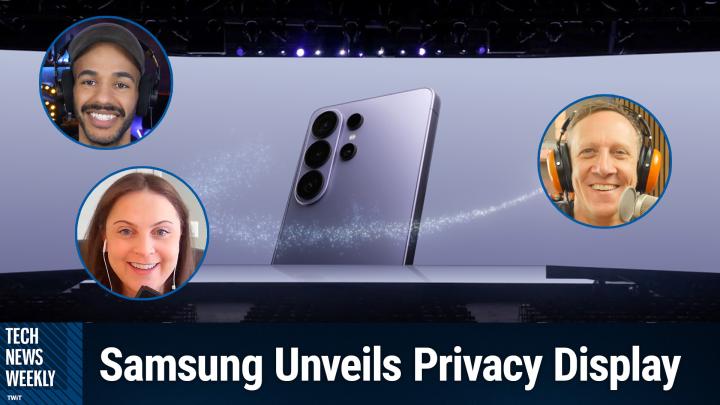
Be sure to register with code ZTWTWIT26. That's ZTWTWIT26. Thank you so much to ThreatLocker for sponsoring this week's episode of Tech News Weekly. All right, we are back from the break. Samsung kicked off 2026 with its Galaxy Unpacked event in San Francisco, and there was no shortage of news to come out of it, from new hardware to a wave of AI-powered features. Honestly, there's a lot to unpack. Joining us today to talk about it is Android faithful's own Jason Howell.
Jason Howell [00:33:28]:
Hello, how's it going, friends? So good to see you again, Mikah.
Mikah Sargent [00:33:33]:
It's good to see you too. Always a pleasure to see you. Always a pleasure to hear you. Uh, great to talk to you.
Jason Howell [00:33:39]:
Yes, indeed.
Mikah Sargent [00:33:41]:
So very exciting. Samsung just held its latest Galaxy Unpacked event in San Francisco. I was hoping you could kind of walk us through the big announcements, give us a sense of what Samsung may have been trying to accomplish with this event overall, given that we've got, uh, I believe like Mobile World Congress right around the corner, right? Yeah, one of those events.
Jason Howell [00:34:01]:
Yeah, no, Mobile World Congress, you're right. Um, it's— I think it starts in a couple of days. It's, it's a crazy, crazy time. There's, you know, if you're in the smartphone world, is it— you're going, you're pulling your hair out at this point because there's just so many things stacked. I mean, Samsung always has its flagship, you know, marquee, um, smartphone event around this time. They, they have shifted it around, but you know, the, the Unpacked is usually the early part of the year.. And it's always, you know, telling the story of their next flagship announcement, which is always the Galaxy S lineup. So this time we've got the Galaxy S26, 2026, it's easy to remember, uh, the S26, S26 Plus, and the S26 Ultra being the top, top tier, uh, line.
Jason Howell [00:34:43]:
And they, I think the story that they were telling is basically like, hey, you know, 2 years ago on the S24, we started with this kind of of modern AI infusion. Last year we brought it a little bit more into the device, and this year it's a totally AI OS. I think that's what they called it. It's an AI OS, which I think is, you know, it's pure marketing. But basically what they're going after is saying AI has evolved a lot in the last couple of years. Now we're kind of entering and finding ourselves engulfed in the agentic kind of world. And so that's a part of these devices. And then another thing that they were talking about is privacy, which we will definitely talk about.
Mikah Sargent [00:35:25]:
Absolutely. So let's start with the Galaxy S26 Ultra. Can you tell us a little bit about the kind of hardware changes? How does it compare to last year's when we're talking about design and specs? People love to dig into the specs. I feel like especially when it comes to the Android side of things. I don't know if that's still the case. Have to clue me in on that.
Jason Howell [00:35:46]:
Oh, people love to dive into the specs because it's the easy thing that you can look at and be like, oh, that's better, that's a, that's a bigger number, it must be better. You know, there's always got to be something like that. Um, or the S, right? The Ultra is— this S26 Ultra is the slimmest and lightest Ultra that has existed before. So at least they can say that. Marginally different, like I took the S25 Ultra with me to unpacked and kind of did side-by-sides, and the differences are small, but they're definitely there. It's a little less, um, kind of pointy and edgy the way the S25 was in the hand, so at least there's that, I suppose. Uh, Gorilla Armor 2 protection on the glass, so, you know, I, I suppose that's— I feel like it's been pretty good last couple of years, but that, that's nice. Um, 25-watt wireless charging, which is an improvement over the previous generation, but still I feel like a little low.
Jason Howell [00:36:41]:
They could improve on that. 60-watt wired, 75% charge from zero in 30 minutes. So that's a nice, you know, kind of fast charging improvement there if you're wired anyways. And then they've done a lot of work on the cameras as they usually do. Samsung cameras on their flagships are pretty good. They're up with the best of the best in my opinion. 200-megapixel F/1.4 aperture, and I think that's changed from— on the main, from, I think, a 1.7. Basically, what does that mean? It means 47% more light.
Jason Howell [00:37:14]:
And in fact, all of the lenses, all of the cameras on this phone got an improvement to their light efficiency, which makes all of them really great in low-light performance. And I definitely tested that out. That was really impressive. Also, you know, the Ultra is a high-performing device. You know, they're thinking of it as their highest-performing device. And so they put a redesigned vapor chamber inside, larger to kind of keep it cool so that it can do all of those things that you might do if you are a high-performance Android user, I guess. And that's $1,299.99 is the cost, or $1,300.
Mikah Sargent [00:37:53]:
Now, one of the— this is kind of moving over to this, the Well, I guess it's sort of software-ish, but I think a standout feature and something that I, I think it might've even been John Ashley, but it could have been somebody else. I remember somebody saying ahead of Unpacked, um, that there was something called Privacy Display. What is this? Like, what's, what's all about?
Jason Howell [00:38:17]:
Yeah, no, Privacy Display. I did really bury the lead because I knew that you were going to ask about Privacy Display. Um, This is definitely the marquee feature. This is the thing that you're probably going to see most people who are covering this talking about at great length. And I think it's really funny, Mikah. I think this is really funny because the technology is really impressive. Don't get me wrong. What is it? It's a privacy feature that's meant to make it so that when I'm looking straight on at my display, I can see everything.
Jason Howell [00:38:46]:
But if you're looking at my display sitting next to me on a subway, you can't see it, or you mostly can't see it. It's obscured for you. It's like darker, and, and the text kind of disappears. And the technology is actually really cool. It's like they've got regular pixels that do their widespread, which is what they've been working on for a long time with our displays to make it so that we don't have falloff. Um, and then they've got these kind of like narrowized, um, if that is a word, pixels that only shoot forward for the most part. And there's a few different kind of like sensitivity settings, so you can have it be more narrow or less narrow. But the idea is that you can switch this on, um, on demand, or you can assign it to a particular app.
Jason Howell [00:39:26]:
So you say anytime I'm using Messages or anytime a notification comes through from my bank account, that particular portion of the screen gets the narrow display.
Mikah Sargent [00:39:37]:
Wait, that seems kind of cool.
Jason Howell [00:39:39]:
It's super cool. It is really cool. I think what's funny to me is that we have spent the last 20 years in smartphones and phones going off-axis viewing that falls off and it doesn't look good from all angles is bad. That's true. Now we're at this point where we're like, off-axis viewing is good.
Mikah Sargent [00:39:57]:
But you know, yes, I want to say you're right that we are doing that. But if you— I'm curious if you feel the same way. If you look around at the people, you know, who are not super techie, I know for me, anecdotally, uh, almost, almost all of the people, almost all of like my family members buy those screen protectors that make it so that if you're standing to the side of them, you can't see what's on the screen. So I wonder if this is, and I use normie in the best sense of the word, if this is like really targeting normies who would, would otherwise be putting a screen protector on that added this privacy feature.
Jason Howell [00:40:40]:
I think you're right. And, and, and by the way, don't, don't misunderstand what I'm, what, where I was headed with this, which is, is not, oh, this is, this is so lame. And yet everybody thinks it's so cool. Um, I just find it interesting that we have moved, that, that technology works in these circular kind of patterns, right? Yeah. And that now we're at a point to where the technology is powerful enough that we can determine when and why and what the, what the scenario is. Where the display does that. And that's the really the big difference. It's not a matter of this display technology is just poor in the way that it's developed, and so you can't see it off-axis.
Jason Howell [00:41:16]:
It's you can see it off-axis until you decide you don't want to, or you can see it off-axis until you decide that this one particular— like the whole notification being the only thing that does that, like that's, that's freaking cool.
Mikah Sargent [00:41:29]:
That is very cool. That is like, that is what I want my technology to be to do. That is super cool.
Jason Howell [00:41:36]:
That's the specificity that takes this out of, oh my goodness, we're totally, you know, stepping backwards in time, and brings us more to— it's reminiscent of the past, but it's also the future. It's a really cool feature to see in, in person as well.
Mikah Sargent [00:41:51]:
It's so innovative, and it's honestly something that I don't think I would have— look, when I— you know, the question that you often get as someone who, you know, talks about tech, I've gotten this question plenty, is like, have we reached the apex when it comes to the smartphone? And can you do anything else with a smartphone? And why does every smart new smartphone seem like it's the same as the old smartphone? And where can innovation happen? I don't think I ever would have thought of this as innovation. Like, I don't think I would have thought of this as an answer to that. And I love that even more. More because hearing about it makes me go, that is such a cool idea. And again, what you talk about with the specificity of what you can do with that privacy, that's just so neat. Good, good for Samsung, honestly.
Jason Howell [00:42:40]:
Yeah. I mean, there, there aren't many features that come out where you're like, oh, I never considered that one before. And you know, are truly a surprise. And this was one of those rare times where that kind of happens. I do wonder, you know, is this the sort of concept that trickles down in the next couple of years or is this truly unique to Samsung? Samsung's phones. And I don't know, it's a great idea. You have to imagine others are going to look at this and go, oh, we want to do that too, you know, at least in the Android space.
Mikah Sargent [00:43:02]:
Well, I realize we're running out of time here, so let's keep, uh, keeping along. Um, one of the things that is— that I found interesting is that there seems to be kind of a lot going on on the AI side of things. It almost felt like Samsung is— it's got too much going on because I've— I'm— if I read correctly, we've got Bixby, or maybe not. We've got Gemini, we've got Perplexity getting involved. Do these all work together? Are any of them being phased out? Did I misunderstand anything when it came to, uh, what the current state of Samsung AI is?
Jason Howell [00:43:36]:
No, I mean, I think this smartphone is showing an AI-fluid approach to artificial intelligence. Uh, you know, you've got your Gemini, that's That's got to be on the phone. I'm sure that's a part of Google's deal with Samsung. So that's on there for agentic tasks, which we can talk about. Perplexity represented for web-based queries inside of Samsung Internet. I'm pretty certain you'll probably be able to apply it to tell or tell the OS to use Perplexity's assistant as your default if you want to, because the app's installed, pre-installed there. Bixby, of course, is Samsung's assistant, and now that's Samsung actually cares about Bixby again and gave it some, you know, conversational upgrades so you can use your voice to say like, hey, my eyes are hurting, can you help me with that? And it'll take you to the right setting and do things like that. So yeah, it's just a very fluid approach to all of the AI models, or not all of them, but at least a couple of key ones.
Jason Howell [00:44:35]:
And I don't know, I have a feeling we're going to see more of that among other manufacturers too.
Mikah Sargent [00:44:41]:
Beyond the Ultra, Samsung announced the standard Galaxy S26, S26 Plus. What should people know about these models? And if you could kind of give a rundown of who perhaps they might be aimed at compared to the Ultra.
Jason Howell [00:44:54]:
I mean, you know, the Ultra is for the power user, right? And the S26 and the S26 Plus are really aimed at the person who wants a solid standard Samsung Galaxy phone and doesn't want to have to pay an exorbitant amount of money because the Ultra can be expensive. It's also a massive brick in your pocket. Right. And so the, the entry-level S26 is now priced at $900, $899.99. That went up $100 from last year. So that was kind of notable. None of the other models actually increased in price. So, you know, you can draw your own correlations as far as like why Samsung did that on the baseline.
Jason Howell [00:45:31]:
You know, does it have something to do with memory shortages or who the heck knows? But that is the case. You got Victus 2 coverage on the front and the back. Both of the cameras are very, very— sorry, both of the phones are very similar. It's just the Plus is a little bit larger, you know, a little bit taller. Same camera system, 50-megapixel main, 10-megapixel 3x optical back there. Both of them have wireless charging. It's just that the Plus is 5 watts more. It's 15 watts to 20 watts wireless charging.
Jason Howell [00:46:01]:
Yeah, they're pretty similar. Very similar to the Ultra. I mean, they all of the designs look very similar. Let's say it's just these, you know, and these have also the snap, same Snapdragon processor. So incredibly capable, just kind of meant for less of the power user and, and more for, do you want a smaller phone or do you want a larger phone? You, that's your pick between these two, basically.
Mikah Sargent [00:46:22]:
Got it. Uh, now I know you didn't get a chance to actually wear these, but Samsung did refresh its earbuds lineup with the Galaxy Buds 4. Buds 4 Pro. Can you just tell us about what are the improvements there over what's already been offered?
Jason Howell [00:46:38]:
Yeah, I mean, you know, anytime they come out with the new buds, it's obviously clearly that the kind of primary motivation is to improve the sound quality. And like I said in our pre-show, and like you just mentioned, I didn't get a chance to check it out myself and I wish that I had, but I just ran out of time at the event. So I can't attest to the improvements in sound. I know that they were talking about the design being allowing for more of a like a bass response through the channeling of the new design. But it is a new blade design. Definitely looks a little different. Definitely has kind of like a little bit of a metallic quality to it that you're either going to love or you're going to hate. Flatter charging case with a see-through top.
Jason Howell [00:47:21]:
My understanding is that a lot of the demo units at the event had lots of scratches on that plastic top, that see-through top. So keep that in mind. More high-res audio support. So 24-bit, 96 kHz high-res audio using Samsung's Seamless codec. And yeah, an improved AI-driven noise cancellation system. $249. I'm missing a price because there are two of these. There's the Buds 4, which is a semi-open design.
Jason Howell [00:47:51]:
So it kind of rests on your ears, not deep inside. And then the Buds 4 Pro seal with rubber tips. So that's kind of what you're getting. You get that sealed off effect with the upgraded.
Mikah Sargent [00:48:03]:
Nice. And last but not least, Google— hi Google— did make some announcements at Unpacked. Agentic AI features for Gemini. What stood out to you and did we get a hint perhaps at the future of Android?
Jason Howell [00:48:21]:
Well, I mean, we definitely did. And I mean, that's starting with the S26 series, which is the Agentic stuff, you know, Agentic Actions on mobile. That's definitely the standout of what Google was showing off. And, you know, a big part of Samsung's kind of offer of AI on these devices, this idea, and it's kind of like an early beta right now, but this idea that instead of, you know, calling your rideshare or ordering your food manually, you could just assign it to an agent and on your device in real time, that will happen either in front of you if you choose or behind the scenes with a little pill that tells you it's running in the background. And you know, I keep calling 2026 the year of like the agentic AI, even though some people might've said that was last year, but I think this is the year where it gets really serious. And that's kind of what we're seeing here, rolling out to the S26 first and then also coming to the Pixel 10. And then we're probably going to see this on a lot more phones. So I know that that's really important to Google.
Jason Howell [00:49:16]:
That gets their Gemini really integrated on a deeper level and shows off just how much wonderful things they've been creating in the world of AI and why everybody needs to respect them in that realm. And then also there's Circle to Search getting an improvement, which allows it to not just detect a single thing in an image, but like if you have an entire outfit and you want to price the fit entirely, you could circle it and it will pull out all the elements and find you the fit, which is kind of neat.
Mikah Sargent [00:49:45]:
Yeah. Uh, Jason, I want to thank you so much. They— I know unpacked— there was a lot to unpack. Um, always really cool to get to chat with you about the— especially the privacy display features. Um, if people would like to keep up to date with the work you're doing and follow you online, where are the places they should go to do so?
Jason Howell [00:50:04]:
Well, Android Faithful is a great podcast that's related to this. We were at the event, me and Florence Ion. We did a part of the episode there. And so you can get our kind of hands-on with some of these devices by going to androidfaithful.com. And then this morning, or really late last night, I published my video from Samsung Unpacked. Go to YouTube, search for Jason Howell. You'll see my video that focuses on the Ultra and the privacy display that we talked about earlier.
Mikah Sargent [00:50:30]:
Beautiful. Thank you, Jason.
Jason Howell [00:50:32]:
Thank you. Great to see you.
Mikah Sargent [00:50:34]:
Good to see you too.
Jason Howell [00:50:35]:
Have a good one.
Mikah Sargent [00:50:37]:
Bye. Alrighty, folks, let's take a quick break so I can tell you about the next sponsor of Tech News Weekly. This episode brought to you by Pebl. Here's a question: are you hiring in another country right now? Because once you do, things can get complicated real quick. But that's where Pebl can help, because you can send offers to anyone in the world in minutes and get them onboarded fast. Pebble is an AI-powered global human resources platform built for founders, HR leaders, and operators who are hiring and supporting teams around the world. Now, Pebl helps you hire, pay, and manage talent in more than 185 countries with fast onboarding that can be done in minutes. Instead of juggling separate tools for contracts and payroll and benefits and compliance, Pebl brings everything together with built-in guidance and local expertise to support you.
Mikah Sargent [00:51:27]:
This is especially helpful if you're managing teams internationally or planning to grow. The fastest growing companies in the world use Pebl to stay organized and reduce risk, and founders use it to scale faster without having to become HR or compliance experts. Rated number 1 in compliance on G2, the customer testimonials speak for themselves. For example, Paige needed global talents to align with its bold mission as a digital diagnostics company revolutionizing cancer pathology with AI. Paige's VP of Finance and Operations said, over the past year, we've doubled, if not tripled, our global headcount. That growth has been largely thanks to our partnership with Pebl. Bottom line, it simplifies global people operations so you can spend more time growing the business and supporting your team. Pebl's new standard discounted pricing at $399 USD per month per employee helps you contain costs.
Mikah Sargent [00:52:26]:
Go to hipebl.ai, hipebl.ai, to get a free estimate. That's hipbl.ai for a free estimate. hipebl.ai. Thank you so much to Pebble for sponsoring this week's episode. Of Tech News Weekly. All right, back from the break, and I want to quickly wrap things up with a little bit of a recap of my favorite Mark Bloomberg— Mark Gurman, who has the rumors on Apple's latest. This week, Gurman has been on a roll with Apple scoops, giving us a detailed look at what Cupertino has in the pipeline. And frankly, there's quite a bit coming from the company.
Mikah Sargent [00:53:10]:
From a— well, rumored to be coming from the company, reportedly coming from the company. From a long-awaited touchscreen MacBook Pro that's bringing the iPhone's Dynamic Island to the Mac, to a trio of new AI-powered wearables including smart glasses, a wearable pendant, and camera-equipped AirPods, Apple appears to be making some of its biggest hardware moves in years. So let's talk about what has been reported. First, the touchscreen Mac. Yes, that thing that we've heard that was not supposed to ever happen seems to be happening. After years of Apple executives publicly dismissing the idea of a touchscreen Mac, do you remember? I think it was like a monkey's paw on the screen, uh, showing how it would be terrible for you to have to press a screen that's in front of you. Steve Jobs famously called it ergonomically terrible. Well, It seems to be the case that the company is finally making the leap.
Mikah Sargent [00:54:08]:
According to Gurman's report from February 24th, Apple's initial touchscreen Macs that are due this fall will be revamped 14-inch and 16-inch MacBook Pro models that have an OLED display. Of course, that's the same screen technology that's used on the iPhone, but here is the thing. It's not just a matter of slapping a touchscreen onto a laptop. Gurman reports that the Mac will get a refreshed dynamic user interface that can shift between being optimized for touch or traditional point-and-click input so that customers can use touch as much or as little as they want and then go back to the point-and-click approach. That's super important because if there's one thing I have heard from other Apple pundits, it's that what are they going to do to make macOS work for touch? Because you would have to change the touch targets and you'd have to do this and you'd have to do that. There's a lot of hand-wringing around it, right?. So being able to kind of switch between those interfaces is very important. I am most excited to hear about the Dynamic Island coming to the Mac.
Mikah Sargent [00:55:07]:
It is one of my favorite features of the iPhone. And so hearing about it on the Mac is pretty cool. Uh, it'll allegedly reportedly feature the iPhone's Dynamic Island at the center of the display. Uh, it will hold the camera and display contextual software information. And it's supposed to be built around this sort of hole punch notch-sized cutout for the computer's camera, smaller actually than the pill-shaped notch on current iPhones, planning a redesigned Dynamic Island as well for the iPhone 18 Pro and 18 Pro Max that is similarly smaller. When it comes to the interface, users touch a button— if they, if they go to touch a button or a control, the interface is going to bring up a new type of menu that actually surrounds finger and provides more relevant options for touch commands. So again, it gives users the controls that make the most sense based on whether they're touching or they're clicking. The software is also reportedly going to display contextually appropriate controls based on the user's prior actions.
Mikah Sargent [00:56:08]:
So if a person taps an item in the menu bar at the top of the screen, those controls will enlarge to be more easily selectable with a finger. You can kind of think about iPadOS in that case where the touch targets for the stoplight buttons, you know, close, minimize, and maximize are larger when they need to be. And then standard touch features like fast scrolling, pinch to zoom for images and PDFs, emoji selection during text input, all present. Now that said, there won't be a focus on touch-based typing. So an on-screen keyboard, not sure, but why would you need one when you've got that physical keyboard right in front of you? And Apple is not looking to, according to Gurman, position the MacBook Pro as an iPad replacement and does not describe the interface as a touch-first experience. It's supposed to be kind of another option for you, an enhancement for you on top of the current experience. Uh, the models that we're hearing about, MacBook Pro 14-inch, 16-inch, and then 3 models that are codenamed KH4, KH6 that are slated for release closer to the end of 2026. Um, part of apparently the Liquid Glass redesign was to make it more possible in macOS for a better touch experience because there's more padding around icons, notifications, sliders, and then Control Center has been optimized for finger input.
Mikah Sargent [00:57:37]:
Uh, as far as the wearables go, uh, February 17th, Gurman said that Apple is accelerating development on these wearables all built around Siri and designed to function as AI-powered companions that are linked to the iPhone. So in this, we have heard about smart glasses. These are an advanced offering that would compete with Meta, you know, previously known as Facebook's Ray-Ban smart glasses. So you'd get a high-resolution camera. It would be able to capture photos and video., no display and instead will pair with the iPhone. It's supposed to have speakers, microphones, cameras, do all sorts of stuff, but almost like the Apple Watch when it first came out, serving as a satellite device for the iPhone. Um, now this was apparently, uh, according to Gurman, Apple employees initially developed the hardware by embedding electronics and cameras into off-the-shelf frames. And so it, you know, worked with others to make it possible, but unfortunately some of those companies ended up partnering with other companies and then needed to be able to create, uh, their own versions of this.
Mikah Sargent [00:58:59]:
The other, other products include an AI pendant about AirTag size, which could be clipped to clothing or worn as a necklace and would just be an always-on camera. Camera and microphone for the iPhone, uh, kind of calling it eyes and ears of the phone. It's supposed to be again, an accessory that goes with the iPhone. So there's no, you know, projector, there's no display system on it and is closer in computing power according to Gurman to AirPods, not closer to an Apple Watch. It's just there to serve as an extra. Accessory that would give it more, uh, you know, ability to see things. Now that said, the pendant is, according to Gurman, in the early stage, could be canceled. I'm not surprised to hear that.
Mikah Sargent [00:59:49]:
It's the one that seems the most, um, or the least sort of ironed out. And then last but not least, AirPods with cameras. Yes, uh, that's planned for as early as this year according to Gurman, and they've been in development for a while. Uh, these would be lower resolution cameras that are designed to help the AI work rather than for taking photos or videos. So think of it as an ability for your Siri control and Siri understanding around you to have sort of two cameras looking around. So you could say, you know, uh, save this event for later, and the AirPods would be able to see what you were looking at, a poster or something, and take that. Uh, there's a lot that Apple needs to do to catch up with the other companies in terms of AI. And I think more importantly, go forth with its, its promises on AI, but it's also important for the company to find new categories to get into new devices to get into, because some of the stuff that Apple has released in the past has not perhaps lived up to what it itself had hoped.
Mikah Sargent [01:01:00]:
Think about the, uh, Vision Pro, very expensive and not a huge success. So a lot to be looking out for. Uh, I'm sure a lot more reporting from Gurman. We've got an Apple event coming up as well. And so there's loads more to talk about, but that is a quick rundown of where things stand when it comes to Apple. And its rumored slate of products by way of Mark Gurman. Loads more details in the report, so as I always say, please go check it out. There are two reports, so go check those out over on Bloomberg.com.
Mikah Sargent [01:01:37]:
Folks, that is going to bring us to the end of this episode of Tech News Weekly. This show, of course, publishes every Thursday, twit.tv/tnw, so you need to head there if you want to subscribe to the show in audio and video formats. I always love to remind you about our wonderful club, which you should join. twit.tv/clubtwit is where you go. $10 a month, $120 a year gets you access to some pretty awesome things. First and foremost, you get access to, uh, well, all of our content ad-free. You also get access to our awesome feeds and that include a feed that is kind of a behind the scenes, before the show, after the show feed. We also have one that has our live coverage of tech news events and a feed that includes our club content.
Mikah Sargent [01:02:23]:
So my crafting corner, Stacy's book club, so much more all get published there. And if you'd like to kind of keep up with that, that's how you do it. And I should also mention that you gain, gain access to our wonderful Discord, a fun place to go to chat with your fellow club members and those of us here at TWiT. If all of that sounds good to you, twit.tv/clubtwit is where you go to sign up. If you'd like to follow me online, I'm @mikahsargent on many a social media network, or you can go to chihuahua.coffee. That's chihuahua.coffee where I've got links to the places I'm most active online. Be sure to check out my other shows, which include iOS Today, Hands on Apple, which we'll publish later today if they haven't already been published. And you can also watch on Sundays Hands on tech.
Mikah Sargent [01:03:10]:
Thank you so much for being here. I'll be back again next week with another episode of Tech News Weekly. Bye-bye.